
- Home
- »
- Medical Devices
- »
-
Stereo Microscopes Market Size & Share Report, 2026-2033GVR Report cover
![Stereo Microscopes Market (2026 - 2033)Report]()
Stereo Microscopes Market (2026 - 2033)
Size, Share & Trends Analysis Report By Head Configuration (Binocular, Trinocular), By Optical Design Type (Greenough), By Application (Industrial Inspection & Metrology, Electronics & Semiconductor), By Region, And Segment Forecasts
Market Size, 2025
$770.7MMarket Estimate, 2026
$831.4MMarket Forecast, 2033
$1,453.1MCAGR, 2026–2033
8.3%Stereo Microscopes Market Summary
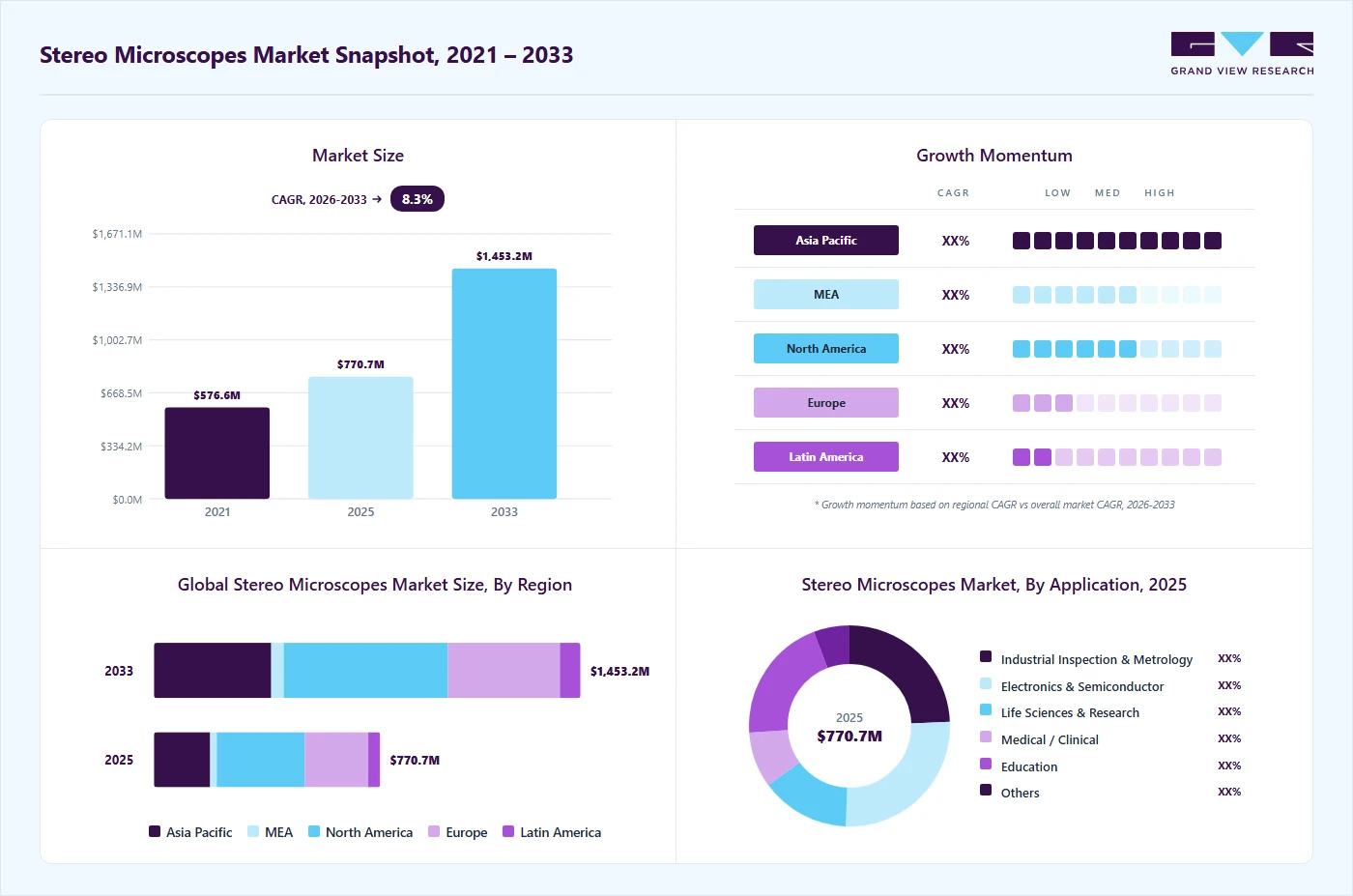
The global stereo microscopes market size was valued at USD 770.7 million in 2025 and is projected to grow from USD 831.4 million in 2026 to USD 1453.1 million by 2033, at a CAGR of 8.3% from 2026 to 2033. The market in North America dominated with a revenue share of 38.9% in 2025. This growth is attributed to the growing demand for advanced diagnostic and surgical tools, especially in pathology, tissue examination, minimally invasive procedures, and microsurgery.
Key Market Trends & Insights
- By head configuration: Trinocular segment held the largest revenue share in 2025.
- By optical design type: Greenough segment held a significant share in 2025
- By application: Industrial inspection & metrology segment and is expected to grow at the fastest CAGR during the forecast period.
Regional Highlights
- Largest regional market: North America (38.87% revenue share, 2025)
- Fastest-growing regional market: Asia Pacific (highest CAGR, 2026-2033)
- The stereo microscopes industry in the U.S. held the largest revenue share in 2025.
Market Size & Forecast
- Market size in 2025: USD 770.7 Million
- Estimated market size in 2026: USD 831.4 Million
- Projected market size by 2033: USD 1453.1 Million
- CAGR (2026-2033): 8.3%

In addition, increased healthcare spending and investments in research and development have enabled hospitals, research institutes, and laboratories to upgrade equipment and adopt digital and LED-enhanced stereo microscopes that offer improved imaging, documentation, and workflow efficiency.Increasing Demand for Precision Diagnostics
Increasing demand for precision diagnostics primarily drives market growth, as modern diagnostic workflows increasingly require accurate, three-dimensional visualization of biological samples and medical specimens. Stereo microscopes enable clinicians and laboratory professionals to examine tissues, cells, surgical samples, and microstructures with enhanced depth perception and clarity, which is critical for identifying subtle abnormalities and pathological changes. The rising emphasis on early disease detection, accurate staging of conditions such as cancer, and improved diagnostic confidence has significantly increased reliance on high-precision optical instruments in hospitals, diagnostic laboratories, and research centers.
World Chagas Disease Day, held in April 2024, aims to give early diagnosis and care for life, highlighting the global need to address Chagas disease as a long-term, often silent public health challenge. The 2024 observance emphasizes that early diagnosis is critical, as most infected individuals remain asymptomatic for years while the disease progressively damages the heart and digestive system. By promoting timely screening, especially among vulnerable and underserved populations, the initiative aims to prevent severe complications and reduce disease-related mortality.
As healthcare systems move toward evidence-based and precision medicine, the need for reliable diagnostic tools that minimize errors and support detailed visual analysis continues to drive the adoption of stereo microscopes across healthcare settings.
The below table highlights the significance of stereo microscopes in precision diagnostics
Healthcare Application
Use of Stereo Microscope
How It Supports Precision Diagnostics
Histopathology & biopsy analysis
Gross examination of tissue and surgical specimens
Enables accurate identification of lesion margins and regions of interest, improving cancer diagnosis accuracy
Oncology diagnostics
Visual assessment of tumor morphology and surface structures
Supports precise tumor staging and informed treatment planning
ENT (otology) diagnostics
Examination of ear canal, tympanic membrane, and middle ear
Allows detailed 3D visualization for accurate diagnosis of infections and perforations
Neuroscience & nerve studies
Observation of nerve fibers and brain tissue samples
Helps detect subtle structural abnormalities linked to neurological disorders
Dental & oral pathology
Inspection of teeth, enamel defects, and oral biopsy samples
Facilitates early detection of cavities, cracks, and oral cancers
IVF & reproductive medicine
Observation and handling of oocytes and embryos
Provides high visual precision, improving diagnostic assessment and treatment outcomes
Source: Grand View Research
Growth in Medical Research & R&D Activities
Growth in medical research & R&D activities acts as a major driver for the market, as expanding investments in biomedical research, drug discovery, and translational medicine significantly increase the need for advanced visualization tools. For instance, in January 2026, NVIDIA and Eli Lilly launched their first-of-its-kind AI co-innovation laboratory aimed at transforming how new medicines are discovered and developed, committing up to USD 1 billion over the next five years to the effort.
“AI is transforming every industry, and its most profound impact will be in life sciences,” said Jensen Huang, founder and CEO of NVIDIA. “NVIDIA and Lilly are bringing together the best of our industries to invent a new blueprint for drug discovery - one where scientists can explore vast biological and chemical spaces in silico before a single molecule is made.”
These microscopy devices are widely used in medical research laboratories for sample preparation, dissection, tissue examination, and observation of three-dimensional biological structures, where depth perception and high optical clarity are critical.
Moreover, rising funding from governments, academic institutions, and pharmaceutical and biotechnology companies is accelerating research in areas such as cancer biology, regenerative medicine, neuroscience, and genomics, all of which rely on precise microscopic analysis. As research workflows become more complex and precision-oriented, healthcare research facilities increasingly adopt stereo microscopes to improve accuracy, efficiency, and reproducibility of experimental outcomes, thereby driving sustained market growth.
Adoption In Surgical And Clinical Procedures
Adoption in surgical and clinical procedures significantly drives the market demand, as modern medical and surgical practices increasingly require high-precision visualization. As per the Production Automation Corporation article, stereo microscopes are used in stem cell research and laboratory sample analysis, as modern life-science workflows increasingly demand prolonged, precise, and ergonomically safe visual inspection. These microscopes provide true three-dimensional views with excellent depth perception, enabling surgeons and clinicians to clearly observe fine anatomical structures during microsurgeries, dental procedures, ENT surgeries, ophthalmic interventions, and minimally invasive procedures. Their ability to deliver magnified, real-time visualization enhances surgical accuracy, reduces the risk of errors, and improves patient outcomes. ZEISS’s ARTEVO microscope platforms launched in March 2024 , significantly enhancing surgical precision, ergonomics, and workflow efficiency. The ARTEVO 750 enhances optical visualization through RGB LED illumination with adjustable color temperature and stable Stereo Coaxial Illumination (SCI), ensuring a high-contrast red reflex critical for cataract surgery.
Dr. Tommy Korn, MD, Ophthalmologist and Chief Physician Evangelist for Digital Health Innovations at Sharp HealthCare in San Diego, CA said:
"As ophthalmologists, precision is everything,” “We've long relied on 2D images to guide us, but with the ZEISS Surgery Optimizer application for the Apple Vision Pro, ZEISS redefines what is possible when viewing stereoscopic eye surgery videos. Viewing eye surgeries in 3D is like being there in the operating room-every detail, every movement is real. It's a game changer for me as a surgeon. Once you go 3D, you can't go back."
In addition, growing emphasis on minimally invasive and precision-based procedures in hospitals and specialty clinics is driving demand for advanced optical tools, positioning stereo microscopes as essential equipment in operating rooms and clinical settings. The eye-piece-less stereo microscope, such as Vision Engineering’s Lynx EVO, highlights a significant trend in the market toward enhanced productivity through ergonomic, user-focused design. This system delivers high-quality 3D stereo imaging without eyepieces, allowing operators to maintain a comfortable posture and reduce neck, back, and eye strain, especially during extended tasks in laboratories or laminar flow cabinets.
Increased Healthcare Spending & Infrastructure Expansion
Increased healthcare spending and infrastructure expansion is a major driver for the stereo microscopes market in healthcare, as governments and private providers invest heavily in upgrading hospitals, diagnostic laboratories, research institutes, and academic medical centers. Rising budgets enable healthcare facilities to procure advanced visualization and imaging equipment to improve diagnostic accuracy, surgical precision, and research capabilities. The expansion of specialty clinics, pathology labs, and medical colleges, particularly in emerging economies further boosts demand for stereo microscopes used in tissue examinations, microsurgical procedures, and biomedical training. In addition, infrastructure modernization initiatives increasingly prioritize technologically advanced, ergonomic, and digitally integrated microscopes, directly supporting sustained market growth in the healthcare sector.
U.S. National Health Expenditure (NHE) reached USD 5.3 trillion in 2024, growing 7.2% year over year and accounting for 18.0% of GDP, reflecting strong demand for healthcare services and a rebound in utilization following pandemic-related disruptions.
3D Stereo Microscope Redefines Inspection Workflows
The launch of 3D digital stereo microscopes with autostereoscopic displays, such as Vision Engineering’s ProteQ VISO, represents a major trend reshaping inspection workflow in the stereo microscopes market. This trend reflects a clear shift away from traditional eyepiece-based systems toward eyepiece-less, flat-screen 3D visualization that delivers true depth perception without glasses, significantly reducing eye strain and operator fatigue. By aligning with natural human stereoscopic vision, these systems improve defect detection accuracy making surface irregularities, depth variations, and micro-features easier to identify in real time compared with conventional 2D imaging.
Simultaneously, enhanced ergonomics, upright viewing postures, and digital zoom capabilities support longer inspection sessions with higher productivity. The integration of digital collaboration tools such as live image streaming, annotation, measurement, and remote connectivity addresses the growing need for team-based, hybrid, and multi-location workflows in advanced inspection labs, medical device development, and precision manufacturing.
Market Concentration & Characteristics
The chart below represents the relationship between industry concentration, industry characteristics, and industry participants. There is a high degree of innovation, moderate level of partnership & collaboration activities, high impact of regulations, and moderate expansion of industry.
The industry is experiencing a high degree of innovation. For instance, in September 2024, Vision Engineering launched a new entry-level stereo microscope alongside upgrades to its existing product lineup highlights a broader market trend toward making advanced microscopy more accessible and versatile for a wider range of users. Product enhancements in optics, digital integration, ergonomic design, and imaging capabilities such as updated stereo optics and digital displays reflect ongoing innovation that increases performance and user comfort across applications.

Paul Newbatt, group sales and marketing director at Vision Engineering says:
“These products are the combined result of listening to our customers and continuously developing our innovative products. By bringing Opta to market now, and enhancing the value propositions of our EVO Cam, Lynx EVO and Swift PRO ranges, we are confident that these new solutions will significantly broaden the appeal of our inspection and metrology portfolio. This enables a much wider range of customers in existing and new markets to better achieve their inspection and measurement objectives with Vision Engineering solutions.”
Several key players are actively engaging in partnerships & collaborations to promote growth & innovation and improve their competitiveness by combining the expertise & efforts of different organizations. For instance , in April 2024, ZEISS and Argolight announced a strategic partnership aimed at enhancing the quality control of microscopy imaging systems by integrating Argolight’s advanced quality control solutions with ZEISS’s extensive range of microscopes.
Arnaud Royon, CEO at Argolight said:
“We are delighted to join forces with ZEISS, a true pioneer in the field,” “Our shared vision of improving the reliability and reproducibility of microscopy imaging will undoubtedly bring immense benefits to users worldwide. This partnership signifies a significant step forward in setting new standards for automated quality control in microscopy.”
In Europe, stereo microscopes intended for medical use must comply with the Medical Device Regulation (MDR) and bear the CE mark, ensuring conformity with stringent health, safety, and performance standards; this involves comprehensive quality management, risk evaluation, and post-market surveillance procedures. Across many jurisdictions, manufacturers are also expected to implement internationally recognized quality and risk-management systems such as ISO 13485 for quality management and ISO 14971 for risk analysis throughout the product lifecycle, which strengthens device reliability and aligns with regulatory expectations globally.
Acer’s expansion of the SpatialLabs Pro ecosystem in September 2025 reflects a strategic move to extend immersive, glasses-free 3D visualization across industrial, inspection, design, and medical training applications. The partnership with Vision Engineering brings 3D stereo microscopy capabilities into inspection, design validation, and prototyping, enabling users to visualize fine details with depth perception while reducing eye strain and improving ergonomic efficiency.
Head Configuration Insights
Based on head configuration, trinocular segment held a significant share in 2025 driven by increasing demand for integrated imaging and documentation capabilities across research, industrial inspection, and clinical settings. A trinocular head adds a third optical port alongside the binocular eyepieces, enabling seamless attachment of cameras or digital imaging devices without compromising the optical experience for the user. This configuration allows scientists, quality control specialists, and medical professionals to capture high-resolution images and videos for documentation, analysis, training, and collaboration an essential requirement in applications such as biological research, pathology, forensic analysis, electronics inspection, and education.
The binocular segment is expected to grow at the fastest CAGR during the forecast period driven by a strong need for improved ergonomics, visual comfort, and high-quality three-dimensional imaging in professional and research environments. Binocular heads provide separate optical paths for each eye, enabling natural depth perception and significantly reducing eye fatigue during prolonged use compared with monocular systems. This makes them particularly valuable in applications such as biomedical research, microsurgery, quality inspection, and materials analysis, where detailed three-dimensional visualization is critical. In addition, the ability of binocular configurations to support adjustable interpupillary distance and individual focus enhances user comfort across multiple operators, a factor that is increasingly important in high-throughput laboratory setting.
Optical Design Type Insights
Based on optical design type, greenough segment held a significant share in 2025, primarily driven primarily by its offering of a combination of performance, ergonomics, and cost-effectiveness that aligns with a wide range of healthcare, research, and industrial applications. In a Greenough design, two separate optical paths converge at a slight angle to provide true three-dimensional imaging with excellent depth perception making it especially valuable for detailed sample inspection, micro-dissection, and routine laboratory tasks. For instance, the Kern And Sohn OZL 463 Stereo Zoom Microscope is a versatile binocular greenough stereo microscope designed for detailed three-dimensional observation of specimens at low to medium magnifications. Furthermore, the design supports flexible working distances and easy integration with accessories such as camera adapters and illumination systems, enhancing usability for diverse workflows.
The common main objective (CMO) segment is expected to grow at the fastest CAGR during the forecast period primarily driven primarily by its offering of a combination of optical performance, versatility, and cost-effectiveness that aligns with the diverse needs of industrial, educational, and research end users. CMO systems share a single high-quality objective that feeds both optical paths, resulting in improved alignment, greater uniformity of image quality, and easier focusing across a wide zoom range. This design reduces optical aberrations and enhances depth perception critical for applications such as micro-assembly, quality inspection, biological research, and precision measurement while also simplifying maintenance and reducing manufacturing costs.
Application Insights
Based on application, the electronics & semiconductor segment held a largest share of 26.24% in 2025.This growth is primarily driven by industry’s growing need for precise visual inspection, assembly, and failure analysis of miniaturized components. With ongoing miniaturization of semiconductor devices and increasing circuit complexity, manufacturers rely on stereo microscopes for three-dimensional, low magnification viewing that enables accurate handling of micro-solder joints, wire bonds, PCBs, wafers, and MEMS components. Stereo microscopes provide excellent depth perception and working distance, which are critical for tasks such as quality control, rework, and defect detection without damaging sensitive components.

The industrial inspection & metrology segment and is expected to grow at the fastest CAGR during the forecast period. This is due to manufacturers across electronics, automotive, aerospace, and precision engineering sectors increasingly require high-resolution, three-dimensional visualization to ensure product quality and dimensional accuracy. The rise of miniaturization in electronics and advanced materials further expands the need for precise, real-time visual inspection tools on production floors and in quality control labs. In addition, integration with digital imaging systems and measurement software enhances traceability, documentation, and automated analysis, aligning with Industry 4.0 initiatives
Regional Insights
North America held the largest revenue share of 38.87% in 2025 owing regions strong research infrastructure, high technological adoption, and diverse industrial and scientific applications that create sustained demand for advanced optical imaging solutions. The region led by the U.S. with its substantial investments in R&D, well-funded academic institutions, and world-class biomedical and life sciences research facilities requires high-precision visualization tools for cellular biology, materials science, and diagnostic workflows, which bolsters the uptake of stereo microscopes in laboratories and clinical environments

U.S. Stereo Microscopes Market Trends
The U.S. stereo microscopes market is experiencing significant growth, driven by the new development and product launches. For instance, the launch of UNITRON’s Z645 zoom stereo microscope in June 2023, strengthens growth in the market by addressing key end-user demands for precision, standardization, and workflow efficiency in industrial and laboratory applications. The introduction of adjustable zoom stops enables repeatable magnification settings, which is particularly valuable for standardized inspection protocols and regulatory compliance common in U.S. industries.
Asia Pacific Stereo Microscopes Market Trends
Asia Pacific is expected to grow at the fastest CAGR during the forecast period. This is due to driven by rapid adoption across research, healthcare, industrial, and educational sectors. Rapid industrialization and expansion of manufacturing hubs particularly in electronics, semiconductors, and precision engineering have increased the demand for high-precision visual inspection tools used in quality control, defect analysis, and micro-assembly tasks. This is especially pronounced in countries such as China and Japan where large electronics and automotive sectors prioritize reliable stereo imaging for detailed component inspection.
The Japan stereo microscopes market held significant revenue share in 2025. The development launch of the AR-enhanced stereo microscope by Evident specifically the SZX-AR1 system in July 2022, overlays work instructions and visual guidance directly into the microscope’s field of view is acting as an important market driver for the stereo microscopes market in Japan. By integrating augmented reality (AR) technology into traditional stereo microscopes, this innovation significantly improves inspection, assembly, and training efficiency for precision manufacturing and quality control tasks, reducing the need for operators to constantly look away from the eyepiece to consult instructions and thereby lowering error rates and physical strain.
The India stereo microscopes market is driven by the presence and growth of microscope manufacturers in the country as highlighted in the ESAW India article published in August 2025 is a significant driver for the stereo microscopes market in the country as it boosts domestic availability, affordability, and technological relevance of these instruments. Indian manufacturers now produce a wide range of microscopes, including stereo microscopes that offer three-dimensional visualization for quality control, dissection, and industrial inspection, meeting the needs of education, research, healthcare, and industrial labs across India.
Europe Stereo Microscopes Market Trends
The market in Europe is expected to witness high growth owing to the strong research activity, industrial demand, and technological innovation that together support robust adoption across scientific, healthcare, and quality-control applications. Europe’s well-established life sciences and materials research infrastructure, supported by significant public and private R&D funding (including programs such as Horizon Europe), fuels demand for high-precision imaging tools stereo microscopes are essential for detailed 3D visualization in biological, cellular, and materials studies.
The Germany stereo microscopes market held a significant share in the Europe industry owing to the expanding distribution channel and supply chain. For instance, in November 2025 , Leica Microsystems extended its online shopping experience to customers in Germany reflecting a strategic move to simplify and modernize the purchasing process for microscopy solutions. By enabling customers to explore products, compare configurations, access detailed technical information, and place orders or request quotes online, Leica enhances convenience and transparency for research laboratories, industrial users, educational institutions, and healthcare providers.
Latin America Stereo Microscopes Market Trends
The industry in Latin America is expected to register considerable growth over the forecast period owing to the expanding investments in healthcare, research, and industrial infrastructure, which are gradually improving the accessibility and adoption of microscopy equipment across the region. Countries such as Brazil and Mexico are notable for their ongoing enhancements in healthcare and diagnostic capabilities, which boost demand for tools such as stereo microscopes in clinical laboratories and medical research institutions.
The Brazil stereo microscopes market held the largest market share in 2025 driven by country’s expanding research and life sciences ecosystem, supported by universities, public research institutions, and government-funded science and technology initiatives, fuels the need for advanced microscopy tools used in biological research, pathology, materials analysis, and innovation labs. This strong research infrastructure including organizations active in biotechnology, agriculture, and biomedical sciences creates sustained demand for high-quality stereo microscopes for precise visualization and analysis.
Middle East & Africa Stereo Microscopes Market Trends
The industry in the Middle East & Africa (MEA) is driven by growing need for high-precision imaging technologies across multiple sectors. Governments, particularly in countries such as Saudi Arabia and the UAE, are prioritizing the modernization of research laboratories, medical facilities, and academic institutions by funding advanced equipment and fostering innovation as part of broader economic diversification initiatives such as Saudi Vision 2030, which accelerates adoption of cutting-edge microscopy tools in clinical, research, and industrial setting.
The UAE stereo microscopes market is being driven by increasing visibility, availability, and applicability of advanced optical inspection tools across multiple sectors. For instance, SEP (Sigma Enterprises) showcases professional stereo imaging systems such as the SZX-AR1 Augmented Reality Microscope System and the SZX 16 stereomicroscope, which highlight modern, high-performance microscopy solutions available locally in the UAE instead of requiring importation from overseas suppliers, reducing lead times and logistical barriers for buyers. By presenting these products as part of their instrumentation portfolio, SEP supports the adoption of stereo microscopes in industrial inspection, quality control, research laboratories, and educational institutions throughout the country.
Key Stereo Microscopes Company Insights
The market is fragmented, with the presence of many region & country level stereo microscopes providers.The market players undertake several strategic initiatives, such as partnerships & collaborations, product launches, mergers & acquisitions, and geographical expansion to maintain their position and grow in the market.
Key Stereo Microscopes Companies:
The following key companies have been profiled for this study on the stereo microscopes market
- Thermo Fisher Scientific Inc.
- Vision Engineering Ltd
- UNITRON
- EVIDENT
- Leica Microsystems
- BW Optics and Instrument Co., Ltd
- ZEISS
- Motic Microscopes
- Metkorp Equipments Pvt. Ltd
- Nikon Corporation Healthcare Business Unit
Recent Developments
- In November 2025, Montana Technological University received a USD 25,014 grant from the Montana IDeA Network of Biomedical Research Excellence (INBRE) to enhance access to its advanced microscopy resources, including a high-powered Hitachi HT7820 electron microscope and a stereo microscope, by enabling remote access through videoconferencing tools and upgraded connectivity.
Biological Sciences Professor Marisa Pedulla said:
“With this funding, we’ll be able to greatly increase research, education, and STEM outreach,” “By developing remote access to the Hitachi HT7820, we aim to provide researchers with state-of-the-art instrumentation and students with transformative science education experiences.”
- In August 2025, Leica Microsystems and Fisher Scientific announced a strategic partnership designed to significantly strengthen the company’s market reach and customer access across Europe, the Middle East, and Africa (EMEA) by leveraging Fisher Scientific’s extensive distribution network. Under this collaboration, Fisher Scientific will distribute a broad range of Leica’s microscopy solutions including standard compound and routine stereo microscopes on a non-exclusive basis throughout the region, improving availability and convenience for research institutions, industrial laboratories, and academic users.
Raniero Centrone, Director, Channel Partner Development, EMEA, Leica Microsystems said:
"This partnership positions us to expand reach and unlock new opportunities, especially in segments where customer access, speed and convenience are critical,".
- In November 2024, Nikon and the European Molecular Biology Laboratory (EMBL) launched a technological development partnership aimed at advancing next-generation microscopy technologies to better address the complex needs of the global research community.
Edith Heard, EMBL Director General said:
“Nikon has been both a scientific collaborator and a generous EMBL partner, supporting young scientists through our Corporate Partnership Programme from the very beginning,” “This newest commitment to collaboration makes everyone a winner. We will see next-generation microscopes and the best new technology concepts progress more quickly.”
Stereo Microscopes Market Report Scope
Report Attribute
Details
Market size in 2025
USD 770.7 million
Estimated market size in 2026
USD 831.4 million
Projected market size by 2033
USD 1,453.1 million
Growth rate
CAGR of 8.3% from 2026 to 2033
Actual data
2021 - 2025
Forecast period
2026 - 2033
Quantitative units
Revenue in USD billion and CAGR from 2026 to 2033
Report coverage
Revenue forecast, company ranking, competitive landscape, growth factors, and trends
Segments covered
Head configuration, optical design type, application, region
Regional scope
North America; Europe; Asia Pacific; Latin America; Middle East & Africa
Country scope
U.S.; Canada; Mexico; Germany; UK; France; Italy; Spain; Norway; Denmark; Sweden; China; Japan; India; South Korea; Australia; Thailand; Brazil; Argentina; Saudi Arabia; South Africa; UAE; Kuwait
Key companies profiled
Thermo Fisher Scientific Inc.; Vision Engineering Ltd; UNITRON; EVIDENT; Leica Microsystems; BW Optics and Instrument Co., Ltd; ZEISS; Motic Microscopes; Metkorp Equipments Pvt. Ltd; Nikon Corporation Healthcare Business Unit
Customization scope
Free report customization (equivalent up to 8 analysts working days) with purchase. Addition or alteration to country, regional & segment scope.
Pricing and purchase options
Avail customized purchase options to meet your exact research needs. Explore purchase options
Global Stereo Microscopes Market Report Segmentation
This report forecasts revenue growth at global, regional, and country levels and provides an analysis of the latest industry trends in each of the sub-segments from 2021 to 2033. For this study, Grand View Research has segmented the global stereo microscopes market report based on head configuration, optical design type, application, and region:

-
Head Configuration Outlook (Revenue, USD Million, 2021 - 2033)
-
Binocular
-
Trinocular
-
-
Optical Design Type Outlook (Revenue, USD Million, 2021 - 2033)
-
Greenough
-
Common Main Objective (CMO)
-
-
Application Outlook (Revenue, USD Million, 2021 - 2033)
-
Industrial Inspection & Metrology
-
Electronics & Semiconductor
-
Life Sciences & Research (including agricultural research)
-
Medical / Clinical
-
Education
-
Others
-
-
Regional Outlook (Revenue, USD Million, 2021 - 2033)
-
North America
-
U.S.
-
Canada
-
Mexico
-
-
Europe
-
UK
-
Germany
-
France
-
Italy
-
Spain
-
Denmark
-
Sweden
-
Norway
-
-
Asia Pacific
-
China
-
Japan
-
India
-
South Korea
-
Australia
-
Thailand
-
-
Latin America
-
Brazil
-
Argentina
-
-
Middle East and Africa (MEA)
-
South Africa
-
Saudi Arabia
-
UAE
-
Kuwait
-
-
Frequently Asked Questions About This Report
North America dominated with a 38.9% revenue share in 2025.
Electronics & semiconductor segment held the largest revenue share 26.2% in 2025, while industrial inspection & metrology segment is the fastest-growing area.
The global stereo microscopes market is expected to grow at a CAGR of 8.3% during the forecast period to reach USD 1,453.1 million in 2033.
Greenough segment led with a 42.1% revenue share in 2025, while common main objective (CMO) is the fastest-growing segment..
The key players in stereo microscopes market include Thermo Fisher Scientific Inc., Vision Engineering Ltd, UNITRON, EVIDENT, Leica Microsystems, BW Optics and Instrument Co., Ltd, ZEISS, Motic Microscopes, Metkorp Equipments Pvt. Ltd, Nikon Corporation Healthcare Business Unit
Key factors driving the stereo microscopes market include the growing demand for advanced diagnostic and surgical tools, especially in pathology, tissue examination, minimally invasive procedures, and microsurgery.
Trinocular held the largest share in 2025 and binocular is the fastest-growing market.
The global stereo microscopes market size was estimated at USD 770.7 million in 2025 and is expected to reach USD 831.4 million in 2026.
About the Author(s)
Medical Devices Research Team
Healthcare · Medical DevicesThis report was authored by the medical devices research team at Grand View Research - comprising two research analysts, one senior research analyst, and one industry expert - with specialized expertise in the medical devices segment of the healthcare industry. All findings are based on proprietary healthcare databases, executive interviews, and regulatory analysis, subject to internal peer review prior to publication.
Last Updated:
Speak to Analyst


Customize this report to your needs — add regions, segments, or data points, with 20% free customization.
Or view our licence options:


ISO 9001:2015 & 27001:2022 Certified
We are GDPR and CCPA compliant! Your transaction & personal information is safe and secure. For more details, please read our privacy policy.


