
- Home
- »
- Petrochemicals
- »
-
Supercritical Fluids Market Size Report, 2025-2033GVR Report cover

Supercritical Fluids Market (2025 - 2033) Size, Share & Trends Analysis Report Product (Supercritical CO2, Supercritical Water), By Application (Pharmaceuticals, Food & Beverages) By Region, And Segment Forecasts
Market Size, 2024
$3.2BMarket Estimate, 2026
$3.7BMarket Forecast, 2033
$6.7BCAGR, 2025–2033
8.8%Supercritical Fluids Market Summary
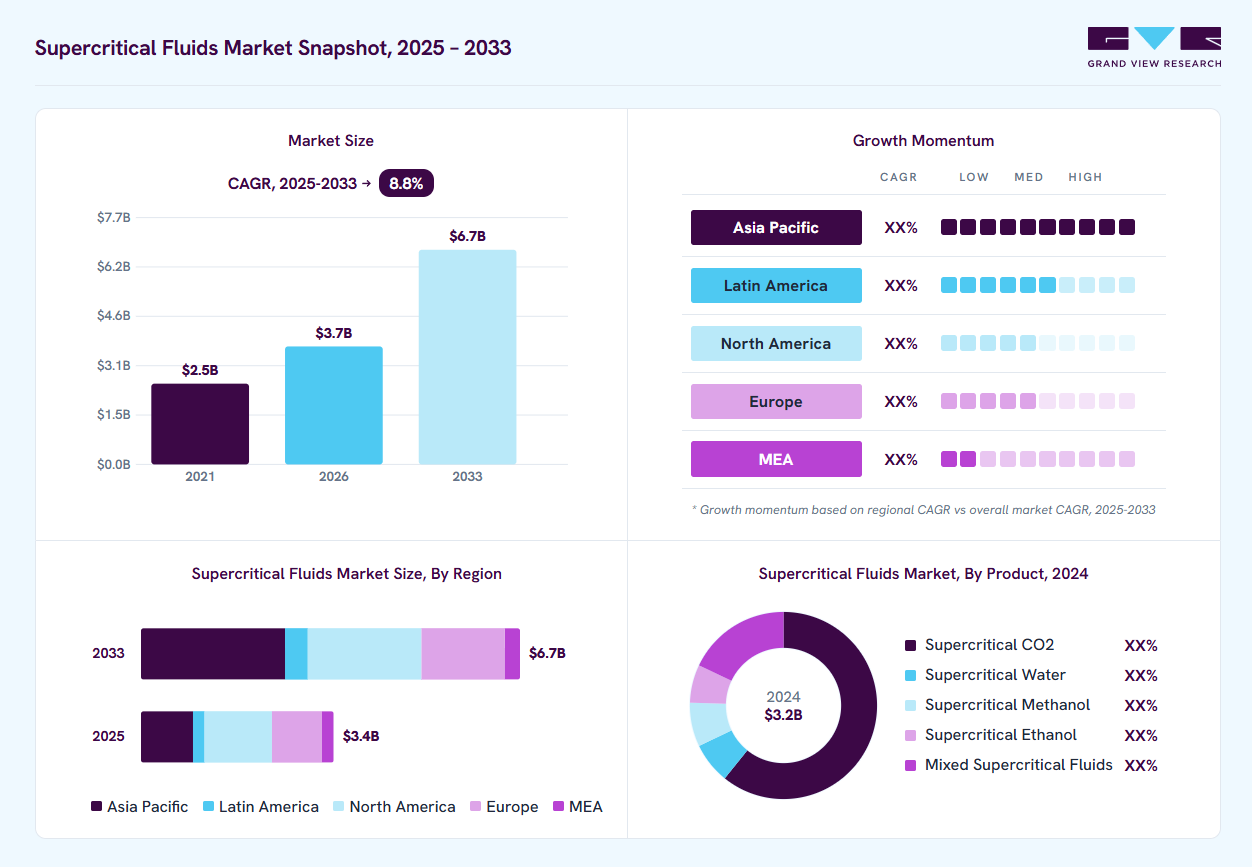
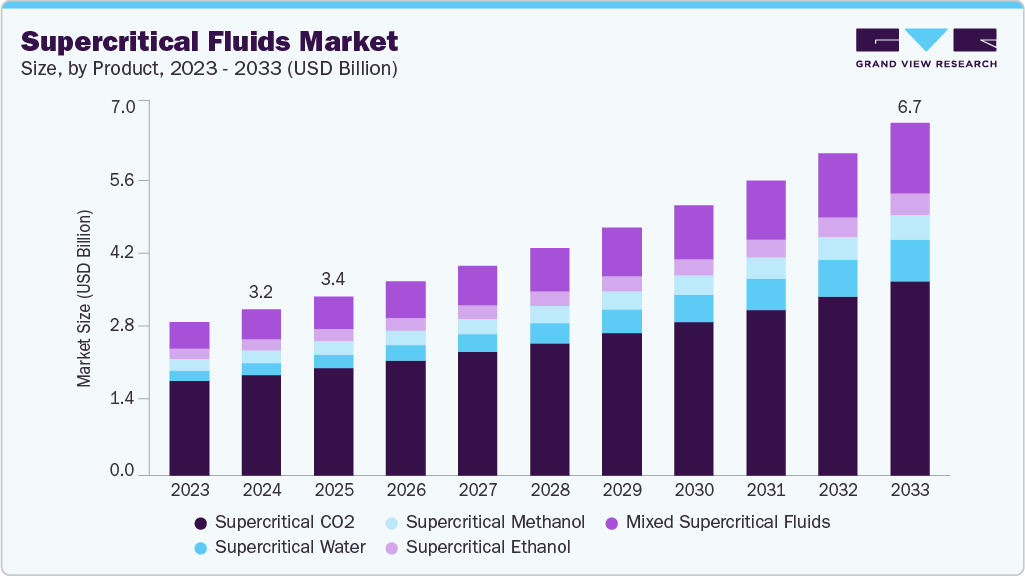
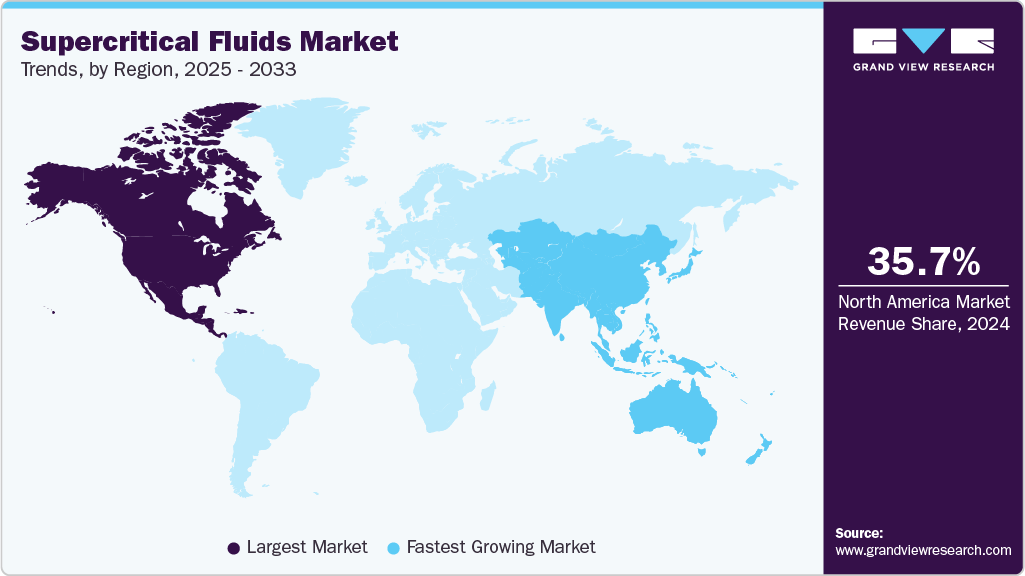
The global supercritical fluids market size was valued at USD 3.2 billion in 2024 and is projected to grow from USD 3.7 billion in 2026 to USD 6.7 billion by 2033, at a CAGR of 8.8% from 2025 to 2033. North America dominated the market, accounting for a revenue share of 35.7% in 2024. Industries are increasingly prioritizing cleaner, safer, and more efficient processing technologies.
 Source: Grand View Research, IR Documents, Primary Interviews, Paid DatabasesTo learn more about this report,
 Download Free Sample Report
 Key Market Trends & Insights
- The supercritical fluids industry in China is expected to grow at the fastest CAGR of 13.5% from 2025 to 2033.
- By product, the supercritical water segment is expected to grow at the fastest CAGR of 15.4% from 2025 to 2033.
- By product, the supercritical CO2 segment led the market with the largest revenue share of 60.8% in 2024.
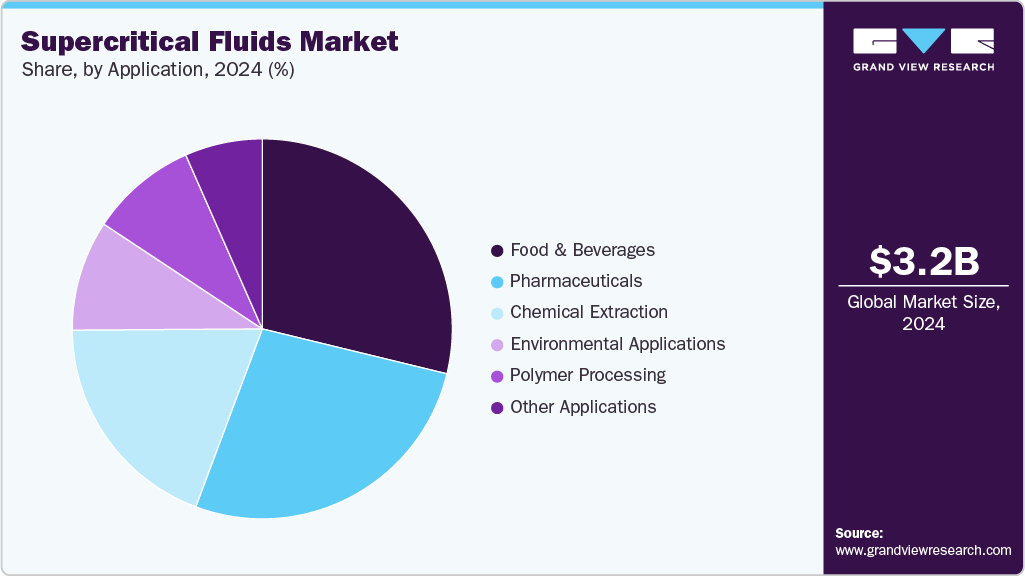
- By application, the food & beverages segment led the market with the largest revenue share of 28.8% in 2024.
Market Size & Forecast
- 2024 Market Size: USD 3.2 Billion
- 2033 Projected Market Size: USD 6.7 Billion
- CAGR (2025-2033): 8.8%
- North America: Largest market in 2024
- Asia Pacific: Fastest growing market
Three ways to get this report
Buy it, customize it, or ask a question.Ask an Analyst
A direct answer, usually in 1 working day
- AccessReport author, directly
- Reply timeWithin 1 working day
- No sales callDirect answer only
- FormatEmail reply
- CostFree, no cost
Get the Full Report
What the study covers
- FormatsPDF · Excel · Dashboard
- Timeline2025–2033 annual, 2024 base
- Coverage20+ countries, 5 regions
- Companies10+ key players profiled
Customize the Report
20% free customization
- IncludeCountries, segments, points
- TailorTo your product definition
- ExtendDeeper competitor detail
- OrA fully bespoke study
- Turnaround5–10 working days
Demand is rising globally due to the strong shift toward sustainable extraction, high-purity processing, and reduced solvent use. These trends align with regulatory tightening and the push for greener manufacturing. They are seen across the pharmaceutical, food and beverage, and specialty chemicals sectors. Supercritical CO₂ remains the leading product segment. Its proven effectiveness, low toxicity, and broad applicability drive its use in extraction and purification. The food and beverage sector continues to dominate application demand.This is supported by the growing need for natural flavors, decaffeination, functional ingredients, and residue-free extraction methods. Regionally, North America leads the market due to its advanced processing infrastructure and strong innovative ecosystem. Early adoption of environmentally friendly technologies also contributes. Europe ranks second, backed by stringent environmental standards and sustained investments in sustainable industrial processes. Together, these factors reinforce global market expansion. They also highlight the strategic importance of supercritical technologies across high-value industries.
 To learn more about this report, Download Free Sample Report
 The supercritical fluids industry is poised for substantial growth, driven by key benefits such as improved process efficiency, cost reduction, and reduced environmental impact. Industries worldwide are accelerating their transition toward sustainable, high-efficiency processing. Regulatory pressure to eliminate harmful solvents is increasing, while demand for clean-label products is on the rise. These factors create significant opportunities for high-purity, low-emission, and higher-yield technologies. The expansion of CO₂ applications in ingredient extraction, pharmaceutical purification, and advanced polymers. Breakthroughs in continuous processing, bio-refinery integration, and green chemistry enable companies to reduce costs and enhance product quality. North America and Europe lead early adoption, with the Asia Pacific region rapidly scaling industrial capability.
Despite growing adoption, the slow expansion of the supercritical fluids industry is primarily driven by high initial capital investment, complex system design, and the need for specialized engineering expertise, which often limits adoption, especially in small and mid-scale industries. Operating supercritical CO₂ and other advanced fluids requires precise pressure and temperature control, which increases maintenance costs and the demand for skilled technical personnel. Inconsistent regulatory frameworks across regions-particularly outside North America and Europe- create additional uncertainty for manufacturers seeking to achieve global scale. Limited awareness of long-term cost benefits and slow commercialization outside food and beverage extraction further hinder market penetration. Collectively, these barriers significantly limit the speed of growth, especially in emerging markets.
Market Concentration & Characteristics
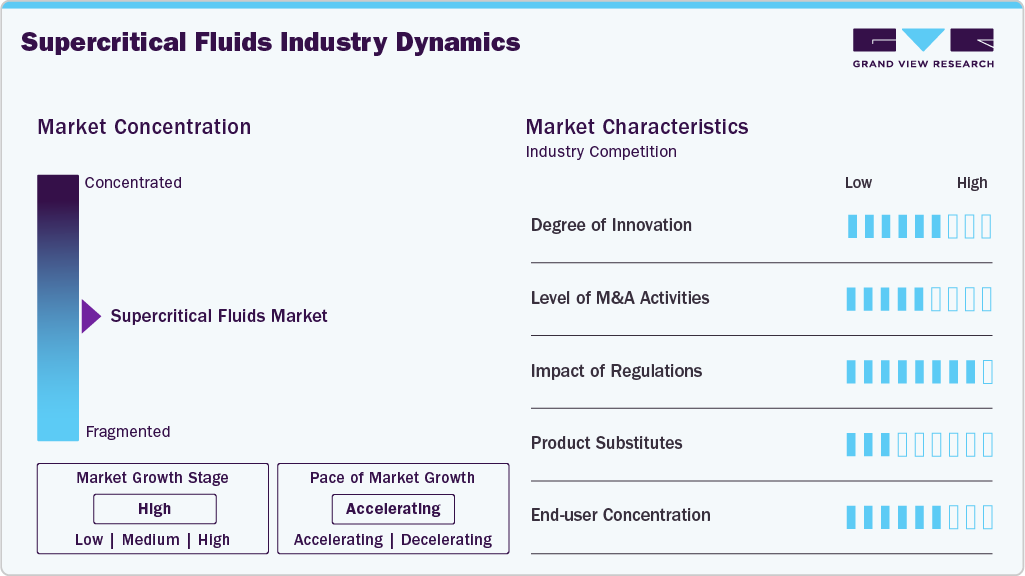
The supercritical fluids industry is moderately consolidated, with leading players such as BASF SE, CO2 Solutions, Merck KGaA, ArrMaz, and Clariant AG holding a significant share. At the same time, regional specialists like Nova Extraction, Eden Labs, Technoforce, Thar Technologies, and Holofluidics cater to localized demand. The top companies collectively account for around half of global revenues, leveraging strong R&D, established distribution networks, and long-term supply partnerships withmajor players in the food, pharmaceutical, and specialty chemical industries.
 To learn more about this report, Download Free Sample Report
 Competition in the supercritical fluids industry centers on the effectiveness of processes, the purity of products, the safety of systems, and compliance with environmental regulations. Vendors are developing equipment that uses less energy, employs flexible high-pressure systems, and utilizes improved CO₂ extraction methods. They want to stand out in a market where cost and trust in performance matter. Smaller companies often struggle with high startup costs, stringent certifications, and limited access to specialized engineering expertise. Top manufacturers address these challenges by investing in environmentally friendly chemistry and collaborating with partners in various regions. They also utilize digital tools and automation to enhance process control, minimize breakdowns, and foster stronger customer connections.
Product Insights
The supercritical CO2 segment led the market with the largest revenue share of 60.8% in 2024. The segment offers a highly efficient, clean, and cost-effective alternative to traditional solvent-based processes. Its ability to deliver high-purity extraction without leaving chemical residues makes it especially valuable for food, beverage, and pharmaceutical applications. In these sectors, safety and quality are critical. The growing demand for natural ingredients, clean-label products, and environmentally friendly processing technologies continues to strengthen their adoption. In addition, supercritical CO₂ systems provide lower toxicity, easier recyclability, and strong regulatory acceptance compared to other supercritical fluids. These advantages, along with ongoing innovation in CO₂ extraction equipment and greater industrial awareness, drive its steady growth and maintain its position as the leading product segment in the global market.
The supercritical water segment is anticipated to grow at the fastest CAGR of 15.4% from 2025 to 2033. The demand for cleaner, safer, and more efficient waste treatment and chemical processing drives the rapid growth of supercritical water. Supercritical water quickly breaks down hazardous materials. It can convert waste into valuable outputs and enable low-emission chemical reactions. These features attract industries under pressure from environmental and regulatory concerns. The global push for sustainable waste management, circular economic practices, and advanced material production is accelerating the adoption of these initiatives. At the same time, advances in reactor design, energy recovery, and continuous processing make these systems more practical and cost-effective. Together, these trends fuel strong growth in environmental, chemical, and industrial uses.
Application Insights
The food & beverages segment led the market with the largest revenue share of 28.8% in 2024, driven by supercritical fluids, especially supercritical CO₂offer an efficient and pure method to extract natural, safe, and high-quality ingredients. This segment is primarily driven by robust global demand for natural flavors, decaffeinated products, essential oils, and functional ingredients, all of which require delicate, residue-free extraction. Supercritical CO₂ enables manufacturers to preserve the taste, aroma, and nutritional value of their products while eliminating harmful chemical solvents, thereby supporting the growing consumer preference for clean-label and healthier foods. In addition, stringent food safety regulations and continual advances in extraction technology drive companies to implement supercritical processing, ensuring that food and beverages remain the dominant global application.
 To learn more about this report, Download Free Sample Report
 The environmental segment is anticipated to grow at the fastest CAGR of 11.8% during the forecast period, as industries and governments increasingly focus on cleaner, safer, and more sustainable waste management solutions. The demand is primarily driven by the ability of supercritical fluids, especially supercritical water, to break down hazardous waste, treat industrial effluents, and convert harmful compounds into safer by-products with minimal emissions. As environmental regulations become increasingly stringent worldwide, companies are seeking technologies that can support low-carbon operations and meet compliance standards. At the same time, advancements in supercritical oxidation systems, energy-efficient reactors, and waste-to-value processing are making these solutions more practical and cost-effective. These factors, when combined, are accelerating the adoption and driving the rapid growth of environmental applications in the global supercritical fluids industry.
Regional Insights
North America dominated the global supercritical fluids market with the largest revenue share of 35.7% in 2024, due to its advanced industrial base, strong technological capabilities, and early adoption of advanced processing techniques. Thar Technologies, Eden Labs, Waters Corporation, Applied Separations, Inc., and Holofluidics are some of the major key producers in the region. Market growth is driven by high demand for clean-label food ingredients, high-purity pharmaceuticals, and eco-friendly extraction and waste treatment technologies. U.S. and Canadian companies invest in R&D, high-pressure equipment, and sustainable processing, expanding the use of supercritical CO₂ and water systems. Strict regulations on food safety, emissions, and chemical handling drive manufacturers to adopt more efficient supercritical technologies. Together, these factors make North America the leading and fastest-growing market for supercritical fluids globally.
 To learn more about this report, Download Free Sample Report
 U.S. Supercritical Fluids Market Trends
The supercritical fluids market in the U.S. accounted for the largest market revenue share of 79.8% in North America in 2024, driven by its robust manufacturing sector, cutting-edge research infrastructure, and rapid adoption of clean and efficient processing technologies. Market expansion in the U.S. is driven by surging demand for natural food ingredients, premium pharmaceutical products, and sustainable extraction and waste-treatment methods. American companies strategically invest in supercritical CO₂ and supercritical water systems for their superior purity, safety, and environmental advantages. Furthermore, rigorous U.S. regulations on food safety, emissions, and hazardous waste management propel industries toward greener, more efficient supercritical processes. These factors position the U.S. as the leading market in North America and a primary driver of global demand.
Asia Pacific Supercritical Fluids Market Trends
The supercritical fluids market in the Asia Pacific is anticipated to witness at the fastest CAGR during the forecast period, supported by strong demand within industries in China, India, Japan, and Southeast Asia, which are rapidly increasing investments in clean, efficient, high-value processing technologies. Growth is fueled by expanding food and beverage manufacturing, rising pharmaceutical production, and a significant shift to sustainable extraction and waste management solutions. Companies are adopting supercritical CO₂ and water systems to enhance product purity, minimize solvent use, and comply with increasingly stringent environmental regulations. Government support for green manufacturing, modern infrastructure, and rising demand for natural ingredients and functional products are further accelerating adoption, making the Asia Pacific the region’s strongest future growth engine for supercritical fluids.
The China supercritical fluids market held a significant revenue share of 37.9% in the Asia Pacific in 2024. The Chinese market is experiencing rapid expansion as the country is promoting high-quality manufacturing, environmentally friendly production, and advanced technologies. Growth comes from strong government support for cleaner industries and higher demand for premium food ingredients and pharmaceuticals. The government also focuses on moving away from solvent-based systems. Chinese industries utilize supercritical CO₂ and supercritical water to enhance extraction, improve product safety, and minimize environmental impact. China’s strong equipment manufacturing, large industrial base, and rising research investments help speed commercialization. Together, these factors make China a leading market, with advances that are among the most significant for supercritical fluids globally.
Europe Supercritical Fluids Market Trends
The supercritical fluids market in Europe captured a 26.5% share of the global market in 2024, driven by its push for low-emission manufacturing and the adoption of circular economy models. The EU’s strict environmental laws, like REACH and the Industrial Emissions Directive, support this shift by motivating industry to replace harmful solvents with cleaner extraction and processing methods. Supercritical CO₂ is seeing particularly strong uptake in Europe’s food, nutraceutical, and cosmetics sectors, reflecting high demand for natural and sustainably processed goods. Simultaneously, research institutions and technology firms are advancing innovations in supercritical water oxidation and high-pressure systems, reinforcing Europe’s leadership in green processing. With government incentives for energy-efficient equipment and waste reduction, supercritical fluids are becoming central to Europe’s climate and industrial modernization strategies.
The Germany supercritical fluids market is expanding as the country strengthens its commitment to high-precision manufacturing, green chemistry, and industrial decarbonization. This growth is driven by Germany’s strong engineering base. Companies specializing in high-pressure technology, process automation, and advanced materials are integrating supercritical systems into next-generation production lines. The country’s large pharmaceutical and food-processing sectors together account for a significant share of EU production. These sectors are adopting supercritical CO₂ to meet strict purity and product safety standards while reducing reliance on organic solvents. Strong R&D investment, world-class research institutes such as Fraunhofer, and industry incentives for energy-efficient technologies are further driving adoption. As a result, Germany is emerging as a key driver of supercritical fluid adoption in Europe.
Middle East & Africa Supercritical Fluids Market Trends
The supercritical fluids market in the Middle East & Africa is anticipated to grow at a significant CAGR during the forecast period, as countries across the region accelerate industrial diversification and invest in cleaner, higher-efficiency processing technologies. The expansion is primarily driven by government-led sustainability programs, such as Saudi Arabia’s Vision 2030, the UAE’s Net Zero 2050 initiative, and Qatar’s National Vision 2030, which emphasize low-emission manufacturing, waste reduction, and the development of advanced materials. Demand is increasing in sectors like food processing, specialty chemicals, and environmental services, where supercritical CO₂ extraction and supercritical water oxidation support higher product purity and safer waste management. The region is also expanding R&D capacity through innovation hubs in the UAE and Saudi Arabia, and several petrochemical companies are exploring supercritical technologies for catalyst recovery and cleaner extraction processes.
Latin America Supercritical Fluids Market Trends
The supercritical fluids market in Latin America is expanding as the region modernizes its industrial base and reduces its dependence on conventional, resource-intensive processing methods. Growth is supported by increasing investment in advanced manufacturing technologies, particularly in Brazil, Argentina, and Colombia. In these countries, companies are upgrading their extraction, purification, and materials-processing capabilities. Their goal is to align with international quality standards. A key factor behind the expansion is the push to enhance export competitiveness in high-value sectors, including specialty chemicals, plant-based products, and pharmaceutical intermediates. These sectors benefit from the precision and consistency offered by supercritical systems.
Key Supercritical Fluids Company Insights
Key players, such as BASF SE, Merck KGaA, CO2 Solutions, Thar Technologies, Nova Extraction, and Eden Labs, are dominating the market.
BASF SE
-
BASF SE holds a strong position in the supercritical fluids industry. The company offers high-purity CO₂ and advanced gas-treatment technologies. Its expanding low-carbon chemical capabilities support this role. BASF also develops CO₂ capture and purification solutions, such as its OASE blue technology. It operates industrial CO₂ recovery projects in collaboration with partners such as Linde and Heidelberg Materials. BASF invests in the company’s sustainable C1 chemistry, carbon-utilization research, and CO₂-free steam generation. These efforts enable BASF to be a key enabler for manufacturers utilizing supercritical CO₂ and supercritical water. Its global infrastructure, regulatory alignment, and focus on innovation help BASF drive responsible growth in supercritical fluid applications.
Key Supercritical Fluids Companies:
The following are the leading companies in the supercritical fluids market. These companies collectively hold the largest market share and dictate industry trends:
- BASF SE
- Merck KGaA
- CO2 Solutions
- Thar Technologies
- Nova Extraction
- Eden Labs
- Waters Corporation
- Applied Separations
- Clariant AG
- Technoforce
Supercritical Fluids Market Report Scope
Report Attribute
Details
Market size in 2024
USD 3.2 billion
Estimated market size in 2026
USD 3.7 billion
Projected market size by 2033
USD 6.7 billion
Growth rate
CAGR of 8.8% from 2025 to 2033
Base year for estimation
2024
Historical data
2018 - 2023
Forecast period
2025 - 2033
Quantitative units
Revenue in USD million/billion, Volume in Kilotons, and CAGR from 2025 to 2033
Report coverage
Revenue forecast, company ranking, competitive landscape, growth factors, and trends
Segments covered
Product, application, region
Regional scope
North America; Europe; Asia Pacific; Middle East & Africa; Latin America
Country scope
U.S.; Canda; Mexico; Germany; UK; France; Italy; Spain; China; India; Japan; South Korea; Brazil; Argentina; South Africa; Saudi Arabia
Key companies profiled
BASF SE; Merck KGaA; CO2 Solutions; Thar Technologies; Nova Extraction; Eden Labs; Waters Corporation; Applied Separations; Clariant AG; Technoforce
Customization scope
Free report customization (equivalent up to 8 analysts’ working days) with purchase. Addition or alteration to country, regional & segment scope.
Pricing and purchase options
Avail customized purchase options to meet your exact research needs. Explore purchase options
Global Supercritical Fluids Market Report Segmentation
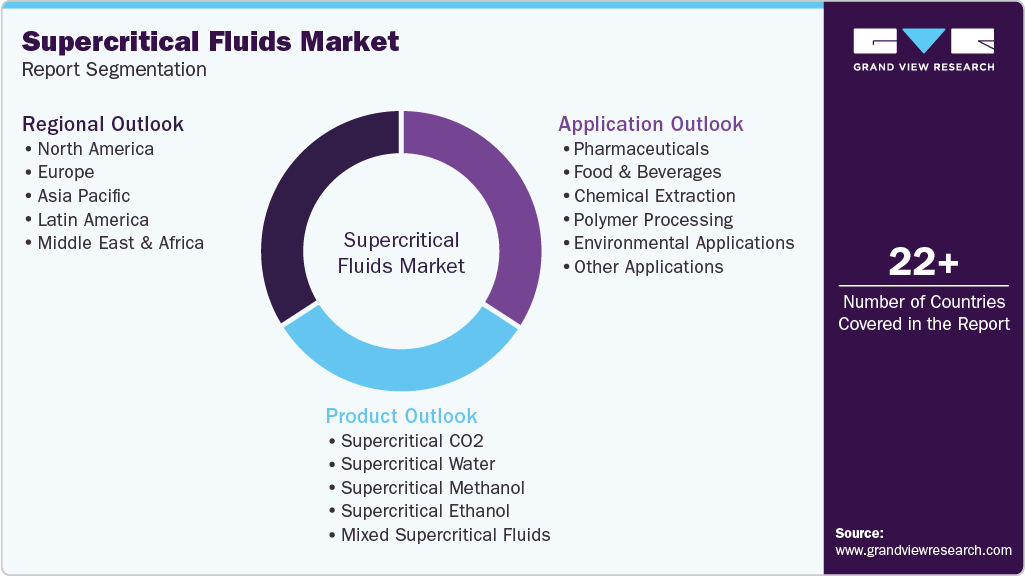
This report forecasts revenue growth at global, regional, and country levels and provides an analysis of the latest industry trends in each of the sub-segments from 2018 to 2033. For this study, Grand View Research has segmented the global Supercritical fluids market report based on product, application, and region.
 To learn more about this report, Download Free Sample Report
 -
Product Outlook (Volume, Kilotons; Revenue, USD Million, 2018 - 2033)
-
Supercritical CO2
-
Supercritical Water
-
Supercritical Methanol
-
Supercritical Ethanol
-
Mixed Supercritical Fluids
-
-
Application Outlook (Volume, Kilotons; Revenue, USD Million, 2018 - 2033)
-
Pharmaceuticals
-
Food & Beverages
-
Chemical Extraction
-
Polymer Processing
-
Environmental Applications
-
Other Applications
-
-
Regional Outlook (Volume, Kilotons; Revenue, USD Million, 2018 - 2033)
-
North America
-
U.S.
-
Canada
-
Mexico
-
-
Europe
-
Germany
-
UK
-
France
-
Italy
-
Spain
-
-
Asia Pacific
-
China
-
India
-
Japan
-
South Korea
-
-
Middle East & Africa
-
Saudi Arabia
-
South Africa
-
-
Latin America
-
Brazil
-
Argentina
-
-
Frequently Asked Questions About This Report
The global supercritical fluids market size was valued at USD 3.2 billion in 2024 and is estimated at USD 3.7 billion for 2026.
The global supercritical fluids market is expected to grow at a CAGR of 8.8% from 2025 to 2033, reaching USD 6.7 billion by 2033.
North America dominated the global supercritical fluids market with a 35.7% revenue share in 2024. Market growth is driven by high demand for clean-label food ingredients, high-purity pharmaceuticals, and eco-friendly extraction and waste treatment technologies. U.S. and Canadian companies invest in R&D, high-pressure equipment, and sustainable processing, expanding the use of supercritical CO₂ and water systems. Strict regulations on food safety, emissions, and chemical handling drive manufacturers to adopt more efficient supercritical technologies.
Some key players operating in the supercritical fluids market include BASF SE; Merck KGaA; CO2 Solutions; Thar Technologies; Nova Extraction; Eden Labs; Waters Corporation; Applied Separations; Clariant AG; Technoforce
Industries are increasingly prioritizing cleaner, safer, and more efficient processing technologies. Demand is rising globally due to the strong shift toward sustainable extraction, high-purity processing, and reduced solvent use. These trends align with regulatory tightening and the push for greener manufacturing
About the Author(s)
Petrochemicals Research Team
Bulk Chemicals · PetrochemicalsThis report was authored by the petrochemicals research team at Grand View Research - comprising two research analysts, one senior research analyst, and one industry expert - with specialized expertise in the petrochemicals segment of the bulk chemicals industry. All findings are based on proprietary bulk chemicals databases, executive interviews, and regulatory analysis, subject to internal peer review prior to publication.
Last Updated:
Speak to Analyst

Customize this report to your needs - add regions, segments, or data points, with 20% free customization.
Or view our licence options:


ISO 9001:2015 & 27001:2022 Certified
We are GDPR and CCPA compliant! Your transaction & personal information is safe and secure. For more details, please read our privacy policy.


