Report Overview
The global surgical sphincteroplasty market size was valued at USD 1.3 billion in 2020 and is anticipated to expand at a compound annual growth rate (CAGR) of 6.6% from 2021 to 2028. The growing prevalence of Anal Incontinence (AI), cost-effectiveness of sphincteroplasty, and rising incidence of obstetric injury post-childbirth are the key factors driving the market. Anal Incontinence (AI) is a chronic condition that affects one out of every three individuals, according to the National Institute of Diabetes and Digestive and Kidney Diseases. Additionally, studies suggest that AI affects nearly 15% of women living in the community and half of the women in nursing homes. Factors such as age, obstetric trauma, pelvic surgery, chronic diarrhea, obesity, and other medical conditions, such as diabetes and stroke, increase the risk of Al.
AI is more commonly seen in women, due to the partial anterior disruption of both the internal and external sphincters caused by prolonged vaginal deliveries. Repair of the sphincters is likely to be the most effective treatment in such circumstances. It can be treated with surgical procedures such as Gluteoplasty, Stimulated Graciloplasty, and Sphincteroplasty. Other treatments include non-surgical procedures such as sacral nerve stimulation like Tibial Nerve Stimulation and InterSIM, use of biocompatible bulking agents such as Solesta, vaginal balloon insert, and artificial bowel sphincter. However, Sphincteroplasty (SP) is highly adopted among women and geriatric patients due to its high success rates, cost efficiency, and reduced need for re-surgery.
Studies suggest that sacral neuromodulation, anal encirclement, and treatment using a bulking agent, costs up to USD 20,000, whereas SP costs only up to USD 2000. Numerous researches are undertaken in the developed nation to establish an improved noninvasive method to cure AI, which is also expected to drive the market for surgical sphincteroplasty. Unfortunately, the outbreak of the Covid19 pandemic in 2020, halted clinical studies in developed nations. Additionally, the fear of virus spread among patients has led to the reduction in elective surgeries and reduced admission rates at hospitals, ultimately affecting the market in 2020. Decreased surgical supplies due to a halt in logistics, and lack of hospital care staff have led to the drop in the surgical sphincteroplasty market. However, it is said to improve steadily by mid-2022.
Type Insights
The surgical (sphincteroplasty) segment accounted for the largest revenue share of 28.1% in 2020. Sphincteroplasty is the most popular surgical treatment for anal incontinence. It is highly adopted among care providers as it requires minimal surgical tools eventually reducing the cost of surgery. Sphincteroplasty is further divided into direct apposition sphincteroplasty and overlapping sphincteroplasty. Direct apposition is performed by cutting the ends of the internal and external anal sphincter (IAS & EAS) and suturing them in layers to treat AI. It held a share of 8.3% in the surgical segment. It is less adopted among surgeons due to its post-operative complications. On the other hand, overlapping sphincteroplasty held a share of 92.0%. Factors such as long-term functional outcomes, reduced surgery time, and promising results have influenced market growth.
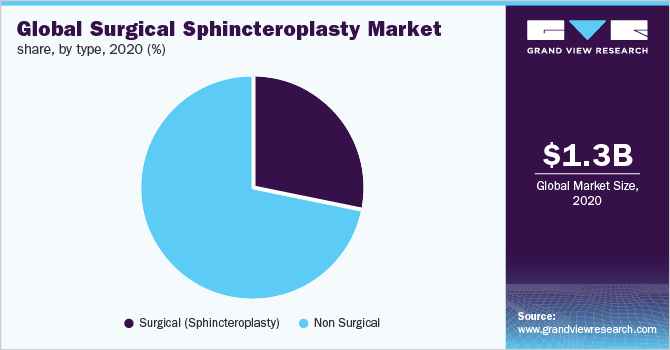
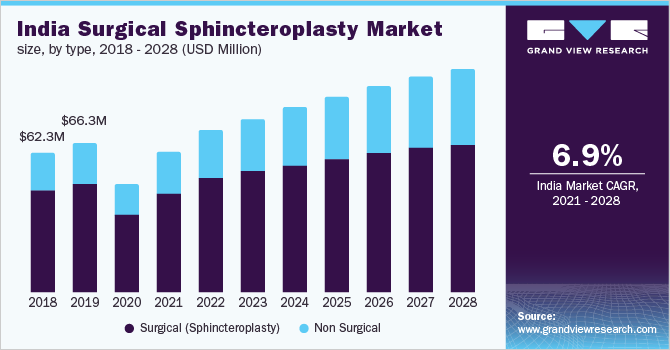
The non-surgical segment is estimated to witness the highest CAGR of 6.9% during the forecast period, owing to its growing adoption among the geriatric population and the ability to quickly regain anal sphincter control upon administration. It is further divided into sacral nerve stimulation, vaginal balloon inserts, and other treatment such as artificial bowel sphincter and solesta. Patients with end-stage AI and those failing to respond to the conventional treatment, have witnessed promising results of the non-surgical techniques. Sacral nerve stimulation held the largest share of 44.7% due to its high success rate, and the ability to reverse or discontinue the treatment without permanently damaging the sacral nerves.
Regional Insights
North America dominated the market for surgical sphincteroplasty and accounted for the largest revenue share of 34.9% in 2020. Due to the improved healthcare infrastructure, and presence of leading market players in this region, the region is expected to capture the largest market share. Additionally, a rise in clinical research to establish concrete treatment options for AI is also said to boost the market growth. However, the Asia Pacific region witnessed the highest CAGR of 7.1% during the forecast period. Factors such as the rise in the aging population increased adoption of cost-effective surgeries like sphincteroplasty, and improved government expenditure on the healthcare sector is said to drive the market in the region.
Key Companies & Market Share Insights
An increase in clinical developments to design innovative products is creating promising opportunities in the market for surgical sphincteroplasty. Due to the presence of fewer market players offering surgical technologies to treat anal incontinence, it is said to be a low competitive market. However, development strategies like collaboration and acquisition undertaken by larger market players are said to boost the market growth. For instance, in October 2021, Laborie Medical Technologies acquired Pevalon’s non-surgical segment Eclipse. The segment is responsible for marketing its largest grossing product, vaginal inserts, to treat incontinence among women. Some of the prominent players in the surgical sphincteroplasty market include:
Surgical Sphincteroplasty Market Report Scope
|
Report Attribute
|
Details
|
|
Market size value in 2021
|
USD 1.7 billion
|
|
Revenue forecast in 2028
|
USD 2.67 billion
|
|
Growth Rate
|
CAGR of 6.6% from 2021 to 2028
|
|
Base year for estimation
|
2020
|
|
Historical data
|
2016 - 2019
|
|
Forecast period
|
2021 - 2028
|
|
Quantitative units
|
Revenue in USD million and CAGR from 2021 to 2028
|
|
Report coverage
|
Revenue forecast, company ranking, competitive landscape, growth factors, and trends
|
|
Segments covered
|
Type, region
|
|
Regional scope
|
North America; Europe; Asia Pacific; Latin America; MEA
|
|
Country scope
|
U.S.; Canada; U.K.; Germany; France; Italy; Spain; China; Japan; India; Australia; Thailand; South Korea; Brazil; Mexico; Argentina; Colombia; Saudi Arabia; South Africa; UAE
|
|
Key companies profiled
|
Medtronic; Pelvalon; Hill-Rom Services, Inc; McKesson; B. Braun; Becton, Dickinson and Company; Novo Surgical, Inc.; Surgical Holdings; Salix Pharmaceutical Inc.; Johnson & Johnson
|
|
Customization scope
|
Free report customization (equivalent up to 8 analyst’s working days) with purchase. Addition or alteration to country, regional, and segment scope
|
|
Pricing and purchase options
|
Avail customized purchase options to meet your exact research needs. Explore purchase options
|
Segments Covered in the Report
This report forecasts revenue growth at global, regional, and country levels and provides an analysis of the latest industry trends in each of the sub-segments from 2016 to 2028. For the purpose of this study, Grand View Research has segmented the global surgical sphincteroplasty market report on the basis of type and region:
-
Type Outlook (Revenue, USD Million, 2016 - 2028)
-
Regional Outlook (Revenue, USD Million, 2016 - 2028)
-
North America
-
Europe
-
U.K.
-
Germany
-
France
-
Italy
-
Spain
-
Asia Pacific
-
Japan
-
China
-
India
-
Australia
-
Thailand
-
South Korea
-
Latin America
-
Brazil
-
Mexico
-
Argentina
-
Colombia
-
Middle East and Africa
-
South Africa
-
Saudi Arabia
-
UAE
Frequently Asked Questions About This Report
b. The global surgical sphincteroplasty market size was estimated at USD 1.3 billion in 2020 and is expected to reach USD 1.7 billion in 2021
b. The global surgical sphincteroplasty market is expected to grow at a compound annual growth rate of 6.6% from 2021 to 2028 to reach USD 2.67 billion by 2028.
b. North America dominated the surgical sphincteroplasty market with a share of 34.9% in 2020. This is attributable to the factors such as the improved healthcare infrastructure, and the presence of leading market players in this region.
b. Some key players operating in the surgical sphincteroplasty market include Medtronic; Pelvalon; Hill-Rom Services, Inc; McKesson; B. Braun; Becton, Dickinson and Company; Novo Surgical, Inc.; Surgical Holdings, Salix Pharmaceutical Inc. and Johnson & Johnson
b. Key factors that are driving the surgical sphincteroplasty market growth include the growing prevalence of anal incontinency (AI), the cost-effectiveness of sphincteroplasty, and the rising incidence of obstetric injury post-childbirth in women.

 Download Sample Report
















