
- Home
- »
- Communication Services
- »
-
Telecom API Market Size And Share Report, 2026-2033GVR Report cover

Telecom API Market (2026 - 2033)
Size, Share & Trends Analysis Report By Type (Messaging API, Web RTC API, Payment API, IVR API, Location API), By End User (Enterprise Developers, Internal Telecom Developers), By Region, And Segment Forecasts
Market Size, 2025
$297.2BMarket Estimate, 2026
$355.6BMarket Forecast, 2033
$1,803.2BCAGR, 2026–2033
26.1%Telecom API Market Summary
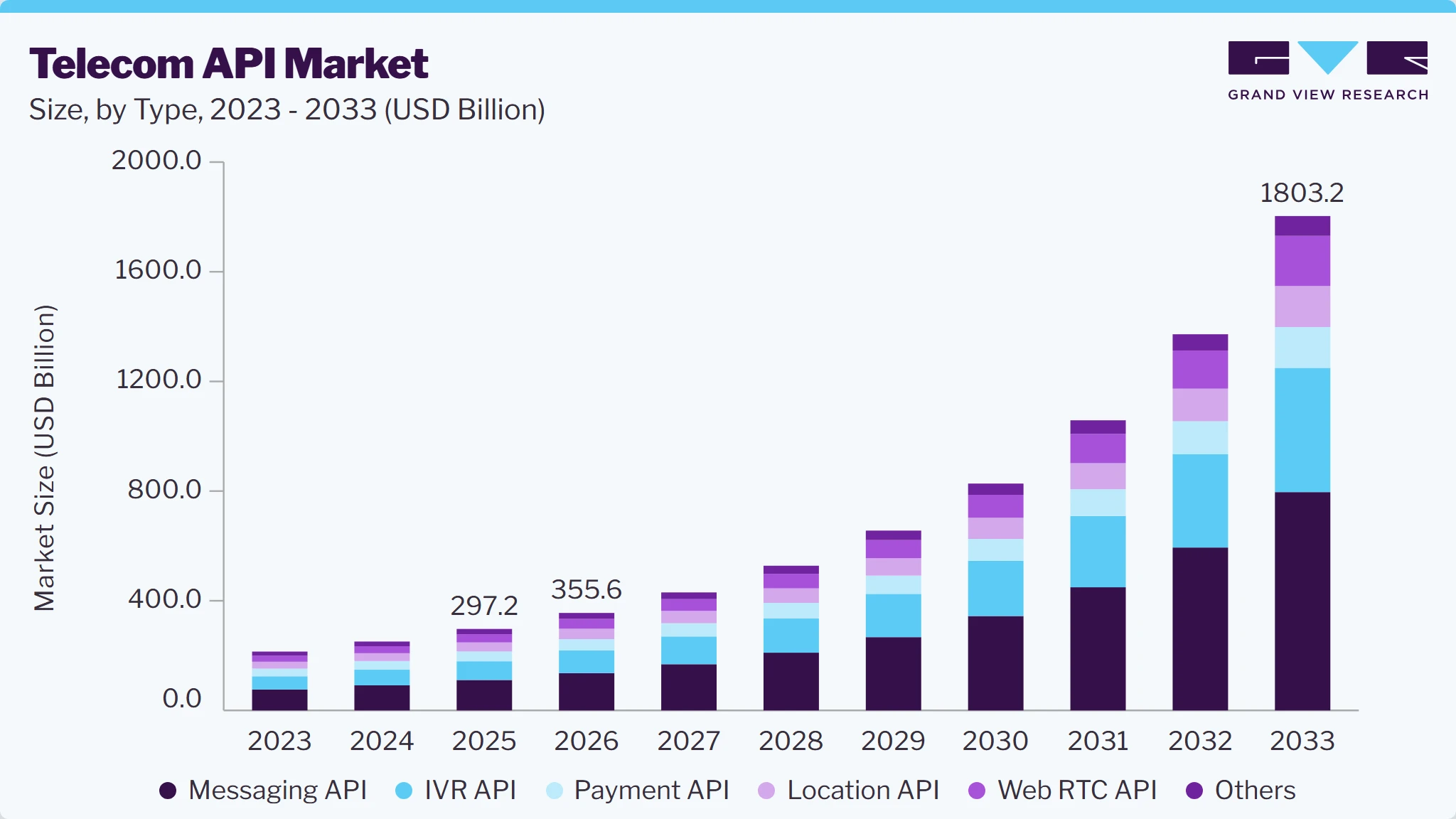
The global telecom API market size was valued at USD 297.2 billion in 2025 and is projected to grow from USD 355.6 billion in 2026 to USD 1,803.2 billion by 2033, at a CAGR of 26.1% from 2026 to 2033. Asia Pacific dominated the market, accounting for the largest share of 32.0% 2025. A telecom application programming interface (API) is used to manage web-based services such as cloud-based, banking, and identity management telecom software by arranging programming instructions and standard protocols.
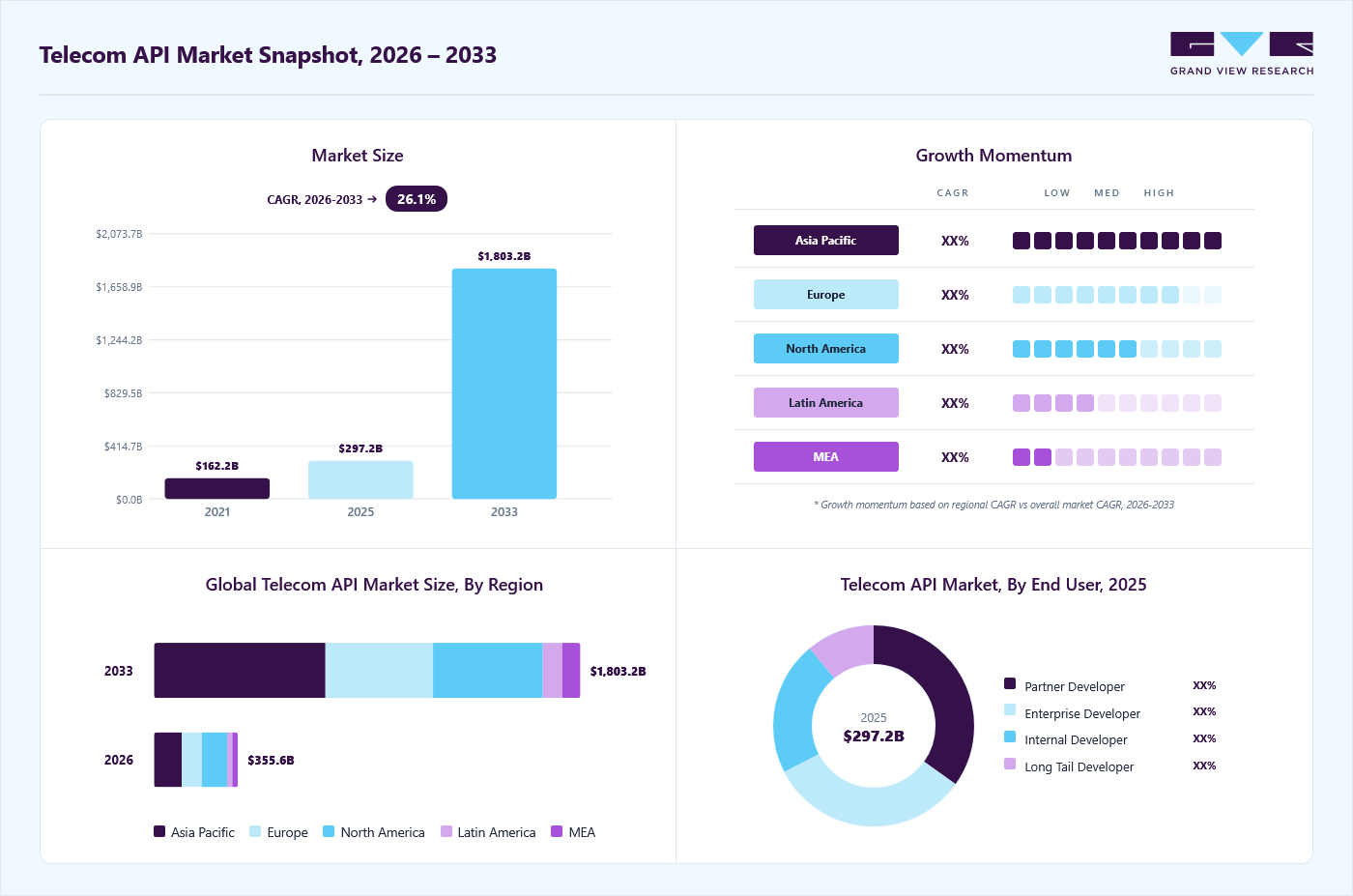 Source: Grand View Research, IR Documents, Primary Interviews, Paid DatabasesTo learn more about this report,
 Download Free Sample Report
 Key Market Trends & Insights
- By type: Messaging API segment dominated the market, with a revenue share of 37.3% in 2025
- By end user: Partner developer segment held the largest market share of 34.8% in 2025
Regional Highlights
- Largest regional market: Asia Pacific (32.0% revenue share, 2025)
- By country: The U.S. held the largest market share of North America in 2025.
Market Size & Forecast
- Market size in 2025: USD 297.2 Billion
- Estimated market size in 2026: USD 355.6 Billion
- Projected market size by 2033: USD 1,803.2 Billion
- CAGR (2026-2033): 26.1%
Three ways to get this report
Buy it, customize it, or ask a question.Ask an Analyst
A direct answer, usually in 1 working day
- AccessReport author, directly
- Reply timeWithin 1 working day
- No sales callDirect answer only
- FormatEmail reply
- CostFree, no cost
Get the Full Report
What the study covers
- FormatsPDF · Excel · Dashboard
- Timeline2026–2033 annual, 2025 base
- Coverage20+ countries, 5 regions
- Companies10+ key players profiled
Customize the Report
20% free customization
- IncludeCountries, segments, points
- TailorTo your product definition
- ExtendDeeper competitor detail
- OrA fully bespoke study
- Turnaround5–10 working days
The market provides cost-effective solutions by enhancing the system performance of existing web-based applications. These device and communication protocols facilitate agility in mobile application development as it enables the developers to focus on developing primary functions without the need to develop them from scratch.Growing penetration of the Internet of Things (IoT), wearable, and device integration in the telecom sector is anticipated to positively impact the market over the forecast period. Telecom APIs allow end-to-end IoT solutions as they act as a singular point of interaction between several nodes within a network and hence reducing the multiple third-party service providers for system integration. With growing IoT penetration, the market for telecom API is anticipated to grow at a phenomenal rate.
 To learn more about this report, Download Free Sample Report
 Telecom API has prominent applications in all areas involving mobile applications and services such as location tracking apps, messaging apps, online mobile payments, and voice & video calls, among others. With the rising number of mobile service subscribers, the demand for mobile-based technologies has increased significantly in recent years, further increasing the demand for telecom APIs due to the scalability it offers. The recent increasing number of start-ups launched in the field of telecom API in emerging markets such as the Asia Pacific and Africa is expected to open new opportunities for the telecom API service providers during the forecast year. Industry giants such as Google, Vodafone, and communications service providers (CSPs) and technology suppliers have developed partnerships with start-ups from these emerging markets to create a nurturing ecosystem for the growth of telecom startups by offering their APIs for application development, thus propelling the market growth.
Despite the phenomenal benefits offered by telecom API, data security concerns amongst the end-users are hindering the market growth. For instance, based on a recently published report on data security, it is observed that for enterprise and commercial web applications, API attacks will become the most frequent attack resulting in data breaches. wherein malicious parties will get access to end-user data such as the name, contact details, and IMEI number of the device on which the application is operating.
The increasing adoption of machine-to-machine (M2M) devices is also estimated to propel the telecom API market from 2026 to 2030. APIs are critical for M2M communication as they identify the message format that can be used for device control. Moreover, increasing the adoption of mobile commerce is expected to increase the demand for telecom APIs in applications such as payment API and location API. Various mobile payment gateways, such as Stripe, Zooz, PayPal, and Amazon Pay, among others, allow the user to purchase products through cards using the payment API for processing the transactions.
Market Dynamics
The telecom API market is growing rapidly due to the increasing adoption of cloud communications, rising demand for digital customer engagement, and the expanding integration of telecom capabilities into enterprise applications. Businesses are leveraging telecom APIs to enable messaging, voice, video, authentication, and location-based services within their digital platforms. However, concerns related to data security and integration complexity could hamper the growth of the market. Moreover, opportunities emerging from 5G networks and AI-enabled communication services are expected to contribute to the market’s growth during the forecast period.
The increasing need for seamless customer engagement across multiple communication channels is a major driver of the market. Businesses are integrating messaging, voice, video, email, and social media communication capabilities into their applications to provide consistent customer experiences. Telecom APIs enable organizations to deploy communication features quickly without investing in complex telecom infrastructure. Enterprises across banking, retail, healthcare, and e-commerce sectors are adopting communication APIs to enhance customer support and engagement. The rising importance of personalized interactions and real-time communication is further driving API adoption. Organizations are leveraging telecom APIs to improve customer satisfaction, operational efficiency, and service accessibility. These factors continue to drive significant market growth.
The expansion of digital customer service models is creating additional demand for communication-enabled applications. Businesses are increasingly utilizing programmable communication services to support automated notifications, customer authentication, appointment reminders, and marketing campaigns. Telecom APIs help streamline communication workflows while reducing deployment complexity. The growing use of mobile applications and digital platforms is increasing the need for embedded communication capabilities. Enterprises are seeking flexible and scalable communication solutions to meet evolving customer expectations. This trend is expected to support the growth of the market.
Data security and privacy challenges could hamper the growth of the telecom API market. Telecom APIs facilitate the exchange of sensitive information such as customer identities, authentication credentials, communication records, and location data. Security vulnerabilities in API ecosystems expose organizations to cyberattacks, unauthorized access, and data breaches. Regulatory requirements governing data privacy and telecommunications compliance further increase implementation complexity. Organizations handling sensitive customer information must invest heavily in security controls and monitoring systems. Concerns about data protection are slowing API adoption in highly regulated industries. These challenges continue to impact market growth.
The global rollout of 5G networks presents a significant opportunity for the telecom API market. 5G technology enables faster data transmission, lower latency, and enhanced network reliability, creating new possibilities for communication applications. Telecom APIs help developers leverage 5G capabilities to build advanced services such as real-time video communication, immersive experiences, IoT connectivity, and mission-critical enterprise applications. Businesses are increasingly exploring innovative use cases that require high-performance communication infrastructure. The availability of 5G-enabled APIs is expected to accelerate application development and service innovation. These advancements are creating substantial growth opportunities for telecom API providers.
Telecommunications companies are actively developing API ecosystems that expose network capabilities to enterprises and developers. 5G networks enable more sophisticated communication experiences and support emerging digital business models. Industries such as healthcare, manufacturing, transportation, and media are expected to benefit from enhanced connectivity services. API-driven access to advanced network functions accelerates innovations across multiple sectors. Continued investment in 5G infrastructure is expected to expand market opportunities during the forecast period.
Analyst Perspective
The telecom API market is evolving as a key enabler of digital communication and application development across industries. Enterprises are increasingly integrating messaging, voice, video, authentication, and location-based capabilities into their digital platforms to enhance customer engagement and operational efficiency. Market players are focusing on expanding API ecosystems, improving developer accessibility, and monetizing advanced network capabilities, particularly with the emergence of 5G. Growing demand for cloud-based communications, embedded connectivity services, and programmable network functions is expected to contribute to the growth of the market.
Type Insights
Based on type, the telecom API market report is categorized into messaging API, webRTC API, payment API, IVR API, location API, and others. Based on type, the messaging API segment led the market with the largest revenue share of 37.3% in 2025. The high growth of messaging APIs is owing to the growing demand for SMS and RCS services, which have led to the application of messaging APIs. The penetration of the SMS market is growing as an increasing number of companies are utilizing SMS services for personalized marketing efforts and enhancing customer engagement and experience. Thus, propelling the demand for messaging APIs.
Furthermore, the location API sub-segment held a considerable revenue share in 2025 owing to increasing demand for location-based web-application services. This growth in the market can be attributed to the increasing number of BPO service providers, specifically in developing markets such as South Africa, China, and India. Furthermore, the location API sub-segment held a considerable revenue share in 2024 owing to increasing demand for location-based web-application services.
End User Insights
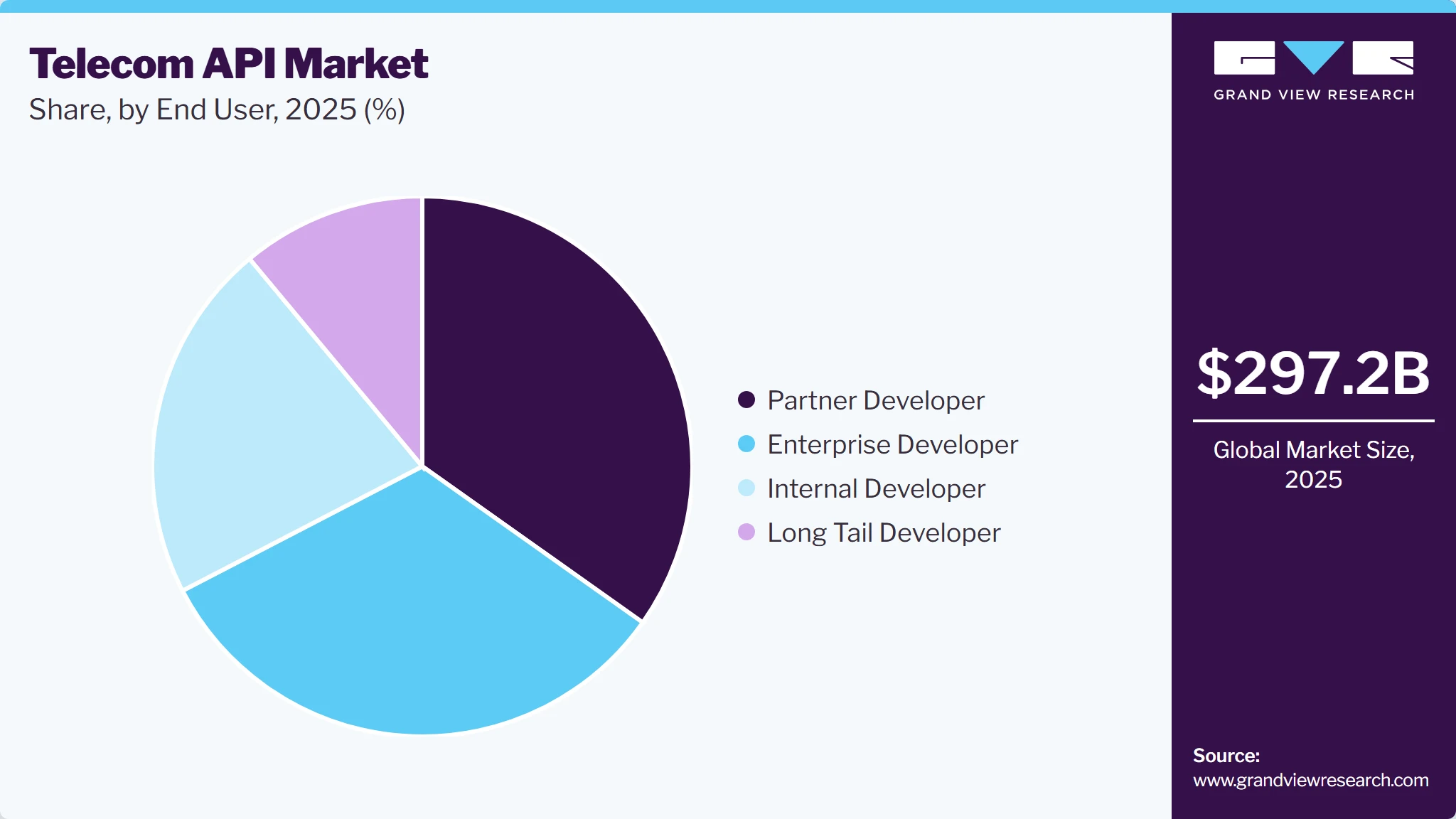
Based on end user, the partner developer segment led the market with the largest revenue share of 34.8% in 2025. Based on end-user, the telecom API market is categorized into internal telecom developers, enterprise developers, partner developers, and long tail developers. , Partner APIs help in creating a single-point data-sharing platform between CSPs and other developers to develop services such as payment services, and streaming services, among others. Developers can develop these services and get support from telecom organizations to manage service infrastructure. Furthermore, the customer base for partner developers is expanding rapidly as compared to enterprise developers, resulting in their growth over the forecast period.
 To learn more about this report, Download Free Sample Report
 The telecom API market in China held the largest share in the Asia Pacific region in 2025, owing to the high penetration and adoption rate of large-scale enterprises. In large-scale organizations, A2P messages are majorly used in the announcement of offers, promotional activities, and changes in company policies, among others. The broadcast the above messages, organizations mostly use bulk messaging tools & software that drive the market growth for telecom APIs.
Regional Insights
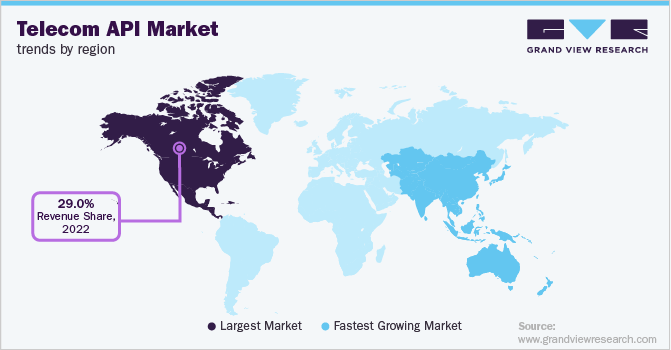
Asia Pacific dominated the global market with the largest revenue share of 32.0% in 2025. The telecom API market in Asia Pacific is projected to be one of the most attractive regions owing to the increasing number of mobile subscribers in the region and the increasing adoption of 5G technologies in the near future.
 To learn more about this report, Download Free Sample Report
 India’s telecom API market is witnessing rapid growth, driven by the surge in mobile internet users, increased digital transformation among enterprises, and the expansion of the 5G ecosystem. Telecom operators are increasingly partnering with third-party developers to monetize network capabilities through APIs, particularly in areas such as messaging, location, and payment services.
North America Telecom API Market Trends
The Telecom API market in North America witnessed a significant market share in 2024. This growth can be attributed to the significant presence of various large market players such as Broadcom, AT&T Intellectual Property, Google, and Oracle Corporation, among others, in this region. Moreover, the adoption of technologies such as 4G and the improvement in 5G technology are major factors contributing to the high telecom API market growth in this region. With the integration of 4G or 5G technology and APIs, communication services such as voice & video calls, and video & speech integration services are delivered competently, and the productivity of businesses is improved to a greater extent.
U.S. Telecom API Market Trends
The U.S. telecom API market is highly mature and innovation-led, supported by strong investments in 5G infrastructure, edge computing, and IoT. Telecom providers are leveraging APIs to expose network services like authentication, number verification, and programmable messaging to enterprise clients, particularly in sectors such as finance, healthcare, and logistics. A large base of cloud-native enterprises and API-first developers in the U.S. drives robust demand for telecom APIs, especially those that enhance customer experience, streamline communications, and enable data monetization.
Europe Telecom API Market Trends
Europe’s telecom API market is characterized by regulatory harmonization, cross-border collaborations, and increasing investments in next-gen telecom infrastructure. The European Commission’s push for open and secure digital markets aligns with telecom operators' efforts to offer standardized APIs across the region, enabling pan-European service delivery.
Germany telecom API market represents a key growth within Europe, supported by its strong industrial base and digital transformation strategies like “Industrie 4.0.” German telecom operators are actively exploring API-based solutions to enhance machine-to-machine (M2M) communications, industrial IoT, and real-time data exchange. The integration of telecom APIs in automotive, manufacturing, and logistics sectors is gaining traction, particularly for location-based services, device management, and secure communications. Furthermore, ongoing 5G deployments and government initiatives to boost digital infrastructure are fostering a conducive environment for telecom API adoption across enterprises.
Key Telecom API Company Insights
Some of the key companies in the telecom API industry include AT&T, Inc., Twilio, Inc., Vodafone Group, and others. The telecom API market is fragmented and characterized by high competition among the key players operating in a particular region. Each region or country is dominated by a few prominent players that mostly include the CSPs of that particular region. These market players are focusing on adopting new organic & inorganic growth strategies such as mergers & acquisitions, partnerships, joint ventures, or collaborations in order to enhance their market presence.
-
AT&T Inc. is a provider of mobile and fixed telephone services. The company’s affiliates and subsidiaries operate worldwide in the technology, media, and telecommunications industries. The wireless broadband networks and high-speed fiber developed by the company offer connectivity services to businesses and people.
-
Huawei Technologies Co., Ltd. develops smart devices and information communications technology (ICT) infrastructure. The company offers integrated solutions across four key domains, namely cloud services, IT, smart devices, and telecom networks. The company provides solutions and network products for telecom carriers. The company offers ICT solutions to enterprise customers and government agencies, and also provides them with intelligent and secure services and products.
Key Telecom API Companies:
The following key companies have been profiled for this study on the telecom API market.
- AT&T, Inc.
- Twilio, Inc.
- Vodafone Group
- Verizon Communications, Inc.
- Huawei Technologies Co., Ltd.
- Telefonaktiebolaget LM Ericsson
- Telefónica S.A.
- Infobip ltd.
- Bharti Airtel Limited
- Deutsche Telekom AG
Competitive Benchmarking
Category
Operating Strategies
Competitive Edge
Weakness
Established Players (AT&T, Inc., Vodafone Group, Verizon Communications, Inc., Huawei Technologies Co., Ltd.)
- Emerging players focus on cloud-based communication platforms, developer-friendly APIs, omnichannel engagement solutions, and rapid service innovation. These companies emphasize flexible consumption models, easy integration, and scalable communication services to attract enterprises and application developers.
- Strong global network infrastructure, extensive customer bases, large-scale investments in 5G and digital services, strong brand recognition, and deep telecom expertise provide significant competitive advantages.
- Dependence on regulatory frameworks, high network investment requirements, and complex organizational structures may slow innovation cycles. Legacy infrastructure can also increase operational complexity and costs.
Emerging Players (Twilio, Inc., Infobip Ltd., Bharti Airtel Limited)
- Emerging players focus on cloud-based communication platforms, developer-friendly APIs, omnichannel engagement solutions, and rapid service innovation. These companies emphasize flexible consumption models, easy integration, and scalable communication services to attract enterprises and application developers.
- Strong developer ecosystems, agile innovation capabilities, cloud-native architectures, flexible pricing models, and rapid deployment capabilities allow them to respond quickly to evolving market requirements.
- Compared to large telecom operators, these companies may have more limited ownership of network infrastructure and greater dependence on partnerships with telecom carriers for service delivery.
Recent Developments
-
In February 2025, Aduna, a collaborative venture by Ericsson and leading U.S. telecom operators AT&T, T-Mobile, and Verizon, has unveiled plans to launch the country’s first standardized network APIs for Number Verification and SIM Swap by 2025. This marks a milestone as it is the first instance where the three largest U.S. mobile carriers are jointly endorsing open, interoperable network APIs. The initiative aims to enhance cross-industry innovation, particularly in financial services, digital commerce, and identity verification, while strategically advancing the United States’ leadership position in the global telecom API economy.
Telecom API Market Report Scope
Report Attribute
Details
Market size in 2025
USD 297.2 billion
Estimated Market size in 2026
USD 355.6 billion
Projected Market size by 2033
USD 1,803.2 billion
Growth rate
CAGR of 26.1% from 2026 to 2033
Base year for estimation
2025
Historical data
2021 - 2024
Forecast period
2026 - 2033
Quantitative units
Revenue in USD billion and CAGR from 2026 to 2033
Report coverage
Revenue forecast, company market share, competitive landscape, growth factors, and trends
Segments covered
Type, end user, region
Regional scope
North America; Europe; Asia Pacific; Latin America; MEA
Country scope
U.S.; Canada; Mexico; Germany; U.K.; France; China; Japan; India; South Korea; Australia; Brazil; Saudi Arabia; UAE; and South Africa
Key companies profiled
AT&T, Inc., Twilio, Inc., Vodafone Group, Verizon Communications, Inc., Huawei Technologies Co., Ltd., Telefonaktiebolaget LM Ericsson, Telefónica S.A., Infobip ltd., Bharti Airtel Limited, Deutsche Telekom AG
Customization scope
Free report customization (equivalent up to 8 analysts' working days) with purchase. Addition or alteration to country, regional & segment scope.
Pricing and purchase options
Avail customized purchase options to meet your exact research needs. Explore purchase options
Global Telecom API Market Report Segmentation
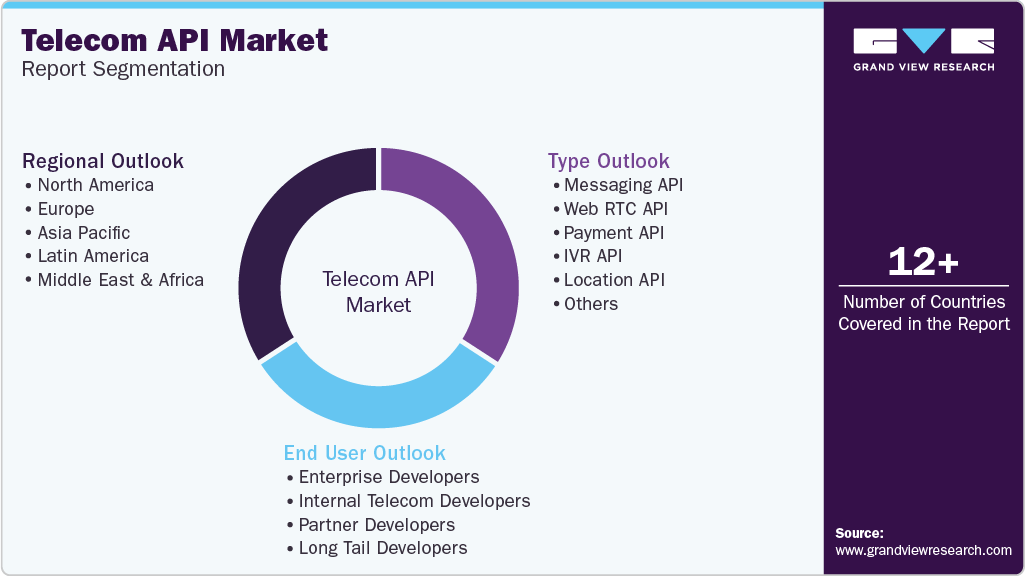
This report forecasts revenue growth at global, regional, and country levels and provides an analysis of the latest industry trends in each of the sub-segments from 2021 to 2033. For this study, Grand View Research has segmented the global telecom API market report based on type, end user, and region.
 To learn more about this report, Download Free Sample Report
 -
Type Outlook (Revenue, USD Million, 2021 - 2033)
-
Messaging API
-
Web RTC API
-
Payment API
-
IVR API
-
Location API
-
Others
-
-
End User Outlook (Revenue, USD Million, 2021 - 2033)
-
Enterprise Developers
-
Internal Telecom Developers
-
Partner Developers
-
Long Tail Developers
-
-
Regional Outlook (Revenue, USD Million, 2021 - 2033)
-
North America
-
U.S.
-
Canada
-
Mexico
-
-
Europe
-
Germany
-
UK
-
France
-
-
Asia Pacific
-
China
-
Japan
-
India
-
South Korea
-
Australia
-
-
Latin America
-
Brazil
-
-
Middle East and Africa (MEA)
-
KSA
-
UAE
-
South Africa
-
-
Research Methodology
The telecom API market figures in this report are based on a proven research process that combines executive interviews with secondary research from proprietary databases, company filings, and recognized regulatory and institutional sources. Market size is built through value-chain sizing - reconciling supply-side and demand-side estimates - and triangulated with bottom-up and top-down approaches. Every estimate passes multiple levels of expert validation before publication, with each telecom API segment quantified using the revenue-capture definitions in the table below.
Segment Definition
Segment - Type
Revenue capture definition
Messaging API
This segment captures revenue generated from APIs that enables applications to send, receive, and manage SMS, MMS, chat messages, notifications, and other messaging services.
Web RTC API
This segment captures revenue generated from APIs that facilitate real-time voice, video, and data communication directly through web browsers and applications.
Payment API
This segment captures revenue generated from APIs that enables secure payment processing and transaction management within applications and digital platforms.
IVR API
This segment captures revenue generated from APIs that enables interactive voice response (IVR) functionality within communication systems.
Location API
This segment captures revenue generated from APIs that provide location-based services by utilizing network, GPS, or device location data.
Others
This segment captures revenue generated from content delivery API, advertising API, and authentication API.
Segment - End User
Revenue capture definition
Enterprise Developers
This segment captures revenue generated from telecom APIs used by developers working within enterprises to build communication-enabled applications and business solutions.
Internal Telecom Developers
This segment captures revenue generated from telecom APIs utilized by developers employed within telecommunications companies.
Partner Developers
This segment captures revenue generated from telecom APIs used by third-party technology partners, system integrators, software vendors, and service providers.
Long Tail Developers
This segment captures revenue generated from telecom APIs used by independent developers, startups, small businesses, and niche application providers.
Estimation Model
Layer Name
Key Question
Description
Digital Application & Communication Demand Base Layer
Who requires communication and connectivity capabilities within digital applications?
Establish the total potential demand base by identifying enterprises, application developers, digital service providers, e-commerce platforms, financial institutions, healthcare providers, media companies, and other organizations that require communication functionalities. It evaluates factors such as application development activity, digital transformation initiatives, customer engagement requirements, and mobile application usage before applying market-specific filters.
Addressable Telecom API Market Layer
Which organizations and developers can realistically adopt telecom APIs?
Refine the total digital ecosystem into the serviceable telecom API market by considering factors such as cloud adoption, API management capabilities, developer accessibility, telecommunications infrastructure availability, digital communication requirements, and regulatory compliance. It determines the share of organizations and developers that can potentially integrate telecom APIs into their applications and business processes.
Telecom API Adoption & Integration Layer
Who is actively deploying telecom APIs?
Estimate annual demand generation by analyzing the adoption of messaging APIs, WebRTC APIs, payment APIs, IVR APIs, location APIs, and other telecom APIs across enterprise developers, internal telecom developers, partner developers, and long-tail developers. It converts the addressable market into measurable API deployments and communication-enabled application implementations.
Revenue Layer
How does telecom API adoption translate into market revenue?
Convert API usage and deployments into market revenue through API subscriptions, usage-based fees, transaction-based pricing, and communication service charges. Revenue is generated by applying pricing models based on API calls, message volumes, voice minutes, payment transactions, authentication requests, location queries, and value-added communication services.
Delivered Customizations
This report has been delivered with the following In-depth customizations
Client Request
Customization Delivered
Value Adds
Regional & Country Opportunity Analysis
- Delivered region-wise and country-wise market sizing, forecasts, and growth analysis across North America, Europe, Asia Pacific, Latin America, and Middle East & Africa
- Assessment of 5G deployment, digital transformation initiatives, and API ecosystem maturity by country
- Identification of high-growth telecom API markets
- Supported regional expansion and investment prioritization
- Enabled geographic opportunity assessment
5G & Open Gateway API Analysis
- Assessment of GSMA Open Gateway initiatives, 5G-enabled APIs, network exposure functions (NEF), and telecom network programmability trends
- Analysis of emerging opportunities created by 5G network APIs
- Supported future technology planning
- Identified next-generation API growth opportunities
Competitive Benchmarking & Strategic Landscape Analysis
- Delivered benchmarking of telecom API providers, telecom operators, CPaaS vendors, and API platform companies based on API portfolio, pricing, geographic presence, developer ecosystem, partnerships, and innovation capabilities
- Analysis of acquisitions, partnerships, Open Gateway initiatives, and new API launches
- Supported competitive intelligence and strategic decision-making
- Enabled identification of market gaps and growth opportunities
- Assisted in strengthening market positioning
Frequently Asked Questions About This Report
The global telecom API market size was estimated at USD 297.2 billion in 2025 and is expected to reach USD 355.6 billion in 2026.
The global telecom API market is expected to grow at a compound annual growth rate of 26.1% from 2026 to 2033 to reach USD 1,803.2 billion by 2033.
Messaging API segment dominated the market, with a revenue share of 37.3% in 2025. This is attributable to the increasing adoption of SMS and RCS services that use messaging APIs.
Some key players operating in the telecom API market include AT&T, Inc.; Twilio, Inc.; Vodafone Group; Verizon Communications, Inc.; Huawei Technologies Co., Ltd.; Telefonaktiebolaget LM Ericsson; Telefónica S.A.; Infobip ltd.; Bharti Airtel Limited; and Deutsche Telekom AG.
Key factors that are driving the telecom API market growth include an increasing number of mobile service subscribers, growing adoption of the Internet of Things (IoT), and increasing number of mobile internet users.
Asia Pacific dominated the global telecom API market with the largest revenue share of 32.0% in 2025 and is the fastest-growing regional market.
Based on end user, the partner developer segment led the market with the largest revenue share of 34.8% in 2025 and is the fastest-growing end user segment.
The telecom API market in the China held the largest share in the Asia Pacific region in 2025.
About the Author(s)
Communication Services Research Team
Technology · Communication ServicesThis report was authored by the communication services research team at Grand View Research - comprising two research analysts, one senior research analyst, and one industry expert - with specialized expertise in the communication services segment of the technology industry. All findings are based on proprietary technology databases, executive interviews, and regulatory analysis, subject to internal peer review prior to publication.
Last Updated:
Speak to Analyst

Customize this report to your needs - add regions, segments, or data points, with 20% free customization.
Or view our licence options:


ISO 9001:2015 & 27001:2022 Certified
We are GDPR and CCPA compliant! Your transaction & personal information is safe and secure. For more details, please read our privacy policy.


