
- Home
- »
- Next Generation Technologies
- »
-
Trade Finance Market Size, Share & Trends Report, 2033GVR Report cover

Trade Finance Market (2026 - 2033)
Size, Share & Trends Analysis Report By Instrument, By Service Provider (Banks, Financial Institutions), By Trade, By Enterprise Size, By Industry, By End Use, By Region, And Segment Forecasts
Market Size, 2024
$54.6BMarket Estimate, 2026
$57.1BMarket Forecast, 2030
$79.0BCAGR, 2025–2030
4.8%Trade Finance Market Summary
The global trade finance market size was valued at USD 54.6 billion in 2025 and is projected to grow from USD 57.1 billion in 2026 to USD 79.0 billion by 2033, growing at a CAGR of 4.8% from 2026 to 2033. North America dominated the global market with the largest revenue share of 26.4% in 2025. Globalization and international trade have significantly propelled the growth of the market.
 Source: Grand View Research, IR Documents, Primary Interviews, Paid DatabasesTo learn more about this report,
 Download Free Sample Report
 Key Market Trends & Insights
- By enterprise size: Large enterprises segment led the market with the largest revenue share of 72.8% in 2025.
- By instrument: Letter of credit segment dominated the market in 2025 and accounted for a revenue share of more than 24.4%.
- By service provider: Banks segment dominated the market in 2025 and accounted for a revenue share of more than 34.2%.
- By trade: International segment dominated the market in 2025 and accounted for a revenue share of over 60.3%.
Regional Highlights
- By country: The U.S. held the largest market share in 2025.
- Largest regional market: North America (26.4% revenue share, 2025)
Market Size & Forecast
- Market size in 2025: USD 54.6 Billion
- Estimated market size in 2026: USD 57.1 Billion
- Projected market size by 2033: USD 79.0 Billion
- CAGR (2026-2033): 4.8%
Three ways to get this report
Buy it, customize it, or ask a question.Ask an Analyst
Analyst response in 1 business day
- AccessReport author, directly
- Reply timeWithin 1 working day
- No sales callDirect answer only
- FormatEmail reply
- CostFree, no cost
Get the Full Report
What the study covers
- FormatsPDF · Excel · Dashboard
- Timeline2025–2030 annual, 2024 base
- Coverage20+ countries, 5 regions
- Companies10+ key players profiled
Customize the Report
20% free customization
- IncludeCountries, segments, points
- TailorTo your product definition
- ExtendDeeper competitor detail
- OrA fully bespoke study
- Turnaround5–10 working days
The ever-evolving technological landscape has revolutionized trade finance. Digital platforms and fintech innovations have made it easier for businesses to access and utilize trade financing. These technologies have streamlined the application process, reduced paperwork, and accelerated decision-making, making trade finance more attractive and efficient. Moreover, in an increasingly complex global economy, businesses face various risks, including credit, currency, and geopolitical risks. Trade finance offers risk mitigation solutions, such as credit insurance and hedging options, allowing businesses to protect themselves from unexpected financial losses.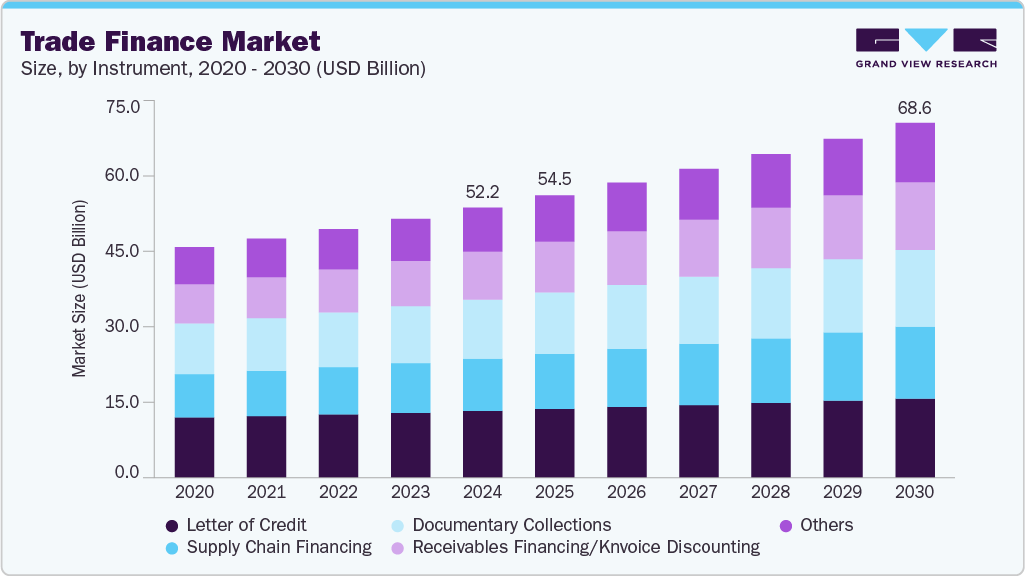 To learn more about this report, Download Free Sample Report
 Shifts in trade patterns play a significant role in driving the dynamics of the trade finance industry. These shifts encompass a range of factors that collectively influence the demand for trade finance services. One notable factor is the emergence of new trade routes and corridors. As global trade networks evolve, new routes may become more prominent due to factors like infrastructure development, political agreements, or changes in supply and demand. These emerging trade routes often require flexible and tailored financing solutions, making trade finance a crucial component in facilitating international commerce.
In times of economic downturns or heightened uncertainty, businesses often turn to trade finance as a strategic tool to navigate challenging circumstances. Such periods, marked by reduced consumer spending, declining business investment, and a general tightening of credit, can strain a company's financial resources. In response, trade finance becomes a vital lifeline, helping companies manage their cash flow effectively. By accessing short-term credit or trade finance facilities, businesses can ensure they have the liquidity required to meet immediate financial obligations, such as paying suppliers or covering operational costs. This financial breathing room can differentiate between survival and insolvency during economic hardships.
A notable restraint in the market for trade finance is the persistence of traditional and paper-based processes, which can lead to inefficiencies, delays, and increased costs. These legacy methods can hinder the smooth flow of trade finance operations, making them susceptible to manual errors and fraud risks. To overcome this challenge, adopting modern technologies such as blockchain, artificial intelligence, and digital documentation is essential. Implementing blockchain can enhance transparency, security, and traceability in trade transactions, reducing the likelihood of fraud. Embracing digital platforms and automated systems streamlines document processing and accelerates the approval and execution of trade finance transactions, ultimately driving efficiency and cost savings.
Market Dynamics
The trade finance market is witnessing steady growth driven by expanding international trade activities, increasing digitalization of financial services, and rising demand for supply chain financing solutions. Businesses are increasingly relying on trade finance instruments to manage cross-border transactions, improve working capital, and mitigate payment risks. However, regulatory complexity and limited access to trade finance for SMEs continue to challenge market growth. On the other hand, opportunities associated with digital trade finance platforms and blockchain-enabled transaction ecosystems are creating new avenues for market growth. Growing globalization and financial technology innovation are expected to shape the future development of the trade finance market.
The growing need for efficient working capital management is driving demand within the trade finance market. Companies across industries are increasingly seeking financing solutions to manage cash flow, optimize receivables and payables, and maintain supply chain continuity. Trade finance products such as invoice financing, factoring, receivables finance, and supply chain finance help businesses improve liquidity while supporting operational stability. The increasing pressure to reduce payment cycles and improve financial flexibility is encouraging organizations to adopt specialized financing instruments. Large enterprises and SMEs alike are using trade finance solutions to support procurement, inventory management, and supplier relationships. This growing focus on financial efficiency is contributing to market growth.
Growing supply chain complexity and market volatility are further accelerating demand for working capital financing tools. Businesses are increasingly adopting financing arrangements that enable faster payments, supplier support, and improved access to short-term capital. Supply chain disruptions, inflationary pressures, and fluctuating commodity prices are increasing the importance of liquidity management strategies. Financial institutions and fintech providers are expanding digital supply chain finance platforms to address evolving enterprise financing requirements. Demand for agile and flexible funding solutions is expected to remain a strong driver of trade finance market development.
Regulatory complexity remains a major restraint affecting the trade finance market. Trade finance transactions are subject to multiple international regulations, anti-money laundering requirements, sanctions frameworks, and compliance obligations across different jurisdictions. Financial institutions often face challenges in managing documentation accuracy, customer due diligence, and cross-border regulatory alignment. Compliance-related processes can increase operational costs, extend transaction timelines, and create administrative burdens for market participants. Businesses operating across multiple geographies may encounter varying legal and financial reporting requirements. These regulatory complexities are expected to slow trade finance adoption and operational efficiency.
The increasing use of blockchain technology in trade finance is creating substantial market opportunities. Blockchain-enabled platforms can improve transaction transparency, document authentication, fraud prevention, and secure information sharing across multiple stakeholders. Smart contracts help automate trade agreements, payment execution, and compliance verification, reducing manual intervention and operational delays. Financial institutions and enterprises are exploring blockchain applications to improve efficiency and reduce costs associated with traditional trade finance processes. These technological capabilities are driving interest in next-generation trade finance ecosystems.
Growing industry investment in decentralized transaction infrastructure is expected to accelerate blockchain adoption within trade finance operations. Pilot projects, consortium partnerships, and technology collaborations are supporting experimentation with distributed ledger applications across banking and supply chain environments. Blockchain-based systems can help improve trust, traceability, and interoperability in cross-border trade transactions. Organizations seeking faster and more secure trade workflows are increasingly evaluating these technologies for operational modernization. This evolving digital landscape presents meaningful long-term growth opportunities for the trade finance market.
Analyst Perspective
The trade finance market is experiencing steady growth driven by expanding global trade activities, increasing demand for working capital solutions, and accelerating digital transformation across financial services. Businesses are increasingly adopting trade finance instruments to manage cross-border transaction risks, improve liquidity, and support supply chain continuity. Financial institutions are investing in digital trade platforms, automation, and blockchain-based solutions to enhance operational efficiency and transaction transparency. Continued globalization, fintech innovation, and modernization of trade ecosystems are expected to support the growth of the trade finance market.
Instrument Insights
Based on instrument, the letter of credit segment led the market with the largest revenue share of 24.4% in 2025. The letter of credit segment has historically dominated the market due to its role in providing a secure and trusted mechanism for international trade transactions. Letters of credit act as a financial guarantee, assuring both the buyer and the seller that the terms of the trade will be met. This mitigates the risk of non-payment for sellers and ensures the delivery of goods for buyers.
The receivables financing/invoice discounting segment is anticipated to register significant growth over the forecast period. It offers businesses a flexible and accessible financing solution by allowing them to leverage their outstanding invoices as collateral. This flexibility is particularly attractive to Small & Medium Enterprises (SMEs) that may face cash flow challenges. Moreover, the digitalization of trade finance has significantly streamlined the receivables financing process. Online platforms and fintech innovations have made it easier for businesses to manage and finance their accounts receivable, reducing paperwork and transaction times.
Service Provider Insights
Based on service provider, the banks segment led the market with the largest revenue share of 34.2% in 2025. They possess extensive networks and established relationships with businesses worldwide, making them trusted intermediaries in international trade transactions. This trust is particularly crucial in cross-border deals, where assurance of payment and delivery is paramount. Moreover, banks offer a wide range of trade finance products and services, including letters of credit, trade loans, and documentary collections. This diversity allows them to cater to the diverse needs of various businesses engaged in global trade.
The financial institutions segment is anticipated to register significant growth over the forecast period. Financial institutions are emerging at a significant rate in the market due to their ability to fill specific niches and offer specialized services. Financial institutions often provide more agile and tailored solutions compared to traditional banks. They leverage technology to streamline processes, reduce paperwork, and offer faster access to financing. This agility allows them to serve a broader spectrum of businesses, including small and medium-sized enterprises that traditional banks may have underserved.
Trade Insights
Based on trade, the international segment led the market with the largest revenue share of 60.3% in 2025. International trade finance has dominated the trade finance industry due to the inherently global nature of trade transactions. This type of trade finance specializes in facilitating cross-border trade by providing financing solutions that bridge gaps in time, distance, and currency. One key reason for its dominance is the scale of international trade, which involves large volumes of goods and services moving between countries.
The domestic segment is anticipated to register significant growth over the forecast period. Domestic trade represents a substantial portion of a country's economic activity, often exceeding international trade volumes. As a result, businesses engaged in domestic trade require financing solutions to manage working capital, bridge cash flow gaps, and ensure the smooth flow of goods and services within a single country. Moreover, the rise of e-commerce and digital platforms has accelerated domestic trade, especially in sectors like retail and distribution.
Enterprise Size Insights
Based on enterprise size, the large enterprises segment led the market with the largest revenue share of 72.8% in 2025. Large corporations often engage in extensive international trade operations involving complex supply chains, numerous suppliers, and global customer bases. Managing these intricate networks requires substantial financial resources and sophisticated trade finance solutions to ensure smooth transactions and minimize risks. Moreover, established large enterprises typically have well-established relationships with financial institutions, granting them access to a wide range of trade finance services, including letters of credit, trade credit insurance, and supply chain financing.
The SMEs segment is anticipated to register significant growth. Globalization and digitalization have leveled the playing field, enabling SMEs to participate more easily in international trade. With the help of online platforms and fintech solutions, SMEs can access trade finance services that were once the domain of larger corporations. Moreover, SMEs are often more agile and adaptable, allowing them to identify niche markets and respond quickly to changing consumer preferences.
Industry Insights
Based on industry, the construction segment led the market with the largest revenue share of 21.1% in 2025. Due to its unique characteristics and substantial financial needs, the construction industry has established a dominant presence in the market. Construction projects often involve complex, cross-border supply chains that require extensive financing for the procurement of raw materials, heavy machinery, and skilled labor. These projects also tend to be long-term endeavors, further necessitating the availability of trade finance solutions to sustain operations over extended periods.
The shipping & logistics segment is anticipated to register significant growth over the forecast period. The shipping and logistics segment is rapidly emerging due to its pivotal role in global trade operations. This sector operates at the heart of supply chains, facilitating the movement of goods across borders and continents. As international trade continues to grow, the demand for efficient logistics services and financing solutions has surged. Shipping and logistics companies increasingly leverage technology and digitization to optimize their operations, resulting in greater transparency and traceability throughout the supply chain.
End Use Insights
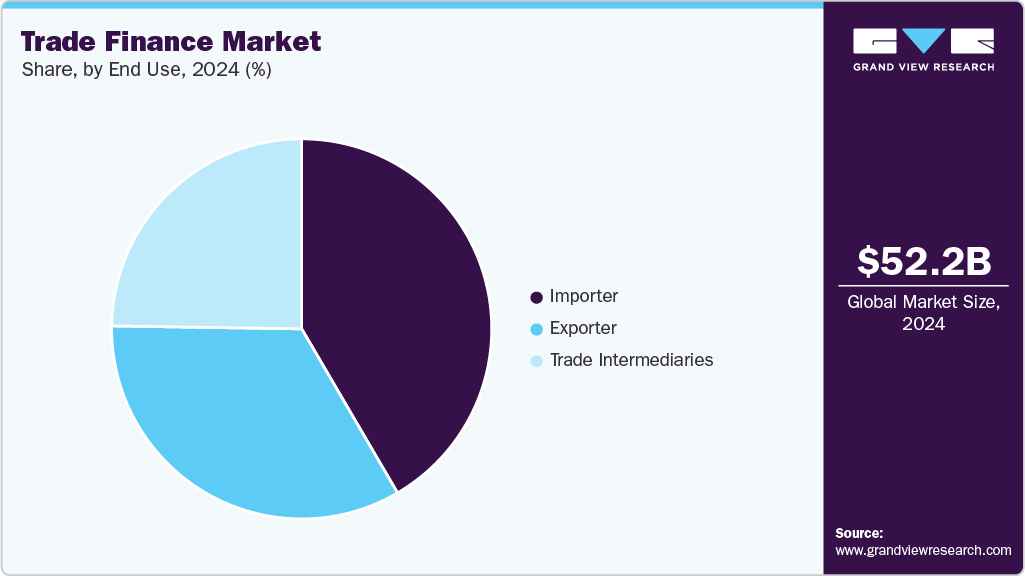
Based on end use, the importer segment led the market with the largest revenue share of 40.6% in 2025. The importer segment has historically dominated the market due to its crucial role in international trade activities. Importers are often the key initiators of trade transactions, sourcing goods and raw materials from various countries to meet domestic demand. To facilitate these transactions, importers require financial instruments that provide security to their suppliers, ensure the timely delivery of goods, and manage currency fluctuations and payment risks. Import financing tools such as letters of credit, open account financing, and trade credit insurance are essential in this context.
 To learn more about this report, Download Free Sample Report
 The trade intermediaries segment is anticipated to register significant growth over the forecast period. Trade intermediaries, including agents, brokers, and logistics providers, play a vital role in connecting buyers and sellers across borders, managing complex supply chains, and ensuring the smooth flow of goods. As global trade becomes more intricate, businesses are increasingly relying on intermediaries to navigate regulatory compliance, customs procedures, and the intricacies of international trade finance. Trade intermediaries often possess in-depth knowledge of specific markets, helping companies expand their global footprint and tap into new opportunities.
Regional Insights
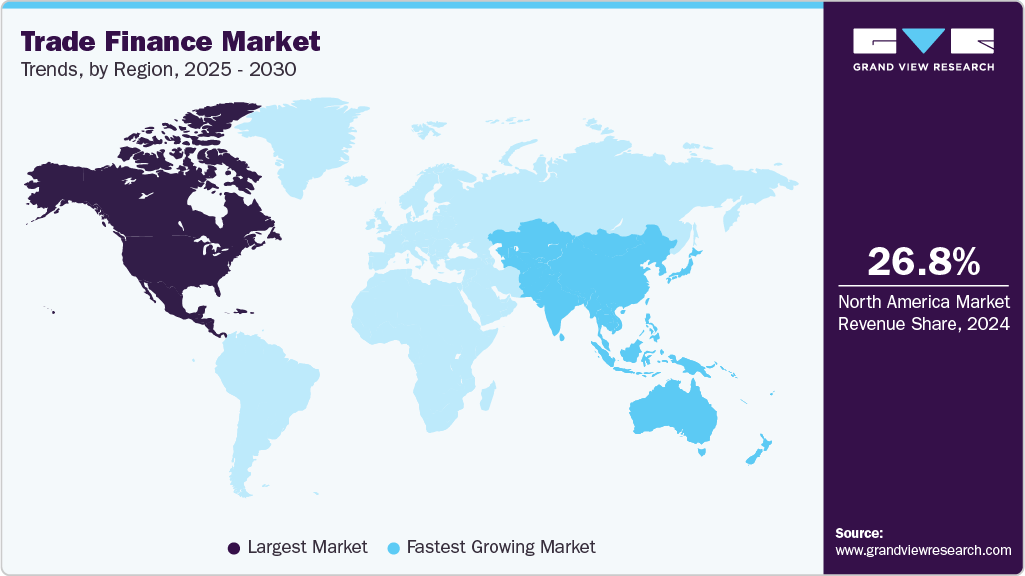
North America dominated the Trade Finance market with the largest revenue share of 26.4% in 2025. The region is home to some of the largest financial institutions, including major banks and financial hubs like New York City. These institutions have a global presence and extensive networks, allowing them to offer a wide range of trade finance services to businesses engaged in international trade. Moreover, North America has a robust and diverse economy with a significant focus on international trade. The U.S., in particular, is one of the world's largest importers and exporters of goods and services. This high level of trade activity naturally drives the demand for trade finance solutions to support the complex financial transactions associated with cross-border trade.
 To learn more about this report, Download Free Sample Report
 U.S. Trade Finance Market Trends
The trade finance market in the U.S. held the largest share in the North America region in 2025. The U.S. trade finance industry is being significantly driven by the expansion of cross-border trade activities, particularly with key partners such as Mexico, Canada, China, and the European Union. As one of the world’s largest importers and exporters, the U.S. relies heavily on robust trade finance mechanisms to manage the complexities and risks associated with global transactions. The increased demand for secure and flexible financing instruments—such as letters of credit, export credit, and trade receivables financing—is directly linked to the evolving nature of global supply chains and heightened geopolitical dynamics, including the need for U.S. exporters to find alternative markets amid shifting tariff policies.
Asia Pacific Trade Finance Market Trends
The Asia Pacific trade finance industry is anticipated to emerge as the fastest-growing market from 2025 to 2033. Asia Pacific is home to some of the fastest-growing economies, such as India and China, which have become major players in international trade. The region's expanding middle class and consumption-driven growth have led to increased imports and exports, driving up the demand for trade finance services to facilitate these transactions. Moreover, Asia Pacific's geographical proximity to key global supply chains and trading partners has made it a central hub for trade activities. The region's strategic location offers convenient access to major markets across Asia, Europe, and North America, making it an ideal gateway for businesses engaged in international trade.
China’s trade finance industry is largely influenced by its position as one of the leading global exporters and importers. The country’s high volume of cross-border trade activity generates ongoing demand for financing instruments such as letters of credit, export credit, and supplier finance. As firms engage in international transactions, trade finance serves as a mechanism to manage payment risk, working capital, and currency exposure. Government policy is another major driver. Initiatives like the Belt and Road Initiative (BRI) have expanded China’s trade links with developing regions, increasing the need for structured trade finance in infrastructure and large-scale goods transactions.
The trade finance industry in India is driven by its increasing participation in global trade, supported by government initiatives like the Remission of Duties and Taxes on Exported Products (RoDTEP) scheme, which is enhancing the competitiveness of Indian exporters. The reinstatement of RoDTEP in June 2025 aims to reimburse exporters for embedded taxes and levies, thereby reducing the cost burden and promoting exports across various sectors, including textiles, chemicals, and agriculture. In addition, the adoption of digital technologies, such as blockchain and artificial intelligence, is streamlining trade finance processes in India. These technologies enhance transparency, reduce processing times, and improve risk assessment, making trade finance more accessible and efficient for businesses, particularly small and medium-sized enterprises (SMEs).
Europe Trade Finance Market Trends
The Europe trade finance industry is driven by the regulatory developments shaping the market, with the EU’s Digital Finance Strategy and stringent AML/CFT (Anti-Money Laundering/Counter-Financing of Terrorism) requirements pushing financial institutions to adopt automated compliance solutions. In addition, digitalization is revolutionizing the sector, with blockchain and distributed ledger technology (DLT) enhancing transparency and reducing fraud. Platforms like we. trade and Marco Polo Network are gaining traction, while AI-powered tools are improving risk assessment and compliance processes.
The UK trade finance industry is continuing to be influenced by the post-Brexit dynamics, with new trade agreements and supply chain realignments creating both challenges and opportunities. The increased complexity of customs procedures and regulatory divergence from EU standards has led to growing demand for risk mitigation instruments such as letters of credit and trade credit insurance. At the same time, the UK's pursuit of trade deals with CPTPP nations, the U.S., and India is opening new avenues for trade finance providers to support businesses expanding into these markets.
Key Trade Finance Company Insights
Some of the key players operating in the market include DBS Bank Ltd, Santander Bank, JPMorgan Chase & Co., Bank of America Corporation, and Deutsche Bank AG. The market is notably fragmented, comprising a mix of global financial institutions, regional banks, and specialized trade finance providers. Leading market participants are investing in technological innovation and product development to diversify their trade finance solutions and improve service efficiency. These players are also engaging in a range of strategic initiatives to strengthen their market position and expand their international footprint. Such initiatives include launching new digital platforms, forming strategic partnerships, entering into trade facilitation agreements, pursuing mergers and acquisitions, increasing capital allocation to trade-focused services, and exploring emerging markets to capture new growth opportunities.
With an increasing number of financial institutions and fintech startups venturing into this domain, the competition has intensified significantly. However, this heightened competition has yielded notable benefits for businesses seeking trade credit. These advantages include the availability of more favorable interest rates and flexible repayment options, making trade finance more accessible and appealing to a broader range of enterprises.
-
JPMorgan Chase & Co. is a prominent provider of trade finance services with a global footprint that spans more than 100 countries. The company supports corporations and financial institutions in managing the financial aspects of cross-border trade, offering a range of services designed to facilitate international commerce while mitigating associated risks. The company’s trade finance portfolio includes documentary trade services such as letters of credit and documentary collections. These services are structured to provide security for both importers and exporters by ensuring that payment and shipment obligations are met in accordance with pre-agreed terms.
-
Deutsche Bank AG is a global financial institution headquartered in Frankfurt, Germany, with a significant presence in international trade finance. The bank offers a broad range of trade finance products aimed at facilitating international trade flows for corporate clients, financial institutions, and exporters/importers worldwide. Its trade finance services include documentary credits, such as letters of credit, which provide a secure payment mechanism to support cross-border transactions by mitigating payment and delivery risks. Deutsche Bank AG also offers documentary collections and guarantees, which serve to manage the transfer of goods and payments between trading partners under established terms.
Key Trade Finance Companies:
The following key companies have been profiled for this study on the trade finance market.
-
BNP Paribas
-
Citigroup, Inc.
-
TD Bank
-
UBS
-
Arab Bank
-
DBS Bank Ltd
-
JPMorgan Chase & Co.
-
Santander Bank
-
Deutsche Bank AG
-
Bank of America Corporation
Competitive Benchmarking
Operating Strategies
Competitive Edge
Weaknesses
Established Players: BNP Paribas, Citigroup, Inc., Deutsche Bank AG, JPMorgan Chase & Co.
- Mature companies focus on expanding their global trade banking capabilities through diversified trade finance portfolios, digital platform investments, and strong correspondent banking networks.
- These players emphasize innovation in supply chain finance, cross-border payment solutions, trade digitization, and risk management services to strengthen their market leadership.
- These companies benefit from extensive international banking networks, strong capital positions, diversified customer bases, and advanced digital trade ecosystems.
- Their global presence, deep expertise in cross-border transactions, and ability to provide integrated financing and treasury solutions enable them to maintain a strong competitive advantage.
- Mature players face challenges associated with evolving regulatory requirements, compliance costs, geopolitical uncertainties, and cybersecurity risks.
- Managing complex international operations, sanctions compliance, and changing trade policies may increase operational burden and affect profitability.
Emerging Players: TD Bank, UBS, Arab Bank
- These companies focus on strengthening trade finance offerings through regional expansion, customer-centric banking services, digital transformation, and strategic partnerships.
- They increasingly invest in trade digitization, supply chain financing capabilities, and tailored financing solutions to support corporate and SME clients across key trade corridors.
- Their competitive advantage stems from technological agility, faster deployment of digital solutions, improved automation capabilities, and enhanced customer experience.
- Technology-led innovation enables improved trade processing speed, reduced paperwork, and more efficient financing workflows.
- These participants may face challenges related to regulatory approvals, integration with traditional banking infrastructure, and achieving widespread enterprise adoption.
- Limited global banking networks and strong competition from established financial institutions can also constrain scaling opportunities.
Recent Developments
-
In December 2024, HSBC and the World Bank's International Finance Corporation (IFC) launched a USD 1 billion trade finance program to support emerging markets. This initiative is designed to boost cross-border trade and increase exports in critical sectors. The partnership aims to tackle global supply chain issues and drive economic growth, providing key industries with better access to trade finance solutions.
-
In September 2023, Bank of America Corporation introduced CashPro Supply Chain Solutions, a platform aimed at digitizing trade finance processes. The initial module, Open Account Automation, streamlines invoice approval and payment, reducing processing time from days or weeks to minutes. By integrating data from suppliers, logistics providers, and warehouse systems, the platform enhances visibility and accelerates decision-making across the supply chain. This initiative is part of Bank of America Corporation's multi-year investment to modernize trade finance and improve efficiency for its business clients
-
In January 2023, the International Chamber of Commerce (ICC) introduced ICC TradeFlow, a new digital platform for trade finance. This platform is designed to simplify and digitize the trade finance process, helping to lower costs and enhance efficiency.
Trade Finance Market Report Scope
Report Attribute
Details
Market size in 2025
USD 54.6 billion
Estimated market size in 2026
USD 57.1 billion
Projected market size by 2033
USD 79.0 billion
Growth rate
CAGR of 4.8% from 2026 to 2033
Base year for estimation
2025
Historical data
2021 - 2024
Forecast period
2026 - 2033
Quantitative units
Revenue in USD billion and CAGR from 2026 to 2033
Report coverage
Revenue forecast, company market share, competitive landscape, growth factors, and trends
Segments covered
Instrument, service provider, trade, enterprise size, industry, end use, region
Regional scope
North America; Europe; Asia Pacific; Latin America; MEA
Country scope
U.S.; Canada; Mexico; UK; Germany; France; China; India; Japan; Australia; South Korea; Brazil; UAE; Saudi Arabia; South Africa
Key companies profiled
BNP Paribas, Citigroup, Inc., TD Bank, UBS, Arab Bank, DBS Bank Ltd., JPMorgan Chase & Co., Santander Bank, Deutsche Bank AG, Bank of America Corporation
Customization scope
Free report customization (equivalent up to 8 analysts' working days) with purchase. Addition or alteration to country, regional & segment scope.
Pricing and purchase options
Avail customized purchase options to meet your exact research needs. Explore purchase options
Global Trade Finance Market Report Segmentation
The report forecasts revenue growth at global, regional, and country levels and provides an analysis of the latest industry trends in each of the sub-segments from 2021 to 2033. For this study, Grand View Research has segmented the trade finance market report based on instrument, service provider, trade, enterprise size, industry, end use, and region.
-
Instrument Outlook (Revenue, USD Billion, 2021 - 2033)
-
Letter of Credit
-
Supply Chain Financing
-
Documentary Collections
-
Receivables Financing/Invoice Discounting
-
Others
-
-
Service Provider Outlook (Revenue, USD Billion, 2021 - 2033)
-
Banks
-
Financial Institutions
-
Trading Houses
-
Others
-
-
Trade Outlook (Revenue, USD Billion, 2021 - 2033)
-
Domestic
-
International
-
-
Enterprise Size Outlook (Revenue, USD Billion, 2021 - 2033)
-
Large Enterprises
-
SMEs
-
-
Industry Outlook (Revenue, USD Billion, 2021 - 2033)
-
BFSI
-
Construction
-
Wholesale/Retail
-
Manufacturing
-
Automobile
-
Shipping & Logistics
-
Others
-
-
End Use Outlook (Revenue, USD Billion, 2021 - 2033)
-
Importer
-
Exporter
-
Trade Intermediaries
-
-
Regional Outlook (Revenue, USD Billion, 2021 - 2033)
-
North America
-
U.S.
-
Canada
-
Mexico
-
-
Europe
-
UK
-
Germany
-
France
-
-
Asia Pacific
-
China
-
India
-
Japan
-
South Korea
-
Australia
-
-
South America
-
Brazil
-
-
Middle East & Africa
-
Kingdom of Saudi Arabia (KSA)
-
UAE
-
South Africa
-
-
Research Methodology
(a) Segment Definition
Segment – Instrument
Revenue capture definition
Letter of Credit
A letter of credit is a banking instrument that guarantees a seller will receive payment from the buyer, as long as the specified terms and conditions of the agreement are met.
Supply Chain Financing
Supply chain financing refers to technology-driven financial solutions that enhance cash flow by enabling buyers to extend payment terms while giving suppliers the option to receive early payments.
Documentary Collections
Documentary Collections is a trade finance method where the exporter entrusts their bank to collect payment from the importer in exchange for shipping documents. The bank acts as an intermediary, but does not guarantee payment, making it a lower-cost but higher-risk alternative to a letter of credit.
Receivables Financing / Invoice Discounting
Receivables financing, also known as invoice discounting, is a trade finance solution that allows businesses to unlock working capital by borrowing against the value of their outstanding customer invoices. This enables companies to maintain cash flow and meet operational needs without waiting for clients to pay their invoices.
Others
The other instruments include bank guarantees, standby letters of credit (SBLC), export credit agency (ECA)-backed financing, and forfaiting.
Segment – Service Provider
Revenue capture definition
Banks
Banks in trade finance act as intermediaries that provide financial instruments such as letters of credit, bank guarantees, and bill discounting to facilitate domestic and international trade transactions.
Financial Institutions
Financial institutions, including non-bank lenders and development finance institutions, offer customized trade finance solutions such as invoice financing, supply chain finance, and forfaiting to support businesses lacking access to traditional banking channels.
Trading Houses
Trading houses are commercial entities that engage directly in the buying and selling of goods across borders while offering embedded trade finance services such as working capital support, risk mitigation, and structured trade solutions to facilitate complex supply chains.
Others
The other insurers and credit insurance companies, logistics and freight forwarding companies, and export credit agencies (ECAs).
Segment – Trade
Revenue capture definition
Domestic
Domestic trade finance refers to financial products and services that support trade transactions within a single country, helping businesses manage cash flow, mitigate risks, and ensure timely payments between local buyers and sellers.
International
International trade finance involves cross-border transactions where financial institutions facilitate global trade by offering instruments such as letters of credit, export credit, and foreign exchange solutions.
Segment – Enterprise Size
Revenue capture definition
Large Enterprises
A commercial company with an employee strength of 500 people or above is termed a large enterprise. Large enterprises are increasingly adopting trade finance solutions to streamline complex transactions, optimize working capital, and mitigate financial risks associated with domestic and international trade.
SMEs
These organizations are non-subsidiary, independent firms with an employee strength of under 500 people. Small and medium enterprises (SMEs) are increasingly leveraging trade finance solutions to optimize their working capital, reduce payment risks, and improve access to cross-border and domestic trade opportunities, thereby strengthening their foothold in the market.
Segment – Industry
Revenue capture definition
BFSI
BFSI leverages trade finance to manage cross-border exposures, ensure payment security, and support the liquidity needs of its clients engaged in domestic and international trade.
Construction
Construction companies use trade finance to manage cash flow and ensure the timely procurement of materials and services for large-scale, often phased projects that require significant upfront investment.
Wholesale/Retail
Wholesale/Retail businesses rely on trade finance solutions such as inventory financing and invoice factoring to maintain liquidity, manage seasonal demand, and support the continuous movement of goods across borders.
Manufacturing
Manufacturing firms utilize trade finance to fund raw material imports, fulfill export orders, and maintain uninterrupted production cycles, especially in capital-intensive operations.
Automobile
Automobile industry players engage in trade finance to support complex, global supply chains by funding parts imports, vehicle exports, and dealer networks, ensuring timely payments and inventory turnover.
Shipping & Logistics
Shipping & Logistics companies use trade finance to bridge cash flow gaps, cover freight and operational costs, and facilitate smooth cargo movement through instruments such as freight finance and receivables funding.
Others
The other segments include pharmaceuticals & healthcare, energy & utilities, chemicals, and telecommunications.
Segment – End User
Revenue capture definition
Importer
This segment includes trade finance products utilized by businesses importing goods, services, or raw materials from domestic or international suppliers. These solutions help importers manage payment obligations, transaction security, and working capital requirements.
Exporter
This segment includes trade finance solutions used by exporters selling goods or services to domestic or international buyers. Exporters commonly use these instruments to reduce payment risks, improve cash flow, and facilitate trade transactions.
Trade Intermediaries
This segment includes trade finance services utilized by intermediaries involved in facilitating trade transactions between buyers and sellers. It includes distributors, brokers, trading firms, agents, and other entities supporting commercial trade activities.
(b) Estimation Model
Layer No.
Layer Name
Key Question
Description
Outcome
01
Trade Participant Base / Demand Layer
Who engages in trade activities and potentially requires trade finance solutions?
Establishes the total potential demand base by identifying businesses involved in domestic and international trade across industries. It evaluates trade volumes, import-export activity, enterprise size, transaction frequency, and supply chain complexity before applying market-specific demand filters.
Defines the total potential demand base.
02
Addressable Market Layer
Who can realistically be reached and served by trade finance providers?
Refines the total business trading population into the realistically serviceable market by considering factors such as banking serviceability, credit eligibility, regulatory environment, trade corridor participation, digital adoption, and financing requirements.
Defines the serviceable market.
03
Financing Adoption & Transaction Layer
Who is actively utilizing, renewing, or expanding trade finance solutions?
Estimates annual demand generation by analyzing trade finance adoption rates, transaction frequency, financing preferences, instrument utilization, and provider engagement across banks, financial institutions, and trading houses.
Converts addressable base into measurable financing activity.
04
Monetisation Layer
How much revenue is generated from trade finance demand?
Converts financing demand into market revenue by applying transaction fees, financing charges, interest margins, service commissions, documentation fees, and provider pricing structures.
Derives Total Market Revenue.
Delivered Customizations
This report has been delivered with the following In-depth customizations
Client Request
Customization Delivered
Value Adds
Regional & Country Opportunity & Cross-Border Trade Analysis
Delivered region-wise and country-wise market sizing, forecasts, and growth analysis across North America, Europe, Asia Pacific, Latin America, and Middle East & Africa. Analyzed country-level trade policies, regulatory environment, trade agreements, and economic indicators influencing trade finance demand.
Enabled identification of high-opportunity regions, countries, and trade corridors. Supported regional expansion, market entry, and investment prioritization strategies.
Market Size by Transaction Value & Trade Finance Volume
Delivered market sizing and forecasts in terms of transaction value (USD) and trade finance volume across key instruments and regions. Analyzed financing demand by trade flows, transaction frequency, and customer type. Evaluated trade finance penetration across industries.
Enabled accurate quantification of market demand. Supported investment planning and business forecasting. Assisted in identifying high-growth transaction segments.
Competitive Benchmarking & Strategic Landscape Analysis
Delivered benchmarking of leading banks, fintech companies, and trade finance providers based on product portfolio, digital capabilities, geographic presence, pricing, and partnerships. Analyzed mergers, acquisitions, product launches, and strategic collaborations.
Supported competitive intelligence and market positioning strategies. Enabled identification of market gaps and growth opportunities. Assisted in strengthening strategic decision-making.
Frequently Asked Questions About This Report
Based on trade, the international segment led the market with the largest revenue share of 60.3% in 2025 and is the fastest-growing segment.
Key factors that are driving the market growth include globalization and international trade and the ever-evolving technological landscape.
The global trade finance market size was estimated at USD 54.6 billion in 2025 and is expected to reach USD 57.1 billion in 2026.
The global trade finance market is expected to grow at a compound annual growth rate of 4.8% from 2026 to 2033 to reach USD 79.0 billion by 2033.
Some key players operating in the trade finance market include BNP Paribas, Citigroup, Inc., TD Bank, UBS, Arab Bank, DBS Bank Ltd., JPMorgan Chase & Co., Santander Bank, Deutsche Bank AG, Bank of America Corporation
North America dominated the trade finance market with a share of 26.4% in 2025. The region is home to some of the world's largest and most influential financial institutions, including major banks and financial hubs like New York City. These institutions have a global presence and extensive networks, allowing them to offer a wide range of trade finance services to businesses engaged in international trade.
Large enterprises segment led the market with the largest revenue share of 72.8% in 2025.
Letter of credit segment led the market with the largest revenue share of 24.4% in 2025, while receivables financing/invoice discounting is the fastest-growing segment.
Banks segment led the market, accounting for the largest revenue share of 34.2% in 2025.
About the Author(s)
Next Generation Technologies Research Team
Technology · Next Generation TechnologiesThis report was authored by the next generation technologies research team at Grand View Research - comprising two research analysts, one senior research analyst, and one industry expert - with specialized expertise in the next generation technologies segment of the technology industry. All findings are based on proprietary technology databases, executive interviews, and regulatory analysis, subject to internal peer review prior to publication.
Last Updated:
Speak to Analyst

Customize this report to your needs - add regions, segments, or data points, with 20% free customization.
Or view our licence options:


ISO 9001:2015 & 27001:2022 Certified
We are GDPR and CCPA compliant! Your transaction & personal information is safe and secure. For more details, please read our privacy policy.


