
- Home
- »
- Next Generation Technologies
- »
-
Travel Insurance Market Size And Share Report, 2026-2033GVR Report cover

Travel Insurance Market (2026 - 2033)
Size, Share & Trends Analysis Report By Insurance Coverage (Single-trip Travel, Annual Multi-trip Travel, Long-stay Travel), By Distribution Channel (Insurance Companies, Banks), By End-use, By Region, And Segment Forecasts
Market Size, 2025
$31.2BMarket Estimate, 2026
$36.0BMarket Forecast, 2033
$99.4BCAGR, 2026–2033
15.6%Travel Insurance Market Summary
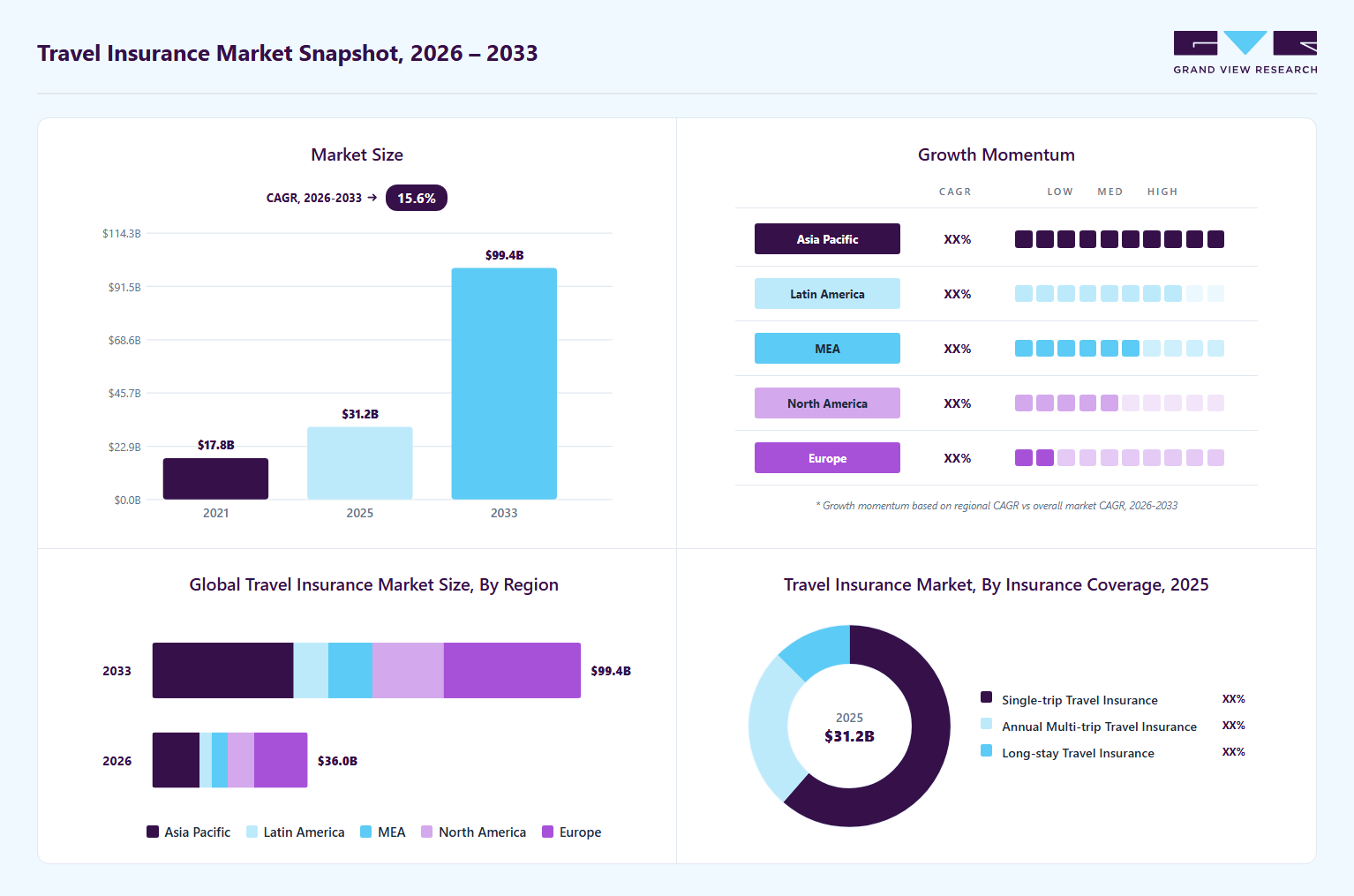
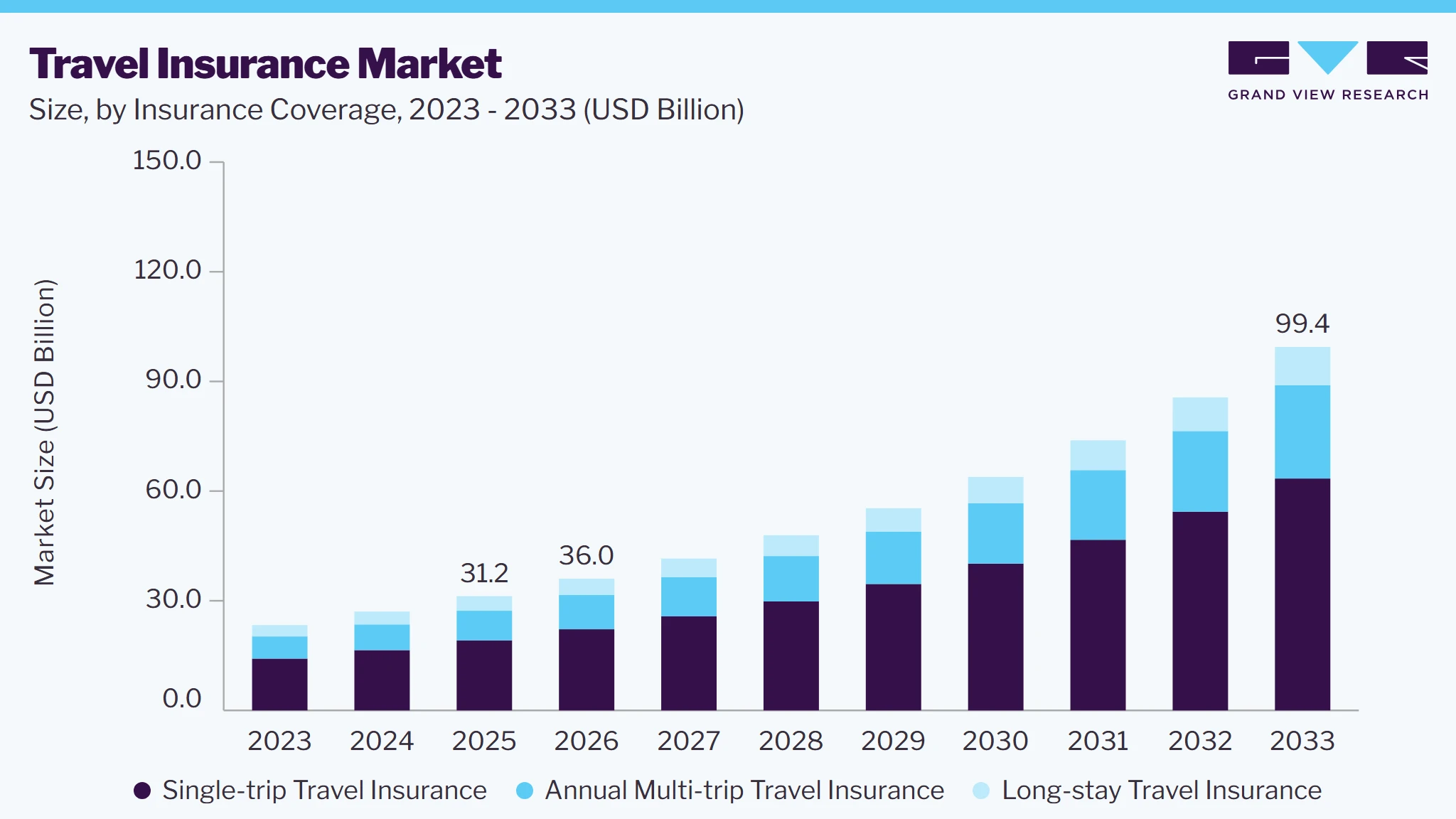
The global travel insurance market size was valued at USD 31.2 billion in 2025 and is projected to grow from USD 36.0 billion in 2026 to USD 99.4 billion by 2033, at a CAGR of 15.6% from 2026 to 2033. Europe dominated the travel insurance market with the largest revenue share of 34.8% in 2025. Furthermore, the adoption of travel insurance is gaining traction as advances in technology are allowing to bundle travel insurance purchases with online ticket booking, thereby contributing to the growth of the market.
 Source: Grand View Research, IR Documents, Primary Interviews, Paid DatabasesTo learn more about this report,
 Download Free Sample Report
Key Market Trends & Insights
- By insurance coverage: Single-trip travel insurance segment led the market with the largest revenue share of 61.3% in 2025.
- By distribution channel: Insurance companies segment led the market with the largest revenue share of 33.1% in 2025.
- By end use: Senior citizens segment led the market with the largest revenue share of 31.0% in 2025.
Regional Highlights
- Largest regional market: Europe (34.8% revenue share, 2025)
- By country: The U.K. held the largest market share in 2025.
Market Size & Forecast
- Market size in 2025: USD 31.2 Billion
- Estimated market size in 2026: USD 36.0 Billion
- Projected market size by 2033: USD 99.4 Billion
- CAGR (2026-2033): 15.6%
Three ways to get this report
Buy it, customize it, or ask a question.Ask an Analyst
Analyst response in 1 business day
- AccessReport author, directly
- Reply timeWithin 1 working day
- No sales callDirect answer only
- FormatEmail reply
- CostFree, no cost
Get the Full Report
What the study covers
- FormatsPDF · Excel · Dashboard
- Timeline2026–2033 annual, 2025 base
- Coverage20+ countries, 5 regions
- Companies10+ key players profiled
Customize the Report
20% free customization
- IncludeCountries, segments, points
- TailorTo your product definition
- ExtendDeeper competitor detail
- OrA fully bespoke study
- Turnaround5–10 working days
Several insurance companies across the globe are striking partnerships with other insurance companies to launch travel insurance policies and provide comprehensive coverage at competitive rates. For instance, in October 2023, Trawick International, an insurance company, announced its partnership with STARR INTERNATIONAL COMPANY, INC., an insurer, to launch three new travel insurance policies underwritten by STARR’s U.S. subsidiary, Starr Indemnity & Liability Company. The newly launched trip cancellation policies, backed by the "A" (excellent) rating from A.M. Best, are called Safe Travels Defend, Safe Travels Armor, and Safe Travels Protect. These policies offer reliable and comprehensive coverage at competitive rates.Insurance companies are integrating cloud computing into advanced analytics for enhanced results. The insurance industry's core skills and outdated business models can be transformed into a new and flexible model. Therefore, cloud, mobility, and advanced analytics are being incorporated to drive efficiency, security, and cost efficiency. In addition, insurance businesses are adopting the test-and-learn process to stratify massive unstructured data influxes using real-time data analysis. With the use of cutting-edge analytics software, insurance businesses can easily eliminate flaws in the execution of core operations, such as insurance underwriting.
 To learn more about this report, Download Free Sample Report
A key trend in the market is the shift toward digital solutions, which streamline the purchase, claims, and customer service processes. Insurers are heavily investing in AI-driven technologies to enhance customer experiences, improve response times, and detect fraud more efficiently. Digital platforms are now providing on-demand insurance solutions and integrating with online travel booking sites, making travel insurance a seamless add-on during the booking process. As a result, travel insurance is becoming more accessible and user-friendly, especially for digitally savvy consumers who prioritize convenience.
In response to changing traveler demographics, insurers are also developing products tailored to specific travel segments, including adventure tourism, eco-tourism, and long-term remote work stays. Younger travelers, especially Millennials and Gen Z, are driving demand for flexible policies that can be modified or extended as their travel plans evolve. Insurers are capitalizing on this trend by offering modular policies that allow travelers to adjust coverage for different destinations, activities, and trip durations. This evolution in product design underscores a broader trend toward personalization, as travel insurance providers cater to the diverse and dynamic needs of modern travelers.
Market Dynamics
The travel insurance market is witnessing rapid growth driven by rising international travel activity, increasing awareness regarding travel-related risks, and rapid digitalization of insurance services. Travelers are becoming more conscious of financial protection against trip cancellations, medical emergencies, baggage loss, and travel disruptions. However, market expansion is constrained by limited consumer awareness in developing regions and high premium costs for comprehensive policies. At the same time, opportunities linked to digital insurance platforms and the growing popularity of customized insurance products are creating favorable conditions for market development. Evolving travel behavior, regulatory support, and technological innovation continue to shape the future growth trajectory of the travel insurance industry.
The increasing volume of international and domestic travel is a major driver of the travel insurance market. Rising disposable incomes, expanding tourism industries, business travel growth, and greater accessibility to low-cost airlines are encouraging higher travel frequency worldwide. Demand for financial protection against travel-related uncertainties is increasing due to the rising number of travelers undertaking journeys for leisure, education, business, and medical purposes. Travelers are seeking coverage for trip cancellations, medical emergencies, lost baggage, flight delays, and emergency evacuations. Governments and travel operators in some regions are also recommending or mandating travel insurance for international visitors. This growing mobility trend is significantly contributing to market expansion.
In addition, the recovery and expansion of the global tourism sector are creating favorable conditions for travel insurance adoption. Increasing participation in international tourism, adventure travel, group tours, and cross-border business activities is encouraging travelers to seek broader and more comprehensive insurance coverage. The rise in visa-linked insurance requirements and growing awareness of healthcare costs in foreign countries are also supporting policy purchases. Travel service providers, airlines, and online booking platforms are increasingly integrating insurance offerings into the travel booking process, making policies more accessible to consumers. The continued rise in travel activity across developed and emerging economies is expected to drive sustained demand for travel insurance products.
Limited awareness regarding travel insurance benefits remains a significant restraint for market growth, particularly in developing economies. Many travelers continue to perceive travel insurance as an optional expense rather than an essential part of travel planning. Misunderstanding of policy terms, exclusions, and claim procedures can further discourage adoption among potential customers. In several regions, low financial literacy and limited exposure to insurance products contribute to lower penetration rates. Consumers may also underestimate travel risks, reducing their willingness to purchase coverage. These factors collectively hinder broader market expansion.
The integration of travel insurance into digital travel ecosystems offers strong growth potential for market participants. Embedded insurance models, where coverage is offered directly during airline ticket purchases, hotel bookings, visa applications, or online travel reservations, are increasing customer convenience and policy uptake. Partnerships between insurers, airlines, online travel agencies, fintech companies, and travel service providers are supporting wider distribution.
Digital ecosystems also enable insurers to leverage customer data for targeted product recommendations and improved risk assessment. The growing adoption of seamless digital purchasing experiences is expected to strengthen market penetration and open new revenue opportunities for insurers.
Analyst Perspective
The travel insurance market is growing at a rapid pace due to rising global travel activity, increasing awareness of travel-related risks, and expanding digital insurance adoption. Demand for coverage against medical emergencies, trip cancellations, and travel disruptions is supporting market growth across multiple traveler segments. Insurers are increasingly focusing on digital platforms, embedded insurance, and customized policy offerings to enhance customer reach and engagement. However, factors such as low insurance awareness, policy complexity, and pricing concerns may restrain adoption. Continued tourism growth and technological advancements are expected to support long-term market expansion.
Insurance Coverage Insights
Based on insurance coverage, the single-trip travel insurance segment led the market with the largest revenue share of 61.3% in 2025. The growth of the single-trip travel insurance segment can be attributed to the factors such as loss of baggage, emergency dental treatment costs, personal liability cover, fire cover, trip interruption or cancellation, missed flight connection, and many more such services. The growing awareness of potential travel disruptions ranging from flight cancellations and lost baggage to unforeseen medical needs has prompted more individuals to opt for single-trip coverage as a practical safeguard. Insurers are responding by offering streamlined, easily accessible single-trip policies that travelers can purchase directly through digital channels, often as an add-on to the booking process.
Annual multi-trip travel insurance segment is anticipated to grow at a significant CAGR during the forecast period. The segment growth can be attributed to the increasing demand among business people, travelers, and other groups who go on multiple trips in a year. As global travel becomes more accessible, many individuals and families are opting for annual policies to cover multiple trips in a year, eliminating the need to purchase separate insurance each time they travel. This option is not only cost-effective but also offers convenience, as it provides continuous coverage throughout the year, appealing to those with dynamic travel schedules. Insurers are enhancing these policies with flexible add-ons, like extended medical coverage, sports and adventure packages, and family plans, making them adaptable to various travel styles and destinations.
Distribution Channel Insights
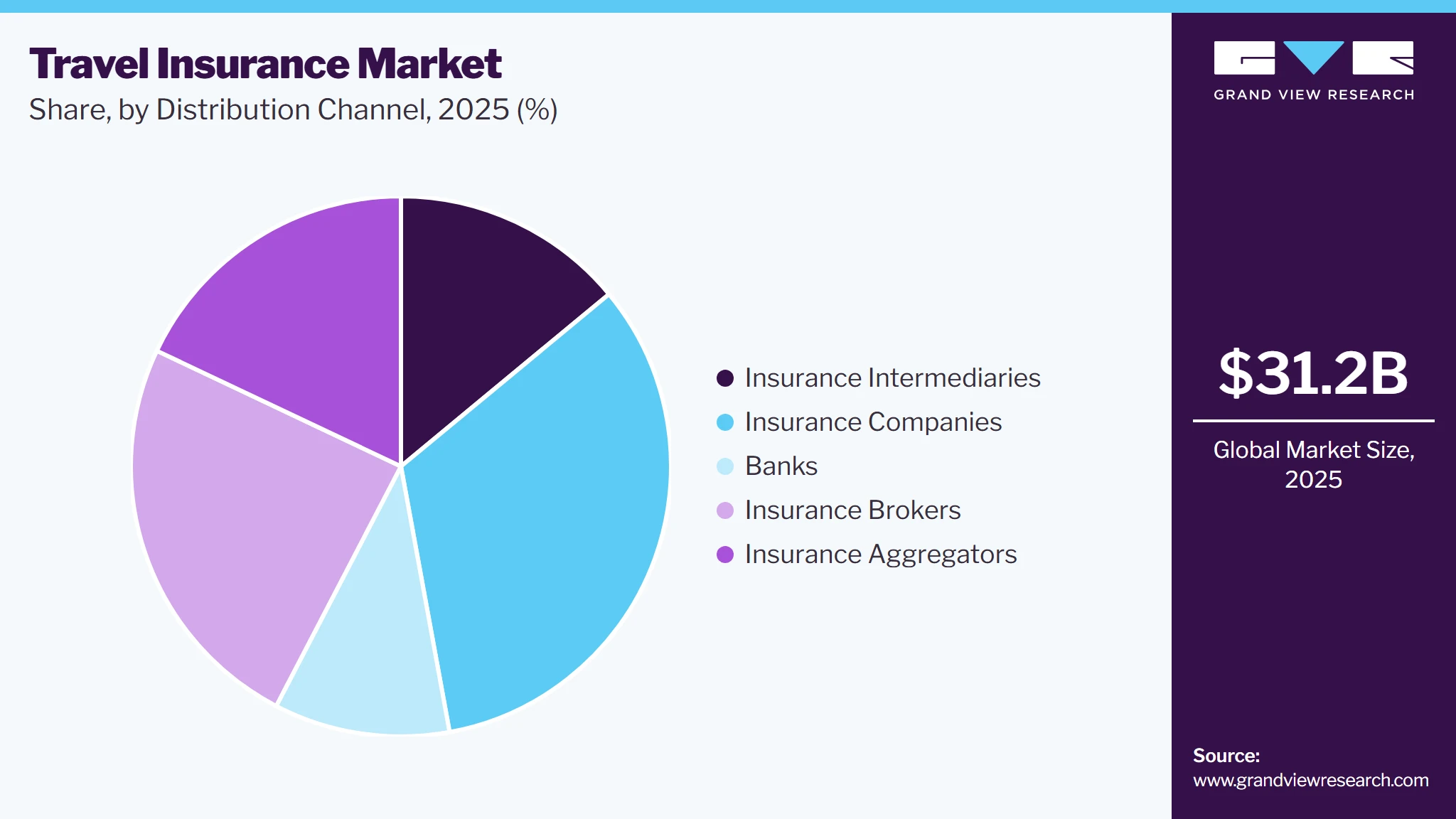
Based on distribution channel, the insurance companies segment led the market with the largest revenue share of 33.1% in 2025. The growth of this segment can be attributed to the factors such as increasing consolidating risk among numerous policyholders and the setting up of premiums according to the likelihood that a specific occurrence will occur and will lead to typical financial loss. As travelers increasingly seek tailored solutions that address their unique needs and concerns, insurance companies are leveraging advanced data analytics and technology to create customized insurance packages. This shift is fueled by the rising demand for flexibility in coverage options, especially in response to uncertainties such as global pandemics and changing travel regulations.
 To learn more about this report, Download Free Sample Report
The banks segment is anticipated to grow at a significant CAGR during the forecast period. The increasing insurance sales and underwriting by banks across regions such as Europe, Asia, and Australia are driving the market growth in this segment. In addition, the rise of digital banking has enabled banks to leverage technology to streamline the purchasing process for travel insurance, making it more accessible to customers through online platforms and mobile apps. As banks continue to focus on enhancing their customer experience and expanding their product portfolios, the integration of travel insurance services is becoming a strategic priority in meeting the evolving needs of travelers.
End Use Insights
Based on end use, the senior citizens segment led the market with the largest revenue share of 31.0% in 2025. The primary reason senior citizens seek travel insurance is to reduce emergency expenses incurred during vacations. The age group of senior citizens varies from country to country. Senior citizen travel insurance policies typically include coverage for emergency evacuation, repatriation of remains, hospital accommodations, ambulance services, trip interruption or delays, loss of baggage or personal belongings, and accidental death coverage. In addition, providers such as Tata AIG General Insurance Company Limited, Travel Guard, and Southern Cross Benefits Limited offer various products and services for senior travelers.
The business travelers segment is anticipated to grow at a significant CAGR during the forecast period. Travel insurance policies for business travelers mainly cover company employees who regularly travel for business meetings, special events, and other work-related tasks. Travel insurance is a plan that protects various expenses, such as eviction, flight cancellation, evacuation, medical care, and damaged or lost luggage. Furthermore, business travel insurance helps employers in fulfilling their duty of care responsibilities to employees traveling on behalf of the company, regardless of whether the trip is local, out of state, or international. For instance, Zurich American Insurance Company's Zurich Travel Assist helps employees in medical, security, and travel emergencies occurring at a distance of 100 miles or more from their home.
Regional Insights
The North America travel insurance market is expected to grow at a significant CAGR during the forecast period. The North America travel insurance market is experiencing robust growth, driven by a surge in both domestic and international travel as restrictions ease and consumer confidence rebounds. Travelers in the region increasingly recognize the importance of securing insurance to protect against unforeseen circumstances such as trip cancellations, medical emergencies, and travel delays. Insurers are responding to this demand by offering a wider range of flexible and comprehensive coverage options that cater to various travel needs, including adventure travel and business trips.
U.S. Travel Insurance Market Trends
The U.S. travel insurance market held a dominant position in 2024 due to the growing emphasis on personalized and flexible coverage options, reflecting the diverse needs of travelers, is a significant factor contributing to the growth of the U.S. travel insurance market. This trend is fueled by the increased awareness among consumers about the importance of tailored insurance plans that cater to specific travel scenarios.
Europe Travel Insurance Market Trends
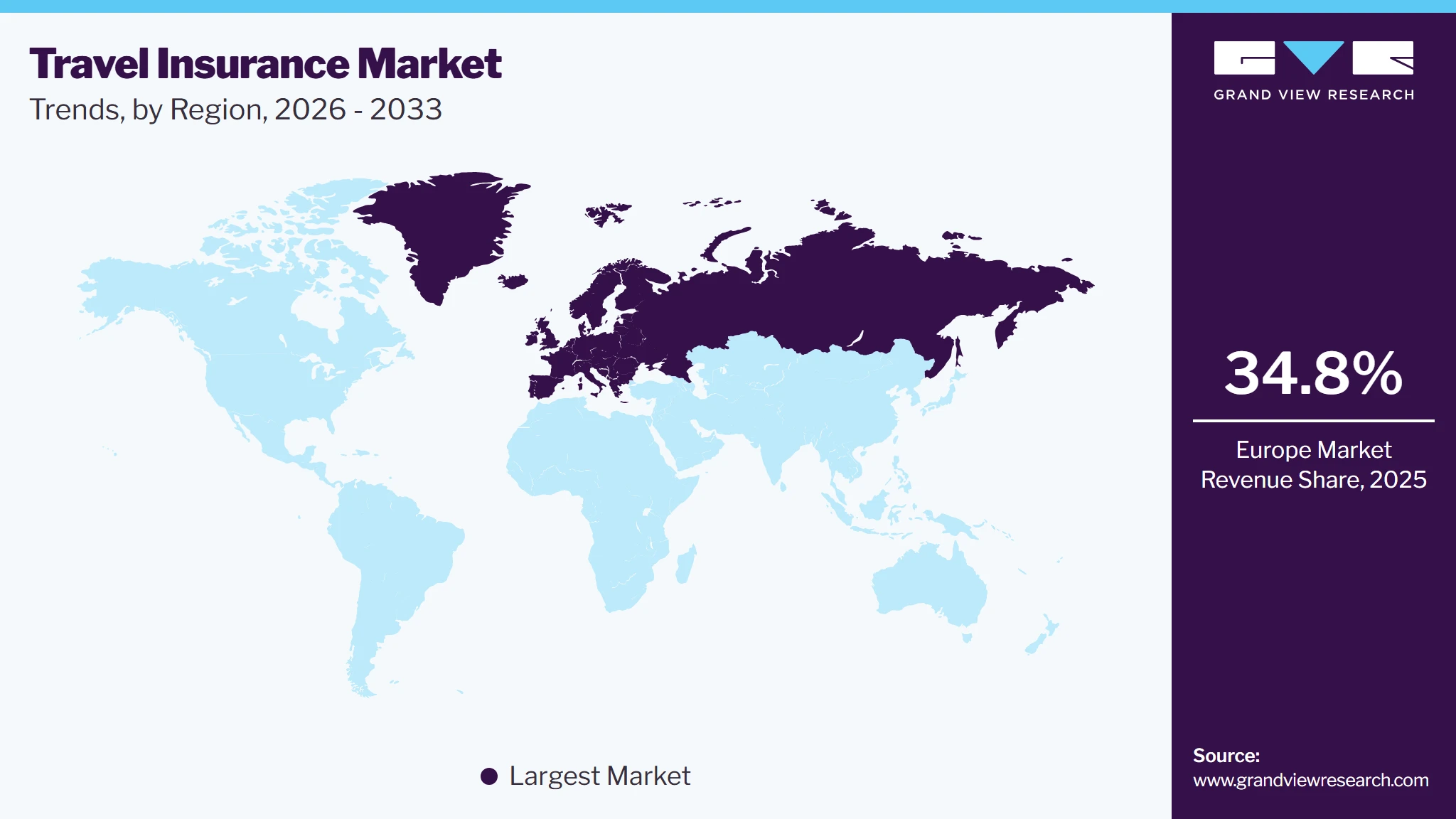
Europe dominated the travel insurance market with the largest revenue share of 34.8% in 2025. As European travelers increasingly prioritize safety and security, there is a growing demand for comprehensive insurance coverage that addresses various concerns, from health emergencies to trip cancellations. Insurers are responding by developing innovative products that cater to specific travel preferences, including multi-trip policies and coverage tailored for adventure or business travelers. Furthermore, the rise of digital technology has transformed the purchasing experience, with many consumers opting for online platforms to easily compare policies and secure coverage quickly.
 To learn more about this report, Download Free Sample Report
The travel insurance market in the U.K. held the largest share in the Europe region in 2025. The UK travel insurance market is expected to grow rapidly in the coming years due to factors such as increased availability of package holidays, rising disposable incomes, extensive media coverage of diverse holiday options, and the convenience of online travel bookings. As the tourism industry expands, there is a consistent increase in reported incidents involving essential document misplacement, lost luggage, occurrences of natural disasters, and medical challenges
The Germany travel insurance market held a substantial market share in 2024 owing to various products tailored to different types of travelers, including business travelers, families, and adventure seekers. This adaptability ensures that travelers can find suitable coverage that meets their specific needs.
Asia Pacific Travel Insurance Market Trends
The Asia Pacific region is expected to grow at a significant CAGR during the forecast period. Travel insurance has become increasingly important in the Asia-Pacific region, where diverse travel patterns and a growing middle class are driving more people to explore both regional and international destinations. As travelers encounter varied climates, healthcare standards, and security conditions across Asia-Pacific countries, the need for protection against unexpected events such as illness, injury, or travel disruptions has grown considerably. Medical expenses, which can be high in certain countries, are often a primary concern, making comprehensive health coverage crucial for travelers in the region.
The Japan travel insurance market is expected to grow rapidly in the coming years. Japan, travel insurance has gained importance as Japanese travelers increasingly venture abroad, valuing the security and support it offers in unfamiliar environments. Japanese travelers are particularly concerned about health and safety while overseas, where healthcare systems and language barriers can make medical emergencies challenging.
The China travel insurance market held a substantial market share in 2024 owing to the importance of travel insurance has risen alongside the country’s rapid increase in outbound tourism, as Chinese travelers now make up a significant portion of the global travel market.
Key Travel Insurance Company Insights
Some of the key companies in the travel insurance market include Allianz, American International Group, Inc., AXA, ASSICURAZIONI GENERALI S.P.A., and others. Prominent players dominate with comprehensive coverage options, leveraging extensive distribution networks and strong brand trust to capture significant portions of the market. Companies with integrated digital platforms and advanced data analytics have been particularly successful as they streamline the customer journey from policy selection to claims processing, catering to tech-savvy travelers seeking convenience. Additionally, partnerships with airlines, travel agencies, and banks have proven to be strategic for expanding market reach and enhancing product visibility at critical touchpoints.
-
Allianz provides a broad array of coverage options tailored to meet the needs of diverse travelers, including those seeking comprehensive protection for leisure, business, and adventure trips. Allianz has also embraced digital innovation, providing a seamless online platform and mobile app to simplify policy management, claim filing, and service access, which makes it a popular choice for tech-savvy travelers looking for convenience alongside comprehensive protection.
-
American International Group, Inc. offers a range of travel insurance solutions designed to address the specific needs of travelers worldwide, including policies focused on comprehensive medical coverage, trip cancellation, and personal liability. Known for its robust financial backing, the company is equipped to support travelers in complex or high-risk situations, making it an appealing choice for international travelers and expatriates.
Key Travel Insurance Companies
The following key companies have been profiled for this study on the travel insurance market.
-
Allianz
-
American International Group, Inc.
-
AXA
-
ASSICURAZIONI GENERALI S.P.A.
-
USI Insurance Services, LLC
-
battleface
-
Insure & Go Insurance Services Limited
-
Seven Corners Inc.
-
Travel Insured International
-
Zurich
-
Delphi Financial Group, Inc.
-
Ping An Insurance (Group) Company of China, Ltd.
Competitive Benchmarking
Category
Operating Strategies
Competitive Edge
Weakness
Established Players (Allianz, American International Group, Inc. (AIG), Zurich)
- These companies focus on strengthening their market position through diversified travel insurance portfolios, digital platform expansion, strategic partnerships with airlines, banks, and travel agencies, and geographic market expansion.
- These players benefit from strong global brand recognition, extensive distribution networks, broad customer bases, and significant financial resources.
- Despite strong market positions, these companies operate in a highly competitive and regulated insurance environment.
- Complex compliance requirements, rising claims costs, pricing pressures, and increasing customer expectations for seamless digital experiences may impact profitability and operational efficiency.
Emerging Players (USI Insurance Services, LLC; Seven Corners Inc.; Travel Insured International)
- Emerging players focus on digital-first business models, customized travel protection products, and niche traveler segments such as adventure travelers, remote workers, and high-risk destinations.
- These companies gain competitive strength through product flexibility, digital accessibility, rapid policy issuance, and specialized risk coverage capabilities.
- Emerging players may encounter challenges in scaling operations due to limited brand recognition, smaller distribution networks, and strong competition from established multinational insurers.
Recent Developments
-
In December 2023, World Nomads launched Travel Wiser, an ultimate online travel companion. Travel Wiser offers practical advice, survival tips to navigate unexpected situations, and wellness guidance to enhance customers’ journeys. With Travel Wiser, travelers can access wellness content that addresses various needs, such as combating altitude sickness and overcoming loneliness during solo trips.
-
In January 2023, BATTLEFACE UNDERWRITING SERVICES SRL launched a new technology-enabled platform as a service called Robin Assist. Robin Assist leverages Application Programming Interface (API) and is apt for general agents, insurance brokers, and enterprise partners involved in providing travel insurance. It supports customer service and emergency claims.
Travel Insurance Market Report Scope
Report Attribute
Details
Market size in 2025
USD 31.2 billion
Estimated market size in 2026
USD 36.0 billion
Projected market size by 2033
USD 99.4 billion
Growth rate
CAGR of 15.6% from 2026 to 2033
Base year for estimation
2025
Historical data
2021 - 2024
Forecast period
2026 - 2033
Quantitative units
Revenue in USD billion and CAGR from 2026 to 2033
Report coverage
Revenue forecast, company market share, competitive landscape, growth factors, and trends
Segments covered
Insurance coverage, distribution channel, end use, region
Regional scope
North America; Europe; Asia Pacific; Latin America; MEA
Country scope
U.S.; Canada; Mexico; Germany; UK; France; China; Japan; India; Australia; New Zealand; Brazil; KSA; UAE; South Africa
Key companies profiled
Allianz; American International Group, Inc.; AXA; ASSICURAZIONI GENERALI S.P.A.; USI Insurance Services, LLC; battleface; Insure & Go Insurance Services Limited; Seven Corners Inc.; Travel Insured International; Zurich; Delphi Financial Group, Inc.; Ping An Insurance (Group) Company of China, Ltd.
Customization scope
Free report customization (equivalent up to 8 analysts' working days) with purchase. Addition or alteration to country, regional & segment scope.
Pricing and purchase options
Avail customized purchase options to meet your exact research needs. Explore purchase options
Global Travel Insurance Market Report Segmentation
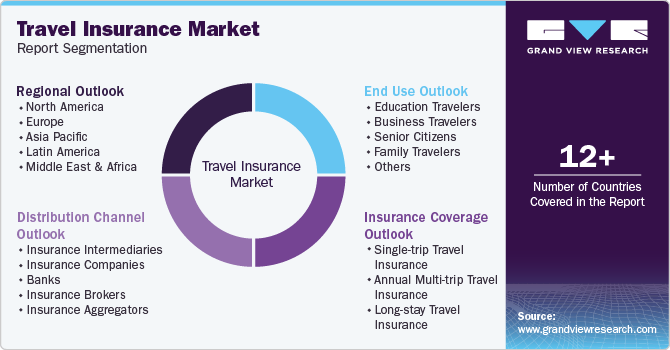
This report forecasts revenue growth at global, regional, and country levels and provides an analysis of the latest industry trends in each of the sub-segments from 2021 to 2033. For this study, Grand View Research has segmented the global travel insurance market report based on, insurance coverage, distribution channel, end use, and region.
 To learn more about this report, Download Free Sample Report
-
Insurance Coverage Outlook (Revenue, USD Million, 2021 - 2033)
-
Single-trip Travel Insurance
-
Annual Multi-trip Travel Insurance
-
Long-stay Travel Insurance
-
-
Distribution Channel Outlook (Revenue, USD Million, 2021 - 2033)
-
Insurance Intermediaries
-
Insurance Companies
-
Banks
-
Insurance Brokers
-
Insurance Aggregators
-
-
End Use Outlook (Revenue, USD Million, 2021 - 2033)
-
Education Travelers
-
Business Travelers
-
Senior Citizens
-
Family Travelers
-
Others
-
-
Regional Outlook (Revenue, USD Million, 2021 - 2033)
-
North America
-
U.S.
-
Canada
-
Mexico
-
-
Europe
-
UK
-
Germany
-
France
-
Italy
-
Ireland
-
-
Asia Pacific
-
China
-
India
-
Japan
-
Australia
-
New Zealand
-
-
Latin America
-
Brazil
-
-
Middle East and Africa (MEA)
-
Kingdom of Saudi Arabia (KSA)
-
UAE
-
South Africa
-
-
Research Methodology
Segment Definition
Segment - Insurance Coverage
Revenue capture definition
Single-trip Travel Insurance
This segment captures revenue generated from insurance policies opted by people for a short break or one-day trip. This insurance policy covers holiday cancellation, belongings & baggage, passport, money, documents, delayed departure, personal accident, accommodation, and medical expenses, among others.
Annual Multi-trip Travel Insurance
This segment includes revenue derived from insurance policies opted by individuals who travel for tourism or business reasons for three or more times a year. An annual multi-trip insurance policy covers trip cancellation, over 100 sports and activities, emergency dental treatment, personal belongings & baggage, personal money, passports, travel documents, accommodation, and legal expenses, among others.
Long-stay Travel Insurance
This segment captures revenue from travel insurance policies designed for extended-duration travel, including long-term stays abroad. It covers travelers such as students, expatriates, long-term tourists, and professionals requiring prolonged travel protection.
Segment - Distribution Channel
Revenue capture definition
Insurance Intermediaries
This segment includes revenue generated through insurance intermediaries who act as a bridge between insurance providers and end customers. They are involved in the process of sales as insurance brokers, insurance agents, or third-party administrators.
Insurance Companies
This segment captures revenue from travel insurance policies sold directly by insurance providers through their own sales channels, websites, mobile applications, or customer service platforms. It includes direct-to-consumer offerings without reliance on external distribution partners.
Banks
This segment includes revenue derived from travel insurance products distributed through banking institutions. Banks may offer travel insurance as standalone products or bundled solutions linked to credit cards, premium accounts, or travel-related financial services.
Insurance Brokers
This segment captures revenue generated through licensed insurance brokers that act as independent advisors connecting customers with suitable travel insurance policies from multiple insurers. Brokers typically support policy selection, customization, and claims-related assistance.
Insurance Aggregators
This segment includes revenue from travel insurance policies sold through a group of independent agencies that collaborate to combine premiums, providing clients with the advantages and scale available only to major agencies. Insurance aggregators offer incentives, higher levels of commission, fixed overrides, and profit sharing, among others, which can be earned by business travelers, family travelers, and groups of people.
Segment - End Use
Revenue capture definition
Education Travelers
This segment captures revenue generated from travel insurance policies purchased by students and academic travelers traveling abroad for education, research, exchange programs, or training purposes.
Business Travelers
This segment includes revenue generated from travel insurance policies purchased by business travelers such as companies’ employees who regularly travel for business meetings, special events, and other work-related tasks.
Senior Citizens
This segment includes revenue generated from travel insurance policies purchased by older travelers for covering expenses and uncertainties while on vacation. The categorization of senior citizens may vary from one country to another.
Family Travelers
This segment includes revenue generated from travel insurance policies purchased by families traveling together for leisure, holidays, or personal purposes.
Others
This segment captures revenue from travel insurance policies purchased by solo travelers, adventure travelers, medical tourists, and pilgrimage travelers. Travel insurance for individuals includes student plans, various business plans, and international trips, among others. This type of insurance provides safety in the case of a mishap or an emergency.
Estimation Model
Layer Name
Key Question
Description
Traveler Base / Demand Layer
Who is traveling and potentially requires insurance coverage?
Establish the total potential demand base by identifying domestic and international travelers across key categories such as leisure travelers, business travelers, students, senior citizens, and family travelers. It evaluates total travel volumes, trip frequency, destination patterns, and traveler demographics before applying market-specific demand filters.
Addressable Market Layer
Who can realistically be reached and insured?
Refine the total traveler population into the realistically serviceable market by considering factors such as insurance awareness, digital accessibility, travel regulations, purchasing behavior, and regional insurance penetration rates. It helps determine the share of travelers that can potentially purchase or adopt travel insurance products.
Policy Purchase & Renewal Layer
Who is actively purchasing, renewing, or upgrading travel insurance policies?
Estimate annual demand generation by analyzing policy purchase rates, renewal patterns, trip frequency, coverage preferences, policy types (single-trip, multi-trip, long-stay), and embedded insurance adoption through airlines, banks, and travel booking platforms.
Monetisation Layer
How much revenue is generated from travel insurance demand?
Convert policy demand into market revenue by applying average premium values, policy pricing structures, coverage tiers, regional pricing variations, distribution channel margins, and add-on service revenues. It also incorporates recurring revenue streams generated through annual multi-trip policies, renewals, and value-added insurance services where applicable.
Delivered Customizations
This report has been delivered with the following In-depth customizations
Client Request
Customization Delivered
Value Adds
Customer Purchasing Behavior & Buyer Trends
Analysis of traveler purchasing behavior across leisure travelers, business travelers, students, senior citizens, and frequent travelers
Assessment of policy purchase drivers, booking patterns, and insurance awareness levels
Evaluation of buyer preferences related to coverage scope, pricing, and claim settlement efficiency
Supported customer targeting and segmentation strategies
Improved understanding of traveler decision-making behavior
Enabled development of customer-centric insurance offerings
Distribution Channel Analysis
Delivered analysis of policy purchase channels including insurance companies, banks, brokers, and online platforms
Comparative evaluation of distribution effectiveness across channels
Supported channel optimization and partnership strategies
Assisted in identifying high-performing sales channels
Competitive Benchmarking & Insurer Positioning Analysis
Delivered benchmarking of key market participants based on policy offerings, pricing, coverage features, digital capabilities, and regional presence
Analysis of partnerships, service launches, and strategic initiatives
Evaluation of competitive strengths, market positioning, and differentiation factors
Supported competitive intelligence and market positioning strategies
Enabled identification of white-space opportunities
Assisted in strengthening competitive differentiation
Frequently Asked Questions About This Report
The global travel insurance market size was estimated at USD 31.2 billion in 2025 and is expected to reach USD 36.0 billion in 2026.
Based on insurance coverage, the single-trip travel insurance segment led the market, accounting for the largest revenue share of 61.3% in 2025, and is the fastest-growing segment.
The global travel insurance market is expected to grow at a compound annual growth rate of 15.6% from 2026 to 2033 to reach USD 99.4 billion by 2033.
Some key players operating in the travel insurance market include Allianz; American International Group, Inc.; AXA; ASSICURAZIONI GENERALI S.P.A.; USI Insurance Services, LLC; battleface; Insure & Go Insurance Services Limited; Seven Corners Inc.; Travel Insured International; Zurich; Delphi Financial Group, Inc.; Ping An Insurance (Group) Company of China, Ltd.
Key factors driving the market growth include the rise in tourism and the technological development in the travel insurance industry across the globe.
Europe dominated the travel insurance market with a share of 34.8% in 2025.
Based on distribution channel, the insurance companies segment led the market, accounting for the largest revenue share of 33.1% in 2025, while banks is the fastest-growing segment.
Based on end user, the senior citizens segment led the market with the largest revenue share of 31.0% in 2025, while business travelers is the fastest-growing segment.
About the Author(s)
Next Generation Technologies Research Team
Technology · Next Generation TechnologiesThis report was authored by the next generation technologies research team at Grand View Research - comprising two research analysts, one senior research analyst, and one industry expert - with specialized expertise in the next generation technologies segment of the technology industry. All findings are based on proprietary technology databases, executive interviews, and regulatory analysis, subject to internal peer review prior to publication.
Last Updated:
Speak to Analyst

Customize this report to your needs - add regions, segments, or data points, with 20% free customization.
Or view our licence options:


ISO 9001:2015 & 27001:2022 Certified
We are GDPR and CCPA compliant! Your transaction & personal information is safe and secure. For more details, please read our privacy policy.


