
- Home
- »
- Medical Devices
- »
-
U.S. Active Adults (55+) Community Market Size Report, 2033GVR Report cover

U.S. Active Adults (55+) Community Market (2026 - 2033) Size, Share & Trends Analysis Report By Gender (Women, Men), By Region (West, Southeast, Southwest, Midwest, Northeast), Consumer Behavior And Competitive Analysis, And Segment Forecasts
Market Size, 2025 (US$B)$661.0Forecast, 2033 (US$B)$906.6CAGR, 2026 - 20334.0%U.S. Active Adults (55+) Community Market Summary
The U.S. active adults (55+) community market size was estimated at USD 661.0 billion in 2025 and is projected to reach USD 906.6 billion by 2033, growing at a CAGR of 4.0% from 2026 to 2033. This growth is driven by the rapid aging of the population, as baby boomers enter retirement and seek vibrant lifestyles beyond traditional senior living.
Key Market Trends & Insights
- Southeast region dominated the U.S. active adult (55+) community market with the largest revenue share in 2025.
- The active adult (55+) community market in the Midwest region is expected to witness a substantial CAGR during the forecast period.
- By gender, the women segment led the market with the largest revenue share of 52.8% in 2025.
- The men segment is anticipated to grow at the fastest CAGR during the forecast period.
Market Size & Forecast
- 2025 Market Size: USD 661.0 Billion
- 2033 Projected Market Size: USD 906.6 Billion
- CAGR (2026-2033): 4.0%
- Southeast: Largest market in 2025
Three ways to get this report
Buy it, customize it, or ask a question.Ask an Analyst
Analyst response in 1 business day
- AccessReport author, directly
- Reply timeWithin 1 working day
- No sales callDirect answer only
- FormatEmail reply
- CostFree, no cost
Get the Full Report
What the study covers
- FormatsPDF · Excel · Dashboard
- Timeline2023–2033 annual, 2022 base
- Coverage20+ countries, 5 regions
- Companies10+ key players profiled
Customize the Report
20% free customization
- IncludeCountries, segments, points
- TailorTo your product definition
- ExtendDeeper competitor detail
- OrA fully bespoke study
- Turnaround5–10 working days
Changing lifestyle preferences, such as the desire for downsizing and maintenance-free living, also play a crucial role. Furthermore, cultural shifts toward “active aging,” emphasizing socialization, travel, hobbies, and lifelong learning, are reinforcing demand for these communities.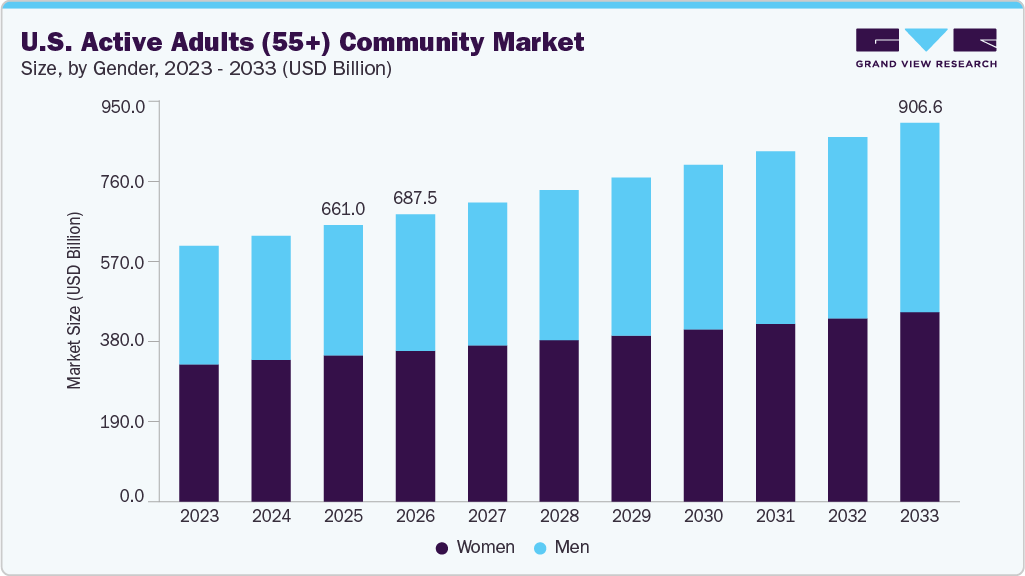 Source: Grand View Research, IR Documents, Primary Interviews, Paid DatabasesTo learn more about this report,
 Download Free Sample Report
 The section below outlines the key factors driving market growth, highlighting the aging population, the rising preference for maintenance-free and wellness-focused lifestyles, and the growing demand for socially connected living environments. It also examines the role of resort-style amenities, healthcare accessibility, technology-enabled living, and age-friendly housing designs in strengthening active adult communities as a preferred residential option for older adults seeking independent, healthy, and socially engaging lifestyles.
Increasing Demand from Aging Baby Boomers
Baby boomers' living preferences are changing, as this population seeks to remain independent and lead active lifestyles. Hence, post-retirement, they prefer to relocate to communities with residents who share their values, rather than to senior living or assisted living facilities. For instance, the active population aged 55–64 in the U.S. stood at approximately 27.4 million in July 2025, according to the U.S. Federal Reserve. This figure highlights the significant presence of older adults who remain engaged in the labor force or are otherwise economically active. In the senior living market, the active adult community has seen strong demand and investor appeal over the last few years. This is attributed to the growing demand for independent, maintenance-free living among the 55- to 64-year-old age group.
As this generation seeks to downsize or find housing that aligns with their lifestyle, active adult communities offer an attractive option with low-maintenance living and amenities that promote social interaction, fitness, and overall wellness. For instance, Del Webb, a prominent developer of 55+ communities, has expanded its projects in both traditional retirement destinations, such as Arizona and Florida, and in suburban areas near urban centers for boomers who want to stay near family while enjoying retirement benefits. Villages in Florida exemplify how the demand from baby boomers has spurred extensive development, making the area one of the fastest-growing metro regions in the country.
In recent years, numerous new active adult communities for 55+ have been developed across the U.S., highlighting the growing demand. For instance, in February 2026, Del Webb announced the first active adult community in Bridgeland. Its plan includes 672 homes, a Del Webb amenity center, and exclusive access to Bridgeland’s extensive network of parks, trails, and recreational facilities.
Preference for Lifestyle-Oriented Living
Currently, older adults approach retirement housing with a markedly different outlook than previous generations. Instead of merely perceiving housing as a place of residence, they seek communities that actively enhance their quality of life, with a particular focus on health, recreation, and social connectivity. There is a growing preference for environments offering amenities such as fitness centers, golf courses, walking and biking trails, wellness and nutrition programs, and a diverse array of social clubs that foster community involvement.
This shift reflects a rising demand for experience-based living, where housing is paired with amenities that enhance physical vitality, mental stimulation, and emotional well-being. Consequently, developers and operators are creating communities that focus on comfortable homes and vibrant, holistic lifestyles. This approach enables residents to remain active, connected, and fulfilled well into their later years.
Healthcare Accessibility & Integrated Wellness
As people age, healthcare needs become more frequent, and the ability to access medical services conveniently is a key consideration when choosing where to live. Active adult communities increasingly emphasize “aging in place,” offering wellness programs, preventive care initiatives, fitness classes, nutrition guidance, and in some cases, partnerships with nearby hospitals and specialty clinics. This model reduces the stress of managing multiple healthcare providers and enhances residents’ quality of life by keeping them healthy, independent, and socially engaged for longer. By embedding healthcare and wellness into the community design, developers cater to a generation of retirees that values both proactive health management and convenience. Such as:
-
The Villages (Florida): Offers on-site wellness centers, fitness programs, and nearby hospital partnerships, making healthcare access seamless.
-
Del Webb Communities (nationwide): Includes fitness centers, walking trails, and health-focused events, often located near regional healthcare hubs.
-
Sun City (Arizona): Features recreation centers alongside easy access to Banner Boswell Medical Center, which specializes in senior care.
- Latitude Margaritaville (Florida & South Carolina): Provides wellness programs and is strategically located close to top medical facilities for senior care.
Technological Adoption & Smart Living
An increasing number of older adults are becoming comfortable with digital technology, making innovative living solutions a significant driver in the market. These solutions range from smart home devices such as automated lighting and voice-controlled assistants (such as Alexa and Google Home) to health-related innovations, including wearable fitness trackers, telehealth services, and remote monitoring. Technology is becoming an integral part of daily life. Active adult communities incorporating these features enhance safety and convenience while supporting residents' ability to live independently for extended periods. For instance, telehealth access reduces the necessity for frequent clinic visits, and emergency alert systems, along with fall-detection sensors, provide peace of mind.
Moreover, communities that offer high-speed internet, app-based resident engagement platforms, and virtual social events are particularly appealing to the growing number of tech-savvy retirees. This seamless integration of digital solutions positions technology-driven communities as highly attractive options for modern adults aged 55 and older who seek both comfort and connectedness.
Instance
Description
Benefit to Residents
Smart Home Systems
Automated lighting, thermostat control, and voice assistants
Energy savings, ease of use, accessibility
Telehealth Platforms
Virtual doctor consultations are integrated into community services
Convenience, reduced travel for care
Wearable Health Devices
Smartwatches with heart rate, sleep, and fall detection
Continuous health monitoring, early alerts
Community Apps/Portals
Digital platforms for event sign-ups, maintenance requests, and social forums
Enhance engagement and communication
Remote Security Systems
Smart door locks, video doorbells, surveillance cameras
Increase safety and peace of mind
Insights Into Regional Migration Patterns, Boomer Lifestyle Preferences, Or Developer Strategies
Category
Insight
Examples
Regional Migration Patterns
Baby Boomers are relocating to states with mild climates, low taxes, and a high quality of life. There is a shift from traditional retiree states to emerging markets closer to family and healthcare.
Florida (The Villages), Arizona (Sun City), North Carolina (Raleigh), Texas (Austin), Tennessee
Boomer Lifestyle Preferences
Boomers value health, wellness, and social connectivity. Desired amenities include fitness centers, pickleball, arts, educational programs, and volunteer opportunities. They prefer active, engaging environments with easy access to healthcare and pet-friendly policies.
Latitude Margaritaville (FL/SC/TN), Del Webb communities with robust lifestyle programming
Developed Strategies
Developers are expanding into non-traditional markets, offering flexible pricing, aging-in-place home designs, and tech-enabled smart homes. Mixed-use developments that offer convenience and community integration are on the rise.
Del Webb (nationwide), Lennar, Toll Brothers; homes with no-step entries, smart tech, wide halls
Source: Grand View Research Analysis
Below are the emerging markets in the U.S. active adult (55+) community sector, where developers are seeing increasing demand from baby boomers looking for alternatives to traditional retirement states
Region/State
Why It’s Emerging
Example Communities
North Carolina
Mild climate, relatively low cost of living, strong healthcare systems, and proximity to the East Coast family.
Carolina Arbors by Del Webb (Durham), Brunswick Forest (Leland)
South Carolina
Tax-friendly, coastal access, and growing towns such as Greenville and Charleston offer culture and walkability.
Sun City Hilton Head (Bluffton), Del Webb Charleston
Texas
No state income tax, diverse cities, affordable land, and access to top-tier medical facilities in Austin, Dallas, and San Antonio.
Del Webb Sweetgrass (Richmond), Kissing Tree (San Marcos)
Tennessee
Low taxes, natural beauty (the Smoky Mountains), a moderate climate, and access to healthcare hubs such as Nashville and Knoxville.
Del Webb Southern Springs (Spring Hill)
Georgia
Warm climate, tax incentives for retirees, and growing metro areas such as Atlanta with strong healthcare infrastructure.
Sun City Peachtree (Griffin), Cresswind at Lake Lanier (Gainesville)
Colorado
Appeals to active, outdoorsy retirees; offers scenic beauty, walkability, and high quality of life in places such as Fort Collins and Colorado Springs.
Banning Lewis Ranch (Colorado Springs), The Retreat at Banning Lewis
Idaho & Utah
Lower cost of living than West Coast states, access to outdoor recreation, and quieter, low-crime environments.
Valencia Park (Eagle, ID), SpringHouse Village (South Jordan, UT)
Source: Grand View Research Analysis
These regions are attracting developers and senior citizens due to a combination of affordability, lifestyle amenities, and strategic locations. Let me know if you want to focus on any one state’s community profiles or compare the cost of living and taxes across these areas.
Market Concentration & Characteristics
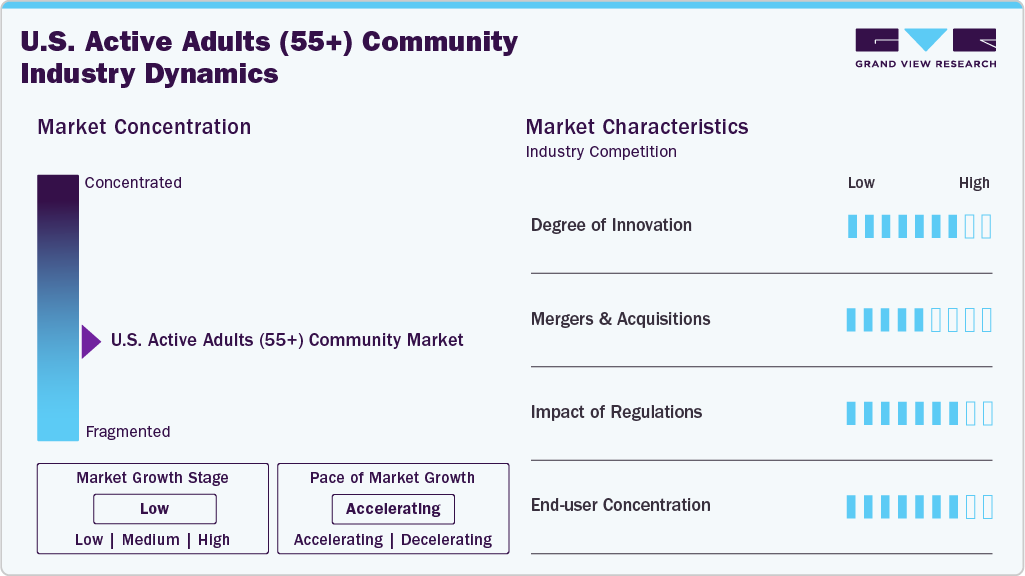
The U.S. active adults (55+) community industry is fragmented, with many service providers entering the market. There is a high degree of innovation, moderate merger & acquisition activity, a high impact of regulations, and a high-end user concentration in the industry.
The U.S. active adults (55+) community industry is experiencing a high degree of innovation. Communities such as Laguna Woods Village and Sun City, Texas, offer innovative, lifestyle-focused environments that cater to the evolving expectations of today’s retirees. Instead of simply providing age-restricted housing, these communities emphasize creativity, wellness, sustainability, and experiential living. Many features are unique themes, such as farm-to-table living, where residents can participate in community gardens, or university-based retirement communities (UBRCs) that offer lifelong learning opportunities and access to campus resources.
 To learn more about this report, Download Free Sample Report
 The market players are leveraging strategies such as collaborations, partnerships, and acquisitions to promote the reach of their offerings and increase their service capabilities. In August 2025, Capital Square acquired an active adult, build-for-rent community near San Antonio, Texas, specifically in Fredericksburg, to launch a new Delaware Statutory Trust (DST) offering under its Section 1031 tax-advantaged investment platform. This investment capitalizes on strong demographic trends, robust rent growth, and high demand in lifestyle-oriented, retirement-appealing markets.
Whitson Huffman, co-chief executive officer and chief investment officer of Capital Square, said:
“The launch of this offering highlights the increasing demand for purpose-built, active adult rental communities in lifestyle-driven markets like Fredericksburg. Fredericksburg offers exceptional regional demographics, rising rent trends, and expansive regional growth, and we believe that this property is uniquely positioned to provide high-quality housing and the potential for long-term value to our investors.”
The regulatory framework for the industry involves compliance with industry-specific guidelines and standards to ensure accuracy and consistency. At the federal level, the Housing for Older Persons Act (HOPA, 1995) provides an exemption from the Fair Housing Act, allowing communities to lawfully market themselves as “55+” or “age-restricted” housing, provided that at least 80% of the units are occupied by at least one resident aged 55 or older. Compliance with this rule requires communities to maintain clear age-verification policies and documentation. In addition, regulations influence how amenities, accessibility features, and housing designs meet Americans with Disabilities Act (ADA) standards to support aging residents with mobility or functional needs.
The majority of end users are concentrated in suburban and Sunbelt regions (Florida, Arizona, Texas, Nevada, and the Carolinas), where favorable climates, tax benefits, and established retirement hubs amplify market demand. As a result, developers and operators often tailor their offerings specifically to this concentrated demographic, with product design, pricing, and community features closely aligned to the preferences of active, financially secure older adults. This concentrated demand ensures consistent market growth and increases competition among developers to differentiate their communities through lifestyle, technology, and healthcare integration.
Gender Insights
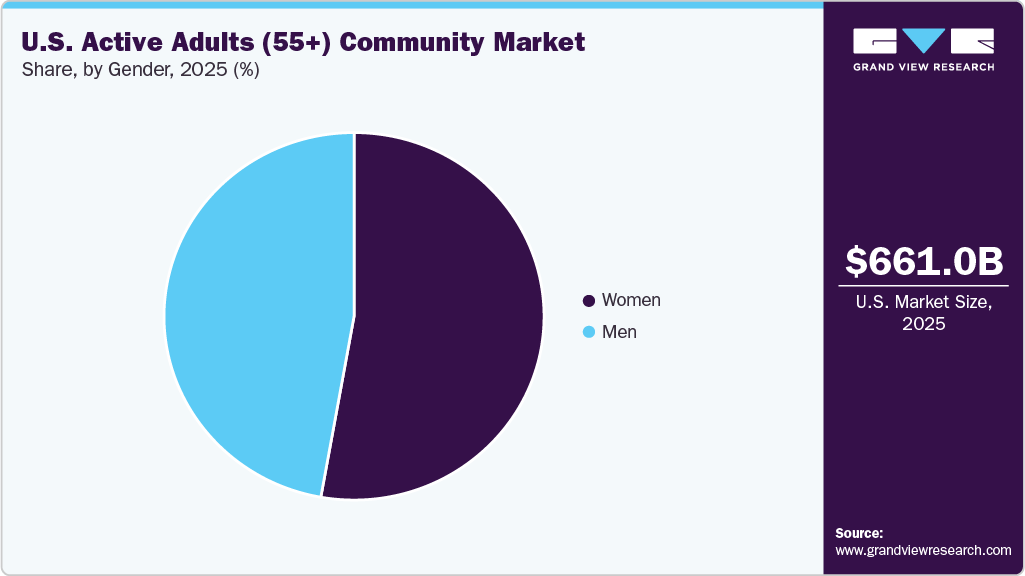
The women segment led the market with the largest revenue share of 52.8% in 2025. The increase of women in the U.S. market for active adult communities (ages 55 and up) is driven by demographic changes, increased longevity, and shifting lifestyle preferences. Women generally have a longer life expectancy than men, around five years more on average, leading to a larger number of single, widowed, or divorced women reaching retirement age who are looking for safe, socially enriching living environments. Many of these women appreciate community, autonomy, and convenience, which makes active adult communities particularly attractive. For instance, locations such as Sun City in Arizona and Del Webb’s developments nationwide commonly offer women-led clubs, wellness programs, and volunteer opportunities that promote strong social connections.
 To learn more about this report, Download Free Sample Report
 The men segment is expected to register the fastest CAGR during the forecast period, driven by lifestyle, health, and social factors. Many men in the 55+ age group seek environments that promote active living and recreational opportunities, such as golf courses, fitness centers, walking trails, swimming pools, and sports clubs. Unlike traditional retirement models, today’s male active adults prefer communities that support their physical vitality and allow them to pursue hobbies such as cycling, fishing, woodworking, or gaming. Access to health and wellness is another key driver, as men are increasingly conscious of preventive healthcare, nutrition, and fitness to support healthy aging. Social connectivity also plays a crucial role in these communities, providing structured activities, men’s clubs, and peer groups that help counter isolation, especially for widowers or divorced individuals.
Regional Insights
The Southeast region (including Florida, the Carolinas, Georgia, and parts of Tennessee) dominated the U.S. active adults (55+) community market with the largest revenue share in 2025, due to a combination of climate, affordability, and lifestyle appeal. The region’s warm weather and mild winters make it highly desirable for retirees seeking year-round outdoor activities such as golf, walking, and water recreation. In addition, states such as Florida and Tennessee offer tax advantages, including no state income tax and relatively lower property taxes, which enhance the financial feasibility of relocating. The Southeast also provides a wide range of master-planned communities that feature resort-style amenities, fitness centers, clubhouses, wellness programs, and cultural activities that cater to the active lifestyle preferences of today’s older adults
The U.S. active adults (55+) community industry in the Midwest region is expected to witness a substantial CAGR over the forecast period, driven by a combination of affordability, lifestyle preferences, and demographic shifts. Unlike coastal or Sunbelt states, the Midwest offers lower housing costs and overall cost of living, making it attractive for retirees and downsizers seeking value without compromising quality of life. Many older adults in the Midwest also prefer to “age in place” near family, friends, and familiar cultural settings, rather than relocating to distant retirement hubs. This proximity to social networks is a strong driver of community development in the region. Moreover, the Midwest’s expanding healthcare infrastructure, including large hospital networks and specialty clinics, supports the health and wellness needs of older adults. Developers are responding by creating low-maintenance housing with modern amenities, fitness facilities, walking trails, and community centers tailored to an active lifestyle.
Key U.S. Active Adults (55+) Community Company Insight
The U.S. active adults (55+) community industry is fragmented, dominated by a few large players. These companies focus on creating communities that emphasize independent living, social engagement, wellness, and low-maintenance housing tailored to the preferences of the 55+ population.
Leading players have established a strong presence through master-planned communities, resort-style amenities, and innovative housing models that appeal to both downsizing retirees and active older adults seeking a vibrant lifestyle. In addition, many companies are expanding into new geographic regions, including the Sunbelt and the Midwest, to capture growing demand.
Key U.S. Active Adults (55+) Community Companies:
- PulteGroup, Inc.
- Holding Company of The Villages, Inc.
- Latitude Margaritaville
- Hot Springs Village
- Rossmoor Walnut Creek
- Robson Communities, Inc.
- Sun Lakes of Arizona
- Green Valley
- Del Webb (PulteGroup, Inc.)
- Sun City Center
- Trilogy (Shea Homes)
- Brookdale Senior Living Inc.
- Oxford Senior Living
Recent Developments
- In April 2025, Viva Bene, the nation’s first 55+ active adult rental community, opened in Missouri, combining attainably priced housing with preventive healthcare. This community model enables residents to access wellness programs, routine health screenings, and preventive care services within their living environment, effectively promoting healthier aging while reducing the reliance on acute healthcare interventions. By integrating affordable housing with proactive health management, Viva Bene creates a synergistic approach that supports independence, lowers long-term medical costs, and enhances overall quality of life for active adults.
Laurie Schultz, co-founder and principal of Viva Bene and Avenue, said:
"We set out to create a model that empowers residents to live healthier, more fulfilling lives in a community offering opportunities for an engaging lifestyle and convenient access to preventive healthcare -- and to do so at a price point far lower than most retirement communities. "Viva Bene changes the 'senior living' paradigm by incorporating early access to care navigation and chronic care management. It's about proactive prevention and infusing wellness into everyday life so people can thrive."- In January 2025, Chicago-based healthcare real estate investment firm Greene Park Capital entered the active adult housing sector with the acquisition of a 225-unit community in the Boston metro area. This marks the firm's inaugural investment in age-restricted, lifestyle-oriented living. The property, branded as Everleigh Cape Cod, offers a range of amenities, including fitness centers, game rooms, and outdoor spaces such as bocce courts and pickleball courts.
Jordyn Berger, partner of the senior housing investment platform at Greene Park Capital, said.
“The institutions are going to want to get into the sector, but there hasn’t been a large enough kind of portfolio trade for them to get into the sector. “Some of the large private equity firms want to invest at least $100 million of equity, and these deal sizes are just not there. I would say the average one we’re kind of buying is anywhere from $30 million to $75 million.”
U.S. Active Adults (55+) Community Market Report Scope
Report Attribute
Details
Market size value in 2026
USD 687.5 billion
Revenue forecast in 2033
USD 906.6 billion
Growth rate
CAGR of 4.0% from 2026 to 2033
Base year for estimation
2025
Historical data
2021 - 2024
Forecast data
2026 - 2033
Quantitative units
Revenue in USD million/billion and CAGR from 2026 to 2033
Report coverage
Revenue forecast, company ranking, competitive landscape, growth factors, and trends
Segments covered
Gender, region
Country scope
U.S.
Regional scope
West; Southeast; Southwest; Midwest; Northeast
Key companies profiled
PulteGroup, Inc.; Holding Company of The Villages, Inc.; Latitude Margaritaville; Hot Springs Village; Rossmoor Walnut Creek; Robson Communities, Inc.; Sun Lakes of Arizona; Green Valley; Del Webb (PulteGroup, Inc.); Sun City Center; Trilogy (Shea Homes); Brookdale Senior Living Inc.; Oxford Senior Living
Customization scope
Free report customization (equivalent up to 8 analysts working days) with purchase. Addition or alteration to country, regional & segment scope.
Pricing and purchase options
Avail customized purchase options to meet your exact research needs. Explore purchase options
U.S. Active Adults (55+) Community Market Report Segmentation
This report forecasts revenue growth at the country level and provides an analysis of the latest industry trends in each of the sub-segments from 2021 to 2033. For this study, Grand View Research has segmented the U.S. active adults (55+) community market report based on gender and region.
-
Gender Outlook (Revenue, USD Billion, 2021 - 2033)
-
Women
-
Men
-
-
Region Outlook (Revenue, USD Billion, 2021 - 2033)
-
West
-
Southeast
-
Southwest
-
Midwest
-
Northeast
-
Frequently Asked Questions About This Report
The U.S. active adults (55+) community market size is expected to reach USD 906.6 billion by 2033, growing at a CAGR of 4.02% from 2026 to 2033.
The U.S. active adult (55+) community market was estimated at USD 661.0 billion in 2025.
Some key players operating in the U.S. active adult (55+) community market include PULTEGROUP INC., Holding Company of The Villages, Inc., Latitude Margaritaville, Hot Springs Village, Rossmoor, Robson Communities, Sun Lakes of Arizona, Green Valley, Del Webb, Sun City Center, Trilogy, Brookdale Senior Living Inc., Oxford Senior Living.
The rapid growth of the aging population, with baby boomers entering retirement age and seeking vibrant lifestyles beyond traditional senior living, is the key factor expected to fuel the U.S. active adult (55+) community market. Furthermore, cultural shifts toward “active aging,” emphasizing socialization, travel, hobbies, and lifelong learning, reinforce demand for these communities.
The women segment dominated the market with the largest share in 2025 attributed to demographic changes, increased longevity, and shifting lifestyle preferences.
About the Author(s)
Medical Devices Research Team
Healthcare · Medical DevicesThis report was authored by the medical devices research team at Grand View Research - comprising two research analysts, one senior research analyst, and one industry expert - with specialized expertise in the medical devices segment of the healthcare industry. All findings are based on proprietary healthcare databases, executive interviews, and regulatory analysis, subject to internal peer review prior to publication.
Last Updated:
Speak to Analyst

Customize this report to your needs - add regions, segments, or data points, with 20% free customization.
Or view our licence options:


ISO 9001:2015 & 27001:2022 Certified
We are GDPR and CCPA compliant! Your transaction & personal information is safe and secure. For more details, please read our privacy policy.


