
- Home
- »
- Medical Devices
- »
-
U.S. Adult Day Care Market Size & Share Report, 2026-2033GVR Report cover

U.S. Adult Day Care Market (2026 - 2033)
Size, Share & Trends Analysis Report By Ownership (Public, Private), By Services (Adult Social Day Services, Adult Day Healthcare Services, Specialized Day Care Services), By Region (Midwest, West), And Segment Forecasts
Market Size, 2025
$7.7BMarket Estimate, 2026
$8.0BMarket Forecast, 2033
$11.9BCAGR, 2026–2033
5.8%U.S. Adult Day Care Market Summary
The U.S. adult day care market size was valued at USD 7.7 billion in 2025 and is projected to grow from USD 8.0 billion in 2026 to USD 11.9 billion by 2033, at a CAGR of 5.8% from 2026 to 2033. The Midwest U.S. dominated the market, accounting for the largest revenue share in 2025. This industry is driven by the growing need for cost-effective, community-based care for older adults and people with disabilities, particularly as participants increasingly have multiple chronic conditions and require assistance with activities of daily living (ADLs).
Key Market Trends & Insights
- By ownership: Public segment dominated the market with the largest revenue share of 77.9% in 2025.
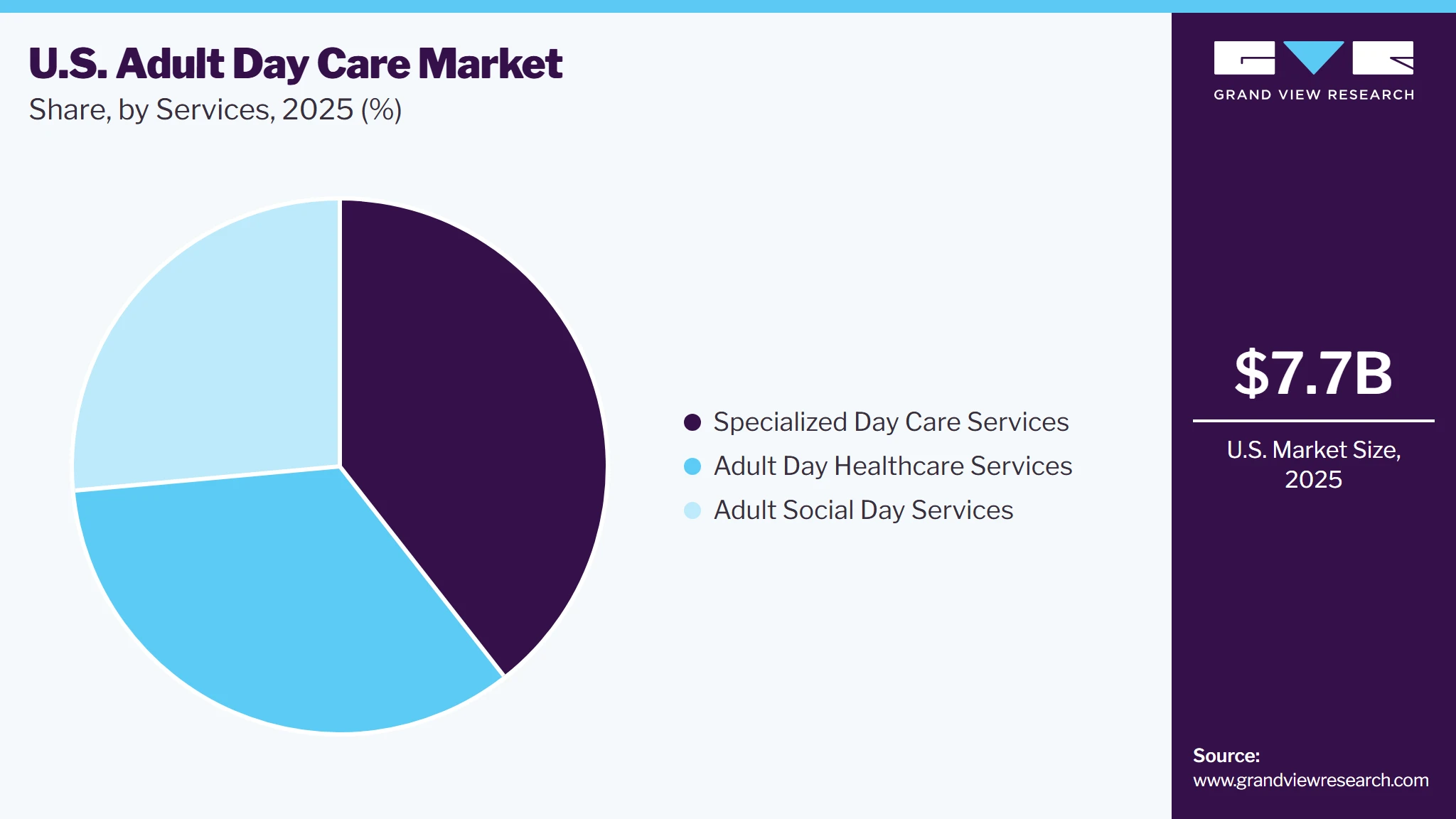
- By services: Specialized day care services segment dominated the market with a revenue share of 39.4% in 2025.
Market Size & Forecast
- Market Size in 2025: USD 7.7 Billion
- Estimated Market Size in 2026: USD 8.0 Billion
- Projected Market Size in 2033: USD 11.9 Billion
- CAGR (2026-2033): 5.8%
Prism AI by Grand View Research Free to tryAsk a question about the U.S. adult day care marketTry asking✓Every figure cited from GVR research Prefer the report? Download free sample →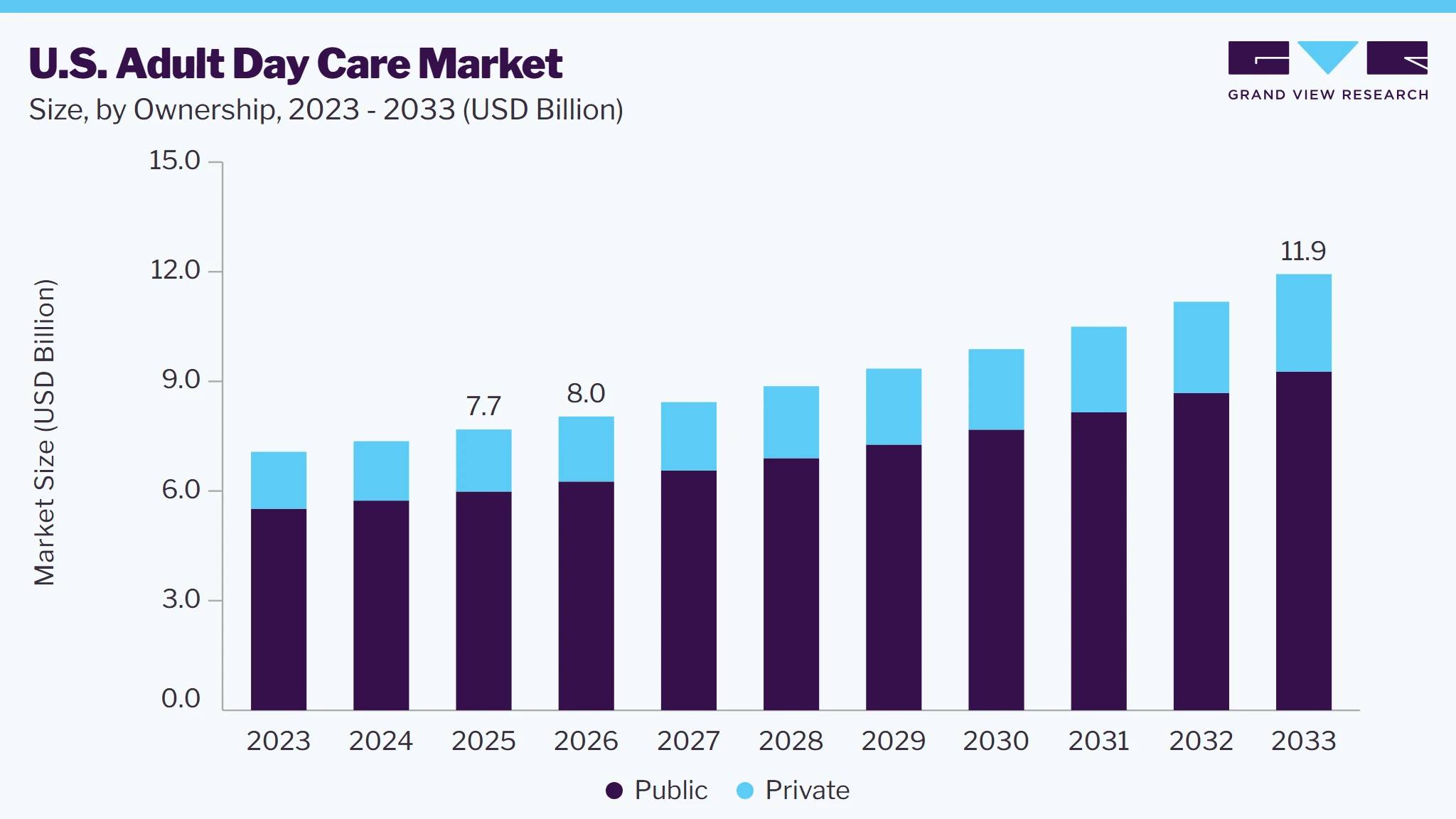 Source: Grand View Research, IR Documents, Primary Interviews, Paid DatabasesTo learn more about this report,
 Download Free Sample Report
The shift toward home- and community-based services (HCBS) instead of institutional nursing-home care is supporting demand, with federal and state programs funding adult day care as part of broader community-support systems.Market Dynamics
The section below outlines the key factors driving the growth of the industry, including the rapidly aging population, rising prevalence of chronic diseases and disabilities, increasing caregiver burden, and growing preference for home- and community-based care over institutional care. It also examines expanding Medicaid and PACE programs, rising demand for adult day health services, increasing need for dementia and specialized care, and the cost-effectiveness of adult day care compared with nursing homes and full-time home care.
The expansion of Medicaid-funded Home & Community-Based Services (HCBS) is a significant driver of the market as Medicaid is increasingly being used to support care delivered in community settings instead of institutional facilities. Adult day services can be incorporated into state Medicaid HCBS programs and waivers, allowing eligible older adults and people with disabilities to receive structured daytime supervision, personal care, social activities, nursing and other supportive services while continuing to live at home. CMS has explicitly positioned HCBS as an alternative to institutional care, with Medicaid playing a central role in financing these services.
A recent CMS announcement in August 2026 provides a strong instance of the U.S. government's increasing emphasis on expanding community-based healthcare, particularly in underserved rural areas. Through the Rural Health Transformation Program (RHTP), Alabama is receiving USD 144 million across 138 grants to expand access to care, modernize healthcare infrastructure and strengthen the rural healthcare workforce. The funding specifically supports community-based care, telehealth, mobile healthcare, remote monitoring, patient transportation, mental and behavioral health services, and improved coordination between providers.
Moreover, the May 2024 Medicaid Managed Care Access, Finance, and Quality Final Rule provides an additional opportunity. CMS stated that more than 70% of Medicaid and CHIP beneficiaries receive some or all their care through managed care plans, while the rule strengthened requirements related to access, payment transparency and HCBS within managed-care arrangements. This supports the development of partnerships between adult day care centers and Medicaid managed-care organizations, allowing centers to become part of broader care networks serving older adults and people with disabilities.
High staffing costs and mandatory staff-to-participant ratios represent a significant restraint on the market as the business model is highly labor-intensive and providers must maintain sufficient direct-care personnel regardless of daily attendance. Adult day centers typically serve older adults and individuals with disabilities who may require assistance with mobility, toileting, medication management, meals, behavioral supervision and other activities of daily living, limiting the extent to which providers can substitute technology for human caregivers. Moreover, staffing requirements vary by state and participant acuity, creating additional compliance costs. For instance, California requires adult day programs to maintain an overall minimum of one direct-care staff member for every eight clients, while the ratio increases to 1:4 for clients who depend on staff for all activities of daily living.
These requirements mean that a center cannot simply reduce staffing when enrollment or daily attendance temporarily declines, putting pressure on operating margins. An August 2026 analysis reported that wages for nursing and residential-care workers increased from approximately USD 17 to nearly USD 27 per hour over the past decade, representing a 57% increase from 2016 to 2026, faster than the 47% increase in overall private-sector wages. The broader long-term-care sector has also continued to face workforce constraints; although nursing and residential-care employment recovered to about 3.49 million workers by May 2026, compared with 2.96 million at the January 2022 low, industry representatives continue to highlight recruitment and retention challenges, while the population aged 80+ is expected to expand substantially.
The increasing integration of medical and social care is a significant opportunity for the industry because adult day centers are increasingly positioned as community-based settings where participants can receive both clinical services and social support in the same location. Instead of functioning primarily as daytime supervision or recreational facilities, centers can provide nursing, medication management, rehabilitation, behavioral health, chronic-disease monitoring, nutrition, transportation, social activities and caregiver support.
There are also signs of state-level expansion of medical services within adult day settings. For instance, CMS's Medicaid State Plan Amendment database shows that in August 2026, American Samoa approved an amendment allowing Personal Care Services to be furnished in both home and adult daycare settings, effective April 2026. Although American Samoa is not representative of the entire U.S. market, the development illustrates how adult daycare settings can become recognized delivery locations for reimbursable personal-care services, supporting the broader convergence of social, personal and healthcare services.
Market Concentration & Characteristics
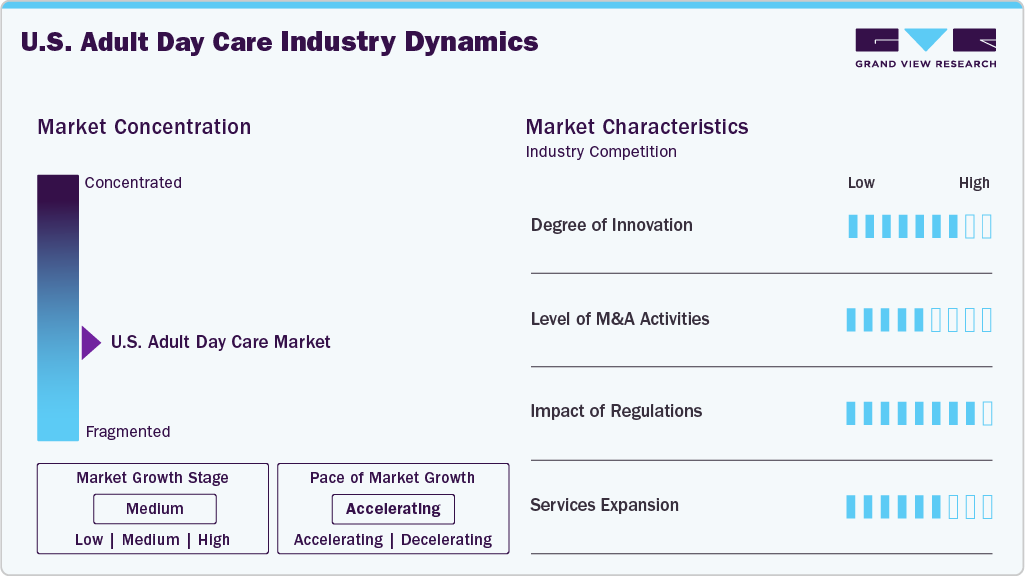
The chart below represents the relationship between industry concentration, industry characteristics, and industry participants. The x-axis shows the level of industry concentration, ranging from low to high. The industry is fragmented, with many service providers entering the market. There is a high degree of innovation, moderate level of merger & acquisitions activities, high impact of regulations, and moderate to high expansion of industry.
Innovation in the market is increasing through telehealth, remote patient monitoring, wearable devices, electronic health records, fall-detection systems, and digital care coordination. These technologies enable providers to monitor participants' health while delivering social engagement and supportive care. The growth of PACE (Program of All-Inclusive Care for the Elderly) also demonstrates the integration of medical, rehabilitative, and social services through adult day health centers. This creates opportunities for providers to develop technology-enabled centers capable of serving higher-acuity and chronic-care patients.
 To learn more about this report, Download Free Sample Report
M&A activity is creating opportunities for consolidation as senior-care companies, PACE organizations, healthcare providers, and investors seek to expand their geographic coverage and service capabilities. In August 2026, ALIS, a senior-living clinical and operational software provider, announced the acquisition of Ella and elbi, two AI-powered dementia and behavioral-care technologies from TapRoot Interventions & Solutions. The acquisition expands ALIS's platform into real-time, personalized dementia-care support, enabling caregivers to receive point-of-care recommendations for managing challenging behaviors through non-pharmacological and person-centered interventions.
“Senior living operators are being asked to deliver better outcomes with fewer resources and nowhere is that pressure more visible than in dementia care. Ella gives caregivers an expert in their pocket the moment they need one for intelligent and personalized interventions at the point of care,” said John Shafaee, Founder and CEO, ALIS.
Regulations significantly influence the market as adult day care providers must comply with state licensing, Medicaid requirements, staffing standards, patient-safety rules, and clinical-service regulations. Medicaid HCBS programs can cover adult day health services through mechanisms such as 1915(c) waivers, subject to state-specific requirements. Although compliance increases operating complexity, it also creates barriers to entry and benefits established providers capable of meeting Medicaid and managed-care requirements.
In March 2026, Oasis Adult Day Center in Fresno, California, operated by Valley Caregiver Resource Center, expanded its facility to three times its previous size, enabling the center to accommodate more older adults and introduce additional activities and specialized care. The nearly USD 1 million expansion, which began construction in spring 2025, added an art room, larger conversation areas, an activity space, and an upgraded outdoor patio with retractable awnings.
Analyst Perspective
Increasing demand for adult social day services, adult day healthcare, specialized dementia care, rehabilitation, nursing support, meals, transportation, and caregiver respite is supporting market growth across the U.S. In addition, the expansion of Medicaid Home- and Community-Based Services (HCBS), PACE programs, and Medicaid managed-care models is improving access to reimbursed adult day services. The integration of medical and social care, adoption of telehealth and remote monitoring technologies, expansion of specialized programs for dementia and developmental disabilities, and growth of multi-location providers are further supporting market development.
Ownership Insights
Based on ownership, the public segment dominated the market with the largest revenue share in 2025. Increasing government support for elderly care and long-term care infrastructure is driving the adult day care market through public funding. Many governments are expanding social welfare programs, subsidies, and healthcare efforts to help aging populations. This also reduces pressure on hospitals and long-term residential care facilities. For instance, public programs, including Medicaid in the U.S. and similar national elder care initiatives in other countries, are recognizing adult day care services as a cost-effective option compared to institutional care. This approach improves affordability and accessibility for seniors and their families.
The private segment is expected to grow at the fastest CAGR during the forecast period due to the rise of personalized, non-medical home care and franchise-based services. For instance, in February 2026, Papa's Place Adult Day Care, a provider focused on dementia care, announced plans to expand into northwest Michigan. As part of this growth plan, the company will first offer private in-home care services. They plan to create a dedicated care facility once they find the right commercial space, which they expect will take six to nine months.
Services Insights
Based on services, the specialized day care services segment dominated the market with a revenue share of 39.4% in 2025 and is expected to grow at the fastest CAGR during the forecast period. The increasing demand for disease-specific and personalized care programs is fueling the specialized daycare services segment. The rise in cognitive disorders, developmental disabilities, Parkinson’s disease, and other complex health issues has heightened the need for care programs that address distinct physical, cognitive, and behavioral needs. Specialized day care centers provide targeted services including memory care, cognitive stimulation therapy, behavioral support, rehabilitation activities, and caregiver education.
 To learn more about this report, Download Free Sample Report
The adult day healthcare services segment is expected to grow at a significant CAGR during the forecast period. This is driven by the rising rates of chronic diseases and a growing need for medical oversight among older adults are driving growth in the adult day healthcare services segment. As the elderly population expands, conditions including dementia, Alzheimer’s, diabetes, cardiovascular issues, and mobility challenges are becoming more common. This increases the demand for structured daytime care that includes health monitoring, medication management, rehabilitation, and nursing support. Adult day healthcare centers offer a cost-effective alternative to long-term institutional care.
Regional Insights
The Midwest region dominated the market with a revenue share of 25.9% in 2025 due to an increasing prevalence of chronic conditions and growing demand for community-based alternatives to nursing-home care. Adult day services are particularly relevant because participants commonly require assistance with activities of daily living and have multiple chronic conditions; nationally, about 61% of participants require assistance with three to six ADLs and nearly 80% have some or all services paid for by Medicaid. The region also benefits from the expansion of Medicaid HCBS programs, which support older adults and people with disabilities in community settings instead of entering institutional care. For instance, in July 2026, Indiana's PathWays and Health & Wellness HCBS waivers had 55,969 federally approved slots for 2025-2026, with the state reaching capacity and maintaining waiting lists, indicating unmet demand for community-based services.
The West region is expected to grow at the fastest CAGR during the forecast period, supported by its comparatively large and growing older-adult population, particularly in states such as Arizona, Nevada, California, and parts of the Pacific Northwest. The U.S. Census Bureau reported that the share of adults aged 65 and older is particularly high in several Western states, including Arizona, Idaho, and Nevada. California is an especially strong driver, with its Medi-Cal Community-Based Adult Services (CBAS) program providing nursing, physical/occupational/speech therapy, mental health, nutrition, social services, personal care, and transportation; the program served approximately 46,000 participants in FY 2025-2026.
Key U.S. Adult Day Care Companies Insights:
The U.S. adult day care market is highly fragmented, with competition coming from independent community-based centers, regional operators, franchise networks, and larger integrated senior-care and PACE organizations. Competition is also expanding from integrated PACE providers such as InnovAge and WelbeHealth, which combine adult day centers with primary care, rehabilitation, behavioral health, transportation, nutrition, and social services. Thus, competition is increasingly shifting from traditional adult day centers toward integrated, clinically oriented and value-based care platforms, while the presence of numerous smaller operators continues to keep the overall market fragmented.
Key U.S. Adult Day Care Companies
-
Active Day/Senior Care, Inc.
-
Alzheimer's Association
-
Centers Health Care
-
Senior Friendship Centers
-
Lifesteps, Inc.
-
MyAdult DayCare
-
Neighborly Senior Care Network
-
SeniorLiving.org
-
University Adult Care (UAC)
-
Innovative Senior Solutions, Inc.
Competitive Benchmarking
Category
Operating Strategies
Competitive Edge
Weakness
Established Players (e.g., Lifesteps, Inc., MyAdult DayCare, Neighborly Senior, Care Network, SeniorLiving.org)
Invest in expanding multi-location networks, increasing participant capacity, broadening healthcare and social services, developing dementia and specialized care programs, strengthening payer relationships, and adopting technology-enabled care coordination. Established providers also focus on standardized care protocols, staff training, transportation infrastructure, Medicaid contracting, partnerships with healthcare systems and PACE organizations, and acquisitions to expand geographic coverage.
Strong brand recognition established participant bases, extensive facility networks, diversified service offerings, experienced care teams, established payer relationships, and greater access to capital. Large operators can leverage economies of scale in staffing, transportation, procurement, technology, administration, and facility management.
High facility and staffing costs, regulatory and licensing requirements, dependence on Medicaid and other reimbursement programs, and challenges in maintaining consistent service quality across multiple locations. Large networks may also face greater administrative complexity and slower adaptation to local participant and caregiver needs.
Emerging Players (e.g., Active Day/Senior Care, Inc., Alzheimer's Association, Centers Health Care)
Focus on specialized populations, personalized care, dementia and chronic-disease programs, community-based services, technology-enabled monitoring, caregiver support, and localized service offerings. Emerging providers increasingly differentiate through specialized adult day healthcare, flexible programs, transportation services, partnerships with local healthcare providers, and expansion into underserved markets.
Greater flexibility, personalized participant care, faster adoption of technology, lower organizational complexity, and the ability to respond quickly to local community needs. Smaller providers can also build strong relationships with families, physicians, social workers, and local organizations through personalized services.
Limited brand recognition, smaller participant and facility bases, constrained access to capital, higher operating costs per location, and limited purchasing power compared with large operators. Smaller providers may also face difficulties recruiting qualified staff, obtaining favorable payer contracts, investing in technology, and expanding into multiple geographic markets.
Recent Developments
- In May 2026, Longevity Day Club launched its first pilot location in Merritt Island, Florida, introducing a new adult day model designed specifically for seniors who want to remain independent and age at home. Unlike traditional adult day programs, the model combines social connection, brain-health activities, exercise and wellness, nutrition, transportation, supportive services, and technology-enabled engagement that continues beyond the center and into the home.
“Traditional adult day programs often focus primarily on supervision and basic daily support. “Our model is built around healthy aging, purpose, prevention, technology, social connection, and helping older adults remain engaged in the community while continuing to live at home.”
- Longevity Day Club founder and CEO Pilar Carvajal told McKnight’s Home Care Daily Pulse.
“This is a pivotal moment for our patients, our providers and our teams,” said Jeffrey Schillinger, Founder and Chief Executive Officer of DermCare. “By joining forces with U.S. Dermatology Partners, we are building an organization with the scale, resources and clinical depth to help even more patients access the dermatologic care they need, when and where they need it. Our combined organization will stay rooted in what has always set us apart: physician-led, patient-first care.”
- In April 2025, Active Day acquired Illinois-based PremierCare Consulting, a provider contracted with the Illinois Division of Developmental Disabilities for person-centered planning and case management. The acquisition expanded Active Day’s community-based services for people with intellectual and developmental disabilities (IDD) and strengthened its presence in Illinois.
U.S. Adult Day Care Market Report Scope
Report Attribute
Details
Market size in 2025
USD 7.7 billion
Estimated market size in 2026
USD 8.0 billion
Projected market size by 2033
USD 11.9 billion
Growth rate
CAGR of 5.8% from 2026 to 2033
Actual data
2021 - 2025
Forecast data
2026 - 2033
Quantitative units
Revenue in USD billion and CAGR from 2026 to 2033
Report coverage
Revenue forecast, company ranking, competitive landscape, growth factors, and trends
Segments covered
Ownership, services, region
Country scope
U.S.
Key companies profiled
Active Day/Senior Care, Inc.; Alzheimer's, Association; Centers Health Care; Senior Friendship Centers; Lifesteps, Inc.; MyAdult DayCare; Neighborly Senior Care Network; SeniorLiving.org; University Adult Care (UAC); Innovative Senior Solutions, Inc.
Customization scope
Free report customization (equivalent up to 8 analysts working days) with purchase. Addition or alteration to country, regional & segment scope.
Pricing and purchase options
Avail customized purchase options to meet your exact research needs. Explore purchase options
U.S. Adult Day Care Market Report Segmentation
This report forecasts revenue growth at the country level and provides an analysis of the latest industry trends in each of the sub-segments from 2021 to 2033. For this study, Grand View Research has segmented the U.S. adult day care market report based on ownership, services, and region.
-
Ownership Outlook (Revenue, USD Billion, 2021 - 2033)
-
Public
-
Private
-
-
Services Outlook (Revenue, USD Billion, 2021 - 2033)
-
Adult Social Day Services
-
Adult Day Healthcare Services
-
Specialized Day Care Services
-
-
Regional Outlook (Revenue, USD Billion, 2021 - 2033)
-
West
-
Southeast
-
Southwest
-
Midwest
-
Northeast
-
Research Methodology
The U.S. adult day care market figures in this report are based on a proven research process that combines executive interviews with secondary research from proprietary databases, company filings, and recognized regulatory and institutional sources. Market size is built through value-chain sizing - reconciling supply-side and demand-side estimates - and triangulated with bottom-up and top-down approaches. Every estimate passes multiple levels of expert validation before publication, with each U.S. adult day care segment quantified using the revenue-capture definitions in the table below.
Segment Definition
Segment - Ownership
Revenue capture definition
Public
Adult day care services operated or funded by government/public-sector organizations, primarily serving eligible older adults or people with disabilities through public programs such as Medicaid.
Private
Adult day care services operated by private, for-profit or nonprofit providers, funded through private-pay, insurance, Medicaid, or other reimbursement sources.
Segment - Services
Revenue capture definition
Adult Social Day Services
Non-medical daytime services focused on socialization, recreation, meals, supervision, and activities of daily living for adults who require daytime support.
Adult Day Healthcare Services
Daytime services combining healthcare and supportive care, such as nursing, medication management, rehabilitation, therapy, and health monitoring, with social activities.
Specialized Day Care Services
Adult day services designed for specific populations or conditions, such as dementia/Alzheimer’s disease, intellectual and developmental disabilities, or adults requiring behavioral or higher-acuity care.
Estimation Model
Section
Key Summary
1.1 Research Approach
Hybrid research approach combining secondary and primary research methodologies. The U.S. adult day care market assessment is based on the number of operating adult day care centers, participant enrollment, daily attendance, operating days, service utilization, average revenue per participant, payer mix, reimbursement rates, and service mix. Insights from adult day care operators, healthcare providers, PACE organizations, Medicaid managed-care organizations, senior-care companies, industry associations, and market experts are used to validate market estimates.
1.2 Market Estimation Framework
Market size is estimated using three complementary approaches: (1) facility and revenue-per-facility model, (2) participant volume and average revenue-per-participant model, and (3) key operator and service-provider revenue validation model. These approaches are triangulated to determine the overall U.S. adult day care market size and forecast projections.
1.2.1 Demand Model
Estimates market demand based on the number of adult day care centers, participant enrollment, average daily attendance, operating days, participation frequency, eligible elderly and disabled population, prevalence of chronic conditions, caregiver demand, Medicaid/Medicare participation, and demand for community-based care. The model also considers demand for adult social day services, adult day healthcare services, and specialized services such as dementia, Alzheimer’s, and intellectual and developmental disability care.
1.2.2 Revenue Model
Market value is calculated based on the number of operating facilities, participant volumes, average revenue per participant per day, annual attendance, service mix, reimbursement rates, private-pay fees, Medicaid payments, Medicare/PACE-related revenues, and ancillary service revenues. Variations in reimbursement and utilization across nonprofit, for-profit, public, independent, and multi-location adult day care providers are incorporated into the model. Revenue from services such as nursing care, therapy, meals, transportation, medication management, and specialized care is included where applicable.
1.2.3 Vendor Model
Market estimates are validated using revenues, number of locations, participant capacity, service portfolios, payer mix, expansion strategies, acquisitions, partnerships, and financial disclosures of leading U.S. adult day care operators, PACE organizations, and community-based care providers. Where operator-level financial information is unavailable, facility counts, estimated participant capacity, utilization rates, average daily reimbursement, and comparable-provider benchmarks are used to validate revenue estimates.
1.3 Forecast Development
Forecast projections are developed by analyzing growth in the aging U.S. population, increasing prevalence of chronic diseases and dementia, rising caregiver burden, expansion of Medicaid HCBS programs, growth of PACE, increasing preference for community-based care over institutional care, and expansion of adult day healthcare services. Increasing integration of medical and social care, adoption of technology-enabled monitoring, demand for specialized dementia services, expansion of Medicaid managed care, and growth of multi-location operators are also considered. Demographic changes, healthcare expenditure, reimbursement trends, provider capacity, and regulatory developments are incorporated into the forecast.
1.4 Segmentation Method
Market segmentation is determined using weighted analysis of participant enrollment, daily attendance, service utilization, reimbursement rates, average revenue per participant, payer mix, provider structure, facility ownership, service mix, geographic distribution, participant demographics, facility capacity, and competitive intensity. The market is segmented by ownership (public, private), service type (adult social day services, adult day healthcare services, specialized day care services), and other relevant dimensions based on their contribution to overall adult day care revenues.
1.5 Scope & Assumptions
Market measured in USD based on revenues generated by adult day care providers in the U.S. from adult social, healthcare, and specialized day care services. Estimates incorporate facility revenues, participant enrollment, attendance, operating days, average revenue per participant, reimbursement rates, service utilization, payer mix, facility capacity, and regional variations in demand and reimbursement. The market primarily captures revenues generated from adult social day services, adult day healthcare services, specialized day care, nursing and health monitoring, rehabilitation and therapy, meals and nutrition, transportation, medication management, dementia care, and other ancillary services, where applicable.
Delivered Customizations
This report has been delivered with the following In-depth customizations
Client Request
Customization Delivered
Value Adds
Service Pricing & Service Mix Analysis
Analysis of adult day care services by category, including adult social day services, adult day healthcare services, and specialized day care, along with average daily fees, reimbursement rates, participant utilization, and revenue contribution.
Helps optimize pricing strategy, service portfolio, reimbursement mix, and revenue per participant.
Service × Demographic Opportunity Matrix
Mapping of adult day care services against key demographic segments, including age group, care needs, and disability status-for example, dementia care × older adults, rehabilitation × post-acute patients, and specialized care × adults with intellectual and developmental disabilities.
Provides a clear view of high-value participant segments, underserved populations, and opportunities for targeted service development and outreach.
Adult Day Care Facility & Capacity Analysis
Assessment of the number of operating adult day care centers, facility capacity, geographic distribution, ownership structure, participant enrollment, daily attendance, and expansion activity across major U.S. states and regions.
Helps clients identify high-potential markets, assess provider concentration, and prioritize geographic expansion, new-center development, or acquisition opportunities.
Technology & Service Adoption Analysis
Assessment of adoption of key technologies and service models, including telehealth, remote patient monitoring, electronic health records, fall-detection systems, medication management, digital care coordination, and specialized dementia-care programs.
Helps clients identify high-growth service models, technology investment priorities, operational improvement opportunities, and emerging areas of differentiation.
Frequently Asked Questions About This Report
The U.S. adult day care market size was valued at USD 7.7 billion in 2025 and is estimated at USD 8.0 billion for 2026.
In terms of ownership, the public segment dominated the market with the largest revenue share in 2025. Increasing government support for elderly care and long-term care infrastructure is driving the adult day care market through public funding.
In terms of services, the specialized day care services segment dominated the market with a revenue share of 39.4% in 2025. The increasing demand for disease-specific and personalized care programs is fueling the specialized day care services segment.
In terms of region, the Midwest dominated the market with the larges revenue share in 2025 due to increasing prevalence of chronic conditions, and growing demand for community-based alternatives to nursing-home care.
The growth of the market is driven by the growing need for cost-effective, community-based care for older adults and people with disabilities, particularly as participants increasingly have multiple chronic conditions and require assistance with activities of daily living (ADLs).
Key playersin the market include Active Day/Senior Care, Inc., Alzheimer's, Association, Centers Health Care, Senior Friendship Centers, Lifesteps, Inc., MyAdult DayCare, Neighborly Senior Care Network, SeniorLiving.org, University Adult Care (UAC), Innovative Senior Solutions, Inc.
The U.S. adult day care market is expected grow at a CAGR of 5.8% from 2026 to 2033, reaching USD 11.9 billion by 2033.
About the Author(s)
Medical Devices Research Team
Healthcare · Medical DevicesThis report was authored by the medical devices research team at Grand View Research - comprising two research analysts, one senior research analyst, and one industry expert - with specialized expertise in the medical devices segment of the healthcare industry. All findings are based on proprietary healthcare databases, executive interviews, and regulatory analysis, subject to internal peer review prior to publication.
Last Updated:
Speak to Analyst

Customize this report to your needs - add regions, segments, or data points, with 20% free customization.
Or view our licence options:


ISO 9001:2015 & 27001:2022 Certified
We are GDPR and CCPA compliant! Your transaction & personal information is safe and secure. For more details, please read our privacy policy.


