
- Home
- »
- Advanced Interior Materials
- »
-
U.S. Agricultural Fencing Market Size Report, 2026-2033GVR Report cover

U.S. Agricultural Fencing Market (2026 - 2033)
Size, Share & Trends Analysis Report By Material (Metal, Wood), By Product (Barbed Wire, Cattle Fence, Field Fence, Stable Mesh Fencing), By End Use (Livestock, Equine, Specialty Agriculture), And Segment Forecasts
Market Size, 2025
$943.6MMarket Estimate, 2026
$977.9MMarket Forecast, 2033
$1,285.3MCAGR, 2026–2033
4.0%U.S. Agricultural Fencing Market Summary
The U.S. agricultural fencing market size was valued at USD 943.6 million in 2025 and is projected to grow from USD 977.9 million in 2026 to USD 1,285.3 million by 2033, at a CAGR of 4.0% from 2026 to 2033. The market growth is supported by the continued need to secure livestock, define agricultural property boundaries, manage grazing areas, protect crops, and improve overall farm and ranch operations.
Key Market Trends & Insights
- By material: Metal segment held the largest revenue share of 48.3% in 2025
- By product: Cattle fence segment held the largest market share of 25.4% in 2025
- By end use, Equine segment is expected to grow at the fastest CAGR of 4.6% from 2026 to 2033, in terms of revenue
Market Size & Forecast
- Market Size in 2025: USD 943.6 Million
- Estimated Market Size in 2026: USD 977.9 Million
- Projected Market Size by 2033: USD 1,285.3 Million
- CAGR (2026-2033): 4.0%
Three ways to get this report
Buy it, customize it, or ask a question.Ask an Analyst
Analyst response in 1 business day
- AccessReport author, directly
- Reply timeWithin 1 working day
- No sales callDirect answer only
- FormatEmail reply
- CostFree, no cost
Get the Full Report
What the study covers
- FormatsPDF · Excel · Dashboard
- Timeline2026–2033 annual, 2025 base
- Coverage20+ countries, 5 regions
- Companies10+ key players profiled
Customize the Report
20% free customization
- IncludeCountries, segments, points
- TailorTo your product definition
- ExtendDeeper competitor detail
- OrA fully bespoke study
- Turnaround5–10 working days
Fencing is widely used across cattle ranches, dairy farms, horse farms, sheep and goat operations, poultry facilities, and diversified agricultural properties. The market benefits from the large installed base of agricultural land and the recurring need for fence repair, replacement, expansion, and maintenance. Demand in the U.S. agricultural fencing industry is further driven by livestock management, rotational grazing, pasture subdivision, predator control, crop protection, and the need to prevent livestock from entering environmentally sensitive areas. The growing emphasis on pasture productivity and resource-efficient livestock management is encouraging producers to install interior fencing to support controlled grazing and better forage utilization. Exterior and property-line fencing remains important for livestock containment and land separation, while temporary and portable systems are gaining relevance for flexible grazing operations.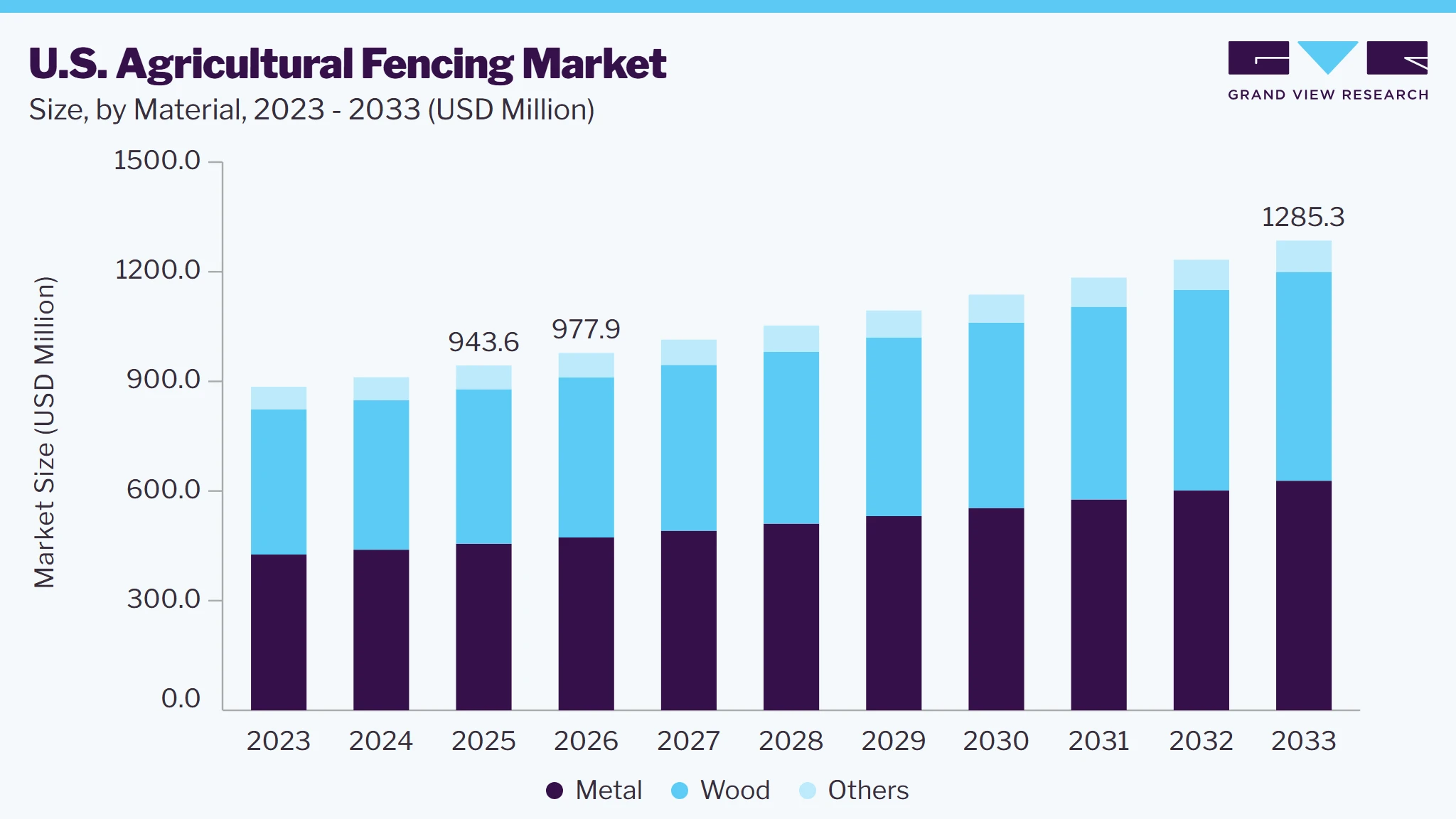 Source: Grand View Research, IR Documents, Primary Interviews, Paid DatabasesTo learn more about this report,
 Download Free Sample Report
Technology innovation is gradually changing the structure of the market from conventional physical barriers toward more flexible and technology-enabled livestock management solutions. Electrified fencing, high-tensile wire, improved coatings, corrosion-resistant materials, portable fencing, automated gates, remote monitoring, and GPS-enabled virtual fencing are gaining attention. Virtual fencing is particularly emerging as a complementary technology because GPS-enabled collars and software can establish livestock boundaries without installing continuous physical barriers. USDA initiatives in 2026 have specifically highlighted virtual fencing as an emerging approach to managing livestock, reducing conflicts with wildlife, and supporting rangeland conservation.
Market Dynamics
The U.S. agricultural fencing market is influenced by livestock production, pasture management, agricultural land consolidation, conservation programs, material durability requirements, labor availability, and technological advancement. While conventional fencing remains dominant because of its reliability and relatively straightforward installation, producers are increasingly evaluating fencing systems based on lifecycle cost, maintenance requirements, animal safety, environmental performance, and operational flexibility.
The growing U.S. population is contributing to higher demand for food products, including dairy and meat, grains and pulses, and fruits & vegetables. The U.S. population increased from approximately 332.1 million in 2021 to 341.8 million in 2025, creating additional demand for agricultural output. This growth, together with increasing demand for reliable domestic food production, is encouraging farmers and agricultural producers to improve productivity and invest in farm infrastructure.
As agricultural production expands, protecting crops, livestock, equipment, and other farm assets becomes increasingly important. Agricultural fencing provides a physical barrier that helps define farm boundaries, restrict unauthorized access, prevent livestock from straying, and limit damage caused by wildlife and predators. Fencing is particularly important for livestock operations, where secure enclosures are required for controlled grazing and animal management.
The cost of raw materials remains a major concern for agricultural fencing manufacturers, as fluctuations in input prices can significantly affect production costs and profit margins. Agricultural fencing products are manufactured using materials such as steel, iron, aluminum, wood, PVC, and other polymers, making manufacturers susceptible to fluctuations in commodity and material prices. Rising raw material prices increase manufacturing costs and may compel manufacturers to adjust product prices, modify material specifications, or substitute lower-cost materials to remain competitive.
The emergence of virtual fencing represents a significant opportunity for market participants to expand beyond conventional physical fencing. GPS-enabled collars, geofencing software, livestock tracking, and remote monitoring can enable producers to control grazing boundaries while reducing the need for permanent physical infrastructure. These systems can also support coexistence with wildlife, targeted grazing, and more flexible pasture management. USDA conservation initiatives are increasingly recognizing virtual fencing as an emerging technology for improving rangeland health and ranch viability.
Market Concentration & Characteristics
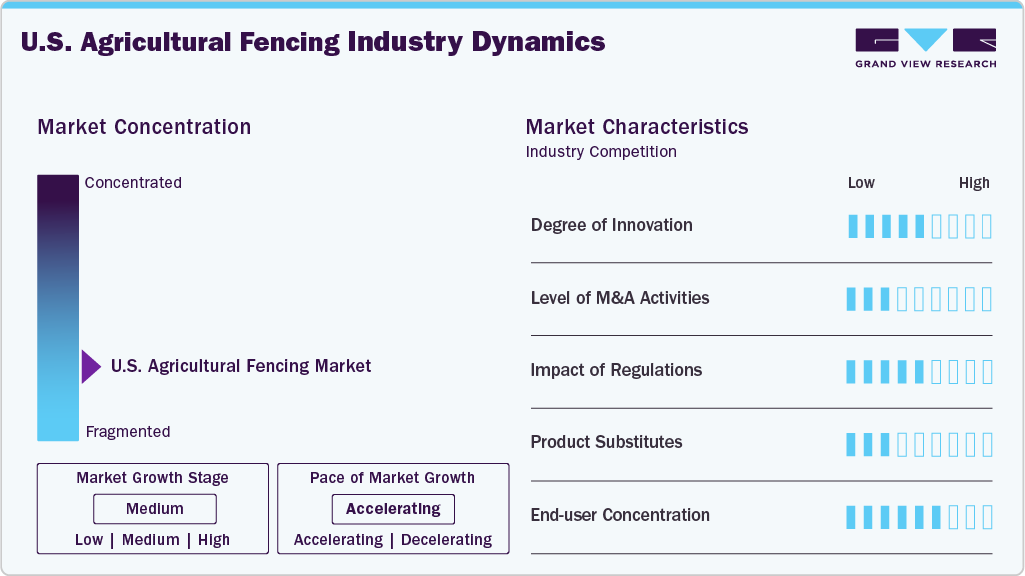
The U.S. agricultural fencing market is moderately fragmented, with participation from large fencing-material manufacturers, wire and hardware producers, agricultural equipment suppliers, regional fencing companies, distributors, installers, and specialized livestock-management technology providers. Traditional fencing remains highly localized because installation requirements vary according to livestock species, terrain, climate, land size, and regional agricultural practices. At the same time, established manufacturers benefit from extensive distribution networks and recognized product portfolios, while technology-oriented companies are creating new competitive segments in electric, remote-monitoring, and virtual-fencing solutions.
 To learn more about this report, Download Free Sample Report
The threat of substitutes is moderate in the U.S. agricultural fencing industry because agricultural fencing serves several functions that are difficult to fully replace, particularly livestock containment, property demarcation, and crop protection. However, alternatives such as natural barriers, hedgerows, ditches, temporary barriers, electric systems, and virtual fencing can substitute for conventional permanent fencing in selected applications. Virtual fencing presents the strongest emerging substitute because it can establish livestock boundaries through GPS-enabled systems without requiring continuous physical fencing. Nevertheless, physical fencing is expected to remain essential for permanent property boundaries, high-security livestock containment, and applications requiring reliable physical separation.
Analyst Perspective
The U.S. agricultural fencing market is expected to grow steadily, supported by continued livestock production, pasture management, agricultural land protection, and the replacement of aging fencing infrastructure. Demand is shifting toward durable, low-maintenance, and cost-efficient solutions, particularly metal and high-tensile fencing systems that can withstand demanding farm and ranch conditions. Livestock applications are expected to remain the core demand segment, while equine and specialty agriculture applications provide additional opportunities. Increasing adoption of rotational grazing, conservation practices, electric fencing, and emerging virtual fencing technologies is also reshaping the competitive landscape.
Material Insights
The metal fencing segment dominated the U.S. agricultural fencing industry in 2025, with a revenue share of 48.3%, driven by its extensive use on farms, ranches, and livestock operations for durable boundary protection and animal containment. Steel-based fencing is particularly favored because of its strength, flexibility, resistance to physical impact, and suitability for manufacturing wire-based systems. Metal fencing is widely used for cattle, pasture, field, and perimeter applications, while galvanized and coated products enhance corrosion resistance and extend service life.
The wood segment is expected to grow at a CAGR of 3.9% over the forecast period, supported by its long-standing use, availability, and suitability for farm applications. Common wood materials used for agricultural fencing include hardwood, cedar, mahogany, and pine, which offer a combination of strength and relatively lightweight construction. These characteristics make wood suitable for fencing applications where durability and ease of installation are important.
Product Insights
The cattle fence segment dominated the U.S. agricultural fencing industry with a revenue share of 25.4% in 2025, driven by its widespread use for cattle containment, pasture management, and farm boundary protection. Cattle fences are commonly used to secure grazing areas, control livestock movement, and prevent cattle from entering crop fields, roads, and other restricted areas. The segment includes high-tensile wire, woven wire, and other fencing configurations, with increasing emphasis on controlled grazing, livestock safety, and efficient ranch management expected to support demand over the forecast period.
The stable mesh fencing segment is expected to maintain a significant position in the U.S. agricultural fencing market, growing at a CAGR of 3.8% over the forecast period, supported by the country's large horse population and the need for secure containment systems. Stable fencing is primarily used to contain horses and prevent them from escaping or entering restricted areas. These fencing systems include rail or plank fences, high-tensile polymer fences, rubber fences, and mesh wire fences, which can be designed to provide sufficient height and strength for horse containment.
End Use Insights
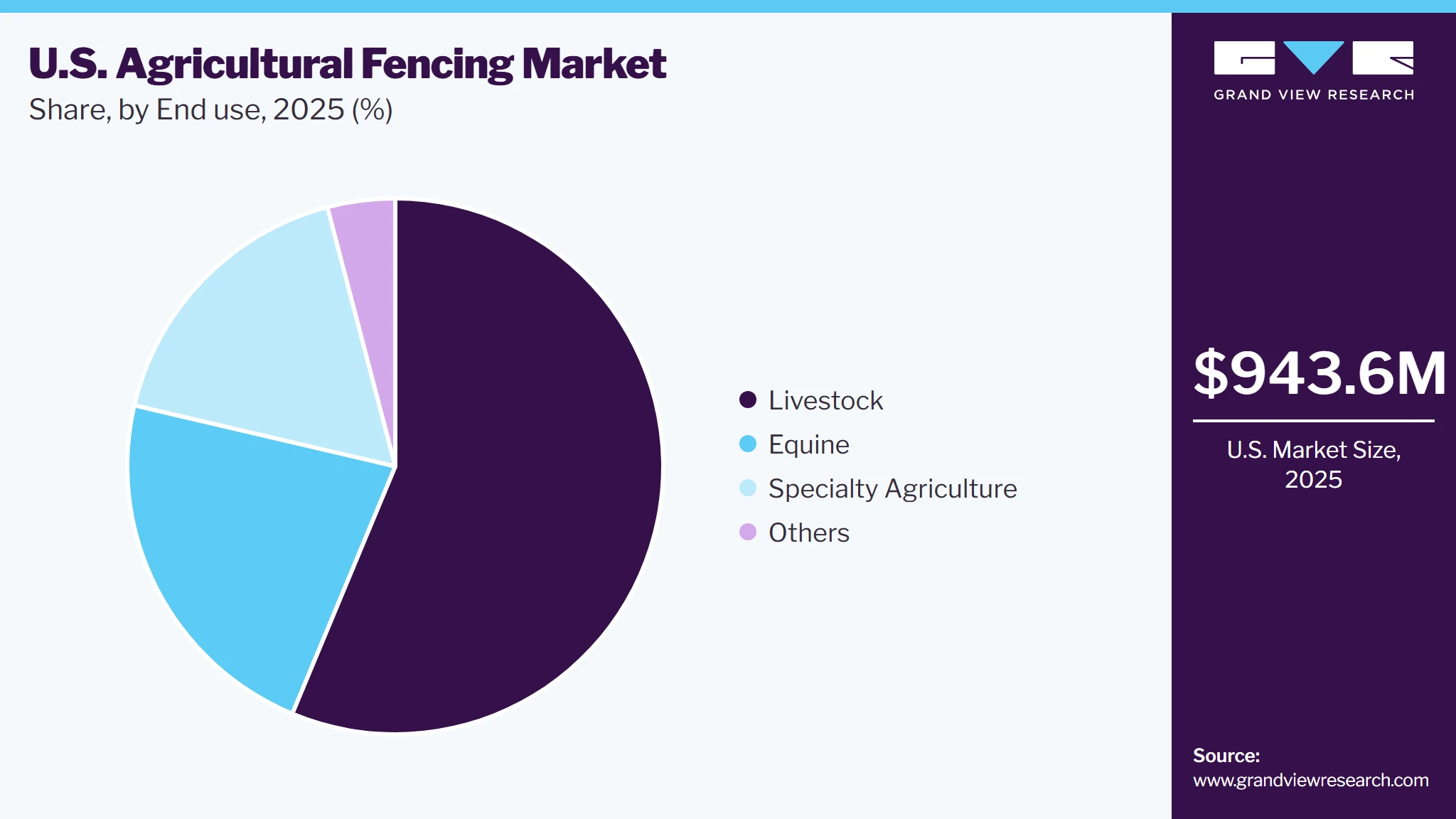
The livestock segment dominated agricultural fencing demand in 2025 with a revenue share of 56.3%, driven by the extensive use of fencing for cattle, dairy, swine, sheep, and other livestock operations. Fencing is essential for controlling grazing areas, preventing livestock from entering crops or roadways, protecting animals from predators, and supporting rotational grazing practices.
 To learn more about this report, Download Free Sample Report
The equine segment is expected to grow at the fastest CAGR of 4.6% over the forecast period, based on revenue. Fencing in equine applications is primarily used to contain horses, establish grazing and exercise areas, and protect animals from external threats. Horse fencing generally requires secure and appropriately designed barriers to reduce the risk of horses escaping or sustaining injuries. The U.S. has a well-established equine industry supported by recreational riding, breeding, racing, farm activities, and other equestrian uses.
Key U.S. Agricultural Fencing Company Insights
Some of the key players operating in the market include Bekaert and Red Brand.
-
Bekaert is a global wire and fencing solutions company offering agricultural fencing products such as barbed wire, field fence, high-tensile fencing, and livestock fencing. Its competitive strength comes from advanced wire technology, durable coatings, and a broad portfolio of agricultural products.
-
Red Brand is a well-established U.S. fencing brand specializing in agricultural and livestock fencing, including field fence, wire fencing, and related farm products. Its strong dealer network, brand recognition, and focus on livestock applications support its position in the U.S. market.
Master Halco and STAY TUFF FENCE are some of the emerging participants in the U.S. agricultural fencing market.
-
Master Halco is a major fencing manufacturer and distributor offering agricultural fencing solutions for cattle, horses, deer, sheep, goats, hogs, and other livestock applications. Its broad product range and extensive distribution network provide strong market reach.
-
STAY TUFF FENCE specializes in high-tensile fixed-knot fencing designed for livestock, wildlife, and agricultural applications. Its product differentiation is based on strength, durability, long service life, and reduced maintenance requirements.
Key U.S. Agricultural Fencing Companies
-
Bekaert
-
Red Brand
-
Oklahoma Steel & Wire, Inc.
-
Midwest Air Technologies Inc.
-
San Antonio Steel Company
-
Tornado Wire Ltd
-
STAY TUFF FENCE
-
Master Halco
-
Seegars Fence Company
-
Kingdom Fence & Supply
Competitive Benchmarking
Category
Operating Strategies
Competitive Edge
Weakness
Established Players Bekaert, Red Brand, Oklahoma Steel & Wire, Inc., Midwest Air Technologies Inc., San Antonio Steel Company, Tornado Wire Ltd
- Invest in high-strength, galvanized, and corrosion-resistant fencing.
- Expand dealer and agricultural distribution networks.
- Focus on durable and livestock-specific fencing solutions.
- Strong brands and manufacturing capabilities.
- Broad agricultural fencing portfolios.
- Established distribution and customer relationships.
- Higher operating and distribution costs.
- Exposure to steel price fluctuations.
- Competition from alternative and smart fencing solutions.
Emerging Players STAY TUFF FENCE, Master Halco, Seegars Fence Company, Kingdom Fence & Supply
- Develop specialized livestock and agricultural fencing.
- Focus on high-strength and low-maintenance products.
- Strengthen regional dealer and contractor networks.
- Strong specialization in agricultural fencing.
- Flexible, application-specific product offerings.
- Strong regional customer relationships.
- Limited geographic reach and production scale.
- Dependence on distributors and suppliers.
- Challenges in competing on price and scaling operations.
Recent Developments
-
In May 2025, Seegars Fence Company announced its expansion into Augusta, Georgia, marking the company's first branch in the state. The expansion extended Seegars' geographic footprint beyond North Carolina and South Carolina, strengthening its ability to serve customers across the Southeast. Seegars' portfolio includes Farm & Ranch Fences, making the expansion relevant to the broader agricultural fencing market.
-
In June 2024, Master Halco acquired US Vinyl Fence and Forest Product Sales in Salt Lake City, Utah. The company stated that the acquisition brought new talent, strengthened its supply capabilities, and established a new home for its Salt Lake City branch. Master Halco is a major North American fencing manufacturer and distributor with agricultural fencing in its portfolio.
U.S. Agricultural Fencing Market Report Scope
Report Attribute
Details
Market size in 2025
USD 943.6 million
Estimated market size in 2026
USD 977.9 million
Projected market size by 2033
USD 1,285.3 million
Growth rate
CAGR of 4.0% from 2026 to 2033
Base year for estimation
2025
Actual estimates/Historical data
2021 - 2024
Forecast period
2026 - 2033
Quantitative units
Revenue in USD million, volume in million linear feet, and CAGR from 2026 to 2033
Report coverage
Revenue forecast, volume forecast, company ranking, competitive landscape, growth factors, and trends
Segments covered
Material, product, and end use
Country scope
U.S.
Key companies profiled
Bekaert; Red Brand; Oklahoma Steel & Wire, Inc.; Midwest Air Technologies Inc.; San Antonio Steel Company; Tornado Wire Ltd; STAY TUFF FENCE; Master Halco; Seegars Fence Company; Kingdom Fence & Supply
Customization scope
Free report customization (equivalent up to 8 analysts working days) with purchase. Addition or alteration to country, regional & segment scope.
Pricing and purchase options
Avail customized purchase options to meet your exact research needs. Explore purchase options
U.S. Agricultural Fencing Market Report Segmentation
This report forecasts revenue & volume growth at the country level and provides an analysis of the industry trends in each of the sub-segments from 2021 to 2033. For this study, Grand View Research has segmented the U.S. agricultural fencing market report based on material, product, and end use:
-
Material Outlook (Volume, Million Linear Feet; Revenue, USD Million, 2021 - 2033)
-
Metal
-
Wood
-
Others
-
-
Product Outlook (Volume, Million Linear Feet; Revenue, USD Million, 2021 - 2033)
-
Barbed Wire
-
Cattle Fence
-
Field Fence
-
Stable Mesh Fencing
-
Others
-
-
End Use Outlook (Volume, Million Linear Feet; Revenue, USD Million, 2021 - 2033)
-
Livestock
-
Equine
-
Specialty Agriculture
-
Others
-
Research Methodology
The U.S. agricultural fencing market figures in this report are based on a proven research process that combines executive interviews with secondary research from proprietary databases, company filings, and recognized regulatory and institutional sources. Market size is built through value-chain sizing-reconciling supply-side and demand-side estimates-and triangulated with bottom-up and top-down approaches. Every estimate passes multiple levels of expert validation before publication, with each U.S. agricultural fencing segment quantified using the revenue-capture definitions in the table below.
Segment Definition
Material
Revenue capture definition
Metal
Revenue generated from the sale of agricultural fencing products manufactured primarily from metal materials, including steel, galvanized steel, aluminum, and other metal alloys, used for livestock containment, property boundaries, pasture management, and crop protection.
Wood
Revenue generated from the sale of agricultural fencing products manufactured primarily from wood, including wooden posts, rails, boards, and other wood-based fencing components used for livestock containment, equine applications, agricultural boundaries, and farm infrastructure.
Others
Revenue generated from the sale of agricultural fencing products manufactured from materials other than metal and wood, including plastic, composite, fiberglass, synthetic, and other alternative materials used for agricultural fencing applications.
Product
Revenue capture definition
Barbed Wire
Revenue generated from the sale of barbed-wire fencing products used for livestock containment, perimeter fencing, pasture boundaries, and agricultural property protection.
Cattle Fence
Revenue generated from the sale of cattle fencing products, including cattle panels, cattle wire fencing, and other fencing systems specifically designed for cattle containment and management.
Field Fence
Revenue generated from the sale of field fencing products, including woven-wire and mesh fencing systems used for livestock containment, pasture division, property boundaries, and agricultural applications.
Stable Mesh Fencing
Revenue generated from the sale of stable mesh fencing products used primarily for horse stables, paddocks, barns, livestock enclosures, and equine facilities.
Others
Revenue generated from the sale of agricultural fencing products not classified under barbed wire, cattle fence, field fence, or stable mesh fencing, including electric, temporary, portable, and specialty fencing systems.
End Use
Revenue capture definition
Livestock
Revenue generated from the sale of agricultural fencing products used for livestock applications, including cattle, sheep, goats, swine, poultry, and other farm animals, for containment, pasture management, grazing control, and movement management.
Equine
Revenue generated from the sale of agricultural fencing products used for equine applications, including horse farms, stables, paddocks, riding facilities, and other horse-management areas.
Specialty Agriculture
Revenue generated from the sale of agricultural fencing products used in specialty agricultural applications, including orchards, vineyards, nurseries, specialty crop farms, and other agricultural operations requiring dedicated fencing systems.
Others
Revenue generated from the sale of agricultural fencing products used in other agricultural applications not classified under livestock, equine, or specialty agriculture, including farm boundaries, wildlife protection, conservation areas, and other agricultural uses.
Estimation Model
Layer Name
Key Question
Description
Parent Market Analysis
What is the overall size and growth outlook of the U.S. fencing, agricultural fencing, livestock fencing, and farm infrastructure markets?
The estimation begins by evaluating the broader U.S. fencing and agricultural fencing markets. Agricultural land area, livestock operations, pastureland, ranching activities, farm infrastructure investments, fencing replacement requirements, fencing installations, material consumption, and demand for livestock and agricultural property protection are analyzed to establish the total addressable market for U.S. agricultural fencing.
Agriculture Fencing Product Penetration Analysis
What proportion of the overall U.S. fencing market is represented by agriculture fencing across materials and product types?
This layer estimates the penetration of agriculture fencing within the broader U.S. fencing market. Adoption is assessed across metal, wood, and other materials and further evaluated across barbed wire, cattle fence, field fence, stable mesh fencing, and other agricultural fencing products. Product usage, fencing applications, installation requirements, durability, replacement cycles, and material preferences are analyzed to determine the contribution of agriculture fencing to the overall fencing market.
End-use & Agricultural Demand Assessment
Which agricultural end-use applications contribute the highest demand for agriculture fencing in the U.S.?
Market demand is evaluated across major agricultural end uses based on livestock populations, ranching and farming activities, pasture management, equine operations, specialty agriculture, agricultural land characteristics, and fencing requirements. Demand is further assessed across livestock, equine, specialty agriculture, and other agricultural applications to determine end-use-level penetration and fencing consumption in the U.S.
Company Revenue Validation & Market Forecasting
How is the final market size validated and forecast?
Final estimates are validated using company revenues, fencing product sales, manufacturing and production capacities, product portfolios, material consumption, distribution networks, installation volumes, replacement demand, manufacturing facilities, expansion plans, acquisitions, and new product launches. Bottom-up and top-down approaches are triangulated using company-level, product-level, material-level, end-use, and agricultural industry data to generate reliable market estimates and forecasts for the U.S. agricultural fencing market.
Delivered Customizations
We have successfully delivered the following deep-dive customizations:
Client Request
Customization Delivered
Value Adds
Technology & Smart Fencing Opportunity Assessment
Evaluate adoption of electric fencing, high-tensile systems, portable fencing, automated gates, remote monitoring, GPS-enabled livestock management, and virtual fencing technologies based on technology maturity, application suitability, operational benefits, and commercialization.
Helps manufacturers and technology providers identify emerging growth opportunities and assess how smart and flexible fencing solutions can complement or substitute conventional agricultural fencing systems.
Sustainability & Conservation Opportunity Assessment
Evaluate the influence of USDA conservation programs, rotational grazing, pasture management, wildlife protection, water-quality initiatives, sustainable livestock practices, and resource-efficient agricultural systems on fencing adoption.
Helps identify conservation-driven demand opportunities and understand how sustainable agricultural practices can support the adoption of specialized fencing systems.
Agricultural Fencing Demand & Application Assessment
Analyze demand for agricultural fencing across livestock, equine, specialty agriculture, and other agricultural applications, including livestock management, pasture division, property boundaries, crop protection, and conservation applications.
Helps identify the largest demand-generating applications and understand the key operational requirements influencing fencing adoption across U.S. farms, ranches, and agricultural properties.
Frequently Asked Questions About This Report
The cattle fence segment held the highest revenue market share of 25.4% in 2025, due to its widespread use for livestock containment, pasture management, rotational grazing, and perimeter protection across cattle farms and ranches in the U.S.
The metal segment is the fastest-growing material in the U.S. agricultural fencing market.
The equine segment is the fastest growing end use in the U.S. agricultural fencing market.
The livestock segment accounted for the largest revenue share, at 56.3%, in 2025, driven by the extensive use of fencing for animal containment, pasture management, rotational grazing, property boundaries, and livestock movement control, particularly in cattle and other large-scale livestock operations.
The U.S. agricultural fencing market size was valued at USD 943.6 million in 2025 and is estimated at USD 977.9 million for 2026.
The U.S. agricultural fencing market is expected to grow at a CAGR of 4.0% from 2026 to 2033, reaching USD 1,285.3 million by 2033.
The metal segment accounted for the highest revenue share of 48.3% in 2025, due to its high durability, strength, weather resistance, long service life, and suitability for livestock containment and large-scale farm boundary applications.
Some key players in the U.S. agricultural fencing market include Bekaert, Red Brand, Oklahoma Steel & Wire, Inc., Midwest Air Technologies Inc., San Antonio Steel Company, Tornado Wire Ltd, STAY TUFF FENCE, Master Halco, Kingdom Fence & Supply, and Seegars Fence Company.
Increasing livestock production, expansion of rotational grazing and pasture management, replacement of aging fencing infrastructure, growing adoption of durable and high-tensile fencing, USDA conservation programs supporting fencing installations, and rising interest in electric and virtual fencing technologies.
About the Author(s)
Advanced Interior Materials Research Team
Advanced Materials · Advanced Interior MaterialsThis report was authored by the advanced interior materials research team at Grand View Research - comprising two research analysts, one senior research analyst, and one industry expert - with specialized expertise in the advanced interior materials segment of the advanced materials industry. All findings are based on proprietary advanced materials databases, executive interviews, and regulatory analysis, subject to internal peer review prior to publication.
Last Updated:
Speak to Analyst

Customize this report to your needs - add regions, segments, or data points, with 20% free customization.
Or view our licence options:


ISO 9001:2015 & 27001:2022 Certified
We are GDPR and CCPA compliant! Your transaction & personal information is safe and secure. For more details, please read our privacy policy.


