
- Home
- »
- Healthcare IT
- »
-
U.S. AI In Medical Scribing Market, Industry Report, 2033GVR Report cover

U.S. AI In Medical Scribing Market (2025 - 2033) Size, Share & Trends Analysis Report By Deployment Mode (Cloud-based, On-premises), By Application (General Documentation, Specialty Documentation), By End-use (Hospitals, Clinics), By Region, And Segment Forecasts
U.S. AI In Medical Scribing Market Summary
The U.S. AI in medical scribing market size was estimated at USD 397.05 million in 2024 and is projected to reach USD 2,955.72 million by 2033, growing at a CAGR of 25.09% from 2025 to 2033. The rising clinical documentation burden, increasing workforce shortages and burnout among clinicians, and the expansion of telehealth and virtual care are significant factors contributing to market growth.
Key Market Trends & Insights
- By deployment mode, the cloud-based segment led the market with the largest revenue share of 78.51% in 2024.
- By application, the general documentation segment led the market with the largest revenue share 48.19% in 2024.
- By end use, the hospitals segment led the market with the largest revenue share of 54.44% in 2024.
Market Size & Forecast
- 2024 Market Size: USD 397.05 Million
- 2033 Projected Market Size: USD 2,955.72 Million
- CAGR (2025-2033): 25.09%
Three ways to get this report
Buy it, customize it, or ask a question.Ask an Analyst
Analyst response in 1 business day
- AccessReport author, directly
- Reply timeWithin 1 working day
- No sales callDirect answer only
- FormatEmail reply
- CostFree, no cost
Get the Full Report
What the study covers
- FormatsPDF · Excel · Dashboard
- Timeline2025–2033 annual, 2024 base
- Coverage20+ countries, 5 regions
- Companies10+ key players profiled
Customize the Report
20% free customization
- IncludeCountries, segments, points
- TailorTo your product definition
- ExtendDeeper competitor detail
- OrA fully bespoke study
- Turnaround5–10 working days
In addition, EHR integration and workflow automation, and advancements in ambient and generative AI technologies are some other factors fueling market growth further. The increasing volume of clinical documentation remains one of the most significant operational challenges in modern healthcare. Hospitals, clinics, and ambulatory centers require clinicians to record extensive patient information, including medical histories, diagnostic findings, treatment plans, medication notes, care coordination summaries, and compliance-related entries. Physicians frequently spend more time on documentation than direct patient care, creating inefficiencies that disrupt clinical productivity. For instance, a national survey series led by Stanford and the AMA found that 45.2% of U.S. physicians reported at least one symptom of burnout in 2023, down from 62.8% in 2021 but still substantially higher than in many other occupations. These burdens consume clinical time and reduce workflow efficiency, driving the need for automation.In addition, the Association of American Medical Colleges predicts the U.S. is likely to face a deficit of 86,000 physicians by 2036. The interplay between workforce shortages and burnout has created an urgent need for sustainable redesign of clinical workflows. AI-powered medical scribing systems are crucial to this transformation, providing scalable support that adapts to the needs of clinicians across diverse care settings. These systems capture patient-clinician interactions in real time, interpret medical terminology through advanced NLP, and generate structured documentation that integrates seamlessly with EHR platforms.
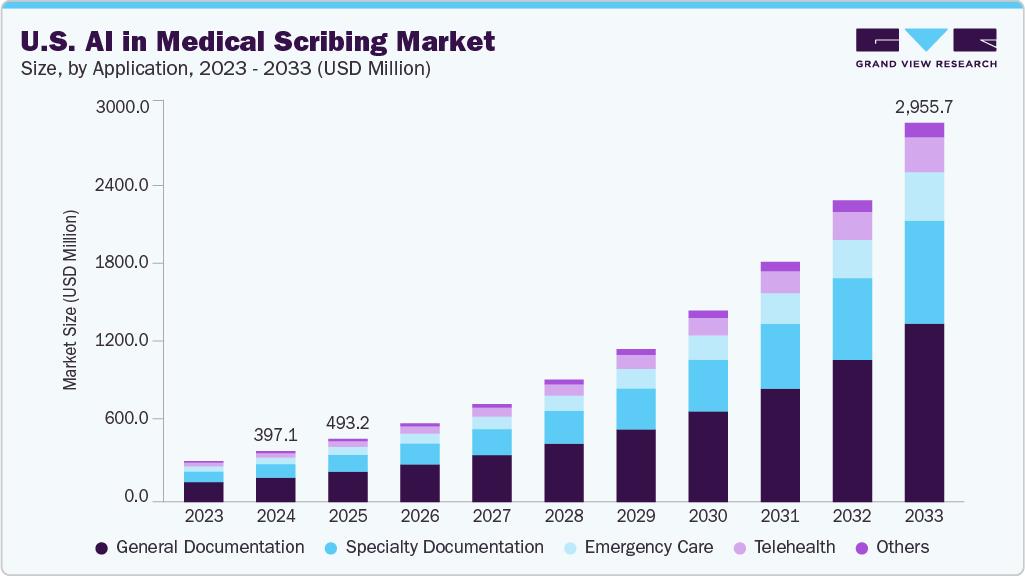 Source: Grand View Research, IR Documents, Primary Interviews, Paid DatabasesTo learn more about this report,
 Download Free Sample Report
Moreover, the expansion of telehealth and virtual care further contributes to market growth. Telehealth and hybrid care models are now embedded in service lines such as primary care, behavioral health, and chronic disease management. During virtual visits, clinicians must manage technology, maintain rapport, and document care simultaneously, thereby increasing cognitive and administrative demands. AI medical scribes capture audio from telehealth platforms, generate structured notes, and automatically enter them into the EHR. This enables clinicians to focus on patient communication and clinical coordination while documentation is managed in the background. For instance, in July 2023, Teladoc Health expanded its partnership with Microsoft to integrate AI-powered clinical documentation tools into its telehealth platform.
“Administrative burden and staff shortages are major reasons why clinicians are leaving the profession. We are focused on using AI to reassert and build the doctor-patient relationship at a time when technology frequently does the opposite.”
-Vidya Raman-Tangella, Teladoc’s chief medical officer
Similarly, in October 2024, Zoom partnered with Suki, an AI medical scribe platform, to integrate automated note-taking into its telehealth services. This tool enables doctors to generate notes during virtual visits, reducing paperwork time and boosting efficiency.
Furthermore, advances in speech recognition, large language models, and domain-specific natural language processing have pushed AI scribing from experimental pilots to production-grade deployments. Modern systems are able to handle overlapping speech, accents, and specialty‑specific terminology with higher accuracy than legacy dictation tools. Generative AI enables summarization, organization into SOAP or specialty‑specific note structures, and style adaptation to match institutional preferences. Ambient AI scribing employs passive audio capture to autonomously generate clinical documentation with minimal user intervention. This advanced capability eliminates the need for manual error correction, thereby enhancing operational efficiency and scalability. Consequently, healthcare organizations are increasingly adopting these AI-driven solutions to replace or supplement traditional human scribes and manual dictation workflows, optimizing clinical documentation processes.
Market Concentration & Characteristics
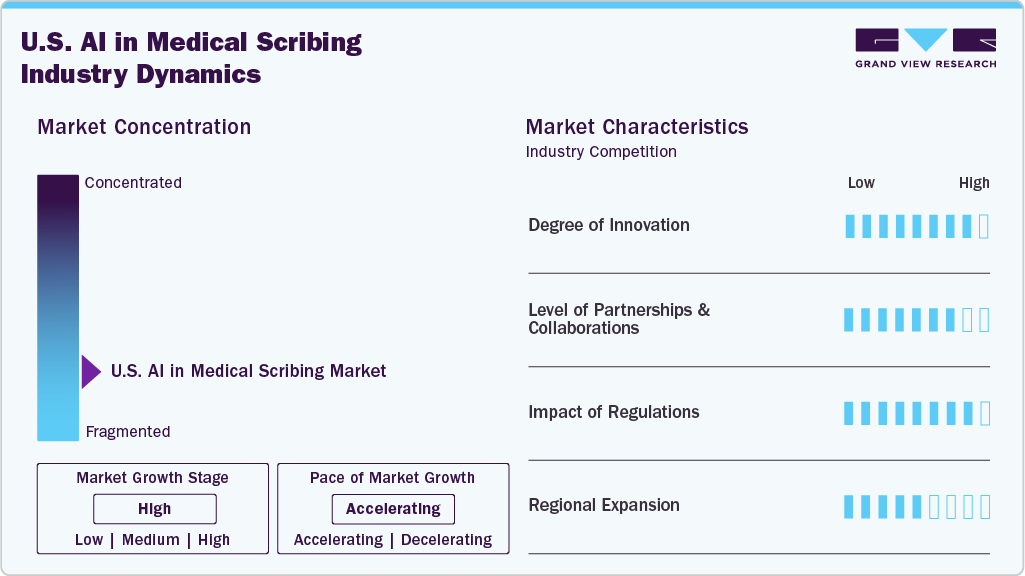
The chart below illustrates the relationship between industry concentration, industry characteristics, and industry participants. The x-axis represents the level of industry concentration, ranging from low to high. The y-axis represents various industry characteristics, including industry competition, level of partnerships & collaboration activities, degree of innovation, impact of regulations, and regional expansion. The U.S. AI in medical scribing industry is fragmented, with several emerging players entering the market, thereby contributing to increased competition within the market. The degree of innovation, the level of partnerships & collaborations, and the impact of regulations is high. However, the regional expansion of industry is moderate.
U.S. AI in medical scribing industry is characterized by constant innovation, with a strong focus on launching new platforms and devices to leverage administrative tasks, improve diagnostic accuracy, and enhance care delivery. Prominent players are launching advanced software to sustain a competitive advantage. For instance, in February 2023, Ambience Healthcare launched AutoScribe, a fully automated AI-powered medical scribe that captures patient visit nuances without the need for human scribes. It integrates seamlessly into EMR workflows, generating real-time notes for immediate review, editing, and sign-off while preserving the provider's workflow.
 To learn more about this report, Download Free Sample Report
“While building a primary care practice at our previous company, we saw our providers burning out from spending over two hours a day entering data into the EMR. We tried every solution we could find-dictation, templates, phrase expanders, and even virtual scribes that claimed to be ‘powered by AI’-but nothing truly worked for our providers,”
-Ambience Healthcare Co-founder and CEO Mike Ng.
“We founded Ambience with the goal of creating that elusive holy grail: an ambient, AI system that generates high-quality documentation in real-time so that providers can purely focus on providing patient care; a system that is always available, scalable at the cost of software, and self-improves over time.”
The industry is experiencing a moderate level of merger and acquisition activities undertaken by several key players. This is due to the desire to gain a competitive advantage in the industry, enhance technological capabilities, and consolidate in a rapidly growing market.
The regulatory framework for the U.S. AI in medical scribing industry is primarily governed by the Health Insurance Portability and Accountability Act (HIPAA), which mandates strict data security and privacy standards for any tool handling protected health information (PHI). Healthcare providers must enter into Business Associate Agreements (BAAs) with AI scribe vendors to ensure compliance and accountability for safeguarding patient data.
The industry is witnessing moderate geographical expansion. Companies within the U.S. AI in medical scribing industry seek geographic expansion strategies to maintain their foothold in the market. For instance, in July 2024, Nabla, an ambient AI scribe company, partnered with Illinois-based Carle Health to deploy its AI scribe assist across hospitals, practices, and 1,500 providers, marking entry into the midwestern U.S. market. The rollout includes emergency departments and 80 specialist types.
Deployment Mode Insights
Based on deployment mode, the cloud-based segment held the largest market share of 78.51%. In addition, this segment is expected to grow at the fastest CAGR during the forecast period. Cloud-based platforms enable rapid deployment, automatic updates, and access from any location, making them particularly attractive for healthcare providers seeking to reduce administrative burdens and improve clinical documentation efficiency.
In addition, cloud-based solutions eliminate the need for substantial upfront investments in hardware and IT infrastructure, lowering barriers to entry for small and medium-sized healthcare organizations. Moreover, they offer easy integration with Electronic Health Records (EHRs) and other cloud-based healthcare applications, supporting streamlined workflows and real-time data access. Such factors contribute to the segment’s growth.
Application Insights
Based on application, the general documentation segment held the largest market share of 48.19% in 2024. General documentation solutions are designed for broad applicability, supporting a wide range of medical specialties and workflows. Their flexibility and ease of integration with electronic health records (EHRs) make them the default choice for hospitals, clinics, and individual practitioners seeking to streamline administrative tasks and reduce physician burnout. The high volume and regulatory importance of general documentation drive demand, making it the most adopted segment in the AI medical scribing ecosystem.
The specialty documentation segment is anticipated to grow at the fastest CAGR over the forecast period due to rising demand for highly tailored solutions that address the unique workflows, terminology, and regulatory requirements of specific clinical specialties such as oncology, cardiology, and behavioral health. For instance, in July 2024, Orchid launched a HIPAA-compliant AI-powered scribe for mental health providers, integrated natively with its EHR and compatible with other EHRs via a Chrome extension. The tool automates clinical note-taking, reducing documentation time from up to 20 minutes to seconds per session. It supports voice recording with patient consent, dictation, and secure data storage in AWS.
End-use Insights
Based on end use, the hospitals segment held the largest market share of 54.44% in 2024 due to high patient volumes, complex clinical workflows, and stringent documentation requirements. Hospitals manage large numbers of patients and require extensive, accurate documentation across multiple specialties, making AI scribing solutions essential for streamlining workflows, reducing administrative burdens, and ensuring regulatory compliance. Hospitals also benefit from the scalability and interoperability of AI scribing platforms, which integrate seamlessly with enterprise EHR systems and support multidisciplinary teams. For instance, in February 2025, John Muir Health (JMH) implemented Ambience Healthcare’s AI scribing platform enterprise-wide. The platform is also expanding to UCSF Health, St. Luke’s, and Memorial Hermann Health Systems. JMH is noted as the first major system with fully integrated ambient AI in Epic workflows.
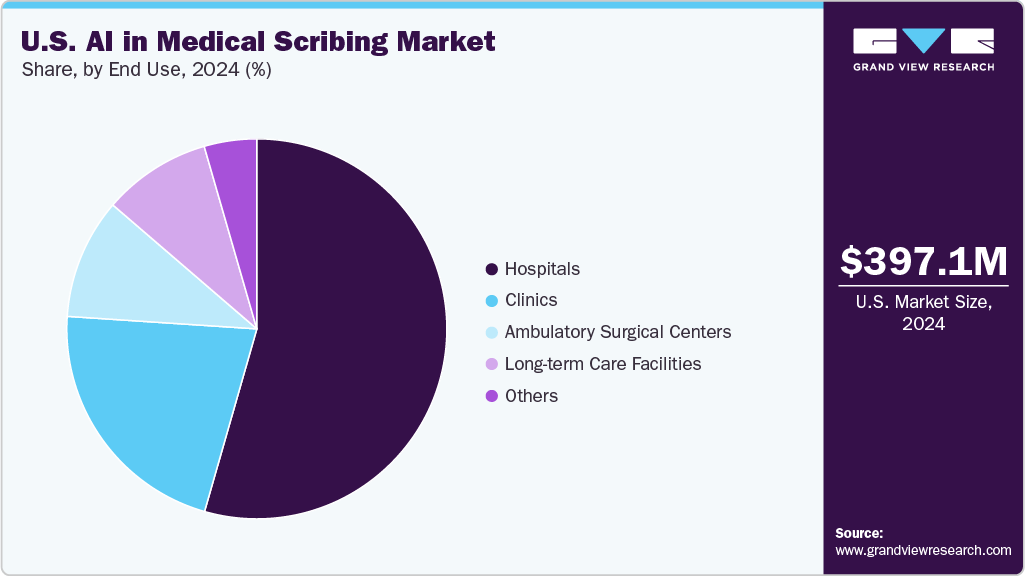 To learn more about this report, Download Free Sample Report
The clinics segment is expected to grow at the fastest CAGR over the forecast period. Clinics often operate with limited administrative resources and face significant time constraints, making automation of clinical documentation valuable for improving productivity and patient care quality. Moreover, the flexibility and affordability of cloud-based AI solutions lower entry barriers for smaller practices, supporting rapid adoption and scalability across diverse specialties and care models.
Key U.S. AI In Medical Scribing Company Insights
Key players operating in the U.S. AI in medical scribing industry are undertaking various initiatives to strengthen their market presence and increase the reach of their products and services. Strategies such as new product launches and partnerships play a key role in propelling market growth.
Key U.S. AI In Medical Scribing Companies:
- Microsoft
- Suki AI, Inc.
- DeepScribe
- COMMURE Incorporated
- Tali AI
- Ambience Healthcare
- AQuity Solution (acquired by IKS Health)
- Cliniko
- Dorascribe
- MedicalMine - CharmHealth
- Eleos Health
- Empathia AI, Inc.
- Tebra
- Heidi
- Sunoh.ai (healow)
Recent Developments
-
In September 2025, Headway expanded its EHR platform for mental health providers, integrating AI-assisted note-taking and embedded telehealth capabilities. The unified system combines scheduling, documentation, billing, and client communication, reducing administrative burden. It is free, HIPAA-compliant, and designed to streamline workflows, enabling providers to focus more on patient care and less on paperwork.
-
In July 2025, Doximity launched a free AI medical scribe for verified U.S. physicians, NPs, PAs, and students. The HIPAA-compliant tool supports in-person/virtual care on desktop/mobile, integrates with Dialer telehealth, and offers free access/onboarding to charitable clinics.
"This functionality has the potential to be especially useful for physicians and free clinics that rely on virtual care to reach patients across various locations. For the first time in over a decade, there's genuine hope that physician burnout and information overload can actually be eased with technology."
-Jeff Tangney, co-founder and CEO of Doximity
-
In February 2025, the Cleveland Clinic announced the rollout of Ambience Healthcare’s AI platform for documentation, clinical documentation integrity, and point-of-care coding across ambulatory U.S. providers.
-
In April 2024, Commure launched Commure Scribe, a free AI-powered tool that automates documentation and generates SOAP notes directly within existing Electronic Medical Records (EMRs).
U.S. AI In Medical Scribing Market Report Scope
Report Attribute
Details
Market size value in 2025
USD 493.15 million
Revenue forecast in 2033
USD 2,955.72 million
Growth rate
CAGR of 25.09% from 2025 to 2033
Actual data
2021 - 2024
Forecast period
2025 - 2033
Quantitative units
Revenue in USD million/billion, and CAGR from 2025 to 2033
Report coverage
Revenue forecast, company ranking, competitive landscape, growth factors, and trends
Segments covered
Deployment mode, application, end-use
Country scope
U.S.
Key companies profiled
Microsoft; Suki AI, Inc.; DeepScribe; COMMURE Incorporated; Tali AI; Ambience Healthcare; AQuity Solution (acquired by IKS Health); Cliniko; Dorascribe; MedicalMine - CharmHealth; Eleos Health; Empathia AI, Inc.; Tebra; Heidi; Sunoh.ai (healow)
Customization scope
Free report customization (equivalent up to 8 analysts working days) with purchase. Addition or alteration to country, regional & segment scope.
Pricing and purchase options
Avail customized purchase options to meet your exact research needs. Explore purchase options
U.S. AI In Medical Scribing Market Report Segmentation
This report forecasts revenue growth at global, regional, and country levels and provides an analysis of the latest industry trends in each of the sub-segments from 2021 to 2033. For this study, Grand View Research has segmented the U.S. AI in medical scribing market report based on deployment mode, application, and end-use.
-
Deployment Mode Outlook (Revenue, USD Million, 2021 - 2033)
-
Cloud-based
-
On-premises
-
-
Application Outlook (Revenue, USD Million, 2021 - 2033)
-
General Documentation
-
Specialty Documentation
-
Emergency Care
-
Telehealth
-
Others
-
-
End-use Outlook (Revenue, USD Million, 2021 - 2033)
-
Hospitals
-
Clinics
-
Ambulatory Surgical Centers
-
Long-term Care Facilities
-
Others
-
About the Author(s)
Healthcare IT Research Team
Healthcare · Healthcare ITThis report was authored by the healthcare it research team at Grand View Research - comprising two research analysts, one senior research analyst, and one industry expert - with specialized expertise in the healthcare it segment of the healthcare industry. All findings are based on proprietary healthcare databases, executive interviews, and regulatory analysis, subject to internal peer review prior to publication.
Last Updated:
Speak to Analyst

Customize this report to your needs - add regions, segments, or data points, with 20% free customization.
Or view our licence options:


ISO 9001:2015 & 27001:2022 Certified
We are GDPR and CCPA compliant! Your transaction & personal information is safe and secure. For more details, please read our privacy policy.


