
- Home
- »
- Medical Devices
- »
-
U.S. Anti-biofilm Wound Dressing Market Size Report, 2030GVR Report cover

U.S. Anti-biofilm Wound Dressing Market (2025 - 2030) Size, Share & Trends Analysis Report By Mode of Mechanism (Physical, Chemical, Biological), By Application (Chronic Wounds, Acute Wounds), By End-use, By Region, And Segment Forecasts
U.S. Anti-Biofilm Wound Dressing Market Summary
The U.S. anti-biofilm wound dressing market size was valued at USD 314.2 million in 2024 and is projected to reach USD 546.3 million by 2030, growing at a CAGR of 9.8% from 2025 to 2030. The market's growth can be attributed to the growing prevalence of chronic and acute wounds owing to the increase in chronic diseases, including diabetes, cancer, cardiovascular diseases, and other autoimmune diseases.
Key Market Trends & Insights
- By mechanism mode, the chemical segment held the highest market share of 45.2% in 2024.
- Based on application, the chronic wound segment held the highest market share in 2024.
- By end use, the hospitals segment held the highest market share in 2024.
Market Size & Forecast
- 2024 Market Size: USD 314.2 Million
- 2030 Projected Market Size: USD 546.3 Million
- CAGR (2025-2030): 9.8%
Prism AI by Grand View Research Free to tryAsk a question about the U.S. anti-biofilm wound dressing marketTry asking✓Every figure cited from GVR research Prefer the report? Download free sample →
According to the U.S. Centers for Disease Control and Prevention, as of 2021, over 38 million people, over 11% of the overall U.S. population, had diabetes. The country's increasing number of road accidents significantly contributes to the market's growth. According to the U.S. Department of Transportation’s National Highway Traffic Safety Administration, over 39,000 people died in road accidents in 2024. The growing number of road accidents increases the demand for wound care products with anti-biofilm properties, as these accidents can lead to severe burns and traumatic injuries. The increasing government and private investments in advanced wound care technologies to improve patient outcomes and lower healthcare costs further contribute to the market's growth.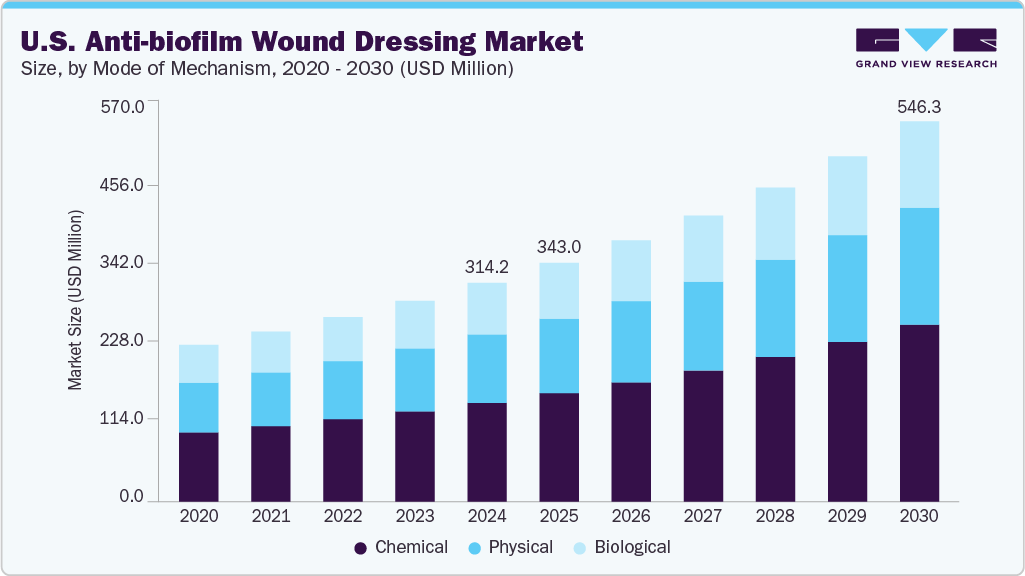 Source: Grand View Research, IR Documents, Primary Interviews, Paid DatabasesTo learn more about this report,
 Download Free Sample Report
Regulatory frameworks ensure safety and efficacy and promote the adoption of advanced antimicrobial dressings, while end-use concentration highlights the significance of key healthcare segments such as hospitals, specialty clinics, and outpatient clinics in driving demand.
Innovation remains crucial as companies invest heavily in R&D to develop dressings with enhanced anti-biofilm capabilities. In April 2025, Convatec announced its plans for the initial market launch of ConvaNiox, a new technology powered by a potent antimicrobial and antibiofilm agent, nitric oxide, which is supported by strong clinical evidence. ConvaNiox will be initially used for the management of diabetic foot ulcers (DFUs), which has been demonstrated to reduce the wound area three times faster and increase DFU healing by 60% in comparison to the standard of care.
The rising incidence of diabetes, alongside an aging demographic, further increases the demand, urging manufacturers to increase production and broaden their product ranges to cater to the sector's specific requirements. For instance, numerous companies have enhanced their manufacturing capabilities within the U. S. and fortified their distribution networks to serve healthcare providers better.
Mode of Mechanism Insights
The chemical mode of mechanism dominated the market with a revenue share of 45.2% in 2024, and it is also expected to be the fastest-growing product segment during the forecast period. Increased research and development initiatives have enhanced the discovery and formulation of novel chemical agents possessing anti-biofilm properties. Wounds treated with the hydrogel exhibited accelerated healing, and bacterial counts significantly decreased within the first three days, remaining low for the subsequent two weeks.
The physical mode of the mechanism is expected to witness lucrative growth during the forecast period. Chronic wounds often face complications due to biofilm formation, which hinders healing. With an aging population, there is a heightened demand for effective solutions targeting biofilms, such as manual and mechanical debridement. In addition, pulsed electrical fields and ultrasound therapies offer targeted biofilm disruption with minimal tissue damage, aligning with the growing preference for patient comfort and expedited healing.
Application Insights
The market is segmented based on application into chronic and acute wounds. The chronic wound segment accounted for the largest revenue share in 2024. Chronic wounds refer to wounds when there is no significant healing of an injury for over 4 weeks. Chronic wounds, including diabetic foot ulcers, venous leg ulcers, and pressure ulcers, are increasing in the country owing to an aging population and growing cases of diabetes and obesity. According to the United States Census Bureau, Americans over 65 years and older are expected to increase from 58 million in 2022 to 82 million by 2050. Also, the Obesity rates for U.S. adults were higher than 35 percent in 23 states in 2023, in comparison to 2012, when no state had an obesity rate of over 35 percent. These wounds are difficult to heal because biofilm formed on wound surfaces protects bacteria from antibiotics and the immune response. Anti-biofilm dressings help disturb these biofilms, improving healing rates, which is driving their demand in chronic wound care.
The acute wounds segment is expected to grow fastest during the forecast period. Acute wounds due to surgeries, trauma, or burns are at high risk of infection due to exposure to bacteria and potential biofilm formation. According to the American Burn Association, over 32,500 burn cases in 2023 and around 155,000 cases from 38 states over the five years in the U.S. required inpatient hospitalization at a burn center. Biofilms slow down the healing and increase the possibility of complications. Anti-biofilm dressings help in post-surgery or trauma to avert infection and improve the healing process, thus driving their adoption in acute wound care.
End Use Insights
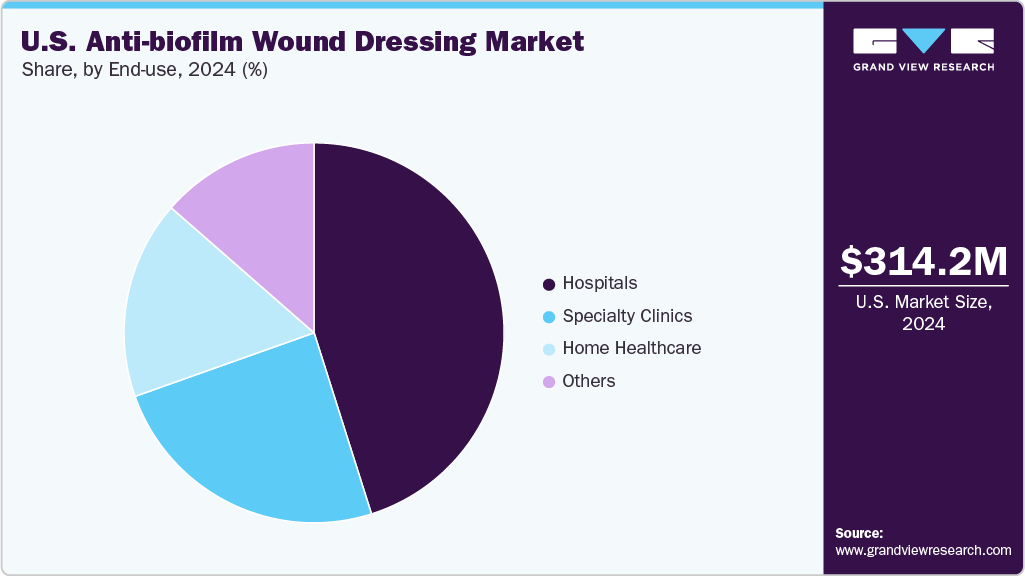
Based on end use, the market is segmented into hospitals, specialty clinics, home healthcare, and others. The hospitals segment accounted for the largest revenue share in 2024. Hospitals treat large numbers of patients with complex wounds, such as surgical wounds, pressure ulcers, and diabetic ulcers, which are susceptible to biofilm formation and can delay healing. Anti-biofilm wound dressing is critical in hospitals to stop bacterial infection and boost recovery. Additionally, hospitals focus on infection prevention due to strict regulatory standards and high costs associated with Healthcare-Associated Infections (HAIs). Anti-biofilm dressing reduces microbial load and biofilm-related infections, aligning with hospital protocols to reduce infection rates.
 To learn more about this report, Download Free Sample Report
The home healthcare segment is expected to witness the fastest CAGR during the forecast period. Patients' growing preference for wound care at home is primarily driven by convenience, comfort, and cost-effectiveness. These dressings allow patients to manage their wounds independently, reducing the need for repeated hospital visits.
Key U.S. Anti-biofilm Wound Dressing Company Insights
Some of the key players operating in the market are ConvaTec Inc., Smith & Nephew PLC, and Imbed Biosciences, Inc.
- ConvaTec Inc. concentrates on establishing strategic alliances with Integrated Delivery Networks (IDNs) and major hospital systems by providing comprehensive wound care packages that feature anti-biofilm dressings combined with ConvaTec’s negative pressure wound therapy (NPWT) and ancillary services.
Key U.S. Anti-biofilm Wound Dressing Companies:
- ConvaTec Inc.
- Smith & Nephew PLC
- Imbed Biosciences
- Next Science
- B. Braun Melsungen AG
- 3M
- Molnlycke Health Care AB
- Coloplast
- Lohmann & Rauscher
Recent Developments
-
In February 2025, HMP Global collaborated with the Alliance of Wound Care Stakeholders (AOWCS), a U.S.-based organization, to equip healthcare professionals with knowledge regarding the implications of the 2025 Medicare policy changes on wound care.
-
In October 2024, Imbed Biosciences obtained 510 (k) approval from the U. S. Food and Drug Administration to market Microlyte Ag/Lidocaine. This antimicrobial wound dressing incorporates lidocaine to alleviate painful skin injuries.
U.S. Anti-biofilm Wound Dressing Market Report Scope
Report Attribute
Details
Revenue forecast in 2030
USD 546.3 million
Growth rate
CAGR of 9.8% from 2024 to 2030
Base year for estimation
2024
Historical data
2018 - 2023
Forecast period
2025 - 2030
Quantitative units
Revenue in USD billion and CAGR from 2025 to 2030
Report coverage
Revenue forecast, company ranking, competitive landscape, growth factors, and trends
Segments covered
Mode of mechanism, application, end-use
Key companies profiled
ConvaTec Inc., Smith & Nephew PLC, Imbed Biosciences, Next Science, B. Braun Melsungen AG, 3M, Mölnlycke Health Care AB, Coloplast, Lohmann & Rauscher
Customization scope
Free report customization (equivalent up to 8 analysts working days) with purchase. Addition or alteration to country, regional & segment scope.
Pricing and purchase options
Avail customized purchase options to meet your exact research needs. Explore purchase options
U.S. Anti-biofilm Wound Dressing Market Report Segmentation
This report forecasts revenue growth at country level and provides an analysis of the latest industry trends in each of the sub-segments from 2018 to 2030. For this study, Grand View Research has segmented the U.S. anti-biofilm wound dressing market report based on mode of mechanism, application, and end-use:
-
Mode of Mechanism (Revenue, USD Million, 2018 - 2030)
-
Physical
-
Manual Debridement
-
Pulse Electrical Field
-
Ultrasound Debridement
-
-
Chemical
-
Ionic Silver
-
Iodine
-
EDTA
-
Others
-
-
Biological
-
Dispersin B
-
Lactoferrin
-
Bacteriophage
-
Others
-
-
-
Application Outlook (Revenue, USD Million, 2018 - 2030)
-
Chronic Wounds
-
Diabetic Foot Ulcers
-
Pressure Ulcers
-
Venous Leg Ulcers
-
Others
-
-
Acute Wounds
-
Surgical & Traumatic Wounds
-
Burn Wounds
-
-
-
End Use Outlook (Revenue, USD Million, 2018 - 2030)
-
Hospitals
-
Specialty Clinics
-
Home Healthcare
-
Others
-
About the Author(s)
Medical Devices Research Team
Healthcare · Medical DevicesThis report was authored by the medical devices research team at Grand View Research - comprising two research analysts, one senior research analyst, and one industry expert - with specialized expertise in the medical devices segment of the healthcare industry. All findings are based on proprietary healthcare databases, executive interviews, and regulatory analysis, subject to internal peer review prior to publication.
Last Updated:
Speak to Analyst

Customize this report to your needs - add regions, segments, or data points, with 20% free customization.
Or view our licence options:


ISO 9001:2015 & 27001:2022 Certified
We are GDPR and CCPA compliant! Your transaction & personal information is safe and secure. For more details, please read our privacy policy.


