
- Home
- »
- Consumer F&B
- »
-
U.S. Biscuits Market Size, Share & Trends Report 2026-2033GVR Report cover

U.S. Biscuits Market (2026 - 2033)
Size, Share & Trends Analysis Report By Type (Branded & Private Label), By Packaging (Pouches/ Packets, Boxes & Jars), By Distribution Channel (Hypermarkets & Supermarkets, Convenience Stores, Online), And Segment Forecasts
Market Size, 2025
$32.5BMarket Estimate, 2026
$34.0BMarket Forecast, 2033
$46.4BCAGR, 2026–2033
4.6%U.S. Biscuits Market Summary
The U.S. biscuits market size was valued at USD 32.5 billion in 2025 and is projected to grow from USD 34.0 billion in 2026 to USD 46.4 billion by 2033, at a CAGR of 4.6% from 2026 to 2033. The U.S. biscuits market is driven by demand for convenient, ready-to-eat snacks, diverse product varieties, and wider availability across retail and e-commerce channels. Manufacturers focus on new flavors, portion-controlled packaging, and ingredient reformulations to meet evolving consumer preferences.
Key Market Trends & Insights
- By type: Branded biscuits segment held the largest market share of 73.3% in 2025.
- By packaging: Pouches/packets segment held the largest market share of 55.7% in 2025.
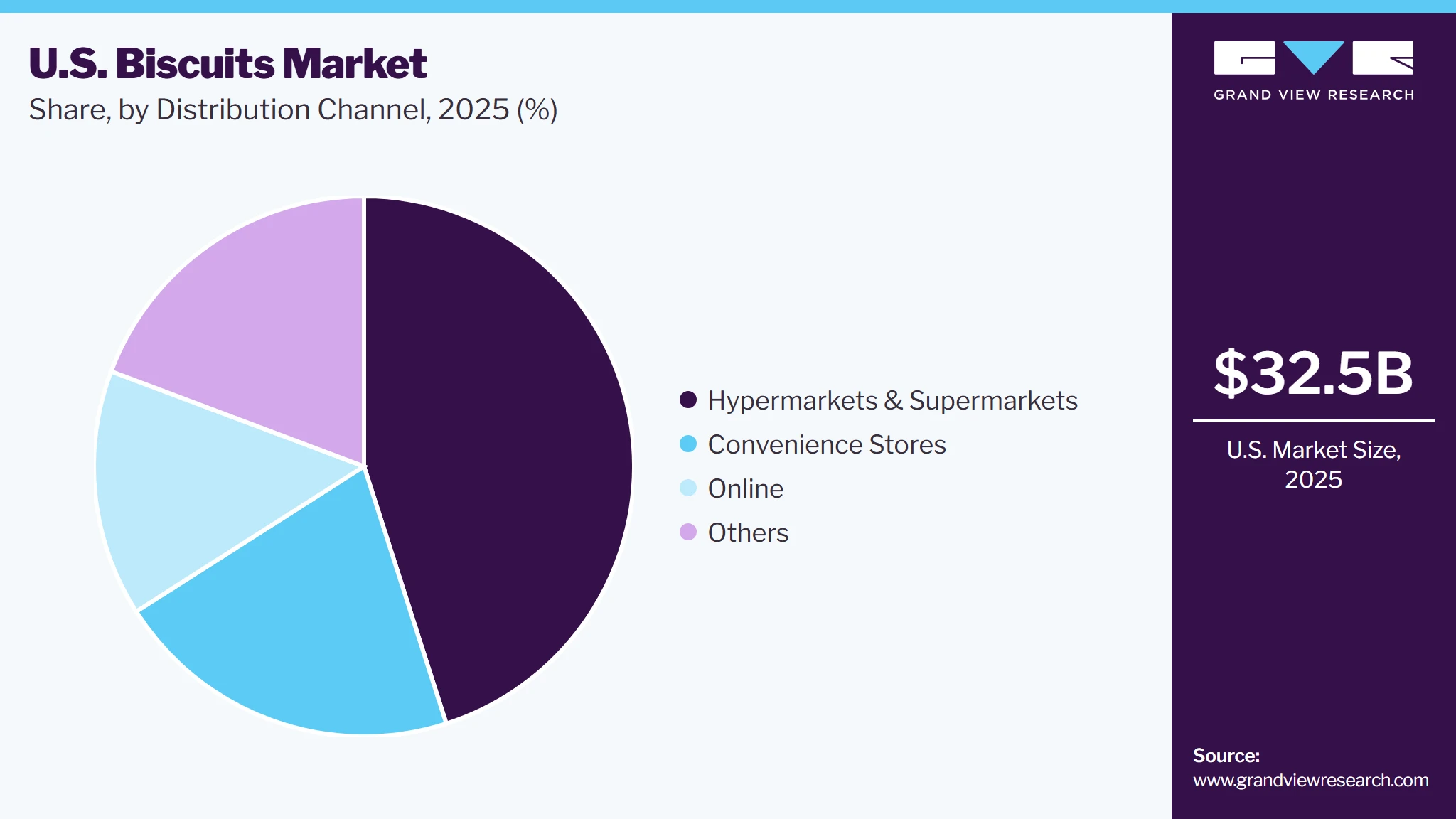
- By distribution channel: Hypermarkets & supermarkets segment held the largest market share of 45.1% in 2025.
Market Size & Forecast
- Market size in 2025: USD 32.5 Billion
- Estimated market size in 2026: USD 34.0 Billion
- Projected market size by 2033: USD 46.4 Billion
- CAGR (2026-2033): 4.6%
Prism AI by Grand View Research Free to tryAsk a question about the U.S. biscuits marketTry asking✓Every figure cited from GVR research Prefer the report? Download free sample →
Product innovation and competition across branded and private-label offerings are important factors influencing the market. Manufacturers are exploring ingredient variations, reduced-sugar formulations, whole-grain options, and products suited to specific dietary preferences. Seasonal launches and limited-edition flavors also provide opportunities to attract consumer attention and encourage repeat purchases. At the same time, companies must manage fluctuations in the costs of flour, sugar, oils, and packaging materials while maintaining product quality and competitive pricing. Businesses that respond to consumer preferences and maintain reliable distribution are positioned to compete across different product categories and retail channels.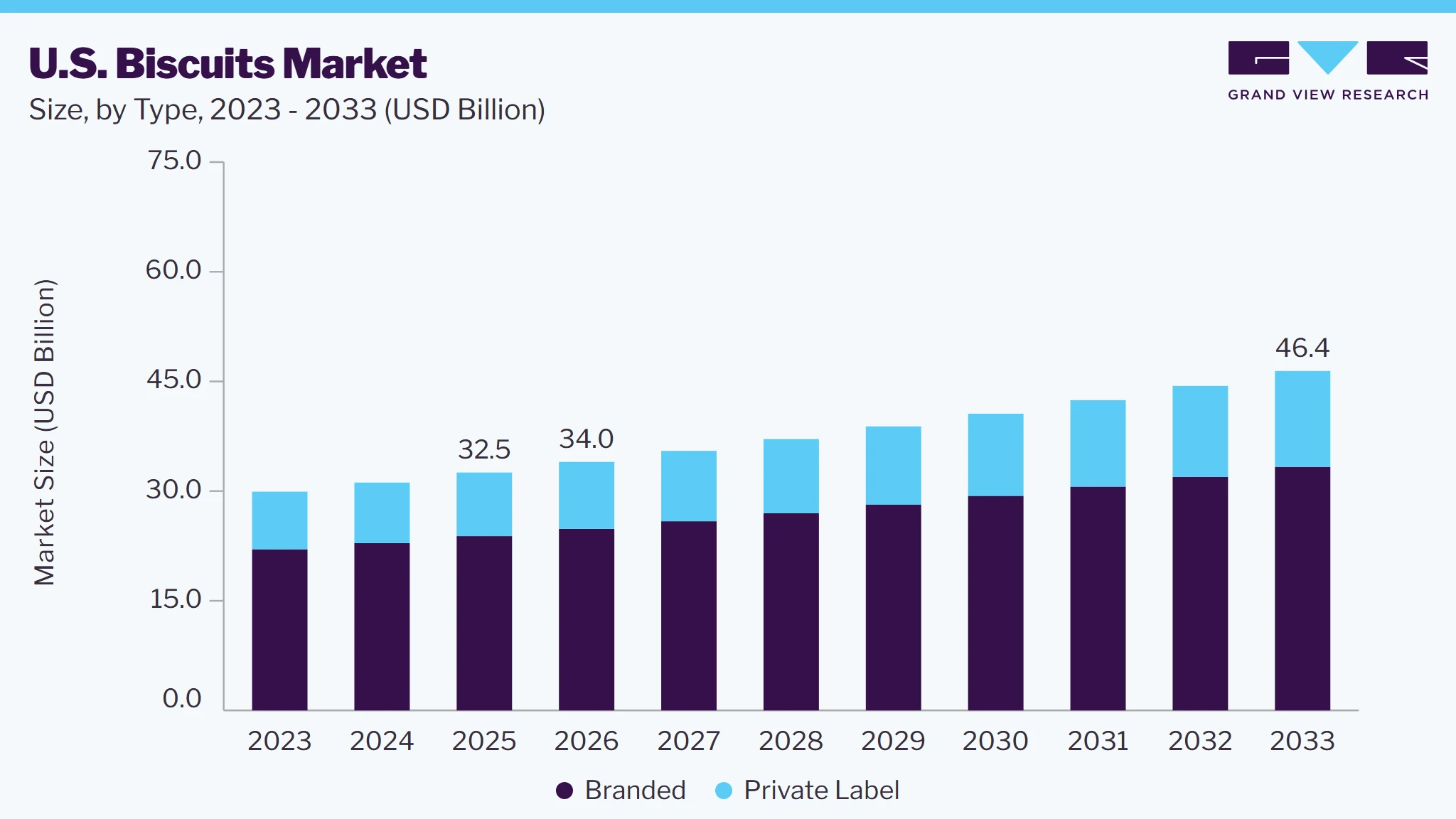 Source: Grand View Research, IR Documents, Primary Interviews, Paid DatabasesTo learn more about this report,
 Download Free Sample Report
The U.S. biscuits industry is shaped by changing dietary preferences and demand for products that accommodate specific nutritional requirements. SPINS data for the 52 weeks ending January 25, 2025, showed that certified gluten-free cookies recorded 34.3% year-over-year growth, compared with 0.7% growth for cookies without gluten-free certification. This difference highlights opportunities for manufacturers to develop specialized biscuit products that cater to consumers seeking gluten-free alternatives and differentiated ingredient formulations.
Snacking frequency also influences demand across the U.S. biscuits market. In April 2025, Circana reported that 48.8% of U.S. consumers snacked three or more times daily, an increase of 2.7 percentage points year over year. Frequent snacking occasions create opportunities for biscuit manufacturers to offer convenient products in different flavors, portion sizes, and packaging formats. Brands can also diversify their portfolios to address preferences for everyday snacks, on-the-go consumption, and products suited to different dietary needs.
Market Dynamics
Demand for biscuits in the U.S. is driven by their convenience, affordability, and suitability for different consumption occasions. Biscuits are easy to store, carry, and consume without preparation, making them a practical option for households, working professionals, and students. Their availability in sweet and savory varieties, with different flavors, textures, and package sizes, allows manufacturers to cater to diverse consumer preferences. Biscuits are also consumed as standalone snacks and alongside beverages such as tea, coffee, and milk. These characteristics maintain their relevance in everyday snacking and encourage manufacturers to introduce products that address changing taste preferences and consumption habits.
Growing price sensitivity and increasing consumer scrutiny of product information are creating challenges for manufacturers in the market. Rising food costs are encouraging consumers to evaluate product prices, ingredients, nutritional information, and overall value before making purchasing decisions. For instance, in June 2025, GS1 US reported that 76% of surveyed U.S. consumers sought additional product information in response to higher food costs, while 71% indicated that they were reading food labels more closely. Although these findings reflect broader grocery purchasing behavior, they highlight growing consumer expectations regarding product transparency and value for money. Consequently, biscuit manufacturers face increasing pressure to maintain competitive pricing, provide clear and accurate product information, and justify premium pricing through differentiated product attributes. These factors can constrain pricing flexibility, increase competitive pressure, and affect manufacturers' profit margins.
Innovation in ingredients and formulations presents opportunities for manufacturers in the market. Consumers seeking greater product variety create scope for biscuits made with whole grains, oats, seeds, alternative flours, and distinctive flavor combinations. Manufacturers can also develop reduced-sugar options, portion-controlled packs, and formulations tailored to specific dietary preferences. Improvements in taste, texture, freshness, and packaging can help brands differentiate their products in a competitive retail environment. In addition, introducing premium varieties alongside affordable everyday options allows manufacturers to serve different consumer groups and purchasing preferences. These approaches provide opportunities to broaden product portfolios and encourage repeat purchases.
Analyst Perspective
The U.S. biscuits industry is expected to remain competitive, with established companies focusing on brand differentiation, product innovation, and broad retail availability. New flavors, limited-edition offerings, convenient packaging, and products tailored to changing consumer preferences are likely to influence purchasing decisions. Manufacturers that balance taste, quality, affordability, and product variety may be better positioned to retain customer loyalty. Online retail also presents opportunities to improve product accessibility and reach specific consumer groups. At the same time, competition from private-label products and changing preferences regarding sugar content, ingredients, and portion sizes will require companies to refine their product portfolios and pricing strategies.
Consumer Insights
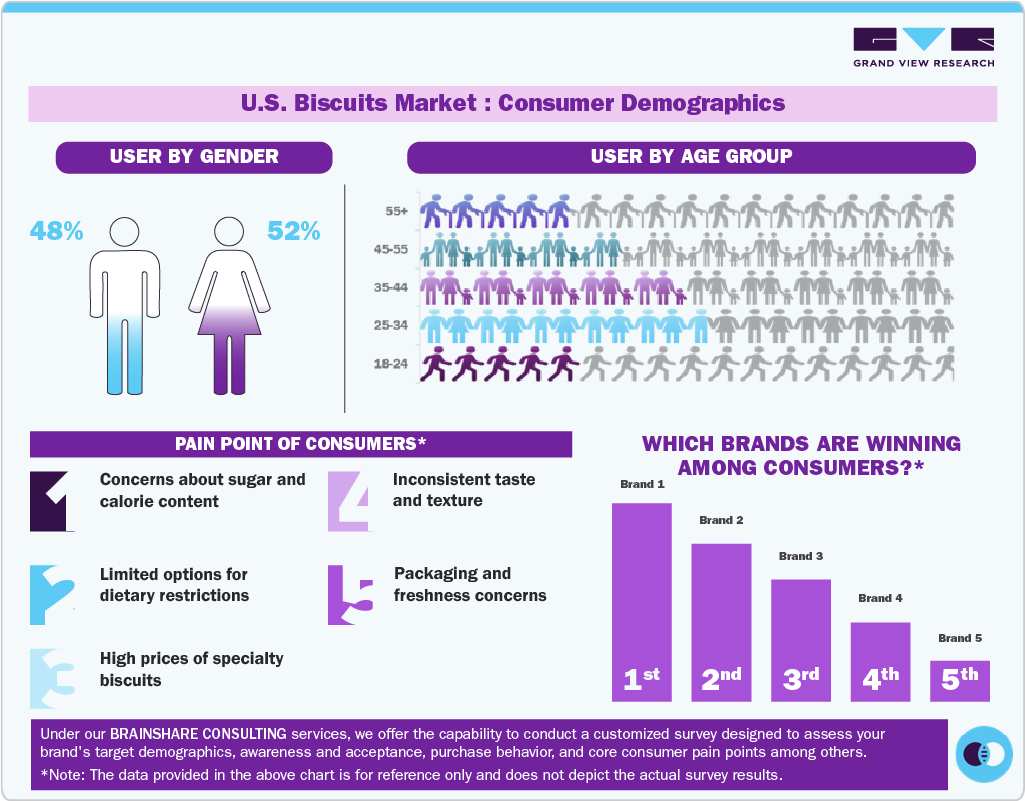
Consumer preferences for convenient and family-friendly snacks influence demand in the U.S. savory biscuits market. According to the American Bakers Association, 93% of parents agree that crackers are a suitable snack for children. This preference highlights the role of crackers in household snacking occasions, particularly for families seeking convenient options for lunchboxes, after-school consumption, and everyday use. Manufacturers can address this demand through varied flavors, easy-to-carry packaging, and products suited to different age groups.
 To learn more about this report, Download Free Sample Report
Product differentiation also presents opportunities for manufacturers in the U.S. biscuits market. The American Bakers Association reported that 60% of consumers are interested in crackers made with unique ingredients. This interest creates opportunities to introduce products with distinctive grain blends, seeds, herbs, and alternative ingredient combinations. Manufacturers can use ingredient innovation to differentiate their offerings, appeal to consumers seeking new taste experiences, and broaden their product portfolios in the competitive savory baked-snack category.
Type Insights
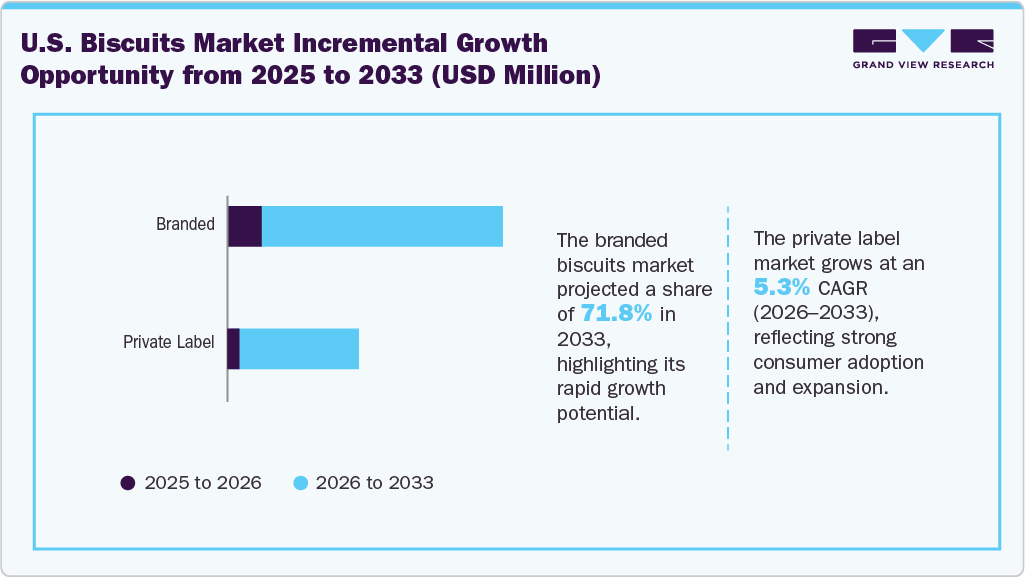
Branded biscuits led the market, accounting for a share of 73.3% in 2025. This is attributed to strong consumer recognition, consistent product quality, widespread retail availability, and established trust in well-known brands. Branded biscuits also benefit from standardized manufacturing processes, attractive packaging, and a broad selection of flavors and product varieties that cater to different age groups and consumption preferences. In addition, established distribution networks across supermarkets, convenience stores, and online platforms improve product accessibility. Promotional activities, new product introductions, and clear brand positioning further encourage repeat purchases and help branded products maintain their preference among U.S. consumers.
 To learn more about this report, Download Free Sample Report
The private label biscuits segment is anticipated to register the fastest CAGR of 5.3% from 2026 to 2033. This growth is driven by increasing consumer interest in affordable alternatives to established biscuit brands, particularly among price-conscious households seeking value without compromising on taste and quality. Retailers are expanding their private-label product ranges across different flavors, ingredients, and package sizes to cater to varied consumer preferences. In addition, greater shelf visibility, competitive pricing, and the availability of retailer-owned products across supermarkets and online grocery platforms are encouraging trial purchases. Improvements in product quality, packaging, and variety are also helping private-label biscuits appeal to a broader consumer base in the U.S. market.
Packaging Insights
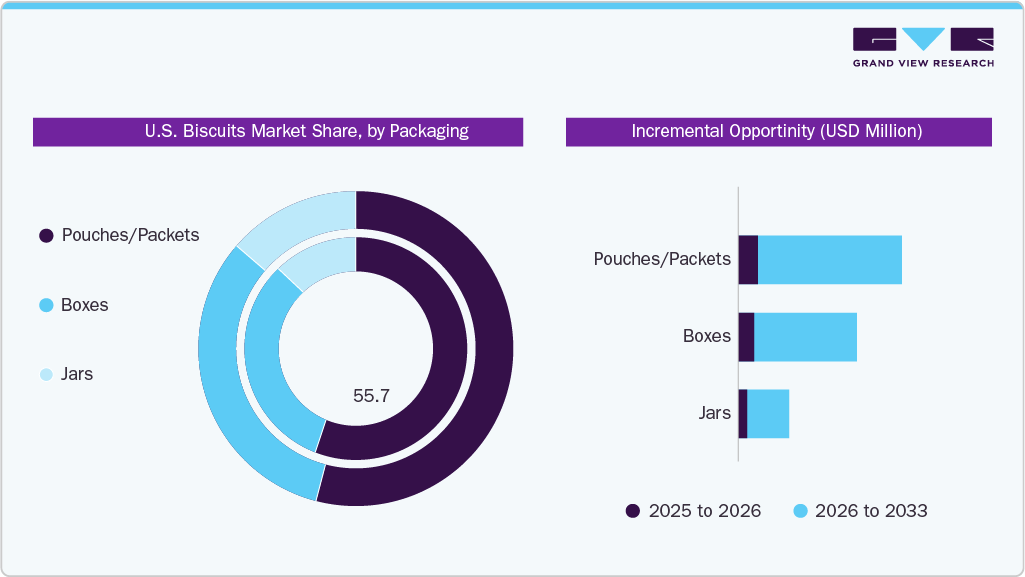
Pouches/packets held the largest revenue share, accounting for 55.7% in 2025. This segment is driven by the lightweight construction, cost efficiency, and flexibility of pouch and packet formats across different biscuit varieties. These packaging options are available in single-serving and family-sized formats, catering to individual consumption and household purchases. In addition, advances in flexible packaging materials and sealing technologies help preserve biscuit freshness and protect products from moisture during storage and transportation. Resealable closures and multipack formats also provide convenience for consumers, while allowing manufacturers to differentiate products through packaging design and portion sizes.
 To learn more about this report, Download Free Sample Report
The boxes market is anticipated to witness the fastest CAGR of 5.2% from 2026 to 2033. This growth is driven by the suitability of boxes for premium biscuits, gift assortments, and multipack products. Box packaging provides structural protection during transportation and storage, helping reduce product breakage and maintain biscuit quality. In addition, attractive designs, compartmentalized layouts, and printed branding allow manufacturers to improve shelf presentation and differentiate their products. Boxes are also suitable for seasonal promotions, festive gifting, and bulk purchases, creating opportunities across retail channels. Growing attention to recyclable paperboard materials and more sustainable packaging designs may further encourage manufacturers to adopt box formats in the U.S. biscuits market.
Distribution Channel Insights
Sales of U.S. biscuits through hypermarkets & supermarkets segment held the largest revenue, accounting for a share of 45.1%. Hypermarkets and supermarkets remain a key sales channel for biscuits in the U.S. because consumers can purchase them alongside their regular grocery items. These stores offer a range of biscuit products across different brands, flavors, and price points, allowing shoppers to choose according to their preferences and budgets. In-store promotions, discounted multipacks, and private-label products also influence purchasing decisions. Furthermore, the availability of biscuits in both large grocery chains and neighborhood supermarkets makes these outlets accessible to a broad consumer base, maintaining their position as an important distribution channel in the U.S. biscuits market.
 To learn more about this report, Download Free Sample Report
Sales of U.S. biscuits through online channel is projected to grow significantly at the fastest CAGR of 7.2% from 2026 to 2033. Online distribution provides consumers with access to a broader assortment of biscuits, including specialty varieties, premium products, and options from regional and international brands. Digital platforms allow shoppers to compare ingredients, package sizes, prices, and customer reviews before making purchasing decisions. Home delivery and flexible ordering also make online shopping convenient for busy households and consumers who prefer purchasing groceries remotely. In addition, personalized recommendations, promotional offers, and multipack options can encourage repeat purchases and increase the visibility of emerging biscuit brands in the U.S. market.
Key U.S. Biscuits Company Insights
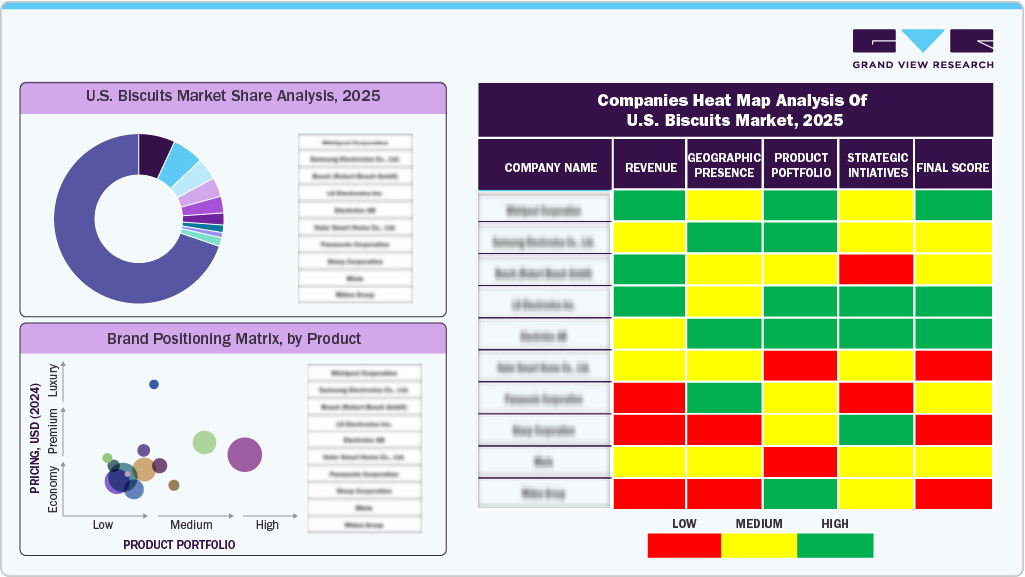
The U.S. biscuits market is characterized by competition among established food manufacturers, specialty biscuit producers, and private-label brands. Key companies focus on product innovation, brand positioning, pricing strategies, and distribution expansion to maintain their market presence. Manufacturers offer diverse product portfolios across sweet biscuits, savory varieties, crackers, and premium options to address different consumer preferences. Investments in packaging, flavor development, ingredient selection, and product reformulation also help companies differentiate their offerings. In addition, partnerships with retailers, e-commerce expansion, and promotional activities provide opportunities to reach wider consumer groups and respond to changing purchasing habits in the U.S. biscuits market.
 To learn more about this report, Download Free Sample Report
Key U.S. Biscuits Companies
-
Mondelēz International
-
Britannia Industries
-
Kellanova
-
United Biscuits
-
PARLE
-
General Mills Inc.
-
Nestlé
-
The Campbell's Company
-
Ferrero
-
PARTNERS
Competitive Benchmarking
Category
Operating Strategies
Competitive Edge
Weakness
Established Players (Mondelēz International, Kellanova, General Mills Inc., Nestlé, The Campbell's Company, Ferrero)
- Expand biscuit, cracker, and snack portfolios; introduce new flavors and limited-edition products; invest in product development and packaging innovation; and maintain distribution across supermarkets, convenience stores, and online channels.
- Strong brand recognition, diversified snack portfolios, established retail relationships, extensive distribution networks, and access to broad consumer groups.
- Complex operations across multiple product categories, high competition for shelf space, exposure to changing ingredient costs, and challenges in responding quickly to niche consumer preferences.
Emerging / Specialized Players (Britannia Industries, United Biscuits, PARLE, PARTNERS)
- Focus on differentiated biscuit offerings, distinctive flavors and ingredients, convenient packaging, and targeted consumer segments; build retail partnerships and strengthen online distribution to increase market access.
- Specialized biscuit-making experience, established product identities in their core markets, focused product portfolios, and opportunities to target specific consumer preferences.
- Comparatively limited U.S. market penetration for some brands, lower brand recognition among U.S. consumers, potential distribution barriers, and the need to adapt products to local tastes and preferences.
Recent Developments
-
In April 2025, Mondelēz International introduced limited-edition RITZ Sunkissed Crackers for the summer snacking season in the U.S. The product featured a crispy texture and the brand's familiar buttery, salty flavor, targeting consumers seeking convenient snacks for everyday consumption and seasonal gatherings. The launch expanded RITZ's product offerings and highlighted the company's focus on limited-edition products to generate consumer interest and create variety within the savory crackers category.
-
In September 2024, Mondelēz International announced that for the packaging of one of its brands, Triscuit Crackers’ products, it will source chemical or molecular recycling technology-related plastics in the U.S. and Canada. By embracing innovation-based packaging technology, Triscuit plans to support the company’s long-term strategy to reduce waste while promoting sustainability in terms of packaging.
-
In October 2024, Ferrero-related company CTH Invest SA acquired Nonni’s Foods LLC, a brand offering product characterized by traditional taste and innovation, from Vestar Capital Partners. This is expected to enhance customer engagements facilitated by Ferrero's vast distribution networks.
U.S. Biscuits Market Report Scope
Report Attribute
Details
Market size in 2025
USD 32.5 billion
Estimated market size in 2026
USD 34.0 billion
Projected market size by 2033
USD 46.4 billion
Growth Rate (Revenue)
CAGR of 4.6% from 2026 to 2033
Base year for estimation
2025
Historical data
2021 - 2024
Forecast period
2026 - 2033
Quantitative units
Revenue in USD million/billion, kilotons and CAGR from 2025 to 2033
Report coverage
Revenue forecast, company ranking, competitive landscape, growth factors, and trends
Segments covered
Type, packaging, distribution channel
Country scope
U.S.
Key companies profiled
Mondelēz International; Britannia Industries; Kellanova; United Biscuits; PARLE; General Mills Inc.; Nestlé; The Campbell's Company; Ferrero; and PARTNERS
Customization scope
Free report customization (equivalent up to 8 analysts’ working days) with purchase. Addition or alteration to country, regional & segment scope.
Pricing and purchase options
Avail customized purchase options to meet your exact research needs. Explore purchase options
U.S. Biscuits Market Report Segmentation
This report forecasts revenue growth at country levels and provides an analysis of the latest trends and opportunities in each sub-segment from 2021 to 2033. For the purpose of this study, Grand View Research has segmented the U.S. biscuits market by type, packaging, distribution channel.
-
Type Outlook (Revenue, USD Million; 2021 - 2033)
-
Branded
-
Chocolate-based
-
Chocolate Chip Cookies
-
Chocolate Coated Biscuits
-
Chocolate Sandwich Cookies
-
Non-Chocolate
-
Digestive/ Fortified Biscuits
-
Butter Cookies
-
Flavored & Cream filled
-
Others
-
-
Private Label
-
Chocolate-based
-
Chocolate Chip Cookies
-
Chocolate Coated Biscuits
-
Chocolate Sandwich Cookies
-
Non-Chocolate
-
Digestive/ Fortified Biscuits
-
Butter Cookies
-
Flavored & Cream filled
-
Others
-
-
-
Packaging Outlook (Revenue, USD Million; 2021 - 2033)
-
Pouches/ Packets
-
Boxes
-
Jars
-
-
Distribution Channel Outlook (Revenue, USD Million; 2021 - 2033)
-
Hypermarkets & Supermarkets
-
Convenience Stores
-
Online
-
Others
-
Research Methodology
The U.S. biscuits market figures in this report are based on a proven research process that combines executive interviews with secondary research from proprietary databases, company filings, and recognized regulatory and institutional sources. Market size is built through value-chain sizing-reconciling supply-side and demand-side estimates-and triangulated with bottom-up and top-down approaches. Every estimate passes multiple levels of expert validation before publication, with each U.S. biscuits segment quantified using the revenue-capture definitions in the table below.
Segment Definition
Type
Revenue capture definition
Branded
This segment includes the sales of biscuits sold under established brand names owned by manufacturers, with products differentiated through flavor, ingredients, quality, packaging, and brand recognition.
Private Label
This segment includes the sales of biscuits marketed under retailer-owned or retailer-exclusive brands, typically offered through supermarkets, hypermarkets, and other retail channels at competitive prices.
Packaging
Revenue capture definition
Pouches/Packets
This segment includes the sales of biscuits packed in flexible packaging, such as plastic pouches, sealed packets, and individual wrappers, designed to maintain freshness, provide convenience, and facilitate portion control.
Boxes
This segment includes the sales of biscuits packed in cardboard boxes or other rigid paperboard packaging, which helps protect products during storage and transportation and provides space for product information and branding.
Jars
This segment includes the sales of biscuits packed in plastic or glass jars, which provide a reusable storage option, help protect biscuits from moisture when properly sealed, and allow convenient access to the contents.
Estimation Model
Layer Name
Key Question
Description
Consumption Universe Layer
Who consumes biscuits regularly?
Biscuits are widely consumed by children, teenagers, working adults, and families across the U.S. as convenient snack options. They are commonly enjoyed during breakfast, between meals, lunch breaks, and travel, supported by their portability, variety of flavors, and ease of consumption.
Access & Availability Layer
Where can consumers purchase biscuits?
Biscuits are available through supermarkets, grocery stores, convenience stores, and online retail platforms across the United States. Their wide distribution through physical and digital channels enables consumers to access different brands, flavors, package sizes, and price options conveniently.
Buying Behavior Layer
How does consumer demand translate into purchases?
Consumer choices are influenced by established biscuit brands, product consistency, flavor variety, pricing, promotional offers, and brand loyalty. Familiarity and perceived quality encourage repeat purchases across household and individual consumption occasions.
Revenue Conversion Layer
How much revenue is generated?
Revenue is generated through branded product sales, multipacks, family-size packages, premium varieties, seasonal offerings, and repeat purchases across retail and e-commerce channels.
Delivered Customizations
This report has been delivered with the following In-depth customizations
Client Request
Customization Delivered
Value Adds
Production, Trade & Consumption Analysis
Analyzed biscuit production, import-export trends, consumption patterns, sales volumes, pricing trends, and key manufacturing and consuming regions across the United States.
Helps stakeholders understand supply-demand dynamics, identify sourcing opportunities, and support production planning and market expansion decisions.
Regulatory Framework & Market Entry Strategies
Evaluated food safety requirements, nutrition labelling, allergen disclosures, distribution channels, and market entry approaches.
Helps businesses understand compliance requirements and develop effective market expansion strategies.
Pricing Analysis
Compared pricing across branded, private-label, value, and premium biscuits, considering pack sizes, promotions, and consumer price sensitivity.
Supports competitive pricing decisions, product positioning, and profitability improvement.
Frequently Asked Questions About This Report
The U.S. biscuits market size was valued at USD 32.5 billion in 2025 and is estimated at USD 34.0 billion for 2026.
The branded segment led with a 73.3% revenue share in 2025, while private label is the fastest-growing segment.
Key players include Mondelēz International; Britannia Industries; Kellanova; United Biscuits; PARLE; General Mills Inc.; Nestlé; The Campbell's Company; Ferrero; and PARTNERS
Key factors include growing demand for convenient snacking options, increasing consumer preference for healthier biscuits, product innovation in flavors and ingredients, rising demand for premium and indulgent snacks, and the expansion of online and retail distribution channels.
The pouches/packets segment led with a 55.7% revenue share in 2025, while boxes are the fastest-growing segment.
The hypermarkets & supermarkets segment led with a 45.1% revenue share in 2025, while the online channel is the fastest-growing channel.
The U.S. biscuits market is expected to grow at a CAGR of 4.6% from 2026 to 2033, reaching USD 46.4 billion by 2033.
About the Author(s)
Consumer F&B Research Team
Consumer Goods · Consumer F&BThis report was authored by the consumer f&b research team at Grand View Research - comprising two research analysts, one senior research analyst, and one industry expert - with specialized expertise in the consumer f&b segment of the consumer goods industry. All findings are based on proprietary consumer goods databases, executive interviews, and regulatory analysis, subject to internal peer review prior to publication.
Last Updated:
Speak to Analyst

Customize this report to your needs - add regions, segments, or data points, with 20% free customization.
Or view our licence options:


ISO 9001:2015 & 27001:2022 Certified
We are GDPR and CCPA compliant! Your transaction & personal information is safe and secure. For more details, please read our privacy policy.


