
- Home
- »
- Homecare & Decor
- »
-
U.S. Branded Residences Market Size Report, 2026-2033GVR Report cover

U.S. Branded Residences Market (2026 - 2033)
Size, Share & Trends Analysis Report By Hotel Type (Hotel & Non-Hotel), By Ownership (Freehold, Leasehold), By Price Tier (Luxury, Upper-Midscale/Midscale), And Segment Forecasts
Market Size, 2025
$14.8BMarket Estimate, 2026
$15.5BMarket Forecast, 2033
$23.9BCAGR, 2026–2033
6.4%U.S. Branded Residences Market Summary
The U.S. branded residences market size was valued at USD 14.8 billion in 2025 and is projected to grow from USD 15.5 billion in 2026 to USD 23.9 billion in 2033, at a CAGR of 6.4% from 2026 to 2033. The market is driven by high concentrations of affluent buyers, strong luxury housing demand, established hospitality brands, and developers’ preference for differentiated, premium residential products.
Key Market Trends & Insights
- By hotel type: Hotel-branded residences accounted for the largest share of 74.2% of the U.S. revenue in 2025.
- By ownership: Freehold branded residences accounted for the largest share of 51.4% of the U.S. revenue in 2025.
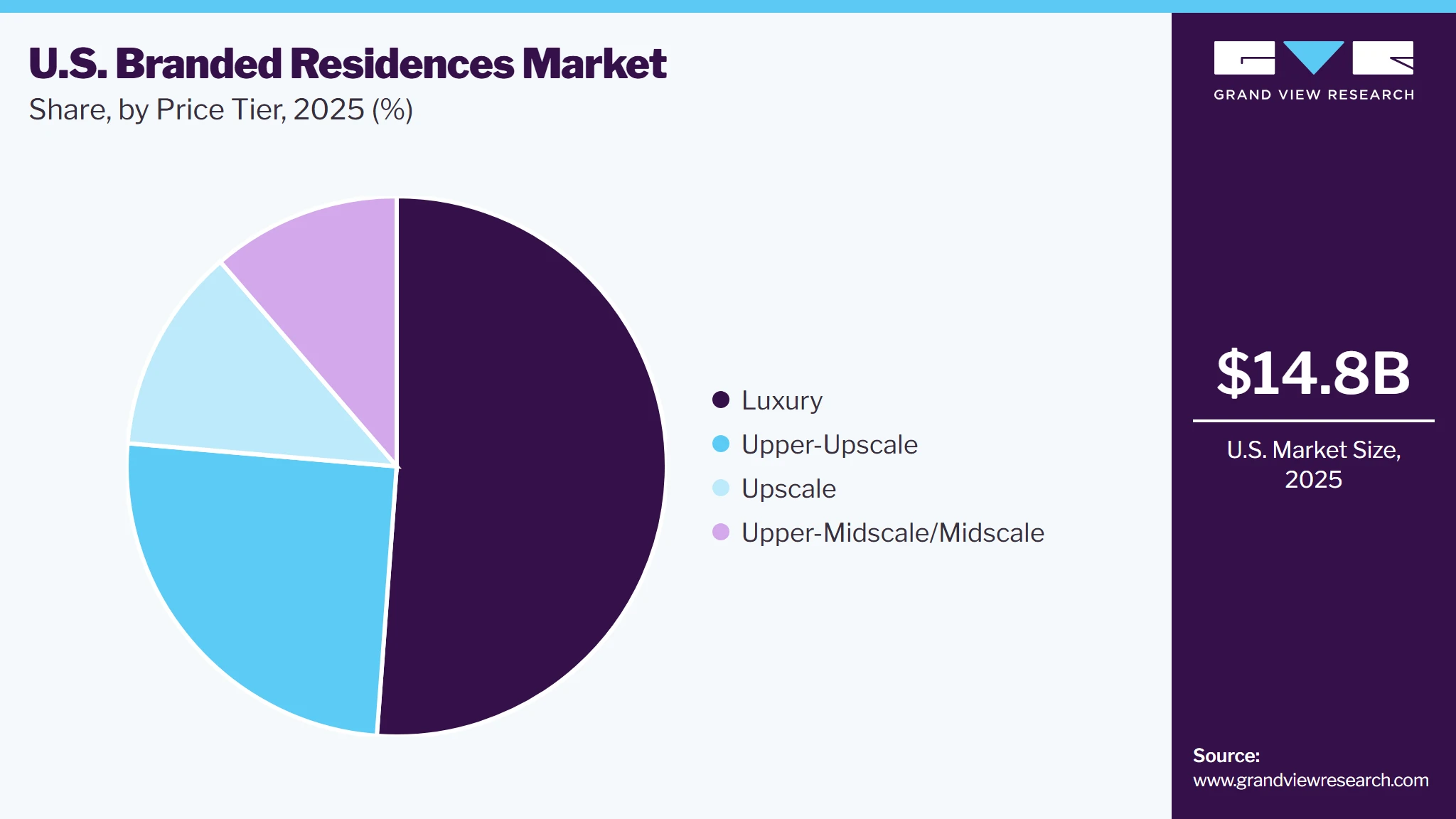
- By price tier: Luxury branded residences accounted for the largest share of 51.2% of the U.S. revenue in 2025.
Market Size & Forecast
- Market size in 2025: USD 14.8 Billion
- Estimated market size in 2026: USD 15.5 Billion
- Projected market size by 2033: USD 23.9 Billion
- CAGR (2026-2033): 6.4%
Three ways to get this report
Buy it, customize it, or ask a question.Ask an Analyst
Analyst response in 1 business day
- AccessReport author, directly
- Reply timeWithin 1 working day
- No sales callDirect answer only
- FormatEmail reply
- CostFree, no cost
Get the Full Report
What the study covers
- FormatsPDF · Excel · Dashboard
- Timeline2026–2033 annual, 2025 base
- Coverage20+ countries, 5 regions
- Companies10+ key players profiled
Customize the Report
20% free customization
- IncludeCountries, segments, points
- TailorTo your product definition
- ExtendDeeper competitor detail
- OrA fully bespoke study
- Turnaround5–10 working days
The U.S. remains the largest concentration of operational branded residences globally, while in 2025, Knight Frank identifies the country as a core market for the sector. In 2024, CBRE also reports a 46% pipeline increase in luxury branded-residence projects across the Americas, indicating continued developer commitment. Wealth concentration, premium housing demand, and established brand recognition are supporting adoption across major U.S. luxury markets. The growing preference for service-led and amenity-rich luxury living is strengthening demand for branded residences, particularly among buyers seeking convenience, privacy, and professionally managed lifestyles. Branded projects increasingly incorporate wellness, concierge, dining, fitness, and residents-only amenities, positioning the residence as a complete lifestyle proposition rather than a conventional condominium. According to JLL in 2025, this is evident in Miami, where The Residences at 1428 Brickell had reached 57% presales by October 2025, supported by 80,000 square feet of dedicated amenities.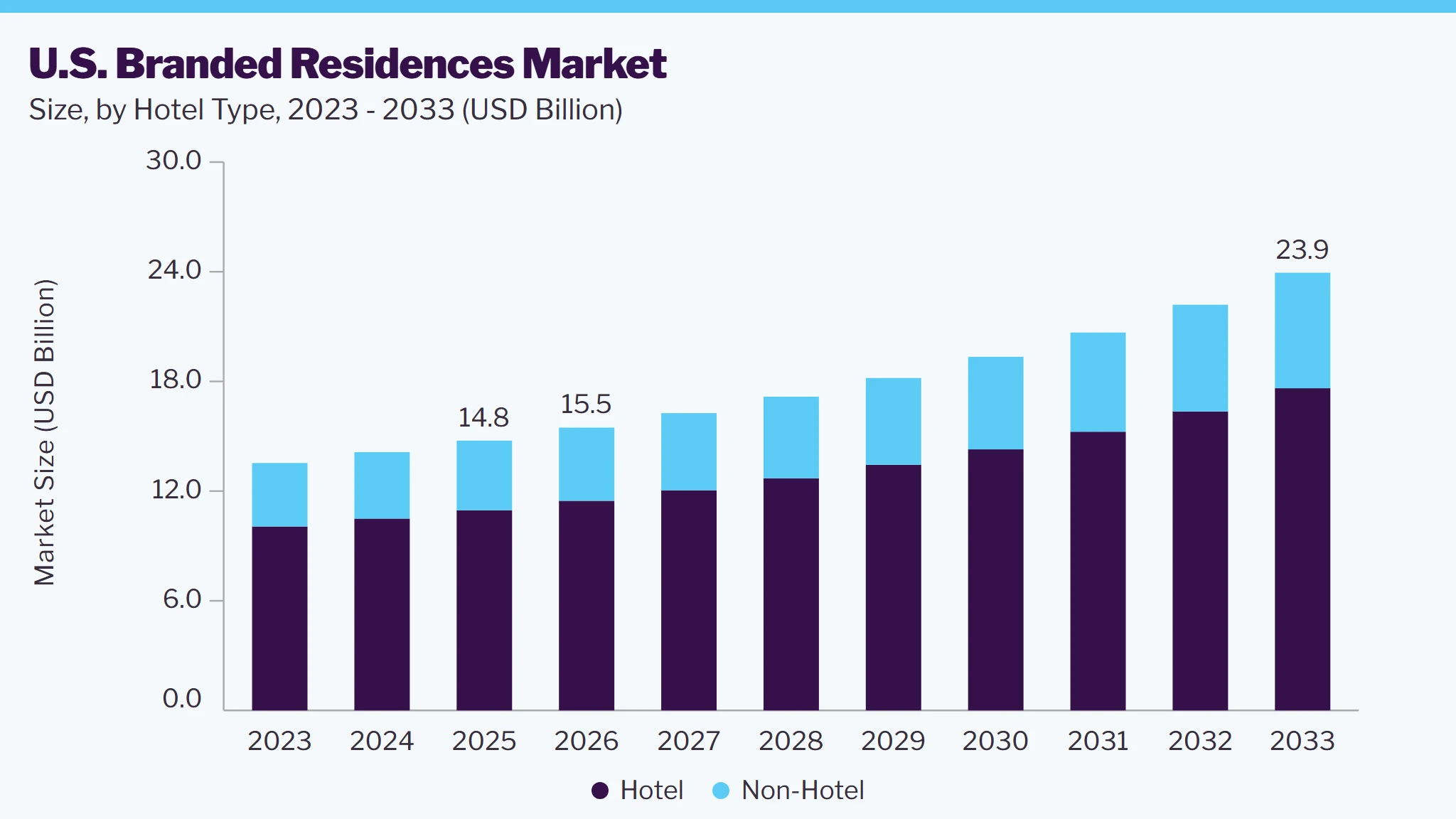 Source: Grand View Research, IR Documents, Primary Interviews, Paid DatabasesTo learn more about this report,
 Download Free Sample Report
Developer adoption is accelerating as established brands provide differentiation, credibility, and access to a pre-existing luxury customer base. Hospitality companies can extend their brand equity from hotels into residential ownership, while developers benefit from the marketing strength and service reputation associated with internationally recognized names. Hilton, for instance, reported 60 residential properties across nine brands and more than 9,000 branded and serviced residential units, demonstrating how hospitality groups are increasingly using residential development as a significant extension of their business model.
Major Trends in the U.S. Branded Residences Industry
Miami is becoming the U.S. branded-residence hub
Miami is seeing an unusually high concentration of branded residential projects, with hospitality, lifestyle, automotive, and entertainment brands entering the condominium market. Four Seasons, Ritz-Carlton, St. Regis, Waldorf Astoria, and other brands have projects across Miami and South Florida. The depth of the pipeline is turning Miami into the primary U.S. market for branded residential development.
Lifestyle and non-hotel brands are entering the market
U.S. developers are moving beyond traditional hotel brands to differentiate residential projects through lifestyle, fashion, automotive, and entertainment identities. Miami is at the forefront of this shift, with projects associated with brands such as Cipriani, Mercedes-Benz, ELLE, and E11even, alongside established hospitality brands. This is allowing developers to use a brand’s existing customer base and lifestyle positioning as a sales proposition in an increasingly competitive luxury condominium market.
Standalone branded residences are gaining ground
U.S. developers are increasingly developing branded residences without an attached hotel, particularly in established luxury markets where the residential product can stand on its own. Four Seasons’ 2025 Washington, DC project is a standalone 64-home development, while its Coconut Grove project in Miami is another standalone offering. Knight Frank reports that 49% of North America’s pipeline hotel-branded schemes are planned as standalone developments, making the region a leading industry for this model.
Branded residences are moving into adaptive reuse
Developers are increasingly converting existing buildings into branded residences rather than relying exclusively on newly built towers. In Hallandale Beach, an existing luxury multifamily property is being converted into Mondrian-branded residences, creating the brand’s first residential project without a hotel component. The approach provides buyers with a turnkey product while allowing developers to repurpose existing assets and reduce the waiting period associated with ground-up development.
Market Dynamics
Wealth migration is creating a new pool of internationally mobile buyers for U.S. branded residences, particularly in markets such as Miami, Florida, and other established luxury destinations. Affluent individuals increasingly maintain multiple residences and seek turnkey properties that provide consistent service, security, and professional management while they move between locations. This is particularly relevant to branded residences because the brand reduces uncertainty for buyers unfamiliar with a local market. In 2026, Knight Frank reported that 41% of individuals newly reaching USD 30 million+ in wealth globally between 2021 and 2026 were created in the U.S., reinforcing the country’s attractiveness as a destination for luxury residential demand.
Branded residences can face a high total cost of ownership beyond the initial purchase price, including association assessments, property taxes, insurance, staffing, and optional hospitality services. These recurring expenses can narrow the pool of qualified buyers and make ownership less attractive compared with comparable luxury residences without branded services. The cost structure is particularly relevant in U.S. markets where buyers must evaluate both the property premium and continuing service obligations.
The U.S. branded residences industry has scope to deepen beyond its established South Florida and New York strongholds. Knight Frank’s 2025 survey specifically identifies U.S. markets beyond New York and Miami as emerging growth areas, while Savills tracks active and pipeline schemes in markets including Los Angeles, Boston, Tampa, and Park City. This geographic diversification gives brands an opportunity to capture affluent demand in lifestyle and secondary luxury markets where branded residential supply remains less concentrated.
Consumer Insights
U.S. buyers increasingly evaluate branded residences on the quality of the overall residential experience, rather than the brand name alone. In major markets such as New York, Miami, and Los Angeles, buyers are placing greater emphasis on private wellness facilities, pools, dining spaces, concierge, housekeeping, and other hotel-style services. Knight Frank notes that U.S. buyers at the USD 20 million-plus level are gravitating toward projects combining distinctive design with extensive amenities and services, while branded developments in Los Angeles are raising expectations for amenity-rich luxury living.
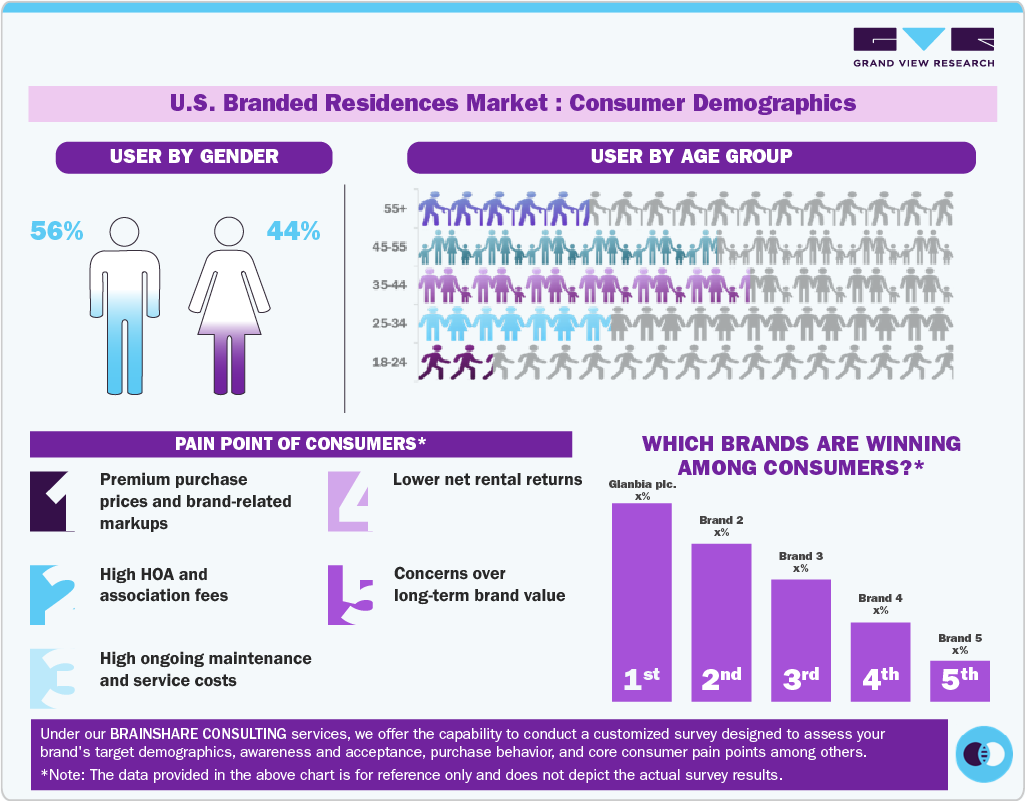 To learn more about this report,Privacy is also an important consideration, particularly as standalone branded residences gain traction in the U.S. These developments allow buyers to access branded services and amenities without sharing facilities with hotel guests. At the same time, location remains critical, with demand concentrated in established luxury markets such as Miami, New York, and Beverly Hills, where affluent buyers seek proximity to premium retail, dining, entertainment, and lifestyle destinations. Download Free Sample Report
Purchase decisions are further influenced by design quality, service consistency, property management, and ownership flexibility. U.S. buyers are increasingly exposed to residences that combine private homes with hospitality, wellness, and leisure components, as seen in projects such as Aman’s One Beverly Hills. The growing presence of hotel, automotive, restaurant, and lifestyle brands is also giving buyers more differentiated propositions beyond traditional hotel-branded residences.
Analyst Perspective
The market is increasingly differentiated by location scarcity, brand heritage, residential service depth, development format, and amenity integration. Florida remains a major competitive hub, particularly Miami, Palm Beach, Sarasota, and other affluent coastal markets, while brands are also expanding into established luxury destinations such as Beverly Hills, Washington, DC, and Charleston. Developers are competing through beachfront and prime urban locations, standalone residential concepts, larger private residences, and access to hotel-grade amenities. Brand-specific advantages increasingly include 24-hour residential concierge, private dining and wellness services, owner-only amenities, rental and property-management support, and seamless access to adjacent hotels. Established hospitality brands with strong U.S. recognition and proven service infrastructure therefore have an advantage in securing premium development partnerships and attracting high-net-worth buyers.
Hotel Type Insights
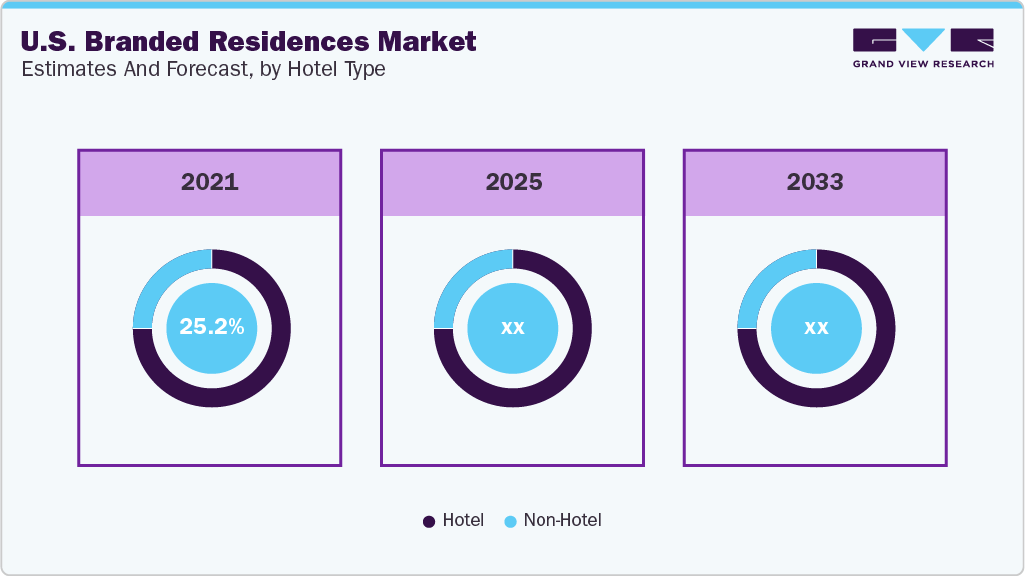
The hotel-branded residences accounted for a share of 74.2% in 2025, driven by strong buyer preference for established hospitality brands and integrated hotel-style services within residential properties. Leading developments increasingly combine private residences with concierge, housekeeping, wellness, dining, and resort amenities, strengthening the value proposition for high-net-worth buyers. The segment also benefits from developers leveraging established hotel brands to differentiate projects and support premium positioning in competitive U.S. luxury markets.
 To learn more about this report, Download Free Sample Report
Non-hotel is projected to grow at a CAGR of 6.7% from 2026 to 2033, valued for lifestyle-led positioning and differentiated residential experiences beyond traditional hospitality brands. Growth is supported by the entry of luxury fashion, automotive, and lifestyle brands into U.S. residential projects, allowing developers to target buyers seeking stronger alignment between their residence and personal interests. These concepts also provide greater scope for design-led, amenity-focused developments tailored to specific luxury consumer segments.
Ownership Insights
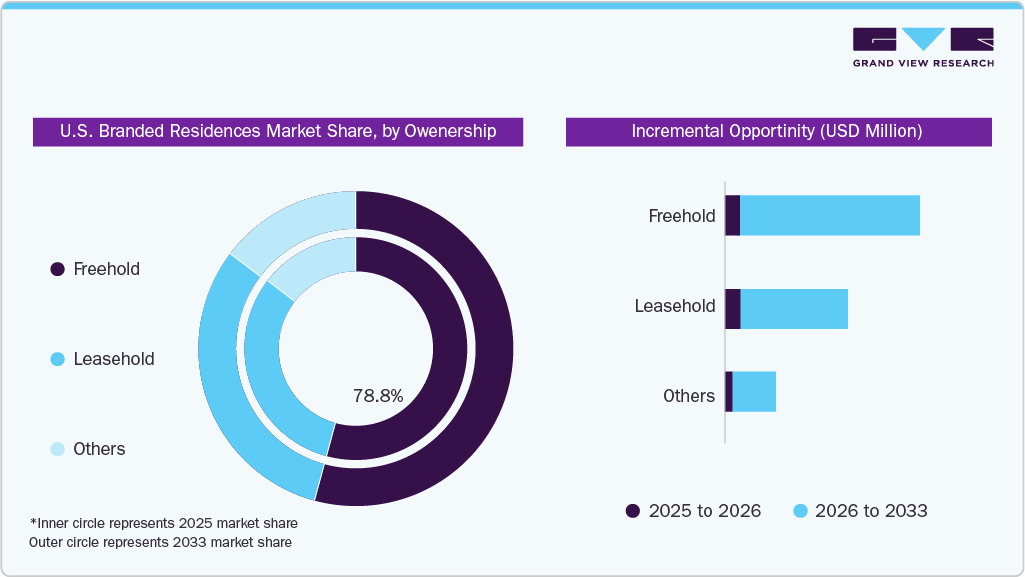
Freehold accounted for a share of 51.4% of the U.S. revenue in 2025, driven by buyer preference for outright property ownership, stronger asset control, and the ability to retain, resell, or lease residences independently. Freehold structures are particularly attractive in established luxury residential industries where ownership rights support long-term wealth preservation and investment-led purchases. The structure also enables developers to command higher transaction values for U.S. branded residences positioned as both lifestyle assets and real estate investments.
 To learn more about this report, Download Free Sample Report
The leasehold branded residences segment, by ownership type, is projected to grow at a CAGR of 6.7% from 2026 to 2033, supported by greater applicability in U.S. resort and destination markets where buyers seek access to branded residential properties without committing to full freehold ownership. Leasehold structures can also enable developers to introduce branded residences on strategically located land while reducing the upfront land-acquisition requirement, supporting projects in high-value U.S. locations where outright ownership of prime sites can be challenging.
Price Tier Insights
Luxury accounted for a share of 51.2% of the U.S. revenue in 2025, reflecting the strong concentration of branded projects in high-value urban and resort locations and the ability of luxury brands to command substantial residential premiums. The segment is supported by residences offering private clubs, concierge, wellness, dining, and hospitality services, with buyers paying for a combination of prime location, high-end finishes, personalized services, and access to exclusive amenities.
 To learn more about this report, Download Free Sample Report
The upper-midscale/midscale segment is projected to grow at a CAGR of 7.3% from 2026 to 2033, supported by the broader adoption of branded residential concepts beyond ultra-luxury developments. Developers can address a wider buyer pool through more attainable price points while retaining selected brand-linked services and amenities. This positioning also creates scope for branded residences in secondary U.S. cities and emerging lifestyle destinations where full-scale luxury projects may face a smaller addressable buyer base.
Key U.S. Branded Residences Company Insights
 To learn more about this report, Download Free Sample Report
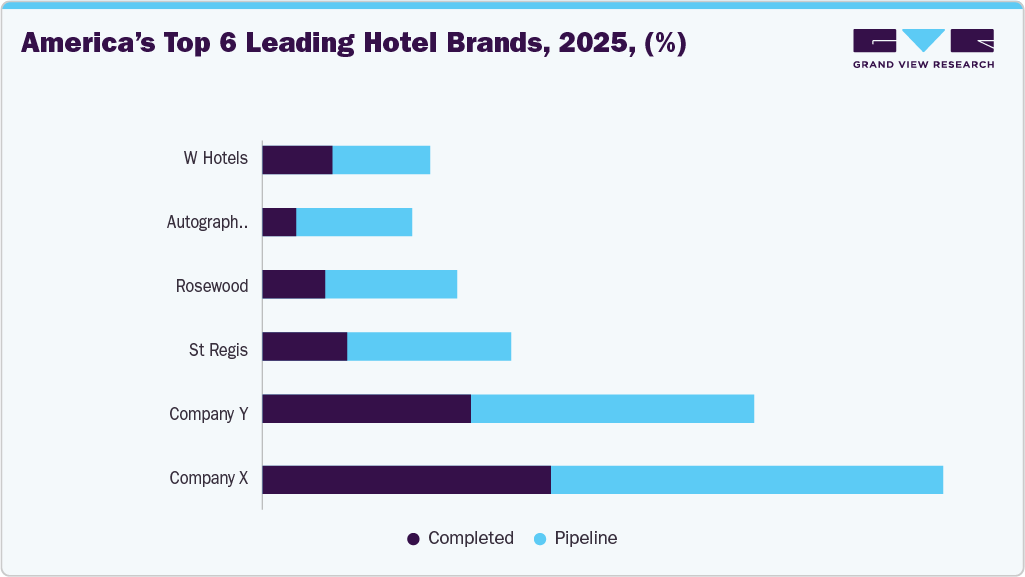
The U.S. branded residences industry is competitive, with leading brands differentiating through hotel-linked residential services, standalone residences, prime U.S. locations, architectural design, private amenities, personalized hospitality, and professional property management. Competition is concentrated in established luxury markets such as Miami, New York, Los Angeles, and other high-value urban and resort destinations. Leading players are expanding through developer partnerships, mixed-use developments, and standalone residential projects, while leveraging established hospitality brands to command residential premiums and attract high-net-worth buyers.
Product differentiation increasingly centers on the depth of services and resident-only amenities offered within U.S. developments. Concierge, housekeeping, private dining, wellness facilities, valet services, and access to hotel or resort amenities are used to distinguish projects. Brands are also strengthening their U.S. presence through partnerships with established developers, projects in high-value locations, and standalone residential concepts that provide greater privacy than conventional hotel-integrated developments. The ability to deliver consistent service standards and personalized experiences remains an important competitive factor.
-
Four Seasons Hotels Limited - Four Seasons competes strongly in the U.S. through its established luxury brand, high-touch residential service model, and presence across major urban and resort markets. Its residential offering combines private ownership with concierge, housekeeping, wellness, and personalized services, while selected developments provide residents with access to hotel amenities and Four Seasons service infrastructure.
-
The Ritz-Carlton Hotel Company, L.L.C. - The Ritz-Carlton competes through luxury residences supported by its established hospitality reputation, premium locations, and extensive owner services. Its U.S. developments combine residential ownership with concierge, dining, wellness, and housekeeping services, while selected projects are integrated with hotels, resorts, or mixed-use developments.
-
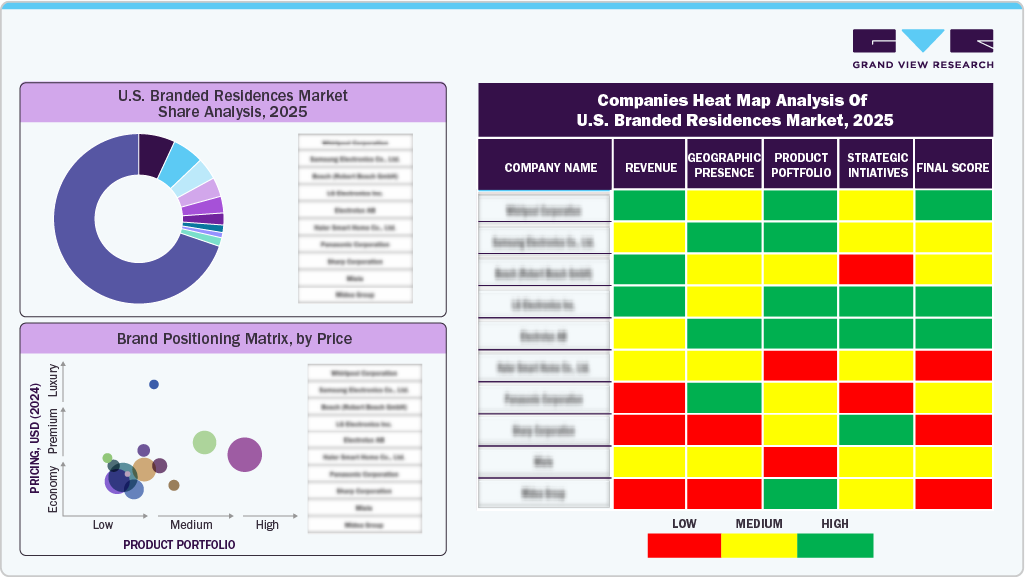
Brand Positioning & Competitive Strength - Competitive positioning in the U.S. is driven by brand equity, service quality, location, residential privacy, amenities, and developer execution. Leading brands seek to differentiate their residences from conventional luxury condominiums by extending established hospitality standards into the ownership experience. Consistent property management, resident-only services, and the ability to maintain brand standards after handover are increasingly important to long-term positioning.
-
Brand Growth & Portfolio Momentum - Growth in the U.S. is being supported by new projects and portfolio expansion across Florida, New York, California, and other established luxury and lifestyle destinations. Brands are pursuing developer collaborations, hotel-linked residences, standalone projects, and mixed-use developments to broaden their U.S. footprint. The expansion of branded residential concepts into additional markets also provides opportunities to capture second-home, primary-residence, and lifestyle-oriented demand.
 To learn more about this report, Download Free Sample Report
Key U.S. Branded Residences Companies
-
The Ritz-Carlton Hotel Company, L.L.C.
-
Four Seasons Hotels Limited
-
St. Regis Hotels & Resorts
-
Rosewood Hotel Group
-
Autograph Collection Hotels
-
W Hotels
-
Waldorf Astoria Hotels & Resorts
-
Auberge Resorts Collection
-
Westin Hotels & Resorts
-
Mandarin Oriental Hotel Group Limited
Competitive Benchmarking
Category
Operating Strategies
Competitive Edge
Weakness
Established Players (Four Seasons Hotels Limited; The Ritz-Carlton Hotel Company, L.L.C.; St. Regis Hotels & Resorts; Rosewood Hotel Group; W Hotels; Waldorf Astoria Hotels & Resorts; Westin Hotels & Resorts; Mandarin Oriental Hotel Group)
Expand U.S. branded residences through hotel-integrated, standalone, and mixed-use developments, with emphasis on major luxury markets and resort destinations. Leverage developer partnerships, established hotel infrastructure, and residential services to extend brand presence into private ownership.
Strong hospitality brand recognition, established U.S. operating networks, high-net-worth customer bases, and extensive service capabilities. Their ability to combine residential ownership with concierge, wellness, dining, housekeeping, and hotel amenities strengthens differentiation in premium U.S. markets.
Premium positioning limits the addressable buyer pool and increases dependence on high-value locations and experienced development partners. Multiple established brands also compete for a limited number of prime U.S. sites and affluent buyers, increasing pressure on project differentiation.
Emerging / Expanding Players (Auberge Resorts Collection; Autograph Collection Hotels)
Build U.S. presence through selective hotel-linked and standalone residential projects, leveraging lifestyle positioning and destination-specific concepts. Focus on differentiated design, resort experiences, local market identity, and partnerships with residential developers.
Distinctive lifestyle positioning, strong appeal among affluent leisure and second-home buyers, and greater flexibility to develop properties around individual destinations rather than a standardized residential format.
Smaller branded-residence portfolios and narrower U.S. geographic coverage compared with the largest established operators. Greater reliance on selective projects and destination markets can limit portfolio scale and brand visibility across the broader U.S. market.
Recent Developments
-
In January 2026, sales commenced at Waldorf Astoria Residences Sarasota in Florida, marking the brand’s first residential address in Sarasota. The standalone 18-story tower comprises 86 private residences and is being developed by Jebcore Companies and WMG Development with Waldorf Astoria branding and services.
-
In June 2025, Four Seasons announced plans for Four Seasons Hotel and Residences Charleston in South Carolina, featuring 36 branded residences within an eight-story development in the city’s historic district. The residences will offer Four Seasons services, private amenities, and access to hotel facilities.
-
In March 2025, Rosewood opened Rosewood Residences Beverly Hills, its first standalone residential offering in the U.S., comprising 17 ultra-luxury residences in Beverly Hills, California. The project combines Rosewood-branded services and amenities with private residences ranging from 3,000 to over 7,000 square feet.
-
In March 2025, Four Seasons announced Four Seasons Private Residences Washington, DC, its first branded residential offering in the U.S. capital, comprising 64 ultra-luxury homes in Georgetown. The project is being developed with The Georgetown Company, The Levy Group, and Mohari Hospitality, offering Four Seasons services and amenities.
U.S. Branded Residences Market Report Scope
Report Attribute
Details
Market size in 2025
USD 14.8 billion
Estimated market size in 2026
USD 15.5 billion
Projected market size by 2033
USD 23.9 billion
Growth rate
CAGR of 6.4% from 2026 to 2033
Actuals
2021 - 2025
Forecast period
2026 - 2033
Quantitative units
Revenue in USD billion and CAGR from 2026 to 2033
Report coverage
Revenue forecast, company ranking, competitive landscape, growth factors, and trends
Segments covered
Hotel type, ownership, price tier
Key companies profiled
The Ritz-Carlton Hotel Company, L.L.C.; Four Seasons Hotels Limited; St. Regis Hotels & Resorts; Rosewood Hotel Group; Autograph Collection Hotels; W Hotels; Waldorf Astoria Hotels & Resorts; Auberge Resorts Collection; Westin Hotels & Resorts; Mandarin Oriental Hotel Group Limited
Customization scope
Free report customization (equivalent up to 8 analysts’ working days) with purchase. Addition or alteration to country & segment scope.
Pricing and purchase options
Avail customized purchase options to meet your exact research needs. Explore purchase options
U.S. Branded Residences Market Report Segmentation
This report forecasts revenue growth at country levels and provides an analysis of the latest trends and opportunities in each sub-segment from 2026 to 2033. For this study, Grand View Research has segmented the U.S. branded residences market report based on hotel type, ownership, and price tier:
-
Hotel Type Outlook (Revenue, USD Billion; 2021 - 2033)
-
Hotel
-
Non-Hotel
-
-
Ownership Outlook (Revenue, USD Billion; 2021 - 2033)
-
Freehold
-
Leasehold
-
Others
-
-
Price Tier Outlook (Revenue, USD Billion, 2021 - 2033)
-
Luxury
-
Upper-Upscale
-
Upscale
-
Upper-Midscale/Midscale
-
Research Methodology
The U.S. branded residences market figures in this report are based on a proven research process that combines executive interviews with secondary research from proprietary databases, company filings, and recognized regulatory and institutional sources. Market size is built through value-chain sizing—reconciling supply-side and demand-side estimates—and triangulated with bottom-up and top-down approaches. Every estimate passes multiple levels of expert validation before publication, with each U.S. branded residences segment quantified using the revenue-capture definitions in the table below.
Segment Definition
Segment - Ownership
Revenue capture definition
Freehold
Revenue is generated from the sale of U.S. branded residences where buyers obtain ownership of the residence and underlying land, subject to applicable local laws and ownership restrictions.
Leasehold
Revenue is generated from the sale of U.S. branded residences where buyers obtain the right to occupy and use the residence for a defined period under a lease agreement, while ownership remains with another party.
Others
Revenue is generated from U.S. branded residences offered through alternative ownership structures, including fractional or shared ownership, usufruct rights, long-term usage rights, and other legally structured forms of residential ownership.
Estimation Model
Each layer progressively narrows the population pool and applies a conversion rate to arrive at addressable revenue.
01
02
03
04
Affluent Buyer Base
Market Accessibility Layer
Purchase Conversion Layer
Monetization Layer
Who has the financial capacity to purchase branded residences?
Who can access and purchase branded residences?
Who is likely to purchase branded residences?
How much revenue is generated?
Identify HNWIs, UHNWIs, affluent investors, and second-home buyers with sufficient purchasing power and interest in premium locations, branded services, lifestyle benefits, and residential property investment.
Filter potential buyers based on geographic availability, foreign ownership regulations, property eligibility, preferred destinations, financing accessibility, and availability of suitable branded residential projects.
Apply purchase propensity based on economic demand, investment objectives, multi-property ownership, brand preference, destination appeal, and lifestyle requirements to estimate the pool of active branded residence buyers.
Estimate market value by applying average transaction prices to active buyers, incorporating regional property values, unit sizes, luxury tiers, brand premiums, ownership structures, and purchase patterns across major markets.
Delivered Customizations
This report has been delivered with the following In-depth customizations
CLIENT REQUEST
CUSTOMIZATION DELIVERED
VALUE ADDS
Branded Residence Service & Amenity Package Configuration Analysis
Assessed branded residence positioning across standalone, hotel-linked, resort-linked, and mixed-use developments, including service levels, private amenities, hospitality integration, ownership flexibility, and residence-management models across development configurations and operating structures, service consistency, operating requirements, and standards.
Identified customization opportunities across amenity packages, service inclusions, private spaces, and ownership structures, supporting product configuration, developer briefing, value engineering, and project programming decisions for new branded residence developments and repositioning initiatives while meeting brand standards.
Branded Residence Pricing & Specification Architecture Analysis
Evaluated branded residence positioning across entry-luxury, luxury, and ultra-luxury concepts, linking purchase pricing with residence size, service intensity, amenity depth, private facilities, hospitality brand integration, and development specifications within a defined project and specification requirements framework.
Identified pricing architecture and specification gaps by mapping residence values against service packages, branded amenities, private facilities, ownership benefits, and development specifications, supporting pricing strategy, product configuration, and feasibility decisions for launch and underwriting decisions.
Branded Residence Development & Sales Milestone Mapping
Analyzed branded residence demand around launch, sales, handover, and opening milestones, including pre-launch reservations, phased inventory releases, construction completion, and post-opening residence availability across individual project timelines and development stages, supporting launch planning and readiness.
Identified timing opportunities across development and sales cycles, supporting phased inventory release, reservation-window planning, launch sequencing, handover coordination, and project-specific sales activation decisions aligned with construction milestones, inventory availability, and opening schedules while reducing conflicts.
About the Author(s)
Homecare & Decor Research Team
Consumer Goods · Homecare & DecorThis report was authored by the homecare & decor research team at Grand View Research - comprising two research analysts, one senior research analyst, and one industry expert - with specialized expertise in the homecare & decor segment of the consumer goods industry. All findings are based on proprietary consumer goods databases, executive interviews, and regulatory analysis, subject to internal peer review prior to publication.
Last Updated:
Speak to Analyst

Customize this report to your needs - add regions, segments, or data points, with 20% free customization.
Or view our licence options:


ISO 9001:2015 & 27001:2022 Certified
We are GDPR and CCPA compliant! Your transaction & personal information is safe and secure. For more details, please read our privacy policy.


