
- Home
- »
- Electronic & Electrical
- »
-
U.S. Camera Accessories Market Size Report, 2026-2033GVR Report cover

U.S. Camera Accessories Market (2026 - 2033)
Size, Share & Trends Analysis Report By Product (Lens & Filters, Bags & Cases, Memory Cards), By Price Tier (Budget/Economy, Mid-Range, Premium), By Distribution Channel (Offline Retail, Online Retail), And Segment Forecasts
Market Size, 2025
$4.5BMarket Estimate, 2026
$4.7BMarket Forecast, 2033
$6.9BCAGR, 2026–2033
5.5%U.S. Camera Accessories Market Summary
The U.S. camera accessories market size was valued at USD 4.5 billion in 2025 and is projected to grow from USD 4.7 billion in 2026 to USD 6.9 billion by 2033, at a CAGR of 5.5% from 2026 to 2033. The industry is driven by increasing demand for photography, videography, content creation, and professional imaging equipment.
Key Market Trends & Insights
- By product: Lens & filters segment accounted for the largest revenue share of 40.1% in 2025.
- By price tier: Mid-range camera accessories segment accounted for the largest revenue share of 40.9% in 2025.
- By distribution channel: Offline retail segment accounted for a market share of 55.0% in 2025.
Market Size & Forecast
- Market Size in 2025: USD 4.5 Billion
- Estimated Market Size in 2026: USD 4.7 Billion
- Projected Market Size by 2033: USD 6.9 billion
- CAGR (2026-2033): 5.5%
Three ways to get this report
Buy it, customize it, or ask a question.Ask an Analyst
A direct answer, usually in 1 working day
- AccessReport author, directly
- Reply timeWithin 1 working day
- No sales callDirect answer only
- FormatEmail reply
- CostFree, no cost
Get the Full Report
What the study covers
- FormatsPDF · Excel · Dashboard
- Timeline2026–2033 annual, 2025 base
- Coverage20+ countries, 5 regions
- Companies10+ key players profiled
Customize the Report
20% free customization
- IncludeCountries, segments, points
- TailorTo your product definition
- ExtendDeeper competitor detail
- OrA fully bespoke study
- Turnaround5–10 working days
Growth is supported by the rising adoption of mirrorless and action cameras, expanding interest in vlogging and social media content, and growing demand for high-performance lenses, memory cards, tripods, camera bags, lighting equipment, filters, batteries, and other camera accessories. Technological advancements, product compatibility, lightweight designs, improved storage capacity, and increasing consumer preference for premium and specialized photography equipment are also expected to strengthen market expansion.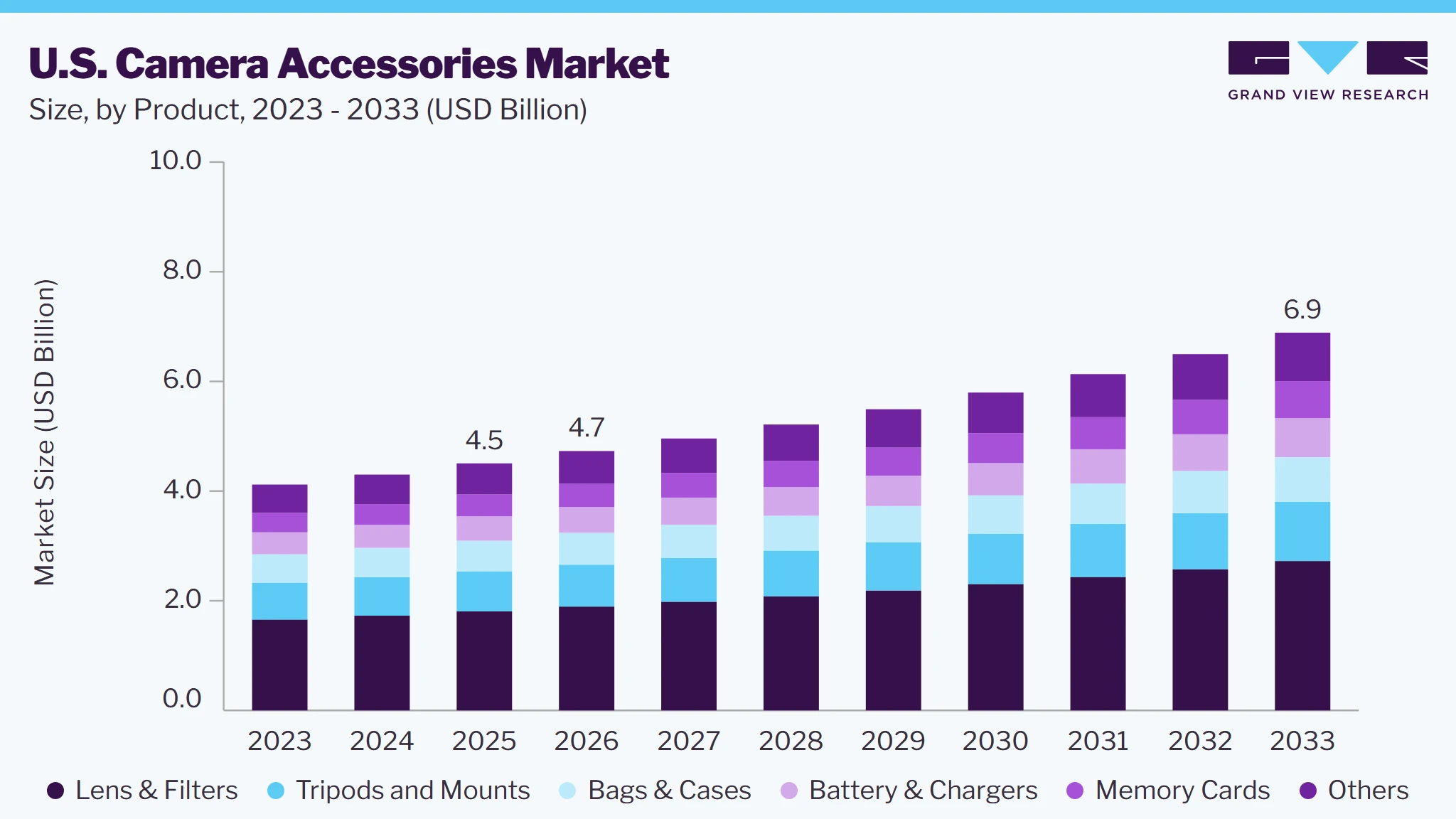 Source: Grand View Research, IR Documents, Primary Interviews, Paid DatabasesTo learn more about this report,
 Download Free Sample Report
 The expansion of interchangeable-lens camera systems is strengthening demand for compatible accessories in the U.S. market. Mirrorless cameras and advanced lenses encourage photographers and videographers to purchase additional equipment, including camera bags, tripods, grips, batteries, filters, and other supporting products. As users upgrade their camera bodies or adopt specialized lenses for professional and enthusiast applications, they also require accessories that improve portability, shooting stability, storage, and overall equipment functionality.
In January 2025, Canon U.S.A. reported that the EOS R6 Mark II was the top-selling full-frame camera in the U.S. in 2024 and Canon held the leading position in interchangeable-lens, mirrorless, and full-frame mirrorless camera categories. The continued adoption of these camera systems supports demand for compatible accessories.
The increasing use of cameras is supporting demand for accessories that improve image quality, audio capture, lighting, and shooting stability. Content creators often require microphones, external lighting, tripods, gimbals, memory cards, and interchangeable lenses to produce higher-quality visual content. The convergence of photography and videography is consequently expanding accessory requirements beyond traditional still photography.
In May 2025, Canon introduced the EOS R50 V, an APS-C mirrorless camera designed with creative video functions for content creators. The development illustrates how camera manufacturers are expanding video-oriented systems, creating opportunities for compatible accessories used in content production.
Advancements in autofocus, image processing, video recording, and optical performance are encouraging photographers and videographers to upgrade their equipment. New camera technologies create demand for compatible lenses, high-capacity memory cards, batteries, filters, and stabilization products that support advanced shooting capabilities. As manufacturers introduce new camera systems and lens formats, accessory suppliers have opportunities to develop products tailored to evolving technical requirements.
Market Dynamics
The expansion of social media content creation, vlogging, and commercial video production is increasing demand for camera accessories that improve image quality, audio capture, lighting, and shooting stability. Content creators use dedicated cameras for high-quality visual production, creating recurring requirements for microphones, tripods, gimbals, memory cards, external monitors, and interchangeable lenses. This shift is strengthening demand for specialized equipment, particularly among creators seeking more professional production capabilities. For instance, Canon’s EOS R50 V supports vertical shooting, 4K video recording, and multiple livestreaming methods, while its compatibility with the RF-S14–30mm power-zoom lens encourages demand for complementary accessories such as tripods, microphones, gimbals, and additional lenses.
The high prices of professional camera accessories, such as premium lenses, gimbals, external monitors, wireless microphones, and advanced lighting systems, can discourage purchases among beginner photographers, casual users, and budget-conscious content creators. Since many users can rely on basic or smartphone-based equipment for routine photography and video creation, they may postpone upgrading to specialized accessories. This price sensitivity can limit the adoption of high-end products and restrain growth. In September 2026, Sigma announced the 20-60mm F2.8-4 DG Contemporary and 85mm F1.2 DG Art lenses in the U.S., priced at USD 849 and USD 1,599, respectively, with availability from October 6 in L-Mount and Sony E-mount. The relatively high prices of these premium lenses may restrain demand for camera accessories in the U.S., particularly among beginner photographers and casual creators, who may defer upgrades or opt for lower-cost alternatives.
The increasing use of cameras is creating opportunities for manufacturers to introduce accessories with AI tracking, wireless audio, integrated lighting, and improved stabilization. These products help creators achieve professional-quality results with compact and easy-to-use equipment, encouraging demand for gimbals, microphones, battery grips, media modules, and lighting accessories. In October 2025, GoPro launched the Fluid Pro AI gimbal for GoPro cameras, smartphones, and compact cameras. The product features AI-based subject tracking, three-axis stabilization, an integrated fill light, and power-bank functionality, demonstrating opportunities for smart accessories that simplify content creation.
Consumer Insights
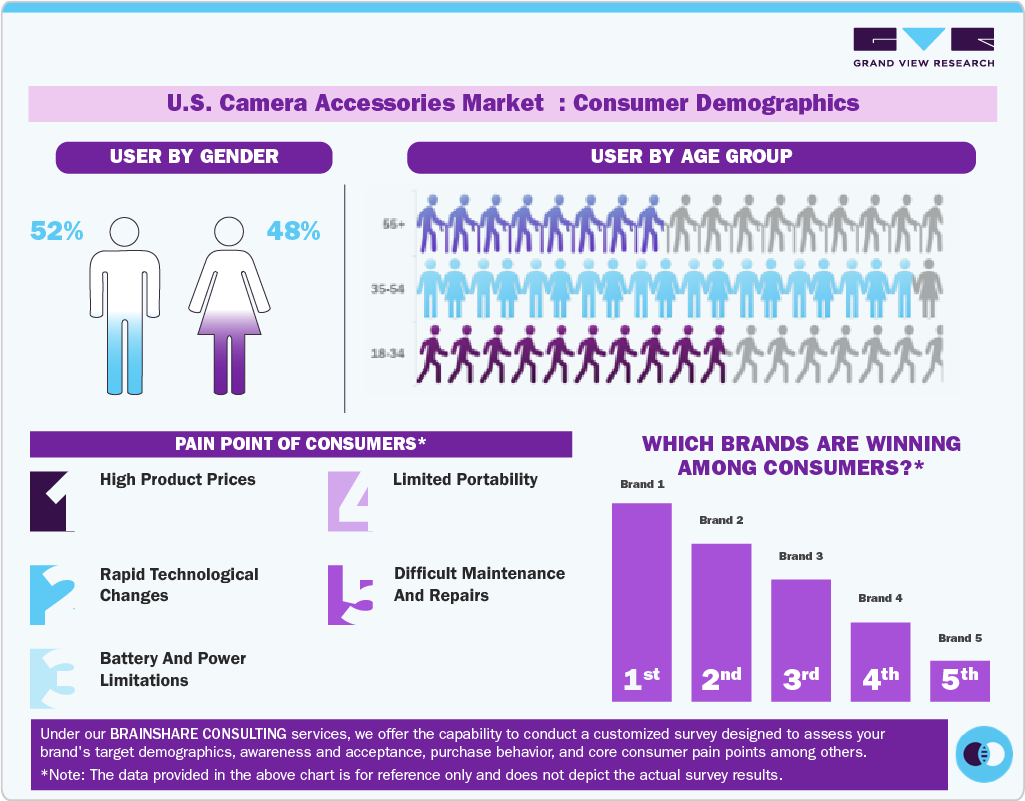
The market indicates a relatively balanced user base, with a slightly higher participation among male consumers. Demand is supported by photography, videography, content creation, travel, and other camera-based activities.
 To learn more about this report, Download Free Sample Report
 -
Male consumers account for 52% of users, reflecting demand from photography enthusiasts, professional photographers, videographers, content creators, and consumers seeking performance-oriented accessories such as lenses, tripods, stabilizers, microphones, and lighting equipment.
-
Female consumers represent 48% of users, supported by growing participation in content creation, travel photography, family photography, social media, and recreational video-making. Demand is also encouraged by preferences for compact, lightweight, easy-to-use, and aesthetically appealing camera accessories.
By age group, consumers aged 35–54 represent the strongest user base, reflecting established interest in photography, videography, travel documentation, content creation, and professional or semi-professional camera usage. This group is likely to prioritize product reliability, compatibility, durability, and performance when purchasing lenses, camera bags, tripods, batteries, and lighting equipment. Consumers aged 18–34 form another important user group, supported by vlogging, social media content creation, short-form video, and interest in technologically advanced accessories such as wireless microphones, gimbals, compact lighting, and smartphone-compatible equipment. Consumers aged 55+ represent a smaller but relevant user group, with demand focused on easy-to-use, reliable, portable, and protective accessories for travel, family photography, hobbies, and recreational use.
Consumers in the U.S. camera accessories market commonly face several product-related pain points that can affect purchasing decisions and overall satisfaction.
-
High product prices remain a concern, particularly for premium lenses, gimbals, external monitors, wireless microphones, and advanced lighting systems, which can discourage beginners and budget-conscious users.
-
Rapid technological changes can make existing accessories outdated or incompatible with newer camera systems, increasing replacement costs and creating uncertainty during purchase decisions.
-
Battery and power limitations affect electronic accessories such as wireless microphones, external monitors, flashes, and stabilizers, particularly during extended shooting sessions or outdoor activities.
-
Limited portability can reduce convenience, as professional tripods, lighting systems, camera bags, and stabilizers may be bulky or heavy for travel and mobile content creation.
-
Difficult maintenance and repairs can create additional costs and inconvenience, especially when accessories require specialized servicing, replacement parts, firmware updates, or brand-specific technical support.
Analyst Perspective
The market is evolving toward more versatile, performance-oriented, and technologically advanced photography and videography equipment, supported by growing interest in content creation, professional imaging, and enthusiast photography. Demand is driven by the increasing adoption of mirrorless cameras, action cameras, and video-recording equipment, which creates opportunities for interchangeable lenses, tripods, camera bags, memory cards, batteries, filters, and lighting accessories. Manufacturers focus on lightweight designs, improved optical performance, wireless connectivity, and compatibility across camera systems to address the needs of professional photographers, content creators, and hobbyists.
Product Insights
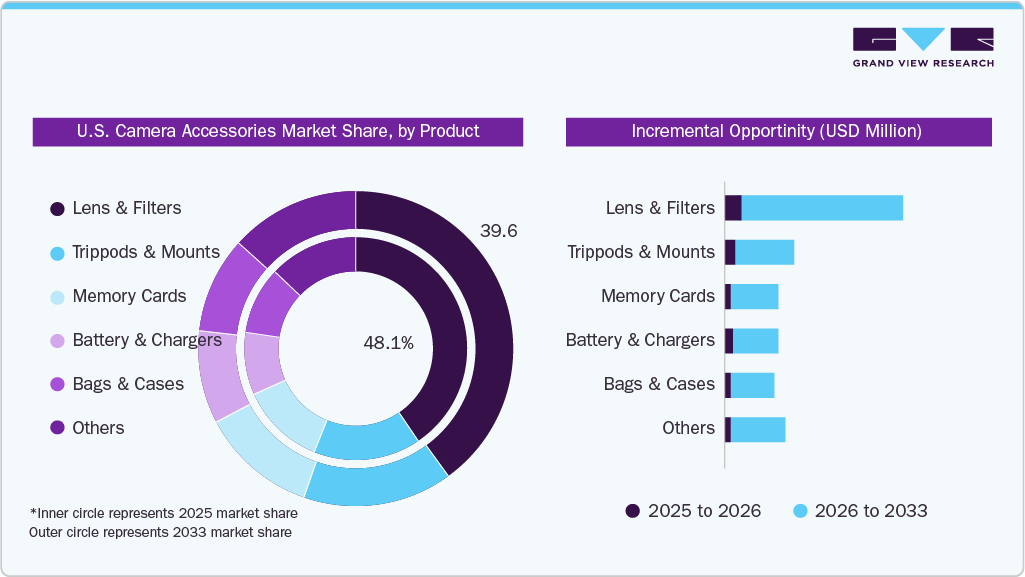
The lens & filters segment accounted for 40.1% of the revenue in 2025, supported by demand for interchangeable lenses that offer greater focal-length flexibility, wider apertures, improved autofocus, and enhanced optical performance. Photographers and videographers seek specialized lenses for portraiture, landscapes, wildlife, sports, filmmaking, and low-light photography. Filters complement these products by helping manage light exposure, reduce reflections, protect lens surfaces, and achieve specific creative effects. In February 2026, Canon Inc. announced the RF7-14mm F2.8-3.5 L Fisheye STM zoom lens and RF14mm F1.4 L VCM prime lens in the U.S. The lenses expand options for sports, landscape, architecture, astrophotography, and video applications. The RF7-14mm lens also supports drop-in clear, circular polarizing, and variable ND filters through a compatible mount adapter, demonstrating the integration of lens and filter functionality.
 To learn more about this report, Download Free Sample Report
 The memory cards segment is projected to grow at a CAGR of 6.8% from 2026 to 2033, supporting the storage and transfer of high-resolution photographs, 4K and 8K video footage, and other digital imaging files. Demand is influenced by the growing use of mirrorless cameras, action cameras, and professional video equipment, which require reliable, high-capacity, and high-speed storage solutions. In April 2026, Lexar introduced its Silver Plus microSDXC memory card lineup, including a 2TB option. The development demonstrates the industry's focus on expanding storage capacity for demanding digital imaging applications, including high-resolution photography and video recording.
Price Tier Insights
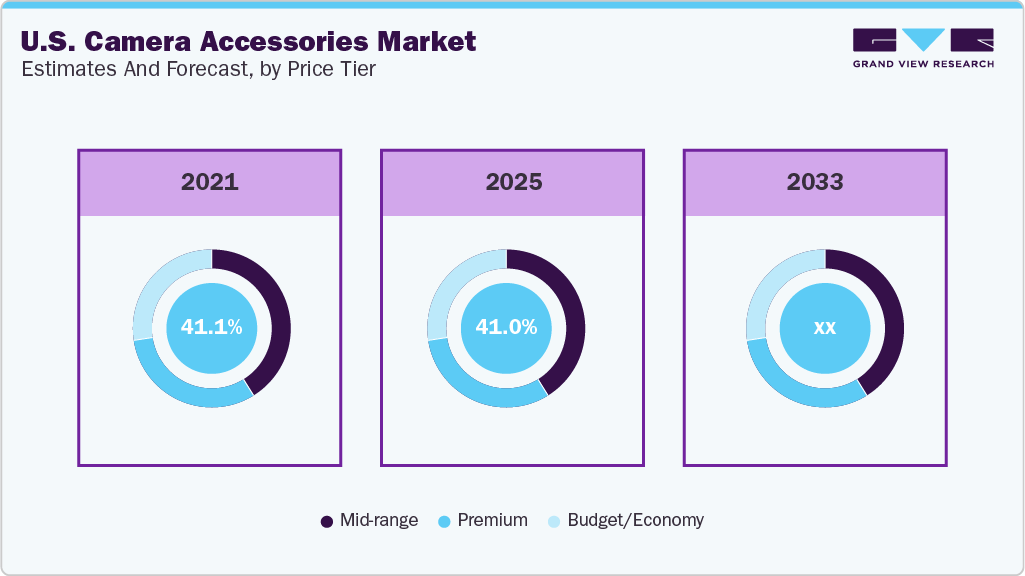
The mid-range segment accounted for 40.9% of the total revenue in 2025. This price tier caters to photography enthusiasts, amateur photographers, emerging content creators, and semi-professional users seeking a balance between product quality, functionality, and affordability. Demand is supported by the growing adoption of interchangeable-lens cameras, increasing video content creation, and photography as a recreational activity. Consumers in this segment typically prioritize reliable performance, compatibility with their camera systems, durability, and useful features without paying the premium associated with professional-grade camera accessories. In 2026, TechRadar highlighted the Lowepro Tahoe BP 150 AW as a lightweight and affordable camera backpack for users with modest equipment requirements. The example demonstrates demand for accessible camera bags that provide practical protection and storage for photography enthusiasts and entry-level professionals.
 To learn more about this report, Download Free Sample Report
 The premium segment is projected to grow at a CAGR of 6.0% from 2026 to 2033, driven by users who require specialized equipment for demanding photography and videography applications. Professional photographers, filmmakers, studio operators, and advanced content creators often select premium camera accessories to achieve greater precision, consistency, and operational reliability. This segment benefits from demand for high-performance lenses, professional lighting systems, advanced camera-support equipment, rugged carrying solutions, and high-speed storage products designed for intensive workflows. In April 2026, Digital Camera World reported on the Spinn Design ProWrapp Impact+, a padded protection system designed for cameras, lenses, tripods, and studio lighting equipment. The product illustrates the willingness of professional users to invest in specialized protective accessories for high-value imaging equipment.
Distribution Channel Insights
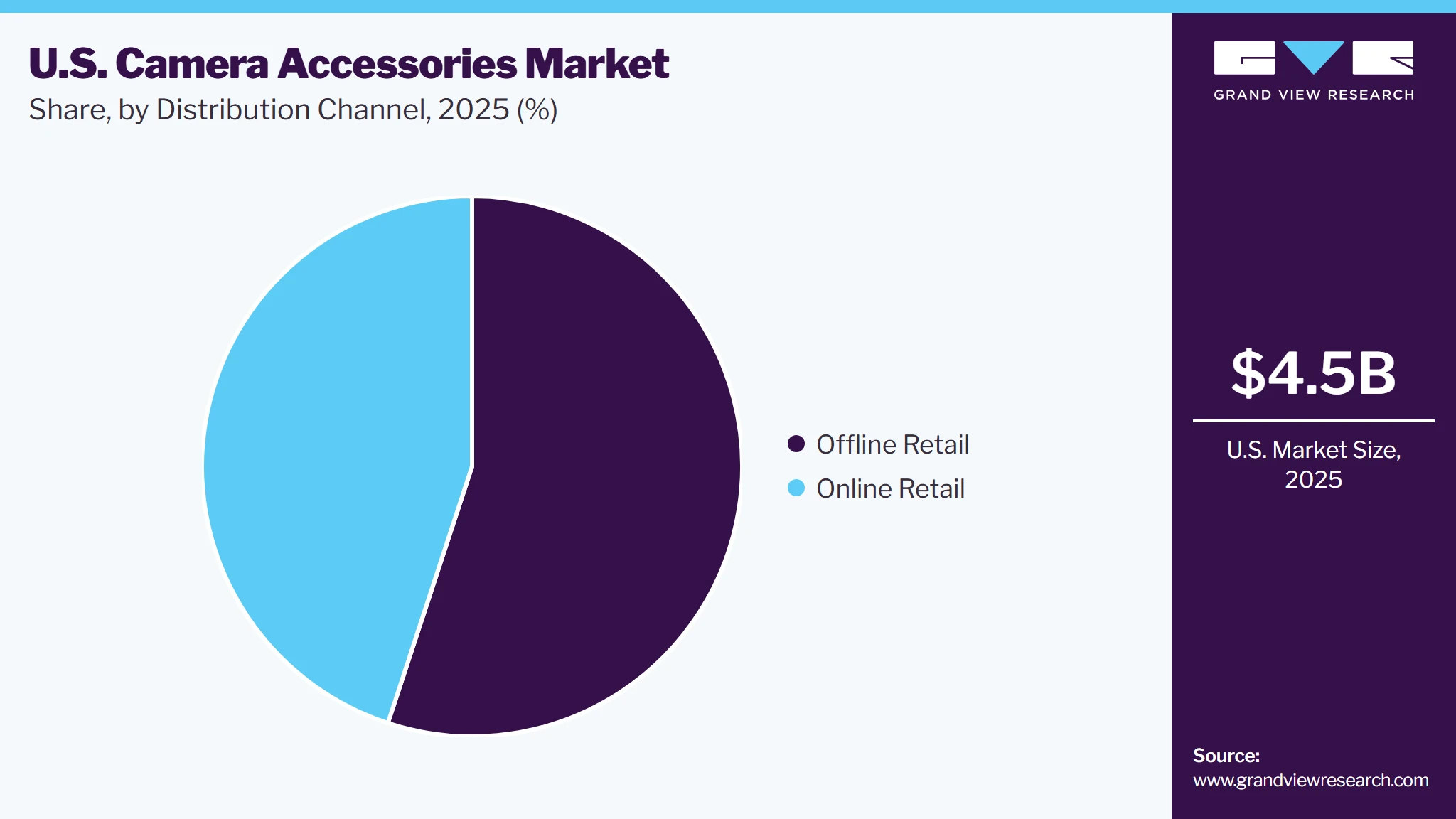
The offline retail segment accounted for 55.0% of U.S. revenue in 2025 as customers often prefer to physically inspect products, compare specifications, assess build quality, and receive expert guidance before purchasing technical equipment. This is particularly relevant for lenses, tripods, lighting systems, camera bags, memory cards, and other accessories that require compatibility checks or product demonstrations. Offline retailers also support immediate product availability, after-sales assistance, equipment rentals, and complementary purchases, making the channel valuable for professional photographers, enthusiasts, and first-time camera users. In September 2025, DICK’S Sporting Goods expanded its physical retail presence through new House of Sport locations, strengthening opportunities for customers to inspect and purchase sports and photography-related equipment in-store. Similarly, specialist retailers such as B&H Photo Video and Adorama provide customers with access to camera accessories, while offering product demonstrations and expert guidance.
 To learn more about this report, Download Free Sample Report
 The online retail segment is projected to grow at a CAGR of 5.9% from 2026 to 2033. Growth is supported by the convenience of home delivery, extensive product availability, easy price comparison, customer reviews, and access to technical specifications. Online platforms enable consumers to compare products across multiple brands before making a purchase. Promotional events, bundled offers, and the increasing adoption of photography, vlogging, and video content creation are expected to further support online-channel demand in the market. In March 2026, Amazon’s U.S. Big Spring Sale featured cameras, lenses, memory cards, tripods, lighting equipment, camera bags, microphones, and other photography products. The promotion demonstrates how online retail events encourage consumers to purchase complementary camera accessories and upgrade their photography or video equipment.
Key U.S. Camera Accessories Company Insights
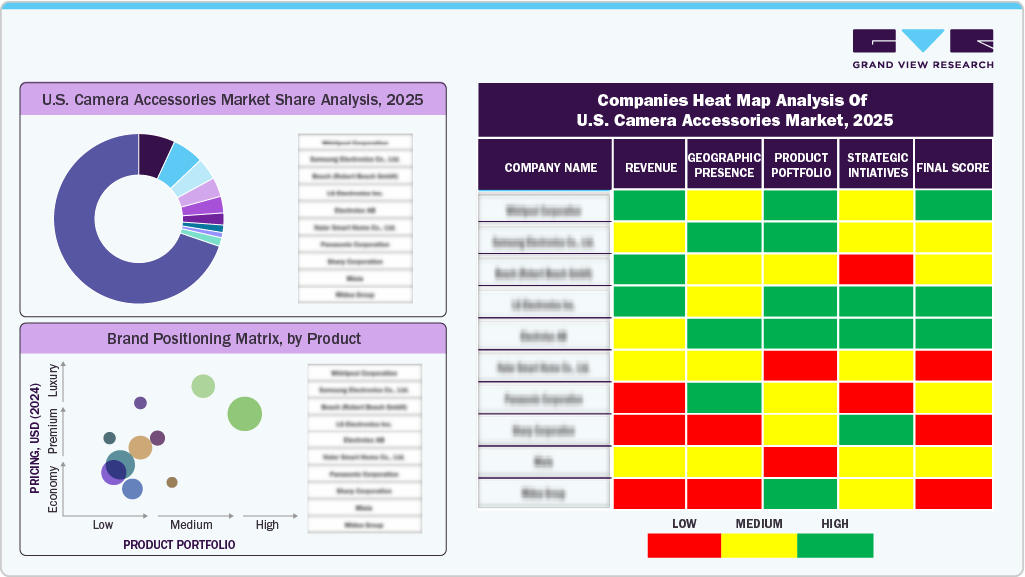
The U.S. camera accessories market is characterized by competition among established camera manufacturers, specialized lens producers, camera-support equipment suppliers, and action-camera brands. Competition is primarily shaped by product compatibility, optical performance, technological innovation, brand reputation, product durability, pricing, and the ability to meet the requirements of professional photographers, videographers, content creators, and photography enthusiasts.
-
Leading Camera-System Manufacturers: Companies such as Canon Inc., Sony Corporation, Nikon Corporation, Fujifilm Holdings Corporation, and Panasonic Holdings Corporation compete through extensive imaging ecosystems, strong brand recognition, and broad product compatibility. These companies offer interchangeable lenses, camera batteries, grips, flashes, and other system-specific equipment. Canon's RF and RF-S lens ecosystem, Sony's E-mount lens lineup, Nikon's NIKKOR Z lenses, Fujifilm's X-mount and G-mount lenses, and Panasonic's L-Mount and Micro Four Thirds-compatible offerings support consumer demand for accessories designed for specific camera systems.
-
Specialized Lens Manufacturers: Sigma Corporation and Tamron Co., Ltd. strengthen competition in the camera accessories market through third-party interchangeable lenses designed for multiple camera mounts. Their product portfolios emphasize optical performance, autofocus capabilities, compact designs, and compatibility with mirrorless and DSLR systems. These companies appeal to photographers seeking alternatives to original-equipment manufacturer lenses, particularly across portraits, landscape, wildlife, sports, and everyday photography applications.
-
Camera Support & Carrying Equipment Providers: Manfrotto and Peak Design compete through specialized camera-support and carrying solutions, including tripods, camera bags, straps, travel equipment, and modular mounting accessories. Manfrotto emphasizes professional support equipment for photography and video production, while Peak Design focuses on functional, durable, and travel-oriented carrying systems. Their offerings address the needs of professional photographers, content creators, and enthusiasts seeking portability, convenience, and reliable equipment protection.
-
Action Camera & Specialized Imaging Brands: GoPro, Inc. contributes to competitive development through action cameras and compatible accessories designed for outdoor recreation, travel, sports, and adventure-based content creation. Its product ecosystem includes camera mounts, protective housing, batteries, lighting solutions, and other equipment that support hands-free and first-person recording. This positioning differentiates GoPro from conventional interchangeable-lens camera manufacturers and supports demand for specialized camera accessories across recreational and professional applications.
 To learn more about this report, Download Free Sample Report
Key U.S. Camera Accessories Companies
-
Canon Inc.
-
Sony Corporation
-
Nikon Corporation
-
Fujifilm Holdings Corporation
-
Panasonic Holdings Corporation
-
Sigma Corporation
-
Tamron Co., Ltd.
-
Manfrotto
-
Peak Design
-
GoPro, Inc.
Competitive Benchmarking
Category
Operating Strategies
Competitive Edge
Key Challenges
Established Players
Canon Inc.
Sony Corporation
Nikon Corporation
Fujifilm Holdings Corporation
Panasonic Holdings Corporation
Focus on developing integrated camera ecosystems supported by interchangeable lenses, flashes, batteries, chargers, grips, microphones, remote controls, and other compatible Camera Accessories. These companies leverage established brand recognition, extensive distribution networks, authorized dealers, specialty camera retailers, and online platforms to serve professional photographers, enthusiasts, and content creators in the U.S. Their strategies emphasize continuous product innovation, compatibility, and customer retention through camera-system upgrades and complementary accessories.
Strong brand equity, extensive product portfolios, established customer relationships, and proprietary camera ecosystems. Compatibility between cameras and dedicated accessories encourages repeat purchases, while advanced imaging technologies, mirrorless cameras, and professional video systems create demand for specialized accessories.
High research and development, manufacturing, and marketing costs; intense competition from third-party accessory providers; rapid technological changes; and dependence on camera upgrade cycles. Compatibility restrictions across different camera mounts and systems may limit customer reach and product interchangeability.
Emerging & Regional Players
Sigma Corporation
Tamron Co., Ltd.
Manfrotto
Peak Design
GoPro, Inc.
Focus on specialized camera accessories, including third-party interchangeable lenses, tripods, monopods, camera bags, straps, mounting systems, protective cases, grips, and action-camera accessories. These companies target specific customer segments such as photography enthusiasts, professional photographers, travelers, outdoor users, and content creators. Their U.S. strategies emphasize product differentiation, direct-to-consumer websites, online marketplaces, specialty retailers, authorized distributors, and niche photography communities.
Greater flexibility in developing specialized products, differentiated optical performance, ergonomic designs, portability, and use-case-specific functionality. Sigma and Tamron strengthen the third-party lens segment, Manfrotto focuses on professional camera support, Peak Design emphasizes premium carrying solutions, and GoPro benefits from its action-camera and mounting-accessory ecosystem.
Smaller scale relative to major global imaging manufacturers in selected product categories, strong competition from first-party brands and low-cost alternatives, dependence on camera-system compatibility, and the need for continuous product innovation. Premium pricing, supply-chain costs, and reliance on specialized customer segments may also limit market penetration.
Recent Developments
-
In February 2026, Tamron introduced the Tamron-Link USB-C dongle, priced at approximately USD 50, which enables wireless control and customization of compatible lenses through the Tamron Lens Utility application. The accessory supports selected Sony E, Nikon Z, and Canon RF APS-C lenses, creating opportunities for advanced camera-control accessories among photographers and videographers.
-
In May 2026, GoPro launched its MISSION 1 Series cameras alongside a range of made-for-MISSION 1 mounts and accessories. The accessories became available through retail outlets and GoPro’s website, supporting demand for camera mounting and specialized equipment for action filmmaking and content creation.
U.S. Camera Accessories Market Report Scope
Report Attribute
Details
Market size in 2025
USD 4.5 billion
Estimated market size in 2026
USD 4.7 billion
Projected market size by 2033
USD 6.9 billion
Growth rate
CAGR of 5.5% from 2026 to 2033
Base year
2025
Actuals
2021 - 2025
Forecast period
2026 - 2033
Quantitative units
Revenue in USD billion and CAGR from 2026 to 2033
Report coverage
Revenue forecast, company ranking, competitive landscape, growth factors, and trends
Segments covered
Product, price tier, distribution channel
Key companies profiled
Canon Inc.; Sony Corporation; Nikon Corporation; Fujifilm Holdings Corporation; Panasonic Holdings Corporation; Sigma Corporation; Tamron Co., Ltd.; Manfrotto; Peak Design; GoPro, Inc.
Customization scope
Free report customization (equivalent up to 8 analysts’ working days) with purchase. Addition or alteration to country, regional & segment scope.
Pricing and purchase options
Avail customized purchase options to meet your exact research needs. Explore purchase options
U.S. Camera Accessories Market Report Segmentation
This report forecasts revenue growth at the country level and provides an analysis of the latest trends and opportunities in each of the sub-segments from 2026 to 2033. For this study, Grand View Research has segmented the U.S. camera accessories market report based on product, price tier, and distribution channel.
-
Product Outlook (Revenue, USD Billion, 2021 - 2033)
-
Lens & Filters
-
Bags & Cases
-
Memory Cards
-
Tripods and Mounts
-
Battery & Chargers
-
Others
-
-
Price Tier Outlook (Revenue, USD Billion, 2021 - 2033)
-
Budget/Economy
-
Mid-range
-
Premium
-
-
Distribution Channel Outlook (Revenue, USD Billion, 2021 - 2033)
-
Offline Retail
-
Online Retail
-
Research Methodology
The U.S. camera accessories market figures in this report are based on a proven research process that combines executive interviews with secondary research from proprietary databases, company filings, and recognized regulatory and institutional sources. Market size is built through value-chain sizing—reconciling supply-side and demand-side estimates—and triangulated with bottom-up and top-down approaches. Every estimate passes multiple levels of expert validation before publication, with each U.S. camera accessories segment quantified using the revenue-capture definitions in the table below.
Segment Definition
Segment – Price Tier
Revenue capture definition
Budget/Economy
Revenue from camera accessories positioned at lower price points, primarily purchased by entry-level photographers, casual users, students, and budget-conscious content creators. Includes affordable camera bags, tripods, batteries, memory cards, filters, straps, and basic lighting equipment. Captures sales of products that emphasize essential functionality and affordability.
Mid-range
Revenue from camera accessories positioned in the mid-price segment, targeting photography enthusiasts, semi-professional photographers, vloggers, and content creators. Includes lenses, tripods, gimbals, flashes, microphones, camera bags, and other accessories offering a balance of performance, durability, and price. Captures sales of products providing enhanced features and improved reliability compared with budget alternatives.
Premium
Revenue from high-priced camera accessories designed for professional photographers, filmmakers, commercial studios, and advanced content creators. Includes professional-grade lenses, high-performance gimbals, advanced lighting systems, premium tripods, specialized camera support equipment, and other high-end accessories. Captures sales of products emphasizing superior optical performance, advanced functionality, durability, precision, and professional-grade reliability.
Estimation Model
01 – Camera User Base Layer
02 – Camera Accessories Demand Layer
03 – Purchase Layer
04 – Monetization Layer
Who purchases Camera Accessories?
Who can access Camera Accessories?
Who actively purchases Camera Accessories?
How much revenue is generated?
Identifies camera users and photography enthusiasts in the U.S., including professional photographers, content creators, videographers, hobbyists, and casual camera owners. Includes individuals and businesses that own or use cameras requiring supplementary equipment and accessories.
Captures camera owners, photography professionals, content creators, and businesses with access to retail stores, online marketplaces, brand websites, and specialty camera dealers. Focuses on consumers and organizations seeking compatible accessories for photography, videography, and camera equipment upgrades.
Segments demand by accessory type, including lenses, tripods, camera bags, memory cards, batteries, flashes, filters, grips, and other compatible equipment. Also considers camera system, price tier, consumer and professional use, purchase frequency, replacement cycles, and online and offline retail channels.
Converts camera accessory purchases into market revenue by applying average selling prices, purchase frequency, replacement demand, and accessory-specific spending. Uses revenue generated through online marketplaces, brand websites, specialty camera stores, electronics retailers, and other relevant distribution channels.
Delivered Customizations
This report has been delivered with the following In-depth customizations
CLIENT REQUEST
CUSTOMIZATION DELIVERED
VALUE ADDS
U.S. Camera Accessories Market Demand, Consumer Preferences & Purchase Behavior Analysis
Conducted a detailed assessment of camera accessory demand by consumer type, including professional photographers, videographers, content creators, photography enthusiasts, and casual camera users. Evaluated purchase preferences across lenses, tripods, camera bags, memory cards, batteries, filters, flashes, and other accessories, considering camera compatibility, product quality, replacement cycles, and purchasing behavior.
Helps stakeholders identify high-value consumer segments, understand evolving photography and videography needs, and target accessory offerings toward consumers seeking improved camera performance, convenience, and creative capabilities.
U.S. Camera Accessories Market Product Innovation, Technology, Customization & Experience Trends
Evaluated innovation across the Camera Accessories industry, including advanced lenses, wireless camera-support equipment, smart camera accessories, high-capacity memory cards, portable lighting systems, stabilization products, and technology-enabled accessories. Examined product customization, ergonomic designs, connectivity features, lightweight materials, and compatibility with mirrorless, DSLR, action, and compact cameras.
Provides insights into evolving consumer expectations for performance, portability, connectivity, and specialized functionality. Supports product differentiation through technology-enabled accessories, customized solutions, and enhanced photography and videography experiences.
U.S. Camera Accessories Market Distribution & Market Opportunity Assessment
Assessed growth opportunities across online marketplaces, brand websites, specialty camera stores, electronics retailers, and other offline retail channels. Evaluated demand by product category, price tier, camera system, consumer segment, and purchasing channel, while analyzing replacement demand, upgrade opportunities, and emerging applications in content creation, professional photography, and videography.
Supports investment and expansion decisions by identifying high-potential product categories, consumer groups, and distribution channels. Helps businesses strengthen their presence in the camera accessories market through targeted product portfolios, channel strategies, and opportunities across professional and consumer applications.
About the Author(s)
Electronic & Electrical Research Team
Consumer Goods · Electronic & ElectricalThis report was authored by the electronic & electrical research team at Grand View Research - comprising two research analysts, one senior research analyst, and one industry expert - with specialized expertise in the electronic & electrical segment of the consumer goods industry. All findings are based on proprietary consumer goods databases, executive interviews, and regulatory analysis, subject to internal peer review prior to publication.
Last Updated:
Speak to Analyst

Customize this report to your needs - add regions, segments, or data points, with 20% free customization.
Or view our licence options:


ISO 9001:2015 & 27001:2022 Certified
We are GDPR and CCPA compliant! Your transaction & personal information is safe and secure. For more details, please read our privacy policy.


