
- Home
- »
- Homecare & Decor
- »
-
U.S. Ceiling Fans Market Size & Share Report, 2026-2033GVR Report cover

U.S. Ceiling Fans Market (2026 - 2033)
Size, Share & Trends Analysis Report By Product (Standard, Decorative), By Type (Indoor, Outdoor), Price Tier By Distribution Channel (Retail, Online, Professional (Wholesale)), Consumer Behavior, Key Companies, Competitive Analysis, And Segment Forecasts
Market Size, 2025
$2.4BMarket Estimate, 2026
$2.5BMarket Forecast, 2033
$3.4BCAGR, 2026–2033
4.4%U.S. Ceiling Fans Market Summary
The U.S. ceiling fans market size was valued at USD 2.4 billion in 2025 and is expected to grow from 2.5 billion in 2026 to 3.4 billion in 2033, at a CAGR of 4.4% from 2026 to 2033, driven by increasing residential renovation and home improvement activities, rising demand for energy-efficient cooling solutions, growing adoption of smart ceiling fans with remote and app-based controls, and increasing consumer preference for decorative designs that combine air circulation with interior aesthetics.
Key Market Trends & Insights
- In the product segment, decorative ceiling fans accounted for the largest revenue share of 61.6% in 2025.
- In the type segment, indoor ceiling fans accounted for the largest revenue share of 71.2% in 2025.
- In the distribution channel segment, sales through the retail channel accounted for a share of revenue of 60.6% in 2025.
Market Size & Forecast
- 2025 Revenue: USD 2.4 billion
- 2026 Estimated Market Size: USD 2.5 billion
- 2033 Projected Market Size: USD 3.4 billion
- CAGR (2026-2033): 4.4%
GVR research-powered AIAsk Prism AI about the U.S. ceiling fans marketGet cited answers from GVR research on market growth, segments, regulations and forecasts.Start with✓ Source-linked answers ✓ Market-specific context ✓ Traceable figuresExplore Prism AI ↗Consumer preferences in the U.S. ceiling fans market are increasingly shaped by the combination of airflow performance, energy efficiency, quiet operation, interior design, and smart-home convenience. Buyers consider not only a fan’s cooling function but also its ability to complement room décor, provide integrated lighting, operate with minimal noise, and fit into everyday routines. For residential users and small offices, these preferences encourage demand for efficient, aesthetically versatile, and easy-to-control ceiling fans.
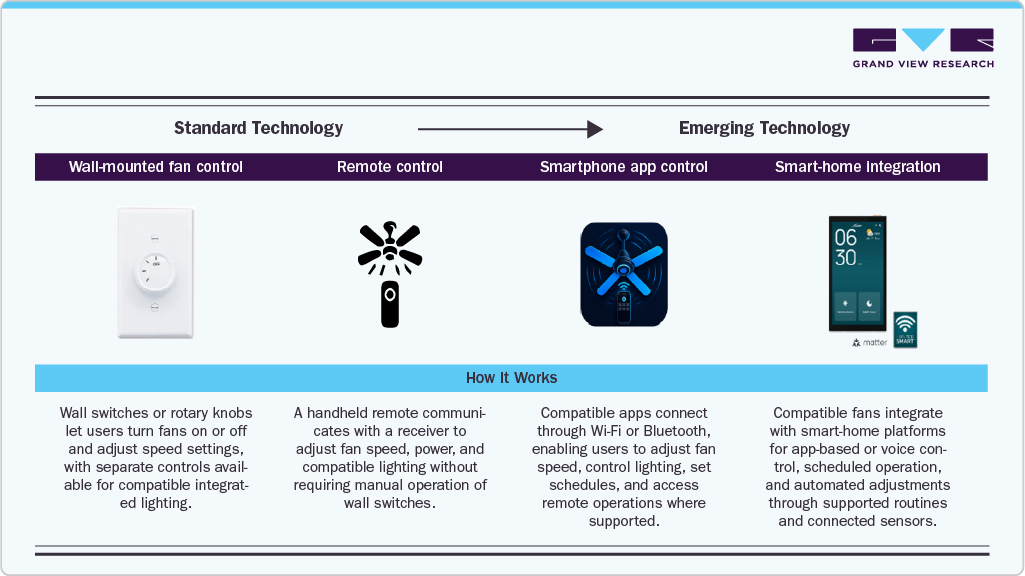
Technological advancements are shaping the U.S. ceiling fans market as consumers increasingly seek convenient controls, energy-efficient operation, and integration with smart-home systems. Wi-Fi connectivity, mobile applications, voice commands, remote access, and programmable schedules allow users to adjust fan speed, control integrated lighting, and manage operation according to daily routines without relying solely on manual switches or pull chains. These features are particularly useful in residential settings and small offices, where convenient control and flexible comfort settings can improve everyday usability. Smart ceiling fans with compatible sensors and automation systems can also adjust operation based on temperature or occupancy, potentially reducing unnecessary runtime when configured appropriately.
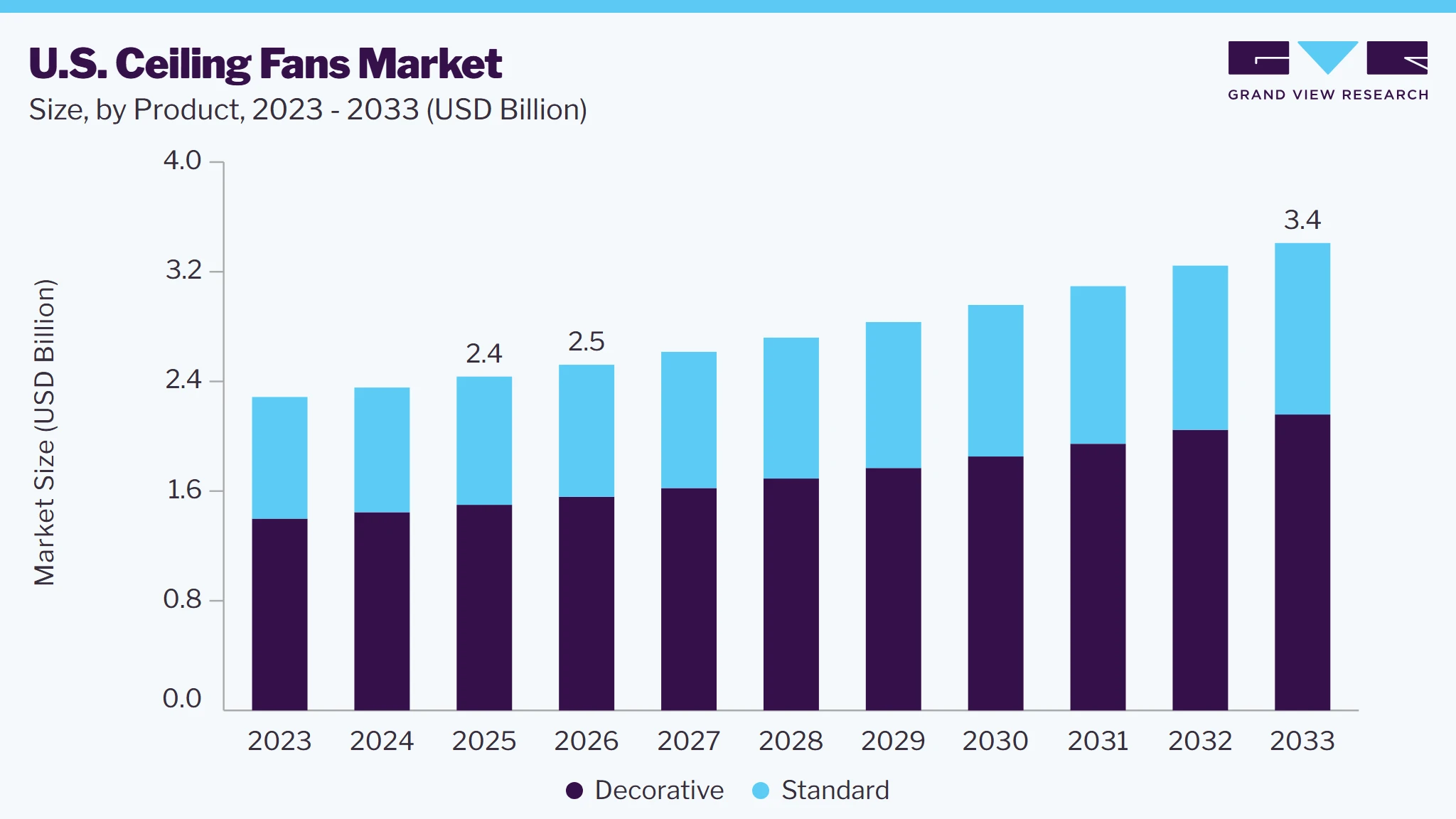 Source: Grand View Research, IR Documents, Primary Interviews, Paid DatabasesTo learn more about this report,
 Download Free Sample Report
The infographic below highlights various technologies employed in ceiling fan controls, spanning from conventional and standard options to emerging technologies. This advancement in technologies aligns with the preferences of consumers, reflecting the diverse range of choices.
 To learn more about this report, Download Free Sample Report
Rising electricity costs and increasing cooling requirements are encouraging U.S. households to adopt more energy-efficient cooling solutions. Consumers are becoming more conscious of the electricity consumption associated with cooling equipment, creating greater interest in products that improve air circulation while using less energy. Ceiling fans provide an efficient way to enhance indoor comfort and complement air-conditioning systems, while advanced models with efficient motors and optimized airflow can further reduce energy consumption. This shift toward lower-energy household solutions is supporting demand for energy-efficient ceiling fans across residential applications.
According to the U.S. Energy Information Administration (EIA), in October 2026, residential electricity prices are forecast to increase from 16.5 cents/kWh in 2024 to 18.2 cents/kWh in 2026 and 18.7 cents/kWh in 2027. In addition, residential electricity consumption increased 6% year over year in Q3 2026, driven partly by higher cooling demand during hot weather. Higher electricity costs are encouraging consumers to seek lower-energy alternatives, supporting demand for efficient ceiling fans that can provide air circulation and cooling with comparatively low electricity consumption.
Market Dynamics
Rising residential remodeling and renovation activity is supporting demand for ceiling fans in the U.S. ceiling fans market. As homeowners upgrade existing properties, they increasingly replace outdated fixtures and improve room aesthetics, lighting, ventilation, and overall comfort. Ceiling fans are often incorporated into renovations of bedrooms, living rooms, kitchens, dining areas, and other residential spaces, creating opportunities for both replacement and new installations. Renovation projects also encourage homeowners to select modern ceiling fans with improved designs, integrated lighting, smart controls, and energy-efficient motors, thereby supporting demand for higher-value and technologically advanced products.
According to Houzz Inc., home renovation activity remained steady in 2025, with 54% of U.S. homeowners undertaking renovation projects. Continued investment in existing homes is creating opportunities for homeowners to replace outdated fixtures and upgrade interior spaces, including ventilation and lighting solutions. This supports demand for ceiling fans as renovation projects provide opportunities to install new or replacement fans, particularly models offering modern designs, integrated lighting, smart controls, and improved energy efficiency, contributing to the growth of the ceiling fans industry.
The widespread availability of air-conditioning systems and alternative cooling technologies is creating competitive pressure on the U.S. ceiling fans market. Consumers increasingly have access to central air-conditioning, window and portable air conditioners, and heat-pump systems that provide direct temperature control and cooling.
These solutions can reduce reliance on ceiling fans as the primary cooling method, particularly in regions with high cooling requirements. In addition, improvements in air-conditioning efficiency, smart controls, and temperature management technologies are enhancing the functionality and convenience of competing cooling systems. As consumers prioritize consistent indoor temperature control and integrated cooling performance, the growing adoption of alternative solutions can limit demand for ceiling fans as standalone cooling products, thereby restraining market growth. According to the U.S. Census Bureau, more than nine out of 10 U.S. households have air conditioning in their homes, highlighting the strong availability of dedicated cooling systems across the country. This high level of AC access reduces consumers’ dependence on ceiling fans as a primary cooling solution, particularly during periods of high temperatures.
The expansion of outdoor living and entertaining spaces is creating opportunities for outdoor ceiling fans in the U.S. ceiling fans market. Homeowners are increasingly transforming decks, porches, and backyards into extensions of indoor living areas for relaxing, dining, cooking, and entertaining. This shift is increasing demand for products that enhance outdoor comfort and airflow. Weather-resistant ceiling fans can improve usability while complementing outdoor furniture, lighting, and décor, supporting market opportunities. According to Houzz’s 2026 U.S. Outdoor Trends Study, 83% of renovated outdoor spaces included lounge or seating areas, highlighting the growing emphasis on outdoor comfort. This trend is supporting demand for weather-resistant ceiling fans that improve airflow and comfort while complementing outdoor furniture, lighting, and décor.
Analyst Perspective
The U.S. ceiling fans market is evolving toward energy-efficient, design-oriented, and technology-enabled cooling solutions, with ceiling fans increasingly serving both functional and decorative purposes across residential and commercial spaces. Demand is supported by home renovation activities, consumer interest in reducing cooling energy consumption, and preferences for products that complement modern interior designs. Manufacturers are expanding portfolios with DC motor technology, smart controls, integrated LED lighting, and indoor-outdoor designs while offering varied finishes, blade configurations, and performance options to address diverse consumer requirements.
Consumer Insights
 To learn more about this report, Download Free Sample Report
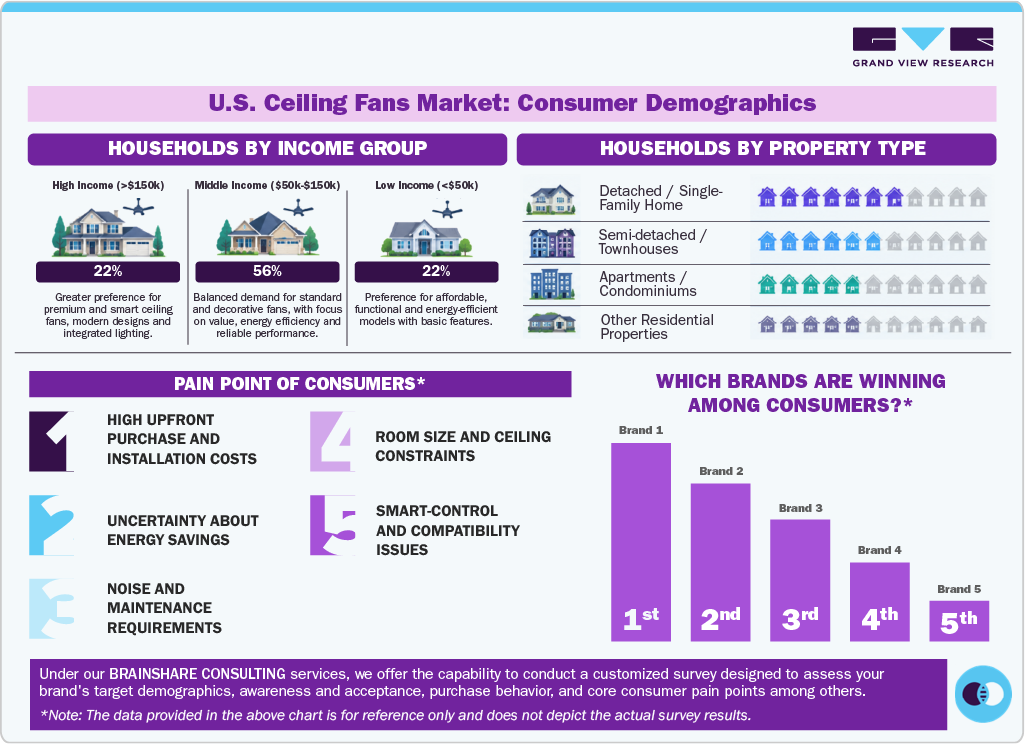
Consumer demand in the U.S. ceiling fans market is primarily influenced by household income, property type, home improvement activity, room size, and cooling requirements, with purchasing decisions increasingly shaped by energy efficiency, installation costs, airflow performance, and interior design preferences.
-
High-income households demonstrate greater potential demand for premium and decorative ceiling fans featuring advanced motor technology, smart controls, integrated lighting, and contemporary finishes. Purchasing decisions are often influenced by design aesthetics, convenience, and compatibility with smart-home systems.
-
Middle-income households represent an important consumer segment, with demand spanning standard and decorative ceiling fans that balance affordability, airflow performance, energy efficiency, and appearance. Replacement purchases and residential renovation projects create opportunities for models with improved functionality and modern designs.
-
Lower-income households primarily prioritize affordable ceiling fans that provide reliable air circulation, practical functionality, and cost-effective operation. Purchase decisions are more sensitive to upfront prices, installation expenses, and long-term electricity consumption.
By property type, detached and single-family homes offer substantial opportunities for ceiling fan installations across bedrooms, living rooms, dining areas, kitchens, and covered outdoor spaces. Semi-detached homes and townhouses typically require space-efficient models that complement interior designs and provide effective airflow across multiple floors. Apartments and condominiums favor appropriately sized ceiling fans that accommodate room dimensions, ceiling heights, building restrictions, and noise considerations. Other residential properties, including manufactured and mobile homes, create demand for compact, practical, and easy-to-install models.
Households in the U.S. ceiling fans market commonly encounter several pain points and challenges during product selection and ownership.
-
High purchase and installation costs can discourage households from upgrading to premium models, particularly when electrical modifications or professional installation are required.
-
Uncertainty about energy savings makes it difficult for consumers to compare motor efficiency, operating costs, and the potential contribution of ceiling fans to household cooling expenses.
-
Noise and maintenance requirements, including motor noise, blade imbalance, and dust accumulation, can affect product satisfaction and long-term usability.
-
Room size and ceiling constraints influence product selection, as ceiling height, available mounting space, and room dimensions determine suitable fan configurations.
-
Smart-control and compatibility issues can complicate adoption among households seeking app-based operation and integration with existing smart-home systems.
Product Insights
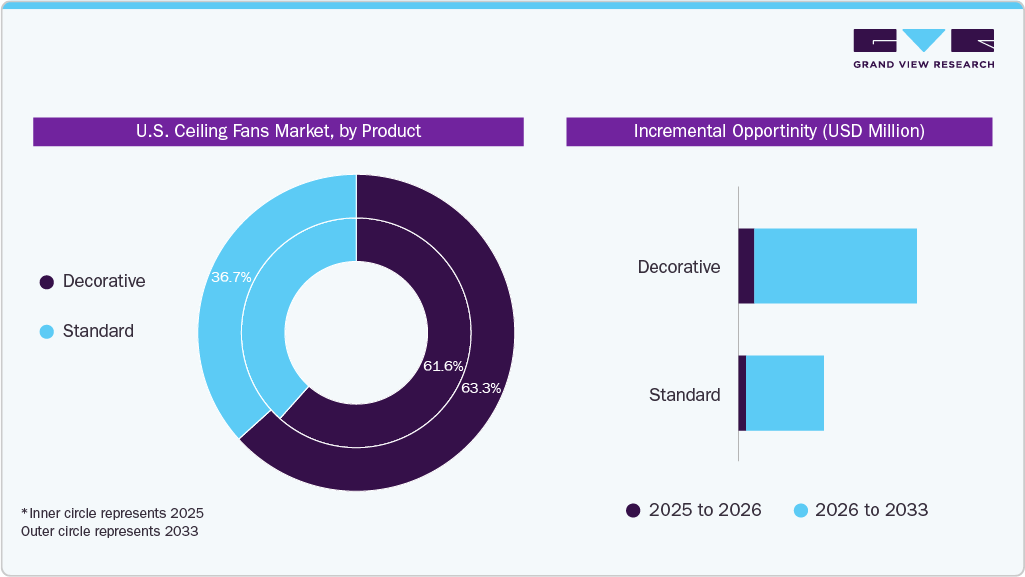
In the product segment, decorative ceiling fans accounted for the largest revenue share of 61.6% in 2025. Decorative ceiling fans are increasingly being integrated into residential and commercial spaces as consumers seek products that combine air circulation with interior aesthetics. The growing focus on home renovation, interior customization, and multifunctional fixtures is encouraging product innovation across the segment.
In addition, the integration of energy-efficient motors, LED lighting, and smart controls is enabling manufacturers to differentiate their offerings while addressing consumer preferences for convenience, functionality, and visual appeal. In January 2025, Kichler introduced the Mint Ceiling Fan Collection, which offers a minimalist 60-inch, six-blade design in multiple finishes. This collection includes integrated LED lighting, selectable color temperatures, a DC motor, and damp-rated construction, illustrating the trend toward combining visual simplicity with functional and energy-efficient features.
 To learn more about this report, Download Free Sample Report
In the product segment, standard ceiling fans are expected to grow at a CAGR of 3.8% from 2026 to 2033. Standard ceiling fans are designed for efficient air circulation, easy installation, and reliable performance. They typically feature simple designs and differ from highly decorative or belt-driven models.
Standard ceiling fans now feature enhanced motor efficiency, improved airflow, quieter operation, and connected controls, while maintaining practical designs. ENERGY STAR reports that certified ceiling fans with advanced motors and blade designs can be up to 44% more efficient than conventional models. The criteria also assess airflow and energy efficiency, encouraging manufacturers to optimize performance without compromising air circulation. In January 2026, Hunter Fan Company introduced its HunterSMART portfolio and ZenTech smart ceiling fan series at PepCom's Digital Experience in Las Vegas. The ZenTech series combines an ultra-slim profile with a quiet DC motor and ENERGY STAR certification and is available in three- and five-blade configurations.
Type Insights
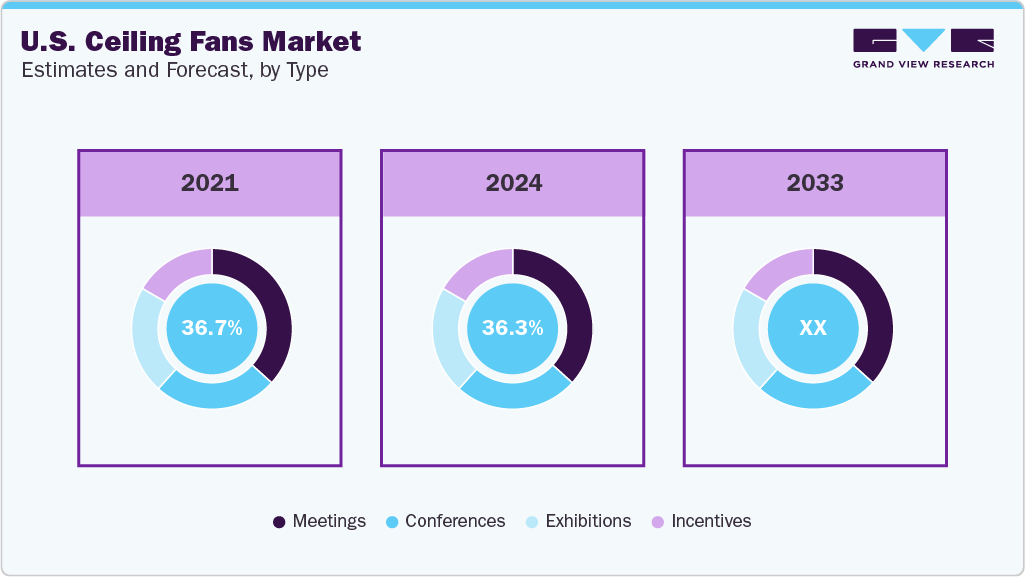
In the type segment, indoor ceiling fans accounted for the largest revenue share of 71.2% in 2025. Growth in residential renovations is increasing demand for indoor ceiling fans, as homeowners seek to upgrade and personalize their living spaces. The 2026 U.S. Houzz & Home Study reports that 67% of respondents renovated interior rooms in 2025, making these spaces the primary focus of renovation. In addition, light fixtures were purchased by 48% of homeowners who renovated in 2025, indicating strong demand for lighting-related fixtures during residential improvement projects. This creates an opportunity for indoor ceiling fans with integrated lighting, particularly in renovated interior spaces. In 2026, Hunter Fan Company expanded its indoor portfolio with the Aerodyne Indoor Smart Fan, a 60-inch model featuring a six-speed DC motor, integrated LED lighting, reversible blades, and remote control. The HunterSMART platform supports Alexa, Apple HomeKit, and Google Home compatibility. ENERGY STAR certification highlights the product’s energy efficiency. This launch illustrates the evolution of indoor ceiling fans into integrated residential fixtures that offer lighting, adjustable operation, and smart-home functionality.
 To learn more about this report, Download Free Sample Report
In the product segment, outdoor U.S. ceiling fans are expected to grow at a CAGR of 5.0% from 2026 to 2033. Outdoor ceiling fans are becoming more common in residential spaces as homeowners use patios, covered decks, verandas, pergolas, and screened outdoor rooms for daily activities. Installation depends on ceiling height, moisture exposure, and area size. Weather-resistant models with larger blades, integrated lighting, and remote or smart controls are especially well-suited for these settings. In April 2026, MULE Products announced the launch of its Max Breeze ceiling fans in 52-inch and 72-inch sizes for larger spaces. The 72-inch model features a 6-speed motor, delivers airflow of up to 7,600 CFM, and is fully wet-rated for outdoor conditions, making it suitable for applications such as patios and pergolas.
Distribution Channel Insights
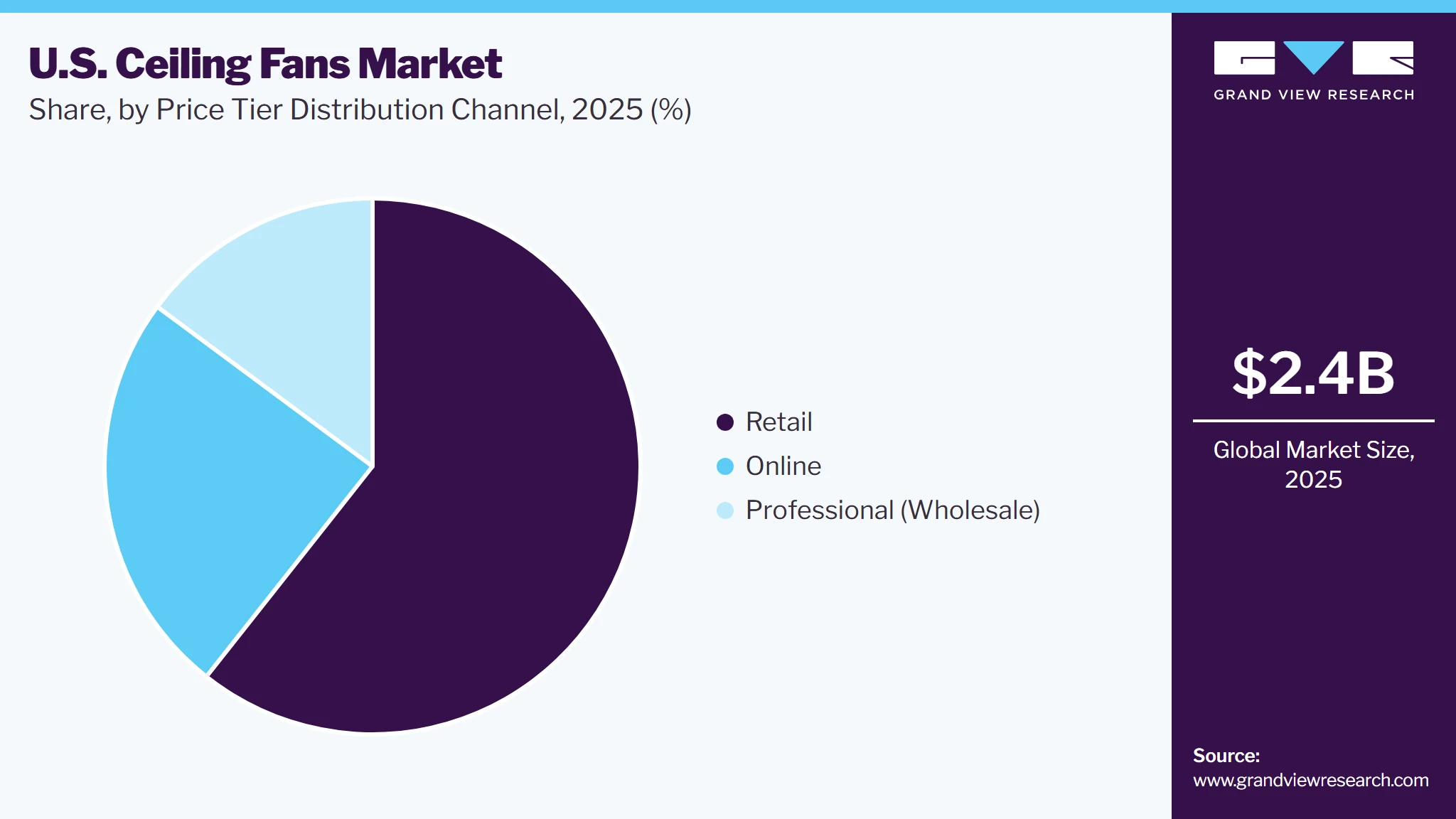
In the distribution channel segment, sales through the retail channel accounted for a share of revenue of 60.6% in 2025. Retail remains an important distribution channel for ceiling fans in the U.S., particularly through home improvement and hardware retailers where consumers can compare fan sizes, designs, controls, and installation requirements before purchase.
 To learn more about this report, Download Free Sample Report
J.D. Power’s 2025 U.S. Home Improvement Retailer Satisfaction Study found that 64% of home-improvement retailer shoppers would shop at their store again, an increase of 9 percentage points from 2024. The study also noted increased use of retailer websites before visiting physical stores. Based on responses from 2,143 customers who had purchased home-improvement-related products from a home improvement retailer during the previous 12 months, the findings indicate the importance of both physical retail experiences and digital product research within the U.S. home-improvement retail channel.
In the distribution channel segment, sales through the online channel are expected to grow at a CAGR of 5.0% from 2026 to 2033. The online distribution channel is gaining importance in the U.S. ceiling fans market as consumers increasingly use digital platforms to compare product specifications, prices, designs, energy-efficiency features, and customer reviews before purchasing.
Additionally, home-delivery services, promotional pricing, easy product discovery, and convenient return policies are encouraging consumers to purchase ceiling fans through digital channels. For instance, in February 2026, Hunter Fan Company expanded its direct-to-consumer online presence through Elevé Comfort, an online-first ceiling fan brand focused on streamlined shopping, fast shipping, and simple installation. The brand operates primarily online and offers ceiling fans with features such as six-speed DC motors, handheld remote controls, and integrated LED lighting.Key Companies & Market Share Insights
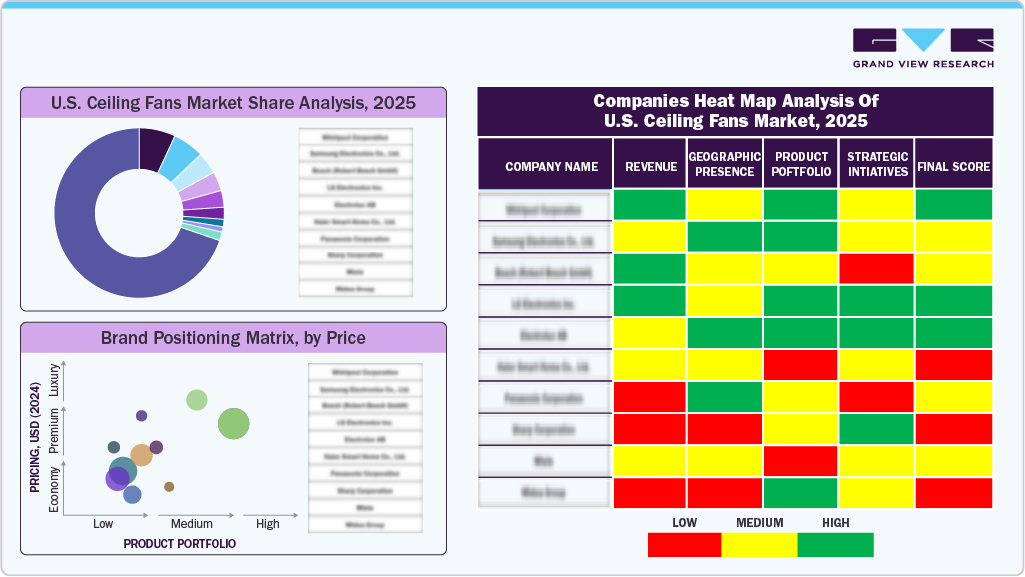
The U.S. ceiling fans market is characterized by competition among established residential ceiling fan manufacturers, premium decorative fan brands, and specialized air circulation solution providers. Market participants compete through product design, airflow efficiency, motor technology, integrated lighting, smart-home functionality, pricing, and distribution reach. The Ceiling Fans Industry serves a diverse customer base, including homeowners, builders, interior designers, retailers, and commercial facility operators. Competitive differentiation is influenced by brand recognition, product assortment, energy efficiency, and the ability to address demand across standard, decorative, indoor, and outdoor ceiling fan applications.
-
Residential & Mainstream Market Participants: Hunter Fan Company, Minka Group LLC, Craftmade, Inc., and Westinghouse Lighting serve residential customers through ceiling fans across traditional, contemporary, and functional design categories. Their competitive positioning is shaped by brand familiarity, product availability, price points, and access to retail and lighting distribution channels. Hunter and Minka also address demand for fans that combine airflow performance with decorative appeal.
-
Premium Decorative & Design-led Manufacturers: Fanimation, Inc., Monte Carlo Fan Company (Visual Comfort & Co.), Matthews Fan Company, and Quorum International, Inc. target consumers seeking distinctive designs, specialized finishes, and ceiling fans that complement interior décor. These companies compete through product styling, design variety, and suitability for premium residential and selected hospitality projects, where visual appeal is an important purchase consideration.
-
Specialized High-performance Fan Solutions: Big Ass Fans differentiates itself through high-volume, low-speed (HVLS) fans and high-performance air circulation products for large residential, commercial, and industrial spaces. This positioning broadens its addressable customer base beyond conventional household ceiling fans, with performance, airflow coverage, and energy efficiency serving as important competitive factors.
-
Lighting-integrated & Home Improvement-focused Brands: Kichler Lighting LLC competes through ceiling fans that combine functional cooling with decorative lighting and coordinated finishes. Its positioning reflects the overlap between ceiling fan purchases, lighting upgrades, and broader home improvement projects. Product assortment and relationships with lighting showrooms and retail channels are important factors in reaching homeowners and design professionals.
 To learn more about this report, Download Free Sample Report
Key U.S. Ceiling Fans Companies:
-
Hunter Fan Company
-
Minka Group LLC
-
Fanimation, Inc.
-
Monte Carlo Fan Company (Visual Comfort & Co.)
-
Big Ass Fans
-
Kichler Lighting LLC
-
Craftmade, Inc.
-
Westinghouse Lighting
-
Quorum International, Inc.
-
Matthews Fan Company
Competitive Benchmarking
Category
Operating Strategies
Competitive Edge
Key Challenges
Established Players (Hunter Fan Company; Minka Group LLC; Big Ass Fans; Kichler Lighting LLC; Westinghouse Lighting)
- Focus on maintaining broad product portfolios across standard, decorative, indoor, and outdoor ceiling fans while strengthening distribution through home improvement retailers, lighting showrooms, distributors, and online channels. These companies emphasize product durability, motor performance, energy efficiency, and design variety to serve residential and commercial customers. Investments in smart controls, remote operation, and connected-home compatibility help address evolving customer preferences.
- Established brand recognition, extensive product selections, established retail and distributor relationships, and experience serving diverse customer segments provide competitive advantages. Hunter benefits from its long-standing market presence and broad residential distribution, while Big Ass Fans differentiates itself through high-performance airflow solutions for residential, commercial, and industrial applications. Minka Group and Kichler compete through design variety and integration with broader home lighting and décor offerings.
- High competition from private-label brands and lower-priced manufacturers puts pressure on pricing and margins. Product development costs associated with energy-efficient motors, smart controls, and updated designs can increase investment requirements. Companies must also manage inventory across numerous blade sizes, finishes, mounting configurations, and performance specifications while meeting applicable energy-efficiency and safety requirements.
Specialized & Design-Oriented Players (Fanimation, Inc.; Monte Carlo Fan Company (Visual Comfort & Co.); Craftmade, Inc.; Quorum International, Inc.; Matthews Fan Company)
- Concentrate on differentiated product designs, decorative finishes, specialized airflow applications, and products tailored to particular interior styles or customer requirements. Strategies include developing contemporary and statement-making ceiling fans, offering varied blade configurations and installation options, and building relationships with lighting showrooms, interior designers, architects, and specialty retailers. Premium-focused manufacturers emphasize aesthetics and customization, while specialized brands target customers seeking distinctive designs or application-specific performance.
- Product differentiation, specialized design expertise, and the ability to serve niche customer preferences provide alternatives to standardized mass-market fans. Fanimation competes through distinctive fan designs, while Monte Carlo benefits from its design-led positioning within Visual Comfort & Co. Matthews Fan Company focuses on design-oriented products, including models suited to contemporary interiors. These differentiated offerings can reduce direct reliance on price competition and support premium positioning in selected applications.
- Smaller-scale operations or narrower product positioning can limit purchasing leverage, marketing reach, and visibility across mass-market retail channels. Demand for specific designs may fluctuate with interior décor trends, increasing the risk of slower-moving inventory. Specialized manufacturers must balance customization and product differentiation with competitive pricing, distribution coverage, installation requirements, and the need to introduce new designs without significantly increasing operating costs.
Recent Developments
-
In May 2026, Big Ass Fans launched the Bison residential ceiling fan, designed for indoor and outdoor spaces in the market. The product delivers more than 16,000 CFM of airflow, features a quiet motor, wet-rated construction, and Matter-compatible connectivity with Apple HomeKit, Amazon Alexa, and Google Assistant. The launch strengthens Big Ass Fans’ premium residential offering by combining high airflow performance, weather resistance, and smart-home functionality within the U.S. ceiling fans market.
-
In February 2026, SKYX Platforms Corp. announced the launch of its SKYFAN & TURBO HEATER at Walmart in the U.S. The all-in-one ceiling-mounted product combines a ceiling fan with an integrated turbo heater, offering year-round functionality for different spaces. The company also planned to offer the product in six color options to serve different consumer preferences. The launch strengthens SKYX’s U.S. retail distribution strategy by bringing its plug-and-play ceiling fan technology to a major national retailer.
-
In February 2026, Griffon Corporation announced a strategic restructuring under which Hunter Fan Company would be moved into its Home and Building Products segment. The realignment is intended to streamline Griffon’s business structure and better align Hunter Fan’s ceiling-fan operations with its broader building-products portfolio. The development highlights ongoing portfolio optimization among established home-improvement manufacturers, while positioning Hunter Fan within a segment focused on residential and building-related products in the U.S. ceiling fans market.
-
In April 2025, Exhale Fans launched its fifth-generation bladeless ceiling fan, featuring an upgraded motor, improved durability, motor protection, and brighter, dimmable LED lighting with selectable color temperatures. The company stated that the product could reduce HVAC energy costs by 10% while maintaining thermal comfort. This launch reinforces Exhale’s focus on energy-efficient airflow technology and product differentiation for different applications in the ceiling fans market.
U.S. ceiling fans Market Report Scope
Report Attribute
Details
Market size in 2025
USD 2.4 billion
Estimated market size in 2026
USD 2.5 billion
Projected market size by 2033
USD 3.4 billion
Growth rate
CAGR of 4.4% from 2026 to 2033
Actuals
2021 - 2025
Forecast period
2026 - 2033
Quantitative units
Revenue in USD billion/Million, Volume in Thousand Units and CAGR from 2026 to 2033
Report coverage
Revenue forecast, company ranking, competitive landscape, growth factors, and trends
Segments covered
Product, Type, Price Tier by Distribution Channel
Key companies profiled
Hunter Fan Company; Minka Group LLC; Fanimation, Inc.; Monte Carlo Fan Company (Visual Comfort & Co.); Big Ass Fans; Kichler Lighting LLC; Craftmade, Inc.; Westinghouse Lighting; Quorum International, Inc.; Matthews Fan Company.
Customization scope
Free report customization (equivalent up to 8 analysts’ working days) with purchase. Addition or alteration to country, regional & segment scope.
Pricing and purchase options
Avail customized purchase options to meet your exact research needs. Explore purchase options
U.S. Ceiling Fans Market Report Segmentation
This report forecasts revenue growth at country levels and provides an analysis of the latest trends and opportunities in each of the sub-segments from 2026 to 2033. For the purpose of this study, Grand View Research has segmented the U.S. ceiling fans market on the basis of product, type, and price tier by distribution channel.
-
Product Outlook (Revenue, USD Million, Volume, Thousand Units 2021 - 2033)
-
Standard
-
Decorative
-
-
Type Outlook (Revenue, USD Million, Volume, Thousand Units 2021 - 2033)
-
Indoor
-
Outdoor
-
-
Price Tier by Distribution Channel Outlook (Revenue, USD Million, Volume, Thousand Units 2021 - 2033)
-
Retail
-
Economy / Entry-Level: USD $0–$199
-
Mid-Range: USD $200–$349
-
Premium: USD $350–$499
-
Luxury / High-End: USD $500+
-
-
Online
-
Economy / Entry-Level: USD $0–$199
-
Mid-Range: USD $200–$349
-
Premium: USD $350–$499
-
Luxury / High-End: USD $500+
-
-
Professional (Wholesale)
-
Economy / Entry-Level: USD $0–$199
-
Mid-Range: USD $200–$349
-
Premium: USD $350–$499
-
Luxury / High-End: USD $500+
-
-
Research Methodology
The U.S. ceiling fans market figures in this report are based on a proven research process that combines executive interviews with secondary research from proprietary databases, company filings, and recognized regulatory and institutional sources. Market size is built through value-chain sizing-reconciling supply-side and demand-side estimates-and triangulated with bottom-up and top-down approaches. Every estimate passes multiple levels of expert validation before publication, with each U.S. ceiling fans segment quantified using the revenue-capture definitions in the table below.
Segment Definition
Segment – Product
Revenue capture definition
Standard
This segment includes ceiling fans designed primarily for functional air circulation, featuring conventional blade designs, basic housings, and standard finishes. The scope covers traditional and contemporary models with fixed or reversible speeds, integrated or separate lighting, and common mounting configurations.
Decorative
This segment includes ceiling fans designed to combine air circulation with distinctive visual appeal, featuring ornamental blade shapes, premium finishes, designer housings, and coordinated lighting elements. The scope covers statement designs, themed styles, and fans incorporating distinctive materials or detailing.
Estimation Model
Residential & Commercial Building Base Layer
Ceiling Fan Adoption Layer
Purchase & Installation Layer
Monetization Layer
Who has potential demand for ceiling fans?
Which buildings are suitable for ceiling fan installations?
Which installations translate into product purchases?
How much revenue is generated?
Identifies the U.S. building base across residential properties, including single-family homes, apartments, and condominiums, as well as commercial establishments such as offices, hotels, restaurants, retail spaces, and institutional buildings. Considers building stock, new construction, renovation activity, and existing ceiling fan installations.
Estimates the share of buildings, rooms, and commercial spaces with existing or potential ceiling fan installations. Accounts for room suitability, climate conditions, cooling requirements, household preferences, energy-efficiency considerations, and demand for standard, decorative, and smart ceiling fans.
Segments demand into new installations, replacement purchases, and additional installations in existing buildings. Evaluates purchase frequency, the number of fans installed per property, product size, indoor and outdoor applications, and distribution through home improvement stores, specialty retailers, distributors, and online channels.
Converts estimated annual ceiling fan purchases into market revenue using average selling prices across standard and decorative products, fan sizes, technology categories, and end-use applications. Incorporates product mix, channel-level pricing, and the contribution of premium and smart ceiling fans to estimate annual U.S. market revenue.
Delivered Customizations
This report has been delivered with the following In-depth customizations
Client Request
Customization Delivered
Value Adds
U.S. Ceiling Fans Market Demand, Consumer Preferences & Purchase Behavior Analysis
Conducted an assessment of U.S. ceiling fan demand across residential and commercial applications, evaluating purchase preferences related to airflow performance, energy efficiency, noise levels, motor technology, blade size, design, integrated lighting, and installation requirements. The analysis also considered replacement demand and the influence of home renovation and interior modernization.
Helps stakeholders identify key purchase drivers, distinguish functional requirements from design-led preferences, and align product development with customer expectations across standard and decorative ceiling fan categories.
U.S. Ceiling Fans Market Product Innovation, Feature Customization & Technology Trends
Evaluated product innovation across conventional, energy-efficient, and smart ceiling fans, including DC motor technology, remote-control operation, app-based controls, voice-assistant compatibility, integrated LED lighting, and indoor and outdoor configurations. The assessment considered the growing relevance of connected-home functionality and energy-conscious cooling solutions.
Provides insights into emerging product differentiation opportunities, helping manufacturers prioritize energy-efficient designs, connected controls, quieter operation, and multifunctional features that address evolving residential and commercial requirements.
U.S. Ceiling Fans Market Distribution Channels, Competitive Positioning & Market Opportunity Assessment
Assessed market opportunities across home improvement retailers, specialty lighting showrooms, distributors, e-commerce platforms, and brand-owned websites. The analysis considered competitive positioning across established manufacturers and design-oriented brands, evaluating product range, pricing, distribution reach, smart features, and opportunities in residential renovation and commercial installations.
Supports strategic decisions regarding channel expansion, product positioning, and investment priorities by identifying attractive customer segments, opportunities for premium and smart ceiling fan offerings, and routes to reach residential and commercial buyers.
About the Author(s)
Homecare & Decor Research Team
Consumer Goods · Homecare & DecorThis report was authored by the homecare & decor research team at Grand View Research - comprising two research analysts, one senior research analyst, and one industry expert - with specialized expertise in the homecare & decor segment of the consumer goods industry. All findings are based on proprietary consumer goods databases, executive interviews, and regulatory analysis, subject to internal peer review prior to publication.
Last Updated:
Speak to Analyst

Customize this report to your needs - add regions, segments, or data points, with 20% free customization.
Or view our licence options:


ISO 9001:2015 & 27001:2022 Certified
We are GDPR and CCPA compliant! Your transaction & personal information is safe and secure. For more details, please read our privacy policy.


