
- Home
- »
- Healthcare IT
- »
-
U.S. Digital Dietitian Market Size, Industry Report, 2035GVR Report cover
![U.S. Digital Dietitian Market Size, Share & Trends Report]()
U.S. Digital Dietitian Market (2026 - 2035) Size, Share & Trends Analysis Report By Component (Apps, Platform, Services), By Delivery Mode (Web-Based Solutions, Cloud-Based Solutions), Consumer Behavior And Competitive Analysis, And Segment Forecasts
Market Size, 2025
$655.4MMarket Forecast, 2035
$1,800.0MCAGR, 2026–2035
10.9%U.S. Digital Dietitian Market Summary
The U.S. digital dietitian market size was estimated at USD 655.4 million in 2025 and is anticipated to reach USD 1.8 billion by 2035, growing at a CAGR of 10.9% from 2026 to 2035. This growth is driven by the increasing prevalence of chronic diseases such as obesity, diabetes, cardiovascular disorders, and digestive health conditions, which are creating strong demand for accessible and personalized nutrition management services. In addition, the rapid expansion of telehealth and digital healthcare infrastructure across the U.S. has further accelerated market growth by enabling patients to access registered dietitians remotely through video consultations, chat-based counseling, and AI-powered nutrition platforms.

The section below outlines key factors such as research and development and trends shaping the U.S. digital dietitian market. It reflects technological advancements, the impact of demographics, and other factors that are strengthening the digital dietitian solutions across the U.S.
Market Dynamics
The growing burden of lifestyle-related diseases such as obesity, diabetes, cardiovascular disorders, and hypertension is significantly driving demand for the market. Asper NCBI study published in June 2023, nearly 6 in 10 people in the U.S. are living with at least one chronic disease. Consumers are increasingly seeking adapted dietary interventions that align with their individual health conditions, metabolic profiles, and wellness goals. For instance, in January 2024, the American Heart Association (AHA) reported that cardiovascular disease was the primary cause of death in the U.S., claiming 931,578 lives, surpassing deaths from all cancers and chronic respiratory diseases combined.
Data privacy and security concerns are some of the major factors expected to impede the adoption of diet and nutrition apps. Healthcare organizations increasingly rely on mobile devices to improve patient experience and productivity. Moreover, healthcare providers use mobile devices to store, process, & transmit patient-related data. However, the security of mobile devices is a top concern for these organizations. As per the Identity Theft Resource Center data published in January 2025, the number of data breach notices issued in 2024 rose dramatically to approximately 1.35 billion, up from 419.3 million in 2023, reflecting a year-over-year increase of 211%. This surge was primarily driven by five major “mega-breaches,” each involving the exposure of data belonging to more than 100 million individuals. Together, these large-scale incidents accounted for over 1 billion breach notices, demonstrating how a limited number of high impacts cyberattacks significantly influenced the overall cybersecurity landscape in 2024.
The U.S. digital dietitian market faces significant challenges, including reimbursement complexity, data privacy concerns, and maintaining clinical quality in AI-enabled nutrition platforms. Although telehealth adoption has increased, nutrition counseling reimbursement policies continue to vary across Medicare, Medicaid, and private insurers, creating operational barriers for scaling providers nationally. In addition, the growing use of AI-driven dietary recommendations raises concerns about HIPAA compliance, patient data security, and state-level telehealth regulations.
The U.S. digital dietitian industry presents strong growth opportunities driven by increasing demand for preventive healthcare, rising obesity and diabetes prevalence, expansion of AI-powered personalized nutrition platforms, and broader employer-sponsored wellness programs. Integration of wearable devices, biomarker testing, and predictive analytics enables highly personalized nutrition interventions, accelerating adoption across consumers, healthcare providers, and corporate wellness networks. For instance, in January 2026, MyFitnessPal, Inc. expanded its digital reach by launching its app within the ChatGPT health experience, enabling seamless access to personalized nutrition and wellness support. Through this integration, users can receive tailored meal recommendations, calorie tracking guidance, and weight management support directly within the conversational interface.
Market Characteristics & Concentration
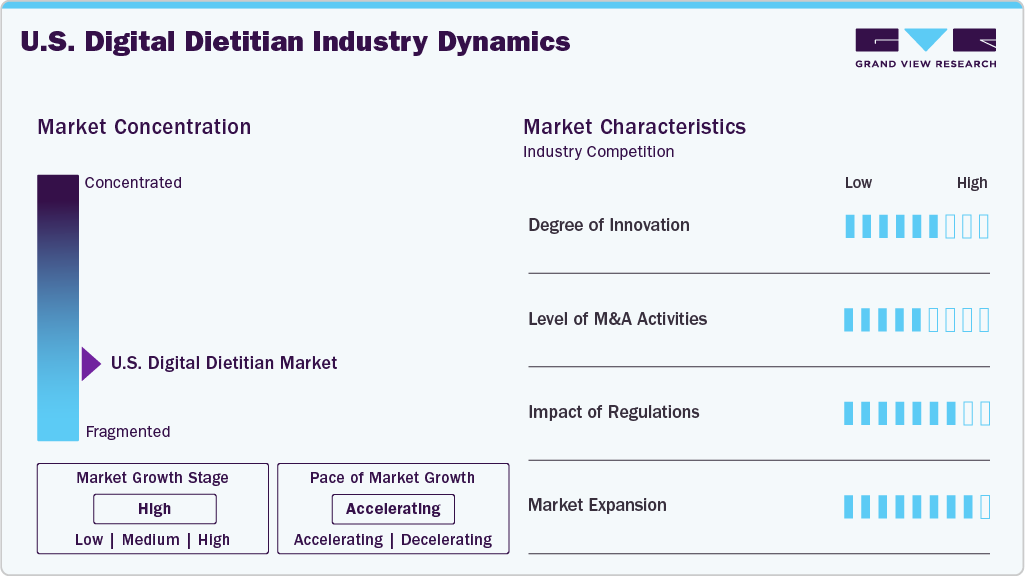
The chart below represents the relationship between industry concentration, characteristics, and participants. There is a medium degree of innovation, moderate level of merger & acquisition activities, a moderately high impact of regulations, and high industry expansion. The market is fragmented, the degree of innovation is medium, and the level of merger & acquisitions activities is medium. The impact of regulations on the market is moderately high, and the market expansion of players is high.
Innovations include advancements in digital dietitian services. Companies are also focusing on product innovation and platform integration to strengthen their market position. For instance, Fitbit (Google) continues to enhance its ecosystem by integrating wearable data with health insights and digital coaching, while Noom, Inc. invests in AI-driven personalization and chronic disease management programs to expand beyond weight loss into metabolic health.
The U.S. digital dietitian market shows notable consolidations as larger companies aim to expand their reach and capabilities and expand their market presence. For instance, in March 2026, MyFitnessPal acquired Cal AI, an app that uses photo-based AI to estimate calories and macros, eliminating manual food logging. The acquisition strengthens MyFitnessPal’s shift toward AI-driven nutrition tracking, combining its large food database with Cal AI’s low-friction, AI-native interface.
The impact of regulations on the U.S. digital dietitian industry is significant. The regulatory framework for the market is multi-layered, involving federal healthcare privacy laws, telehealth reimbursement rules, professional licensing requirements, and emerging state-level data protection regulations. The telehealth regulatory framework is designed to ensure that Medical Nutrition Therapy (MNT) and nutrition counseling delivered digitally meet the same standards of safety, quality, and reimbursement as in-person care. The Academy of Nutrition and Dietetics emphasizes that telehealth is a critical delivery model for expanding access to registered dietitian nutritionists (RDNs), particularly for chronic disease management and underserved populations. Together, these rules govern how digital dietitian platforms collect, store, and deliver nutrition-related healthcare services.
The industry is experiencing significant market expansion, driven by factors such as increased investments, facility launches, and innovation. For instance, in October 2024, Healthie raised USD 23 million to expand its API-first platform (EHR, scheduling, patient engagement) that supports virtual-first, continuous care delivery, including nutrition and health coaching services.
Case Study
Case study: ZOE personalized nutrition platform
Overview:
ZOE is a personalized nutrition and digital health platform that leverages microbiome analysis, continuous glucose monitoring, blood fat testing, and artificial intelligence (AI) to provide individualized dietary recommendations. The company aims to improve metabolic health, support weight management, and prevent chronic disease through data-driven nutrition insights. ZOE gained significant market traction through large-scale nutrition studies, celebrity-backed investments, and growing consumer interest in precision health solutions.
Business Challenge
Traditional dietary guidelines often rely on generalized recommendations that may not account for differences in metabolism, gut microbiome composition, and blood sugar responses among individuals. Rising rates of obesity, diabetes, and cardiovascular diseases have increased demand for personalized nutrition solutions capable of delivering measurable health outcomes. However, maintaining long-term user engagement, simplifying onboarding, and ensuring scalability of highly personalized services remain major operational challenges for digital nutrition companies.
Solution Implemented
ZOE developed a digital nutrition ecosystem that combines at-home diagnostic kits, wearable glucose monitoring devices, AI-powered analytics, and mobile app-based coaching. Users complete gut microbiome tests and metabolic assessments, after which the platform generates personalized food scores and dietary guidance. The app also includes meal tracking, educational content, behavior-change coaching, and recipe recommendations to support long-term lifestyle modification. According to UX analysis published on Medium, the platform continuously refines user experience through usability testing and behavioral design frameworks to improve adoption and retention.
Key Developments & Market Expansion:
-
ZOE expanded its personalized nutrition study into the U.S. market and reportedly surpassed 130,000 registered users, reflecting growing demand for AI-enabled nutrition platforms.
-
The company attracted investment from high-profile investors, including Steven Bartlett’s Flight Fund, supporting platform scaling and international expansion.
-
Clinical studies associated with ZOE demonstrated improvements in weight management, blood sugar control, gut health, and cardiometabolic markers compared to conventional dietary guidance approaches.
-
ZOE’s platform integrates CGM technology and microbiome science to strengthen precision nutrition recommendations, aligning with broader healthcare trends toward preventive and personalized medicine.
User Insights & Operational Learnings
A UX-focused case study conducted on ZOE identified several key user pain points, including meal planning complexity, difficulty sustaining dietary changes, challenges during travel, and family-based food preferences. Suggested improvements included recipe sharing, ingredient-based meal search, and location-aware nutrition guidance to enhance customer engagement and retention.
Industry Impact
ZOE represents a leading example of how artificial intelligence (AI), wearable technologies, and microbiome science are reshaping the digital dietitian and personalized nutrition market. The company demonstrates the growing shift from generic wellness programs toward precision nutrition platforms capable of delivering individualized health interventions on scale. Its success has also accelerated broader investment and innovation across the U.S. digital nutrition ecosystem.
Consumer reactions remain mixed, with many users praising the personalized insights and metabolic-tracking capabilities, while others raise concerns about pricing, the depth of personalization, and long-term usability.
Component Insights
The apps segment dominated the U.S. digital dietitian market, accounting for the largest share of 64.4% in 2025, driven by the rising prevalence of lifestyle-related disorders, increasing demand for personalized nutrition, and expanding adoption of mobile health solutions. In addition, advancements in artificial intelligence, real-time data analytics, and digital therapeutics are enhancing app capabilities by enabling adaptive coaching, automated meal planning, and continuous engagement. For instance, in August 2025, MyFitnessPal, in its summer release, introduced advanced features, such as AI-powered meal planning, smart food logging, and integrated grocery support to deliver personalized and scalable nutrition solutions.
This Summer Release reflects our understanding that nutrition looks different for everyone, and our tools are designed to support those individual paths. We're always working to evolve the app around our members' needs. Nutrition remains at the heart of everything we do, and these updates are designed to help people reach their goals in ways that work best for them."
-Tim Holley, Chief Product Officer at MyFitnessPal.
The platforms segment is expected to grow at the fastest CAGR of 11.6% over the forecast period, driven by rising demand for personalized nutrition, preventive healthcare, and digital-first care delivery models. The increasing adoption of AI-based health analytics and interoperability standards is accelerating platform consolidation across diet-tracking, telehealth, and wellness ecosystems. In addition, healthcare providers and insurers are adopting platform-based nutrition solutions to improve patient engagement, reduce the burden of chronic disease, and enable continuous remote care management. For instance, in March 2026, NutriGreene expanded its dietitian-led digital health platform by integrating mobile applications, GLP-1 care support, blood testing services, and meal delivery partnerships into a unified care ecosystem. The platform enables personalized nutrition management through data-driven insights and coordinated clinical nutrition services, strengthening its position in integrated digital dietitian care delivery.
“Patients are looking for more than just recommendations; they want guidance they can follow day to day. By building around our core nutrition services, we’re able to provide more structure, better support, and a more complete experience for everyone.”
-Nicole Barrato, Owner and Registered Dietitian at NutriGreene.
Delivery Mode Insights
The web-based segment held the largest share of the U.S. digital dietitian industry in 2025, driven by increasing demand for device-agnostic healthcare access, rising adoption of tele-nutrition, and the expansion of browser-based digital health infrastructure. Web-based delivery reduces entry barriers by eliminating installation requirements and supports rapid deployment across enterprise and healthcare ecosystems. The integration of AI-based nutrition engines, EHR connectivity, and real-time consultation systems is further strengthening clinical and preventive nutrition care. For instance, Season Health delivers dietitian-led medical nutrition therapy (MNT) through a web-accessible clinical platform that supports structured, evidence-based dietary care without requiring users to install a mobile application. The platform enables patients to access registered dietitians via browser-based sessions, making it suitable for integration into clinical workflows, employer wellness programs, and payer-supported nutrition interventions.

The cloud segment is expected to grow at the fastest CAGR over the forecast period, driven by increasing demand for scalable healthcare infrastructure, real-time data-driven decision-making, and integrated digital health ecosystems. For instance, in January 2024, Teladoc Health partnered with Aramark to enable hospitals to connect patients with registered dietitians through a cloud-based telehealth platform. The solution allows virtual delivery of nutrition counseling services, extending dietitian access to underserved populations while supporting remote clinical workflows and addressing workforce shortages in nutrition care delivery systems. The platform leverages cloud-based infrastructure to enable real-time communication between patients and dietitians, thereby strengthening access to scalable digital nutrition services.
“Medical nutrition therapy is an important aspect of our care team and the innovation offered with the Aramark program has enabled us to leverage technology to retain difficult to recruit dietitians and continue to provide, safe, high-quality care to our patients.”
-Jeff Hill, Senior Vice President of Support Services and Government Relations at the University Medical Center in Lubbock.
Competitive Benchmarking
Operating Strategies
Competitive Edge
Weaknesses
Mature Players: MyFitnessPal, Inc.
- Mature players focus on expanding AI-powered nutrition coaching, integrated telehealth ecosystems, chronic disease management programs, wearable connectivity, and subscription-based personalized diet planning services.
- Strong brand recognition, extensive consumer databases, advanced analytics capabilities, broad payer/provider partnerships, and integrated digital health platforms support large-scale adoption across the U.S. healthcare ecosystem.
- High operational and customer acquisition costs, data privacy concerns, and slower adaptation to highly personalized regional nutrition and culturally tailored diet requirements.
Emerging Players: Season Health
- Emerging players focus on food-as-medicine models, virtual registered dietitian access, personalized metabolic health programs, employer partnerships, and Medicaid/value-based care expansion.
- Agile innovation, niche nutrition specialization, personalized patient engagement, scalable virtual care delivery, and increasing partnerships with healthcare providers and insurers support rapid market penetration.
- Limited financial resources, smaller user bases, restricted geographic visibility, and dependence on partnerships for reimbursement and clinical scalability.
Key U.S. Digital Dietitian Companies:
- MyFitnessPal, Inc.
- FitNow, Inc.
- Teladoc Health, Inc.
- Fitbit (Google)
- American Well
- Healthie
- NourishedRx
- Noom, Inc.
- Nourish, Inc.
- Season Health
Recent Developments
-
In November 2025, Noom, Inc. introduced a Diabetes Lifestyle Program combining personalized nutrition guidance, coaching, and behavior-change tools to help manage and prevent type 2 diabetes. It also launched an AI-powered glucose forecasting tool that predicts how specific meals will impact future blood sugar levels without requiring continuous glucose monitoring devices. The platform uses user data (e.g., age, BMI, metabolic status) to deliver predictive insights and identify which foods drive glucose spikes, enabling proactive dietary decisions.
“Managing diabetes requires a proactive approach, not just reactive treatment. By pairing our proven behavioral science tools with cutting-edge predictive technology, Noom, Inc. empowers individuals and partners to intervene earlier, prevent progression, and make healthier choices every day. This is about tackling a national health crisis at scale and making powerful insights accessible to everyone not just those already living with diabetes, supporting a future of greater longevity for all.”
-Chief Commercial Officer at Noom, Inc.
-
In April 2026, Levels partnered with Season Health to integrate 1:1, insurance-covered dietitian support directly into the Levels app, enhancing personalized nutrition guidance for users. Through integration, dietitians can access real-time glucose data and food logs, enabling highly customized, data-driven dietary recommendations aligned with individual metabolic responses.
-
In February 2026, Community Health Network partnered with Nourish to integrate virtual, insurance-covered nutrition care directly into clinical workflows across multiple specialties in Indiana. The collaboration enables providers to refer patients to registered dietitians for ongoing, virtual consultations, supported by an AI-powered app for continuous engagement between visits.
“Metabolic health sits at the foundation of so many conditions we treat every day. We are excited to partner with Nourish to deliver consumer-focused metabolic care to our patients across Indiana.”
-MD, President and CEO of Community Health Network.
U.S. Digital Dietitian Market Report Scope
Report Attribute
Details
Revenue forecast in 2035
USD 1.8 billion
Growth rate
CAGR 10.9% from 2026 to 2035
Actual data
2021 - 2025
Forecast data
2026 - 2035
Quantitative units
Revenue in USD million/billion and CAGR from 2026 to 2035
Report coverage
Revenue forecast, company ranking, competitive landscape, growth factors, and trends
Segments covered
Component and delivery mode
Country scope
U.S.
Key companies profiled
MyFitnessPal, Inc.; FitNow, Inc.; Teladoc Health, Inc.; Fitbit (Google); American Well; Healthie; NourishedRx; Noom, Inc.; Nourish, Inc.; Season Health
Customization scope
Free report customization (equivalent to up to 8 analysts working days) with purchase. Addition or alteration to country, regional & segment scope.
Pricing and purchase options
Avail customized purchase options to meet your exact research needs. Explore purchase options
U.S. Digital Dietitian Market Report Segmentation
This report forecasts revenue growth at the country level and provides an analysis of the latest industry trends in each of the sub-segments from 2021 to 2035. For this study, Grand View Research has segmented the U.S. digital dietitian market report based on component and delivery mode:
-
Component Outlook (Revenue, USD Million, 2021 - 2035)
- Apps
-
By Type
-
Diet Tracking Apps
-
Health and Wellness Apps
-
Specialized Dietary Apps
-
-
By Payment
-
Freemium Model
-
One-Time Purchase
-
Subscription Model
-
-
-
Platforms
-
By Type
-
Telehealth Platforms
-
Integrated Health Platforms
-
Community Platforms
-
-
By Payment
-
Pay-Per-Consultation
-
Corporate Accounts
-
Subscription Model
-
Freemium Model
-
-
-
Services
- Apps
-
Delivery Mode Outlook (Revenue, USD Million, 2021 - 2035)
-
Web-Based Solutions
-
Cloud-Based Solutions
-
Delivered Customizations
This report has been delivered with the following In-depth customizations
Client Request
Customization Delivered
Value Adds
Cloud-Based Infrastructure & Scalability Assessment
Conducted a detailed evaluation of cloud-based and web-based delivery infrastructure supporting digital dietitian platforms, including scalability, data analytics capabilities, cybersecurity readiness, AI integration potential, and multi-device accessibility. The study further assessed operational efficiency, platform uptime requirements, and real-time dietary monitoring capabilities.
Supports long-term infrastructure planning, helps companies prioritize scalable deployment models, identifies opportunities for AI-driven personalization and predictive analytics, and strengthens operational readiness for expanding user bases and enterprise-level deployments.
Employer Wellness & Corporate Nutrition Program Analysis
Delivered a targeted assessment of digital nutrition adoption across employer-sponsored wellness initiatives, health plans, and corporate healthcare programs. The analysis examined utilization of subscription-based nutrition platforms, employee engagement strategies, chronic disease prevention initiatives, and ROI metrics linked to workforce wellness investments.
Helps clients identify high-growth enterprise opportunities, evaluate corporate demand for preventive nutrition solutions, optimize B2B commercialization strategies, and strengthen positioning within employer-driven digital health ecosystems
Chronic Disease Management & Preventive Care Opportunity Mapping
Developed an in-depth analysis of the role of digital dietitian solutions in managing obesity, diabetes, cardiovascular disorders, gastrointestinal conditions, and metabolic health challenges across the U.S. healthcare landscape. The study assessed demand for personalized nutrition intervention programs, remote dietary coaching, and AI-assisted meal planning tools within preventive healthcare frameworks.
Supports identification of high-growth clinical application areas, enables prioritization of chronic care-focused nutrition solutions, strengthens market forecasting linked to rising lifestyle disease prevalence, and enhances strategic positioning within value-based preventive healthcare models
Frequently Asked Questions About This Report
The U.S. digital dietitian market was valued at USD 655.4 million in 2025.
The U.S. digital dietitian market is anticipated to witness growth at a rate of 10.9% over the forecast period to reach a value of 1.8 billion by 2035.
The web based dominated the market with the largest share in 2025, driven by increasing demand for device-agnostic healthcare access, rising adoption of tele-nutrition, and the expansion of browser-based digital health infrastructure.
Key players in the market include MyFitnessPal, Inc.; FitNow, Inc; Teladoc Health, Inc.; Fitbit (Google); American Well; Healthie; NourishedRx; Noom, Inc.; Nourish, Inc.; Season Health.
The market is driven by the increasing prevalence of chronic diseases such as obesity, diabetes, cardiovascular disorders, and digestive health conditions, which are creating strong demand for accessible and personalized nutrition management services.
About the Author(s)
Healthcare IT Research Team
Healthcare · Healthcare ITThis report was authored by the healthcare it research team at Grand View Research - comprising two research analysts, one senior research analyst, and one industry expert - with specialized expertise in the healthcare it segment of the healthcare industry. All findings are based on proprietary healthcare databases, executive interviews, and regulatory analysis, subject to internal peer review prior to publication.
Last Updated:
Speak to Analyst -


Customize this report to your needs — add regions, segments, or data points, with 20% free customization.
Or view our licence options:


ISO 9001:2015 & 27001:2022 Certified
We are GDPR and CCPA compliant! Your transaction & personal information is safe and secure. For more details, please read our privacy policy.


