
- Home
- »
- Medical Devices
- »
-
U.S. First Aid Products Market Size & Share Report, 2033GVR Report cover

U.S. First Aid Products Market (Sporting Goods Retail Channel Analysis) (2026 - 2033)
Size, Share & Trends Analysis Report By Product Type (First Aid Kits, Wound Management), By Retail Format (Sporting Goods Chains, Independent/Regional Sporting Goods Retailers), And Segment Forecasts
Market Size, 2025
$237.8MMarket Estimate, 2026
$251.1MMarket Forecast, 2033
$361.1MCAGR, 2026–2033
5.3%U.S. First Aid Products Market Summary
The U.S. first aid products market (sporting goods retail channel analysis) size was valued at USD 237.8 million in 2025 and is projected to grow from USD 251.1 million in 2026 to USD 361.1 million by 2033, at a CAGR of 5.3% from 2026 to 2033. Driven by increasing awareness of personal health and safety, stringent workplace safety regulations, and the rising incidence of minor injuries in homes, workplaces, schools, and recreational settings.
Key Market Trends & Insights
- By product type: First aid kits segment led the market with the largest revenue share of 36.8% in 2025.
- By retail format: Sporting goods chains segment led the market with the largest revenue share of 60.4% in 2025
Market Size & Forecast
- Market size in 2025: USD 237.8 Million
- Estimated market size in 2026: USD 251.1 Million
- Projected market size by 2033: USD 361.1 Million
- CAGR (2026-2033): 5.3%
Three ways to get this report
Buy it, customize it, or ask a question.Ask an Analyst
Analyst response in 1 business day
- AccessReport author, directly
- Reply timeWithin 1 working day
- No sales callDirect answer only
- FormatEmail reply
- CostFree, no cost
Get the Full Report
What the study covers
- FormatsPDF · Excel · Dashboard
- Timeline2026–2033 annual, 2025 base
- Coverage20+ countries, 5 regions
- Companies10+ key players profiled
Customize the Report
20% free customization
- IncludeCountries, segments, points
- TailorTo your product definition
- ExtendDeeper competitor detail
- OrA fully bespoke study
- Turnaround5–10 working days
Growing participation in outdoor activities, sports, and travel has further increased demand for portable first-aid kits, wound-care products, bandages, antiseptics, and emergency medical supplies. The expansion of occupational health programs across industries such as manufacturing, construction, logistics, and healthcare continues to support product adoption to ensure compliance with safety standards.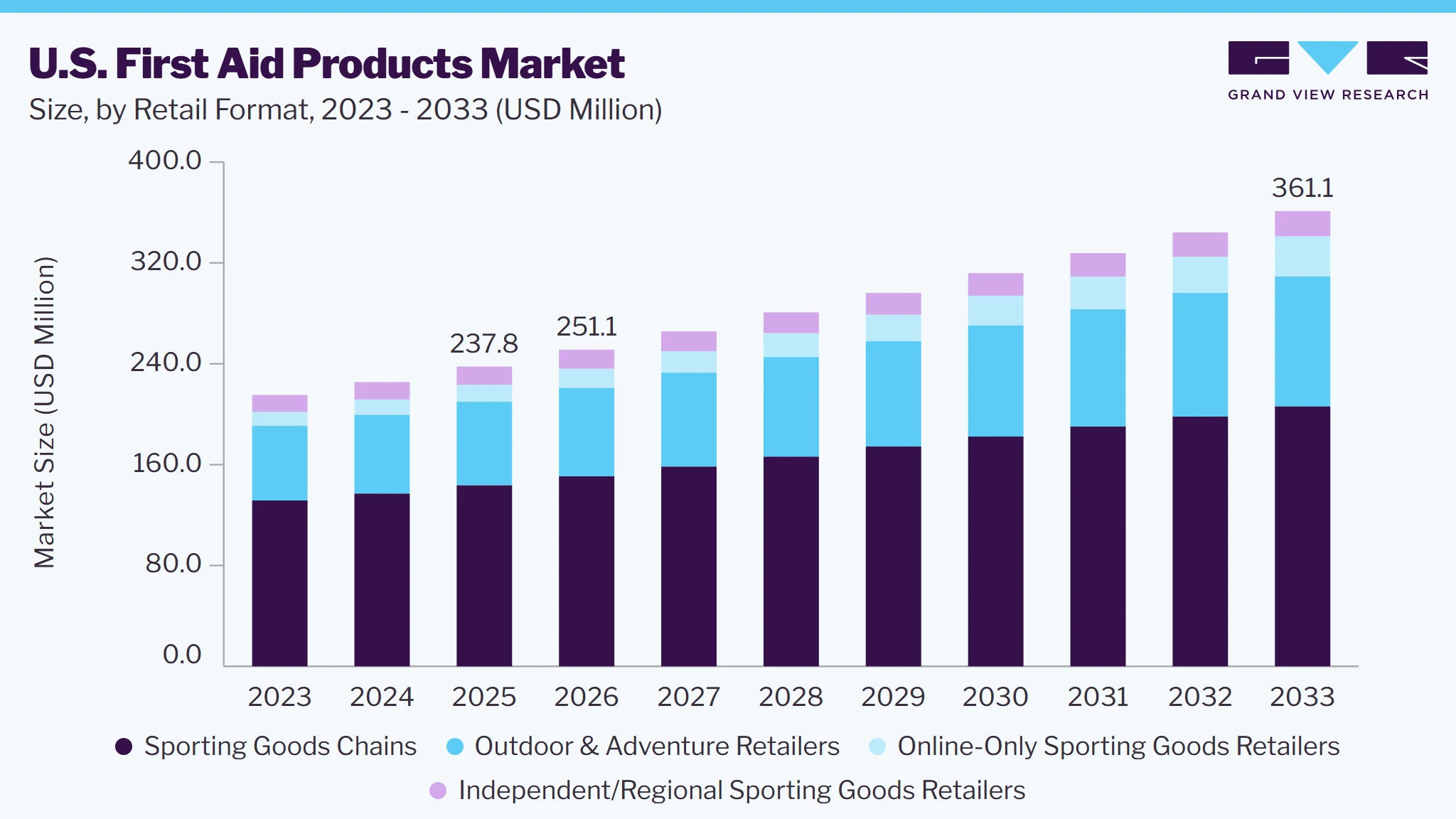 Source: Grand View Research, IR Documents, Primary Interviews, Paid DatabasesTo learn more about this report,
 Download Free Sample Report
The growing incidence of sports-related injuries is a significant driver of the U.S. first aid products market (sporting goods retail channel analysis) by increasing the need for immediate injury management across professional sports, schools, colleges, fitness centers, and recreational activities. Sprains, strains, cuts, abrasions, blisters, bruises, and minor fractures frequently require prompt treatment using products such as adhesive bandages, gauze, antiseptic wipes, elastic wraps, cold packs, wound dressings, and adhesive tapes. Rising participation in youth sports, organized athletic events, marathons, cycling, and fitness programs has increased demand for well-equipped first-aid kits in sports facilities and training centers. Educational institutions, sports organizations, gyms, and athletic clubs are also strengthening their on-site emergency preparedness by maintaining comprehensive first-aid supplies to ensure a rapid response to injuries. In addition, increasing awareness of injury prevention, faster recovery, and proper wound care has encouraged consumers to keep first-aid products readily available at home and during outdoor activities.
-
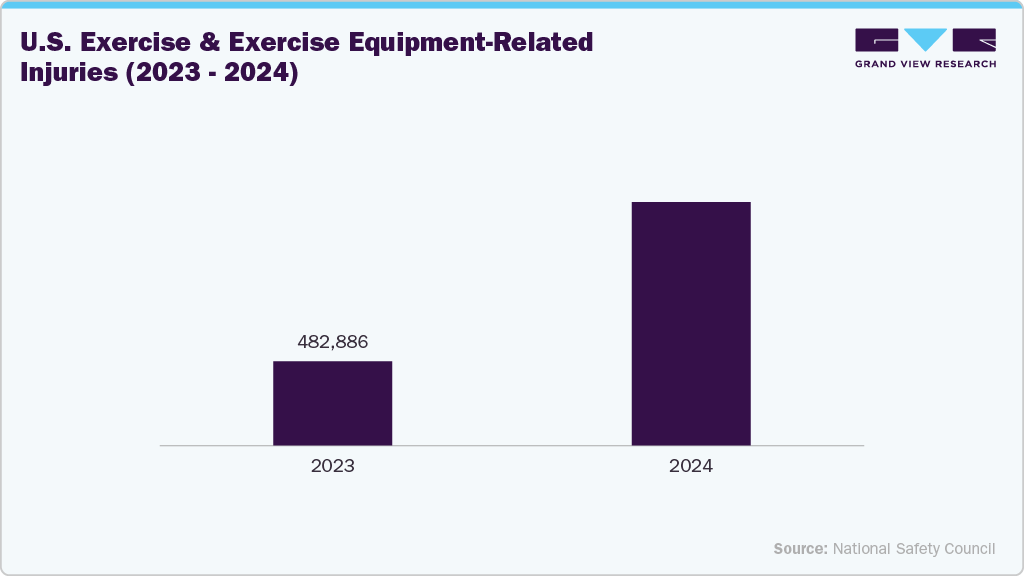
Sports- and recreation-related injuries in the U.S. increased by 17% in 2024, reflecting higher participation in physical and recreational activities and driving greater demand for first-aid products.
-
Approximately 4.4 million people were treated in U.S. emergency departments for injuries involving sports and recreational equipment in 2024. Among all activities, exercise and exercise equipment accounted for the highest number of injuries, followed by cycling and basketball, highlighting the significant burden of sports-related injuries and the growing need for first aid and injury management products.
 To learn more about this report, Download Free Sample Report
The rising number of pedal cyclist injuries in the U.S. is driving growth in the first-aid products market by creating sustained demand for immediate wound care and emergency treatment supplies. Cyclists frequently experience injuries such as abrasions, lacerations, road rash, cuts, bruises, and minor fractures resulting from falls, collisions, and roadway accidents, all of which require prompt first aid intervention. As cycling participation continues to expand for commuting, recreation, and fitness, individuals are carrying portable first-aid kits and essential wound-care products on their rides. Bicycle clubs, cycling events, and training organizations are also strengthening on-site emergency preparedness by maintaining comprehensive first-aid supplies to provide immediate care after accidents. In addition, growing awareness of the importance of rapid wound treatment in reducing infection risk and promoting faster recovery is encouraging greater adoption of adhesive bandages, antiseptic solutions, gauze, dressings, and trauma care products.
U.S. Pedal Cyclists Injured by Age Group and Gender (2023)
Age Group
Male Injured
Female Injured
Total Injured
Overall Injury Rate
<5
73
45
118
1
5–9
850
271
1,120
6
10–14
4,939
936
5,875
28
Children (≤14)
5,861
1,252
7,113
12
15–20
5,926
953
6,879
26
21–24
2,630
556
3,185
18
25–29
3,735
928
4,664
21
30–34
4,028
953
4,981
21
35–39
3,790
635
4,425
20
40–44
Upgrade report license to gain access to the complete analysis
45–49
50–54
55–59
60–64
65–69
70–74
75–79
80+
Ages 65+
Total
Source: NHTSA’s National Center for Statistics and Analysis
The expansion of outdoor recreation and adventure activities is driving growth in the U.S. first-aid products market by increasing demand for portable medical supplies to treat injuries sustained during hiking, camping, trekking, climbing, fishing, kayaking, mountain biking, hunting, and other outdoor pursuits. These activities expose participants to cuts, abrasions, blisters, insect bites, sprains, burns, and minor wounds that require immediate treatment before professional medical care is available. As participation in outdoor recreation continues to rise, consumers are purchasing compact first-aid kits, adhesive bandages, antiseptic wipes, gauze, elastic bandages, burn-care products, and emergency survival supplies as essential safety equipment. Outdoor organizations, adventure tour operators, campsites, and recreational facilities are also strengthening emergency preparedness by maintaining well-stocked first aid kits for participants.
For instance, in March 2026, the U.S. National Park Service (NPS) reported that more than 323 million recreation visits were made to national parks in 2025, including over 13 million overnight stays, with 26 parks recording all-time visitation highs. The continued growth in hiking, camping, backpacking, climbing, and other outdoor recreation activities is increasing the need for portable first aid kits, blister care products, wound dressings, insect bite treatments, and emergency medical supplies, thereby driving demand in the U.S. first aid products market (sporting goods retail channel analysis).
“America’s national parks continue to be places where people come to experience our country’s history, landscapes and shared heritage,” said Jessica Bowron, Comptroller, Exercising the Delegated Authority of the Director. “We are committed to keeping parks open, accessible and well-managed so visitors can safely enjoy these extraordinary places today and for generations to come.”
Market Dynamics
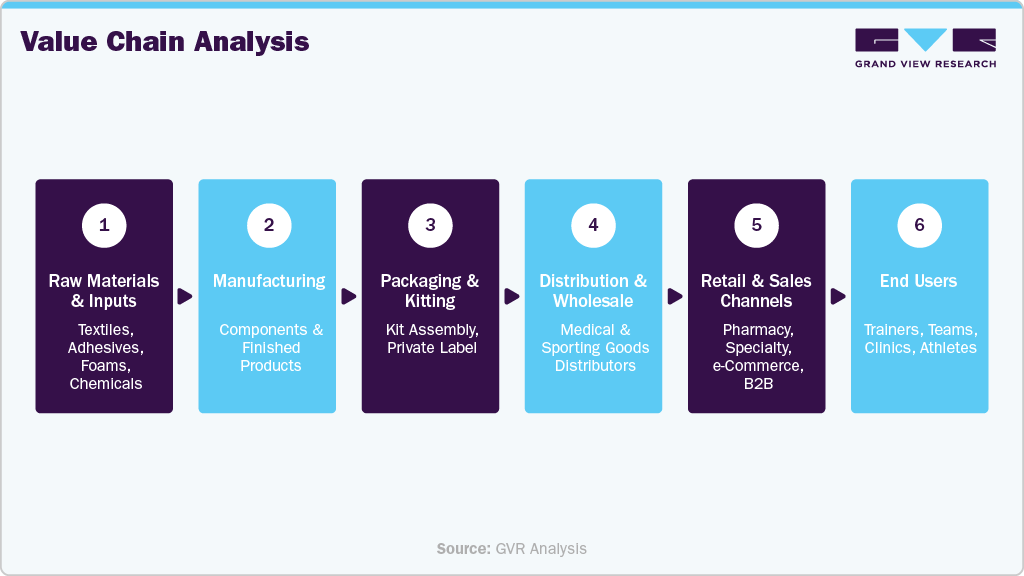
The U.S. first-aid products market is experiencing growth, driven by rising awareness of emergency preparedness, increasing participation in sports and outdoor recreational activities, and the rising incidence of minor injuries requiring immediate treatment. The expanding number of pedal cyclist injuries, workplace accidents, household injuries, and recreational mishaps has significantly increased the demand for first aid kits, adhesive bandages, wound dressings, antiseptics, gauze, and other essential medical supplies. In addition, stringent workplace safety regulations and emergency preparedness requirements across industries, schools, public institutions, and commercial facilities continue to support product adoption. The growing preference for portable, easy-to-use, and travel-friendly first aid kits, combined with continuous product innovations such as advanced wound care solutions, antimicrobial dressings, and compact emergency kits, is further strengthening market growth.
The growing emphasis on preventive healthcare and sports safety is a significant driver of the U.S. first aid products market (sporting goods retail channel analysis). Rising participation in organized sports, fitness programs, school athletics, and outdoor recreation has increased awareness of injury prevention and the importance of immediate first aid response. As a result, consumers, coaches, schools, sports clubs, and outdoor enthusiasts are purchasing products such as sports first aid kits, adhesive bandages, athletic tape, cold therapy products, braces, and wound care supplies to manage minor injuries and reduce recovery time. This proactive approach to health and safety is driving demand for portable, sport-specific first aid products across the U.S.
The availability of low-cost private-label alternatives is restraining growth in the U.S. first-aid products market by intensifying price competition and limiting the adoption of premium-branded products. Retailers and e-commerce platforms offer affordable private-label first-aid kits, bandages, antiseptics, wound-care products, and other basic medical supplies that provide similar functionality at lower prices. Price-sensitive consumers, small businesses, and organizations often prefer these cost-effective alternatives, reducing demand for higher-priced products from established manufacturers. This trend puts pressure on branded companies to maintain competitive pricing while investing in product innovation, quality assurance, and marketing. In addition, the widespread availability of economical substitutes in retail stores and online marketplaces makes it challenging for premium brands to differentiate their products based on advanced features and reliability.
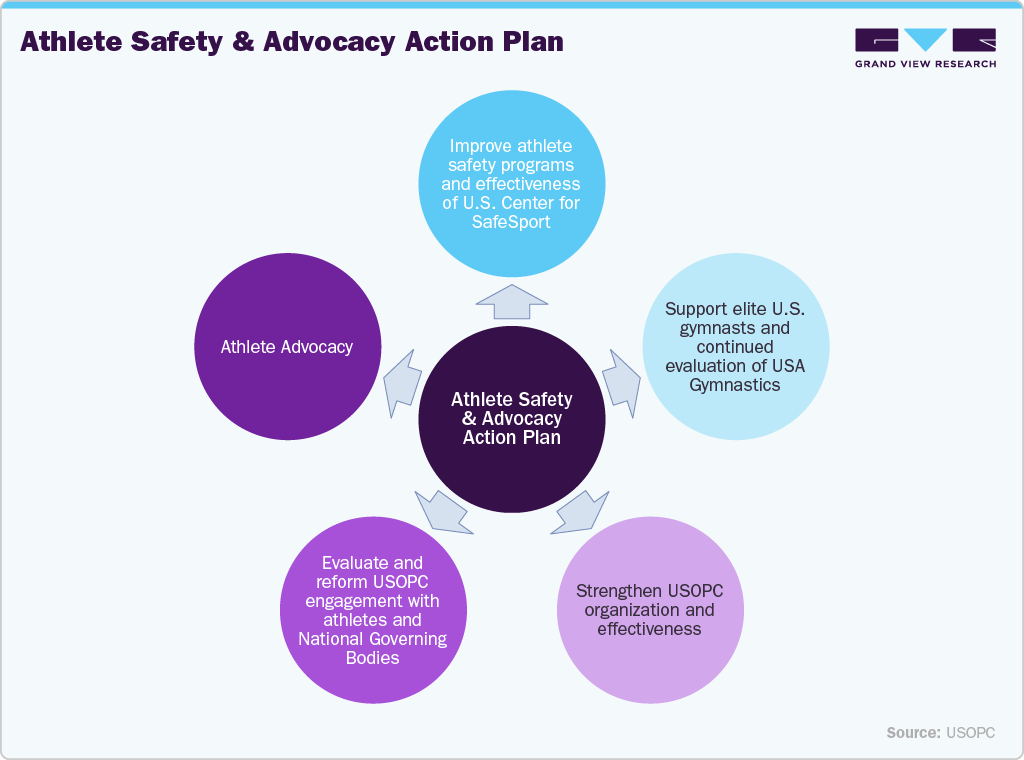
The growing demand for sports-specific first aid solutions presents a significant opportunity for the U.S. first aid products market (sporting goods retail channel analysis) by creating demand for specialized products designed to address athletic injuries and provide rapid on-field care. Increasing participation in professional sports, school athletics, fitness activities, and recreational sports has increased the need for targeted solutions such as sports injury kits, instant cold packs, athletic tapes, compression wraps, blister treatments, wound dressings, and muscle care products. Sports organizations, gyms, training centers, and educational institutions are investing in dedicated first-aid supplies to ensure rapid injury management and improve athlete safety.
 To learn more about this report, Download Free Sample Report
For instance, in February 2026, KT Tape, the Official Kinesiology Tape of the U.S. Olympic and Paralympic Teams, strengthened its support for Team USA athletes ahead of the 2026 Winter Olympic and Paralympic Games, underscoring its focus on sports injury prevention, muscle support, and recovery solutions. This reflects the demand for sports-specific first-aid products, including athletic tape, instant cold packs, compression bandages, and specialized first-aid kits for athletes and sports organizations.
 To learn more about this report, Download Free Sample Report
Technological Overview
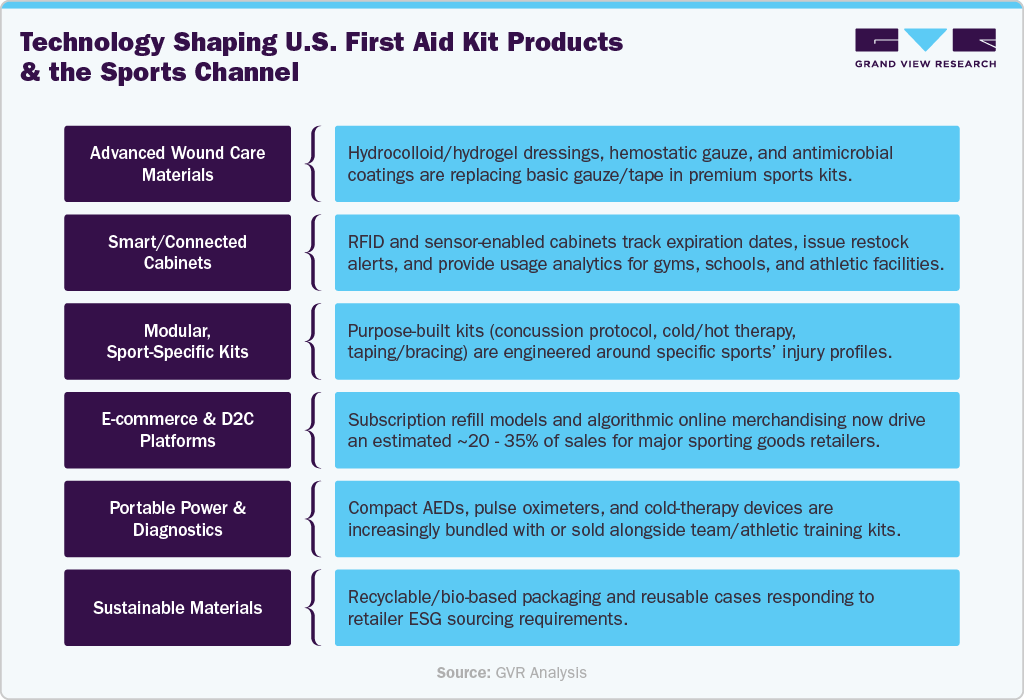
The technological landscape of the U.S. first aid kit products market through sports retail channels is evolving through continuous advancements in product design, wound care materials, and portable kit functionality to address the needs of athletes, outdoor enthusiasts, and active consumers. Manufacturers are integrating advanced wound care components such as hydrocolloid blister dressings, antimicrobial bandages, instant cold packs, cohesive compression wraps, and latex-free adhesive bandages to improve injury management, comfort, and recovery during sports and outdoor activities. Product development is also focused on lightweight, waterproof, impact-resistant cases with modular compartments and compact, travel-friendly designs that enhance convenience for hiking, camping, cycling, trail running, and team sports. In addition, manufacturers are adopting sustainable packaging, refillable kit formats, and eco-friendly materials to align with growing consumer demand for environmentally responsible products.
 To learn more about this report, Download Free Sample Report
 To learn more about this report, Download Free Sample Report
Market Concentration & Characteristics
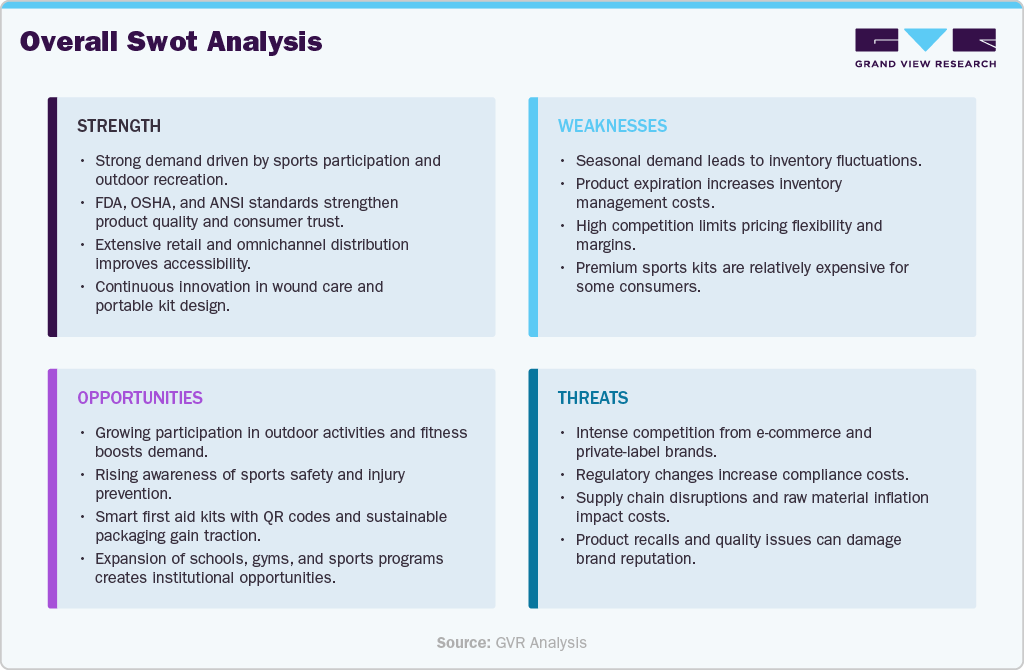
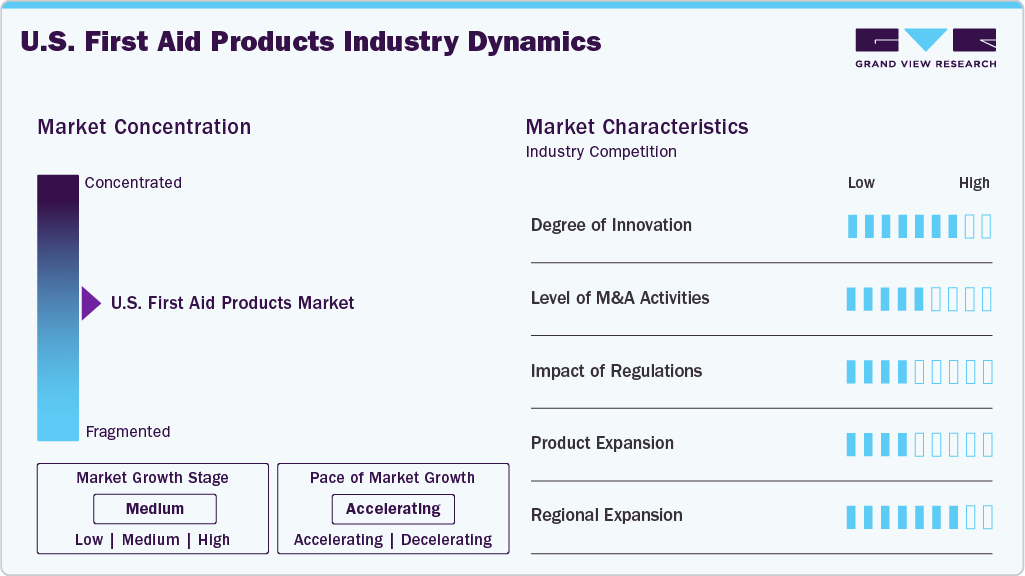
The U.S. first aid products market is characterized by strong consumer awareness, widespread product availability, and consistent demand across residential, commercial, industrial, and healthcare settings. The market includes a broad range of products such as first aid kits, wound care products, bandages, antiseptics, dressings, tapes, burn care supplies, and emergency response products, catering to different user needs. Demand is supported by increasing emphasis on workplace safety compliance, emergency preparedness, sports injury management, and personal healthcare awareness. The market is highly competitive, with established medical supply manufacturers, retail brands, and private-label providers offering diverse product portfolios.
The degree of innovation in the U.S. first-aid products market through sporting goods retail channels is increasing as consumers and athletes demand specialized, convenient, and performance-oriented injury-management solutions. Sporting goods retailers are expanding their product offerings beyond traditional first aid kits by introducing sports-specific solutions, including compact athletic first aid kits, instant cold therapy products, advanced blister-prevention systems, compression supports, antimicrobial wound care products, and recovery-focused supplies. Manufacturers are focusing on lightweight, portable, and durable packaging designs that cater to athletes, outdoor enthusiasts, and fitness users who require quick access to emergency care during activities. Integration of features such as waterproof packaging, organized compartments, multi-use components, and sport-specific configurations is enhancing product differentiation.
 To learn more about this report, Download Free Sample Report
The level of merger and acquisition activity in the U.S. first aid products market (sporting goods retail channel analysis) through sporting goods retail channels remains moderate, driven by companies seeking to expand product portfolios, strengthen retail presence, and capture growing demand for sports-specific safety solutions. Manufacturers and healthcare product companies are exploring strategic acquisitions and partnerships with sports equipment brands, outdoor retailers, and specialty medical supply providers to improve distribution capabilities and access new consumer segments. Consolidation activities enable companies to integrate advanced wound care technologies, expand geographic reach, and enhance their presence across sporting goods retail networks.
-
In May 2025, DICK'S Sporting Goods entered into a definitive merger agreement to acquire Foot Locker, strengthening its position in the global sporting goods and athletic footwear retail market. The transaction, valued at approximately USD 2.4 billion in equity value and USD 2.5 billion in enterprise value, significantly expanded DICK'S retail footprint, customer base, and omnichannel capabilities while enhancing its portfolio of footwear and athletic apparel brands.
Regulatory requirements significantly impact the U.S. first-aid products market by inducing product quality, safety standards, labeling requirements, and distribution practices across sporting goods retail channels. First aid products sold through sporting goods retailers must comply with applicable guidelines related to medical device classification, packaging, ingredient safety, and consumer information to ensure product reliability and effectiveness. Regulatory oversight encourages manufacturers to maintain quality control, conduct appropriate product testing, and provide accurate usage instructions, which strengthens consumer confidence in sports-related first aid solutions. In addition, workplace and athletic safety standards encourage sports facilities, schools, fitness centers, and recreational organizations to maintain compliant first-aid supplies, thereby supporting demand through sporting goods retailers.
The end use concentration of the U.S. first aid products market (sporting goods retail channel analysis) through sporting goods retail channels is primarily driven by individual consumers, athletes, sports teams, fitness enthusiasts, and outdoor recreation participants seeking immediate access to injury management solutions. Sporting goods retailers serve as important distribution points for customers purchasing first-aid kits, wound-care products, athletic tape, compression wraps, cold-therapy products, and other sports-related emergency supplies for personal and group use. Sports organizations, schools, gyms, and recreational facilities also contribute significantly to demand by maintaining first-aid supplies to support athlete safety and to comply with preparedness requirements.
Analyst Perspective
The U.S. first aid products market in sporting goods retail is growing as more consumers engage in outdoor recreation and sports. Heightened awareness around personal safety and injury prevention is driving demand for first aid kits, blister care, athletic tapes, and specialized wound management supplies. Growth is further accelerated by expanding retail distribution and a shift toward compact, travel-friendly options. To gain a competitive edge, brands must deliver innovative, portable, and value-focused solutions tailored to active lifestyles. Ultimately, maximizing product visibility and securing strong partnerships across key retail channels will be vital for capturing market share.
Product Type Insights
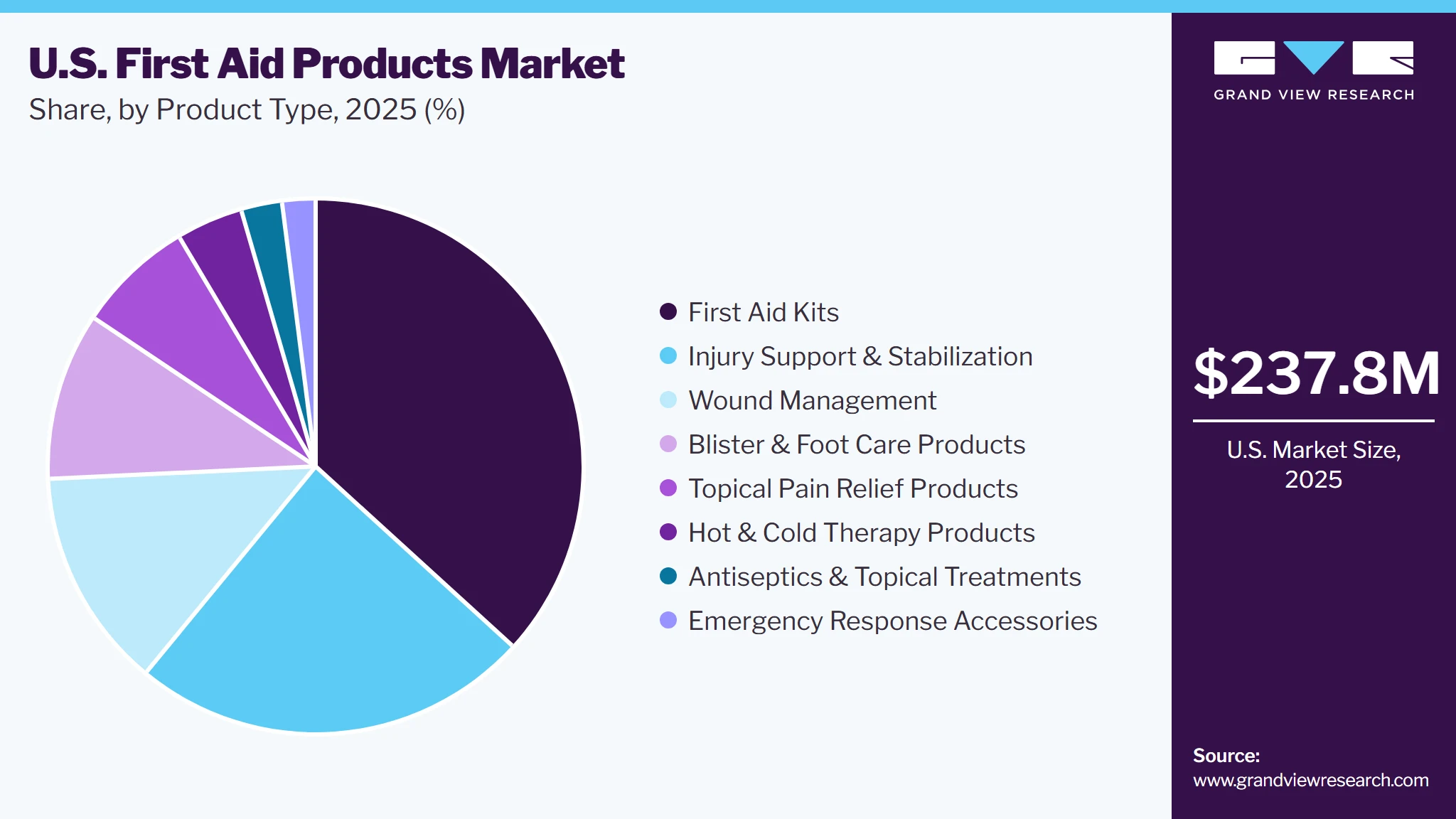
Based on product type, the first aid kits segment led the market, accounting for 36.8% of revenue in 2025. Athletes, sports teams, coaches, and outdoor enthusiasts commonly purchase first aid kits as essential safety equipment for managing injuries such as cuts, abrasions, sprains, bruises, and minor wounds during activities. Sporting goods retailers offer a wide range of first-aid kits, including compact travel kits, team-based kits, and specialized sports injury kits, making them easily accessible to consumers. Increasing participation in recreational sports, cycling, hiking, camping, and adventure activities has further strengthened demand for portable emergency care solutions.
 To learn more about this report, Download Free Sample Report
Topical pain relief products are experiencing significant growth in the U.S. first aid products market (sporting goods retail channel analysis) through sporting goods retail channels, driven by increasing demand for quick, convenient management of sports-related muscle and joint discomfort. Athletes and fitness enthusiasts frequently use topical pain-relief solutions such as creams, gels, sprays, and patches to manage muscle soreness, strains, sprains, and minor sports injuries. Rising participation in fitness programs, recreational sports, endurance events, and outdoor activities is increasing the need for immediate pain-management products that can be applied without interrupting activity routines. Sporting goods retailers are expanding their offerings of targeted pain-relief solutions to meet consumer demand for portable, easy-to-use recovery products.
Retail Format Insights
Based on retail format, the sporting goods chains segment led the market with the largest revenue share of 60.4% in 2025. These retail formats provide convenient access to first-aid kits, wound-care products, topical pain-relief solutions, athletic tape, compression supports, and other sports-related healthcare products alongside sporting equipment. The availability of knowledgeable staff, in-store product visibility, and the ability for consumers to physically evaluate products before purchase strengthen the preference for sporting goods chains. In addition, established relationships with leading brands and manufacturers enable these retailers to offer diverse product portfolios across professional sports, recreational activities, and fitness segments. The presence of large customer bases, promotional activities, and integrated retail experiences continues to support the leading position of sporting goods chains in the distribution of first aid products.
Online-only sporting goods retailers are experiencing significant growth in the U.S. first-aid products market, driven by growing consumer preference for convenient digital purchasing and broader product accessibility. These platforms enable customers to compare products, review specifications, access user feedback, and purchase sports-related first-aid supplies from anywhere, thereby improving the overall buying experience. The growing adoption of e-commerce among athletes, fitness users, and outdoor enthusiasts has accelerated demand for the online availability of first aid kits, pain relief products, wound care supplies, and injury management products.
Key U.S. First Aid Products Company Share Insights
The U.S. first aid products market (sporting goods retail channel analysis) through sporting goods retail channels is characterized by established healthcare product manufacturers, sports safety brands, and retail-focused suppliers competing on product innovation, brand recognition, distribution strength, and portfolio expansion. Key companies operating in this space focus on offering a diverse range of first-aid solutions, including sports injury kits, wound care products, topical pain-relief solutions, athletic tapes, and emergency-response supplies to address the needs of athletes, fitness enthusiasts, and outdoor consumers. Companies with strong retail partnerships, extensive product availability, and established brand trust maintain a competitive advantage across sporting goods chains and online retail platforms.
Key U.S. First Aid Products Companies:
-
Dick's Sporting Goods
-
Academy Sports + Outdoors
-
REI (Recreational Equipment, Inc.)
-
BPS Direct, L.L.C. (Bass Pro Shops)
-
Sportsman's Warehouse
-
Dunham's Sports
-
Sports Basement
-
West Marine
-
SCHEELS SPORTS
-
MonkeySports, Inc.
-
Kittery Trading Post
Competitive Benchmarking
Category
Operating Strategies
Competitive Edge
Weakness
Established Players (Dick's Sporting Goods, Academy Sports + Outdoors)
Focus on expanding first aid product assortments across physical retail stores and e-commerce platforms, including first aid kits, wound management products, sports injury care supplies, and outdoor emergency products.
Strengthen partnerships with leading healthcare and outdoor brands, improve in-store merchandising, and leverage loyalty programs to increase consumer engagement.
Strong nationwide retail presence, extensive customer reach, established supplier relationships, and integrated omnichannel sales capabilities.
High brand recognition, strong purchasing power, and ability to provide broad product selections across sports, outdoor, and recreational segments enable these companies to maintain competitive positioning.
High operational costs associated with maintaining large retail networks, inventory management challenges, and dependence on consumer spending trends.
Competition from online marketplaces and specialized outdoor retailers may pressure pricing and margins.
Emerging Players (Dunham's Sports, Sports Basement, MonkeySports, Inc.)
Focus on serving regional sports communities through targeted product assortments, competitive pricing, and localized customer engagement.
Expand first aid product availability across team sports, fitness, recreational activities, and specialty sporting categories.
Strong local market presence, personalized customer service, flexible inventory strategies, and ability to cater to specific sports segments.
Faster decision-making and localized merchandising allow these companies to respond quickly to regional consumer needs.
Smaller geographic footprint, limited purchasing power, and lower brand visibility compared with national sporting goods chains.
Dependence on regional demand patterns and challenges in competing with large-scale retailers on pricing, product variety, and digital capabilities.
Recent Developments:
-
In October 2025, Sports Basement announced the opening of its new retail store in Hawthorne, California, expanding its presence in the South Bay region. Located at 14351 Hindry Avenue, the new store strengthened the company's retail network, improved customer access to sporting goods, outdoor equipment, apparel, and footwear, and supported its regional growth strategy in California.
-
In September 2025, DICK'S Sporting Goods announced a multi-year extension of its partnership with the Women's National Basketball Association (WNBA). Under the renewed agreement, the company will continue to serve as the Official Sporting Goods Retailer and an Official Marketing Partner of the WNBA through the 2028 season. DICK'S Sporting Goods also retained its designation as the Official Sporting Goods Retailer for the Chicago Sky and Minnesota Lynx, reinforcing its commitment to supporting women's professional basketball and expanding engagement with athletes and fans.
-
In June 2025, Dunham's Sports announced the grand opening of its new retail store in Spindale, North Carolina, located at White Oaks Plaza. The store expansion strengthened the company's retail presence in the southeastern U.S., enhanced accessibility to sporting goods and outdoor products for local communities, and supported its continued geographic growth strategy.
U.S. First Aid Products Market (Sporting Goods Retail Channel Analysis) Report Scope
Report Attribute
Details
Market size in 2025
USD 237.8 million
Estimated market size in 2026
USD 251.1 million
Projected market size by 2033
USD 361.1 million
Growth rate
CAGR of 5.3% from 2026 to 2033
Base year for estimation
2025
Historical data
2021 - 2024
Forecast period
2026 - 2033
Quantitative units
Revenue in USD million/billion and CAGR from 2026 to 2033
Report coverage
Revenue forecast, company ranking, competitive landscape, growth factors, and trends
Segments covered
Product type, retail format
Key companies profiled
Dick's Sporting Goods; Academy Sports + Outdoors; REI (Recreational Equipment, Inc.); BPS Direct, L.L.C. (Bass Pro Shops); Sportsman's Warehouse; Dunham's Sports; Sports Basement; West Marine; SCHEELS SPORTS; MonkeySports, Inc.; Kittery Trading Post
Customization scope
Free report customization (equivalent up to 8 analysts' working days) with purchase.
Pricing and purchase options
Avail customized purchase options to meet your exact research needs. Explore purchase options
U.S. First Aid Products Market (Sporting Goods Retail Channel Analysis) Report Segmentation
This report forecasts revenue growth at the country levels and provides an analysis of the latest industry trends across each sub-segment from 2021 to 2033. For this study, Grand View Research has segmented the U.S. first aid products market report based on product type and retail format:
-
Product Type Outlook (Revenue, USD Million, 2021 - 2033)
-
First Aid Kits
-
General Purpose First Aid Kits
-
Outdoor & Survival Kits
-
Sports First Aid Kits
-
Emergency & Trauma Kits
-
-
Injury Support & Stabilization
-
Braces & Supports
-
Splints
-
Athletic Tape
-
Kinesiology Tape
-
Elastic Bandages & Compression Wraps
-
-
Wound Management
-
Adhesive Bandages
-
Gauze & Dressings
-
Surgical/Medical Tape
-
Wound Closure Strips
-
Liquid Bandages
-
-
Blister & Foot Care Products
-
Blister Bandages
-
Moleskin
-
Foot Protection Pads
-
Friction Prevention Products
-
-
Topical Pain Relief Products
-
Pain Relief Creams
-
Cooling Gels
-
Roll-ons
-
Sprays
-
Topical Pain Relief Patches
-
-
Hot & Cold Therapy Products
-
Reusable Cold Packs
-
Instant Cold Packs
-
Heat Packs
-
Hot/Cold Combination Packs
-
-
Antiseptics & Topical Treatments
-
Antibiotic Ointments
-
Antiseptic Wipes
-
Alcohol Pads
-
Anti-Itch Treatments
-
Hydrocortisone Creams
-
Burn Treatments
-
-
Emergency Response Accessories
-
Emergency Blankets
-
Rescue Shears
-
Tick Removal Tools
-
Tweezers
-
First Aid Refill Components
-
CPR Masks
-
-
-
Retail Format Outlook (Revenue, USD Million, 2021 - 2033)
-
Sporting Goods Chains
-
Outdoor & Adventure Retailers
-
Independent/Regional Sporting Goods Retailers
-
Online-Only Sporting Goods Retailers
-
Research Methodology
The U.S. first aid products market figures in this report are based on a proven research process that combines executive interviews with secondary research from proprietary databases, company filings, and recognized regulatory and institutional sources. Market size is built through value-chain sizing—reconciling supply-side and demand-side estimates—and triangulated with bottom-up and top-down approaches. Every estimate passes multiple levels of expert validation before publication, with each U.S. first aid products segment quantified using the revenue-capture definitions in the table below.
Segment Definition
Segment: Retail Format
Revenue capture definition
Sporting Goods Chains
Revenue generated from the sale of first aid products, including first aid kits, wound management products, athletic injury care supplies, and emergency preparedness items through large-scale sporting goods retail chains with multiple physical store locations and established distribution networks.
Outdoor & Adventure Retailers
Revenue captured from first aid product sales through retailers specializing in outdoor recreation and adventure activities, including camping, hiking, cycling, climbing, and travel-related equipment. This segment includes sales of portable first aid kits, survival-oriented medical supplies, blister care products, and outdoor injury management solutions.
Independent/Regional
Sporting Goods Retailers
Revenue generated from first aid product sales through locally owned, regional, and specialty sporting goods stores that serve specific geographic markets or niche sports communities. Revenue includes sales of general first aid kits, wound care products, and sport-specific injury prevention and treatment supplies.
Online-Only Sporting
Goods Retailers
Revenue captured from digital-first sporting goods platforms and e-commerce retailers through online sales of first aid kits, wound management products, and sports safety supplies. This segment includes direct-to-consumer purchases, marketplace sales, subscription-based replenishment, and online promotional-driven product sales.
Estimation Model
Approach
Description
Bottom-Up Estimation
The market is estimated by analyzing the annual sales volume of first aid products through sporting goods chains and independent/regional sporting goods retailers across the U.S. The assessment incorporates product categories such as first aid kits and wound management products, along with sales associated with outdoor recreation, camping, hiking, cycling, fitness, and team sports. ASPs, retail penetration rates, consumer purchasing frequency, and seasonal demand patterns are used to derive the overall market value.
Top-Down Approach
The market estimation begins with an assessment of the U.S. first aid products market, followed by evaluating the share contributed by sporting goods retail channels through secondary research and expert validation. The analysis considers key market indicators such as outdoor recreation participation,, fitness activities, camping and hiking trends, consumer spending on sports and outdoor equipment, and retail sales performance across sporting goods outlets to estimate the channel-specific market size.
Supply-Side Analysis
The analysis considers manufacturing capacity, annual shipments of first aid kits and wound management products, product portfolio diversification, average selling prices, distribution partnerships with national sporting goods chains and independent retailers, inventory availability, and regional sales networks. In addition, factors such as new product launches, private-label offerings, merchandising strategies, and promotional activities.
Delivered Customizations
This report has been delivered with the following In-depth customizations
Client Request
Customization Delivered
Value Adds
Sporting Goods Retail Product Portfolio & Category Analysis
Conducted a comprehensive assessment of first aid product portfolios sold through sporting goods retail channels, including first aid kits, wound management products, bandages, antiseptics, cold therapy products, sports tapes, blister care, and emergency medical supplies. Evaluated product positioning by recreational sports, outdoor activities, fitness, hiking, cycling, camping, and team sports. The analysis also examined premium versus economy product offerings, branded and private-label products, seasonal demand patterns, and product assortment strategies across sporting goods retailers.
Helps stakeholders identify high-demand product categories, optimize retail assortments, understand sport-specific consumer purchasing behavior, and strengthen product portfolio strategies aligned with evolving outdoor and sports safety needs.
Retail Format Adoption & Consumer Purchasing Analysis
Analyzed the distribution and sales performance of first aid products across sporting goods chains and independent/regional sporting goods retailers. Assessed consumer purchasing behavior, in-store merchandising strategies, promotional activities, private-label adoption, replacement purchasing trends, impulse buying patterns, and regional demand variations. The study also evaluated the influence of outdoor recreation participation, organized sports, and seasonal activities on retail sales performance.
Enables manufacturers and retailers to optimize channel strategies, improve inventory planning, identify high-growth retail formats, enhance promotional effectiveness, and expand market penetration across diverse sporting goods retail networks.
Competitive Positioning & Brand Performance Assessment
Evaluated leading first aid product manufacturers and brands based on product portfolio breadth, pricing strategies, retail presence, brand recognition, innovation, packaging formats, regulatory compliance, distribution partnerships, and merchandising strength within sporting goods retail channels. The assessment also analyzed recent product launches, retail expansion initiatives, private-label competition, and competitive differentiation across the U.S. sporting goods retail market.
Supports competitive benchmarking, identifies growth opportunities, strengthens channel-specific go-to-market strategies, improves brand positioning, and enables manufacturers to enhance competitiveness through product innovation, retail partnerships, and portfolio expansion.
Frequently Asked Questions About This Report
The U.S. first aid products market (sporting goods retail channel analysis) is expected to grow at a CAGR of 5.3% from 2026 to 2033 to reach USD 361.1 million by 2033.
Some key players operating in the market include Dick's Sporting Goods, Academy Sports + Outdoors, REI (Recreational Equipment, Inc.), BPS Direct, L.L.C. (Bass Pro Shops), Sportsman's Warehouse, Dunham's Sports, Sports Basement, West Marine, SCHEELS SPORTS, MonkeySports, Inc., Kittery Trading Post, among others.
The U.S. first aid products market (sporting goods retail channel analysis) size was estimated at USD 237.8 million in 2025 and is projected to grow from USD 251.1 million in 2026.
The first aid kits segment led the market, accounting for 36.8% of revenue in 2025, while topical pain relief products segment is fastest growing product type.
The sporting goods chains segment led the market with the largest revenue share of 60.4% in 2025, while online-only sporting goods retailers segment is fastest growing retail format.
Key factors that are driving the market by increasing awareness of personal health and safety, stringent workplace safety regulations, and the rising incidence of minor injuries in homes, workplaces, schools, and recreational settings.
About the Author(s)
Medical Devices Research Team
Healthcare · Medical DevicesThis report was authored by the medical devices research team at Grand View Research - comprising two research analysts, one senior research analyst, and one industry expert - with specialized expertise in the medical devices segment of the healthcare industry. All findings are based on proprietary healthcare databases, executive interviews, and regulatory analysis, subject to internal peer review prior to publication.
Last Updated:
Speak to Analyst

Customize this report to your needs - add regions, segments, or data points, with 20% free customization.
Or view our licence options:


ISO 9001:2015 & 27001:2022 Certified
We are GDPR and CCPA compliant! Your transaction & personal information is safe and secure. For more details, please read our privacy policy.


