
- Home
- »
- Medical Devices
- »
-
U.S. Hospital & Healthcare Spending For Filtration Market Report, 2033GVR Report cover

U.S. Hospital & Healthcare Spending For Filtration Market (2025 - 2033) Size, Share & Trends Analysis Report By Product (Air Filtration, Liquid Filtration, Medical Device Filtration), By End Use (Hospitals, Healthcare Facilities), By State, And Segment Forecasts
Market Size & Trends
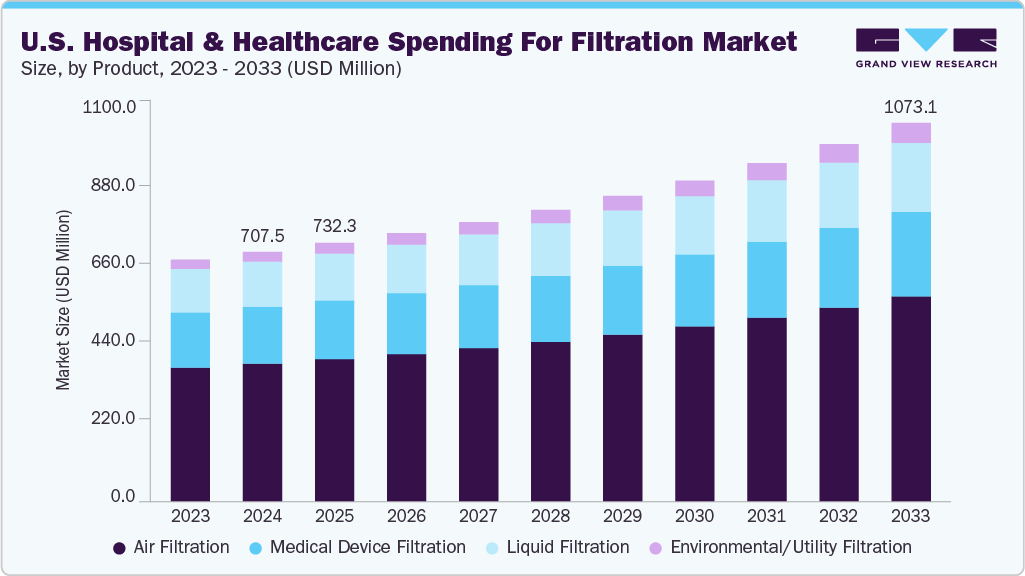
The U.S. hospital & healthcare spending for filtration market size was valued at USD 707.52 million in 2024 and is expected to reach USD 1,073.10 million by 2033, growing at a CAGR of 4.89% from 2025 to 2033. This growth is attributed to growing stringent infection prevention protocols, rising regulatory compliance standards, and the growing emphasis on patient and staff safety. Healthcare facilities depend on efficient air and liquid filtration systems to control pathogens and ensure sterile environments. Thus, the rise in hospital-acquired infections and increased awareness post-COVID-19 have boosted demand for advanced filters such as HEPA and ULPA. In addition, expanding specialized areas such as operating rooms, isolation wards, ICUs, and laboratories requires high-efficiency filtration to maintain air quality and protect vulnerable patients.
 Source: Grand View Research, IR Documents, Primary Interviews, Paid DatabasesTo learn more about this report,
 Download Free Sample Report
Stringent Infection Control & Regulatory Standards:
Stringent infection control and regulatory compliance requirements are a major factor driving filtration spending across U.S. hospitals and healthcare facilities. Air, water, and device filtration systems are essential for preventing healthcare-associated infections (HAIs), which represent a persistent challenge in clinical settings. According to the Centers for Disease Control and Prevention (CDC) report, in 2023, 1 in 31 hospital patients in the U.S. contracts at least one healthcare-associated infection on any given day. This has made infection prevention a central policy objective and has increased investment in technologies such as HEPA, ULPA, and sterile water filtration systems that directly support infection control efforts.
Microorganisms Associated with Airborne Transmission:
Evidence for airborne transmission
Fungi
Bacteria
Viruses
Numerous reports in health-care facilities
Aspergillus spp.+
Mucorales (Rhizopus spp.)
Mycobacterium tuberculosis+
Measles (rubeola) virus, Varicella-zoster virus
Occasional reports in health-care facilities (atypical)
Acremonium spp.
Fusarium spp.
Pseudoallescheria boydii
Scedosporium spp.
Sporothrix cyanescens
Acinetobacter spp.
Bacillus spp.
Brucella spp.
Staphylococcus aureus
Group A Streptococcus
Smallpox virus (variola),
Influenza viruses
Respiratory syncytial virus
Adenoviruses
Norwalk-like virus
No reports in health-care facilities; known to be airborne outside
Coccidioides immitis
Cryptococcus spp.
Histoplasma capsulatum
Coxiella burnetii (Q fever)
Hantaviruses
Lassa virus
Marburg virus
Ebola virus†
Crimean-Congo virus
Under investigation
Pneumocystis carinii
N/A
N/A
Source: Centers for Disease Control and Prevention
Expansion of Healthcare Infrastructure & Outpatient Facilities:
The expansion and modernization of healthcare infrastructure in the U.S. is a significant driver of spending on filtration systems. Hospitals, outpatient clinics, and specialized facilities require reliable air, water, and device-based filtration technologies to ensure safe care delivery and regulatory compliance. According to the American Hospital Association (AHA) in its 2025 Fast Facts report, based on 2023 data, there were 6,093 hospitals operating across the country with over 918,000 staffed beds.
Furthermore, the rapid growth of outpatient care facilities has expanded the scope of filtration needs beyond traditional hospitals. Ambulatory surgery centers (ASCs), urgent care clinics, and rehabilitation centers are increasingly important in the U.S. healthcare system. According to the ASC Data report, in Q2 2024, there were 6,382 Medicare-certified ASCs nationwide. These centers require compact and efficient air and water filtration systems to ensure surgical safety and meet regulatory requirements in smaller-scale settings. The shift of surgical procedures from hospitals to outpatient facilities has led to a steady rise in demand for specialized filtration technologies designed for ambulatory care environments.
Growing Technological Advancements in Filtration:
Recent advancements in filtration technology, particularly in healthcare, include sensor-based systems that enable real-time monitoring of air quality. These systems track particulate matter, humidity, and airflow to maintain optimal conditions with minimal manual adjustments. Daikin's HVAC systems feature advanced micro-filtration and UV lights for improved air quality. In addition, UltraViolet Germicidal Irradiation (UVGI) is being used for air purification, eliminating harmful microorganisms. Many facilities now employ UV-C lighting alongside traditional filtration for continuous disinfection in critical areas such as operating rooms. The TRACS system combines UV-C technology with HEPA filtration for effective air purification in larger spaces.
Moreover, the shift toward sustainable filtration solutions became more prominent in healthcare. Energy-efficient filtration systems were developed to provide high-performance filtration while consuming less energy. These systems helped healthcare facilities reduce operational costs and minimize their environmental impact. Healthcare providers, such as Partners HealthCare (now Mass General Brigham), invested in energy-efficient HVAC systems that incorporated sustainable filtration technologies. This move aligned with their efforts to meet the growing demand for eco-friendly solutions in healthcare infrastructure.
Rising Burden of Chronic and Infectious Diseases:
The increasing prevalence of chronic diseases, particularly chronic kidney disease (CKD), is driving demand for advanced filtration systems in U.S. healthcare facilities, especially for dialysis. According to a 2024 CDC report, approximately 35.5 million adults in the U.S. have CKD, many of whom require dialysis treatment. To ensure patient safety and prevent infections, healthcare facilities are adopting high-performance water filtration systems that eliminate contaminants from dialysis water. As the number of dialysis patients rises, the need for these filtration systems is expected to grow significantly.
Market Concentration & Characteristics
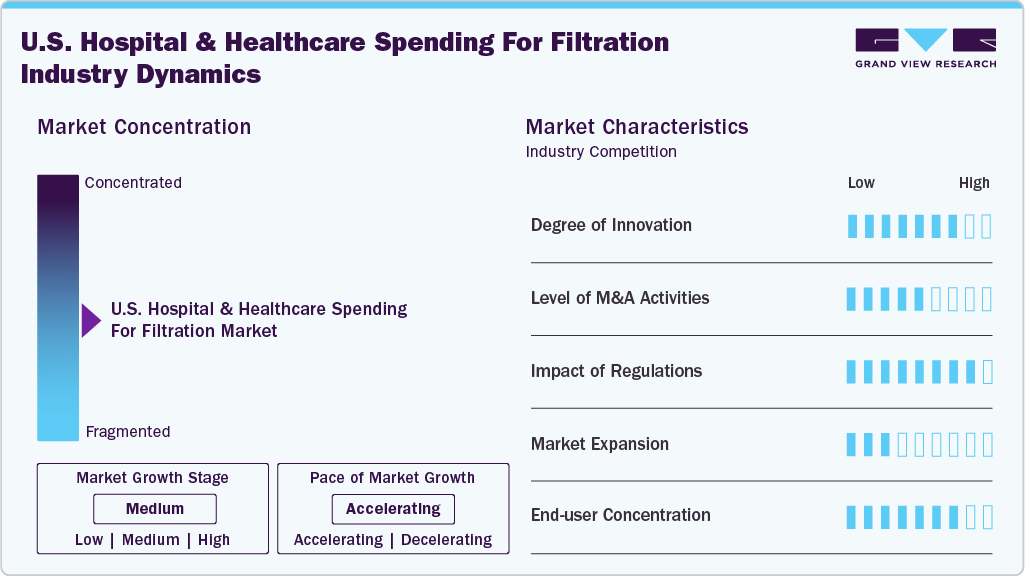
The market is fragmented, with many small players entering the market. The degree of innovation is medium, and the level of acquisition and merger activities is high. The impact of regulations on the market is medium, and the service expansion of players is medium.
Innovations include the integration of HEPA, ULPA, nanofiber, and activated carbon filters for superior removal of airborne pathogens, allergens, and chemical contaminants. Portable and modular filtration units are also gaining traction, offering flexibility for emergency care, isolation wards, and temporary healthcare setups. In August 2024, MANN+HUMMEL launched a nanofiber-based cabin air filter, designed to provide superior protection against ultrafine particles and harmful pollutants inside vehicles. Using advanced nanofiber technology, the filter offers a much higher filtration efficiency compared to conventional cabin filters, effectively capturing particles as small as 0.05 micrometers, including dust, allergens, bacteria, and certain viruses.
 To learn more about this report, Download Free Sample Report
The market players are leveraging strategies such as acquisitions and mergers to promote the reach of their offerings and increase their service capabilities. In March 2024, AAF International announced the acquisition of Northeast Air Solutions, Inc. This strategic move strengthened AAF’s market presence in the Northeastern U.S., enhancing its ability to deliver a broader range of high-performance filtration solutions to healthcare facilities, cleanrooms, commercial buildings, and industrial clients. The acquisition expanded AAF’s customer base and integrated Northeast Air Solutions’ strong local expertise and service network, enabling improved responsiveness and tailored support.
State and federal regulations safeguard patients in filtration spending for hospitals & healthcare facilities to provide high-quality care. For instance, the California Code of Regulations, Title 22, Section 71643 mandates that healthcare facilities regularly inspect, clean, or replace filters in heating, air conditioning, and ventilating systems to maintain normal operating conditions. The efficiency of replacement filters must match or exceed that of the original filters. Detailed records of inspections and maintenance, including static pressure drop measurements, must be maintained and available for inspection.
The level of regional expansion is significant in the U.S. due to various government programs and initiatives. For instance, in June 2025, University Hospital, in partnership with Rutgers Health, launched the first phase of a major redevelopment project aimed at expanding healthcare access in Newark. This initiative involves modernizing existing facilities and constructing new patient care areas to accommodate increasing demand for medical services in the region. Governor Phil Murphy said:
“University Hospital and Rutgers Health play a critical role in delivering exceptional health care to New Jersey residents, both in Newark and throughout the state. Their partnership on the redevelopment of University Hospital’s new campus will help improve access to high-quality health care for our residents by bringing state-of-the-art tools and facilities to the Newark community. This initiative complements our Administration’s commitment to advance public health and bolster positive outcomes for patients and their families.”
In the U.S. healthcare sector, hospitals represent the most significant filtration spending within the broader hospital and healthcare facility market. The hospital facilities include air and water filtration needs across essential infrastructure, such as HVAC systems serving patient rooms, emergency departments, administrative areas, shared spaces, and potable water systems for various non-critical functions, according to Consegic Business Intelligence. Laboratories, including diagnostic centers and research units, are the next fastest-growing segment of this market. Stringent purity requirements for cleanrooms, lab equipment, biosafety environments, and precision diagnostics drive their growth.
Product Insights
The air filtration segment dominated the market with the largest revenue share in 2024. The segment is further categorized into HEPA Filters, ULPA Filters, carbon/activated charcoal filters, and pre-filters & bag filters. The growth of the segment is attributed to the rising awareness after COVID-19 and longstanding CDC recommendations concerning ventilation and supplemental air cleaning (including UVGI), facilities have been prompted to upgrade their HVAC filtration systems and add portable HEPA units to minimize the risk of airborne transmission. In addition, wider availability of medical-grade air purifiers, smart sensors/controls, and energy-efficient high-MERV/HEPA solutions raises both unit costs and the perceived value of upgrades, prompting replacement cycles and new purchases.
Furthermore, increasing product launches and approvals are driving market growth. In July 2025, Camfil launched new clean air solutions that are specifically designed for hospitals in Dallas, Texas, U.S. These solutions from Camfil feature HEPA filters for critical areas such as intensive care units (ICUs), operating rooms, and isolation rooms.
Camfil USA Dallas Team branch manager John Davidson said:
“These indoor air quality concerns, paired with high patient volumes and constant use of medical equipment, make air quality a vital issue for healthcare providers in the region.”
The environmental/utility filtration segment is anticipated to grow at the fastest CAGR during the forecast period. These systems are important for keeping hospital facilities safe, efficient, and compliant with regulations. These systems focus on air, water, and waste management across the facility. Hospitals in the U.S. are investing in these systems to improve energy efficiency, maintain hygiene, and meet safety standards. Regulations from the Joint Commission, OSHA, and the EPA encourage healthcare facilities to upgrade their environmental filtration systems. Investments in these systems help hospitals improve facility safety, reduce maintenance issues, and meet sustainability goals. Expansion of hospital infrastructure and renovation projects also increases the demand for these filtration systems.
End Use Insights
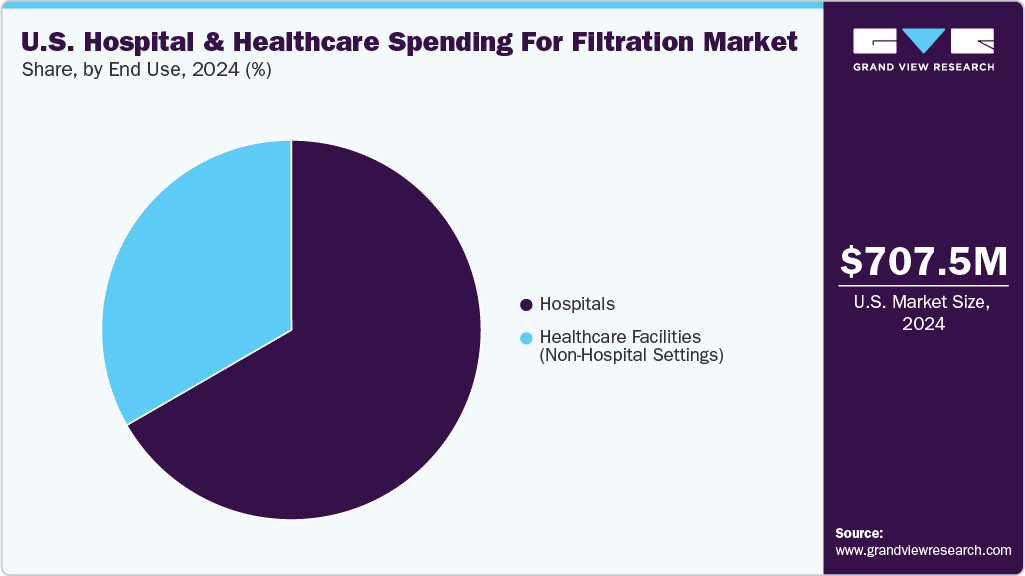
The hospitals segment dominated the market with the largest revenue share of 66.67% in 2024 and is anticipated to grow at the fastest CAGR during the forecast period. This is driven by the critical need to maintain sterile, contaminant-free environments that protect patients, staff, and visitors. Filtration systems in hospitals are essential for air, water, and medical device safety, preventing healthcare-associated infections (HAIs) and ensuring patient protection. According to the 2023 AHA Annual Survey, U.S. hospitals recorded approximately 34.43 million patient admissions across all hospitals. Thus, highlighting the scale of patient interactions and the resulting demand for effective filtration systems. Hospitals are also investing heavily in air and liquid filtration solutions to support specialized medical equipment, pharmaceutical preparations, and water safety standards.
 To learn more about this report, Download Free Sample Report
The healthcare facilities segment is anticipated to grow at a significant CAGR during the forecast period. These facilities cater to high patient throughput, chronic disease management, and specialized treatments, making air, water, and medical device filtration essential to ensure patient safety. For instance, ambulatory surgery centers provide same-day surgical procedures and minor operations, giving patients a convenient alternative to hospital-based surgeries. For instance, as per a study released in JAMA Surgery in 2024, over 30% of the more than 70 million surgeries carried out each year in the U.S. take place at ASCs, which operate independently of hospitals and emergency departments. This shows the growing importance of ASCs in the healthcare system.
State Insights
In Arizona, the market is expected to grow significantly due to the growing technological innovations and developments are primarily driving the market growth in the state. Advancements such as innovative HVAC systems with IoT-enabled monitoring, energy-efficient HEPA and ULPA filters, and renewable-powered purification units enable facilities to achieve regulatory compliance and operational cost savings. For instance, Amkor’s new semiconductor facility, launched in Arizona in July 2025, sets a high standard for air quality protection, indirectly influencing filtration expenditures in the state’s hospitals and healthcare facilities. This facility emphasizes the need for ultra-clean air in semiconductor manufacturing to protect sensitive processes, showcasing the feasibility and importance of advanced filtration in critical industries.
In California, the market is expected to grow due to the rising expansion of California's healthcare infrastructure and outpatient facilities significantly drives the spending on filtration systems. The USD 500 million Hoag Hospital Irvine expansion, led by McCarthy in February 2025, significantly enhances California's healthcare infrastructure with new high-acuity spaces. This includes the construction of two inpatient towers and specialized facilities, necessitating extensive installation of HEPA and MERV-rated filtration to comply with infection control and state building codes. The design focuses on sustainability and wildfire smoke preparedness, promoting low-pressure-drop media and intelligent monitoring systems.
In Texas, the market is expected to grow due to the increasing adoption of clean air solutions, which is a significant factor driving filtration spending in hospitals and healthcare facilities. In July 2025, Camfil introduced clean air solutions to Dallas’ healthcare facilities, which underscores the growing importance of indoor air quality and infection control in medical environments. By offering advanced filtration technologies, including HEPA, ULPA, and energy-efficient air purification systems, Camfil helps hospitals and clinics reduce airborne contaminants, protect immunocompromised patients, and comply with stringent regulatory standards. These solutions also enhance staff and patient comfort, improve operational efficiency, and support sustainability goals through lower energy consumption.
John Davidson, Branch Manager on Camfil USA's Dallas team, said:
"If HVAC systems are not properly maintained, they can become breeding grounds for mold and bacteria. These indoor air quality concerns, paired with high patient volumes and constant use of medical equipment, make air quality a vital issue for healthcare providers in the region."
Key U.S. Hospital & Healthcare Spending For Filtration Company Insights
Key players operating in the U.S. hospital & healthcare spending for filtration market are undertaking various initiatives to strengthen their presence and increase the reach of their products and services. Strategies such as expansion activities and partnerships are key in propelling the market growth.
Key U.S. Hospital & Healthcare Spending For Filtration Companies:
- 3M
- Freudenberg Filtration Technologies
- Camfil AB
- AAF International (Daikin Industries)
- MANN+HUMMEL
- Mar Cor (Cantel Medical / STERIS)
- General filter
- APC Filters (APC Filtration Inc.)
- Sidco Filter Company
- AmeriWater
Prism AI by Grand View Research Free to tryAsk a question about the U.S. hospital & healthcare spending for filtration marketTry asking✓Every figure cited from GVR research Prefer the report? Download free sample →Recent Developments
-
In April 2025, Camfil AB expanded its presence in the Southeast by introducing advanced HEPA and ULPA air filtration solutions to Birmingham, Alabama, reinforcing its commitment to improving indoor air quality in critical environments. These high-efficiency filtration systems are designed to meet the stringent demands of healthcare facilities, laboratories, pharmaceutical manufacturing, and other sensitive industries where airborne contaminants pose significant risks.
-
In December 2024, FinalFilters.com launched a diverse selection of carbon-filled final filters aimed at eliminating odors and gases from the air, making them ideal for hospitals, laboratories, clean rooms, and various settings where chemical hazards and fumes pose a risk.
-
In July 2024, Rensa Filtration announced the launch of its new family of advanced HEPA filters, designed to deliver superior particle capture efficiency and energy savings for critical environments. These filters are built to meet stringent regulatory and industry standards, ensuring reliable removal of airborne pathogens, allergens, and fine particulate matter while supporting sustainability goals through extended service life and reduced pressure drop.
-
In May 2023, 3M announced plans to invest nearly USD 150 million to strengthen its capabilities in biopharma filtration technology, underscoring its commitment to supporting the rapidly growing biopharmaceutical industry. The investment will focus on expanding research and development, scaling advanced manufacturing, and enhancing global supply chain capacity for critical filtration and purification solutions used in the production of biologics, vaccines, and novel therapeutics.
Robert Befidi, President, 3M Separation and Purification Sciences Division said:
"Our investment further demonstrates 3M's continued market leadership and ongoing commitment to customer-centric innovation in health care. Our technologies improve the lives of people all over the world, and we are helping biotech customers do more, faster, to advance their specialized medicines."
U.S. Hospital & Healthcare Spending For Filtration Market Report Scope
Report Attribute
Details
Revenue forecast in 2025
USD 732.29 million
Revenue forecast in 2033
USD 1,073.10 million
Growth rate
CAGR of 4.89% from 2025 to 2033
Actual data
2021 - 2024
Forecast data
2025 - 2033
Quantitative units
Revenue in USD million/billion and CAGR from 2025 to 2033
Report coverage
Revenue forecast, company ranking, competitive landscape, growth factors, and trends
Segments covered
Product, end use, state
Country scope
50 U.S. States; District of Columbia (D.C.)
Key companies profiled
3M; Freudenberg Filtration Technologies; Camfil AB; AAF International (Daikin Industries); MANN+HUMMEL; Mar Cor (Cantel Medical / STERIS); General filter; APC Filters (APC Filtration Inc.); Sidco Filter Company; AmeriWater
Customization scope
Free report customization (equivalent up to 8 analysts working days) with purchase. Addition or alteration to country, regional & segment scope.
Pricing and purchase options
Avail customized purchase options to meet your exact research needs. Explore purchase options
U.S. Hospital & Healthcare Spending For Filtration Market Report Segmentation
This report forecasts revenue growth at country and state levels and provides an analysis of the latest industry trends in each of the sub-segments from 2021 to 2033 For this study, Grand View Research has segmented the U.S. hospital & healthcare spending for filtration market report based on product, end use, and states:
-
Product Outlook (Revenue, USD Billion, 2021 - 2033)
-
Air Filtration
-
HEPA Filters
-
ULPA Filters
-
Carbon/Activated Charcoal Filters
-
Pre-filters & Bag Filters
-
-
Liquid Filtration
-
Water Filtration
-
Sterile Filtration
-
Dialysis Filtration Systems
-
-
Medical Device Filtration
-
Ventilator Filters
-
Anesthesia Equipment Filters
-
IV Line/Blood Filtration Units
-
-
Environmental/Utility Filtration
-
Operating Room Cleanroom Filtration Systems
-
HVAC Systems (facility-wide)
-
Laboratory Filtration Units
-
Wastewater Filtration Systems
-
-
-
End Use Outlook (Revenue, USD Billion, 2021 - 2033)
-
Hospitals
-
General Acute Care Hospitals
-
Specialty Hospitals
-
Academic/Teaching Hospitals
-
Government/Military Hospitals
-
-
Healthcare Facilities (Non-Hospital Settings)
-
Ambulatory Surgery Centers (ASCs)
-
Long-Term Care Facilities & Nursing Homes
-
Outpatient Clinics & Urgent Care Centers
-
Diagnostic/Imaging Centers
-
Rehabilitation Centers
-
-
-
State Outlook (Revenue, USD Billion, 2021 - 2033)
-
50 U.S. states
-
Alabama
-
Alaska
-
Arizona
-
Arkansas
-
California
-
Colorado
-
Connecticut
-
Delaware
-
Florida
-
Georgia
-
Hawaii
-
Idaho
-
Illinois
-
Indiana
-
Iowa
-
Kansas
-
Kentucky
-
Louisiana
-
Maine
-
Maryland
-
Massachusetts
-
Michigan
-
Minnesota
-
Mississippi
-
Missouri
-
Montana
-
Nebraska
-
Nevada
-
New Hampshire
-
New Jersey
-
New Mexico
-
New York
-
North Carolina
-
North Dakota
-
Ohio
-
Oklahoma
-
Oregon
-
Pennsylvania
-
Rhode Island
-
South Carolina
-
South Dakota
-
Tennessee
-
Texas
-
Utah
-
Vermont
-
Virginia
-
Washington
-
West Virginia
-
Wisconsin
-
Wyoming
-
-
District of Columbia (D.C.)
-
About the Author(s)
Medical Devices Research Team
Healthcare · Medical DevicesThis report was authored by the medical devices research team at Grand View Research - comprising two research analysts, one senior research analyst, and one industry expert - with specialized expertise in the medical devices segment of the healthcare industry. All findings are based on proprietary healthcare databases, executive interviews, and regulatory analysis, subject to internal peer review prior to publication.
Last Updated:
Speak to Analyst

Customize this report to your needs - add regions, segments, or data points, with 20% free customization.
Or view our licence options:


ISO 9001:2015 & 27001:2022 Certified
We are GDPR and CCPA compliant! Your transaction & personal information is safe and secure. For more details, please read our privacy policy.


