
- Home
- »
- Homecare & Decor
- »
-
U.S. Hotels, Resorts And Cruise Lines Market Report, 2030GVR Report cover

U.S. Hotels, Resorts And Cruise Lines Market (2025 - 2030) Size, Share & Trends Analysis Report By Type (Hotels, Resorts, Cruise), By Booking Mode (Direct Booking, Online Travel Agents And Travel Agencies (OTAs)), And Segment Forecasts
Market Size & Trends
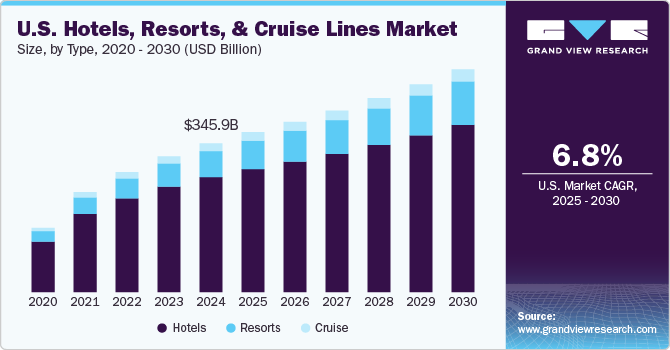
The U.S. hotels, resorts and cruise lines market size was estimated at USD 345.96 billion in 2024 and is expected to grow at a CAGR of 6.8% from 2025 to 2030. The market's growth is driven by several key factors, including increasing domestic and international tourism, business travel, and the evolving preferences of modern travelers. The expansion of technology-driven solutions such as mobile check-ins, digital concierge services, and smart room amenities has enhanced guest experiences, fostering customer loyalty and driving occupancy rates. In addition, the rise of lifestyle and boutique hotels, which cater to niche markets seeking personalized, unique accommodations, has contributed to market diversification. The growth in both leisure and corporate travel segments, coupled with the demand recovery post-pandemic, further stimulates investments in new hotel developments across key urban and suburban markets.
 Source: Grand View Research, IR Documents, Primary Interviews, Paid DatabasesTo learn more about this report,
 Download Free Sample Report
 According to statistics from the American Hotel and Lodging Association, approximately 5.3 million guest rooms are available across the U.S., supporting 1.3 billion guest nights annually. This vast room capacity underscores the extensive scale and demand within the U.S. hotel industry. Such a significant number of guest rooms allows hotels to cater to diverse travelers, from business professionals to leisure tourists, ensuring that the market remains robust. High occupancy levels across luxury and economy segments and consistent demand for extended stays and short-term bookings contribute to steady revenue streams. Moreover, the growing trend of domestic travel and the recovery in international tourism post-pandemic are driving higher utilization rates, further accelerating the expansion of the U.S. hotel market.
As per the statistics published by the U.S. Travel Association, air passenger growth remained positive, increasing by 6% compared to 2022, though slightly below the double-digit growth recorded in 2023. International arrivals remained robust, experiencing a 24% year-over-year increase. This sustained growth in air travel, particularly the significant rise in foreign visitors, is a key driver for the U.S. hotel and resort markets. The influx of international travelers directly boosts demand for short-term and extended-stay accommodations, particularly in major tourist destinations and urban centers. This surge in foreign visits enhances occupancy rates across various hotel segments, from luxury to midscale properties, contributing to revenue growth. Furthermore, the rise in international tourists fuels the expansion of resorts in sought-after locations, as these travelers often seek premium, all-inclusive experiences. With more visitors arriving by air, the U.S. hospitality sector benefits from increased spending on accommodations, dining, and leisure activities, further accelerating the market's expansion.
Similarly, the cruise line industry has experienced robust growth, driven by increasing consumer demand for experiential travel and the expansion of innovative offerings. Cruise lines capitalize on rising disposable incomes, heightened interest in multi-destination vacations, and a preference for all-inclusive experiences. Strategic investments in state-of-the-art ships, enhanced amenities, and diversified itineraries have allowed operators to cater to a broader demographic, ranging from families and couples to luxury travelers. Moreover, the focus on sustainability, such as eco-friendly practices and fuel-efficient vessels, has further positioned the industry for long-term growth amid evolving consumer preferences.
Furthermore, the industry's recovery post-pandemic has been accelerated by the resurgence of domestic and international travel, combined with targeted marketing campaigns that highlight the health and safety measures onboard. Major U.S. ports, such as Miami and Fort Lauderdale, have expanded their capacity to accommodate larger ships, further fueling the sector's expansion. Technological advancements, including onboard digital experiences and streamlined booking processes, enhance customer engagement and loyalty, contributing to higher occupancy rates and revenue growth. This upward trajectory is expected to continue, supported by the growing demand for personalized and immersive cruise experiences.
According to data released by the UN Tourism Organization, approximately 790 million international tourists traveled during the first seven months of 2024. This represents an 11% increase compared to the same period in 2023, although it remains 4% below pre-pandemic levels recorded in 2019.
This surge in international tourism significantly drives growth across the U.S. hospitality industry, particularly within the hotels, resorts, and cruise lines sectors. Increased tourist inflow enhances occupancy rates and bolsters premium services and amenities demand. Furthermore, this influx stimulates expansion efforts, operational enhancements, and investment in infrastructure, all of which contribute to the market's long-term resilience and competitiveness in a rapidly evolving landscape.
Type Insights
Hotels captured a market share of 77.33% in 2024. With the easing of COVID-19 restrictions and a renewed focus on experiential travel, leisure, and business travelers seek diverse accommodation options. Corporate travel has also rebounded, fueled by hybrid work models that necessitate more frequent business trips. The U.S. remains a global hub for conferences, conventions, and major events, which drive occupancy rates across major urban centers and secondary markets.
U.S. hotels' average daily rates (ADR) are anticipated to maintain their upward momentum in the coming year. In 2023, U.S. hotels experienced a 4.2% increase in ADR, reaching USD155.47, surpassing the forecasted figure of USD151.26. For 2024, ADR is projected to increase by 3.0% over the 2023 rate, rising to USD160.16. This represents a substantial 21.8% increase compared to the ADR of USD131.42 recorded in 2019. This sustained growth in ADR is expected to enhance the overall profitability of the U.S. hotel market significantly. As average daily rates rise, hotel operators will likely see improved revenue per available room (RevPAR), allowing for reinvestment in property upgrades, service enhancements, and marketing initiatives. Furthermore, higher ADRs will contribute to the sector's resilience against economic fluctuations, attracting a more affluent clientele and fostering a competitive landscape prioritizing quality and guest experience.
The demand for resorts is anticipated to grow at a CAGR of 8.8% from 2025 to 2030. The U.S. resort market has experienced notable growth over recent years, driven by increased demand for leisure travel and evolving consumer preferences toward immersive experiences. The sector has benefited from a strong post-pandemic rebound as travelers prioritize wellness, nature-based activities, and unique accommodations. In addition, a rising trend towards eco-tourism and sustainable hospitality has led many resorts to incorporate green practices that appeal to environmentally conscious consumers. This shift is further amplified by investments in infrastructure and technology, enhancing guest experiences through personalized services and modern amenities.
Furthermore, the diversification of resort offerings, including niche markets like wellness resorts, eco-resorts, and adventure-focused properties, has played a pivotal role in capturing a broader audience. Luxury resorts have particularly seen a surge in demand from affluent travelers seeking high-end experiences, contributing to the industry's upward trajectory. With steady economic growth and increased disposable income, the U.S. resort market is poised for continued expansion, supported by a favorable regulatory environment and a focus on sustainability and innovation within the hospitality sector.
Booking Mode Insights
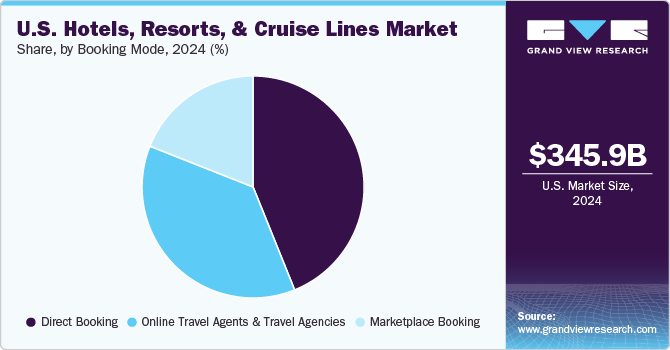
Direct booking contributed to a market share of 43.89% in 2024. The direct booking mode within the market has emerged as a significant growth driver, primarily due to technological advancements, changing consumer behaviors, and strategic marketing initiatives. With the advent of sophisticated online booking platforms and mobile applications, consumers are increasingly inclined to book accommodations directly through brand websites. The desire for personalized experiences fuels this shift, as direct bookings often offer exclusive perks such as discounted rates, complimentary amenities, and loyalty program incentives. By eliminating third-party intermediaries, establishments can enhance customer engagement, foster brand loyalty, and optimize pricing strategies, maximizing revenue.
 To learn more about this report, Download Free Sample Report
 Marketplace bookings are expected to grow at a CAGR of 7.7% from 2025 to 2030. As consumers increasingly prioritize convenience, the ability to compare multiple options in one interface has made marketplaces highly attractive. Customers benefit from streamlined search functionalities, real-time availability, and simplified booking processes, enhancing their overall experience. Marketplaces provide hotels, resorts, and cruise lines with a platform that significantly enhances their visibility. By aggregating multiple offerings in one location, these platforms attract a broader audience, facilitating access to potential customers who may not engage with individual properties or companies directly. Marketplaces often offer competitive pricing through exclusive deals, discounts, and package offers. This pricing strategy incentivizes consumers to book through these platforms rather than directly, as they perceive greater value and savings.
Key U.S. Hotels, Resorts And Cruise Lines Company Insights
The market's competitive landscape is characterized by a blend of established hospitality giants and innovative newcomers operating in a fragmented environment. Major players such as Marriott International, Hilton Worldwide, and Hyatt Hotels Corporation dominate the sector, leveraging extensive brand recognition, loyalty programs, and economies of scale to maintain significant market shares. These companies invest heavily in marketing strategies and technological enhancements, such as mobile booking platforms and personalized guest experiences, to differentiate themselves in a crowded marketplace. However, the rise of alternative accommodation providers, including platforms like Airbnb and Vrbo, poses a formidable challenge to traditional hotels by appealing to travelers seeking unique, cost-effective lodging options. This trend has compelled established brands to adapt their offerings and pricing strategies to remain competitive.
In addition to evolving consumer preferences, the landscape is increasingly influenced by a heightened focus on sustainability and wellness, with travelers showing a preference for eco-friendly practices and wellness-focused experiences.
Key U.S. Hotels, Resorts And Cruise Lines Companies:
- Marriott International, Inc.
- Hilton Worldwide Holdings Inc.
- Wyndham Hotels & Resorts
- Accor S.A.
- InterContinental Hotels Group (IHG)
- Four Seasons Hotels and Resorts
- Banyan Tree Holdings Limited
- Hyatt Hotels Corporation
- American Cruise Lines
- Carnival Cruise Line
Three ways to get this report
Buy it, customize it, or ask a question.Ask an Analyst
Analyst response in 1 business day
- AccessReport author, directly
- Reply timeWithin 1 working day
- No sales callDirect answer only
- FormatEmail reply
- CostFree, no cost
Get the Full Report
What the study covers
- FormatsPDF · Excel · Dashboard
- Timeline2025–2030 annual, 2024 base
- Coverage20+ countries, 5 regions
- Companies10+ key players profiled
Customize the Report
20% free customization
- IncludeCountries, segments, points
- TailorTo your product definition
- ExtendDeeper competitor detail
- OrA fully bespoke study
- Turnaround5–10 working days
Recent Developments
-
In February 2024, Six Senses Hotels Resorts Spas, a subsidiary of IHG Hotels & Resorts, announced its intention to launch its inaugural U.S. resort in South Carolina, with an opening date set for 2026. Following this announcement, the brand revealed additional U.S. locations, including resorts in Napa, California, and Telluride, Colorado, both slated for 2026 and 2028, respectively. The forthcoming Six Senses South Carolina Islands will embody eco-conscious design. It will feature a resort, spa, and residential community along a picturesque stretch of South Carolina’s coastline, encompassing Hilton Head Island, Daufuskie Island, and Bay Point Island. Situated conveniently near Savannah/Hilton Head International Airport, the resort is positioned to attract visitors seeking luxury and sustainability.
-
In August 2024, American Cruise Lines announced the launch of American Liberty, the third vessel in its innovative Coastal Cat series of 100-passenger ships, during a ceremony held in Newport, Rhode Island. The event occurred on a splendid sunny day at Fort Adams State Park, the docking location for all American small ships visiting Newport. American Liberty is navigating one of the Line’s most sought-after summer itineraries during its inaugural cruise, offering a roundtrip New England Islands cruise from Providence, RI, with guests onboard.
-
In October 2024, Marriott International, Inc. announced its strategic plan to introduce the City Express by Marriott brand in Canada and the U.S., entering the affordable midscale transient market. Formerly known as Project Mid-T, this expansion underscores the company’s commitment to enhancing its footprint in the affordable midscale segment, providing diverse lodging solutions tailored to various travel needs and price points. This initiative aligns with Marriott's ongoing efforts to deliver regionally relevant accommodations that cater to the evolving preferences of today’s travelers.
U.S. Hotels, Resorts And Cruise Lines Market Report Scope
Report Attribute
Details
Market size value in 2025
USD 407.40 billion
Revenue forecast in 2030
USD 567.38 billion
Growth rate
CAGR of 6.8% from 2025 to 2030
Actual data
2018 - 2024
Forecast period
2025 - 2030
Report updated
October 2024
Quantitative units
Revenue in USD billion and CAGR from 2025 to 2030
Report coverage
Revenue forecast, company ranking, competitive landscape, growth factors, and trends
Segments covered
Type, booking mode
Key companies profiled
Marriott International, Inc.; Hilton Worldwide Holdings Inc.; Wyndham Hotels & Resorts; Accor S.A.; InterContinental Hotels Group (IHG); Four Seasons Hotels and Resorts; Banyan Tree Holdings Limited; Hyatt Hotels Corporation; American Cruise Lines; Carnival Cruise Line
Customization scope
Free report customization (equivalent up to 8 analysts working days) with purchase. Addition or alteration to segment scope.
Pricing and purchase options
Avail customized purchase options to meet your exact research needs. Explore purchase options
U.S. Hotels, Resorts And Cruise Lines Market Report Segmentation
This report forecasts revenue growth at a country level and provides an analysis of the latest trends and opportunities in each of the sub-segments from 2018 to 2030. For this study, Grand View Research has segmented the U.S. hotels, resorts and cruise lines market based on type and booking mode:
-
Type Outlook (Revenue, USD Billion, 2018 - 2030)
-
Hotels
-
Resorts
-
Cruise Lines
-
-
Booking Mode Outlook (Revenue, USD Billion, 2018 - 2030)
-
Direct Booking
-
Online Travel Agents and Travel Agencies (OTAs)
-
Marketplace Booking
-
Frequently Asked Questions About This Report
The market size of U.S. hotels, resorts, and cruise lines was estimated at USD 345.96 billion in 2024 and is expected to reach USD 407.40 billion in 2025.
The U.S. hotels, resorts, and cruise lines market is expected to grow at a compound annual growth rate of 6.8% from 2025 to 2030, reaching USD 567.38 billion by 2030.
Hotels dominated the U.S. hotels, resorts, and cruise lines market with a share of 77.33% in 2024. This is attributable to the increase in travel spending and the high demand for accommodation from business travelers and international tourists.
Some key players operating in the U.S. hotels, resorts, and cruise lines market include Marriott International, Inc., Hilton Worldwide Holdings Inc., Wyndham Hotels & Resorts, Accor S.A., InterContinental Hotels Group (IHG), Four Seasons Hotels and Resorts, Banyan Tree Holdings Limited, Hyatt Hotels Corporation, American Cruise Lines, and Carnival Cruise Line.
Key factors that are driving the U.S. hotels, resorts and cruise lines market growth include rising domestic and international travel rates, high demand for accommodations, and enhanced consumer spending.
About the Author(s)
Homecare & Decor Research Team
Consumer Goods · Homecare & DecorThis report was authored by the homecare & decor research team at Grand View Research - comprising two research analysts, one senior research analyst, and one industry expert - with specialized expertise in the homecare & decor segment of the consumer goods industry. All findings are based on proprietary consumer goods databases, executive interviews, and regulatory analysis, subject to internal peer review prior to publication.
Last Updated:
Speak to Analyst

Customize this report to your needs - add regions, segments, or data points, with 20% free customization.
Or view our licence options:


ISO 9001:2015 & 27001:2022 Certified
We are GDPR and CCPA compliant! Your transaction & personal information is safe and secure. For more details, please read our privacy policy.


