
- Home
- »
- Advanced Interior Materials
- »
-
U.S. Industrial Fasteners Market Size, Industry Report, 2033GVR Report cover

U.S. Industrial Fasteners Market (2026 - 2033) Size, Share & Trends Analysis Report By Raw Material (Metal, Plastic), By Product (Externally Threaded, Internally Threaded, Non-threaded, Aerospace), By Application (Automotive, Building And Construction), And Segment Forecasts
U.S. Industrial Fasteners Market Summary
The U.S. industrial fasteners market size was estimated at USD 18.24 billion in 2025 and is anticipated to reach USD 23.18 billion by 2033, growing at a CAGR of 3.1% from 2026 to 2033. This growth can be attributed to the fact that industrial fasteners are a vital part of major industries, including automotive, electronics, aerospace, heavy equipment, marine, shipbuilding, and industrial machinery.
Key Market Trends & Insights
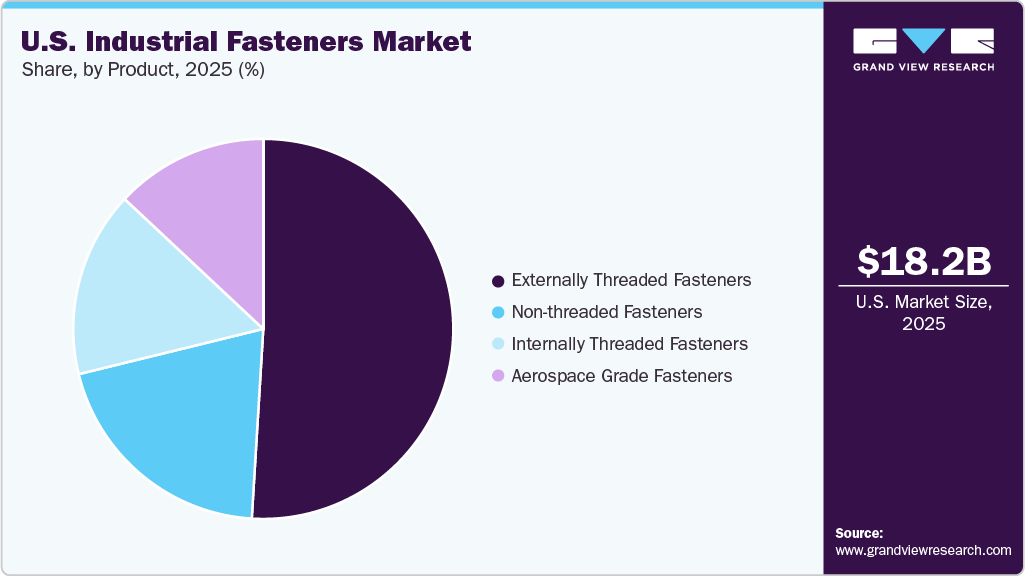
- Externally Threaded Fasteners dominated the product segment in 2025, with a revenue share of 51%.
- By raw material, the Plastic segment is expected to grow at the fastest CAGR of 3.9% over the forecast period.
- By product, the Non-Threaded Fasteners segment is expected to grow at the fastest CAGR of 3.7% over the forecast period.
- By application, the Lawns and Gardens segment is expected to grow at the fastest CAGR of 4.6% over the forecast period.
Market Size & Forecast
- 2025 Market Size: USD 18.24 Billion
- 2033 Projected Market Size: USD 23.18 Billion
- CAGR (2026-2033): 3.1%
Three ways to get this report
Buy it, customize it, or ask a question.Ask an Analyst
Analyst response in 1 business day
- AccessReport author, directly
- Reply timeWithin 1 working day
- No sales callDirect answer only
- FormatEmail reply
- CostFree, no cost
Get the Full Report
What the study covers
- FormatsPDF · Excel · Dashboard
- Timeline2026–2033 annual, 2025 base
- Coverage20+ countries, 5 regions
- Companies10+ key players profiled
Customize the Report
20% free customization
- IncludeCountries, segments, points
- TailorTo your product definition
- ExtendDeeper competitor detail
- OrA fully bespoke study
- Turnaround5–10 working days
Furthermore, fasteners can securely fasten or bond a wide range of materials, including plastic, wood, and even metal parts, with great effectiveness. Fasteners are an essential component of the automotive industry and are available in a wide range of shapes and sizes. The common products used in this industry include nuts, bolts, screws, rivets, studs, bits, and anchors. Automotive is the largest application, and the production trends in the U.S. automotive industry directly impact the market.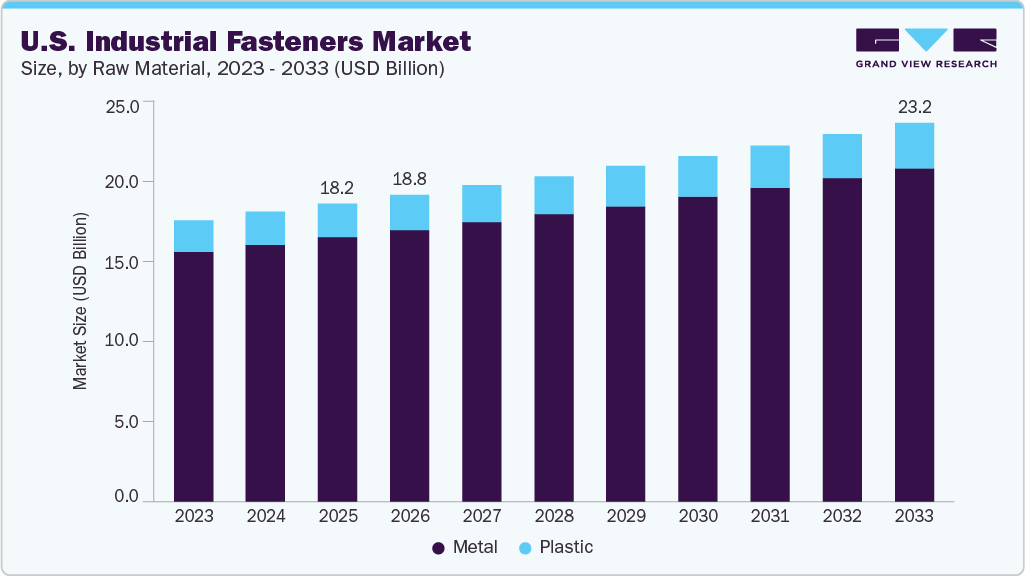 Source: Grand View Research, IR Documents, Primary Interviews, Paid DatabasesTo learn more about this report,
 Download Free Sample Report
Fasteners play a vital role in defining the structural integrity, longevity, and design philosophy of various metallic aircraft structures. The rising demand for aerospace bolts, rivets, screws, and studs is expected to boost the market growth in the U.S. As fasteners find a wide range of applications in the aerospace industry, the growth of the aerospace sector is expected to boost product demand in the U.S. over the forecast period.
The industrial fastener industry is characterized by rapid technological advances aimed at producing superior, lightweight products used in automotive and other industrial applications. Commercial car and LCV manufacturers are continuously striving to reduce overall vehicle weight, improve reliability, reduce wear, and maintain vehicle strength. Various benefits, such as reduced cost, lower weight, and excellent chemical & corrosion resistance, offered by plastic fasteners provide them a competitive edge over their counterparts in automotive applications.
Drivers, Opportunities & Restraints
The U.S. industrial fasteners market is mainly propelled by strong demand from the automotive, aerospace, construction, and industrial machinery industries. Continuous infrastructure improvement projects, increased electric vehicle manufacturing, and the return of manufacturing jobs to the U.S. are boosting the use of high-performance, specialized fasteners. Furthermore, strict quality and safety regulations in the aerospace and defense sectors are driving the demand for precision-engineered, corrosion-resistant, and lightweight fastening solutions.
Market expansion is limited by fluctuations in raw material costs, especially for steel and aluminum, which directly affect production expenses and profit margins. Interruptions in the supply chain, reliance on imports for specific specialty fasteners, and fierce price competition from low-cost international producers add further strain on domestic manufacturers. Additionally, the cyclical nature of construction and automotive production can result in varying demand trends.
There are considerable opportunities for growth in the development of renewable energy systems, the assembly of electric vehicle batteries, and advancements in aerospace that require robust, lightweight fastening solutions. The rise in automation within manufacturing is also driving the need for precision fasteners that work well with robotic assembly lines. Additionally, the movement toward tailored, application-specific fastening solutions, along with the increase in aftermarket maintenance and repair services, offers significant long-term revenue opportunities.
Market Concentration & Characteristics
The U.S. market for industrial fasteners exhibits moderate-to-high innovation, particularly in the development of lightweight, corrosion-resistant, and high-tensile fasteners for the aerospace, electric vehicle, and advanced manufacturing sectors. Firms are focusing on developing coating technologies, advanced material engineering (such as innovative alloys and composites), and fastening systems compatible with automation to improve assembly performance and efficiency. Mergers and acquisitions continue at a steady pace, driven by efforts to expand portfolios, consolidate geographically, and pursue vertical integration strategies to bolster distribution networks and enhance value-added capabilities, such as customized fastening solutions.
The market is heavily influenced by stringent industry standards and regulatory requirements, especially in the aerospace, automotive safety, and construction sectors, where certification and traceability are essential. Environmental regulations regarding coatings, plating materials, and sourcing practices also influence production methods and cost structures. Regarding alternatives, adhesives, welding, and advanced bonding techniques pose competitive challenges in certain applications; however, mechanical fasteners remain the preferred choice for load-bearing and serviceable assemblies due to their reliability and ease of maintenance.
 To learn more about this report, Download Free Sample Report
The U.S. market for industrial fasteners shows moderate end-user concentration, with demand primarily driven by sectors such as automotive, aerospace & defense, construction, and industrial machinery. Significant portions of bulk buying come from large OEMs and Tier suppliers through long-term agreements, which provide them with pricing power and strict quality requirements. However, a wide array of small and mid-sized manufacturers, along with MRO (maintenance, repair, and operations) activities, contributes to varied downstream demand, mitigating the risk of relying too heavily on a single industry vertical.
Raw Material Insights
In terms of raw material, metal and plastic industrial fasteners are among the most prominent types. The metal industrial fasteners segment dominated the industry in 2025, with a 88.6% revenue share. However, due to its high corrosion resistance and lightweight features, the product is anticipated to expand at a slower rate than its counterpart, as the penetration of plastic in applications such as aerospace and automotive is rising.
The metal fasteners industry is dominated by small- and medium-scale fastener manufacturing companies spread across the U.S., as metal fasteners offer high mechanical strength and impact resistance and are less susceptible to harsh conditions such as high temperature and pressure. A key concern for metal fastener manufacturers is that metal often corrodes when exposed to water, impairing its performance and durability in end-use applications.
The plastic industrial fasteners segment is anticipated to register the fastest-growing CAGR of 3.9% over the forecast period. As of 2025, plastic raw material accounts for a small share of the overall market. However, the product is expected to gain increasing importance, especially in the automotive, electronics, and aerospace industries, owing to its lightweight design, improved mechanical properties, and lower cost compared to metal fasteners.
Plastic material is primarily used in the automotive industry. Automotive plastic fasteners are generally non-threaded and used in applications such as wire harnessing, electronics, and car interiors. These fasteners help maintain a car's aesthetic appeal because they are available in a variety of sizes, shapes, and colors.
Product Insights
In terms of product, industrial-grade fasteners have been broadly classified by design into four major categories: externally threaded, internally threaded, non-threaded, and aerospace-grade fasteners. In 2025, the externally threaded segment held the largest market share of 51.0% owing to its wide application in the automotive, building & construction, railway, marine, and shipbuilding industries.
Internally threaded fasteners are mostly nuts and inserts. Nuts predominate in internally threaded segments and are typically utilized in opposition to bolts to connect two more sections of the construction. The most used nuts are hexagonal and are widely used in construction, industrial machinery, trains, automobiles, and motorcycle manufacturing.
 To learn more about this report, Download Free Sample Report
Over the projected period, the non-threaded segment is anticipated to register the fastest CAGR of 3.7%. Pins, washers, rivets, hooks, grommets, O-rings, clamps, cable ties, and nails are examples of non-threaded fasteners. These devices are used to fasten pipe fittings in the automotive and construction industries, as well as for cable management and wire harnesses. Due to their low cost and weight, plastic non-threaded fasteners are expected to drive strong demand across various application areas.
Over the projection period, the aerospace-grade segment is anticipated to grow at a CAGR of 3.2%. The aircraft industry employs a wide range of fasteners, including pins, rivets, bolts, screws, and collars. Aerospace grades are distinguished from other industrial fasteners by their excellent quality. Aerospace-grade materials must be exceptionally durable to withstand extremely high pressures and temperatures. Furthermore, the weight of aerospace-grade fasteners is a major consideration in their selection, as lightweight, durable fasteners are sought for aircraft applications.
Application Insights
In terms of applications, the automotive segment is a key market segment. The segment held over 27% market share in 2022. High vehicle production volumes in the U.S. have been a key driver of the country's automotive industry's growth over the past few years. In the automotive industry, fasteners serve two basic functions: bonding and reducing noise, vibration, and harshness (NVH). The parts of passenger cars and light commercial vehicles are manufactured separately and then assembled to develop a unit. This process requires various bonding components, including adhesives, tapes, sealants, and fasteners.
Aerospace has been a major market segment, as it consumes high volumes of prime-grade fasteners. The products used in aerospace applications are primarily divided into four categories, namely, screws and bolts; nuts; and expansion fasteners, including bolts, rivets, pins, nails, hooks, and rings. These fasteners are used in either permanent or temporary aerospace applications.
The growing popularity of gardening in the U.S. is expected to drive demand for lawn and garden products, including cultivators, mini tractors, and irrigation sprinklers. Fasteners are essential components of these machines, as they hold the various equipment parts together. The mechanization of gardening, which enables the use of electric equipment instead of handheld tools, is anticipated to positively impact the growth of the lawns and gardens segment of the market from 2026 to 2033.
Key U.S. Industrial Fasteners Company Insights
The U.S. industrial fasteners industry is highly competitive, owing to the presence of many manufacturers. Although fasteners account for a very small portion of total costs in the automotive or electrical & electronics industries, their prices have a significant impact on calculating replacement cost and duration, as they are consumed in large numbers. Competition faced by the suppliers is primarily due to a large number of players across the U.S. To preserve their dominance in the industrial fasteners market, prominent suppliers are working to achieve optimal operational costs, maximize production facility efficiency, shorten lead times, and improve product quality.
Key U.S. Industrial Fasteners Companies:
- Arconic Fastening Systems and Rings
- Hilti Corporation
- Illinois Tool Works, Inc.
- Acument Global Technologies, Inc.
- ATF, Inc.
- MW Industries, Inc.
- Birmingham Fastener and Supply, Inc.
- SESCO Industries, Inc.,
- Elgin Fastener Group LLC
- Slidematic
Recent Developments
-
In October 2025, Essentra Components unveiled a new line of PEEK (Polyether Ether Ketone) industrial fasteners in the U.S., engineered for harsh operating conditions that require exceptional chemical resistance, thermal stability, and mechanical performance. These PEEK fasteners provide a lightweight yet robust alternative to conventional metal components, addressing the needs of sectors such as aerospace, automotive, and advanced manufacturing, where high-temperature performance and resistance to aggressive substances are essential. This launch reflects ongoing trends in material innovation in the U.S. industrial fasteners market, aimed at enhancing capabilities for specialized engineering applications.
-
In April 2025, The Hillman Group introduced its advanced Power Pro fasteners, which feature a dual-thread configuration that allows for up to 30% quicker engagement into wood while ensuring robust holding strength, with the goal of increasing installation speed in construction and industrial assembly tasks. This launch highlights the ongoing advancements in fastening solutions designed to meet the efficiency and performance needs of the U.S. industrial sector. In the same month, Huyett launched over 60,000 new SKUs for threaded fasteners, including bolts, screws, nuts, washers, and anchors, to expand its offerings for distributors and OEMs.
U.S. Industrial Fasteners Market Report Scope
Report Attribute
Details
Market size value in 2026
USD 18.77 billion
Revenue forecast in 2033
USD 23.18 billion
Growth rate
CAGR 3.1% from 2026 to 2033
Base year for estimation
2025
Actual estimates/Historical data
2021 - 2024
Forecast period
2026 - 2033
Quantitative units
Revenue in USD million/billion and CAGR from 2026 to 2033
Report coverage
Revenue forecast, company ranking, competitive landscape, growth factors, and trends
Country scope
U.S.
Segments covered
Raw material, product, and application
Key companies profiled
Arconic Fastening Systems and Rings; Hilti Corporation; Illinois Tool Works, Inc.; Acument Global Technologies, Inc.; ATF, Inc.; MW Industries, Inc.; Birmingham Fastener and Supply, Inc.; SESCO Industries, Inc.; Elgin Fastener Group LLC; Slidematic
Customization scope
Free report customization (equivalent up to 8 analysts working days) with purchase. Addition or alteration to country, regional & segment scope.
Pricing and purchase options
Avail customized purchase options to meet your exact research needs. Explore purchase options
U.S. Industrial Fasteners Market Report Segmentation
This report forecasts revenue growth at the country level and provides an analysis of industry trends across sub-segments from 2021 to 2033. For this study, Grand View Research has segmented the U.S. industrial fasteners market report based on raw material, product, and application:
-
Raw Material Outlook (Revenue, USD Billion, 2021 - 2033)
-
Metal
-
Plastic
-
-
Product Outlook (Revenue, USD Billion, 2021 - 2033)
-
Externally Threaded Fasteners
-
Internally Threaded Fasteners
-
Non-threaded Fasteners
-
Aerospace Grade Fasteners
-
-
Application Outlook (Revenue, USD Billion, 2021 - 2033)
-
Automotive
-
Aerospace
-
Building and construction
-
Industrial Machinery
-
Robotics
-
Others
-
-
Home appliances
-
Lawns and Gardens
-
Motors and Pumps
-
Furniture
-
Plumbing Products
-
Energy & Power
-
Large-scale Nuclear Power
-
SMR (Small Modular Reactors)
-
Wind Power
-
Others
-
-
Defense
-
Marine & Shipbuilding
-
Others
-
Frequently Asked Questions About This Report
Some of the key players operating in the U.S. industrial fasteners market include Arconic Fastening Systems and Rings, Hilti Corporation, Illinois Tool Works, Inc., Acument Global Technologies, Inc., ATF, Inc., and MW Industries, Inc.
The key factor driving the U.S. industrial fasteners market is rising automotive production and growing construction activities due to rapid urbanization and industrialization across the country.
The U.S. industrial fasteners market size was estimated at USD 18.24 billion in 2025 and is expected to reach USD 18.77 billion in 2026.
The U.S. industrial fasteners market is expected to grow at a compound annual growth rate of 3.1% from 2026 to 2033 to reach USD 23.18 billion by 2033.
Metal industrial fasteners accounted for the largest share in terms of revenue with 88.6% in 2025 as they offer high mechanical strength, impact resistance, and are less susceptible to harsh conditions such as high temperature and pressure.
About the Author(s)
Advanced Interior Materials Research Team
Advanced Materials · Advanced Interior MaterialsThis report was authored by the advanced interior materials research team at Grand View Research - comprising two research analysts, one senior research analyst, and one industry expert - with specialized expertise in the advanced interior materials segment of the advanced materials industry. All findings are based on proprietary advanced materials databases, executive interviews, and regulatory analysis, subject to internal peer review prior to publication.
Last Updated:
Speak to Analyst

Customize this report to your needs - add regions, segments, or data points, with 20% free customization.
Or view our licence options:


ISO 9001:2015 & 27001:2022 Certified
We are GDPR and CCPA compliant! Your transaction & personal information is safe and secure. For more details, please read our privacy policy.


