
- Home
- »
- Medical Devices
- »
-
U.S. Laparoscopic Roux-en-Y Gastric Bypass Market Report, 2035GVR Report cover

U.S. Laparoscopic Roux-en-Y Gastric Bypass Market (2027 - 2035)
Size, Share & Trends Analysis Report By Component (Product, Services), By Indication, By End Use (Hospitals, ASCs), By Payer (Insurance, Self Pay, Others), And Segment Forecasts
Market Size, 2026
$1.7BMarket Estimate, 2027
$1.7BMarket Forecast, 2035
$2.8BCAGR, 2027–2035
6.4%U.S. Laparoscopic Roux-en-Y Gastric Bypass Market Summary
The U.S. laparoscopic roux-en-y gastric bypass market size was valued at USD 1.7 billion in 2026 and is projected to grow from USD 1.7 billion in 2027 to USD 2.8 billion by 2035, at a CAGR of 6.4% from 2027 to 2035. The U.S. Laparoscopic RYGB market is driven by the continued demand for surgical treatment of obesity and obesity-related metabolic conditions, including type 2 diabetes, hypertension, and cardiovascular risk factors. RYGB is an established metabolic and bariatric surgical procedure involving the creation of a small gastric pouch and rerouting of the small intestine to reduce food intake and alter nutrient absorption.
Key Market Trends & Insights
- By component, the services segment held the highest market share of 95.6% in 2026.
- By end use, the inpatient segment held a leading market share of 57.2% in 2026.
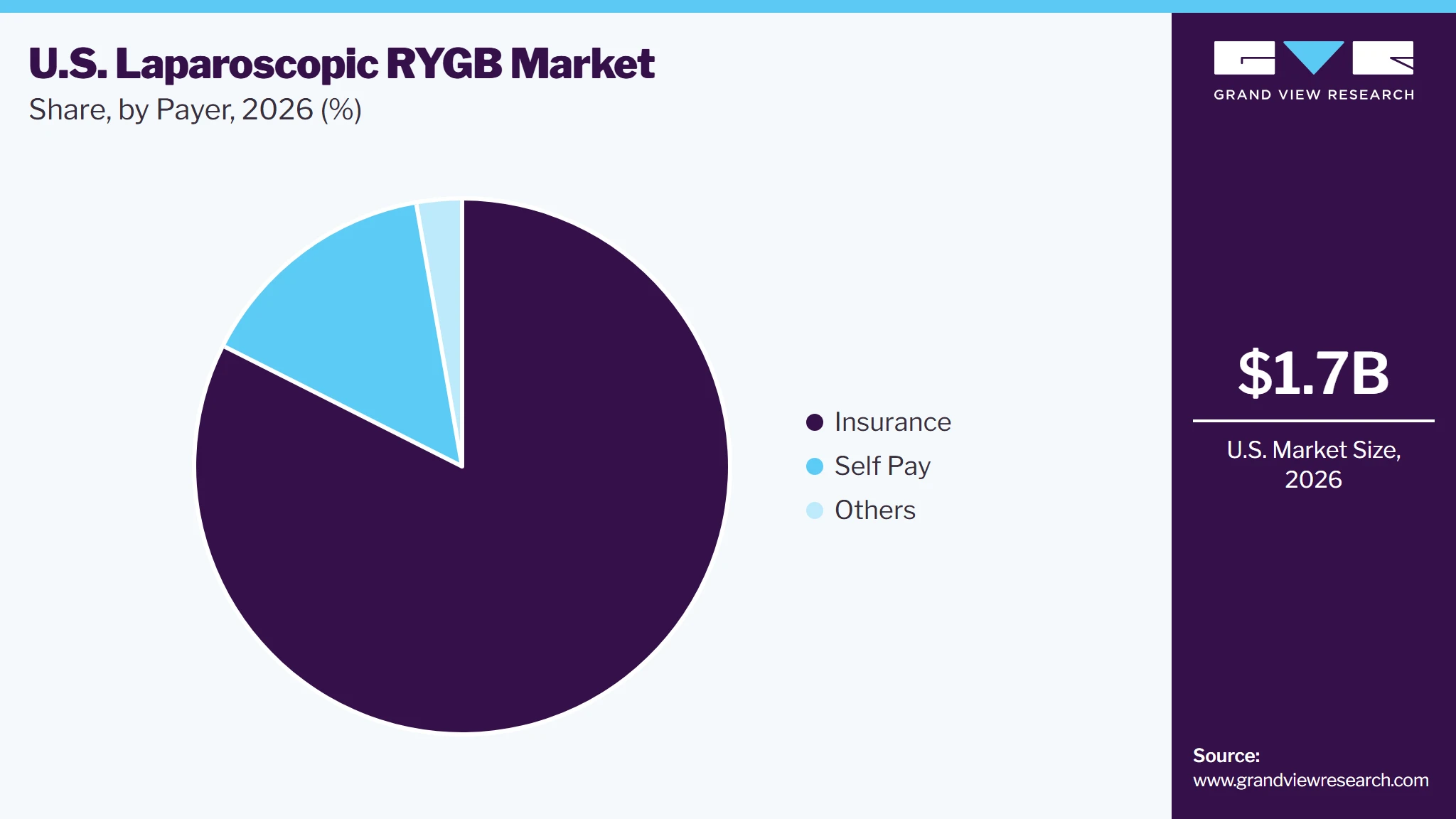
- By payer, the insurance segment held a leading market share of 82.4% in 2026.
Market Size & Forecast
- 2026 Market Size: USD 1.7 billion
- 2035 Projected Market Size: USD 2.8 billion
- CAGR (2027-2035): 6.4%
Prism AI by Grand View Research Free to tryAsk a question about the U.S. laparoscopic Roux-en-Y gastric bypass marketTry asking✓Every figure cited from GVR research Prefer the report? Download free sample →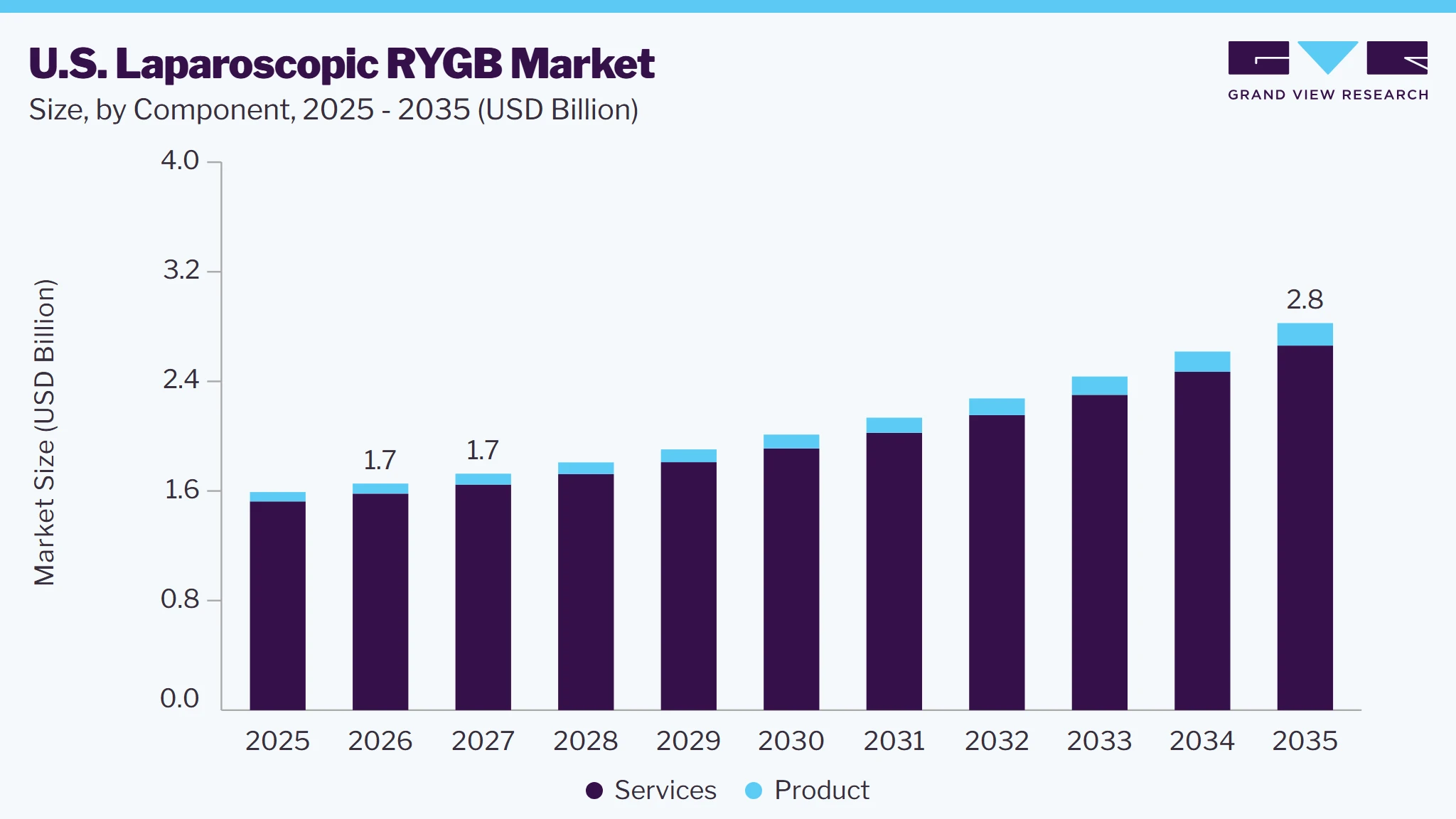 Source: Grand View Research, IR Documents, Primary Interviews, Paid DatabasesTo learn more about this report,
 Download Free Sample Report
The procedure is commonly performed using a minimally invasive laparoscopic approach, which involves smaller incisions and the use of specialized surgical instruments, visualization systems, and energy-based devices. The market is expected to witness growth over the forecast period as bariatric surgery remains an important treatment option for eligible patients with obesity. Demand is supported by the clinical role of metabolic and bariatric surgery, increasing awareness of the long-term health consequences of obesity, and continued adoption of minimally invasive surgical techniques. At the same time, procedure volumes are influenced by patient eligibility, insurance coverage requirements, access to accredited bariatric centers, affordability, and competition from non-surgical obesity management approaches.Market Dynamics
The market forecast is influenced by the number of laparoscopic RYGB procedures performed annually, the average revenue attributable to each procedure, the mix of hospital and ASC procedures, product utilization, and changes in the reimbursement and payment mix. Procedure volume and average selling price (ASP) should be modeled separately to distinguish growth arising from increased surgical activity from growth arising from changes in procedure costs, product pricing, or service intensity. National metabolic and bariatric surgery volume provides a useful indicator of the broader addressable surgical environment, but it should not be treated as the RYGB procedure count. The American Society for Metabolic and Bariatric Surgery (ASMBS) estimated approximately 200,667 metabolic and bariatric surgery procedures in the U.S. in 2024 across accredited and non-accredited settings. This figure includes multiple procedure types and therefore cannot be used as the annual laparoscopic RYGB volume without further procedure-level allocation..
The growing burden of obesity and associated metabolic conditions supports demand for surgical interventions among eligible patients who require more substantial and sustained weight-management treatment. RYGB is an established bariatric procedure and may be considered for patients with obesity, particularly when accompanied by obesity-related comorbidities. The procedure can contribute to substantial weight loss and improvement in metabolic health, supporting its continued use within multidisciplinary obesity treatment pathways. The clinical relevance of RYGB supports demand for specialized surgical products and associated services. The procedure requires a combination of laparoscopic instruments, stapling systems, access devices, sutures, energy devices, anesthesia, and peri-operative monitoring. Patients also require pre-operative assessment and post-operative follow-up, contributing to demand across the broader procedural value chain.
Although insurance coverage supports access to bariatric surgery in the U.S., coverage is subject to eligibility criteria, medical-necessity requirements, documentation, and plan-specific provisions. Medicare coverage for bariatric surgery, including gastric bypass, is available to qualifying beneficiaries under applicable coverage criteria. Private insurers and Medicaid programs may apply their own coverage policies, which can differ by payer and state.
These requirements can create administrative and financial barriers for patients. The need to demonstrate medical necessity, document prior treatment attempts where required, complete pre-operative assessments, and obtain authorization can lengthen the time between patient evaluation and surgery. Patients who do not meet coverage criteria or whose plans exclude the procedure may need to pay out of pocket, which can limit affordability and reduce conversion from consultation to surgery.
The cost of surgery is also influenced by the facility, surgeon, anesthesia, length of stay, patient complexity, and post-operative care requirements. Consequently, the availability of insurance coverage does not imply that all patients have access to the procedure or that all components of the surgical episode are reimbursed uniformly. These factors can constrain procedure volumes and limit the growth of the addressable market.
Industry Characteristics
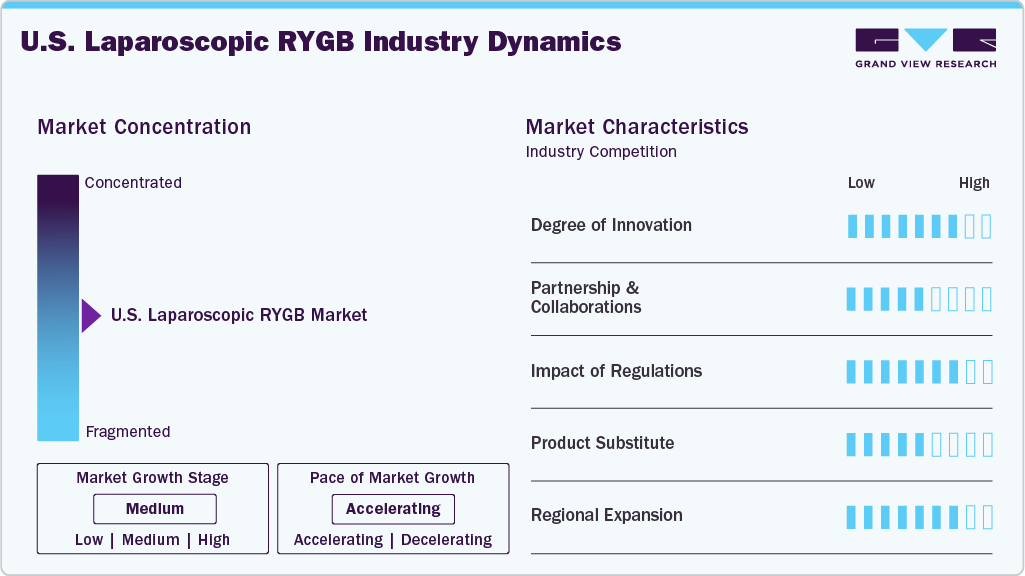
The U.S. laparoscopic RYGB market is moderately concentrated and sits inside a well-measured clinical ecosystem. The MBSAQIP registry, run jointly by the American College of Surgeons and ASMBS, captures more than 200,000 bariatric cases a year, and 58,183 of the 177,297 cases recorded in 2024 were gastric bypasses. Device companies compete across staplers, energy devices, visualization, and surgery platforms, and hospital value-analysis committees and surgeon preference largely decide purchasing.
The U.S. Laparoscopic RYGB market is primarily associated with improvements in minimally invasive surgical instruments, stapling technologies, visualization systems, and energy devices, and operating-room integration. Manufacturers continue to develop products intended to improve instrument handling, procedural precision, tissue management, and workflow efficiency. This reflects into manufacturers financial reportings. For instance, by end of September 2026, Intuitive grew its da Vinci installed base to 12,094 systems i.e., up 12% year on year. It placed 546 systems in Q3 2026, including 315 da Vinci 5 units. Innovation in consumables is focused on product reliability, ease of use, and compatibility with surgical workflows. Trocars, sutures, stapler cartridges, and energy-device handpieces are recurring-use products, making their utilization closely linked to procedure volumes and the number of devices or units consumed per case.
 To learn more about this report, Download Free Sample Report
Device manufacturers work with surgeons and healthcare facilities to evaluate product performance, provide training, and support the adoption of new surgical technologies. Such engagement can influence product selection and purchasing decisions, particularly for stapling systems, energy devices, and laparoscopic visualization platforms. Device-maker partnerships with academic centers that are generating RYGB evidence, such as the OTTAVA first cases at Memorial Hermann-Texas Medical Center (April 2025, per the J&J release in your GI report). A randomized trial (NCT06803888) is comparing RYGB or sleeve gastrectomy against semaglutide and tirzepatide, with the last participant visit scheduled for December 1, 2027. Its results could shape surgery-versus-drug referral patterns.
The U.S. laparoscopic RYGB market is influenced by medical-device regulation, hospital accreditation and quality requirements, payer coverage policies, and clinical standards.
-
The U.S. Food and Drug Administration (FDA) regulates medical devices used during the procedure. Manufacturers must meet relevant requirements for device clearance or approval, quality systems, labeling, and post-market obligations, depending on the product and its regulatory pathway.
-
Medicare coverage for bariatric surgery is governed by applicable CMS coverage policies. Medicare covers certain beneficiary patient cases when relevant coverage criteria are satisfied. CMS coverage guidance generally includes clinical eligibility requirements such as BMI thresholds, obesity-related comorbidities, and documentation of unsuccessful non-surgical treatment, subject to the applicable policy and patient circumstances.
-
Private insurance and Medicaid coverage may differ by plan, state, and program. Insurers may require prior authorization, documentation of medical necessity, participation in specified treatment programs, or other conditions before approving surgery. Consequently, coverage policies influence patient access, procedure volumes, and the distribution of revenue across payer categories.
-
Healthcare facilities are also subject to applicable licensing, accreditation, patient-safety, and quality requirements. Bariatric surgery programs may participate in accreditation and quality-reporting initiatives, which can influence clinical protocols and provider selection. These requirements are particularly relevant to the assessment of hospital and ASC participation in the market.
The principal substitutes for laparoscopic RYGB are alternative surgical and non-surgical obesity-management approaches. Sleeve gastrectomy is a major surgical alternative and is commonly performed in the U.S. Non-surgical alternatives include lifestyle interventions, dietary management, behavioral therapy, and pharmacological obesity treatments. The growing use of anti-obesity medications, including GLP-1-based therapies, may influence the decision of some patients to delay or avoid surgery. These treatments may also be used as part of a broader obesity-management pathway, including before or after surgical intervention..
The U.S. Laparoscopic RYGB market is supported by an established network of hospitals, bariatric surgery programs, and outpatient surgical facilities. Regional differences in procedure volumes and market revenue are influenced by population size, obesity prevalence, provider availability, access to specialized bariatric centers, insurance coverage, and the concentration of healthcare infrastructure. Large metropolitan areas and states with extensive hospital networks and bariatric surgery programs may account for a substantial proportion of procedures.
Analyst Perspective
The U.S. laparoscopic Roux-en-Y gastric bypass market is a mature, evidence-backed segment of bariatric surgery that is being reshaped by GLP-1 competition rather than eliminated by it. Total bariatric volumes have fallen from their 2022 peak, but RYGB has been more resilient than sleeve gastrectomy, helped by its durable metabolic outcomes and by a growing flow of revisional and conversion cases from earlier sleeve patients. Revenue is spread across a broad value chain. Products are anchored in high-volume consumables such as staplers, cartridges, trocars and energy devices, supported by capital equipment and reusable instruments. Services revenue is tied to bundled surgeon and facility payments across the pre-, intra- and post-operative pathway. Hospitals remain the primary setting, supported by the accredited-center network, while ASCs are an emerging channel whose growth depends on payment reform and tight patient selection. Insurance is the dominant payer, with self pay filling gaps in coverage.
Competition is led by large surgical device companies that bundle staplers, energy, access and visualization, with robotic platforms from Intuitive, J&J MedTech and Medtronic adding pressure on conventional laparoscopic procedures. Companies that combine broad portfolios with surgeon training, clinical evidence, hospital contracting strength and a credible robotic strategy are best placed to defend share through 2035.
Component Insights
The service segment dominated the market and accounted for the largest share of 95.6% in 2026. The segment includes pre-operative, intra-operative, and post-operative services directly attributable to the procedure. The substantial contribution of services reflects the resource-intensive nature of bariatric surgery, which requires facility infrastructure, surgical expertise, anesthesia, patient monitoring, and follow-up care. The services segment is expected to maintain a significant market contribution over the forecast period because RYGB requires coordinated care across multiple stages.
The product segment is expected to witness the fastest growing CAGR over the forecast period. Growth is supported by the recurring need for procedure-related consumables and the use of specialized laparoscopic instruments and capital equipment. As RYGB procedures are performed using a minimally invasive approach, surgical facilities require access to instruments, capital equipment, and consumables.
End Use Insights
The inpatient segment dominated the market and accounted for the largest revenue share in 2026. Inpatient facilities provide well equipped operating rooms, recovery facilities, and access to multidisciplinary clinical teams. These capabilities support the treatment of patients with obesity and associated comorbidities who may require more comprehensive peri-operative management.
The outpatient segment is expected to witness fastest CAGR over the forecast period. The segment benefits from the broader expansion of outpatient surgical infrastructure and the potential for selected bariatric procedures to be performed in lower-cost settings. However, comorbidity burden, anesthesia risk, facility capabilities, emergency-transfer arrangements, post-operative monitoring, and payer policies influences outpatient adoption/penetration in the laparoscopic RYGB procedure instead the plain trend of outpatient adoption in US healthcare industry.
Payer Insights
The insurance segment dominated the market and held the largest revenue share in 2026. Insurance remains the largest payer category because it provides a financing pathway for eligible patients who may not be able to fund the procedure independently. However, coverage should not be interpreted as universal. Patients may face exclusions, authorization requirements, deductibles, co-payments, or other out-of-pocket expenses.
 To learn more about this report, Download Free Sample Report
The self pay is expected to witness the significant growing CAGR over the forecast period. Self pay cohort may include uninsured individuals, patients whose insurance does not cover bariatric surgery, patients who do not satisfy payer eligibility requirements, and individuals who choose to pay directly. The growth is supported by patients seeking greater control over treatment timing or those who do not have access to coverage. However, the relatively high cost of bariatric surgery can constrain demand, particularly among price-sensitive patients.
Key Companies & Market Share Insight
The U.S. Laparoscopic RYGB market is manufacturers of surgical instruments, capital equipment and consumable manufacturers. The competitive environment is fragmented across product categories because no single manufacturer necessarily supplies all products and services used during the procedure.
Key U.S. Laparoscopic Roux-en-Y Gastric Bypass Companies:
-
Johnson & Johnson MedTech / Ethicon
-
Medtronic
-
Stryker
-
Olympus
-
KARL STORZ
-
CONMED
-
Applied Medical
-
Teleflex
-
B. Braun
-
Becton, Dickinson and Company (BD)
Competitive Benchmarking
Category
Operating Strategies
Competitive Edge
Weakness
Established Players (Johnson & Johnson MedTech / Ethicon, Medtronic, Stryker, Olympus, KARL STORZ, B. Braun, Becton, Dickinson and Company (BD))
- Focus on expanding minimally invasive, laparoscopic, endoscopic, and advanced surgical solutions across bariatric, colorectal, gastric, hepatobiliary, and other gastrointestinal procedures.
- Strengthen hospital relationships through surgeon training, clinical education, product innovation, technology upgrades, and broad procedural portfolios.
- Leverage established distribution networks and long-standing hospital procurement relationships to expand product penetration across surgical instruments, stapling systems, visualization platforms, energy devices, and access products.
- Strong brand recognition, extensive hospital penetration, established surgeon relationships, and broad product portfolios provide significant competitive advantages.
- Advanced stapling, laparoscopic visualization, endoscopic, energy-based, and operating-room technologies support minimally invasive surgical procedures.
- Established manufacturing capabilities, regulatory expertise, and global distribution networks enable consistent product availability and customer support.
- High R&D, manufacturing, regulatory, and clinical-validation costs increase operating complexity.
- Broad product portfolios and established organizational structures may limit flexibility in responding to niche procedural requirements and emerging technologies.
- High capital requirements for advanced surgical and visualization platforms can constrain adoption among smaller hospitals and ambulatory facilities.
Emerging Players (CONMED, Applied Medical, Teleflex)
- Focus on differentiated laparoscopic instruments, surgical access devices, energy systems, and minimally invasive technologies for gastrointestinal and other surgical procedures.
- Target hospitals, ambulatory surgery centers, and surgical facilities seeking reliable, cost-effective alternatives across laparoscopic instruments, trocars, electrosurgical systems, and related consumables.
- Strengthen market presence through product innovation, surgeon engagement, distribution partnerships, and expansion of specialized surgical portfolios.
- Focused product expertise and specialized surgical portfolios enable differentiation across laparoscopic access, instrumentation, and energy-based technologies.
- Established relationships with surgeons and healthcare facilities support product adoption and recurring consumable sales.
- Ability to compete through product specialization, pricing, and procedural workflow improvements provides opportunities to gain share in selected product categories.
- Comparatively narrower product portfolios across certain GI surgical categories may limit their ability to offer fully integrated procedural solutions.
- Competition from larger diversified medical-device manufacturers can create pricing and procurement pressures.
- Dependence on selected product categories and hospital purchasing decisions may constrain growth and market penetration.
Recent Development
-
In September 2026, Medtronic received FDA clearance for the LigaSure RAS Maryland instrument on the Hugo system. This is a vessel-sealing and dissection tool used in robotic general surgery. It widens the instrument set available on Hugo ahead of a general surgery indication, which would put the platform in the same procedure space as robotic RYGB.
-
In May 2026, a collaborative study of laparoscopic RYGB with Moon Surgical’s Maestro platform reported that the system shortened procedure duration and was linked to a more consistent operative course, with no compromise to safety.
U.S. Laparoscopic RYGB Market Report Scope
Report Attribute
Details
Market size value in 2026
USD 1.7 billion
Market size value in 2027
USD 1.7 billion
Revenue forecast in 2035
USD 2.8 billion
Growth rate
CAGR of 6.4% from 2027 to 2035
Base year for estimation
2026
Historical data
2023 - 2025
Forecast period
2027 - 2035
Quantitative units
Revenue in USD billion and CAGR from 2027 to 2035
Report coverage
Revenue forecast, company ranking, competitive landscape, growth factors, and trends
Segments covered
Component, End Use, Payer
Key companies profiled
Johnson & Johnson MedTech / Ethicon, Medtronic, Stryker, Olympus, KARL STORZ, CONMED, Applied Medical, Teleflex, B. Braun, Becton, Dickinson and Company (BD).
Customization scope
Free report customization (equivalent up to 8 analyst’s working days) with purchase. Addition or alteration to country, regional, and segment scope
Pricing and purchase options
Avail customized purchase options to meet your exact research needs. Explore purchase options
U.S. Laparoscopic Roux-en-Y Gastric Bypass Market Report Segmentation
This report forecasts revenue growth and provides an analysis of the latest industry trends in each of the sub-segments from 2023 to 2035. For the purpose of this study, Grand View Research has segmented the U.S. Laparoscopic RYGB market report based on component, end use, payer:
-
U.S. Laparoscopic RYGB Market Component Outlook (Revenue, 2023 - 2035)
-
Product
-
Instruments
-
Stapler
-
Liver Retractors
-
Gastroscope
-
Others
-
-
Capital Equipment
-
Patient monitoring equipment
-
Anesthesia monitoring equipment
-
Laparoscopic tower
-
Insufflation system
-
Others
-
-
Consumables
-
Trocars
-
Sutures
-
Stapler Cartridges
-
sizing tube/bougie
-
Energy Device (handpiece)
-
Others
-
-
-
Services
-
Pre Op
-
Intra Op
-
Post Op
-
-
-
U.S. Laparoscopic RYGB Market End Use Outlook (Revenue, 2023 - 2035)
-
Inpatient
-
Outpatient
-
-
U.S. Laparoscopic RYGB Market Payer Outlook (Revenue, 2023 - 2035)
-
Insurance
-
Medicare
-
Medicaid
-
Private
-
-
Self Pay
-
Others
-
Research Methodology
The U.S. laparoscopic roux-en-y gastric bypass market figures in this report are based on a proven research process that combines executive interviews with secondary research from proprietary databases, company filings, and recognized regulatory and institutional sources. Market size is built through value-chain sizing - reconciling supply-side and demand-side estimates - and triangulated with bottom-up and top-down approaches. Every estimate passes multiple levels of expert validation before publication, with each U.S. laparoscopic roux-en-y gastric bypass segment quantified using the revenue-capture definitions in the table below.
Segment Definition
Component
Revenue capture definition
Product
Revenue is generated through facility purchases of devices and consumables used in laparoscopic Roux-en-Y gastric bypass, from high-volume single-use items to capital platforms. This includes linear staplers and reload cartridges for pouch and anastomosis construction, energy and vessel-sealing devices, trocars and access ports, laparoscopic visualization systems, suturing and closure products, and surgical-assistance or robotic platforms with their instruments and accessories. Revenue flows through hospital and center purchasing contracts, per-procedure disposable sales, and capital equipment placements and leases, and scales with procedure volume and surgeon preference.
Service
Revenue is captured through professional and facility fees billed for laparoscopic gastric bypass, covering primary, longer-limb, and revisional procedures. Income flows through surgeon professional fees with bundled global-period follow-up, anesthesia and operating room time, facility and recovery charges, and perioperative care such as pre-operative evaluation, nutrition counseling, and long-term post-operative monitoring.
End Use
Revenue capture definition
Inpatient
Revenue is generated through bundled hospital admission billings for gastric bypass patients formally admitted for an overnight or longer stay. This setting captures surgical suite facility fees, nursing and bed-day charges, anesthesia, and management of complications or complex revisional cases. It is the traditional setting for the procedure, and revenue is driven by inpatient prospective payment rates, accredited bariatric center volumes, and enterprise purchasing contracts for surgical equipment and consumables.
Outpatient
Revenue flows through per-case facility fees for gastric bypass performed in hospital outpatient departments and ambulatory surgical centers, with same-day or short-observation discharge. Income is driven by streamlined clinical pathways, shorter recovery stays, lower-cost device and supply use, and payer interest in lower-cost sites of care. Growth depends on payment policy shifts that move more procedures out of inpatient-only status, and on strict clinical patient selection.
Payer
Revenue capture definition
Insurance
Revenue is captured through claims reimbursed by third-party payers, including commercial and employer-sponsored plans and government programs such as Medicare and Medicaid. Income flows through pre-authorization against clinical eligibility criteria, contracted rates for surgeon and facility services, and bundled global-period payments. This is the dominant payer segment, and revenue is driven by coverage policy and payer-specific eligibility rules.
Self Pay
Revenue is generated from patients who pay out of pocket for gastric bypass, typically because they lack coverage or their plans exclude bariatric surgery. Providers monetize all-inclusive cash packages that bundle surgeon, facility, anesthesia, and follow-up fees. Income is driven by transparent package pricing, financing options, and demand from patients who bypass insurer pre-authorization requirements.
Others
Revenue encompasses procedures funded outside standard insurance and self-pay arrangements. This includes employer direct-contracting and center-of-excellence programs, charity and uncompensated care, institutional or grant-funded programs, and payers not otherwise classified. Income is typically secured through negotiated bundled rates and case-by-case funding.
Estimation Model
Scope Definition
Build the Product Base
Estimate Penetration
Revenue Conversion
Key Question
Key Question
Key Question
Key Question
Which laparoscopic RYGB procedures, components, settings and payers are included in the market?
How many laparoscopic RYGB procedures are performed annually in the U.S.?
What share of procedures generates measurable market revenue, and what determines the economic value?
How does ophthalmic device demand translate into market revenue?
Process Steps
Process Steps
Process Steps
Process Steps
Define the scope of laparoscopic Roux-en-Y gastric bypass procedures (CPT 43644-43645), including primary, longer-limb and revisional cases.
Establish the component structure: products (instruments, capital equipment, consumables) and services (pre-op, intra-op, post-op).
Define the market boundary against sleeve gastrectomy, banding, open bypass and non-surgical treatments.
Establish U.S.’s geographic scope, base year, and forecast period.Quantify annual RYGB volumes from registry and claims data.
Build the procedure-level database, reconciling accredited-center data with national estimates.
Determine utilization by care setting (hospitals and ASCs).
Cross-check volumes against ASMBS estimates and claims data.Segment procedures by payer (Medicare, Medicaid, private, self pay, others).
Segment volumes by procedure type and complexity, including primary versus revisional cases.
Assess device and service utilization per case across the component segments.
Estimate the addressable procedure pool, adjusting for GLP-1 substitution and eligibility.Determine procedure-specific average revenue, including facility, surgeon and device spend per case.
Apply the procedure volume × value methodology by component.
Adjust for payer mix and site-of-care mix.
Cross-check the calculated market value against company filings and distributor feedback.Data Sources
Hcup/Ahrq, Acs Mbsaqip, Asmbs, Cms Medicare Claims And Fee Schedules, Cdc.Data Sources
Hcup Nis/Sid/Sasd, Acs Mbsaqip, Asmbs Estimates, Cms Claims.Data Sources
Cms Claims, Medicare Physician Fee Schedule, Cms Ms-Drg/Apc Information, Hcup, Acs Mbsaqip.Data Sources
Cms Medicare Physician Fee Schedule, Cms Payment Data, Hcup, Company Financial Reports, Hospital Self-Pay Price Lists.Delivered Customizations
This report has been delivered with the following In-depth customizations
Client Request
Customization Delivered
Value Adds
Porter’s Analysis
Conducted a comprehensive Porter’s Five Forces analysis of the U.S. laparoscopic RYGB market, assessing competitive rivalry, threat of new entrants, bargaining power of suppliers, bargaining power of hospitals, ASCs and payers, and threat of substitutes. The analysis evaluated competition among surgical device manufacturers across staplers, energy devices, access, visualization and capital equipment, and the capital and training barriers around robotic and advanced platforms. It covered surgeon preference and switching costs, hospital and group-purchasing contracts, and the influence of payers on coverage and site of care. Demand-side pressure was assessed using registry data: procedures fell 23% from a 2022 peak of more than 230,000 to a little over 177,000 in 2024, as GLP-1 drugs, sleeve gastrectomy and endoscopic options compete for patients.
Enables stakeholders to understand the competitive intensity and structural attractiveness of the laparoscopic RYGB market. The analysis helps identify buyer and supplier power, barriers to technology adoption, substitution risk from GLP-1 therapy, pricing pressure from hospital contracting, and opportunities created by the shift to ASCs and robotic-assisted procedures.
Key Market Players Analysis
Conducted a detailed assessment of key companies participating in the U.S. laparoscopic RYGB ecosystem, including Johnson & Johnson MedTech / Ethicon, Medtronic, Stryker, Olympus, KARL STORZ, CONMED, Applied Medical, Teleflex, B. Braun and Becton, Dickinson and Company (BD). The assessment examined company positioning, product portfolios across staplers, energy devices, access, visualization, sutures and capital equipment, regulatory progress, clinical evidence, surgeon-training initiatives, hospital relationships and commercialization strategies. Particular emphasis was placed on companies expanding robotic and minimally invasive capabilities. For example, Intuitive reported that U.S. da Vinci procedures grew about 10% in Q3 2026, with general-surgery growth partly offset by a low double-digit decline in U.S. bariatric procedures, about 2% of worldwide da Vinci volume, while Johnson & Johnson received U.S. FDA De Novo authorization for the OTTAVA robotic system in July 2026 for multiple upper-abdominal general-surgery procedures.
Provides stakeholders with a clear understanding of competitive positioning, technological differentiation, portfolio strength and strategic direction among major market participants. The analysis supports competitor benchmarking, identification of technology gaps, assessment of partnership and acquisition opportunities, evaluation of emerging robotic platforms, and understanding of how companies compete through clinical outcomes, procedural efficiency, surgeon adoption, recurring consumables and economic value propositions.
Market Dynamics Analysis
Conducted an in-depth analysis of the major factors shaping the U.S. laparoscopic RYGB market, covering growth drivers, restraints, opportunities and emerging trends. The assessment examined the persistent burden of severe obesity, the small share of eligible patients who receive surgery (less than 1% in any given year per ASMBS), and the rising role of RYGB within bariatric practice. Gastric bypass rose from 28.44% to 32.82% of procedures between 2020 and 2024, and sleeve-to-bypass conversions grew from 39.8% to 60.3% of all conversions. The analysis also covered the restraint from GLP-1 therapy, with U.S. bariatric volumes on da Vinci declining at a low double-digit rate in Q3 2026, the influence of insurance coverage changes (Intuitive noted that expiration of enhanced ACA premium subsidies modestly dampened U.S. procedure growth), the role of 902 accredited centers in the MBSAQIP network, and the migration of selected cases toward outpatient settings and robotic platforms.
Enables stakeholders to identify the key forces influencing procedure volumes, technology adoption and market development. The analysis helps organizations anticipate the shift toward revisional and conversion procedures, understand the impact of GLP-1 competition and payer coverage on volumes, evaluate the effect of reimbursement and hospital economics on device purchasing, and assess opportunities from ASC migration and advanced surgical technologies.
About the Author(s)
Medical Devices Research Team
Healthcare · Medical DevicesThis report was authored by the medical devices research team at Grand View Research - comprising two research analysts, one senior research analyst, and one industry expert - with specialized expertise in the medical devices segment of the healthcare industry. All findings are based on proprietary healthcare databases, executive interviews, and regulatory analysis, subject to internal peer review prior to publication.
Last Updated:
Speak to Analyst

Customize this report to your needs - add regions, segments, or data points, with 20% free customization.
Or view our licence options:


ISO 9001:2015 & 27001:2022 Certified
We are GDPR and CCPA compliant! Your transaction & personal information is safe and secure. For more details, please read our privacy policy.


