
- Home
- »
- Homecare & Decor
- »
-
U.S. Luxury Mice Hotels Market Size Report, 2026-2033GVR Report cover

U.S. Luxury MICE Hotels Market (2026 - 2033)
Size, Share & Trends Analysis Report By Hotel (5-Star Luxury Hotels, Ultra-Luxury Hotels), By Event (Meetings, Incentives), By Meeting Size, By Event Theme, By Booking Mode, And Segment Forecasts
Market Size, 2025
$9.2BMarket Estimate, 2026
$9.8BMarket Forecast, 2033
$14.4BCAGR, 2026–2033
5.6%U.S. Luxury MICE Hotels Market Summary
The U.S. luxury MICE hotels market size was valued at USD 9.2 billion in 2025 and is projected to grow from USD 9.8 billion in 2026 to USD 14.4 billion by 2033, at a CAGR of 5.6% from 2026 to 2033. The industry is driven by a rise in corporate travel, business events, conferences, incentive programs, and high-value group meetings, along with ongoing investment in premium hospitality infrastructure in key business and leisure destinations.
Key Market Trends & Insights
- By hotel: 5-star luxury hotels segment accounted for the largest revenue share of 78.3% in 2025.
- By event: Meetings segment accounted for the largest revenue share of 36.1% in 2025.
- By meeting size: 500 to 999 segment accounted for the largest revenue share of 24.0% in 2025.
- By event theme: Technology & digital innovation events segment accounted for the largest revenue share of 19.3% in 2025.
- By booking mode: Direct booking segment accounted for a market share of 39.9% in 2025.
Market Size & Forecast
- Market Size in 2025: USD 9.2 Billion
- Market Size in 2026: USD 9.8 Billion
- Projected Market Size by 2033: USD 14.4 Billion
- CAGR (2026-2033): 5.6%
Three ways to get this report
Buy it, customize it, or ask a question.Ask an Analyst
A direct answer, usually in 1 working day
- AccessReport author, directly
- Reply timeWithin 1 working day
- No sales callDirect answer only
- FormatEmail reply
- CostFree, no cost
Get the Full Report
What the study covers
- FormatsPDF · Excel · Dashboard
- Timeline2026–2033 annual, 2025 base
- Coverage20+ countries, 5 regions
- Companies10+ key players profiled
Customize the Report
20% free customization
- IncludeCountries, segments, points
- TailorTo your product definition
- ExtendDeeper competitor detail
- OrA fully bespoke study
- Turnaround5–10 working days
Demand is further supported by a preference for upscale venues that offer sophisticated accommodation, advanced meeting facilities, personalized event services, and premium dining. The market also benefits from the rise of hybrid and experiential events, increased corporate spending on employee engagement and incentive travel, and greater use of luxury hotels for executive meetings, industry conferences, product launches, and exclusive social events.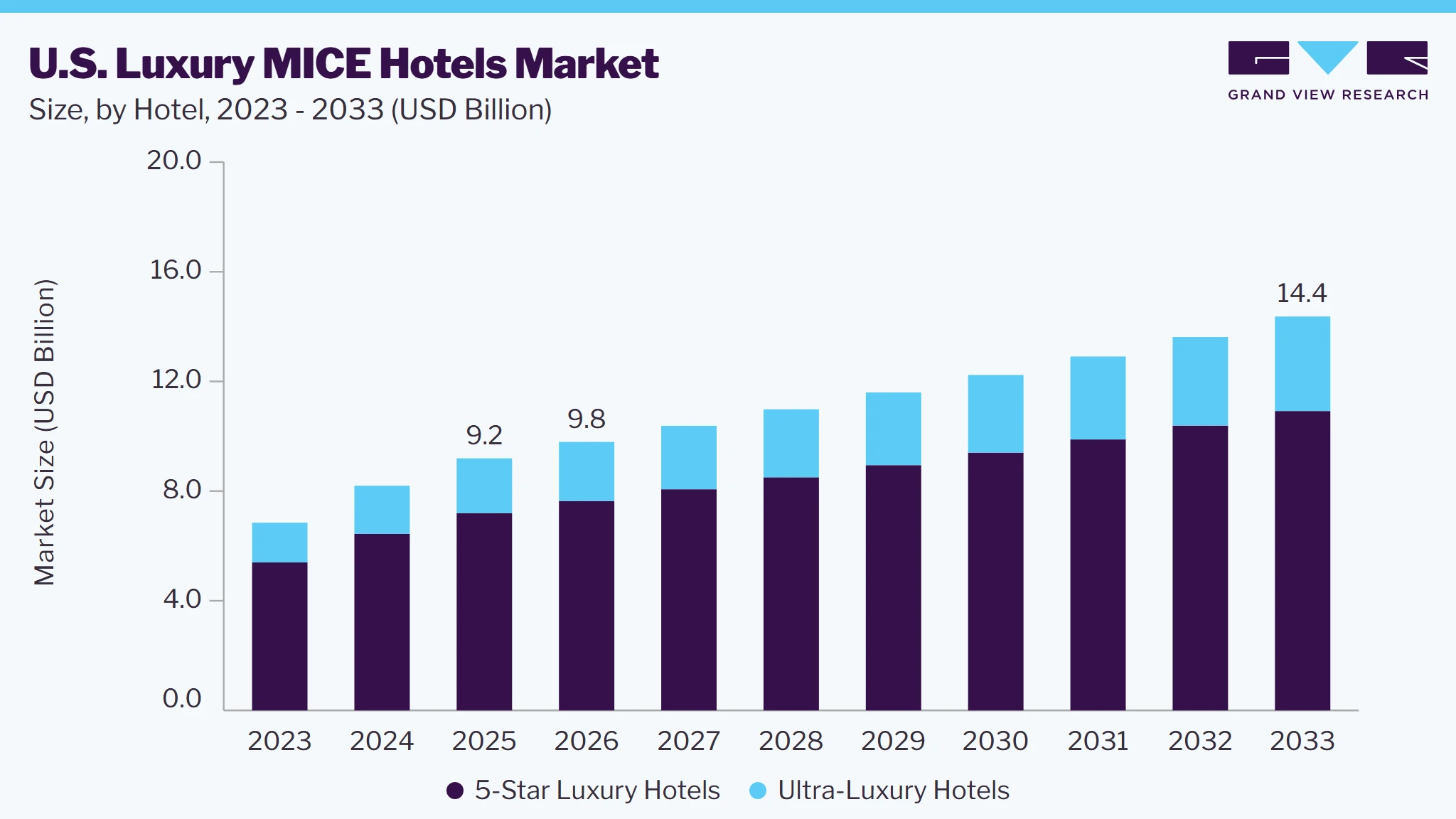 Source: Grand View Research, IR Documents, Primary Interviews, Paid DatabasesTo learn more about this report,
 Download Free Sample Report
 The post-pandemic recovery in corporate travel has restored spending toward, and now beyond, pre-COVID levels, strengthening the foundation for renewed in-person meetings and events. According to the Global Business Travel Association, global business travel spending reached approximately USD 1.34 trillion in 2023, recovering to around 93% of the 2019 peak of USD 1.43 trillion after rising 30% year-on-year. For 2024, GBTA reported spending of USD 1.47 trillion, representing 10% annual growth and exceeding the pre-pandemic nominal level. This rebound reflects companies reallocating budgets toward physical business interactions as travel restrictions disappeared and confidence improved.
This spending recovery is directly translating into stronger demand for in-person corporate meetings, conferences, and incentive events, making MICE an increasingly important component of hotel demand. The World Travel & Tourism Council (WTTC) reported in 2024 that global business travel spending was expected to reach USD 1.5 trillion, 6.2% above 2019 levels, as business leaders re-emphasized the importance of face-to-face interaction. The U.S. alone was expected to generate USD 472 billion in business travel spending in 2024, 13.4% above its 2019 record. Cvent further reported that USD 16.5 billion of group business was sourced through its platform in 2024, while room nights increased 16% versus 2019, demonstrating renewed corporate investment in face-to-face engagement.
Expansion of incentive travel and experiential corporate events is driving demand for luxury MICE hotels. Companies are favoring premium hotel venues that can integrate meetings with curated dining, entertainment, wellness programs, and destination-based experiences. This shift toward experience-led corporate events is encouraging businesses to select luxury hotels with comprehensive event infrastructure and personalized offerings that enhance attendee engagement and provide stronger reward experiences for employees and business partners. According to Cvent 2025, 49% of North American planners were using unique venues in 2025, compared with only 17% of North American planners in 2023, highlighting the shift toward more experiential event environments.
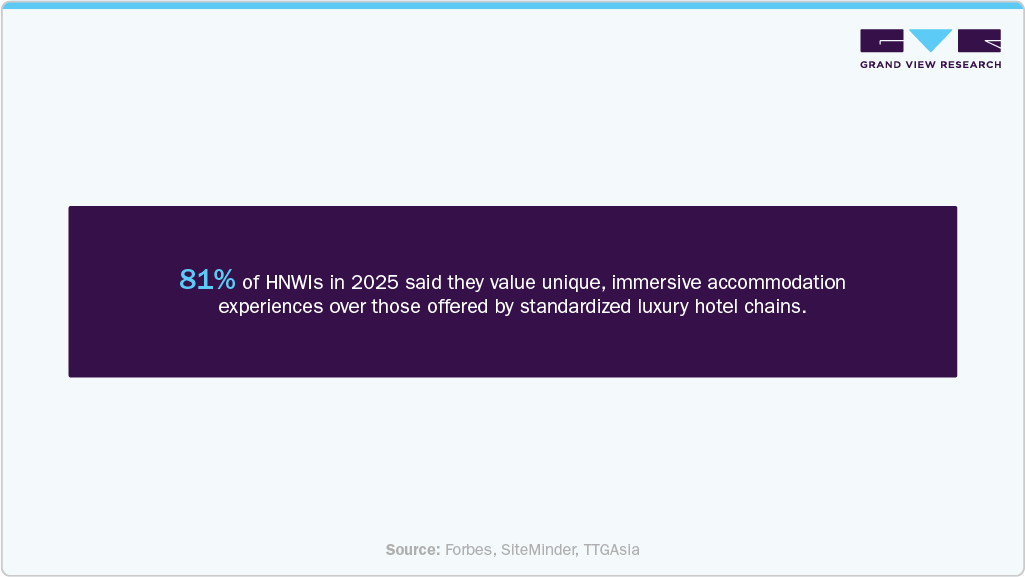
The growing emphasis on attendee experience, personalized service, unique venues, premium food and beverage, advanced event technology, and wellness amenities is shifting Luxury MICE buyers’ focus beyond room rates, thereby increasing demand for luxury and ultra-luxury properties capable of delivering differentiated group experiences.
 To learn more about this report, Download Free Sample Report
 Market Dynamics
Higher incentive-travel budgets are supporting premium demand within the luxury MICE hotel industry, as companies allocate more money to accommodation, dining, and high-value experiences for qualified employees and partners. The 2024 Incentive Travel Index placed average global incentive-program spending at USD 4,900 per person, with 41% of buyers spending more than USD 5,000 per participant. Importantly for luxury hotels, accommodation accounted for 27% of planned 2025 program budgets, making it the largest spending category. North American buyers already averaged USD 5,400 per person, indicating a stronger willingness to fund premium programs. This progression establishes a higher spending baseline than the earlier post-pandemic incentive environment and directly expands the addressable spend for upscale MICE properties.
Persistent staffing shortages are increasing the cost of delivering luxury MICE hotel services, where high-touch staffing across banquets, housekeeping, concierge, culinary, and event operations is essential. According to the American Hotel & Lodging Association (AHLA), in 2024, 76% of surveyed U.S. hotels reported staffing shortages, while 79% remained unable to fill open positions despite higher wages. AHLA also reported in 2024 that hotels paid more than USD 123 billion in employee compensation, up from USD 118 billion in 2023 and USD 102 billion in 2019. For luxury MICE properties, these pressures raise the cost of servicing group business and constrain margins, making profitable expansion increasingly difficult.
Luxury MICE hotels can use AI to automate RFP responses, personalize proposals, recommend event configurations, and identify suitable packages based on planner requirements. AI-supported demand forecasting can also help hotels optimize group pricing, meeting-space allocation, inventory, and upselling opportunities while reducing the administrative workload of sales teams. Digitally enriched venue listings, virtual walkthroughs, and automated sourcing can improve conversion by allowing planners to evaluate properties faster and with greater confidence. According to Cvent, in 2024, 69% of planners expected to increase their use of AI-powered tools for venue sourcing, while 45% said meeting-room specifications influenced their decision to send an RFP, demonstrating the growing importance of digitally enabled hotel sourcing.
Analyst Perspective
The market is evolving toward premium, experience-led business travel, with luxury hotels increasingly serving as venues for corporate meetings, conferences, incentive programs, and executive gatherings. Demand is supported by the continued importance of in-person business interactions and growing preference for personalized, high-quality event experiences. Luxury hotel operators are expanding meeting spaces, premium amenities, and destination-based experiences while offering tailored event packages and flexible services to attract high-value corporate groups.
Consumer Insights
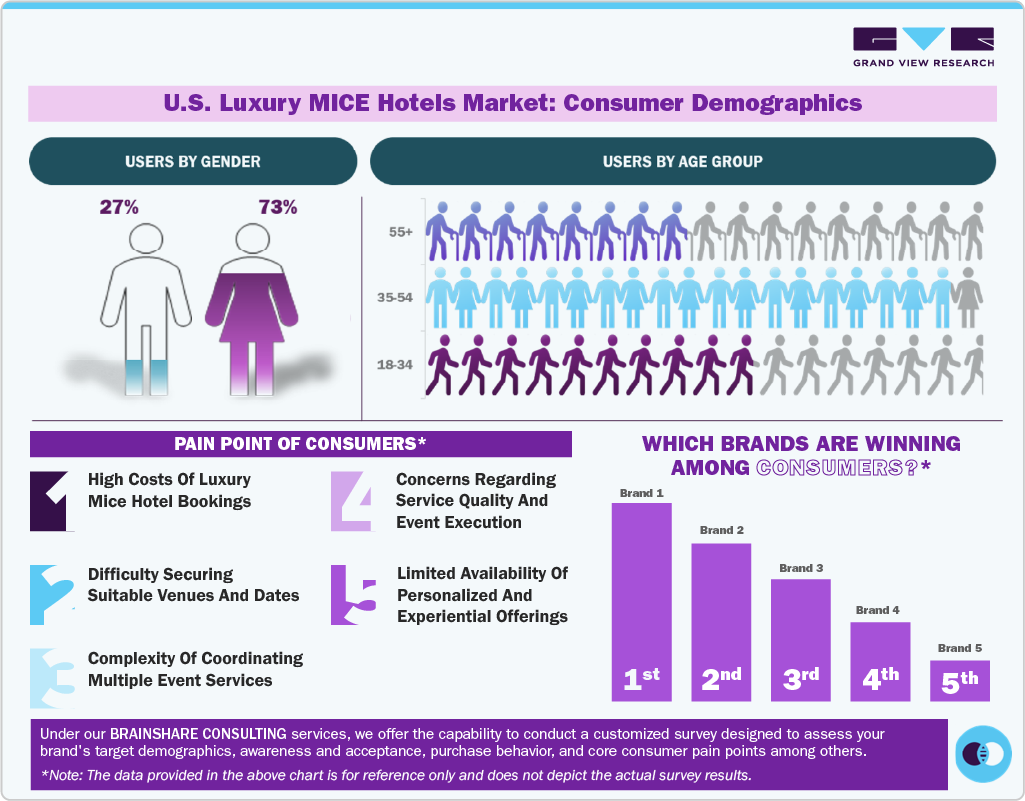
The market serves business travelers, corporate executives, event organizers, and other professionals across diverse age groups and genders, with demand influenced by their business travel needs, professional roles, and event participation.
 To learn more about this report, Download Free Sample Report
 Users by Gender
-
Female consumers account for the largest share at 73%, reflecting their significant participation in corporate meetings, conferences, incentive programs, networking events, and business travel. Female attendees also represent an important segment of decision-makers involved in event planning, venue selection, accommodation, and experience customization.
Users by Age Group
-
Consumers aged 35-54 form the largest user group, consisting of mid-career professionals, senior managers, executives, business owners, and corporate decision-makers who attend conferences, leadership meetings, corporate retreats, incentive programs, and networking events. Those aged 55 and above mainly participate in executive meetings, leadership programs, business conferences, incentive travel, and high-value corporate events, with a preference for premium accommodation, personalized services, and comfort. Consumers aged 18-34 are primarily younger professionals, emerging managers, entrepreneurs, and corporate employees who engage in conferences, training programs, networking events, and incentive activities, showing greater interest in technology-enabled meeting spaces, wellness programs, social experiences, and interactive event formats.
Consumers commonly face several challenges when planning and attending premium corporate events.
-
High costs of luxury MICE hotel bookings remain a major concern, as premium room rates, meeting packages, catering, audiovisual services, and additional event requirements can substantially increase overall event expenditure.
-
Difficulty securing suitable venues and dates can affect event planning, particularly when organizers require specific meeting-room configurations, accommodation capacity, premium amenities, and preferred dates.
-
The complexity of coordinating multiple event services remains another challenge because organizers may need to manage guestrooms, meeting spaces, catering, audiovisual equipment, transportation, entertainment, and attendee requirements simultaneously.
-
Concerns regarding service quality and event execution can influence hotel selection, as inconsistencies in hospitality, catering, technology, or event coordination can negatively affect attendee satisfaction and corporate brand perception.
-
Limited availability of personalized and experiential offerings can make it difficult for organizers to deliver distinctive incentive and corporate experiences that combine business activities with premium dining, wellness, entertainment, and customized programming.
Hotel Insights
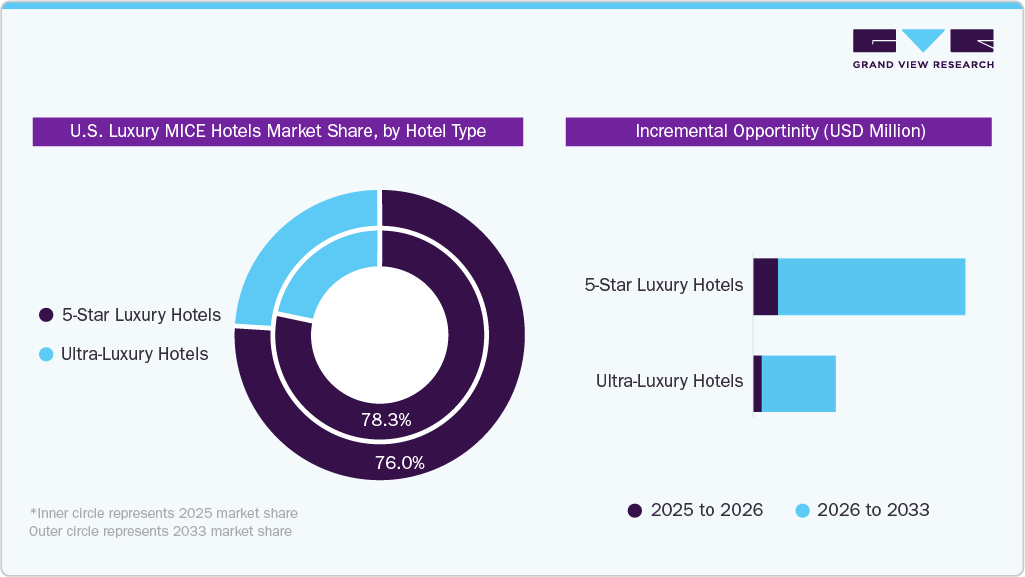
The 5-star luxury hotels segment accounted for the largest revenue share of 78.3% in 2025, reflecting the strong concentration of MICE activity in properties that offer premium meeting infrastructure, high-end accommodation, and comprehensive event services. This can be attributed to the increasing use of luxury hotels for executive meetings, corporate conferences, incentive trips, product launches, and high-value group events. For instance, Hilton expanded its luxury portfolio and continued investing in luxury brands such as Waldorf Astoria, Conrad, and LXR Hotels & Resorts, strengthening the availability of premium properties for luxury business travel and corporate events.
 To learn more about this report, Download Free Sample Report
 In addition, major U.S. luxury hotels are enhancing meeting spaces, private event venues, wellness offerings, and personalized experiences to attract corporate groups seeking more experiential and premium events. The combination of upscale accommodation, integrated meeting facilities, and tailored event experiences is supporting the dominance of 5-Star Luxury Hotels in the U.S. luxury MICE hotel market, reinforcing the leadership of the luxury MICE hotel segment.
The ultra-luxury hotels segment is expected to grow at a CAGR of 6.9% from 2026 to 2033, benefiting from the driving demand for ultra-luxury hotels that offer premium accommodation and sophisticated event infrastructure. Corporate clients seek venues that combine luxury guestrooms with private meeting spaces, fine dining, personalized service, advanced audiovisual capabilities, and curated attendee experiences. For instance, The Ritz-Carlton New York, NoMad provides state-of-the-art technology, enhanced audiovisual capabilities, dedicated event specialists, and customizable menus for executive meetings and corporate functions. This focus on elevated meeting services and personalized event experiences is strengthening demand for luxury MICE hotel properties, particularly in major U.S. business centers, while the expansion of Luxury Business Travel further supports premium hotel selection within the market.
Event Insights
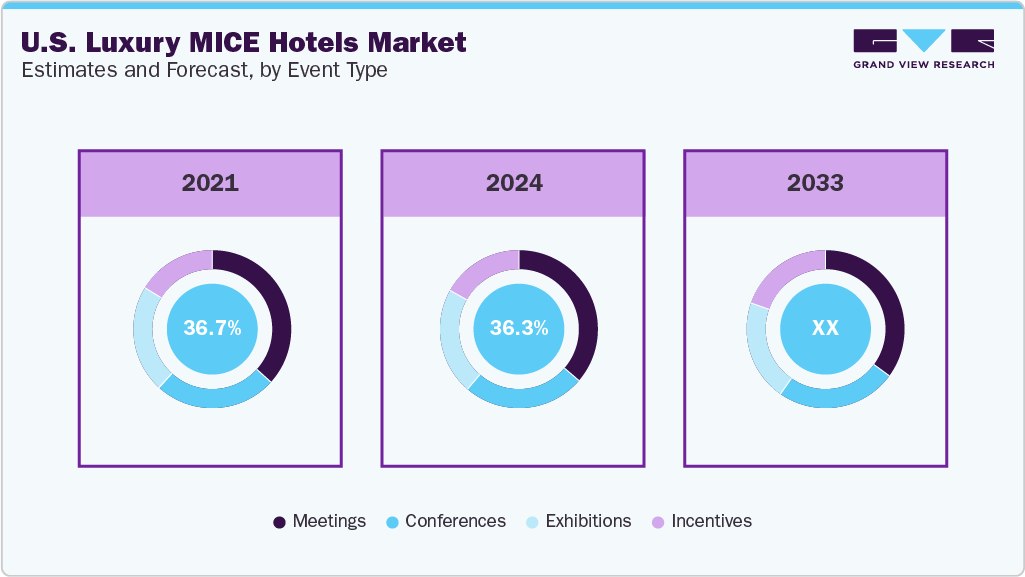
The meetings segment accounted for the largest revenue share of 36.1% in 2025, supported by the continued need for executive discussions, corporate collaboration, business retreats, and client meetings that require premium venues and professional event services. For instance, Park Hyatt New York offers dedicated meeting spaces for board meetings, business retreats, and corporate events, along with versatile venues, curated catering, built-in audiovisual equipment, and a dedicated planning team. Its 3,100-square-foot Onyx Room can accommodate up to 250 guests and features integrated AV technology, highlighting the premium meeting infrastructure available within luxury hotels. This growing emphasis on sophisticated venues and tailored services is supporting the Meetings segment within the U.S. luxury MICE hotel market and strengthening demand for luxury MICE hotel properties among luxury business travel users.
 To learn more about this report, Download Free Sample Report
 The incentives segment is expected to grow at a CAGR of 7.1% from 2026 to 2033, driven by the growing emphasis on employee recognition, motivation, retention, and relationship-building through premium corporate travel experiences. Companies are using incentive programs to reward high-performing employees and recognize business partners through personalized experiences that go beyond conventional corporate gatherings. This trend is encouraging demand for luxury hotels offering premium accommodation, fine dining, wellness activities, entertainment, and customized group experiences. For instance, Marriott International offers dedicated incentive travel solutions across its luxury portfolio, including The Ritz-Carlton, St. Regis, EDITION, and JW Marriott, with tailored experiences, personalized service, and distinctive venues designed for group and incentive programs. This experience-led approach is supporting demand for luxury MICE hotels.
Meeting Size Insights
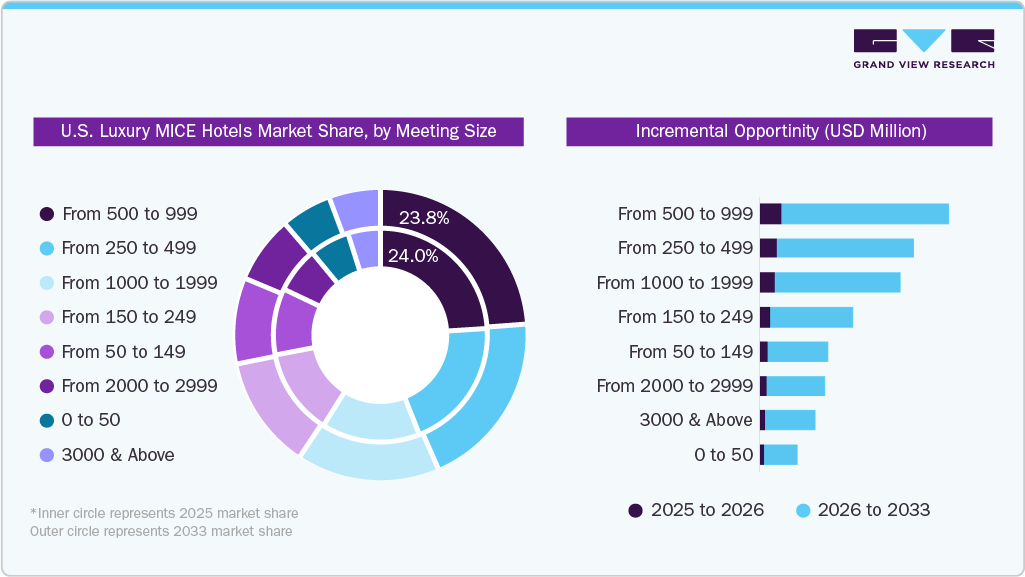
The 500 to 999 segment accounted for the largest revenue share of 24.0% in 2025, driven by the increasing requirement for large-scale corporate conferences, annual meetings, leadership summits, industry gatherings, and company-wide events that need substantial ballroom capacity and multiple supporting spaces. Hotels serving this segment are strengthening their appeal by offering large ballrooms, breakout rooms, integrated audiovisual infrastructure, customized catering, and dedicated event-planning teams, enabling organizers to manage high attendee volumes within a single luxury MICE hotel. Palace Hotel, a Luxury Collection Hotel, San Francisco, offers a Grand Ballroom accommodating up to 1,000 guests in theater and reception configurations, while its Ralston Ballroom can accommodate 600 guests for receptions, demonstrating the capacity and flexible event infrastructure required for large corporate gatherings. The availability of scalable meeting facilities is supporting demand for large-format Corporate Meetings and Business Events within the market.
 To learn more about this report, Download Free Sample Report
 The 3000 & above segment is expected to grow at a CAGR of 7.5% from 2026 to 2033, supported by the growing demand for large-scale conventions, industry congresses, corporate gatherings, and high-volume business events that require extensive event infrastructure within a single hotel property. Hotels targeting this segment are differentiating through large ballrooms, extensive breakout areas, high-capacity accommodation, advanced audiovisual systems, and dedicated event-planning capabilities, enabling organizers to manage thousands of attendees efficiently. For instance, Rio Hotel & Casino in Las Vegas offers the 55,000-square-foot Pavilion Ballroom with capacity for up to 6,110 guests, along with 11 breakout rooms, a theatrical stage, and a loading dock, making it suitable for major corporate conventions and large-scale events. The availability of high-capacity, integrated event infrastructure is supporting demand for large-format MICE hotel venues and strengthening the U.S. market for luxury business travel and major corporate events.
Event Theme Insights
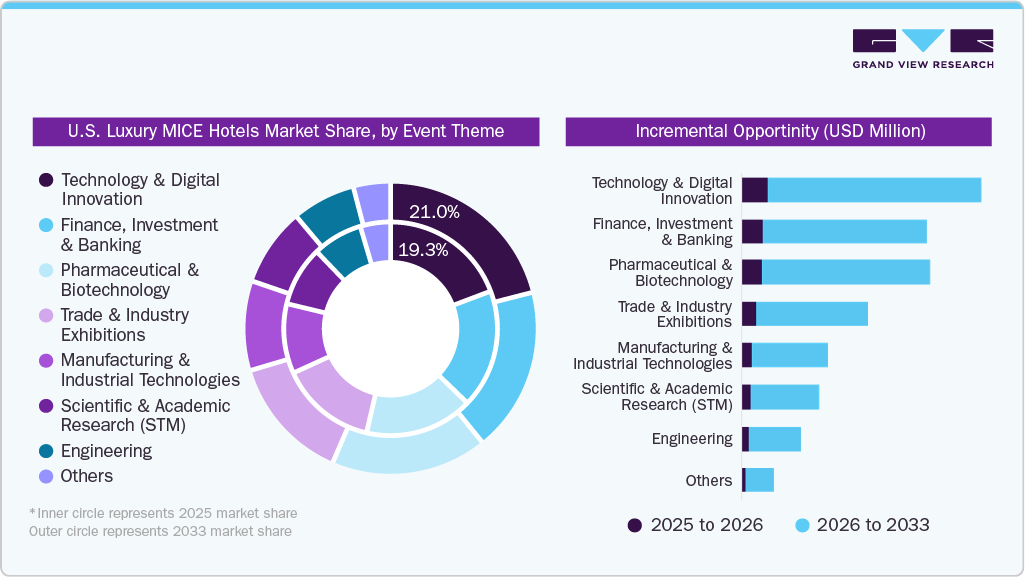
The technology & digital innovation events segment accounted for the largest revenue share of 19.3% in 2025, driven by the rapid adoption of artificial intelligence, digital transformation, automation, and emerging technologies across industries. Companies are organizing technology-focused conferences, innovation forums, and executive events that require sophisticated audiovisual infrastructure, interactive experiences, high-speed connectivity, and flexible meeting spaces. For instance, Phocuswright Conference 2025 was held at the Manchester Grand Hyatt San Diego in November 2025 and focused on technology, innovation, and changing consumer behavior in the travel industry, with speakers from companies including Expedia, Zillow, YouTube, and Google.
 To learn more about this report, Download Free Sample Report
 The pharmaceutical & biotechnology events segment is expected to grow at a CAGR of 6.3% from 2026 to 2033, driven by the continued need for industry executives, researchers, investors, healthcare professionals, and pharmaceutical companies to meet for clinical research discussions, drug-development updates, investment discussions, licensing activities, and industry networking. These events favor premium hotel venues that can provide sophisticated meeting facilities, private spaces for executive discussions, high-quality catering, accommodation, and seamless event services. For instance, the J.P. Morgan Healthcare Conference 2026 brought thousands of biotechnologies and pharmaceutical executives, investors, and industry professionals to The Westin St. Francis San Francisco in January 2026, with attendees using hotel suites and meeting spaces for discussions and deal-making.
Booking Mode Insights
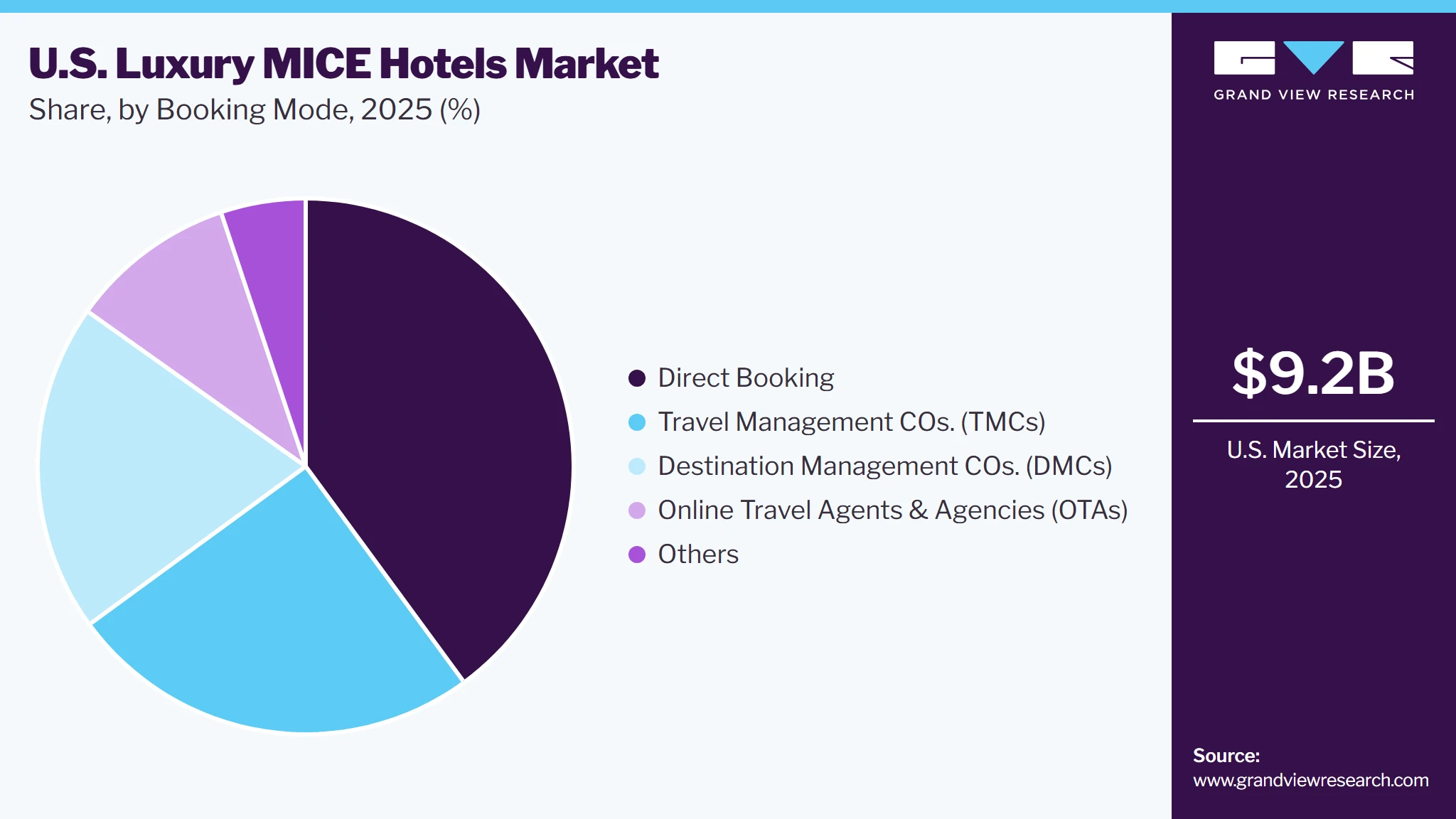
The direct booking segment accounted for a share of 39.9% in 2025, as corporate planners increasingly prefer establishing direct relationships with hotels to coordinate meeting spaces, room blocks, catering, audiovisual requirements, and other event-specific services. Direct engagement can also simplify proposal management and provide greater flexibility for customized corporate events. For instance, Marriott International enables meeting planners to directly search venues, submit requests for proposals, and book meeting spaces online at participating properties, providing a streamlined channel for managing group events and associated hotel requirements.
 To learn more about this report, Download Free Sample Report
 The destination management companies (DMCs) segment is expected to grow at a CAGR of 6.3% from 2026 to 2033, providing corporate planners with local expertise, venue sourcing, supplier coordination, transportation management, event production, and on-site execution. Their role becomes particularly valuable for companies organizing events in unfamiliar destinations, where coordinating luxury hotel room blocks, meeting facilities, local activities, and multiple vendors can increase planning complexity. For instance, RMC, a U.S.-based luxury DMC, operates across more than 40 destinations in the U.S. and works with corporate groups and meeting planners to source, plan, and execute customized meetings, incentive programs, and destination experiences. Its services strengthen the role of DMCs as an intermediary booking channel for luxury MICE hotel properties, particularly for complex Corporate Events and Incentive Travel programs.
Key U.S. Luxury MICE Hotels Company Insights
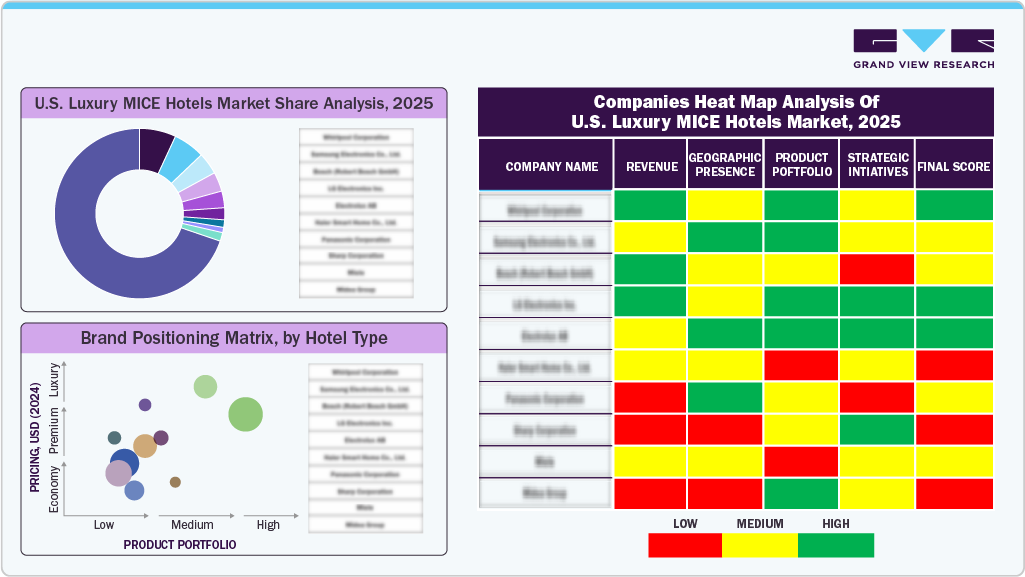
The U.S. luxury MICE hotel market is characterized by a competitive structure comprising global luxury hotel groups, heritage luxury brands, destination-focused operators, and premium hotel collections. Competition is primarily shaped by brand reputation, geographic presence, meeting and event capacity, personalized service, luxury accommodations, and the ability to deliver customized Corporate Meetings, Incentive Travel, conferences, and executive events.
-
Luxury Hotel Leaders: Companies such as Four Seasons Hotels Limited, Mandarin Oriental International Limited, Hyatt Corporation, The Ritz-Carlton Hotel Company, L.L.C., and St. Regis Hotels & Resorts compete through extensive luxury hospitality capabilities, strong international brand recognition, and sophisticated meeting and event infrastructure. Four Seasons offers meeting and event solutions ranging from intimate board meetings to conferences with dedicated planning teams, customized experiences, and exclusive property buyouts. Similarly, Mandarin Oriental provides bespoke meetings, incentive programs, product launches, hybrid events, and private buyouts supported by dedicated event teams and advanced event technology.
-
Ultra-Luxury & Experiential Hospitality Brands: Auberge Resorts, LLC, Rosewood Hotel Group, The Peninsula Hotels, Raffles Hotels & Resorts, Waldorf Astoria Hotels & Resorts, and The Luxury Collection compete at the premium end of the market by emphasizing personalized service, exclusivity, distinctive destinations, and experience-led hospitality. These brands are particularly positioned to attract high-value luxury business travel, executive meetings, incentive programs, and premium corporate events where event customization and guest experience are key purchasing considerations.
-
Luxury Lifestyle & Destination-Focused Operators: Banyan Tree Hotels & Resorts Pte. Ltd., Fairmont Hotels Limited, and Preferred Travel Group strengthen competition through destination-oriented properties, distinctive hospitality concepts, and flexible event environments. Their offerings appeal to organizations seeking to combine business programs with leisure, wellness, cultural activities, and destination experiences, particularly for incentive travel and executive retreats.
-
Luxury Hotel Brands with Strong MICE Infrastructure: The Ritz-Carlton Hotel Company, L.L.C., St. Regis Hotels & Resorts, The Luxury Collection, and Hyatt Corporation leverage substantial meeting infrastructure, event-planning capabilities, premium catering, audiovisual services, and destination experiences to compete for large and high-value group bookings. For example, The Ritz-Carlton positions its meeting offerings around event specialists, chef-led catering, audiovisual expertise, and immersive destination experiences, strengthening its appeal for sophisticated luxury MICE hotel programs.
 To learn more about this report, Download Free Sample Report
 Key U.S. Luxury MICE Hotels Companies
-
Four Seasons Hotels Limited
-
Mandarin Oriental International Limited
-
Auberge Resorts, LLC
-
Rosewood Hotel Group
-
The Ritz-Carlton Hotel Company, L.L.C.
-
St. Regis Hotels & Resorts
-
Raffles Hotels & Resorts
-
Waldorf Astoria Hotels & Resorts
-
The Peninsula Hotels
-
Fairmont Hotels Limited
-
Hyatt Corporation
-
The Luxury Collection
-
Preferred Travel Group
Competitive Benchmarking
Category
Operating Strategies
Competitive Edge
Key Challenges
Established Players (Four Seasons Hotels Limited; Mandarin Oriental International Limited; Rosewood Hotel Group; The Ritz-Carlton Hotel Company, L.L.C.; St. Regis Hotels & Resorts; Raffles Hotels & Resorts; Waldorf Astoria Hotels & Resorts; The Peninsula Hotels; Fairmont Hotels Limited; Hyatt Corporation; The Luxury Collection)
- Focus on expanding and strengthening luxury hotel portfolios across major U.S. business and MICE destinations while investing in high-end meeting spaces, private event venues, audiovisual capabilities, personalized event planning, premium catering, and corporate group services. These players increasingly integrate wellness, culinary experiences, technology-enabled events, and customized incentive programs to capture higher-value Corporate Meetings, conferences, and Incentive Travel demand.
- Strong global brand recognition, established relationships with multinational corporations and event planners, extensive luxury hospitality expertise, premium service standards, and access to high-quality meeting and event infrastructure. Their presence in major business hubs provides strong destination appeal for luxury business travel and large corporate group bookings. The U.S. luxury segment is also benefiting from renewed group and business travel demand, with convention-linked group RevPAR showing strong growth in 2026.
- High operating and labor costs, substantial investment requirements for maintaining luxury standards, intense competition for prime urban locations, and increasing expectations for personalized experiences and technologically advanced event facilities. Established brands also face pressure to differentiate their properties as corporate planners increasingly seek distinctive venues and experiential programs.
Emerging & Regional Players (Auberge Resorts, LLC; Preferred Travel Group)
- Focus on distinctive, destination-oriented luxury properties, curated guest experiences, boutique-scale hospitality, and flexible event programs that appeal to executive retreats, incentive travel, leadership meetings, and smaller premium corporate groups. These companies can strengthen their U.S. presence through selective property expansion, strategic partnerships, independent luxury hotel affiliations, and experiential programming rather than relying primarily on large standardized portfolios.
- Greater flexibility in creating highly customized experiences, distinctive property identities, destination-based programming, and personalized service.
- Smaller scale relative to global hotel groups, comparatively limited presence across major U.S. MICE destinations, fewer large-scale convention facilities at individual properties, and greater dependence on destination appeal and property-level differentiation. Expanding geographic coverage while maintaining highly personalized service can also increase operating and investment requirements.
Recent Developments
-
In September 2026, W Hotels announced the development of a 173-room W Charlotte as part of the redevelopment of Uptown Charlotte’s 400 S. Tryon tower. The property will include 27 suites and a rooftop bar, expand the city’s luxury hospitality infrastructure, and strengthen its capacity to host premium corporate meetings, incentive programs, and other MICE events.
-
In July 2025, The Remi Scottsdale, an Autograph Collection property, opened with 161 rooms and suites and nearly 24,000 sq. ft. of event space. Its upscale accommodation, extensive event facilities, and food-and-beverage offerings are expanding Scottsdale's supply of premium venues for corporate meetings and incentive events.
U.S. Luxury MICE Hotels Market Report Scope
Report Attribute
Details
Market size in 2025
USD 9.2 billion
Estimated market size in 2026
USD 9.8 billion
Projected market size in 2033
USD 14.4 billion
Growth rate
CAGR of 5.6% from 2026 to 2033
Base year
2025
Actuals
2021 - 2025
Forecast period
2026 - 2033
Quantitative units
Revenue in USD billion and CAGR from 2026 to 2033
Report coverage
Revenue forecast, company ranking, competitive landscape, growth factors, and trends
Segments covered
Hotel, event, meeting size, event theme, booking mode
Country scope
U.S.
Key companies profiled
Four Seasons Hotels Limited; Mandarin Oriental International Limited; Auberge Resorts, LLC; Rosewood Hotel Group; The Ritz-Carlton Hotel Company, L.L.C.; St. Regis Hotels & Resorts; Raffles Hotels & Resorts; Waldorf Astoria Hotels & Resorts; The Peninsula Hotels; Fairmont Hotels Limited; Hyatt Corporation; The Luxury Collection; Preferred Travel Group
Customization scope
Free report customization (equivalent up to 8 analysts’ working days) with purchase. Addition or alteration to country, regional & segment scope.
Pricing and purchase options
Avail customized purchase options to meet your exact research needs. Explore purchase options
U.S. Luxury MICE Hotels Market Report Segmentation
This report forecasts revenue growth at the country level and provides an analysis of the latest trends and opportunities in each of the sub-segments from 2026 to 2033. For this study, Grand View Research has segmented the U.S. luxury MICE hotel market report on the basis of hotel, event, meeting size, event theme, and booking mode.
-
Hotel Outlook (Revenue, USD Billion, 2021 - 2033)
-
5-Star Luxury Hotels
-
Ultra-Luxury Hotels
-
-
Event Outlook (Revenue, USD Billion, 2021 - 2033)
-
Meetings
-
Incentives
-
Conferences
-
Exhibitions
-
-
Meeting Size Outlook (Revenue, USD Billion, 2021 - 2033)
-
0 to 50
-
From 50 to 149
-
From 150 to 249
-
From 250 to 499
-
From 500 to 999
-
From 1000 to 1999
-
From 2000 to 2999
-
3000 & Above
-
-
Event Theme Outlook (Revenue, USD Billion, 2021 - 2033)
-
Pharmaceutical & Biotechnology
-
Scientific & Academic Research (STM)
-
Technology & Digital Innovation
-
Finance, Investment & Banking
-
Engineering
-
Manufacturing & Industrial Technologies
-
Trade & Industry Exhibitions
-
Others
-
-
Booking Mode Outlook (Revenue, USD Billion, 2021 - 2033)
-
Direct Booking
-
Online Travel Agents and Agencies (OTAs)
-
Destination Management Companies (DMCs)
-
Travel Management Companies (TMCs)
-
Others
-
Research Methodology
The U.S. luxury MICE hotels market figures in this report are based on a proven research process that combines executive interviews with secondary research from proprietary databases, company filings, and recognized regulatory and institutional sources. Market size is built through value-chain sizing - reconciling supply-side and demand-side estimates - and triangulated with bottom-up and top-down approaches. Every estimate passes multiple levels of expert validation before publication, with each U.S. luxury mice hotels segment quantified using the revenue-capture definitions in the table below.
Segment Definition
Segment - Hotel
Revenue capture definition
5-Star Luxury Hotels
Revenue from hotels officially classified as five-star properties, offering high-end accommodation, premium guest services, upscale dining, and dedicated meeting and event facilities for corporate meetings, conferences, incentive programs, and other MICE activities.
Ultra-Luxury Hotels
Revenue from the highest tier of luxury hotels that provide highly personalized and exclusive accommodation, exceptional service, premium amenities, bespoke experiences, and sophisticated meeting and event facilities for high-value corporate, executive, incentive, and private MICE events.
Estimation Model
Luxury Hotel Base Layer
MICE Demand Layer
Service & Booking Layer
Monetization Layer
Who purchases Car Accessories?
Who can access Automotive Accessories?
Who actively purchases Car Accessories?
How much revenue is generated?
Identifies luxury hotels in the U.S. with accommodation and MICE facilities.
Captures corporate groups, business travelers, associations, and incentive groups.
Segments demand by hotel type, event format, meeting facilities, accommodation, and catering.
Converts MICE room nights and event bookings into market revenue.
Includes properties capable of hosting meetings, conferences, incentives, and corporate events.
Focuses on travelers and organizations selecting luxury hotels for MICE activities.
Also considers direct bookings, meeting planners, corporate programs, and group-booking channels.
Uses room rates, meeting-space fees, food and beverage spending, and ancillary event services.
Delivered Customizations
This report has been delivered with the following In-depth customizations
Client Request
Customization Delivered
Value Adds
U.S. Luxury MICE Hotel Market Demand, Corporate Preferences & Booking Behavior Analysis
Conducted a detailed assessment of corporate demand for luxury MICE hotels, covering meeting formats, group bookings, incentive travel, event sizes, preferred destinations, premium accommodation, meeting facilities, and experiential offerings.
Help stakeholders identify high-value corporate segments, understand evolving meeting and incentive preferences, and target hotel offerings toward organizations seeking premium accommodation, integrated event facilities, and personalized experiences.
U.S. Luxury MICE Hotel Market Product Innovation, Event Customization & Experience Trends
Evaluated innovation across luxury MICE hotel offerings, including flexible meeting spaces, technology-enabled event planning, customized dining, wellness programs, experiential activities, premium audiovisual facilities, and personalized corporate packages.
Provides insights into evolving corporate event expectations, supporting differentiation through customized experiences, advanced meeting infrastructure, wellness-oriented programs, and integrated business and leisure offerings.
U.S. Luxury MICE Hotel Market Distribution & Market Opportunity Assessment
Assessed growth opportunities across luxury hotel brands, independent luxury properties, resorts, convention hotels, destination hotels, and corporate booking platforms, while analyzing regional demand, business hubs, convention destinations, and emerging MICE locations.
Supports investment and expansion decisions by identifying high-potential destinations, corporate demand centers, premium hotel opportunities, and distribution channels serving luxury business travel and MICE groups.
Frequently Asked Questions About This Report
The U.S. luxury MICE hotels market size was estimated at USD 9.2 billion in 2025 and is expected to reach USD 9.8 billion in 2026.
The U.S. luxury MICE hotels market is expected to grow at a compound annual growth rate of 5.6% from 2026 to 2033 to reach USD 14.4 billion by 2033.
The 5-star luxury hotels accounted for the largest revenue share of 78.3% in 2025.
By booking mode, direct booking accounted for a market share of 39.9% in 2025.
The U.S. luxury MICE hotels Market is driven by rising corporate travel, increasing demand for premium business meetings, conferences, and incentive programs, and the growing preference for personalized, high-end hospitality experiences.
Key players in the U.S. luxury MICE hotels Market include Four Seasons Hotels and Resorts, Mandarin Oriental Hotel Group, Marriott International (Ritz-Carlton, St. Regis, and The Luxury Collection), Hilton (Waldorf Astoria), Rosewood Hotels & Resorts, Auberge Resorts Collection, Banyan Tree Hotels & Resorts, Fairmont Hotels & Resorts, The Peninsula Hotels, Raffles Hotels & Resorts, and Preferred Travel Group. These companies compete through luxury accommodations, premium meeting facilities, personalized services, and high-end corporate event experiences.
By event type, MICE hotels for meetings accounted for the largest revenue share of 36.1% in 2025.
By meeting size, MICE hotels for 500 to 999 accounted for the largest revenue share of 24.0% in 2025.
By event theme, MICE hotels for technology & digital innovation events accounted for the largest revenue share of 19.3% in 2025.
About the Author(s)
Homecare & Decor Research Team
Consumer Goods · Homecare & DecorThis report was authored by the homecare & decor research team at Grand View Research - comprising two research analysts, one senior research analyst, and one industry expert - with specialized expertise in the homecare & decor segment of the consumer goods industry. All findings are based on proprietary consumer goods databases, executive interviews, and regulatory analysis, subject to internal peer review prior to publication.
Last Updated:
Speak to Analyst

Customize this report to your needs - add regions, segments, or data points, with 20% free customization.
Or view our licence options:


ISO 9001:2015 & 27001:2022 Certified
We are GDPR and CCPA compliant! Your transaction & personal information is safe and secure. For more details, please read our privacy policy.


