
- Home
- »
- Clothing, Footwear & Accessories
- »
-
U.S. Pepper Spray Market Size & Share Report, 2026-2033GVR Report cover

U.S. Pepper Spray Market (2026 - 2033)
Size, Share & Trends Analysis Report By Product Type (Steam, Gel), By Product Format (Standard Handheld, Keychain / Pocket), By End User (Individual Consumers, Private Security), By Distribution Channel (Offline, Online), And Segment Forecasts
Market Size, 2025
$40.3MMarket Estimate, 2026
$41.8MMarket Forecast, 2033
$53.9MCAGR, 2026–2033
3.7%U.S. Pepper Spray Market Summary
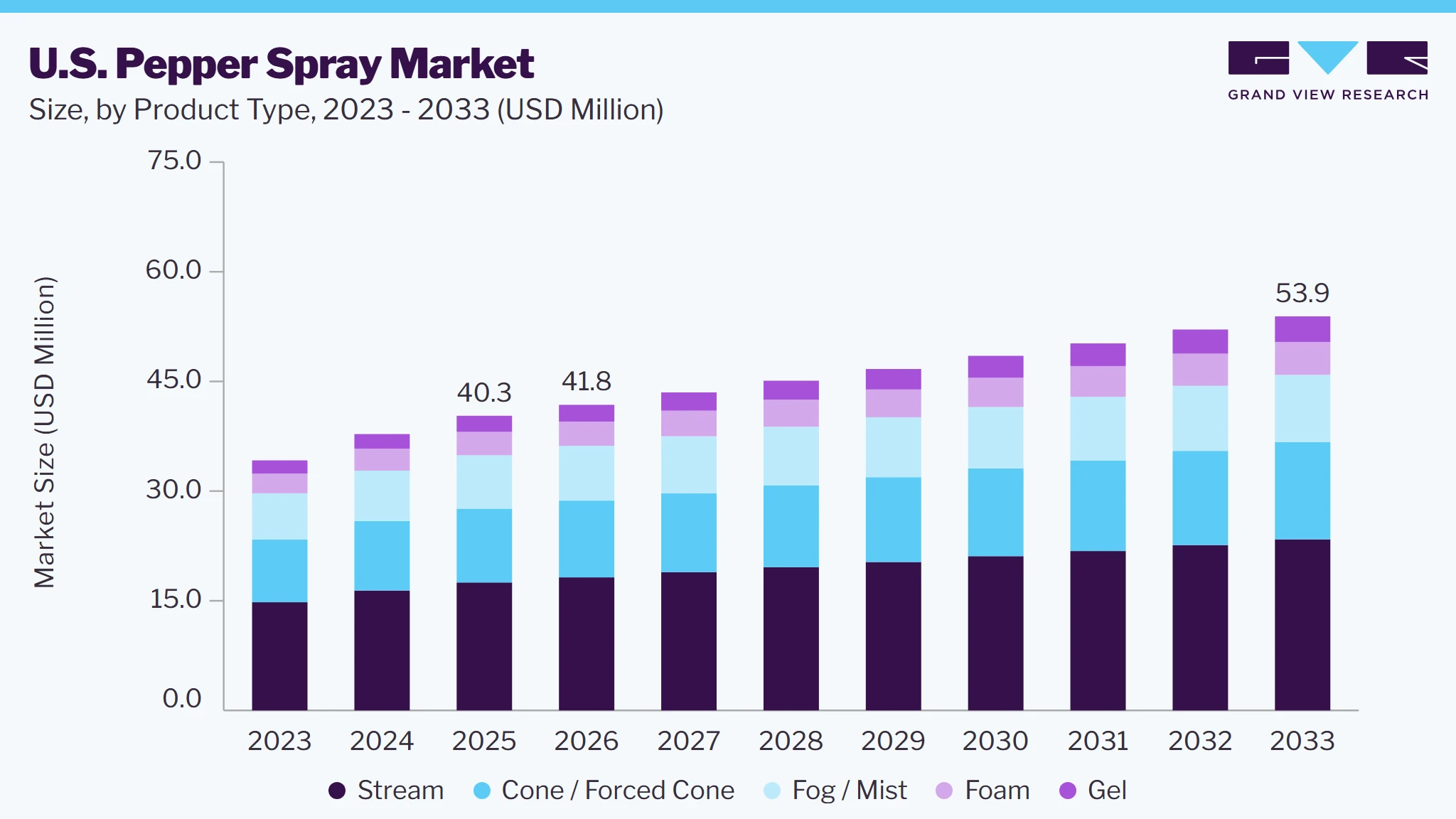
The U.S. pepper spray market size was valued at USD 40.3 million in 2025 and is projected to grow from USD 41.8 million in 2026 to USD 53.9 million in 2033, at a CAGR of 3.7% from 2026 to 2033. The U.S. market is supported by widespread consumer awareness of personal safety products, established domestic manufacturers and distribution networks, strong availability across offline and online retail channels, and continued demand for compact, non-lethal self-defense products.
Key Market Trends & Insights
- By product type: Stream pepper spray held the largest revenue share of 43.4% in 2025
- By product format: Standard handheld pepper spray held the largest revenue share of 34.1% in 2025
- By end user: Pepper spray for individual consumers is expected to grow at a CAGR of 3.9% from 2026 to 2033
- By distribution channel: Sales of pepper sprays through offline channels held the largest revenue share of 55.3% in 2025
Market Size & Forecast
- Market size in 2025: USD 40.3 Million
- Estimated market size in 2026: USD 41.8 Million
- Projected market size by 2033: USD 53.9 Million
- CAGR (2026-2033): 3.7%
Three ways to get this report
Buy it, customize it, or ask a question.Ask an Analyst
A direct answer, usually in 1 working day
- AccessReport author, directly
- Reply timeWithin 1 working day
- No sales callDirect answer only
- FormatEmail reply
- CostFree, no cost
Get the Full Report
What the study covers
- FormatsPDF · Excel · Dashboard
- Timeline2026–2033 annual, 2025 base
- Coverage20+ countries, 5 regions
- Companies10+ key players profiled
Customize the Report
20% free customization
- IncludeCountries, segments, points
- TailorTo your product definition
- ExtendDeeper competitor detail
- OrA fully bespoke study
- Turnaround5–10 working days
Personal safety concerns represent a meaningful demand driver for civilian pepper spray in the U.S., particularly among women. CDC data indicate that more than 1 in 3 U.S. women, or approximately 43.5 million, have experienced contact sexual violence, physical violence, and/or stalking by an intimate partner during their lifetime. Specifically, 19.7% of women have experienced contact sexual violence, 22.5% have experienced physical violence, and 12.2% have experienced stalking.Safety concerns also vary materially across the country. SafeWise's 2025 State of Safety survey found that 46% of Americans reported a high level of concern about their safety and security, with concern reaching 66% in Pennsylvania, 63% in Louisiana, 60% in New York, 59% in Maryland, and 58% in California and Illinois, compared with just 30% in South Dakota. These differences indicate that perceived personal safety risk is not uniform across the U.S. and can contribute to stronger demand for accessible self-defense products in higher-concern states.
 Source: Grand View Research, IR Documents, Primary Interviews, Paid DatabasesTo learn more about this report,
 Download Free Sample Report
 Broader U.S. victimization data further reinforce this safety-related demand environment. According to the latest Bureau of Justice Statistics National Crime Victimization Survey, the violent victimization rate was 23.3 incidents per 1,000 U.S. residents aged 12 or older in 2024, compared with 22.5 per 1,000 in 2023. The measure covers rape or sexual assault, robbery, aggravated assault, and simple assault. These data provide a broad indicator of exposure to violent crime, although they should not be interpreted as a direct measure of pepper-spray purchases.
Importantly, safety concerns have translated into measurable adoption of personal-defense products. Gallup found that 26% of U.S. adults reported carrying mace or pepper spray for protection in 2021, up from 14% in 2007. Adoption was substantially higher among women, at 38%, compared with 15% among men. This established pattern of carrying pepper spray provides direct evidence of consumer use and supports the role of personal safety concerns as a structural demand driver in the U.S. civilian pepper spray market.
Market Dynamics
Private-security operations provide a structured source of demand for civilian-grade OC pepper spray in the U.S. In 2024, the U.S. Bureau of Labor Statistics reported approximately 1.3 million security guards employed across the country, providing a large professional user base for defensive equipment. Regulatory requirements in several states also create formal training and equipment frameworks for security personnel.
For instance, the Texas Department of Public Safety requires Level II security officer training and additional training for security officers authorized to carry certain nonlethal weapons, including chemical-dispensing devices. The combination of a large private security workforce and state-level training requirements supports recurring demand for pepper spray among professional users, replacement purchases, and training-related consumption.
The U.S. civilian pepper spray market operates under a fragmented regulatory environment, with restrictions varying across states and municipalities. Requirements can differ with respect to permissible formulations, canister size, labeling, sales conditions, age requirements, and possession or use restrictions.
California, for instance, imposes specific requirements on tear-gas weapons, including limitations on the amount of active ingredient and container capacity. New York also imposes restrictions on the sale and possession of certain self-defense sprays. These differences increase compliance requirements for manufacturers and retailers and can limit the uniform distribution of products across the U.S. market.
Manufacturers in the U.S. are introducing pepper-spray systems designed around replaceable canisters, creating an opportunity to shift part of the category from one-time device purchases toward recurring replacement demand. Mace, for example, has introduced products incorporating replaceable-canister designs, including its Chameleon vehicle-defense system and other pepper-spray products. Such systems allow the primary delivery device to remain in use while the active spray canister is replenished separately, creating additional purchase occasions over the product lifecycle. The model also provides manufacturers with opportunities to differentiate products through modular designs and build recurring revenue from replacement canisters.
Consumer Insights
-
 To learn more about this report, Download Free Sample Report
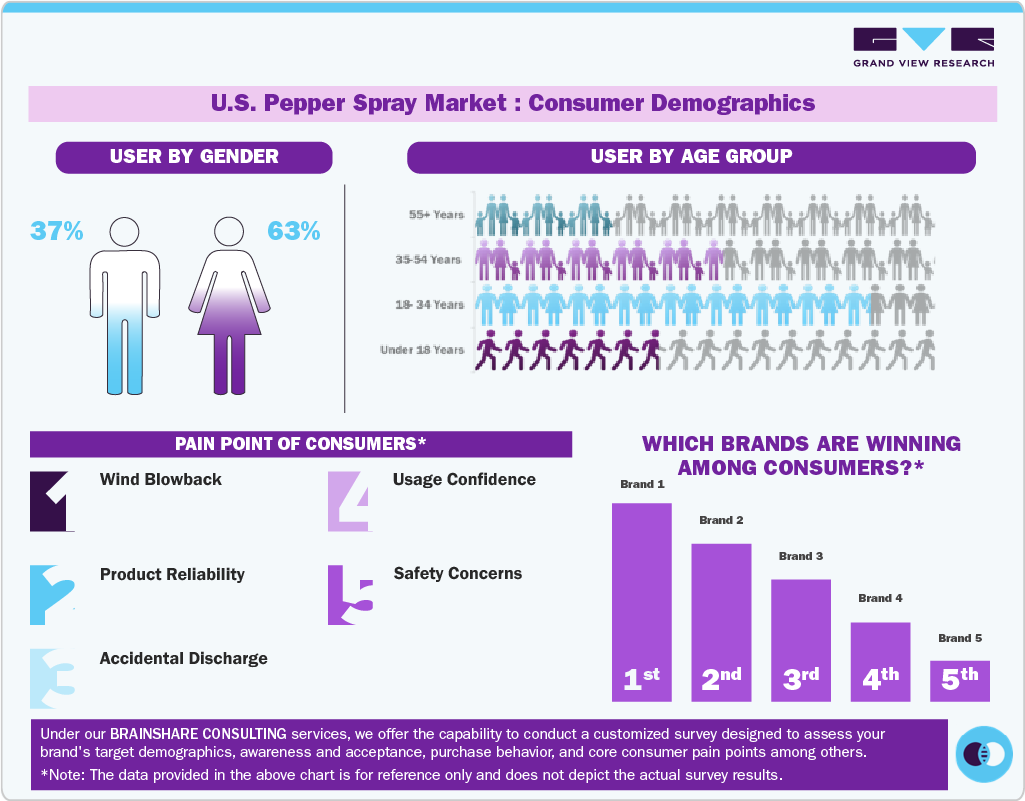
 Gender: Women represent a particularly important target segment within the U.S. civilian pepper-spray market. This is reflected in product positioning focused on discreet carrying and personal protection, with keychain, pocket, and purse-compatible formats providing manufacturers with clear opportunities to tailor products to female consumers.
-
A 2025 U.S. consumer-safety survey by SafeWise found that 44% of Americans include pepper spray in their self-defense arsenal, making it the second-most-used form of personal protection, while women showed a stronger preference for pepper spray than men.
-
-
Age Group: Younger adults represent the most commercially relevant age segment for civilian pepper spray in the U.S., supported by greater independent mobility and frequent movement across work, education, social, and public settings. This creates a strong fit for discreet, easily accessible formats, particularly keychain and pocket products, while conventional handheld formats extend the addressable market across older consumers.
-
Pain Points: Product safety and unintended exposure represent important pain points for pepper-spray users in the country. A U.S. emergency-department study covering 2000-2020 identified an estimated 34,582 pepper-spray-related injuries, with ocular exposure accounting for 52.0% of cases, followed by dermal exposure at 25.7% and inhalation at 13.6%. The findings highlight the importance of controlled deployment, minimizing unintended exposure, and providing clear instructions for safe handling and use.
Regulatory Landscape
State / Jurisdiction
Civilian Use Status
Key Regulatory Evidence
Implication
California
Permitted with product restrictions
California Penal Code §22810 permits civilian possession/use for self-defense but restricts tear-gas weapons to aerosol devices containing no more than 2.5 oz. and prohibits projectile or non-aerosol delivery systems.
Creates a large civilian market but requires manufacturers to maintain state-compliant canister size, delivery method, labeling, and product specifications.
New York
Permitted with significant purchase/sale restrictions
New York Penal Law §265.20 permits qualifying adults to possess self-defense spray for protection, while the law establishes requirements concerning authorized sellers, age verification, labeling, safety information, and purchase quantity.
Increases compliance requirements for manufacturers and retailers and makes distribution-channel compliance particularly important.
Massachusetts
Permitted; regulated sale and possession
Massachusetts law specifically regulates self-defense spray under M.G.L. c.140 §§122C-122D. Current state materials identify restrictions on who may purchase or possess self-defense spray, while sales are subject to statutory requirements.
Creates an accessible but more tightly controlled civilian market, requiring manufacturers and retailers to account for eligibility and sales restrictions.
Michigan
Permitted with formulation and age restrictions
Michigan law defines a qualifying self-defense spray/foam device and specifies permissible formulations, including OC concentrations. The law also prohibits sale of a self-defense spray or foam device to a minor.
Product formulation and age-compliance requirements affect which products can legally be sold, limiting complete product standardization across states.
Other U.S. states
Generally permitted; requirements vary
Civilian pepper spray is broadly available across the U.S., but state laws differ in areas such as age, prohibited persons, formulation, container size, delivery method, sale, and carrying conditions.
Provides the majority of the addressable U.S. market, while requiring manufacturers to manage state-by-state compliance rather than a single national product specification.
Analyst Perspective
The U.S. pepper spray market is shifting toward portable, everyday-carry, and application-specific products, with stream remaining dominant while gel, foam, and forced-cone formats gain traction. Personal safety concerns, established civilian adoption, private security demand, and expanding online availability are supporting market growth. However, state-level differences in product, purchase, point-of-sale, and shipping requirements continue to shape market accessibility. Manufacturers are responding with compact formats, improved spray control, safety features, and differentiated product designs to address evolving consumer and professional needs.
Product Type Insights
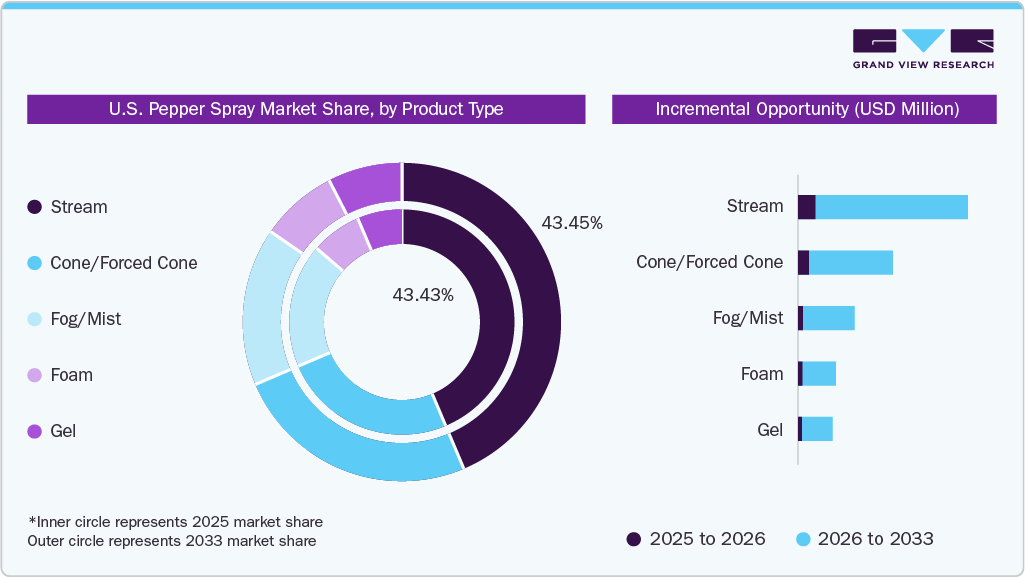
The stream pepper spray segment dominated the U.S. pepper spray industry, accounting for a revenue share of 43.4% in 2025 as its delivery characteristics directly address the practical requirements of personal defense. The EPA's August 2024 Technical Support Document identifies streaming formulations as providing precise delivery, reduced blowback potential, and generally longer range, supporting their suitability for personal-defense applications. These functional advantages make stream particularly suitable for civilian self-defense, supporting its leading market share.
 To learn more about this report, Download Free Sample Report
 The gel pepper spray segment is projected to grow at a CAGR of 5.9% from 2026 to 2033, as the U.S. consumers increasingly seek pepper-spray options that offer a greater range and more controlled application. SafeWise's 2025 U.S. product testing selected Sabre Red Pepper Gel as its best pepper spray for distance, highlighting its 18-foot range and clip-on carry format.
Product Format Insights
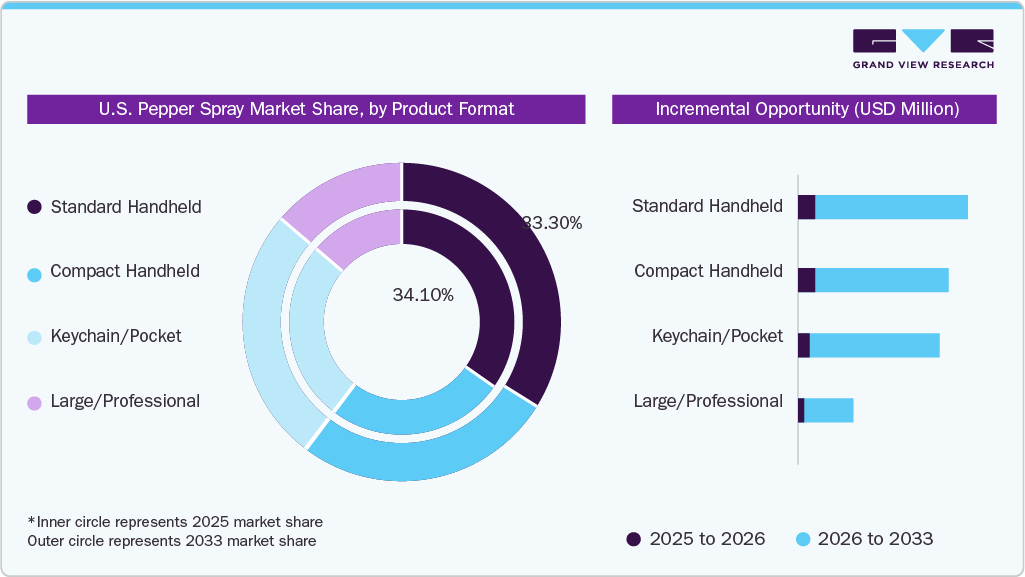
The standard handheld pepper spray segment dominated the U.S. pepper spray market, accounting for a revenue share of 34.1% in 2025, as it continues to attract U.S. consumers through new products that combine familiar canister designs with added convenience and everyday-use features. In 2025, Safely, a U.S. women’s self-defense brand, expanded its pepper-spray range with compact cylindrical sprays featuring replaceable canisters, positioning them as both personal safety products and everyday accessories. The launch demonstrates continued product development around the conventional handheld format, while the replaceable-canister design also gives consumers a practical reason to choose a reusable handheld system.
 To learn more about this report, Download Free Sample Report
 The keychain/pocket pepper spray segment is projected to grow at a CAGR of 4.3% from 2026 to 2033, supported by the growing emphasis on everyday carry and accessibility in the U.S. SABRE's 2025 sizing guide identifies keychain spray as a core carry format and highlights products that attach to keys, bags, purses, and lanyards, while its compact products are specifically designed for pockets and small purses. This focus on integrating pepper spray into everyday belongings supports faster growth of keychain and pocket formats.
End User Insights
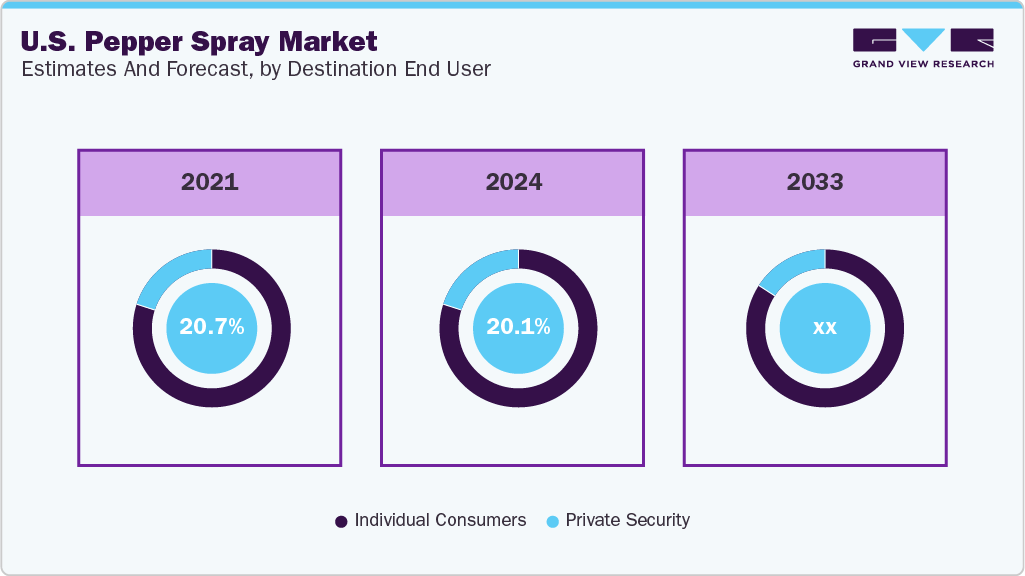
Pepper spray for individual consumers accounted for 79.8% of the revenue share in 2025. Personal safety concerns among potential users continue to support civilian demand for pepper spray. The latest U.S. National Crime Victimization Survey data show an estimated 560,890 rape/sexual-assault victimizations in 2024, equivalent to 2.0 victimizations per 1,000 people aged 12 and older. The FBI also recorded a 37.5 per 100,000 reported rape rate in 2024, while its latest Crime Data Explorer shows reported rape declining 19.1% during May 2025-April 2026.
 To learn more about this report, Download Free Sample Report
 The continued scale of sexual-violence exposure supports demand for readily accessible personal-protection products among U.S. individual consumers, particularly products designed for everyday carry.
Pepper spray for private security is projected to grow at a CAGR of 2.9% from 2026 to 2033, supported by a large installed workforce and formal requirements governing pepper-spray use. The U.S. had approximately 1.24 million security guards in 2024, according to the Bureau of Labor Statistics. In Texas, security officers carrying a chemical dispensing device must have approved training, with pepper-spray training tied to the state's Level III security training. This creates recurring professional demand for compliant OC products and training-related equipment among private security personnel.
Distribution Channel Insights
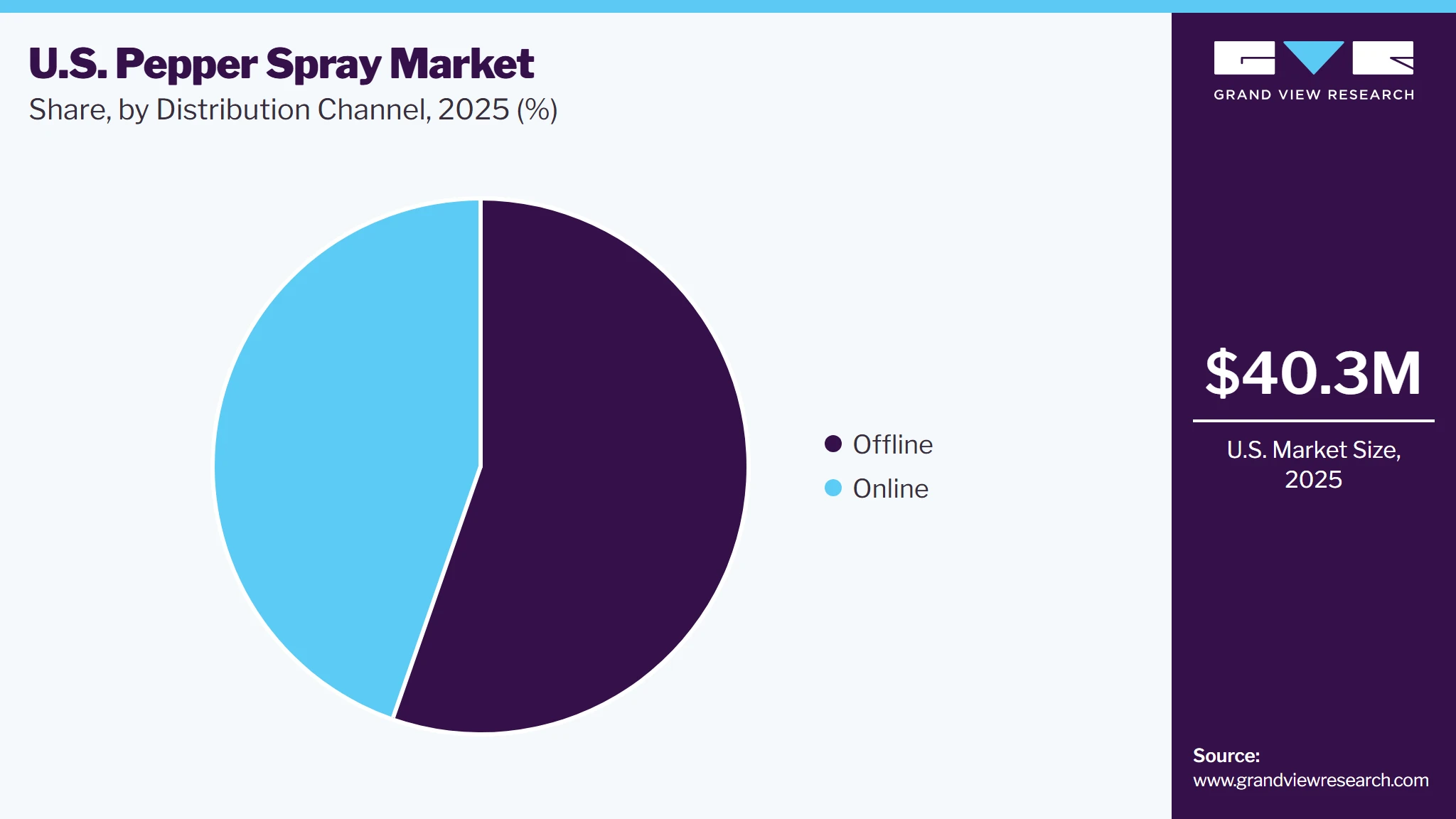
The sale of pepper sprays through offline retail and dealers accounted for a revenue share of 55.3% in 2025. Offline distribution remains crucial as pepper-spray sales can be affected by state-specific eligibility, product, and shipping requirements. This creates an advantage for retailers and dealers that can screen products according to local requirements and offer consumers products appropriate to their jurisdiction. The continued presence of security-supply retailers such as Security Pro USA in California provides an additional physical channel for personal-protection and security equipment, supporting the continued relevance of offline dealers in the U.S. pepper spray industry.
 To learn more about this report, Download Free Sample Report
 The sale of pepper sprays through online channels is projected to grow at a CAGR of 4.3% from 2026 to 2033. Growing e-commerce penetration is supported by direct-to-consumer availability and measurable online consumer activity. POM operates its own U.S. e-commerce site and allows direct-to-consumer pepper-spray shipments to 47 U.S. states and jurisdictions, with restrictions in states including New York and Massachusetts.
In addition, 2026 Amazon marketplace tracking by Flapen identified 52 sellers across 24 tracked pepper-spray products, with POM, SABRE, and Fox Labs among the leading brands; the tracked product niche generated an estimated 387,000 searches annually. The broad geographic availability of direct online purchasing and measurable marketplace activity support the continued expansion of online distribution in the U.S. pepper spray market.
Key U.S. Pepper Spray Company Insights
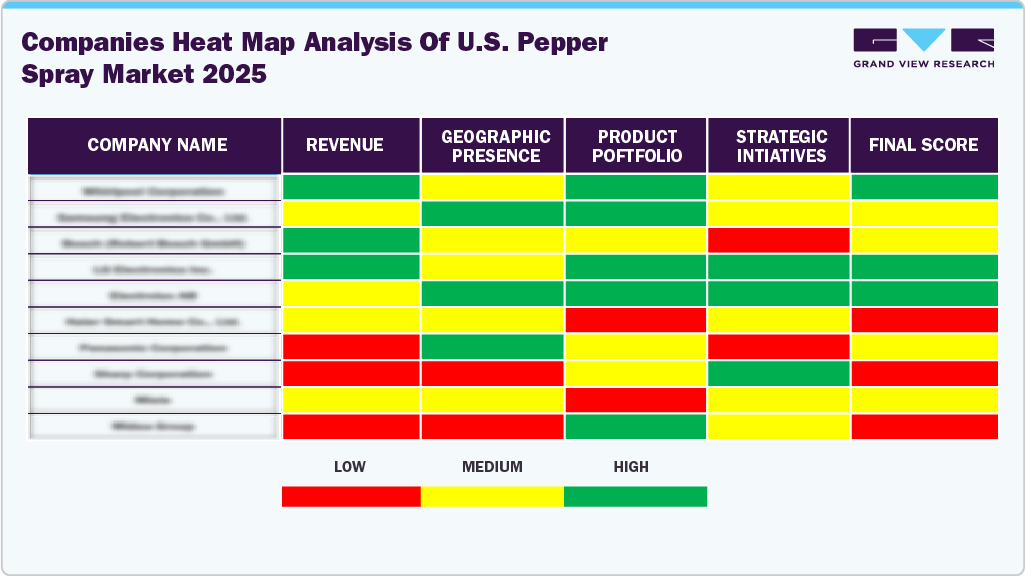
The U.S. market for pepper sprays is moderately fragmented, with competition distributed among established personal safety brands, specialized manufacturers, mixed-portfolio defense-spray suppliers, and smaller consumer-focused players.
The market includes manufacturers that supply qualifying OC/capsaicin-based human-defense pepper sprays to individual consumers and private security users, even when they also serve law enforcement, military, corrections, or other markets. Competition is shaped by brand strength, product breadth, pricing, formulation, portability, and retail and online distribution reach.
-
Established Personal Safety Brands: SABRE, Mace Security International, Fox Labs International, and POM Industries compete through strong consumer recognition, broad product portfolios, and extensive retail and online availability.
-
Established Multi-Market Manufacturers: Guardian Protective Devices, Zarc International, UDAP Industries, and Aerko International leverage manufacturing capabilities, formulation expertise, and experience serving multiple customer segments. Only qualifying human-defense OC/capsaicin products are included in the assessed market.
-
Consumer-Focused & Niche Players: Plegium, Guard Dog Security, Streetwise Security Products, and J&L Self Defense Products target specific consumer use cases through compact products, distinctive designs, and focused online or specialty distribution.
 To learn more about this report, Download Free Sample Report
 Key U.S. Pepper Spray Companies
-
SABRE (Security Equipment Corporation)
-
Mace Security International
-
Fox Labs International
-
POM Industries
-
Plegium
-
Guard Dog Security
-
Streetwise Security Products (Cutting Edge Products)
-
Guardian Protective Devices
-
Zarc International
-
J&L Self Defense Products
Competitive Benchmarking
Category
Operating Strategies
Competitive Edge
Key Challenges
Established Players (SABRE; Mace Security International; Fox Labs International; POM Industries; Guardian Protective Devices; Zarc International)
- Focus on OC/capsaicin-based human-defense sprays across stream, cone, foam, fog/mist, and gel formats, with broad coverage of U.S. offline retail, e-commerce, distributors, and specialty security channels. Emphasis on product reliability, portability, spray control, safety features, and compliance with varying state requirements.
- Strong U.S. brand recognition, established retail and distributor relationships, broad product portfolios, manufacturing/formulation expertise, and greater ability to serve both individual consumers and private-security users.
- Intense competition, price pressure, product commoditization, state-by-state regulatory differences, and the need to differentiate through spray pattern, format, formulation, usability, and product features.
Emerging Players (Plegium; Guard Dog Security; Streetwise Security Products; J&L Self Defense Products)
- Focus on compact everyday-carry products, differentiated designs, and targeted U.S. consumer use cases, with greater reliance on online, specialty, and direct channels. Emphasis on portability, ease of carry, product design, and consumer-oriented features.
- Agile product development, focused positioning, differentiated designs, specialized SKUs, and ability to address specific U.S. consumer needs and carry occasions.
- Lower brand recognition, narrower U.S. distribution, smaller operating scale, higher customer-acquisition costs, limited mainstream retail presence, and difficulty competing with established brands for retail shelf space and online visibility.
Recent Developments
-
In July 2026, SABRE launched the SABRE Smart Pepper Spray, combining pepper spray with connected GPS functionality and a companion mobile app. The product can share the user's live location and trigger emergency notifications, reflecting the industry's move toward connected personal safety products.
-
In June 2026, Arcus Hunting and Smith & Wesson launched a new line of personal-defense pepper sprays, including jogger-style, keychain, and belt-clip configurations. The range is designed for everyday personal protection and is being distributed through sporting goods and online retail channels.
-
In August 2025, SABRE launched the Quick Grip Pepper Spray with Practice Spray, featuring an index-finger loop for faster access and improved grip stability, along with an extended spray duration, UV marking dye, and a water-based practice canister. The launch specifically targeted student and campus personal safety use.
U.S. Pepper Spray Market Report Scope
Report Attribute
Details
Market size in 2025
USD 40.3 million
Estimated market size in 2026
USD 41.8 million
Projected market size by 2033
USD 53.9 million
Growth rate
CAGR of 3.7% from 2026 to 2033
Base year
2025
Actuals
2021 - 2024
Forecast period
2026 - 2033
Quantitative units
Revenue in USD million and CAGR from 2026 to 2033
Report coverage
Revenue forecast, company ranking, competitive landscape, growth factors, and trends
Segments covered
Product type, product format, end user, distribution channel
Key companies profiled
SABRE (Security Equipment Corporation); Mace Security International; Fox Labs International; POM Industries; Plegium; Guard Dog Security; Streetwise Security Products (Cutting Edge Products); Guardian Protective Devices; Zarc International; J&L Self Defense Product
Customization scope
Free report customization (equivalent up to 8 analysts’ working days) with purchase. Addition or alteration to country, regional & segment scope.
Pricing and purchase options
Avail customized purchase options to meet your exact research needs. Explore purchase options
U.S. Pepper Spray Market Report Segmentation
This report forecasts revenue growth at the country level and provides an analysis of the latest trends and opportunities in each sub-segment from 2026 to 2033. For this study, Grand View Research has segmented the U.S. pepper spray market report based on product type, product format, end user, and distribution channel:
-
Product Type Outlook (Revenue, USD Million, 2021 - 2033)
-
Stream
-
Cone / Forced Cone
-
Fog / Mist
-
Foam
-
Gel
-
-
Product Format Outlook (Revenue, USD Million, 2021 - 2033)
-
Keychain / Pocket
-
Compact Handheld
-
Standard Handheld
-
Large / Professional
-
-
End User Outlook (Revenue, USD Million, 2021 - 2033)
-
Individual Consumers
-
Private Security
-
-
Distribution Channel Outlook (Revenue, USD Million, 2021 - 2033)
-
Offline
-
Online
-
Research Methodology
The U.S. pepper spray market figures in this report are based on a proven research process that combines executive interviews with secondary research from proprietary databases, company filings, and recognized regulatory and institutional sources. Market size is built through value-chain sizing-reconciling supply-side and demand-side estimates-and triangulated with bottom-up and top-down approaches. Every estimate passes multiple levels of expert validation before publication, with each U.S. pepper spray segment quantified using the revenue-capture definitions in the table below.
Segment Definition
Segment - PRODUCT TYPE
Revenue capture definition
Stream
Revenue from OC/capsaicin-based pepper sprays that discharge the formulation in a narrow, directed stream designed for targeted human-to-human self-defense. Includes consumer and private-security products sold in aerosol/canister formats through offline, online, and direct channels.
Excludes non-OC sprays, animal-defense sprays, and products intended primarily for law enforcement, military, corrections, or other excluded institutional applications.Cone / Forced Cone
Revenue from OC/capsaicin-based pepper sprays that discharge the formulation in a broader cone-shaped pattern, including forced-cone designs engineered to provide wider coverage while remaining suitable for human-to-human self-defense. Includes civilian and private-security products.
Excludes animal-defense sprays, non-OC formulations, and products whose intended market is law enforcement, military, corrections, or other excluded institutional users.Fog / Mist
Revenue from OC/capsaicin-based pepper sprays that disperse the formulation as a fine aerosol, fog, or mist, creating a relatively broad area of coverage for human-to-human self-defense. Includes consumer and private-security products across applicable retail, online, and direct channels.
Excludes bear spray, dog spray, other animal repellents, non-OC sprays, and excluded government or institutional applications.Foam
Revenue from OC/capsaicin-based pepper sprays that discharge as a foam formulation, depositing the active agent onto the target while reducing airborne dispersion relative to fog/mist products. Includes civilian and private security human-defense products.
Excludes non-OC foam sprays, animal-defense products, and products intended for law enforcement, military, corrections, or other excluded institutional applications.Gel
Revenue from OC/capsaicin-based pepper sprays that use a gel-based formulation designed to produce a concentrated, adherent stream or pattern upon discharge for human-to-human self-defense. Includes consumer and private-security gel pepper sprays sold through qualifying channels.
Excludes non-OC gels, animal-defense sprays, and products intended primarily for law enforcement, military, corrections, or other excluded institutional applications.Estimation Model
Layer
Key Question
Description
Human-Defense Addressable Base Layer
Who forms the addressable user base?
Individuals and private-security personnel who may purchase or carry OC/capsaicin-based pepper spray for human-to-human self-defense, including consumers seeking personal protection and private security personnel requiring defensive spray as part of their duties.
Pepper Spray Demand Layer
Which users actually require or purchase pepper spray?
The addressable base is narrowed to users with a practical need, willingness, and propensity to purchase pepper spray for human-to-human defense, based on personal safety concerns, security requirements, carry behavior, regulatory accessibility, and replacement needs.
Purchase Profile Layer
What type of pepper spray is purchased, by whom, and through which channel?
The purchasing base is allocated across Individual Consumers and Private Security, then segmented by product type, product format, and distribution channel based on purchasing preferences.
Monetisation Layer
How much revenue is generated?
The estimated number of pepper spray units sold is converted into market revenue using average selling price, product-type mix, product-format mix, end-user pricing, channel-specific pricing, and replacement/purchase frequency assumptions.
Delivered Customizations
This report has been delivered with the following In-depth customizations
Client Request
Customization Delivered
Value Adds
Product × Format × End User Demand Mapping
Quantify demand across the U.S. civilian and private-security segments by product type, format, and end user.
Developed a U.S.-specific cross-segment demand model mapping Stream, Cone/Forced Cone, Fog/Mist, Foam, and Gel across Keychain/Pocket, Compact Handheld, Standard Handheld, and Large/Professional formats and Individual Consumers vs. Private Security, identifying the highest-demand configurations.
State-Level Regulatory Accessibility & Market Entry Assessment
Assess how U.S. state regulations affect the addressable market and commercial availability of pepper spray.
Mapped state-level requirements covering possession, purchase, sale, formulation, canister size, age restrictions, labeling, point of sale, and shipping, including requirements in states such as New York, Massachusetts, California, Michigan, and Texas, and assessed their impact on product accessibility.
Consumer Need × Competitor Offering Gap Analysis
Identify unmet consumer needs and competitive whitespace in the U.S. pepper spray market.
Benchmarked leading U.S. products against consumer purchase priorities including portability, range, spray control, safety mechanism, ease of carry, capacity, price, and format, using current U.S. product offerings and consumer-safety evaluations to identify gaps.
Frequently Asked Questions About This Report
The U.S. pepper spray market size was valued at USD 40.3 million in 2025 and is estimated at USD 41.8 million for 2026.
The global pepper spray market is expected to grow at a CAGR of 3.7% from 2026 to 2033, reaching USD 53.9 million.
Key factors driving the pepper spray market growth is supported by widespread consumer awareness of personal safety products, established domestic manufacturers and distribution networks, strong availability across offline and online retail channels, and continued demand for compact, non-lethal self-defense products.
The stream pepper spray led with a 43.4% revenue share in 2025, while gel pepper spray is the fastest-growing segment.
Gel pepper spray is projected to grow at a CAGR of 5.9% from 2026 to 2033.
Pepper spray for individual consumers accounted for 79.7% revenue share in 2025, and is expected to grow be the fastest growing segment.
The sale of pepper sprays through offline retail and dealers accounted for a revenue share of 55.3% in 2025 and is the fastest-growing distribution channel.
Key players include SABRE (Security Equipment Corporation); Mace Security International; Fox Labs International; POM Industries; Plegium; Guard Dog Security; Streetwise Security Products (Cutting Edge Products); Guardian Protective Devices; Zarc International; J&L Self Defense Product
Keychain/pocket pepper spray is projected to grow at a CAGR of 4.3% from 2026 to 2033
About the Author(s)
Clothing, Footwear & Accessories Research Team
Consumer Goods · Clothing, Footwear & AccessoriesThis report was authored by the clothing, footwear & accessories research team at Grand View Research - comprising two research analysts, one senior research analyst, and one industry expert - with specialized expertise in the clothing, footwear & accessories segment of the consumer goods industry. All findings are based on proprietary consumer goods databases, executive interviews, and regulatory analysis, subject to internal peer review prior to publication.
Last Updated:
Speak to Analyst

Customize this report to your needs - add regions, segments, or data points, with 20% free customization.
Or view our licence options:


ISO 9001:2015 & 27001:2022 Certified
We are GDPR and CCPA compliant! Your transaction & personal information is safe and secure. For more details, please read our privacy policy.


