
- Home
- »
- Electronic & Electrical
- »
-
U.S. Residential Boiler Market Size & Share Report, 2033GVR Report cover

U.S. Residential Boiler Market (2026 - 2033)
Size, Share & Trends Analysis Report By Type (Combi Boilers, Conventional Boilers), By Fuel Type (Gas Boilers, Electric Boilers), By Technology, By Installation Type, By Residential Property, By Application, By Capacity, And Segment Forecasts
Market Size, 2025
$2.4BMarket Estimate, 2026
$2.6BMarket Forecast, 2033
$3.7BCAGR, 2026–2033
5.6%U.S. Residential Boiler Market Summary
The U.S. residential boiler market size was valued at USD 2.4 billion in 2025 and is projected to grow from USD 2.6 billion in 2026 to USD 3.7 billion by 2033, at a CAGR of 5.6% from 2026 to 2033. Market growth is primarily supported by the replacement of aging residential heating systems, continued demand for hydronic heating in the Northeast and Midwest, increasing adoption of high-efficiency condensing technologies, and the need for integrated space-heating and domestic hot-water solutions.
Key Market Trends & Insights
- By type: The conventional boilers segment held the largest market share of 46.2% in 2025.
- By fuel type: The gas boilers segment held the largest market share of 75.7% in 2025.
- By technology: Condensing boilers held the largest market share of 55.2% in 2025
- By installation type: Floor-standing boilers held the largest market share of 58.2% in 2025.
- By residential property: Single-family homes held the largest market share of 62.6% in 2025.
Market Size & Forecast
- Market Size in 2025: USD 2.4 Billion
- Estimated Market Size in 2026: USD 2.6 Billion
- Projected Market Size by 2033: USD 3.7 Billion
- CAGR (2026-2033): 5.6%
Prism AI by Grand View Research Free to tryAsk a question about the U.S. residential boiler marketTry asking✓Every figure cited from GVR research Prefer the report? Download free sample →
At the same time, the U.S. residential boiler industry is undergoing a gradual technology transition as homeowners and contractors increasingly evaluate energy efficiency, electrification, smart controls, and lower-emission heating alternatives. Gas boilers remain the dominant fuel category, while electric boilers are expanding at a faster pace. The market is also shifting toward wall-mounted, condensing, and lower-capacity systems, although floor-standing and conventional boilers continue to represent a substantial installed-base replacement opportunity.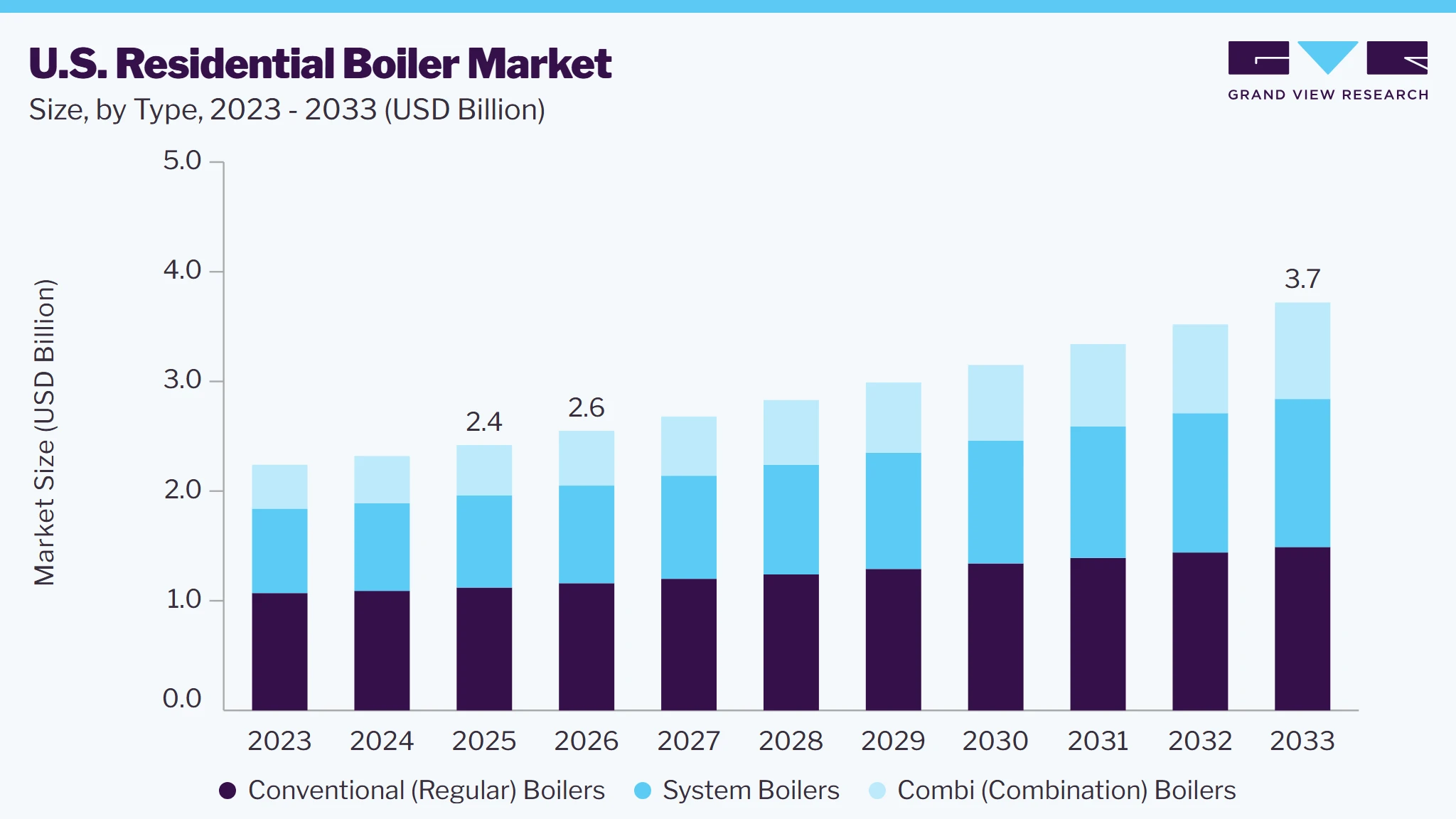 Source: Grand View Research, IR Documents, Primary Interviews, Paid DatabasesTo learn more about this report,
 Download Free Sample Report
The U.S. residential boiler market is increasingly shaped by energy efficiency, replacement demand, and tightening building performance requirements, particularly in mature heating markets in Europe. The European Commission estimates that central hydronic heating systems supplied around 40% of EU27 space-heating demand in 2020, while the average efficiency of boilers sold that year was approximately 82% versus 64% for the installed boiler stock, highlighting a substantial efficiency gap and long-term replacement opportunity. The Commission also estimates that Ecodesign and Energy Labelling measures for central-heating boilers could deliver 306 TWh of primary-energy savings by 2030 and reduce consumer expenditure by around €14 billion. This is accelerating the adoption of condensing boilers, advanced modulation, improved heat exchangers, and intelligent controls, with companies such as Viessmann, Vaillant, Bosch Home Comfort, Baxi, and Ariston increasingly positioning high-efficiency systems around lifetime operating economics rather than upfront purchase price.
Technology differentiation is shifting toward connected and integrated heating systems. Manufacturers are incorporating smart thermostats, weather compensation, remote monitoring, diagnostics, and automated scheduling to improve real-world system performance and simplify ownership. For example, Bosch Home Comfort's Greenstar platform combines condensing technology with modulation and connected controls, while Vaillant's senso ecosystem and Viessmann's ViCare platform provide digital monitoring and control capabilities for compatible heating systems. This transition is strategically important because field performance can differ materially from laboratory ratings; European Commission-supported research has indicated that seasonal efficiencies measured in real installations can be 15–20% below optimized demonstration conditions, making system design, installation quality, and controls increasingly important. Consequently, premiumization is moving beyond boiler hardware toward measurable benefits such as lower fuel consumption, remote diagnostics, maintenance visibility, and optimized heating schedules.
Electrification and the transition toward lower-carbon residential heating are creating a structural competitive challenge for conventional gas boilers. While gas remains deeply embedded in existing residential heating infrastructure, manufacturers are expanding into heat pumps, electric heating, hybrid systems, and broader home-energy solutions. Vaillant and Viessmann, for instance, have expanded their portfolios beyond gas boilers into heat pumps and connected energy management systems, while Bosch Home Comfort operates across boilers, heat pumps, water heating, and smart controls. This diversification allows manufacturers to participate in multiple technology pathways as household heating systems evolve. At the same time, compact wall-mounted and combi configurations remain commercially important in apartments and space-constrained homes, with Worcester Bosch, Baxi, Vaillant, and Ariston offering compact systems that integrate space heating and domestic hot water.
Competitive advantage is consequently shifting from standalone equipment toward complete heating ecosystems and service capabilities. The large installed base of aging boilers creates recurring replacement demand, making installer relationships, spare parts availability, warranty coverage, technical training, and after-sales support important purchase considerations alongside efficiency and price. Manufacturers such as BDR Thermea, Bosch Home Comfort, Vaillant, Viessmann, Ariston, and Rinnai are therefore competing across product efficiency, installation flexibility, digital controls, emissions performance, and service networks. The strategic direction is toward boilers that can operate within a broader residential energy system, enabling manufacturers to retain customers as homes increasingly adopt connected controls, renewable electricity, heat pumps, thermal storage, and other lower-carbon technologies.
Market Dynamics
Replacement of aging heating equipment remains a core demand driver in the U.S. residential boiler market, particularly in the Northeast and Midwest, where hydronic heating systems have a long-established installed base. The U.S. Department of Energy defines residential boilers as systems below 300,000 Btu/hour used as the principal residential heating source and notes that manufacturers have been subject to federal boiler efficiency standards since 1987. The replacement opportunity is strengthened by the efficiency gap between older equipment and current products: ENERGY STAR-certified gas boilers must achieve at least 90% AFUE, while certified models currently available in the U.S. reach up to 97% AFUE. ENERGY STAR estimates that a certified gas boiler can save approximately $780 over its lifetime compared with a conventional alternative. This is encouraging manufacturers such as Navien, U.S. Boiler Company, Bosch Home Comfort, Weil-McLain, and A. O. Smith to emphasize condensing technology, modulation, and controls in replacement products. For example, U.S. Boiler's Burnham-branded Aspen condensing boiler appears in the ENERGY STAR database with a 96% AFUE rating, illustrating how manufacturers are targeting replacement consumers through efficiency-led upgrades.
Electrification and heat-pump adoption represent the most significant structural restraint on long-term U.S. boiler demand. Unlike boilers, heat pumps can provide both heating and cooling, making them more attractive to homeowners undertaking whole-home HVAC replacements. The competitive pressure is particularly relevant for new construction and major renovations, where homeowners have greater flexibility to select an alternative heating architecture. However, the impact is not uniform across the U.S. because established hydronic systems, cold-weather requirements, electrical infrastructure, and installation costs can make a direct transition to heat pumps less attractive in existing homes. The restraint, therefore, affects new installations more directly than replacement demand. This distinction is important for companies such as Navien, Bosch Home Comfort, and Carrier, which increasingly operate across both combustion heating and heat-pump technologies. Bosch Home Comfort, for instance, reported that its 2025 strategy involved gaining market share in heat pumps while also expanding its U.S. HVAC presence, demonstrating how major heating manufacturers are diversifying beyond conventional boiler technologies.
The large installed base of radiators, baseboards, and hydronic distribution systems creates a specific opportunity for high-efficiency boilers. Homeowners replacing an older boiler can upgrade the heat-generation equipment while retaining much of the existing distribution infrastructure, potentially making the project less disruptive than converting an entire residence to a different heating architecture. Federal energy-efficiency analysis illustrates the economic case: DOE's FEMP comparison assumes a 20-year boiler life and estimates lifetime energy costs of approximately $11,589 for an 84% AFUE gas boiler versus $9,765 for a 97% AFUE model, representing potential lifetime energy-cost savings of approximately $1,824 for the higher-efficiency system under its assumptions. This supports the positioning used by companies such as Navien, Bosch Home Comfort, Weil-McLain, and U.S. Boiler, which offer high-efficiency condensing products targeted at residential replacement applications. Bosch's Greenstar Combi documentation, for example, shows configurations incorporating a gas condensing boiler, multiple heating zones, domestic hot water, and outdoor-temperature sensing, demonstrating how manufacturers are expanding the value proposition beyond basic heat generation.
Consumer Insights
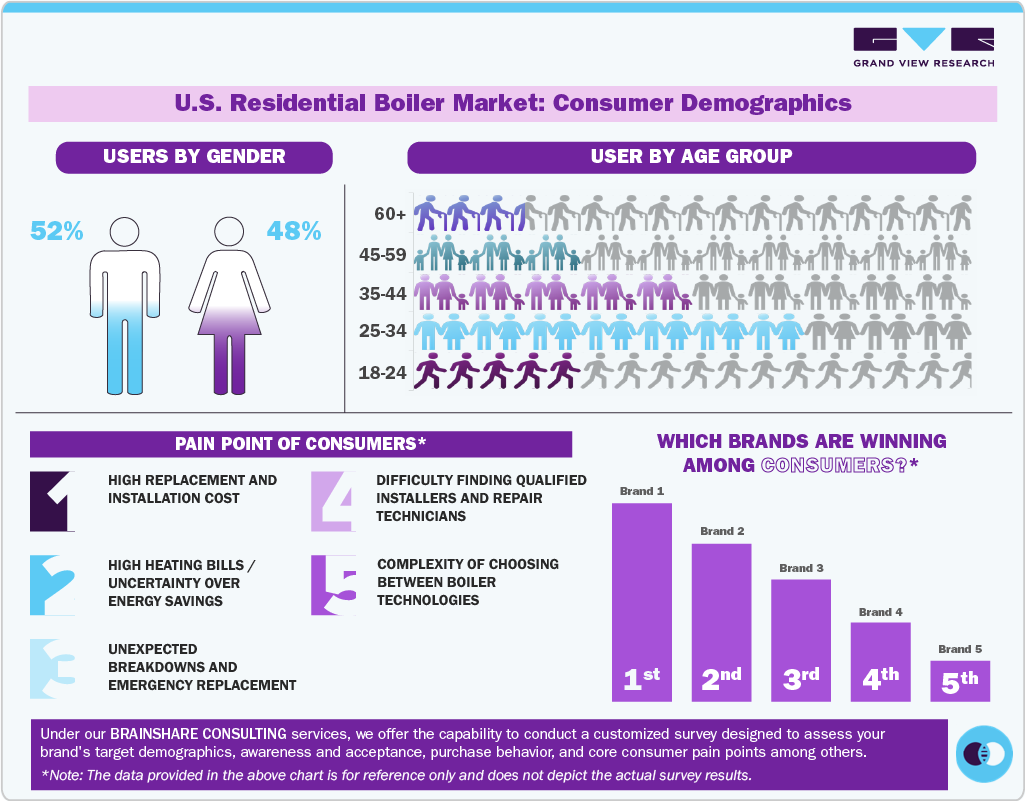
The consumer behavior in the U.S. residential boilers market is primarily shaped by replacement needs, heating reliability, energy efficiency, installation economics, and contractor recommendations. Unlike discretionary residential appliances, boilers are essential heating equipment with relatively long replacement cycles, meaning purchase decisions are often triggered by equipment failure, age, repeated repairs, or rising operating costs. At the same time, growing awareness of energy efficiency and household electrification is influencing technology choices, particularly among homeowners considering major heating-system upgrades. Regional differences in climate, housing stock, fuel availability, and existing hydronic infrastructure further create distinct consumer preferences across the U.S. market.
 To learn more about this report, Download Free Sample Report
-
Replacement-driven purchasing: Residential boiler purchases in the U.S. are predominantly need-based rather than discretionary. Homeowners generally consider a replacement when an existing boiler becomes unreliable, requires repeated repairs, reaches the end of its useful life, or results in rising energy costs. HVAC homeowner research indicates that 80% of homeowners consider replacement when equipment is still operating but has required multiple repairs, while 76% consider equipment age a trigger. This makes equipment reliability, lifespan, and maintenance history important determinants of boiler replacement decisions.
-
Growing importance of energy efficiency: Energy efficiency is becoming an increasingly important consideration for U.S. homeowners, particularly as heating costs remain a significant component of household energy expenditure. Research cited by ENERGY STAR found that 67% of surveyed homeowners indicated they would or definitely would purchase an energy-efficient heating system during their next replacement, compared with lower historical adoption. For residential boilers, this supports growing consumer interest in high-efficiency and condensing models that can reduce fuel consumption, although higher upfront equipment and installation costs can limit adoption.
-
Strong contractor influence: Boiler purchases are highly influenced by HVAC contractors, plumbers, and heating specialists because consumers often have limited technical knowledge regarding boiler sizing, AFUE efficiency, venting requirements, fuel compatibility, and system configuration. Consequently, homeowners frequently depend on installers to recommend the appropriate boiler type and brand. This makes contractor relationships, product availability, installation simplicity, technical support, warranty coverage, and after-sales service particularly important competitive factors for manufacturers in the U.S. market.
-
Existing infrastructure influences brand and technology choice: Unlike many household appliances, boiler replacement is strongly constrained by the home's existing heating infrastructure. Consumers must consider existing radiators or baseboards, piping, fuel availability, venting configuration, electrical requirements, and the overall hydronic heating system. As a result, homeowners with established boiler-based heating systems often prefer a direct boiler replacement to a complete heating-system conversion. This creates replacement inertia and supports continued demand for gas and other boiler technologies, particularly in regions with established hydronic heating systems.
-
Regional differences are becoming increasingly important: Consumer preferences vary significantly across U.S. regions because of differences in climate, housing stock, energy prices, existing heating infrastructure, and electrification policies. The Northeast and Midwest have relatively strong concentrations of homes using hydronic heating, making reliability, replacement compatibility, and cold-weather performance important purchasing considerations. Meanwhile, consumer openness to electrification and heat-pump technologies is increasing in several other regions. A U.S. household energy-technology study covering 10,000 households found meaningful regional differences in adoption and preferences for energy technologies, indicating that boiler manufacturers need differentiated strategies by geography.
-
Reliability and total cost of ownership remain decisive: Even with growing environmental and efficiency considerations, consumers primarily want dependable whole-home heating and predictable ownership costs. Boiler failure can affect the heating of the entire residence, making reliability and quick replacement particularly important. Consumers therefore evaluate boilers based on a combination of initial purchase and installation cost, expected energy savings, service requirements, warranty, operating life, contractor recommendation, and brand reputation. This creates an opportunity for manufacturers to position high-efficiency boilers not simply as energy-efficient products, but as long-life, low-maintenance heating solutions with measurable lifetime cost savings.
Analyst Perspective
The U.S. residential boiler market is being shaped by replacement-driven demand, tighter efficiency standards, and the aging installed base of hydronic heating systems, particularly across the Northeast and Midwest. Condensing gas boilers are gaining traction as homeowners prioritize lower fuel consumption and compliance with higher efficiency requirements, while electric boilers remain a niche option where electrification is practical. Manufacturers such as A. O. Smith Corporation, Navien, Inc., Carrier Corporation, and Robert Bosch GmbH are competing through high-efficiency systems, compact designs, controls integration, and contractor-focused distribution. Retrofit economics and installer availability remain critical purchasing factors.
Type Insights
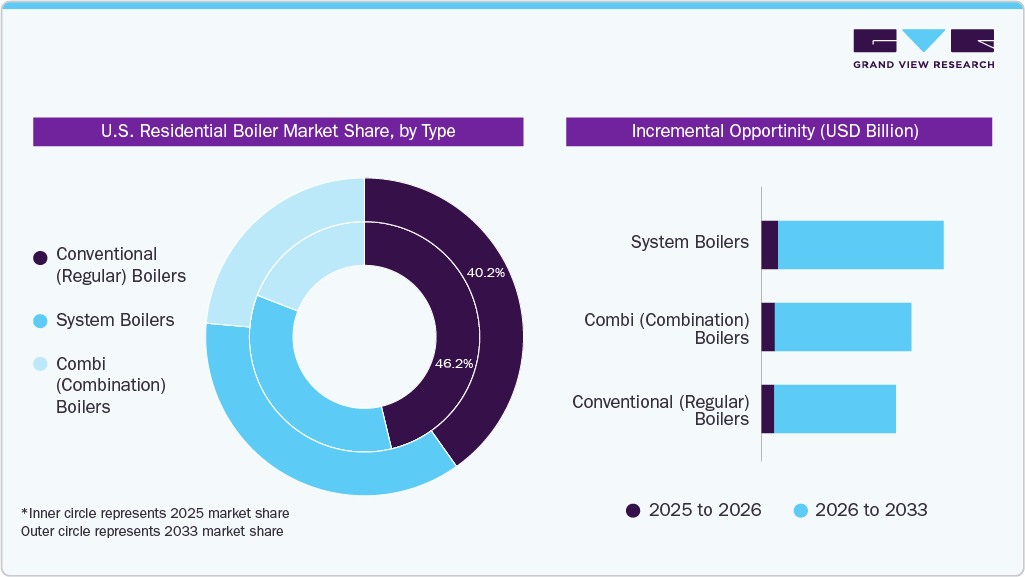
The conventional (regular) boilers segment dominated the U.S. residential boiler industry, accounting for the largest revenue share of 46.2% in 2025, making them the leading product type in the U.S. residential boiler market. Their dominance is supported by the large installed base of traditional hydronic heating systems across existing U.S. homes, particularly in colder regions where boiler-based space heating remains well established. Conventional boilers are also relevant for replacement demand because homeowners can replace aging equipment with comparable systems without requiring major changes to existing heating infrastructure. Their compatibility with established radiators, baseboard heating systems, and other hydronic distribution networks further supports demand. However, the segment is expected to grow relatively slowly as efficiency regulations, energy-cost considerations, and consumer preference for higher-efficiency equipment increasingly shift demand toward condensing and combination technologies.
 To learn more about this report, Download Free Sample Report
The combi (combination) boilers segment is projected to grow at the fastest CAGR of 8.4% during the forecast period, compared with approximately 5.6% for the overall U.S. residential boiler market. Their growth is supported by the ability to provide space heating and domestic hot water from a single compact system, reducing equipment requirements and installation footprint. Combi boilers are particularly attractive for smaller homes and households seeking to consolidate heating and hot-water equipment. Their compact configuration also supports wall-mounted installations, while improvements in modulation, controls, and energy efficiency are strengthening their appeal in replacement and renovation projects.
Fuel Type Insights
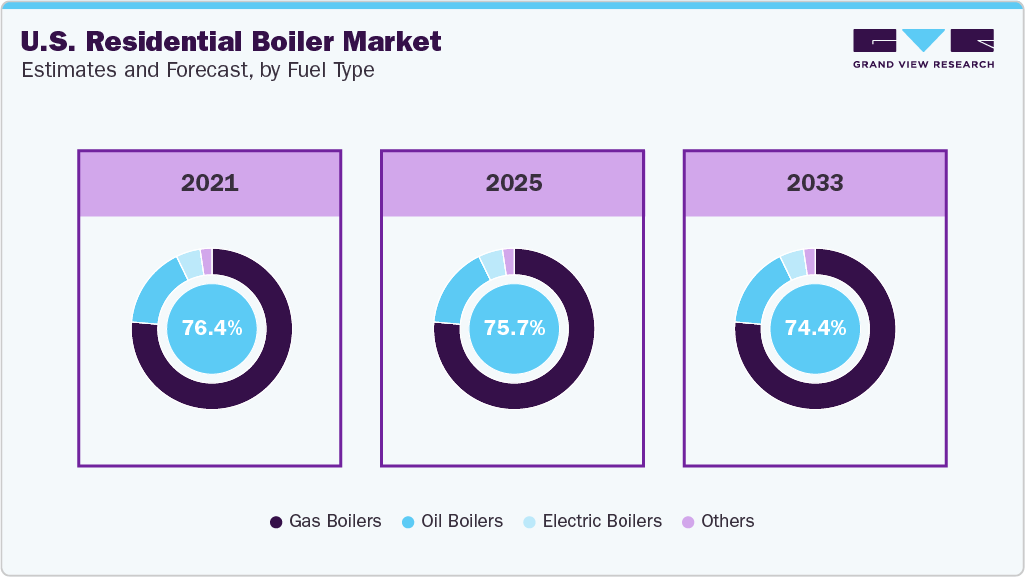
The gas boilers segment dominated the U.S. residential boiler industry, accounting for the largest revenue share of 75.7% in 2025. This leadership reflects the extensive availability of natural-gas distribution infrastructure across major residential heating markets, particularly in the Northeast and Midwest, where hydronic heating systems have a long-established presence. Gas boilers also benefit from their ability to provide relatively high heating output while supporting established residential heating configurations. The large installed base of gas-fired systems creates a substantial replacement market as older boilers reach the end of their operating lives. In addition, homeowners replacing existing gas systems can often retain much of the existing fuel and distribution infrastructure, reducing the disruption associated with switching to another heating technology.
 To learn more about this report, Download Free Sample Report
The electric boilers are projected to grow at the fastest CAGR of 10.2% over the forecast period. Their expansion is supported by increasing electrification of residential heating, the gradual decarbonization of building energy systems, and the ability to integrate electric heating with increasingly renewable electricity generation. Electric boilers can also provide an alternative in locations where natural-gas availability is limited or where homeowners seek to reduce direct fossil-fuel consumption. Their relatively simple mechanical configuration and compatibility with hydronic heating systems further support adoption. Nevertheless, gas boilers are expected to remain dominant because of their substantially larger installed base, established fuel infrastructure, and continued relevance in high-heating-load residential applications.
Technology Insights
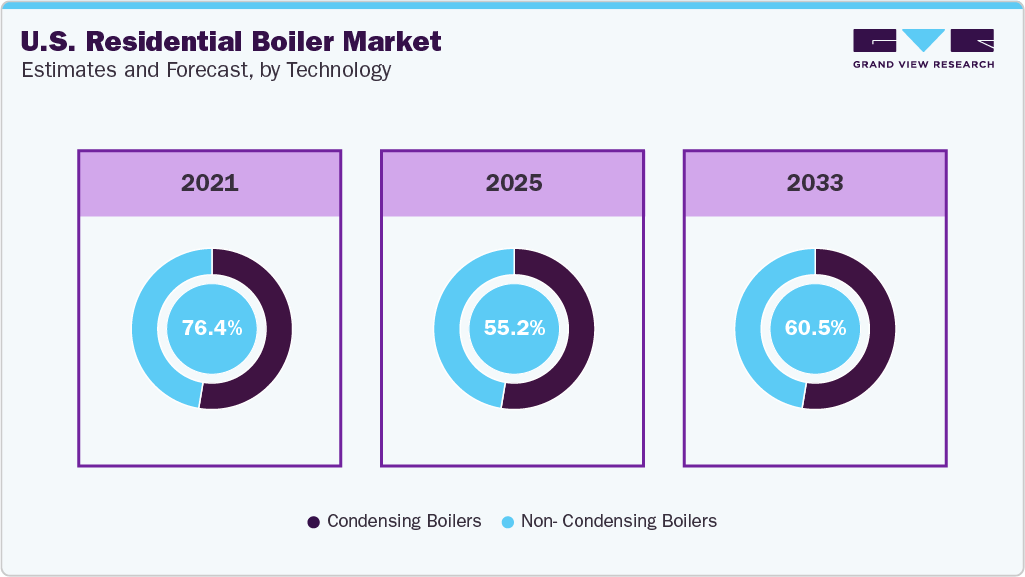
Condensing boilers accounted for the largest revenue share of 55.2% in 2025, making them the leading technology in the U.S. residential boiler market. Their position is supported by higher thermal efficiency than conventional non-condensing systems, allowing homeowners to obtain more useful heat from the same amount of fuel. This efficiency advantage is particularly relevant in replacement applications, where households seek to reduce energy consumption and operating costs. Condensing technology is also benefiting from the continued tightening of energy-efficiency requirements and the broader movement toward high-efficiency residential heating equipment.
 To learn more about this report, Download Free Sample Report
The condensing boilers segment is projected to grow at the fastest CAGR of 6.8% CAGR during the forecast period. Their faster expansion is expected to come primarily from the replacement of older, less-efficient equipment and greater consumer awareness of lifetime operating costs. Non-condensing boilers will continue to serve a substantial installed base, particularly where replacement projects prioritize compatibility and lower upfront costs, but their relative position is expected to weaken as high-efficiency systems become increasingly standard in new installations and major residential renovations.
Installation Type Insights
Floor-standing boilers accounted for the largest revenue share of 58.2% in 2025, making them the dominant installation configuration in the U.S. residential boiler industry. Their leadership is associated with their suitability for higher-capacity heating applications, established use in detached homes, and compatibility with traditional boiler-room or utility-room configurations. Floor-standing systems are particularly relevant in replacement markets, where homeowners replace existing equipment with similar configurations and can use existing mechanical room space. Their larger physical footprint is less restrictive in single-family homes with dedicated utility areas, while their ability to accommodate higher heating capacities supports their use in larger residential properties.
The wall-mounted boilers segment is projected to grow at the fastest CAGR of 7.4% during the forecast period, significantly above the growth rate of floor-standing systems. Their compact footprint makes them attractive for homes with limited utility space, while their compatibility with combi and other high-efficiency boiler configurations strengthens their adoption potential. Wall-mounted designs can also simplify installation in renovation projects by reducing floor-space requirements.
Residential Property Insights
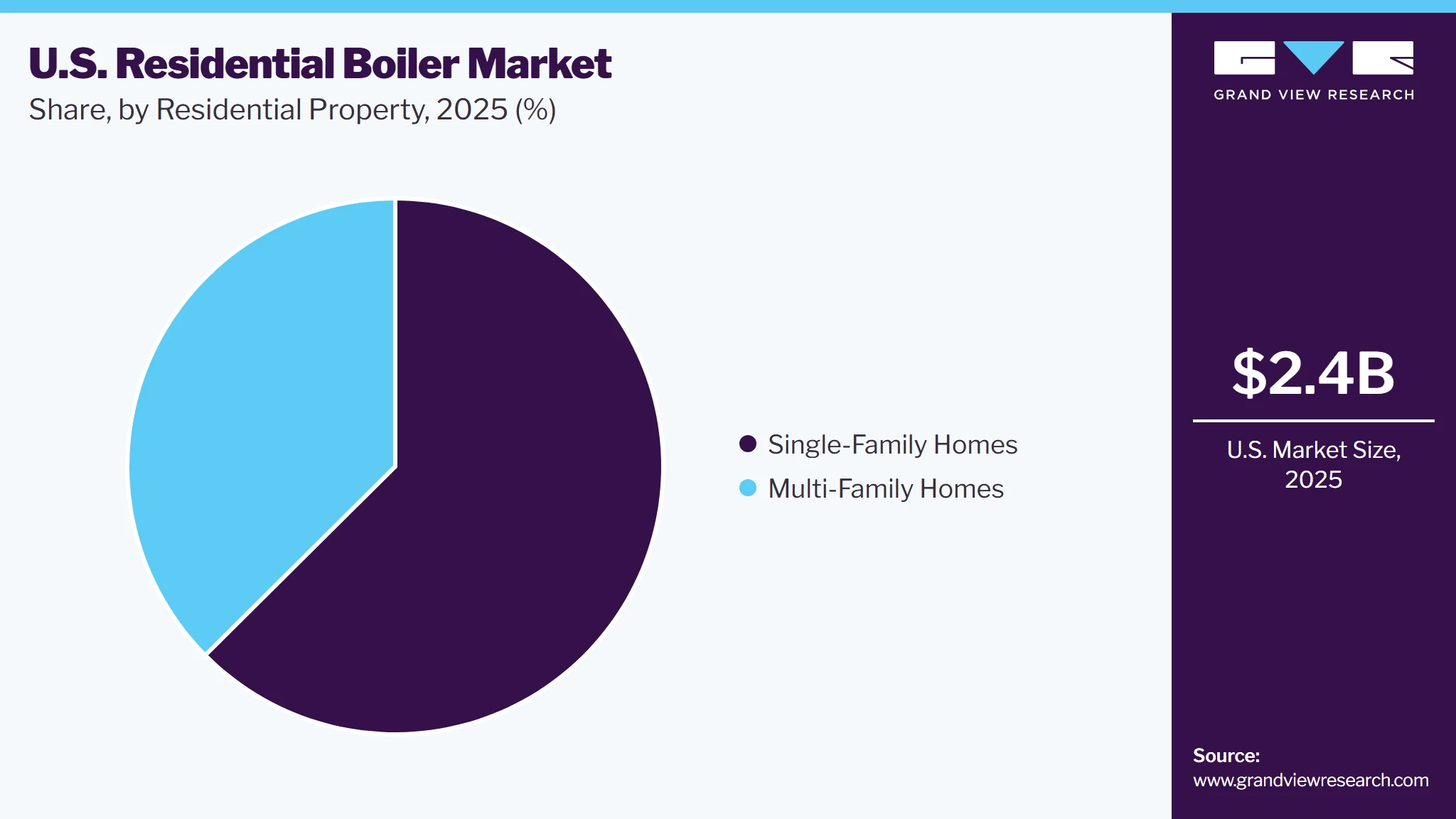
Single-family homes accounted for the largest revenue share of 62.6% in 2025, making them the primary residential property type for boiler demand in the U.S. The segment benefits from the large installed base of detached and single-family residences that use hydronic heating, particularly in colder northern states. Homeowners in these properties have greater control over heating-system replacement decisions and may invest in higher-efficiency boilers, smart controls, and upgraded hydronic components when existing equipment reaches the end of its service life. Single-family homes also generally offer sufficient mechanical and utility space to accommodate traditional floor-standing boilers, supporting continued demand for conventional residential configurations.
 To learn more about this report, Download Free Sample Report
The multi-family homes segment is projected to grow at the fastest CAGR of 7.0% during the forecast period. Growth is supported by continued demand for efficient centralized and individual heating solutions across apartment buildings, condominiums, and other multi-unit residential properties. Property owners and managers have stronger incentives to reduce energy consumption and operating expenses across multiple dwelling units, increasing the attractiveness of high-efficiency boilers and modern control systems. Multi-family developments can also benefit from compact, wall-mounted, modular boiler configurations when equipment-room space is constrained. As older multifamily housing stock undergoes renovation and heating systems are modernized, this segment is expected to expand faster than the single-family market.
Application Insights
The space heating segment dominated the U.S. residential boiler industry, accounting for the largest revenue share of 55.2% in 2025. Boiler systems remain particularly relevant for whole-home heating in colder regions, where hydronic distribution through radiators, baseboards, and radiant systems provides consistent heating throughout the residence. Replacement demand from aging heating equipment further supports this application, as homeowners generally prioritize maintaining reliable space-heating capability when replacing existing boilers. The established hydronic heating infrastructure also reduces the need for major changes to the distribution system during boiler replacement.
The space heating + domestic hot water boiler segment is projected to grow at the fastest CAGR of 7.3% over the forecast period. The segment growth is driven by increasing consumer interest in integrated heating solutions that can serve multiple household needs through a single system. Combination and system-boiler configurations can provide greater equipment integration while reducing the need for separate heating and hot-water equipment. This application is particularly relevant when homeowners have limited utility space or are undertaking broader heating system modernization. The segment is also supported by demand for higher-efficiency equipment that can optimize both space heating and hot-water production.
Capacity Insights
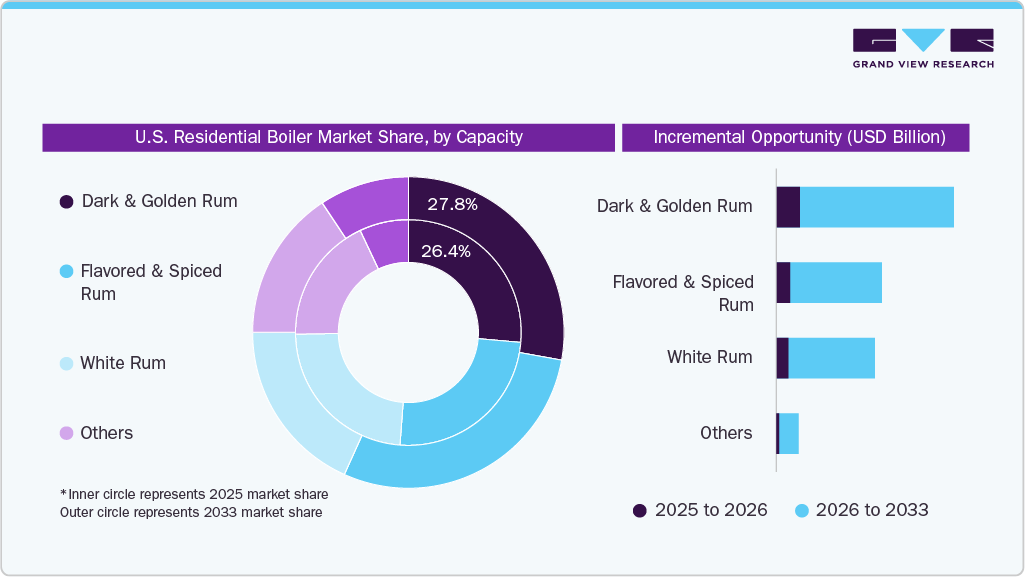
Boilers with a capacity of 30–40 kW accounted for the largest revenue share of 26.4% in 2025, making this the leading capacity segment in the U.S. residential boiler market. The segment provides a practical balance between heating output and equipment size and is suitable for a broad range of medium-to-large residential properties. Its relatively broad applicability allows manufacturers to offer multiple configurations across conventional, system, condensing, and other boiler technologies. The 30–40 kW range is therefore positioned between lower-capacity systems designed for compact homes and higher-capacity equipment intended for larger residences or properties with greater heating loads.
 To learn more about this report, Download Free Sample Report
Boilers with a capacity below 20 kW are projected to grow at the fastest CAGR of 9.3% during the forecast period. The rapid expansion of this segment is driven by the increasing demand for compact, energy-efficient heating systems in smaller residences, renovated properties, and space-constrained installations. Lower-capacity boilers can also complement the trend toward better-insulated homes, where reduced building heat loads require less installed heating capacity. The segment is further aligned with the growing adoption of compact wall-mounted and combination boilers, which can provide adequate heating for smaller households while minimizing equipment footprint and energy consumption.
Key U.S. Residential Boiler Company Insights
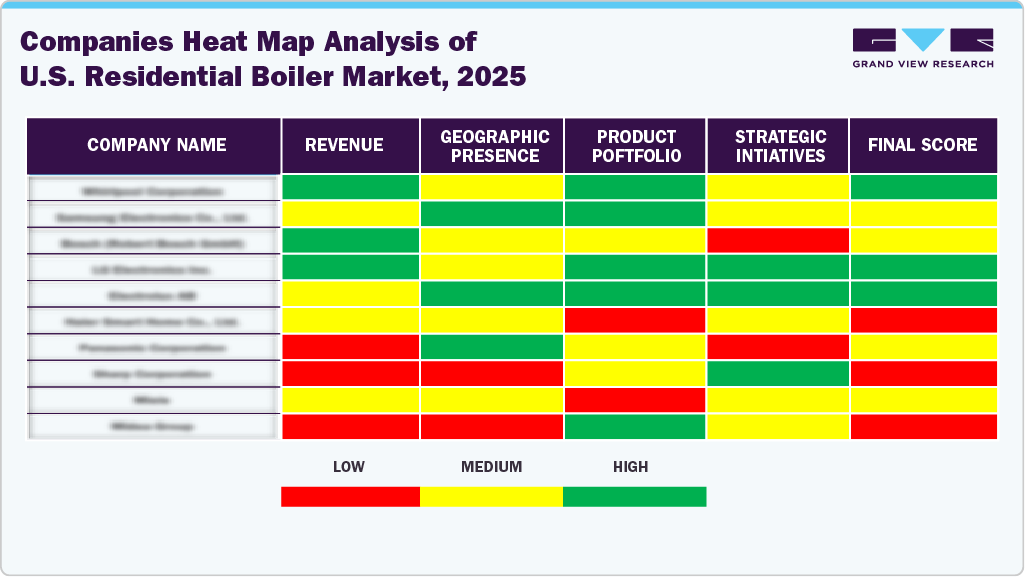
The U.S. residential boilers market is moderately fragmented, with competition distributed among established hydronic-heating manufacturers, high-efficiency boiler specialists, and broader HVAC/heating companies. Unlike highly consolidated HVAC categories, no single manufacturer appears to control a dominant share of U.S. residential boiler sales. Competitive positioning is shaped by boiler efficiency, condensing technology, fuel compatibility, product reliability, installer familiarity, distributor coverage, replacement compatibility, controls, warranty support, and availability of service parts. The competitive landscape is also bifurcated between established cast-iron and oil/gas boiler brands serving the large installed base and newer high-efficiency manufacturers targeting condensing and wall-hung replacements.
-
Leading U.S. Residential Boiler Manufacturers: Companies such as Navien, Weil-McLain, U.S. Boiler Company, Bosch Thermotechnology, A. O. Smith/Lochinvar, BDR Thermea, PB Heat (Peerless), Slant/Fin, and Viessmann form the principal competitive group. These companies benefit from established contractor relationships, distributor networks, broad residential product portfolios, and extensive installed bases. Navien has developed a particularly strong position in wall-hung condensing boilers, while Weil-McLain, U.S. Boiler, and Peerless maintain significant exposure to conventional cast-iron, gas, oil, and steam applications.
-
High-Efficiency & Technology-Focused Players: Navien, Bosch, Viessmann, BDR Thermea, and Lochinvar compete strongly in high-efficiency condensing and wall-mounted systems. Product differentiation increasingly centers on AFUE ratings, compact installation, modulation, integrated controls, domestic hot water integration, and reduced operating costs. Navien's NHB/NFB condensing boilers and NCB/NFC combination systems exemplify the shift toward compact high-efficiency equipment, while Bosch and Viessmann compete through premium engineering, controls, and system integration.
-
Established Hydronic & Replacement Specialists: Weil-McLain, U.S. Boiler Company, PB Heat and Slant/Fin retain an important competitive advantage through their large installed bases and contractor familiarity. Their portfolios continue to cover conventional gas, oil, cast iron, steam, and hydronic applications, as well as newer high-efficiency products. This is strategically important because a substantial portion of U.S. residential boiler demand is replacement-driven, allowing established brands to benefit from installer preference, familiarity with existing systems, replacement compatibility, and parts availability rather than competing solely on new technology.
-
Regional & Broader HVAC Competition: The market also includes companies such as Carrier and A. O. Smith that can leverage broader heating, HVAC, and water-heating portfolios. Carrier's position provides access to established HVAC distribution and contractor channels, while A. O. Smith's acquisition and development of Lochinvar have strengthened its exposure to high-efficiency hydronic heating. BDR Thermea and Bosch similarly benefit from international heating technology capabilities and broader product portfolios. This creates competitive pressure on specialist manufacturers as boiler purchasing increasingly becomes integrated with wider residential heating-system decisions.
-
Market Share is moderately consolidated: Company-level U.S. residential boiler shares should be interpreted cautiously because manufacturers generally do not separately disclose U.S. residential boiler revenue or unit sales. Public company reporting frequently combines residential and commercial boilers, water heaters, HVAC equipment, or broader heating businesses. Available industry evidence indicates that the leading manufacturers collectively account for a substantial portion of the market, but the remaining share is distributed across specialist manufacturers, regional suppliers, and established brands with strong local contractor relationships. Navien's reported leadership in North American wall-hung boilers does not translate directly into an equivalent share of the total U.S. residential boiler market because conventional floor-standing and replacement boilers remain important.
-
Installer & Distributor Networks as a Competitive Moat: Contractor relationships are particularly important in the U.S. boiler market because installation, commissioning, maintenance, and replacement require specialized hydronic expertise. Manufacturers with strong wholesale-distributor coverage and trained contractor networks, therefore, possess an advantage in securing replacement demand. The availability of replacement parts, technical support, training programs, warranty coverage, and local service capabilities can materially influence brand selection, particularly when homeowners rely on contractors to specify the replacement system.
-
Condensing Technology & Efficiency as Key Differentiators: Competition is increasingly shifting toward high-efficiency condensing boilers, particularly in replacement applications where homeowners seek lower fuel consumption and improved system performance. Manufacturers are differentiating through higher AFUE ratings, modulating burners, variable-speed pumps, outdoor-reset controls, integrated domestic hot-water capabilities, and compact wall-hung configurations. However, conventional non-condensing and cast-iron boilers remain relevant due to system compatibility, lower upfront costs, simpler replacement requirements, and established contractor familiarity.
-
Replacement Installed Base Supports Incumbents: Unlike markets driven predominantly by new construction, U.S. residential boilers benefit from a large installed base of existing hydronic heating systems. This creates a structural advantage for companies with long-standing brands such as Weil-McLain, U.S. Boiler, Peerless, and Slant/Fin. Replacement decisions are often influenced by the existing fuel type, venting configuration, piping, chimney requirements, boiler dimensions, and contractor familiarity, limiting the ability of newer entrants to rapidly displace incumbent brands.
The competitive environment is expected to remain fragmented, but the basis of competition is gradually shifting from traditional boiler manufacturing scale toward efficiency, condensing technology, installer ecosystems, and system integration. Established brands are likely to retain significant replacement-market share through their installed bases and contractor relationships, while Navien, Bosch, Viessmann, Lochinvar, and other high-efficiency specialists are positioned to capture a disproportionate share of technology-driven upgrades. The strongest competitive advantages, therefore, increasingly come from product efficiency, contractor support, distribution reach, replacement compatibility, controls, and lifecycle service rather than manufacturing capacity alone.
 To learn more about this report, Download Free Sample Report
Key U.S. Residential Boiler Companies:
-
Robert Bosch GmbH (Bosch/Buderus)
-
BDR Thermea Group (Baxi)
-
A. O. Smith Corporation
-
Navien, Inc.
-
Weil-McLain
-
Carrier Corporation
-
U.S. Boiler Company
-
PB Heat, LLC (Peerless Boilers)
-
Slant/Fin Corporation
-
Energy Kinetics
Competitive Benchmarking
Category
Operating Strategies
Competitive Edge
Weakness
Established Players (Robert Bosch GmbH; BDR Thermea Group (Baxi); A. O. Smith Corporation; Navien, Inc.; Carrier Corporation; Weil-McLain)
Maintain broad residential heating portfolios spanning combi, conventional, and system boilers, with increasing emphasis on high-efficiency condensing technologies and integrated heating solutions. Strengthen relationships with HVAC contractors, distributors, plumbing professionals, and residential developers to support specification and replacement demand. Invest in energy-efficient, low-emission, and connected heating systems, while expanding product availability across replacement and new-construction applications.
Strong brand recognition established contractor and distributor networks, broad product portfolios, and significant engineering and manufacturing capabilities. Established players benefit from large installed bases, recurring replacement demand, technical service infrastructure, and the ability to serve different fuel types, home sizes, and regional heating requirements. Their scale also supports investment in high-efficiency and next-generation heating technologies.
Greater exposure to fluctuations in residential construction, renovation cycles, energy prices, and regulatory changes affecting fossil-fuel heating equipment. Large organizations may also have longer product development and channel decision-making cycles, while their extensive product portfolios can increase operational complexity as the market shifts toward electrification and alternative heating technologies.
Specialized & Regional Players (U.S. Boiler Company; PB Heat, LLC (Peerless Boilers); Slant/Fin Corporation; Energy Kinetics)
Focus on residential boiler specialization, particularly replacement applications, hydronic heating, high-efficiency systems, and contractor-driven sales. Maintain strong relationships with heating contractors, wholesalers, plumbing professionals, and regional distributors while differentiating through application-specific engineering, installation support, and technical service.
Strong expertise in hydronic and boiler heating, established relationships with HVAC professionals, and deep knowledge of the U.S. replacement market. Specialized portfolios allow these companies to respond closely to contractor requirements, installation constraints, fuel preferences, and regional heating conditions. Their focus on boiler technology also provides credibility among professional installers and homeowners seeking dedicated hydronic heating systems.
More limited geographic reach, financial scale, and product diversification compared with multinational HVAC and heating-equipment manufacturers. Higher dependence on the U.S. residential replacement and hydronic-heating market can increase vulnerability to changes in heating technology preferences, new construction activity, fuel regulations, and competition from heat pumps and other electrification technologies.
Recent Developments
-
In July 2026, U.S. Boiler Company introduced its OneTouch Boiler Control System, adding a new control platform to its residential and commercial boiler portfolio. The system is designed to simplify boiler setup, commissioning, monitoring, and troubleshooting through a more integrated control interface. The launch reflects the U.S. residential boiler industry's shift toward smarter controls and easier installation and servicing, particularly as high-efficiency modulating boilers become more common.
-
In June 2026, Rheem expanded its FT Series boiler portfolio with two higher-capacity models, FT260 and FT399, rated at 260,000 and 399,000 BTU/h, respectively. The expansion extends Rheem's hydronics offering into larger residential and light-commercial applications while retaining the FT Series' high-efficiency condensing platform. The development strengthens Rheem's position in the U.S. boiler market and demonstrates manufacturers' efforts to cover a wider range of residential heating loads with modular, high-efficiency equipment.
-
In February 2026, U.S. Boiler Company introduced the ALTA OneVent common-venting system, enabling up to four ALTA high-efficiency boilers to share a single vent pathway. The system can combine four 180 MBH boilers for up to 720 MBH of capacity and is designed to reduce building penetrations, installation complexity, and material requirements. The development is particularly relevant to retrofits and large residential projects where mechanical room space and venting constraints influence boiler selection.
-
In January 2026, Bosch completed the integration of the residential and light-commercial HVAC business acquired from Johnson Controls and the Johnson Controls-Hitachi Air Conditioning joint venture. Bosch reported that the integration was completed on schedule and had already generated initial portfolio and logistics synergies. For the U.S. heating market, the transaction expands Bosch Home Comfort's overall North American HVAC platform while Bosch continues to offer Buderus residential and commercial hydronic boilers through its U.S. business.
-
In November 2025, Rheem launched the FT Series Combi Boiler in the U.S., extending its newly developed high-efficiency boiler platform into the residential combination-boiler segment. The unit provides both space heating and domestic hot water in a single system, with up to 95% AFUE, a stainless-steel fire-tube heat exchanger, modulating gas burner, integrated pump, four-zone capability, and cascade operation. The launch strengthens Rheem's positioning in compact whole-home heating solutions, particularly for high-demand homes in colder U.S. regions.
-
In August 2025, PB Heat's Peerless residential boiler portfolio continued to emphasize high-efficiency condensing and combination systems, with its 2025 residential product literature highlighting the PureFire gas boiler and PBC gas combination boiler. The PureFire range covers eight residential sizes from 50 to 399 MBH with up to 95% AFUE, while the PBC combination boiler reaches up to 95.3% AFUE. This product positioning demonstrates the continued transition of the U.S. residential boiler market toward condensing and combi technologies alongside traditional boiler formats.
-
In May 2025, Energy Kinetics expanded its Ascent residential boiler platform with Ascent Combi and Ascent Plus Combi gas boilers. The product documentation identifies the new combi configurations alongside the Ascent gas and oil ranges, extending Energy Kinetics' offering into systems that combine space heating and domestic hot-water production. The development reflects the growing demand for compact, multi-function heating equipment and offers U.S. homeowners an alternative to separate boiler and water-heating systems.
U.S. Residential Boiler Market Report Scope
Report Attribute
Details
Market size in 2025
USD 2.4 billion
Estimated market size in 2026
USD 2.6 billion
Projected market size by 2033
USD 3.7 billion
Growth rate
CAGR of 5.6% from 2026 to 2033
Base year
2025
Actual data
2021 - 2025
Forecast period
2026 - 2033
Quantitative units
Revenue in USD billion and CAGR from 2026 to 2033
Report coverage
Revenue forecast, company ranking, competitive landscape, growth factors, and trends
Segments covered
Type, fuel type, technology, installation type, residential property, application, capacity
Country scope
U.S.
Key companies profiled
Robert Bosch GmbH; BDR Thermea Group; A. O. Smith Corporation; Navien, Inc.; Weil-McLain; Carrier Corporation; U.S. Boiler Company; PB Heat, LLC (Peerless Boilers); Slant/Fin Corporation; Energy Kinetics
Customization scope
Free report customization (equivalent up to 8 analysts’ working days) with purchase. Addition or alteration to country, regional & segment scope.
Pricing and purchase options
Avail customized purchase options to meet your exact research needs. Explore purchase options
U.S. Residential Boiler Market Report Segmentation
This report forecasts revenue growth at the country level and provides an analysis of the latest trends and opportunities in each of the sub-segments from 2026 to 2033. For this study, Grand View Research has segmented the U.S. residential boiler market report based on type, fuel type, technology, installation type, residential property, application, and capacity:
-
Type Outlook (Revenue, USD Billion, 2021 - 2033)
-
Combi (Combination) Boilers
-
Conventional (Regular) Boilers
-
System Boilers
-
-
Fuel Type Outlook (Revenue, USD Billion, 2021 - 2033)
-
Gas Boilers
-
Oil Boilers
-
Electric Boilers
-
Others
-
-
Technology Outlook (Revenue, USD Billion, 2021 - 2033)
-
Condensing Boilers
-
Non-Condensing Boilers
-
-
Installation Type Outlook (Revenue, USD Billion, 2021 - 2033)
-
Wall-Mounted
-
Floor-Standing
-
-
Residential Property Outlook (Revenue, USD Billion, 2021 - 2033)
-
Single-Family Homes
-
Multi-Family Homes
-
-
Application Outlook (Revenue, USD Billion, 2021 - 2033)
-
Space Heating
-
Domestic Hot Water
-
Space Heating + Domestic Hot Water
-
-
Capacity Outlook (Revenue, USD Billion, 2021 - 2033)
-
Below 20 kW
-
20–30 kW
-
30–40 kW
-
40–50 kW
-
Above 50 kW
-
Research Methodology
The U.S. residential boiler market figures in this report are based on a proven research process that combines executive interviews with secondary research from proprietary databases, company filings, and recognized regulatory and institutional sources. Market size is built through value-chain sizing—reconciling supply-side and demand-side estimates—and triangulated with bottom-up and top-down approaches. Every estimate passes multiple levels of expert validation before publication, with each U.S. residential boiler segment quantified using the revenue-capture definitions in the table below.
Segment Definition
Segment - Type
Revenue capture definition
Combi (Combination) Boilers
Covers U.S. residential combination boilers integrating space heating and domestic hot-water production within a single appliance. Includes gas, propane, oil, and electric configurations commercially offered for residential use, covering wall-mounted and floor-standing models installed in single-family and multi-family homes.
Conventional (Regular) Boilers
Covers U.S. residential conventional or regular boilers supplying space heating through hydronic or steam systems, generally used with separate domestic-hot-water storage components. Includes gas, propane, oil, and applicable electric configurations across replacement and new residential installations in single-family and multi-family homes.
System Boilers
Covers U.S. residential system boilers incorporating major heating-system components within the boiler and typically operating with a separate domestic-hot-water storage cylinder or tank. Includes commercially available gas, propane, oil, and electric configurations across applicable capacities, installation formats, technologies, and residential property types.
Segment - Fuel Type
Revenue capture definition
Gas Boilers
Covers residential boilers fired primarily by natural gas or propane in the U.S. market. Includes hot-water and steam boilers across combi, conventional, and system configurations, covering condensing and non-condensing technologies and wall-mounted or floor-standing units used in single-family and multi-family residential properties.
Oil Boilers
Covers U.S. residential boilers using home heating oil or other applicable liquid petroleum-based fuels as the primary energy source. Includes conventional and system configurations, as well as applicable combi models, covering hot-water and steam applications across condensing or non-condensing technologies and residential property types.
Electric Boilers
Covers U.S. residential boilers using single-phase electricity as the primary energy source for heating water and supplying residential heating requirements. Includes electric hydronic boiler configurations across applicable types, capacities, installation formats, and applications in single-family and multi-family homes, including electrically heated boiler systems.
Others
Covers residential boiler configurations using energy sources outside the primary gas, oil, and electric categories, including biomass and other commercially deployed fuels where applicable in the U.S. Includes relevant residential boiler technologies, configurations, capacities, installation formats, and applications serving qualifying residential properties.
Segment - Technology
Revenue capture definition
Condensing Boilers
Covers U.S. residential boilers designed to recover latent heat from combustion exhaust through condensation. Includes gas, propane, oil, and other applicable condensing configurations across combi, conventional, and system boilers, covering wall-mounted and floor-standing units used for space heating, domestic hot water, or combined applications.
Non-Condensing Boilers
Covers U.S. residential boilers that operate without intentionally condensing water vapor in combustion exhaust to recover latent heat. Includes gas, propane, oil, electric, and other applicable configurations across conventional, system, and relevant combi boilers used for residential space heating and hot-water applications.
Segment - Installation Type
Revenue capture definition
Wall-Mounted
Covers U.S. residential boilers specifically designed for wall or vertical mounting, including compact boiler configurations commonly installed in homes with constrained mechanical-room or utility-space availability. Includes relevant fuel types, boiler types, condensing technologies, capacities, and applications across single-family and multi-family residential properties.
Floor-Standing
Covers U.S. residential boilers designed for installation directly on a floor, platform, or dedicated supporting base. Includes gas, propane, oil, electric, and other applicable configurations across conventional, system, and combi boilers, covering condensing and non-condensing technologies and residential heating applications.
Segment - Residential Property
Revenue capture definition
Single-Family Homes
Covers boilers installed in detached, attached, semi-detached, and other single-family residential dwellings serving one household. Includes equipment used for space heating, domestic hot water, or both, across applicable boiler types, fuel sources, technologies, installation formats, and capacity ranges within the U.S.
Multi-Family Homes
Covers boilers installed in U.S. residential structures containing multiple dwelling units, including apartments, condominiums, duplexes, and similar multi-unit housing. Includes individually installed and shared residential boiler systems serving space heating, domestic hot water, or combined requirements across applicable types, fuels, technologies, and capacities.
Segment - Application
Revenue capture definition
Space Heating
Covers U.S. residential boilers primarily supplying heat to occupied living spaces through hydronic distribution systems, including radiators, baseboards, radiant floors, and hydronic air handlers. Includes hot-water and steam applications across relevant boiler types, fuels, technologies, capacities, and installation formats in residential properties.
Domestic Hot Water
Covers residential boiler applications where the boiler supplies domestic hot water for bathing, washing, cleaning, and other household sanitary requirements. Includes direct and indirect hot-water production arrangements, including systems connected to storage tanks, across applicable boiler types, fuel sources, technologies, capacities, and residential property types.
Space Heating + Domestic Hot Water
Covers U.S. residential boiler systems providing both space heating and domestic hot water within the same overall heating installation. Includes combination boilers and boiler systems connected to domestic hot water storage or heat-exchange components, across applicable fuels, technologies, installation formats, capacities, and residential property types.
Segment - Application
Revenue capture definition
Below 20 kW
Covers U.S. residential boilers with rated thermal output below 20 kW, equivalent to approximately 68,200 Btu/h. Includes applicable boiler types, fuel sources, technologies, and installation configurations for lower-load residential applications, such as space heating, domestic hot water, or combined requirements in qualifying homes.
20–30 kW
Covers U.S. residential boilers with rated thermal output from 20 kW through 30 kW, equivalent to approximately 68,200-102,400 Btu/h. Includes applicable boiler types, fuels, technologies, installation formats, and residential applications serving single-family and multi-family properties within the defined residential product scope.
30–40 kW
Covers U.S. residential boilers with rated thermal output above 30 kW and up to 40 kW, equivalent to approximately 102,400-136,500 Btu/h. Includes applicable gas, propane, oil, electric, and other configurations across boiler types, technologies, installations, and residential space-heating or hot-water applications.
40–50 kW
Covers U.S. residential boilers with rated thermal output above 40 kW and up to 50 kW, equivalent to approximately 136,500-170,600 Btu/h. Includes relevant boiler types, fuel sources, condensing and non-condensing technologies, installation formats, and applications serving higher-load single-family and multi-family residential properties.
Above 50 kW
Covers U.S. residential boilers with rated thermal output exceeding 50 kW, extending up to the applicable residential-boiler threshold of below 300,000 Btu/h under the federal definition. Includes higher-capacity units across relevant fuels, types, technologies, installations, and residential space-heating or hot-water applications. (The Department of Energy's Energy.gov)
Estimation Model
No.
Layer
Key Question
Description
01
Boiler-Compatible Housing Base Layer
Which U.S. homes represent the potential addressable base?
Establish the occupied housing stock by housing type, region, climate zone, heating fuel, and existing heating equipment. Emphasis is placed on homes using hydronic/boiler-based heating and homes in colder regions where space-heating requirements are structurally higher.
02
Installed Boiler Stock Layer
How large is the existing residential boiler equipment base?
Quantify existing boiler installations by fuel and equipment characteristics, using EIA/DOE equipment-stock data and housing characteristics. The installed base provides the foundation for replacement demand, while housing construction data captures incremental demand from newly built homes.
03
Replacement & New Installation Layer
How many boilers are purchased annually?
Estimate annual replacement demand based on equipment age and useful life, supplemented by new residential construction, remodeling, fuel-switching, and heating-system upgrades. DOE equipment-cost data indicates an approximately 20-year average life for residential gas-fired boilers, providing a measurable basis for replacement-cycle assumptions.
04
Monetisation Layer
How much revenue is generated?
Annual boiler unit demand multiplied by blended selling prices across combi, conventional, and system boilers, differentiated by gas, oil, and electric configurations and condensing versus non-condensing technology. Revenue can be triangulated against manufacturer shipments, distributor pricing, imports, and replacement/installation economics.
Delivered Customizations
This report has been delivered with the following In-depth customizations
Client Request
Customization Delivered
Value Adds
Boiler Replacement & Retrofit Opportunity Mapping by Home Type and Heating System
Detailed assessment of residential boiler demand arising from the replacement of aging boilers versus new installations, mapped across single-family and multifamily homes. The analysis evaluates compatibility with existing radiators, baseboards, radiant-floor systems, steam systems, and hydronic distribution networks, while differentiating replacement requirements for legacy cast-iron boilers and newer high-efficiency systems.
Identifies where replacement demand is structurally stronger than new construction and which installed heating systems create the largest retrofit opportunity. This is particularly relevant because a substantial portion of U.S. homes using hydronic heating are older properties, creating opportunities to upgrade inefficient legacy equipment.
Regional Boiler Demand Mapping by Climate, Fuel Availability & Housing Characteristics
State-level analysis of boiler demand across the Northeast, Midwest, South, and West, with further mapping of natural gas availability, heating degree days, housing age, prevalence of hydronic heating, oil-heated homes, and urban versus rural housing. Major states can be benchmarked individually to identify high-potential replacement markets.
Distinguish markets where boilers are structurally embedded in residential heating from markets where furnaces and heat pumps dominate. It also highlights locations where oil remains relevant because natural gas infrastructure is limited and where colder climates support higher heating system utilization.
Fuel Switching & Electrification Opportunity Assessment
Assessment of the residential boiler installed base by natural gas, oil, electricity, propane, and other fuels, examining opportunities for fuel switching during boiler replacement. The analysis evaluates gas availability, electricity costs, local electrification policies and incentives, home configuration, and the suitability of electric boilers for integration with existing hydronic distribution systems.
Helps identify markets where replacement demand is likely to result in like-for-like boiler replacement versus movement toward electric or other lower-carbon heating solutions. This creates a more realistic view of future boiler demand by separating equipment replacement from technology substitution.
Frequently Asked Questions About This Report
The U.S. residential boilers market size was valued at USD 2.4 billion in 2025 and is estimated at USD 2.6 billion in 2026.
The U.S. residential boilers market is expected to grow at a CAGR of 5.6% from 2026 to 2033, reaching USD 3.7 billion by 2033.
The provided market data indicates continued growth driven by increasing adoption of energy-efficient condensing boilers, combination boiler systems, wall-mounted boilers, electric boilers, and integrated space heating and domestic hot water systems. Growth in multi-family residential properties and replacement demand also supports market expansion.
Key players include Robert Bosch GmbH (Bosch/Buderus), BDR Thermea Group (Baxi), A. O. Smith Corporation, Navien, Inc., Weil-McLain, Carrier Corporation, U.S. Boiler Company, PB Heat, LLC (Peerless Boilers), Slant/Fin Corporation, and Energy Kinetics.
Gas Boilers led the market with a 75.7% revenue share in 2025, while electric boilers is the fastest-growing fuel type.
Condensing Boilers dominated the market with a 55.2% revenue share in 2025 and is the fastest-growing technology.
Conventional (Regular) Boilers dominated the market with a 46.2% revenue share in 2025, while combi (combination) boilers segment is the fastest growing type.
The space heating segment dominated the market with largest revenue share of 55.2% in 2025, while space heating + domestic hot water boiler segment is fastest growing application.
Floor-standing boilers accounted for the largest revenue share of 58.2% in 2025, while wall-mounted boilers is fastest-growing segment.
About the Author(s)
Electronic & Electrical Research Team
Consumer Goods · Electronic & ElectricalThis report was authored by the electronic & electrical research team at Grand View Research - comprising two research analysts, one senior research analyst, and one industry expert - with specialized expertise in the electronic & electrical segment of the consumer goods industry. All findings are based on proprietary consumer goods databases, executive interviews, and regulatory analysis, subject to internal peer review prior to publication.
Last Updated:
Speak to Analyst

Customize this report to your needs - add regions, segments, or data points, with 20% free customization.
Or view our licence options:


ISO 9001:2015 & 27001:2022 Certified
We are GDPR and CCPA compliant! Your transaction & personal information is safe and secure. For more details, please read our privacy policy.


