
- Home
- »
- Medical Devices
- »
-
U.S. Spine Endoscopy Market Size And Share Report, 2033GVR Report cover

U.S. Spine Endoscopy Market (2026 - 2033)
Size, Share & Trends Analysis Report By Product Type (Reusable Spinal Endoscopes, Disposable/Single-use Spinal Endoscopes), By Setting (Hospitals, Ambulatory Surgery Centers (ASCs)), By Region, And Segment Forecasts
Market Size, 2025
$10.8MMarket Estimate, 2026
$11.7MMarket Forecast, 2033
$20.1MCAGR, 2026–2033
8.1%U.S. Spine Endoscopy Market Summary
The U.S. spine endoscopy market size was valued at USD 10.8 million in 2025 and is projected to reach USD 11.7 million in 2026 to USD 20.1 million by 2033, at a CAGR of 8.1% from 2026 to 2033. The market growth is driven by the increasing adoption of minimally invasive spine surgery, the rising prevalence of spinal disorders, and the growing demand for procedures that reduce tissue disruption and recovery time. Technological advancements in endoscopic visualization and instrumentation are further expanding the range of spinal procedures amenable to endoscopic approaches. In addition, the increasing shift toward outpatient and same-day spine procedures is supporting adoption across hospitals and ambulatory surgical centers.
Key Market Trends & Insights
- By Product: Reusable spine endoscopes segment held the majority share of 69.45% in 2025.
- By setting: Hospitals segment held the majority share of 73.59 % in 2025.
Market Size & Forecast
- Market size in 2025: USD 10.8 Million
- Estimated market size in 2026: USD 11.7 million
- Projected market size by 2033: USD 20.1 Million
- CAGR (2026-2033): 8.1%
Prism AI by Grand View Research Free to tryAsk a question about the U.S. spine endoscopy marketTry asking✓Every figure cited from GVR research Prefer the report? Download free sample →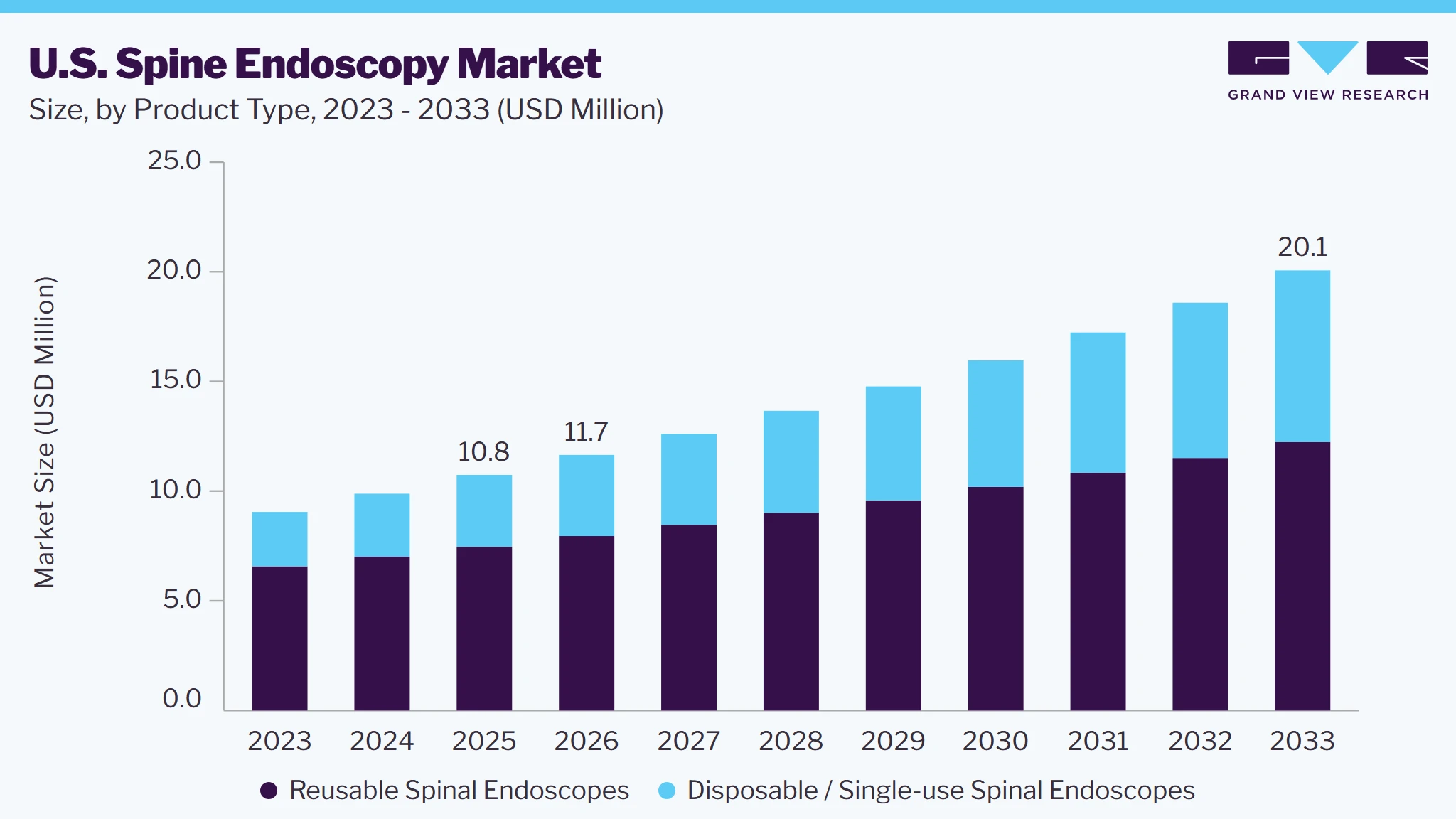 Source: Grand View Research, IR Documents, Primary Interviews, Paid DatabasesTo learn more about this report,
 Download Free Sample Report
Market Dynamics
The U.S. spine endoscopes market is driven by the increasing adoption of minimally invasive spine surgery, growing preference for outpatient spinal procedures, and advancements in endoscopic visualization and surgical instrumentation. The expansion of ambulatory surgery centers (ASCs) and the growing emphasis on reducing surgical trauma, postoperative pain, and recovery time are supporting the use of endoscopic techniques in selected spinal procedures, including discectomy and decompression. In addition, improvements in endoscope design, visualization capabilities, and specialized surgical instruments are expanding the procedural applications of spine endoscopy across U.S. healthcare facilities.
However, high equipment acquisition costs, the technical complexity of endoscopic procedures, and the need for specialized surgeon training continue to challenge market adoption. The learning curve associated with endoscopic spine surgery and variations in reimbursement and facility-level investment capacity may also limit adoption across certain healthcare settings. Despite these constraints, continued technological innovation, increasing utilization of outpatient spine surgery, expanded surgeon training programs, and growing interest in less invasive treatment approaches are creating opportunities for market expansion.
The adoption of minimally invasive spine surgery (MISS) has increased, supported by advancements in surgical techniques and endoscopic technologies. According to a Modern Spine article published in April 2024, as cited in a World Neurosurgery report, MISS is used in approximately 75% of the nearly 1.2 million spinal procedures performed annually in the U.S. This substantial applicability highlights the potential for broader adoption of minimally invasive approaches and supports demand for advanced spine endoscopy.
Clinical benefits of minimally invasive spine surgery:
- Reduced tissue trauma: Smaller incisions and limited muscle disruption minimize tissue damage, thereby supporting improved recovery and preserving surrounding structures.
- Reduced postoperative pain: Minimally invasive techniques reduce postoperative pain by limiting muscle and soft-tissue damage, potentially decreasing the need for pain medication.
- Faster recovery and shorter hospitalization: Reduced surgical trauma support earlier mobilization, shorter hospital stays, and same-day discharge for appropriately selected patients.
- Reduced blood loss and complication risk: Smaller access points and limited tissue disruption reduce intraoperative blood loss and the risk of certain surgery-related complications.
- Improved cosmetic outcomes: Smaller incisions generally result in less noticeable scarring, improving cosmetic outcomes and increasing patient acceptance of minimally invasive procedures.
The integration of advanced navigation technologies with endoscopic spine surgery is supporting the adoption of minimally invasive spinal procedures. In May 2026, a neurosurgery team at Emory University Hospital Midtown in Atlanta, Georgia, led by Daniel Refai, MD, completed the first continuously navigated endoscopic transforaminal lumbar interbody fusion (TLIF). The procedure combined endoscopic visualization with real-time surgical navigation throughout the operation, including incision planning, spinal access, disc-space preparation, implant placement, and screw fixation. This development demonstrates the advancement of technology-enabled minimally invasive spine surgery and thus supports demand for integrated spine endoscopic.
“This is an important advancement for minimally invasive spine surgery. Continuous navigation helps the surgical team stay oriented throughout the procedure, supporting precision and accuracy while limiting disruption to surrounding tissue.”
- Daniel Refai, MD, professor in the Department of Neurosurgery at Emory University School of Medicine
Establishing endoscopic spine surgery requires substantial investment in endoscopic towers, visualization equipment, specialized optics, dedicated instrument sets, imaging equipment, and supporting infrastructure. The capital expenditure can vary considerably depending on the facility and system configuration. A 2026 case report published in the Journal of Neurosurgery: Case Lessons reported that the capital expense of specialized endoscopic spine systems can exceed USD 330,000, creating a financial burden for smaller hospitals, ambulatory surgery centers, and military treatment facilities. Similarly, Mohammad Shukairy, MD, a neurosurgeon and minimally invasive spine surgeon at Bone and Joint Specialists in Merrillville, Indiana, stated that the capital expenditure required to establish an endoscopic spine surgery setup typically exceeds USD 600,000, whether implemented in an ASC or a hospital. Such high upfront investment, therefore, restricts the implementation of endoscopic spine surgery programs, particularly among smaller facilities with limited capital budgets.
In addition to the initial capital investment, recurring procedure-related operating costs further increase the financial burden associated with endoscopic spine surgery. For instance, in January 2026, a U.S. tertiary academic medical center reported average intraoperative supply costs of approximately USD 1,223 for interlaminar endoscopic procedures and USD 2,090 for transforaminal endoscopic procedures. Transforaminal procedures also required substantially greater fluoroscopy utilization, averaging 105.4 X-ray images per case, compared with 42.7 images for interlaminar procedures. These recurring supply and imaging requirements add to the overall operating expenditure of endoscopic spine programs
The increasing shift of spinal procedures toward ambulatory surgery centers and outpatient settings is supporting the adoption of minimally invasive and endoscopic spine surgery in the U.S. For instance, according to Ambulatory Surgery Center News, published in March 2025, nearly 900,000 outpatient spinal procedures were performed in U.S. ASCs between 2018 and 2024. This growing procedural volume highlights the expanding role of ASCs in spine care and supports demand for compact endoscopic visualization systems that support efficient outpatient procedures and same-day patient discharge. Furthermore, there are more than 180 ASCs in the U.S. that offer minimally invasive spine surgery. The recognition of these specialized facilities highlights the development of orthopedic outpatient infrastructure, which facilitates the expansion of endoscopic spine services and investment in related surgical technologies.
The cost advantages associated with ambulatory surgery centers are encouraging the shift of spinal procedures from hospital settings to outpatient facilities. According to research conducted by AcuityMD using U.S. Centers for Medicare & Medicaid Services (CMS) data and more than 300 million patient claims, procedures performed in ASCs cost 45%-60% less than comparable hospital-based procedures. Moreover, supporting the economic benefits of outpatient spine care, Becker’s Healthcare reported that the total one-year cost of spinal fusion performed in an ASC was USD 5,879.46, compared with USD 12,873.97 for procedures performed in a hospital setting. These cost differences encourage healthcare providers and payers to expand outpatient spine care services, while increasing demand for minimally invasive and endoscopic spine technologies that enable efficient procedures and cost-effective patient management.
Furthermore, CMS expanded the ASC Covered Procedures List by 560 codes, including spinal procedures such as posterior lumbar interbody fusion (PLIF). This expansion supports outpatient spine surgery and creates opportunities for adopting minimally invasive and endoscopic technologies in ambulatory surgery centers.
Market Characteristics
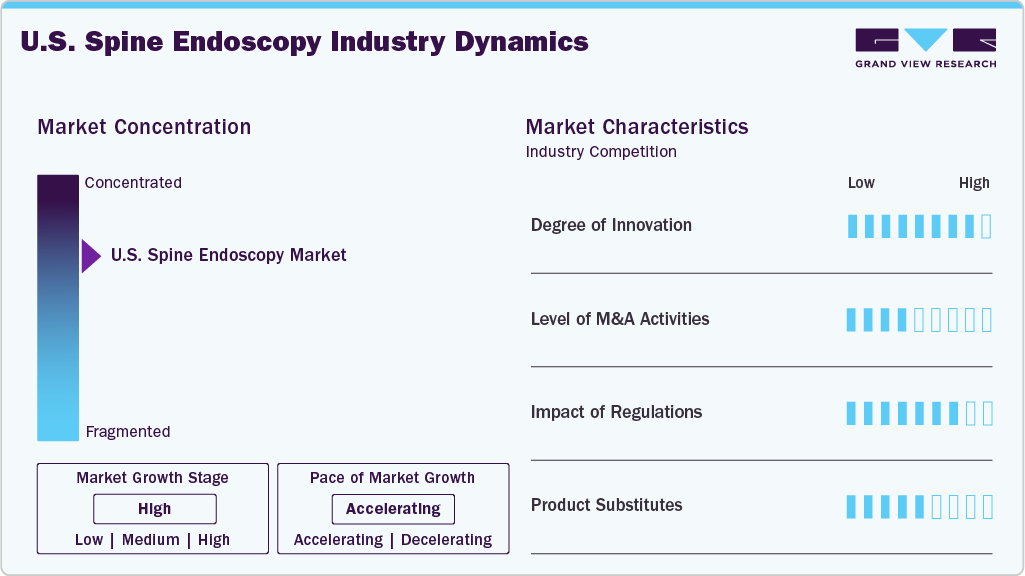
The chart below illustrates the relationship between industry concentration, industry characteristics, and industry participants. The X-axis represents the level of market concentration, ranging from low to high. The Y-axis represents various market characteristics, including industry competition, degree of innovation, level of mergers & acquisition activities, regulatory impact, product substitutes, and regional expansion.
The U.S. market is characterized by a high degree of innovation, as participants compete to differentiate through dedicated spine endoscopes, navigation-enabled platforms, and integrated visualization. For instance, in May 2025, Arthrex received FDA 510(k) clearance for its Spine Endoscope. The reusable endoscope is specifically intended for visualization during spinal endoscopic procedures and minimally invasive surgery.
 To learn more about this report, Download Free Sample Report
The U.S. market is characterized by moderate merger and acquisition activity, with the focus of established medical technology companies on adding complementary digital and visualization technologies to their portfolios. For instance, in January 2026, VB Spine agreed to acquire the SpineHawk intraoperative visualization platform from Robotron Surgical Technologies, adding visualization-enabled instruments and AI-enabled image recognition software to its portfolio.
The regulatory environment has a moderate-to-high impact on the U.S. market, since spine endoscopes require FDA 510(k) clearance before commercialization, influencing product development timelines and the pace of new entrants. For instance, in July 2025, Hydrocision received FDA clearance for its SpineSite Endoscope System, about twelve months after its submission was received in July 2024.
The threat from product substitutes is moderate, with endoscopic techniques competing against established open and microscopic or tubular minimally invasive spine procedures. Surgeon familiarity, training requirements, and the learning curve associated with full-endoscopic techniques continue to support these alternatives, particularly for complex cases.
Analyst Perspective
The demand is supported by the shift toward tissue-sparing procedures, shorter recovery pathways, and increasing use of endoscopic visualization during selected spine interventions. Reusable spinal endoscopes maintain a strong position due to their established clinical use and broader integration into hospital systems, while disposable and single-use platforms provide an alternative supported by simplified instrument processing and procedure-specific availability. Ambulatory surgery centers provide an expanding demand channel as selected endoscopic spine procedures move toward outpatient care, while adoption remains concentrated in facilities with experienced spine surgeons, appropriate imaging capabilities, and dedicated endoscopic infrastructure.
Product Type Insights
The reusable spinal endoscopes segment accounted for the largest share of 69.45% in 2025, supported by their established use across endoscopic discectomy, decompression, foraminotomy, and other spinal procedures. Reusable systems provide stable visualization and dedicated working channels, supporting repeated use across procedures and compatibility with established endoscopic platforms. For instance, in April 2025, Arthrex received FDA clearance for its Spine Endoscope, a reusable rigid endoscope designed for visualization during spinal endoscopic procedures. The continued availability of reusable systems across major spine endoscopy portfolios supports their established role in clinical practice.
The disposable / single-use spinal endoscopes segment is expected to register the fastest CAGR during the forecast period, supported by the shift of spine procedures toward outpatient settings and the need for simplified equipment management. Single-use systems provide ready-to-use functionality and reduce requirements associated with cleaning, sterilization, and reprocessing. According to Becker’s ASC in May 2025, as high-acuity procedures, including spine surgeries, increasingly transition to outpatient settings, several new spine-focused ASCs have been opened or planned across the U.S. The publication reported that 88% of spinal decompressions and laminectomies and 67% of cervical spinal fusions were expected to be performed in outpatient settings by 2028. The expansion of ASC-based spine care supports demand for single-use endoscopic systems suited to streamlined outpatient workflows.
Setting Insight
The hospitals segment accounted for the largest share of 73.59% in 2025, supported by comprehensive surgical infrastructure, advanced imaging capabilities, and multidisciplinary spine care. Hospitals represent a key setting for spine endoscopy procedures in the U.S., supported by the establishment of dedicated endoscopic spine programs within major academic medical centers and specialized spine institutions. The availability of dedicated programs is also expanding the clinical application of endoscopy across different spinal regions and procedural approaches. Furthermore, the growing procedural activity at leading institutions demonstrates the increasing utilization of endoscopic spine surgery in hospital-based settings, for instance, as of December 2024, Emory Healthcare surgeons performed over 160 endoscopic spine surgeries, including thoracic disc resections, cervical foraminotomies, and lumbar laminectomies, demonstrating the technique’s versatility across spinal regions and clinical indications.
The ambulatory surgery centers (ASCs) segment is expected to register the fastest CAGR during the forecast period, supported by increasing use of endoscopic spine procedures in outpatient care, shorter recovery requirements, and improvements in perioperative management. For instance, a nationwide study published in November 2025 analyzed 3,097 endoscopic spine surgery procedures performed in U.S. ASCs between 2018 and 2022 and reported an increase in procedure volume, particularly in the Western U.S. The findings demonstrate the expanding use of ASCs for endoscopic spine surgery and support demand for endoscopic systems suited to outpatient surgical workflows.
Region Insights
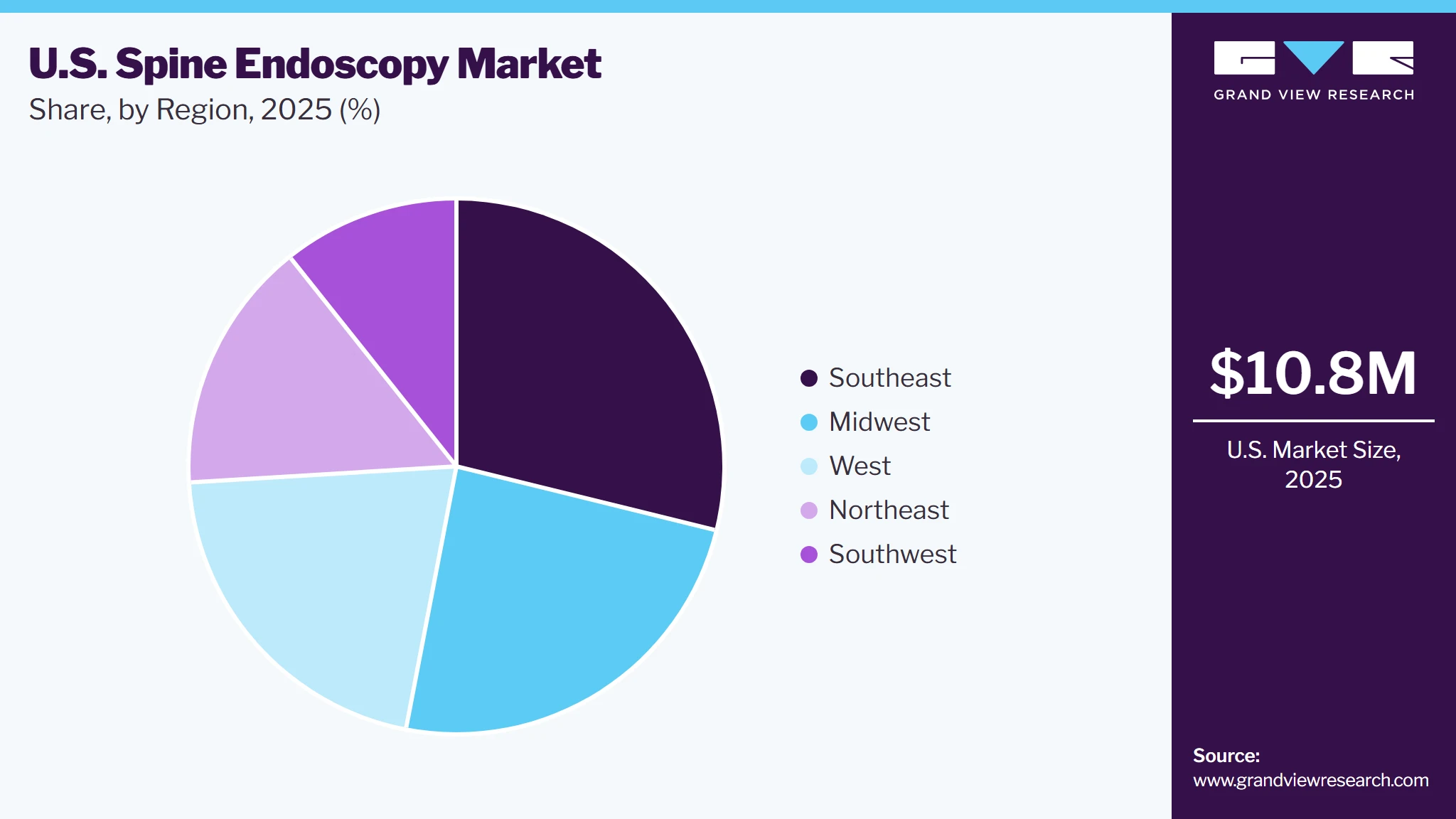
The Southeast accounted for the largest share of 28.80% in 2025, supported by a broad hospital network, established spine surgery infrastructure, and increasing availability of endoscopic procedures across the region. For instance, in March 2025, Northeast Georgia Medical Center Braselton introduced ultra-minimally invasive endoscopic spine surgery using Arthrex technology for conditions such as herniated discs, spinal stenosis, and arthritis. The introduction of endoscopic spine surgery at the facility reflects the expansion of specialized spine care across the Southeast and supports regional demand for endoscopic systems.
 To learn more about this report, Download Free Sample Report
The Southwest is expected to register the fastest CAGR during the forecast period, supported by increasing adoption of endoscopic techniques, expansion of specialized spine services, and growing use of minimally invasive procedures. For instance, in September 2025, Banner - University Medical Center Tucson introduced endoscopic spine surgery, with its first patient undergoing the procedure in June 2025. The procedure supports treatment of herniated discs, spinal stenosis, and pinched nerves, with same-day discharge reported for appropriate patients. This expansion of endoscopic spine capabilities in Arizona supports the development of regional minimally invasive spine care.
Key U.S. Spine Endoscopy Companies:
-
Joimax GmbH
-
RIWOspine GmbH
-
Arthrex
-
Armed Inc.
-
Johnson & Johnson
-
(DePuy Synthes)
-
elliquence
-
MAXMORESPINE BY HOOGLAND SPINE PRODUCTS
-
Nexon Medical
-
Unintech GMBH
- KARL STORZ
Competitive Benchmarking
Players
Operating Strategies
Competitive Edge
Weaknesses
Mature Players
- joimax
- KARL STORZ
- RIWOspine GmbH
- DePuy Synthes (J&J MedTech)
- MaxMoreSpine by Hoogland Spine Products
- Expanding endoscopic spine portfolios across transforaminal, interlaminar, biportal and minimally invasive fusion procedures.
- Investing in advanced visualization technologies, including 4K imaging, integrated camera systems and specialized endoscopic instruments.
- Strengthening surgeon adoption through clinical training, hands-on workshops, proctoring and procedural support.
- Leveraging established U.S. hospital relationships, distribution networks and complementary spine surgery portfolios to expand market penetration.
- Established brand recognition and surgeon relationships within the U.S. spine surgery market.
- Comprehensive product portfolios spanning endoscopes, visualization systems, access instruments, RF devices and surgical accessories.
- Stronger commercial infrastructure, distribution networks and technical support capabilities.
- Established clinical experience and installed customer bases supporting repeat equipment and instrument purchases.
- High capital investment in visualization systems and specialized instrumentation can constrain adoption among smaller hospitals and ASCs.
- Dependence on surgeon training and procedural expertise can slow conversion from conventional minimally invasive spine surgery.
- Competition from lower-cost and specialized vendors offering procedure-specific systems.
- Differences in portfolio breadth and dedicated spine endoscopy capabilities create varying competitive positions across players.
Emerging Players
- Elliquence
- Nexon Medical
- Unintech GmbH
- Armed Inc.
- Developing specialized endoscopic platforms and instruments for full-endoscopic and unilateral biportal endoscopic spine procedures.
- Expanding complementary offerings across RF generators, electrodes, visualization systems, access instruments and procedure-specific accessories.
- Targeting unmet procedural requirements through specialized instrumentation, system configurations and minimally invasive surgical solutions.
- Building U.S. market presence through surgeon engagement, distributor partnerships, clinical demonstrations and procedural training.
- Specialized product development focused on full-endoscopic and biportal spine surgery.
- Ability to address specific surgeon requirements through dedicated instruments and procedure-oriented system configurations.
- Integrated offerings across visualization, RF technologies and surgical instruments among selected players.
- Opportunities to compete through product specialization, pricing flexibility and differentiated procedural solutions.
- Relatively limited U.S. brand recognition, installed base and commercial reach compared with established suppliers.
- Dependence on distributor networks and surgeon-led adoption to expand market penetration.
- Limited scale of clinical evidence, training infrastructure and technical support compared with mature competitors.
- Challenges in securing hospital procurement agreements and competing with established vendors' broader product ecosystems.
Recent Developments
-
In July 2026, Johnson & Johnson (DePuy Synthes) acquired Expanding Innovations, Inc., a spine-technology company focused on expandable interbody cage technology. The acquisition strengthens DePuy Synthes’ spine portfolio, particularly its lumbar fusion offering.
-
In January 2025, KARL STORZ acquired the medical business of T1V, including its CollaboratOR portfolio for displaying and sharing surgical images and clinical information. The acquisition supports KARL STORZ’s digital surgery capabilities and development of integrated surgical visualization solutions.
-
In May 2025, Arthrex partnered with SGMC Health to support the hospital’s first endoscopic spine surgery in Valdosta, Georgia. The collaboration included endoscopic spine technology, training, and implementation support for the minimally invasive procedure.
U.S. Spine Endoscopy Market Report Scope
Report Attribute
Details
Market size in 2025
USD 10.8 million
Estimated market size in 2026
USD 11.7 million
Projected market size by 2033
USD 20.1 million
Growth Rate
CAGR of 8.1% from 2026 to 2033
Actual data
2021 - 2025
Forecast data
2026 - 2033
Quantitative units
Revenue in USD million, Unit Volume, ASP, Installed Based, and CAGR from 2026 to 2033
Report coverage
Revenue forecast, company ranking, competitive landscape, growth factors, and trends
Segments covered
Product type, setting, region
Regional scope
Northeast, Southeast, Southwest, Midwest, West
Key companies profiled
Joimax GmbH; RIWOspine GmbH; Arthrex; Armed Inc.; Johnson & Johnson (DePuy Synthes); elliquence; MAXMORESPINE BY HOOGLAND SPINE PRODUCTS; Nexon Medical; Unintech GMBH; KARL STORZ
Customization scope
Free report customization (equivalent up to 8 analysts working days) with purchase. Addition or alteration to country, regional & segment scope.
Pricing and purchase options
Avail customized purchase options to meet your exact research needs. Explore purchase options
U.S. Spine Endoscopy Market Report Segmentation
This report forecasts revenue growth at global, regional, and country levels and provides an analysis of the latest industry trends in each of the sub-segments from 2021 to 2033. For this study, Grand View Research has segmented the global U.S. Spine Endoscopy Market report based on product type, setting, and region.
-
Product Type Outlook 2021 - 2033 (Revenue, USD Million), Unit (in 000’ Units), ASP (USD per Unit)
-
Reusable Spinal Endoscopes
-
Uniportal / Full-endoscopic Working-channel Spinal Endoscopes
-
Lumbar Spinal Endoscopes
-
Transforaminal
-
Interlaminar
-
-
Cervical Spinal Endoscopes
-
Anterior Cervical
-
Posterior Cervical
-
-
Thoracic Spinal Endoscopes
-
Transforaminal / Posterolateral
-
Interlaminar / Posterior
-
-
-
Biportal Spinal Endoscopes
-
-
Disposable / Single-use Spinal Endoscopes
-
-
Setting Outlook 2021 - 2033 (Revenue, USD Million), Unit (in 000’ Units), ASP (USD per Unit)
-
Hospitals
-
Inpatient
-
Outpatient
-
-
Ambulatory Surgery Centers (ASCs)
-
-
Region Outlook 2021 - 2033 (Revenue, USD Million), Unit (in 000’ Units), ASP (USD per Unit)
-
Northeast
-
Southeast
-
Midwest
-
Southwest
-
West
-
Research Methodology
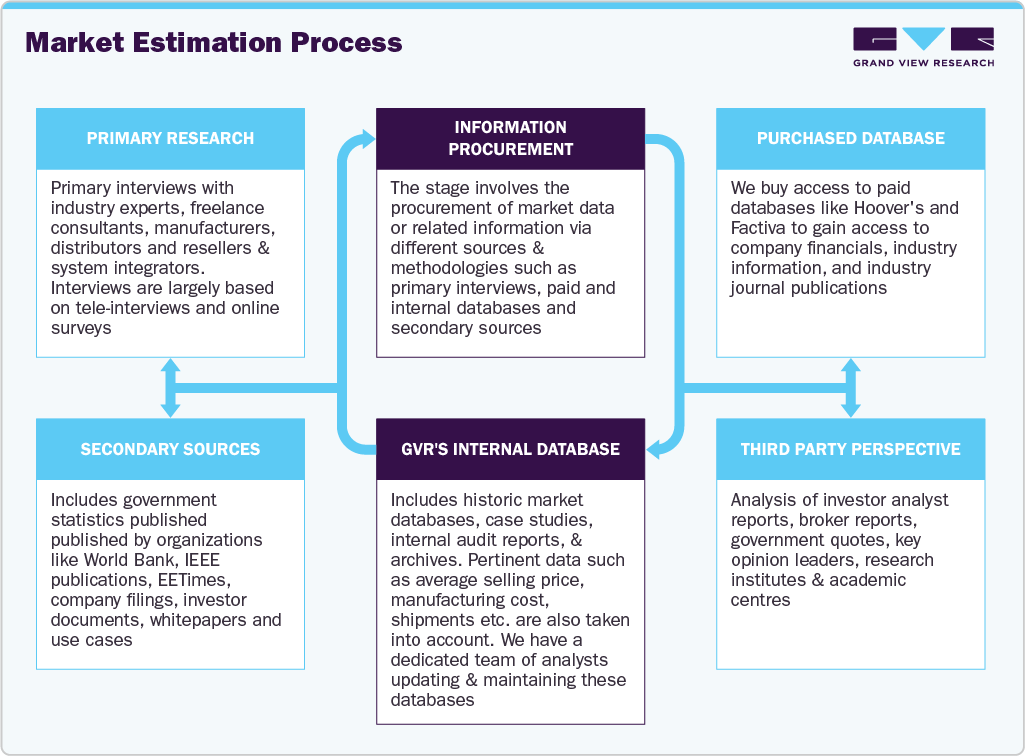
The U.S. spine endoscopy market figures in this report are based on a proven research process that combines executive interviews with secondary research from proprietary databases, company filings, and recognized regulatory and institutional sources. Market size is built through value-chain sizing-reconciling supply-side and demand-side estimates-and triangulated with bottom-up and top-down approaches. Every estimate passes multiple levels of expert validation before publication, with each U.S. spine endoscopy segment quantified using the revenue-capture definitions in the table below.
Segment Definition
Segment - Product Type
Revenue capture definition
Reusable Spinal Endoscopes
Reusable spinal endoscopes are endoscopic systems designed for repeated use in spinal procedures following appropriate cleaning, disinfection, sterilization, and maintenance. They typically include full-endoscopic working-channel systems and biportal endoscopic systems and are used across different spinal regions and surgical approaches.
Uniportal/Full-endoscopic Working-channel Spinal Endoscopes
These systems integrate visualization, irrigation, and a working channel within a single endoscope, allowing surgical instruments to pass through the same access portal. They provide direct visualization and enable minimally invasive tissue resection, decompression, and discectomy.
Lumbar Spinal Endoscopes
Lumbar spinal endoscopes are designed for endoscopic treatment of pathologies affecting the lumbar spine, including disc herniation, foraminal or lateral recess stenosis, and other degenerative conditions. They primarily use transforaminal or interlaminar access routes.
Transforaminal
Transforaminal endoscopy accesses the lumbar spine through the neural foramen, providing a working route toward the disc and adjacent neural structures. It is commonly used for endoscopic discectomy, foraminal decompression, and treatment of selected lateral or foraminal pathologies.
Interlaminar
Interlaminar endoscopy accesses the spinal canal through the interlaminar space between adjacent laminae. It is used for procedures such as lumbar discectomy and lateral recess or central canal decompression, particularly where the interlaminar route provides appropriate access to the pathology.
Cervical Spinal Endoscopes
Cervical spinal endoscopes are designed to provide minimally invasive visualization and access to pathologies affecting the cervical spine. Depending on the location of the pathology, these systems are used through anterior or posterior approaches.
Anterior Cervical
Anterior cervical endoscopy provides access to cervical spinal pathology through an anterior approach to the cervical spine. The approach is used for selected cervical disc and neural decompression procedures where anterior access is appropriate.
Posterior Cervical
Posterior cervical endoscopy approaches cervical pathology from the posterior side of the spine and are used for procedures such as endoscopic cervical foraminotomy and decompression.
Thoracic Spinal Endoscopes
Thoracic spinal endoscopes are designed for minimally invasive access to thoracic spinal pathology, including disc herniation and neural compression. Transforaminal/posterolateral and interlaminar/posterior approaches are selected according to the location and characteristics of the pathology.
Transforaminal/Posterolateral
This approach accesses thoracic pathology through a transforaminal or posterolateral route, providing a minimally invasive pathway toward thoracic disc and neural structures. It is particularly used for selected thoracic disc herniations and other lateral or ventral pathologies.
Interlaminar/Posterior
This approach accesses the thoracic spine through the posterior or interlaminar region between the laminae. It enables endoscopic decompression of selected posterior or centrally located thoracic pathologies while using a posterior access route.
Biportal Spinal Endoscopes
Biportal spinal endoscopy uses two separate access portals—one primarily for endoscopic visualization and the other for surgical instruments. The separation of the viewing and working portals allows greater instrument maneuverability and continuous irrigation during spinal procedures.
Disposable Spinal Endoscopes
Disposable or single-use spinal endoscopes are designed for use in a single procedure and are discarded afterward rather than undergoing reprocessing for subsequent cases. These systems can reduce dependence on sterilization and reprocessing workflows and are particularly relevant where simplified procedure setup and equipment turnover are priorities.
Segment - Setting
Revenue capture definition
Hospitals
Hospitals are healthcare facilities equipped to provide spine surgical care using comprehensive clinical, surgical, imaging, anesthesia, and postoperative resources. Spine endoscopy procedures performed in hospitals are conducted in either inpatient or outpatient settings, depending on procedure complexity and patient requirements.
Inpatient
Inpatient settings involve spine procedures where patients are formally admitted to the hospital and typically require overnight or extended postoperative monitoring. These settings generally accommodate more complex or higher-acuity procedures requiring hospital-based resources.
Outpatient
Outpatient settings involve spine procedures performed without an overnight hospital admission, allowing patients to undergo treatment and return home following postoperative recovery. This segment includes hospital outpatient departments (HOPDs) where selected minimally invasive spine procedures are performed using hospital-based resources.
Ambulatory Surgery Centers (ASC)
ASCs are specialized facilities designed to perform surgical procedures on an outpatient basis without overnight hospital admission. Spine endoscopy procedures performed in ASCs generally emphasize minimally invasive treatment, efficient surgical workflows, and same-day patient discharge.
Estimation Model
 To learn more about this report, Download Free Sample Report
Market-Specific Research Models
Model
Methodology
Consensus-Based Estimates & Forecasting
The U.S. spine endoscopy market was estimated using supply-side and demand-side models, supported by public data, company disclosures, primary research, and internal databases. The model covers 2021-2033, with 2021-2024 as historical estimates, 2025 as the base year, and 2026-2033 as forecast years.
Model 1: Commodity Flow Analysis
Company-level revenues were assessed using annual reports, 10-K filings, investor presentations, company disclosures, paid databases, and primary research. Revenue was allocated to qualifying spinal endoscopes based on product portfolios, U.S. availability, FDA 510(k) clearance, geographic exposure, scope-only revenue, and realized ASPs. Broader visualization systems, instruments, implants, and services were excluded.
Model 2: Demand-Based Market Sizing
Demand was estimated using CMS hospital and ASC records, screened facility counts, reusable scope installed bases, replacement and expansion units, procedure capacity, single-use adoption, and product-level ASPs. Hospitals and ASCs, as well as uniportal and biportal platforms, were modeled separately.
Model 3: Primary Research
Interviews and structured surveys with spine surgeons, hospitals, ASC administrators, procurement teams, sterile processing professionals, OEMs, and distributors validated scope density, procedure utilization, useful life, replacement cycles, single-use adoption, pricing, and regional assumptions.
Model 4: Internal Database
Internal research databases, historical project findings, audit reports, and archived information supported facility screening, market assumptions, and model validation.
Model 5: CAGR Calculation and Forecasting
Annual forecasts were developed using facility growth, installed-base expansion, replacement cycles, procedure volumes, application mix, single-use adoption, product mix, and ASP changes. Growth rates were calculated separately by segment rather than applying a uniform CAGR across the market.
Market Scope and Revenue Calculation
The market includes reusable and single-use spinal endoscopes used for visualization in lumbar, cervical, and thoracic procedures, covering uniportal and qualifying biportal (UBE) techniques. Camera towers, monitors, light sources, irrigation pumps, RF generators, drills, instruments, access kits, implants, and repair services are excluded.
Market revenue is calculated using annual new-sale units multiplied by the corresponding realized ASP for reusable scopes, and scopes consumed per procedure multiplied by ASP for single-use products. Estimates are reconciled across company revenues, procedure demand, product segments, care settings, and U.S. regions.
Delivered Customizations
This report has been delivered with the following In-depth customizations
Client Request
Customization Delivered
Value Adds
Installed Base & Unit Sales Analysis (2021-2033)
Delivered an analysis of the installed reusable spinal endoscope base and annual unit sales (000s) for 2021-2033 at the overall U.S. market and segment levels, covering reusable and disposable/single-use systems and accounting for new procurement and replacement demand.
Helps manufacturers and distributors assess equipment replacement requirements, quantify unit demand, evaluate procurement patterns, and optimize production, inventory, distribution, and sales planning.
Realized ASP / Price Range (USD), 2021-2033
Provided realized average selling price (ASP) and price range analysis in USD for 2021-2033 at the overall U.S. level and across covered segments. The analysis reflects differences in pricing across reusable and disposable/single-use spine endoscopy systems.
Supports pricing assessment, revenue modeling, margin analysis, and evaluation of pricing differences across product segments.
Annual Procedure Volume (2021-2033)
Provided annual spine endoscopy procedure volume in 000's for 2021-2033 at the overall U.S. level and across covered segments. The analysis captures procedure activity across relevant spine endoscopy applications and healthcare settings.
Helps stakeholders connect procedure growth with endoscope demand, estimate utilization levels, and assess the relationship between clinical activity and equipment sales.
About the Author(s)
Medical Devices Research Team
Healthcare · Medical DevicesThis report was authored by the medical devices research team at Grand View Research - comprising two research analysts, one senior research analyst, and one industry expert - with specialized expertise in the medical devices segment of the healthcare industry. All findings are based on proprietary healthcare databases, executive interviews, and regulatory analysis, subject to internal peer review prior to publication.
Last Updated:
Speak to Analyst

Customize this report to your needs - add regions, segments, or data points, with 20% free customization.
Or view our licence options:


ISO 9001:2015 & 27001:2022 Certified
We are GDPR and CCPA compliant! Your transaction & personal information is safe and secure. For more details, please read our privacy policy.


