
- Home
- »
- Clothing, Footwear & Accessories
- »
-
U.S. Sports Sunglasses Market Size, Share Report, 2033GVR Report cover

U.S. Sports Sunglasses Market (2026 - 2033)
Size, Share & Trends Analysis Report By Lens (Polarized, Non-Polarized), By Price Tier (Mass, Mid-range), By End Use (Men, Women), By Distribution Channel (Optical Retail Chains, Sports Specialty Stores), And Segment Forecasts
Market Size, 2025
$1.1BMarket Estimate, 2026
$1.2BMarket Forecast, 2033
$1.7BCAGR, 2026–2033
5.1%U.S. Sports Sunglasses Market Summary
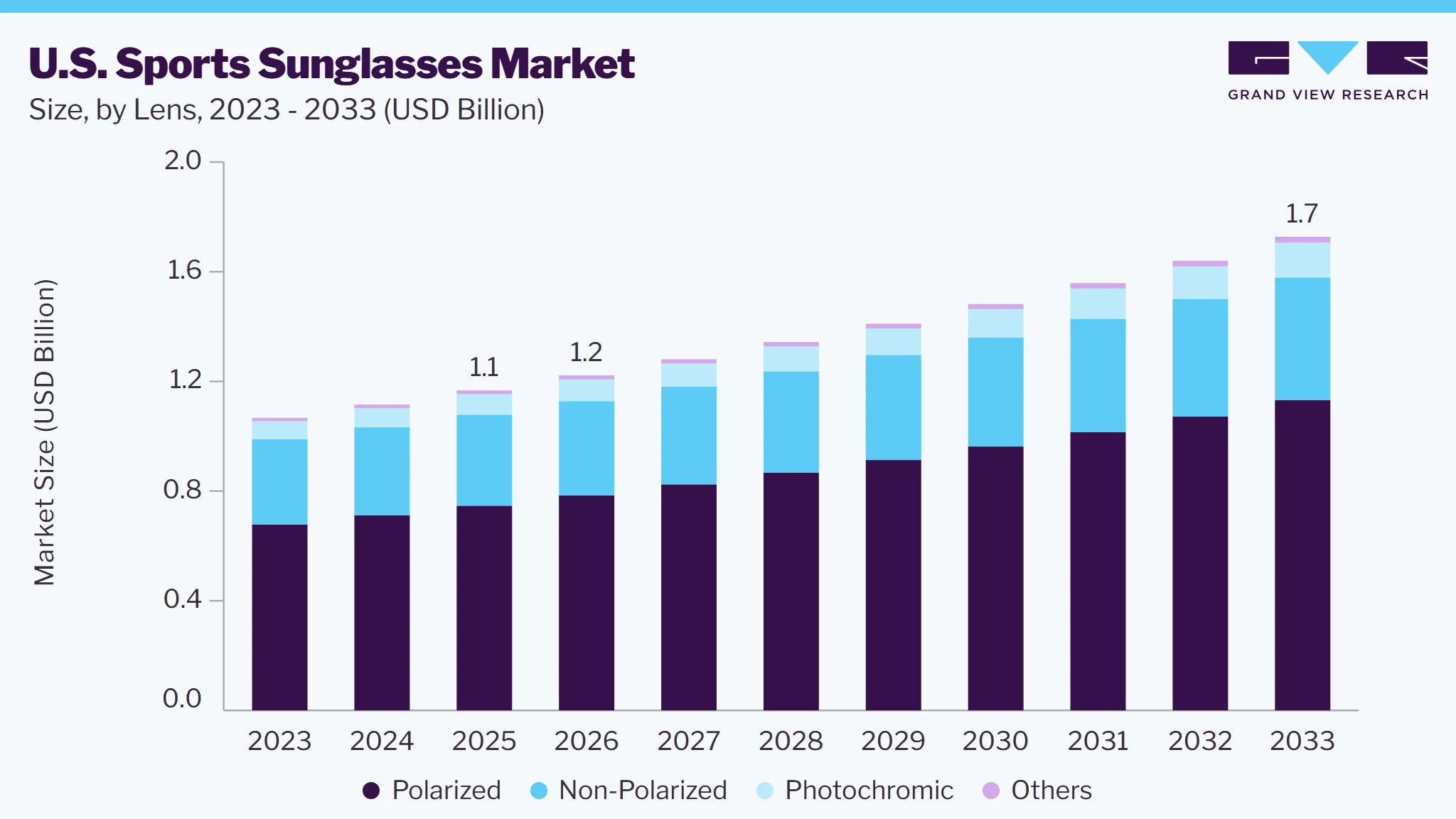
The U.S. sports sunglasses market size was valued at USD 1.1 billion in 2025 and is projected to grow from USD 1.2 billion in 2026 to USD 1.7 billion by 2033, at a CAGR of 5.1% from 2026 to 2033. The growth is driven by rising participation in outdoor and recreational sports, increasing consumer focus on eye protection during high-exposure activities, and growing demand for performance-oriented eyewear. Growth is supported by advancements in polarized, UV-protective, impact-resistant, and lightweight lens technologies, as well as rising interest in cycling, running, skiing, golf, water sports, and other outdoor activities.
Key Market Trends & Insights
- By lens: Polarized accounted for the largest revenue share of 64.0% in 2025.
- By price tier: Mid-range accounted for the largest revenue share of 43.7% in 2025.
- By end use: Men accounted for the largest revenue share of 56.5% in 2025.
- By distribution channel: Sports specialty stores accounted for a market share of 34.4% in 2025.
Market Size & Forecast
- Market size in 2025: USD 1.1 Billion
- Estimated market size in 2026: USD 1.2 Billion
- Projected Market Size by 2033: USD 1.7 Billion
- CAGR (2026-2033): 5.1%
Three ways to get this report
Buy it, customize it, or ask a question.Ask an Analyst
A direct answer, usually in 1 working day
- AccessReport author, directly
- Reply timeWithin 1 working day
- No sales callDirect answer only
- FormatEmail reply
- CostFree, no cost
Get the Full Report
What the study covers
- FormatsPDF · Excel · Dashboard
- Timeline2026–2033 annual, 2025 base
- Coverage20+ countries, 5 regions
- Companies10+ key players profiled
Customize the Report
20% free customization
- IncludeCountries, segments, points
- TailorTo your product definition
- ExtendDeeper competitor detail
- OrA fully bespoke study
- Turnaround5–10 working days
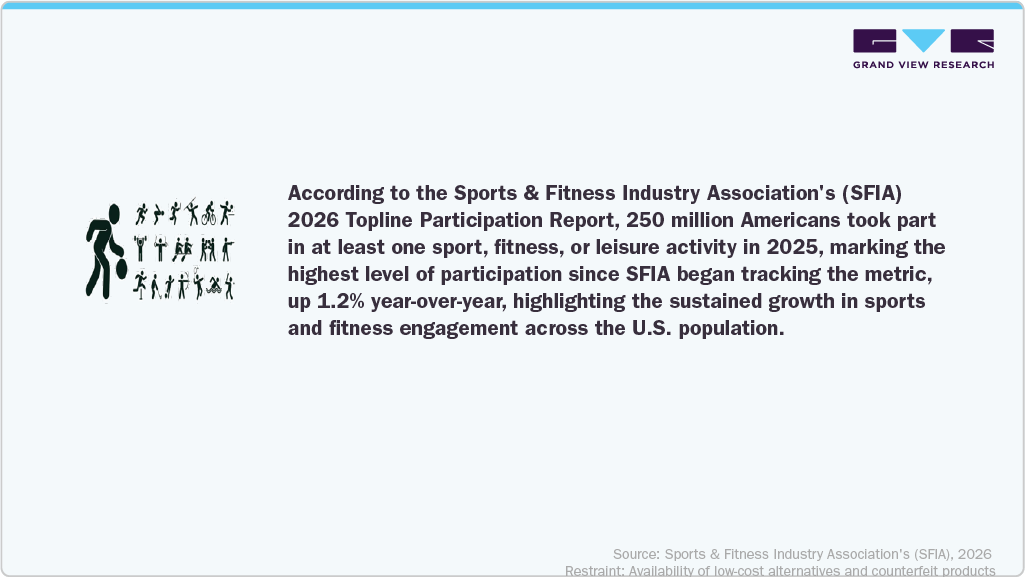
Increasing preference for sports sunglasses that combine protection, comfort, durability, and stylish designs is also encouraging consumers to upgrade from conventional eyewear to specialized performance products. Rising participation in sports and recreational activities is expanding the consumer base for the U.S. sports sunglasses market, as frequent engagement in outdoor activities increases the need for specialized sports eyewear that provides UV protection, glare reduction, and visual comfort. In 2025, 250 million Americans participated in at least one sport, fitness, or leisure activity, up 1.2% year over year, according to SFIA. The growing participation across running, cycling, golf, water sports, and other outdoor activities is therefore creating recurring demand for performance-oriented sports sunglasses designed for prolonged outdoor use.
 Source: Grand View Research, IR Documents, Primary Interviews, Paid DatabasesTo learn more about this report,
 Download Free Sample Report
 Growing engagement in outdoor recreation is supporting demand for sunglasses that provide protection and visual comfort during prolonged exposure to sunlight. The Outdoor Industry Association reported that 183.2 million Americans participated in outdoor recreation in 2025, representing 59% of Americans aged six and older. This wider outdoor participant base increases opportunities for sports-specific eyewear across activities such as hiking, cycling, fishing, skiing, and water sports.
Sports sunglasses are increasingly positioned as both performance equipment and lifestyle accessories, allowing consumers to use the same products for both sporting and casual outdoor activities. Oakley’s 2025 Tour de France Frogskins range, for example, combined Prizm lenses and no-slip Unobtainium components with a lifestyle-oriented design and bio-based BiO-Matter frame material. This convergence is expanding demand for sports eyewear beyond competitive athletes toward recreational consumers seeking functional, fashionable, and versatile eyewear, supporting the growth of the U.S. sports sunglasses market.
Market Dynamics
Growing awareness of the harmful effects of prolonged UV exposure is encouraging consumers to prioritize eye protection during outdoor activities. Excessive UV exposure can contribute to eye conditions such as photokeratitis, cataracts, and other long-term eye damage. As consumers become more conscious of these risks, sunglasses are increasingly viewed as essential protective products rather than solely fashion accessories. This is supporting demand for sports sunglasses offering UV protection, glare reduction, wraparound coverage, and improved visual comfort, particularly among active consumers and outdoor sports participants.
 To learn more about this report, Download Free Sample Report
 The availability of low-cost alternatives and counterfeit sports sunglasses can restrain market growth by offering consumers inexpensive substitutes for branded, technologically advanced products. Counterfeit products often imitate established brands and designs while being sold at substantially lower prices, making them attractive to price-sensitive consumers. This can reduce consumers’ willingness to pay for genuine sports sunglasses equipped with advanced lenses, UV protection, impact resistance, and specialized performance features. Counterfeiting can also affect brand reputation and consumer trust, while legitimate manufacturers face increased costs related to brand protection and enforcement.
The integration of AI, cameras, audio, fitness connectivity, and smart sensors is creating a new category of performance-oriented sports sunglasses that combine eye protection with digital functionality. Instead of serving only as protective eyewear, smart sports sunglasses can provide hands-free access to performance information, navigation, audio, activity tracking, photography, and AI-based assistance. This creates an opportunity for manufacturers to differentiate products, attract technology-oriented consumers, and increase the value proposition of premium sports eyewear.
In June 2025, Oakley and Meta announced the Oakley Meta HSTN, a new generation of performance-oriented smart glasses designed for athletes and sports enthusiasts. The eyewear combines a 3K camera, open-ear speakers, a microphone, Meta AI, and enhanced battery life of up to eight hours, enabling users to capture videos, access information, and interact with AI hands-free during outdoor activities. The opportunity to combine advanced digital functionality with sports eyewear and create premium, technology-driven products for active consumers.
Analyst Perspective
The U.S. sports sunglasses market is evolving toward performance-oriented and activity-specific eyewear, with consumers increasingly seeking products that combine eye protection, visual clarity, comfort, and sport-specific functionality. Demand is supported by participation in outdoor activities such as cycling, running, golf, tennis, skiing, and fishing, where prolonged exposure to sunlight and glare increases the need for specialized sports eyewear. Manufacturers are responding with polarized and photochromic lenses, enhanced-contrast technologies, lightweight and impact-resistant frames, interchangeable lens systems, and secure-fit designs, while expanding offerings across specialty sporting-goods retailers, optical stores, brand websites, and online marketplaces.
Consumer Insights
 To learn more about this report, Download Free Sample Report
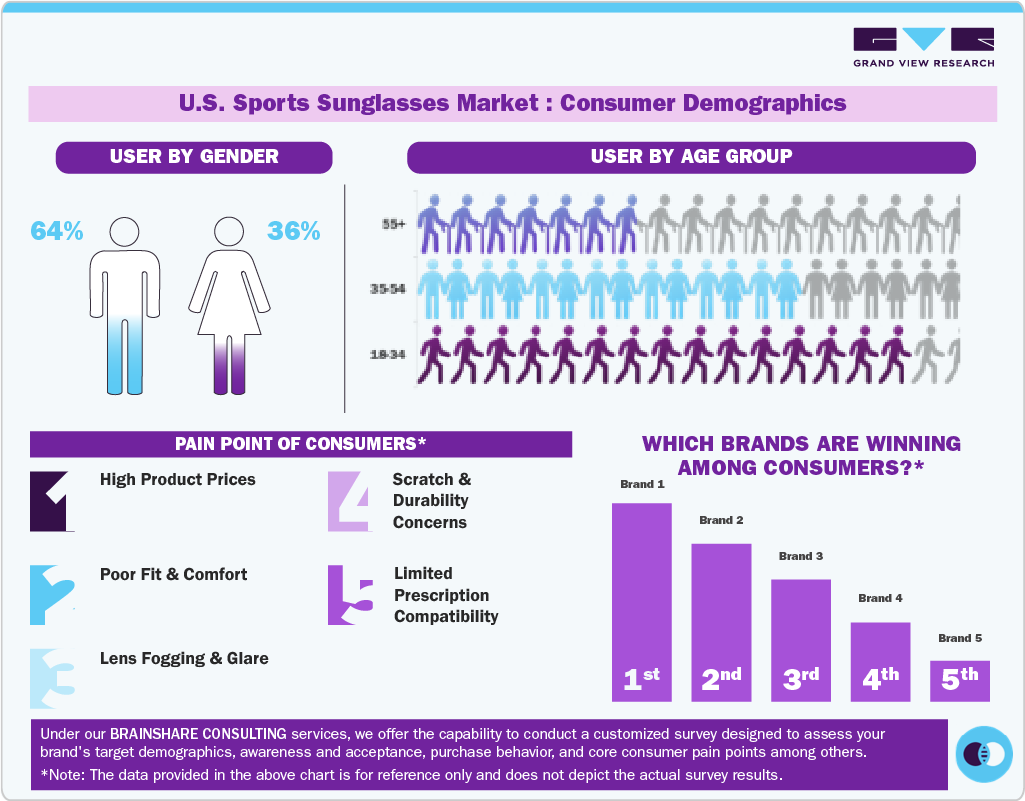
 The gender distribution in the U.S. sports sunglasses market reflects greater participation among male consumers, supported by higher engagement in outdoor recreation, fitness, and performance-oriented sports.
-
Male consumers account for 64% of sports sunglasses users, driven by greater participation in cycling, running, hiking, fishing, and other outdoor sports where eye protection and performance eyewear are important.
-
Female consumers represent 36% of users, with demand supported by growing participation in fitness, running, hiking, cycling, and recreational outdoor activities, alongside preferences for lightweight, comfortable, and stylish sports eyewear. However, women represent a substantial outdoor-consumer base, with the Outdoor Industry Association reporting in 2024 that 51.9% of U.S. women participated in outdoor recreation in 2023. Rising female participation across outdoor activities creates additional opportunities for sports sunglasses adoption.
By age group, consumers aged 18-34 represent the strongest user base, reflecting higher participation in active lifestyles, outdoor recreation, running, cycling, hiking, and other sports activities. This group also shows greater interest in performance features such as UV protection, polarized lenses, lightweight frames, and modern styling. Consumers aged 35-54 form another important user group, with demand associated with recreational sports, fitness, golf, fishing, and outdoor leisure activities, while consumers aged 55+ primarily seek comfortable, protective, and easy-to-use eyewear for recreational and outdoor activities.
Consumers in the U.S. sports sunglasses industry commonly face several product-related pain points that can affect purchasing decisions and satisfaction.
-
High product prices remain a concern, particularly for premium sports sunglasses incorporating polarized, photochromic, impact-resistant, and advanced lens technologies.
-
Poor fit and comfort can reduce usability during prolonged or high-movement activities, with consumers seeking secure frames, lightweight construction, and reduced pressure around the nose and temples.
-
Lens fogging and glare can interfere with visibility during intense outdoor activities and changing weather conditions, increasing the need for effective anti-fog and glare-reduction performance.
-
Limited prescription compatibility can restrict choices for consumers requiring corrective vision, particularly when specialized sports frames and prescription lenses involve higher costs.
-
Scratch and durability concerns arise from frequent outdoor exposure, handling, and impact, increasing demand for scratch-resistant lenses and durable frame construction.
Lens Insights
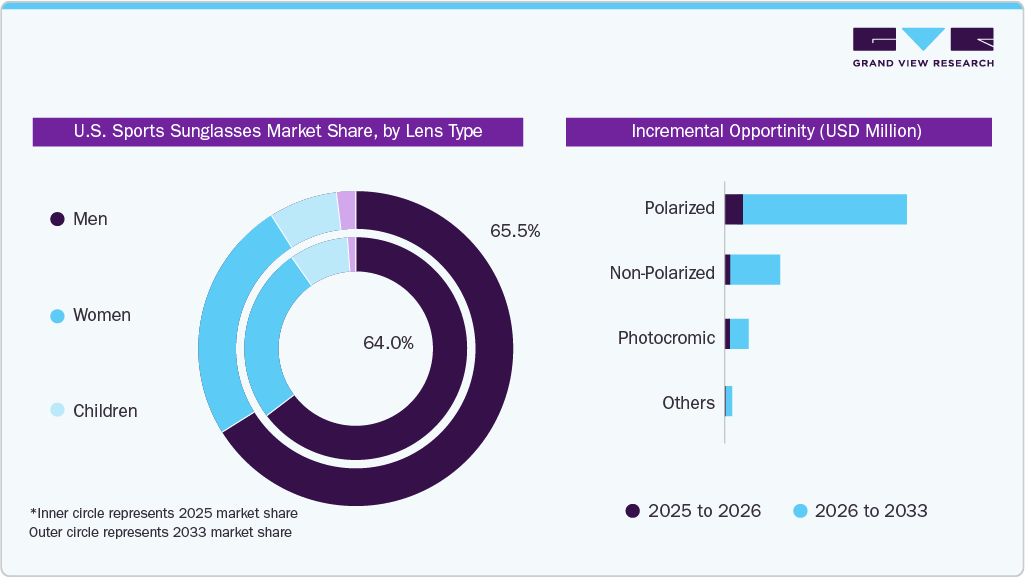
The polarized segment accounted for the largest revenue share of 64.0% in 2025, driving demand for polarized sports sunglasses in the U.S., as athletes and recreational users seek clearer vision and reduced eye strain during outdoor activities. Polarized lenses are increasingly incorporated into performance-oriented sports eyewear for cycling, fishing, skiing, golf, and water sports, where reflected sunlight can affect visibility and visual comfort. For instance, Oakley’s sports eyewear portfolio offers polarized lens options specifically designed to reduce glare from reflective surfaces such as water, snow, and roads, reinforcing polarization as a performance feature rather than solely a fashion attribute.
 To learn more about this report, Download Free Sample Report
 The photochromic segment is expected to grow at a CAGR of 6.9% from 2026 to 2033, driving the adoption of photochromic lenses, particularly among cyclists, runners, and other endurance-sport participants who move between shaded and brightly exposed environments. Julbo’s REACTIV photochromic technology automatically adjusts lens darkness according to changing light, allowing athletes to maintain clear vision without switching lenses. Its FASTER performance sunglasses are specifically positioned for MTB, running, and cycling, while Julbo’s REACTIV portfolio also targets skiing, hiking, and other outdoor activities.
Price Tier Insights
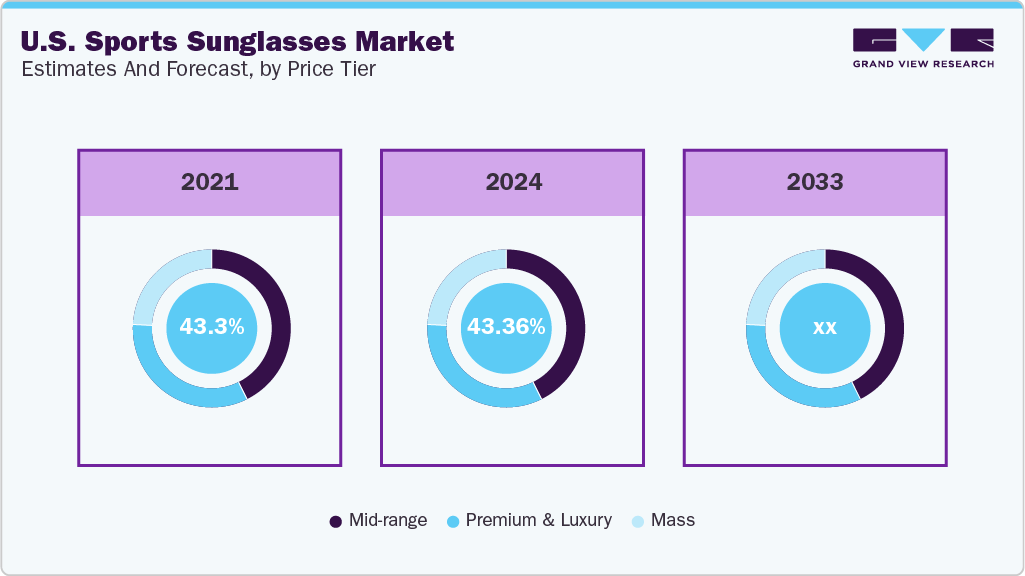
The mid-range segment accounted for the largest revenue share of 43.7% in 2025, largely attributed to the growing consumer preference for affordable performance eyewear, and recreational athletes increasingly seek technical features without paying premium prices. Tifosi Optics, for instance, offers its Vero multi-sport sunglasses at USD 79.95, with options including polarized lenses, UV400 protection, and glare reduction for activities such as running, cycling, golf, and pickleball. The availability of sport-specific functionality at sub-USD 100 price points is encouraging broader adoption of mid-range sports eyewear among recreational and fitness-oriented consumers.
 To learn more about this report, Download Free Sample Report
 The premium & luxury sports sunglasses are expected to grow at a CAGR of 5.5% from 2026 to 2033. The growing convergence of sports performance and fashion is driving the growth as consumers show a preference for eyewear that delivers athletic functionality while complementing everyday and fashion-oriented looks. The shift is expanding the role of high-wrap and shield-style sports eyewear beyond dedicated sporting activities, creating greater demand for premium designs. For instance, Financial Times reported in July 2025 that sporty sunglasses had become mainstream fashion accessories, with Prada, Loewe, and Burberry introducing sport-inspired styles, while Oakley models gained traction in fashion and lifestyle settings.
End Use Insights
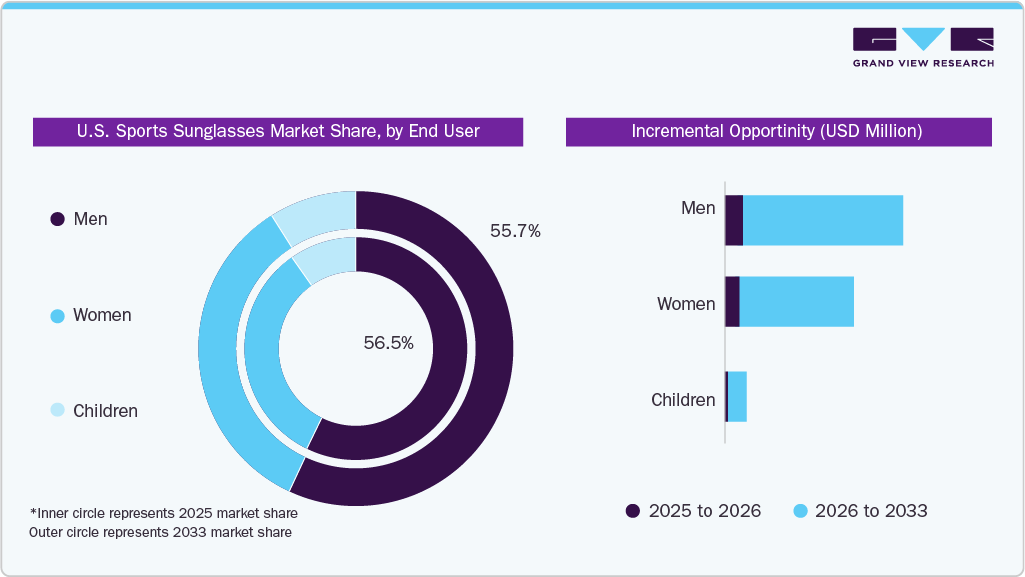
The men segment accounted for the largest revenue share of 56.5% in 2025. Growing adoption of performance-oriented eyewear across sports, fitness, and everyday menswear is driving the demand for sports sunglasses among men in the U.S. The increasing overlap between athletic functionality and men’s fashion is also broadening usage beyond dedicated sporting activities. For instance, GQ identified sporty retro designs such as the Oakley Straight Jacket among notable men’s eyewear trends for summer 2025, while Oakley’s Radar EV Path was highlighted as a sport-focused model that has transitioned into mainstream menswear.
 To learn more about this report, Download Free Sample Report
 The women segment is expected to grow at a CAGR of 5.8% from 2026 to 2033. Rising female participation in outdoor sports is strengthening the women’s category in the U.S. sports sunglasses market, particularly in activities such as golf, where prolonged exposure to sunlight and reflective surfaces increases the need for protective eyewear. According to the National Golf Foundation, more than 8.1 million women and girls played golf on-course in the U.S. in 2025, representing 28% of all on-course golfers, the highest female share on record. Female participation also increased by approximately 2.5 million golfers between 2019 and 2025, indicating a sustained expansion of the potential consumer base for sports sunglasses designed for UV protection, glare reduction, and outdoor comfort.
Distribution Channel Insights
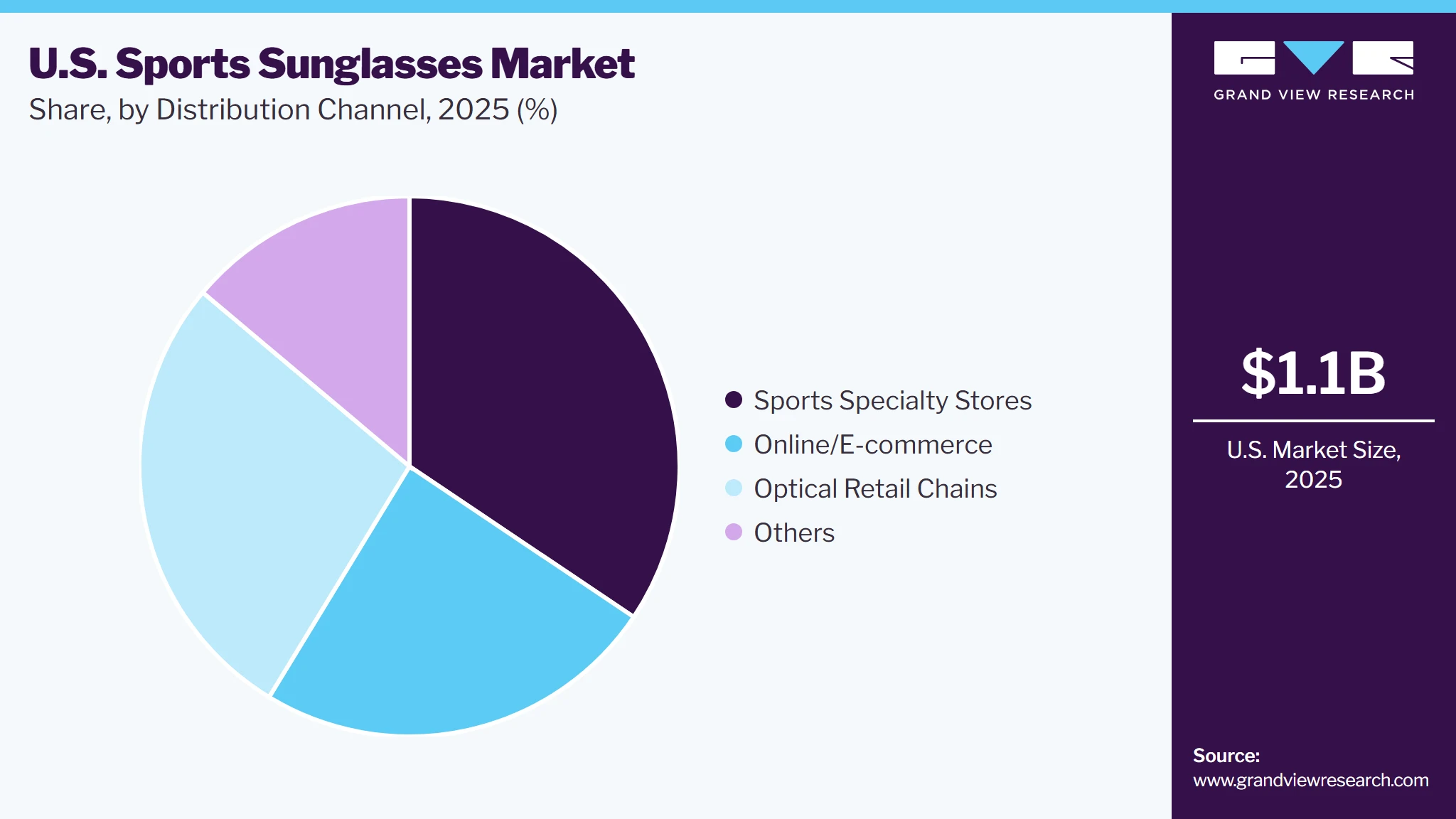
The sports specialty stores segment accounted for a revenue share of 34.4% in 2025, reflecting the importance of specialized retail environments where consumers can access sport-specific eyewear and evaluate products based on lens technology, fit, and activity requirements. DICK’S Sporting Goods, a U.S. sporting goods retailer, offers 127 sunglasses within its sports eyewear assortment, including brands such as Oakley, Nike, 100%, and Under Armour, with products targeting activities such as cycling, golf, fishing, running, baseball, and pickleball. The expansion of experiential sporting-goods retail is also strengthening the channel.
 To learn more about this report, Download Free Sample Report
 The online/e-commerce segment is expected to grow at a CAGR of 7.9% from 2026 to 2033. Amazon’s growing use as a promotional channel for performance eyewear is strengthening online sales of sports sunglasses in the U.S. In June 2026, Runner’s World highlighted Amazon Prime Day discounts on sports and running sunglasses from brands including Oakley, Goodr, Tifosi, and Under Armour, with selected Oakley models discounted by 25%. The availability of premium sports eyewear at promotional prices through a major online marketplace is encouraging consumers to compare products and purchase performance sunglasses digitally.
The expansion of sports eyewear into Amazon’s online assortment is also increasing the visibility of technologically advanced products through the online/e-commerce distribution channel. In April 2026, the Oakley Meta Vanguard became available on Amazon, extending access to smart performance eyewear that integrates Garmin and Strava connectivity. This developmentindicates that online marketplaces are increasingly being used not only for conventional sunglasses but also for higher-value, technology-enabled sports eyewear.
Key U.S. Sports Sunglasses Company Insights
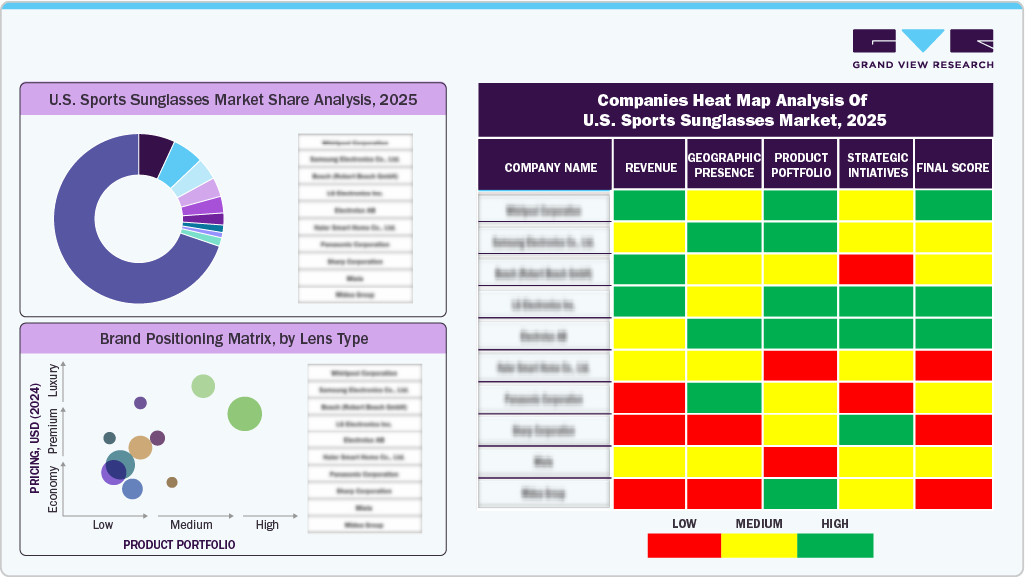
The U.S. sports sunglasses market is characterized by a diverse competitive structure, comprising performance-focused eyewear brands, mass-market sports brands, premium optical players, and value-oriented specialists. These companies compete through lens technologies, lightweight and impact-resistant frames, sport-specific designs, athlete partnerships, polarized and photochromic technologies, and expanding online and specialty retail distribution.
-
Performance & Technology-led Sports Eyewear Leaders: Oakley, Smith Optics, and Julbo are positioned strongly around technical performance and optical innovation. Oakley differentiates through Prizm lens technology and sport-specific eyewear, while Smith emphasizes ChromaPop and interchangeable-lens technologies. Julbo focuses on adaptive and photochromic lens technologies for cycling, running, skiing, and other outdoor activities. Their emphasis on optical clarity, coverage, fit, and changing-light performance strengthens their positioning among serious athletes and outdoor enthusiasts.
-
Sport & Lifestyle Eyewear Brands: Nike Vision, Under Armour, Roka, and Maui Jim compete by combining sports functionality with lifestyle-oriented styling. Nike Vision and Under Armour leverage established sports-brand recognition and broad athletic consumer reach, while Roka emphasizes lightweight, secure-fit performance eyewear and Maui Jim differentiates through polarized lens technology and premium optical positioning. Their ability to serve both active and everyday consumers expands the addressable customer base for Sports Sunglasses.
-
Value-focused & Accessible Performance Players: Tifosi Optics and Goodr target recreational athletes and active consumers seeking sport functionality at more accessible price points. Tifosi offers performance features such as polarized and photochromic lenses across cycling, running, golf, and other activities, while Goodr has built its positioning around affordable, lightweight sunglasses designed for running and active lifestyles. This segment increases competition in the mid-price and value-oriented portions of the U.S. sports sunglasses market.
-
Premium Outdoor & Water-Sports Specialists: Costa Del Mar maintains a differentiated position through premium polarized eyewear designed particularly for fishing, boating, and other water-based outdoor activities. Its focus on glare reduction and specialized outdoor use allows it to compete beyond conventional athletic sunglasses and capture consumers seeking high-performance Sports Eyewear for demanding outdoor environments. Costa is also consistently included among leading sports-sunglasses brands in industry and retail assortments.
 To learn more about this report, Download Free Sample Report
Key U.S. Sports Sunglasses Companies
-
Oakley
-
Smith Optics
-
Tifosi Optics
-
Roka
-
Nike Vision
-
Under Armour
-
Goodr
-
Costa Del Mar
-
Maui Jim
-
Julbo
Competitive Benchmarking
Category
Operating Strategies
Competitive Edge
Key Challenges
Established Players (Oakley; Smith Optics; Nike Vision; Costa Del Mar; Maui Jim; Julbo)
Focus on differentiated lens technologies, sport-specific frame designs, UV and glare protection, lightweight construction, and premium product positioning. Expand across cycling, running, golf, fishing, skiing, water sports, and other outdoor activities. Leverage athlete partnerships, established brand recognition, specialty retail, e-commerce, and prescription capabilities to reach both performance-oriented and recreational consumers.
Strong brand recognition and established credibility across multiple sports and outdoor activities. Advanced lens technologies such as Oakley’s Prizm, Smith’s ChromaPop, Maui Jim’s polarized technology, Costa Del Mar’s glare-reducing polarized lenses, and Julbo’s photochromic solutions create clear product differentiation. Broad distribution and established customer relationships provide these brands with greater visibility and access to premium consumers.
Premium pricing can limit adoption among price-sensitive and occasional users. Broad product portfolios and established brand structures can increase product-development complexity and make rapid responses to emerging niche sports more difficult. Strong specialization in particular activities, such as water sports for Costa Del Mar or outdoor performance for Julbo, can also limit relevance across the full sports-sunglasses category.
Emerging & Regional Players (Tifosi Optics,
ROKA,
Goodr)
Target specific sports and active-lifestyle consumers through lightweight frames, secure-fit designs, polarized and photochromic lenses, sport-specific models, and accessible price points. Use direct-to-consumer and online channels alongside sporting goods and specialty retail to expand reach. Under Armour additionally leverages its broader athletic brand ecosystem, while Tifosi, Roka, and Goodr maintain more focused sports-eyewear positioning.
Greater portfolio flexibility enables faster response to sport-specific requirements and emerging consumer preferences. Competitive pricing and functional features allow these brands to attract recreational athletes and first-time buyers without requiring premium-brand spending. Strong connections with running, cycling, fitness, and outdoor communities also support targeted marketing and product development.
Lower brand scale and smaller retail footprints can restrict visibility relative to Oakley and other established global players. More focused portfolios and dependence on selected sports segments can increase exposure to shifts in participation and consumer preferences. Limited marketing resources compared with large athletic and eyewear groups can also make nationwide customer acquisition and retention more challenging.
Recent Developments
-
In August 2026, Oakley launched its second Justin Jefferson Signature Series, expanding its collaboration with the NFL athlete through performance-focused eyewear featuring the Signature Series Highland with a silver glass-effect frame and Prizm Black lenses. The launch strengthens Oakley’s athlete-led product strategy and reinforces the brand’s positioning in premium, performance-oriented sports eyewear.
-
In June 2026, Oakley x SATISFY: Oakley and performance-running brand SATISFY introduced Equipment for Our World Chapter VII, featuring the Straight Jacket 99 sunglasses with Prizm Black Vented lenses, a 25 g O Matter frame, and Unobtainium grips. The collaboration highlights the increasing integration of lightweight construction and sport-specific ventilation into performance eyewear.
-
In October 2025, Smith revived its Ultralite sunglasses for its 60th anniversary, combining a lightweight half-frame design with ChromaPop lenses and sport-oriented performance features. The development illustrates the use of heritage designs alongside modern lens and frame technologies.
U.S. Sports Sunglasses Market Report Scope
Report Attribute
Details
Market size in 2025
USD 1.1 billion
Estimated market size in 2026
USD 1.2 billion
Projected market size by 2033
USD 1.7 billion
Growth rate
CAGR of 5.1% from 2026 to 2033
Base year
2025
Actuals
2021 - 2025
Forecast period
2026 - 2033
Quantitative units
Revenue in USD Million and CAGR from 2026 to 2033
Report coverage
Revenue forecast, company ranking, competitive landscape, growth factors, and trends
Segments covered
Lens, price tier, end use, distribution channel
Key companies profiled
Oakley; Smith Optics; Tifosi Optics; ROKA; Nike Vision; Under Armour; Goodr; Costa Del Mar; Maui Jim; Julbo.
Customization scope
Free report customization (equivalent up to 8 analysts’ working days) with purchase. Addition or alteration to country, regional & segment scope.
Pricing and purchase options
Avail customized purchase options to meet your exact research needs. Explore purchase options
U.S. Sports Sunglasses Market Report Segmentation
This report forecasts revenue growth at the country level and provides an analysis of the latest trends and opportunities in each of the sub-segments from 2026 to 2033. For this study, Grand View Research has segmented the U.S. sports sunglasses market report based on lens, price tier, end use, and distribution channel.
-
Lens Outlook (Revenue, USD Million, 2021 - 2033)
-
Polarized
-
Non-Polarized
-
Photochromic
-
Others
-
-
Price Tier Outlook (Revenue, USD Million, 2021 - 2033)
-
Mass
-
Mid-range
-
Premium & Luxury
-
-
End Use Outlook (Revenue, USD Million, 2021 - 2033)
-
Men
-
Women
-
Children
-
-
Distribution Channel Outlook (Revenue, USD Million, 2021 - 2033)
-
Optical Retail Chains
-
Sports Specialty Stores
-
Online/E-commerce
-
Others
-
Research Methodology
The U.S. sports sunglasses marketfigures in this report are based on a proven research process that combines executive interviews with secondary research from proprietary databases, company filings, and recognized regulatory and institutional sources. Market size is built through value-chain sizing-reconciling supply-side and demand-side estimates-and triangulated with bottom-up and top-down approaches. Every estimate passes multiple levels of expert validation before publication, with eachU.S.sports sunglassessegment quantified using the revenue-capture definitions in the table below.
Segment Definition
Segment - Lens
Revenue capture definition
Polarized
Includes sports sunglasses featuring polarized lenses that reduce reflected glare and improve visual clarity during outdoor sporting activities. Covers products using different lens materials, coatings, frame formats, and performance configurations designed for cycling, running, fishing, skiing, water sports, golf, hiking, and other active applications.
Non- Polarized
Includes sports sunglasses using conventional non-polarized lenses that provide UV protection and optical clarity without polarization technology. Covers products across different lens materials, tints, coatings, frame designs, sporting applications, and price tiers, including performance eyewear intended for recreational and competitive outdoor activities.
Photochromic
Includes sports sunglasses equipped with light-responsive lenses that automatically adjust their tint according to changes in surrounding light conditions. Covers UV-activated and sunlight-responsive technologies across different lens materials, frame designs, and sports applications, including cycling, running, hiking, skiing, and multisport activities.
Others
Includes sports sunglasses incorporating lens technologies other than polarized, non-polarized, and photochromic formats. Covers specialized offerings such as contrast-enhancing, color-enhancing, low-light, prescription, interchangeable-lens systems, and other proprietary performance lens technologies used across various sporting applications.
Estimation Model
Layer
Guiding Question
Description
Sports & Outdoor Participant Base Layer
Who participates in sports and outdoor activities?
Establishes the addressable population participating in activities such as cycling, running, golf, tennis, skiing, fishing, hiking, and other outdoor sports. This layer identifies active participants with regular exposure to outdoor environments and sunlight.
Sports Sunglasses Demand Layer
Who uses sports sunglasses?
Narrows the participant base to consumers who use sports sunglasses for UV protection, glare reduction, visual clarity, contrast enhancement, and performance during sporting and outdoor activities.
Purchase & Usage Layer
Who purchases sports sunglasses and how?
Segments demand by sport, lens type, frame design, price tier, purchase frequency, replacement cycle, and sales channel. It also considers purchases through specialty sporting goods stores, optical retailers, manufacturer websites, and online marketplaces.
Monetization Layer
How much revenue is generated?
Converts estimated sports sunglasses purchases into market revenue using average selling prices across product types, performance levels, and distribution channels. Revenue reflects consumer spending on sports eyewear purchased for athletic and outdoor applications.
Delivered Customizations
This report has been delivered with the following In-depth customizations
Client Request
Customization Delivered
Value Adds
U.S. Sports Sunglasses Market Demand, Consumer Preferences & Usage Behavior Analysis
Conducted a detailed assessment of sports sunglasses demand across key sporting and outdoor activities, including cycling, running, golf, tennis, fishing, skiing, and other outdoor applications. The analysis covers consumer preferences for lens technology, UV protection, glare reduction, lightweight frames, durability, fit, and performance-oriented designs.
Helps stakeholders identify high-value sports applications, understand evolving consumer requirements, and align sunglasses portfolios with activity-specific needs such as enhanced contrast, secure fit, impact resistance, and all-day outdoor comfort.
U.S. Sports Sunglasses Market Product Innovation, Lens Technology & Performance Trends
Evaluated innovation across sports sunglasses, including polarized and photochromic lenses, interchangeable lens systems, wraparound designs, impact-resistant materials, ventilation features, lightweight frames, enhanced contrast technologies, and activity-specific lens configurations.
Provides insights into evolving performance expectations and supports product differentiation through advanced lens technologies, ergonomic designs, improved durability, and application-specific functionality for athletes and outdoor consumers.
U.S. Sports Sunglasses Market Distribution & Market Opportunity Assessment
Assessed opportunities across specialty sporting-goods stores, optical retailers, mass/general retailers, manufacturer websites, online marketplaces, and other digital channels, while analyzing demand across sports applications, consumer groups, and major U.S. regions.
Supports expansion and channel strategies by identifying high-potential sports applications, consumer demand centers, attractive retail formats, and digital sales opportunities for sports sunglasses brands.
Frequently Asked Questions About This Report
The U.S. sports sunglasses market size was estimated at USD 1.1 billion in 2025 and is expected to reach USD 1.2 billion in 2026.
The U.S. sports sunglasses market is expected to grow at a compound annual growth rate of 5.1% from 2026 to 2033 to reach USD 1.7 billion by 2033.
The men end users accounted for the largest revenue share of 56.5% in 2025.
The polarized accounted for the largest revenue share of 64.0% in 2025.
The mid-range accounted for the largest revenue share of 43.7% in 2025.
The U.S. sports sunglasses market is driven by rising participation in outdoor recreation, fitness, and sports activities, alongside growing awareness of UV protection and eye safety. Increasing demand for polarized, photochromic, and performance-enhancing lenses, coupled with product innovations and expanding online and specialty retail channels, further supports market growth.
Key players in the U.S. sports sunglasses market include Oakley, Smith Optics, Tifosi, Roka, and Nike Vision. Other prominent companies include Costa Del Mar, Maui Jim, Julbo, Goodr, and Under Armour.
The distribution channel, through sports specialty stores, accounted for a market share of 34.4% in 2025.
About the Author(s)
Clothing, Footwear & Accessories Research Team
Consumer Goods · Clothing, Footwear & AccessoriesThis report was authored by the clothing, footwear & accessories research team at Grand View Research - comprising two research analysts, one senior research analyst, and one industry expert - with specialized expertise in the clothing, footwear & accessories segment of the consumer goods industry. All findings are based on proprietary consumer goods databases, executive interviews, and regulatory analysis, subject to internal peer review prior to publication.
Last Updated:
Speak to Analyst

Customize this report to your needs - add regions, segments, or data points, with 20% free customization.
Or view our licence options:


ISO 9001:2015 & 27001:2022 Certified
We are GDPR and CCPA compliant! Your transaction & personal information is safe and secure. For more details, please read our privacy policy.


