
- Home
- »
- Beauty & Personal Care
- »
-
U.S. Sun Care Market Size, Share, Trends Report 2026-2033GVR Report cover

U.S. Sun Care Market (2026 - 2033)
Size, Share & Trends Analysis Report By Product (Sunscreen & Sunblock, After-Sun, Moisturizers), By Format (Lotions, Cream, Spray), By End User, By Distribution Channel (Hypermarkets & Supermarkets, Online), And Segment Forecasts
Market Size, 2025
$6.8BMarket Estimate, 2026
$7.4BMarket Forecast, 2033
$13.4BCAGR, 2026–2033
8.9%U.S. Sun Care Market Summary
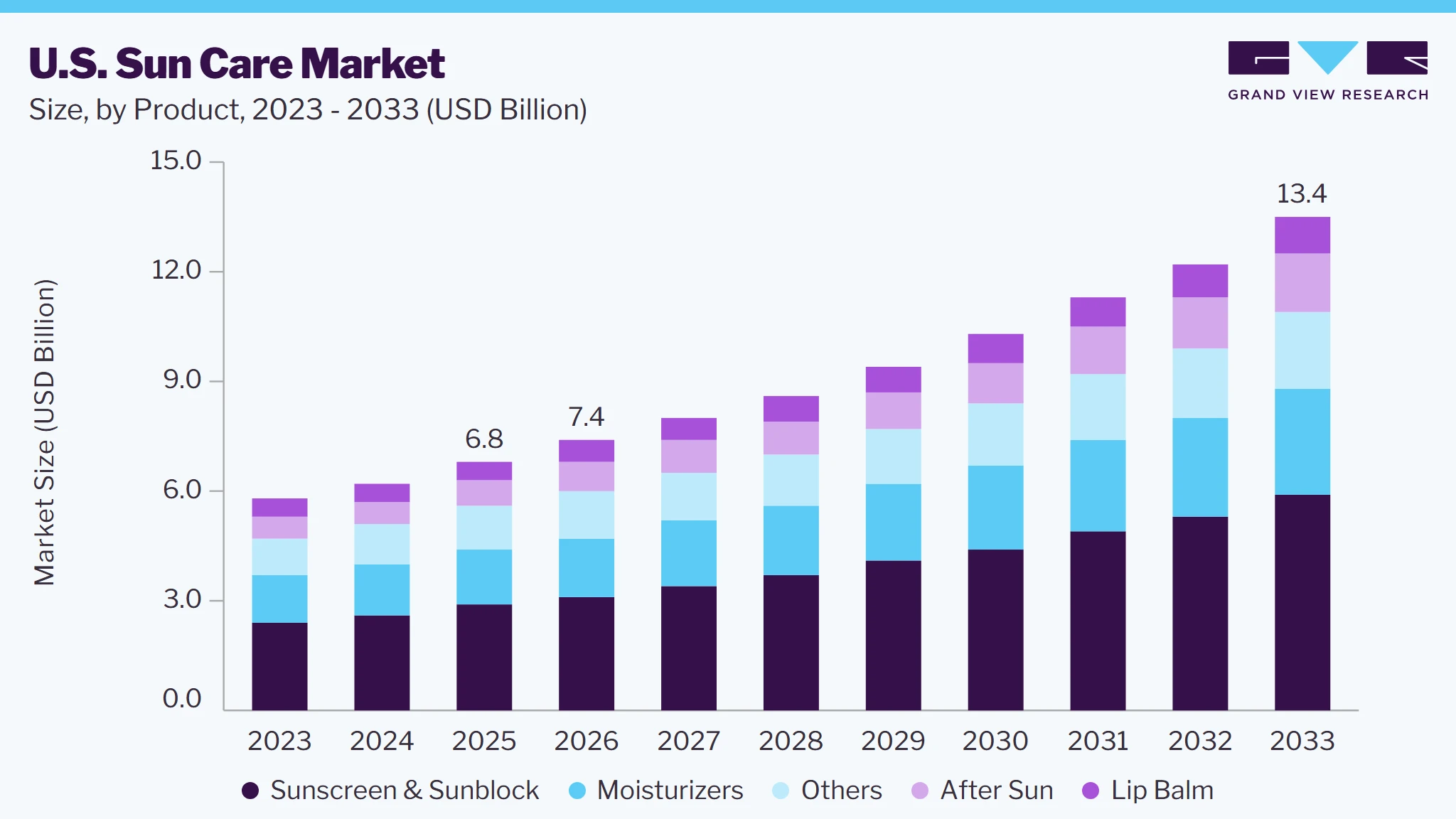
The U.S. sun care market size was valued at USD 6.8 billion in 2025 and is projected to grow from USD 7.4 billion in 2026 to USD 13.4 billion by 2033, at a CAGR of 8.9% from 2026 to 2033. The U.S. sun care industry is a mature skincare category supported by high awareness of ultraviolet (UV) protection, established sunscreen use, and continued product innovation across sunscreens, after-suns, moisturizers, lip balms, and other sun-protection products. Demand is supported by the health and preventive-care role of sun protection, with the American Academy of Dermatology recommending broad-spectrum, water-resistant sunscreen with SPF 30 or higher.
Key Market Trends & Insights
- By product: Sunscreen & sunblock segment held the largest revenue share of 42.1% in 2025.
- By format: Lotions held the largest revenue share of 43.4% in 2025.
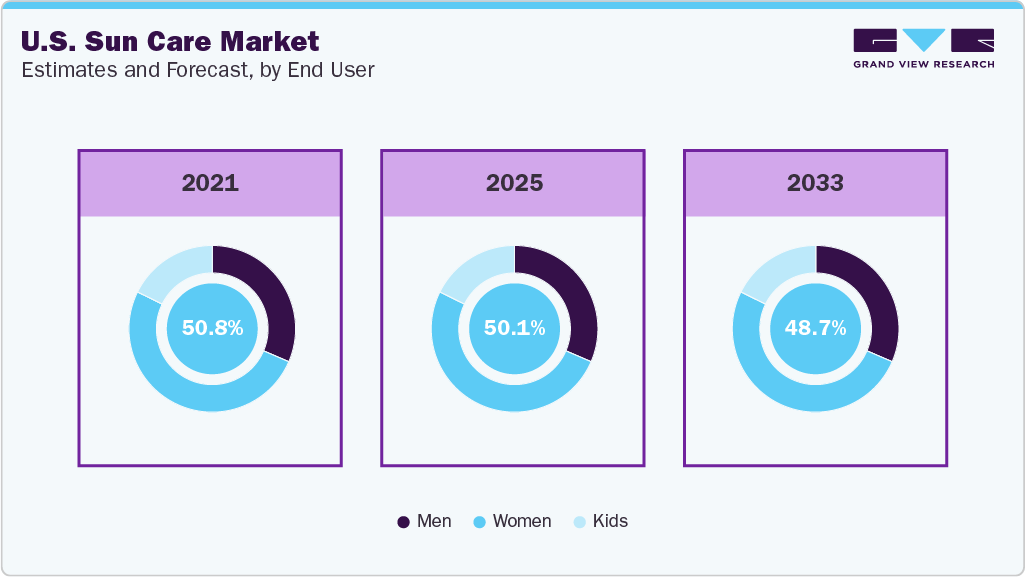
- By end user: Women segment held the largest revenue share of 50.1% in 2025.
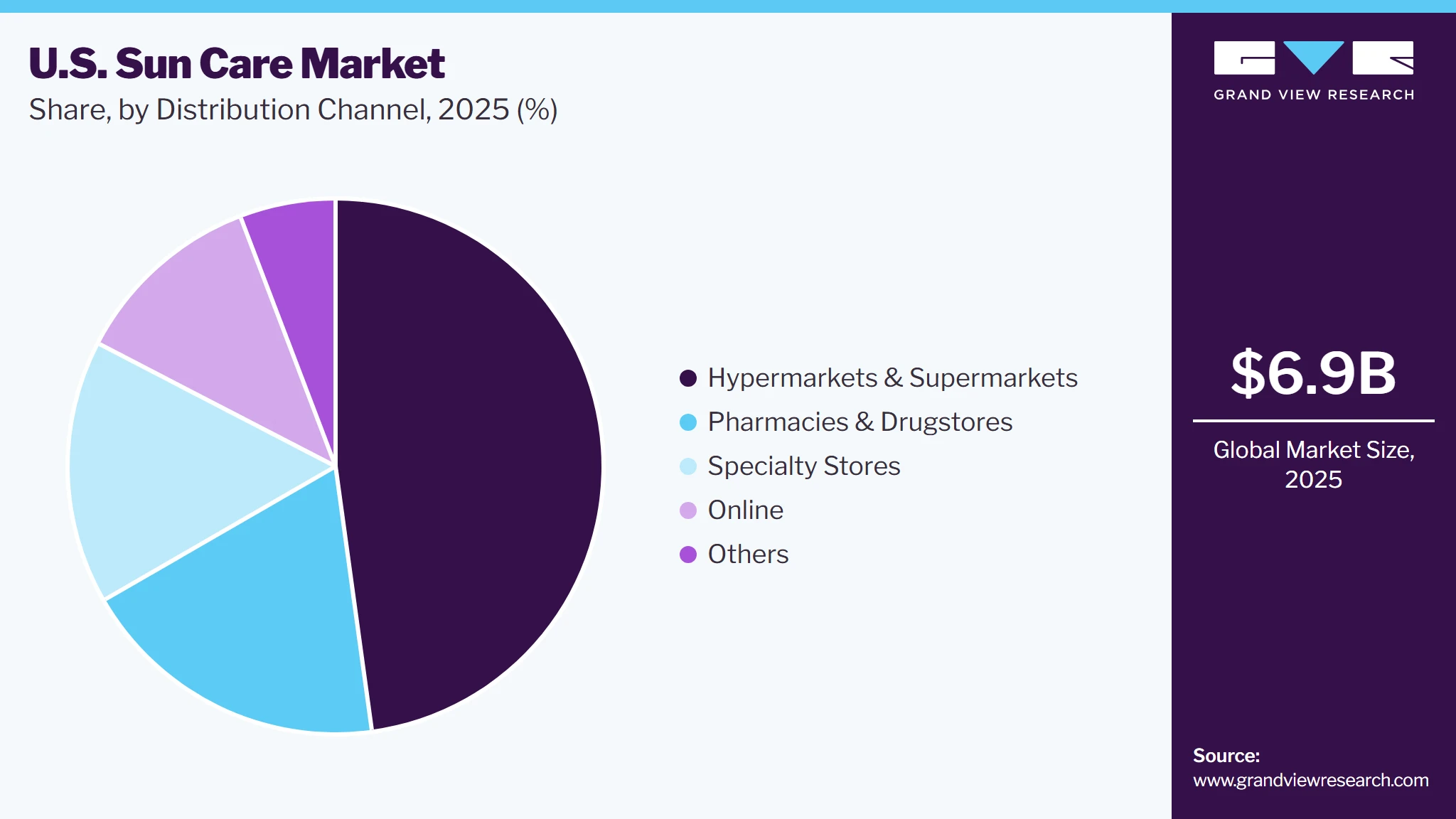
- By distribution channel: Hypermarkets & supermarkets held the largest revenue share of 48.2% in 2025.
Market Size & Forecast
- Market size in 2025: USD 6.8 Billion
- Estimated market size in 2026: USD 7.4 Billion
- Projected market size by 2033: USD 13.4 Billion
- CAGR (2026-2033): 8.9%
Three ways to get this report
Buy it, customize it, or ask a question.Ask an Analyst
Analyst response in 1 business day
- AccessReport author, directly
- Reply timeWithin 1 working day
- No sales callDirect answer only
- FormatEmail reply
- CostFree, no cost
Get the Full Report
What the study covers
- FormatsPDF · Excel · Dashboard
- Timeline2026–2033 annual, 2025 base
- Coverage20+ countries, 5 regions
- Companies10+ key players profiled
Customize the Report
20% free customization
- IncludeCountries, segments, points
- TailorTo your product definition
- ExtendDeeper competitor detail
- OrA fully bespoke study
- Turnaround5–10 working days
Sunscreen is increasingly positioned not only for protection against sunburn and skin cancer but also for the prevention of premature skin aging, dark spots, and other visible effects of UV exposure. The category is also diversifying across lotions, creams, sprays, gels, sticks, and other application formats, enabling brands to address different skin types, usage occasions, and consumer preferences. Product development is increasingly focused on lightweight textures, water resistance, tinted formulations, sensitive-skin positioning, and formulations that integrate sun protection with broader skincare benefits. Regulatory developments are also influencing innovation: in June 2026, the U.S. FDA added bemotrizinol to the OTC sunscreen monograph, marking the first addition of a new sunscreen active ingredient to the U.S. monograph since the late 1990s. At the same time, established brands and retailers are expanding the availability of sunscreen across mass merchants, drugstores, specialty beauty retailers, department stores, and e-commerce, strengthening year-round accessibility and supporting the shift toward daily sun protection rather than purely seasonal use.
 Source: Grand View Research, IR Documents, Primary Interviews, Paid DatabasesTo learn more about this report,
 Download Free Sample Report
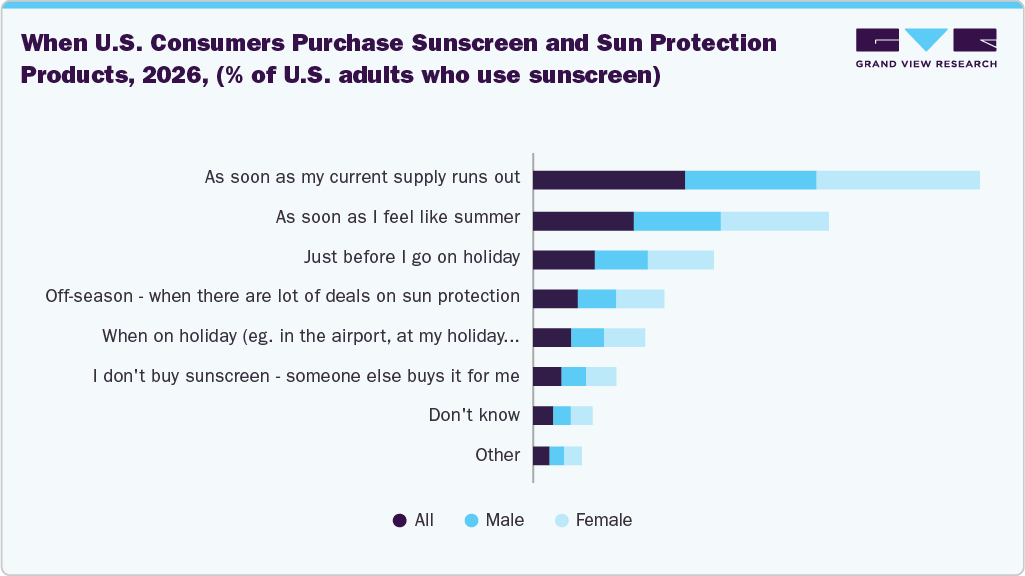
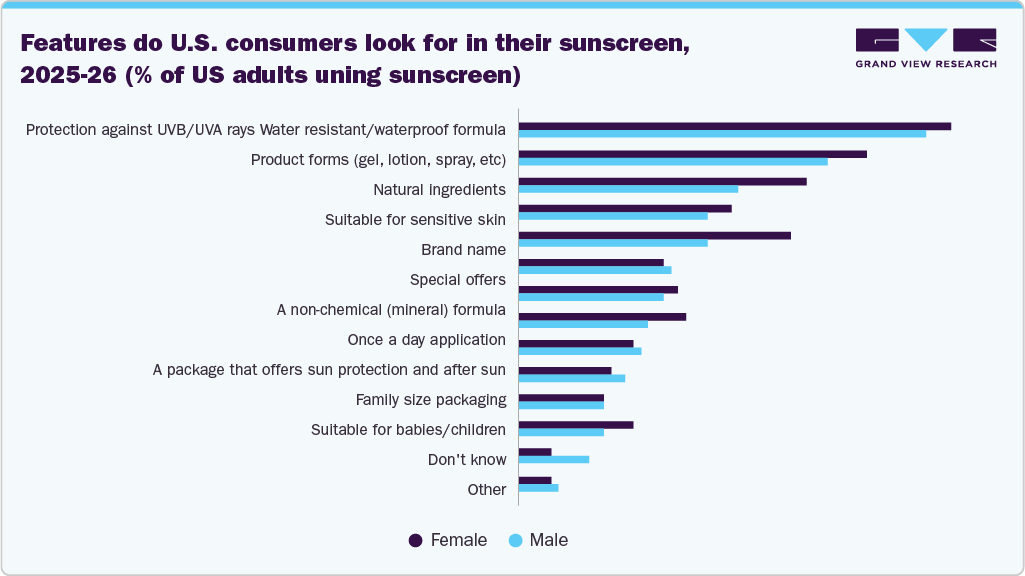
Consumer purchasing behavior is also supporting more frequent replenishment and product diversification within the category. According to YouGov’s 2026 U.S. consumer data, 46% of consumers purchase sunscreen when their existing supply runs out, while 30% purchase when summer begins, and 18% purchase before a holiday. Product performance remains more important than brand recognition: 55% of consumers prioritize UVA/UVB protection, 44% prioritize water resistance, 34% prioritize product format, and 31% prioritize suitability for sensitive skin. These preferences are encouraging brands to differentiate through texture, application experience, skin compatibility, and multifunctionality rather than relying solely on SPF positioning. For example, Beiersdorf expanded NIVEA SUN in 2025 with Protect & Moisture formulations incorporating antioxidant protection and hyaluronic acid, while its 2-in-1 Primer Daily UV Serum SPF50+ combines facial skincare, UV protection, and makeup-preparation benefits.
 To learn more about this report, Download Free Sample Report
Innovation in UV filters and high-performance formulations is another important growth catalyst. In June 2026, the FDA added bemotrizinol to the U.S. OTC sunscreen monograph, making it the first new sunscreen active ingredient added since the late 1990s. The ingredient can be used at concentrations of up to 6% and protects against both UVA and UVB radiation, creating additional formulation possibilities for U.S. sunscreen manufacturers. This regulatory development coincides with growing innovation in targeted skin care. For instance, L’Oréal’s La Roche-Posay launched Anthelios UVAIR SPF 50+ in 2025 with an ultra-light texture and hydration positioning, alongside Anthelios UVMUNE 400 Anti-Dark Spot Fluid, which combines long-UVA protection with hyperpigmentation-focused skincare benefits. The company reported that La Roche-Posay remained the largest growth contributor within its Dermatological Beauty division in 2025.
A further trend is the movement toward sun care as an integrated skincare category, particularly through facial products designed to fit into everyday routines. This is increasing the relevance of serums, primers, moisturizers, tinted products, and lightweight facial fluids alongside conventional body sunscreens. The emphasis on sensory characteristics is particularly significant because product feel can influence repeat usage; Beiersdorf, for example, highlighted non-greasy textures, rapid absorption, no-residue application, hydration, and antioxidant benefits in its 2025 NIVEA SUN innovations. Meanwhile, according to YouGov Profiles’ 2026 U.S. consumer data, 27% of consumers look for natural ingredients when selecting sunscreen, while 20% consider mineral formulations, special offers, and brand name. These preferences are creating opportunities for brands to segment the market by formulation philosophy, skin concerns, application format, and perceived skincare value, rather than by protection level alone.
The U.S. sun care market is evolving from a predominantly protection-focused category toward a broader, skincare-oriented market characterized by formulation innovation, multifunctionality, and greater product specialization. Rising interest in lightweight textures, sensitive-skin formulations, mineral and hybrid technologies, tinted products, and skincare-infused sunscreens is creating additional avenues for product differentiation. At the same time, the FDA’s inclusion of bemotrizinol in the U.S. sunscreen monograph provides manufacturers with an additional UV filter option and could support the development of new-generation formulations. With brands such as L’Oréal, Beiersdorf, Edgewell, Shiseido, and Unilever continuing to expand product portfolios across facial, body, and specialty sun care, competition is increasingly centered on efficacy, sensory experience, formulation technology, and broader skin health benefits.
Major Trends in the U.S. Sun Care Market
Trends
Description
Higher-protection formulations are expanding as consumers seek broader UV defense
Product innovation is increasingly moving toward high-SPF and broad-spectrum formulations that protect against a wider range of UV exposure conditions. Brands are extending protection beyond conventional SPF positioning through technologies targeting UVA, UVB, and, increasingly, longer-wavelength radiation. L’Oréal’s La Roche-Posay Anthelios UVMUNE 400 uses the company's Mexoryl 400 technology to address ultra-long UVA wavelengths, while the brand's U.S. portfolio includes products reaching SPF 60 and SPF 100. Edgewell has similarly expanded Banana Boat across high-SPF, sport, kids, and sensitive-skin propositions. The trend is increasing the emphasis on protection efficacy and encouraging manufacturers to differentiate products through filter technology and broad-spectrum performance rather than SPF number alone.
Visible-light and blue-light protection are creating new avenues for next-generation formulations
Sun care is increasingly addressing radiation beyond conventional UVA and UVB, particularly visible light associated with pigmentation and concerns about prolonged digital device exposure. Beiersdorf's research has focused on the effects of visible light on skin pigmentation and on the development of protective technologies for different skin tones. Its Eucerin Sun Pigment Control range, for example, combines UV protection with Thiamidol to address hyperpigmentation, while newer research within the company is examining how melanin-rich skin responds to sunlight and visible light. This is creating opportunities for brands to position advanced sun care around broader photoprotection and pigmentation management rather than limiting the proposition to traditional UVB-focused sunburn prevention.
Multifunctional formulations are combining sun protection with skincare and cosmetic benefits
Sun care products are increasingly expected to provide multiple benefits within a single application, reducing the need to layer separate skincare products. Beiersdorf's NIVEA SUN 2in1 Primer Daily UV Serum SPF50+ combines UV protection, hyaluronic acid, antioxidant licochalcone A, and makeup-primer functionality, while Eucerin Advanced Hydration SPF 50 combines broad-spectrum protection with hyaluronic acid and antioxidant ingredients. L’Oréal's La Roche-Posay has similarly expanded Anthelios with products addressing hydration, pigmentation, and other skin concerns alongside UV protection. This multifunctionality is broadening the competitive space between traditional sun care, facial skincare, and cosmetics while creating opportunities for premium products with higher perceived value.
Texture and cosmetic elegance are becoming important differentiators in everyday sunscreen
Formulation developers are increasingly focused on creating sunscreens that are lightweight, rapidly absorbed, non-greasy, and compatible with makeup, particularly as facial SPF becomes integrated into daily skincare routines. Supergoop!'s Unseen Sunscreen SPF 40 uses a clear, weightless gel formula with a makeup-gripping finish, while Shiseido's Clear Sunscreen Stick SPF 50+ provides a transparent, portable stick designed for convenient reapplication over or alongside makeup. Vacation's Classic Whip SPF 30 takes a different approach by using a whipped, mousse-like texture to make application more distinctive and experiential. In the inclusive sun-care segment, Black Girl Sunscreen Make It Matte SPF 45 is formulated as a lightweight gel that dries to a matte finish without leaving a visible cast. These products illustrate how brands are competing through texture, finish, application experience, and makeup compatibility in addition to conventional UV-protection claims.
Tinted and tone-adapting sunscreens are gaining relevance through pigmentation and cosmetic positioning
Tinted sun care is increasingly positioned as a bridge between UV protection, complexion correction, and daily makeup. EltaMD UV Clear Tinted SPF 46, for example, combines broad-spectrum protection with a tinted finish and is marketed toward consumers seeking a more cosmetically acceptable facial sunscreen. La Roche-Posay also offers Anthelios Mineral Tinted Ultra-Light Fluid SPF 50, combining mineral UV filters with a universal tint. Tinted formulations can provide additional cosmetic benefits while helping address the visible appearance of sunscreen on the skin, making them particularly relevant for facial use and consumers seeking products that can replace or complement complexion products. The expansion of these formats is supporting greater convergence between sun protection and color cosmetics.
Sustainability considerations are influencing packaging and formulation development
Environmental considerations are increasingly becoming part of sun care product development, particularly through packaging reduction, recyclable materials, and formulations designed to respond to consumer concerns around ingredients and aquatic environments. Beiersdorf has committed to increasing the share of recycled plastic in its packaging and reported that more than 50% of its plastic packaging was already designed for improved recyclability or reuse in 2025. The company has also been developing sun-care formulations with consideration for their environmental profile. Meanwhile, major brands are increasingly communicating packaging and formulation attributes alongside conventional SPF and skincare claims. Sustainability is therefore becoming a secondary differentiation factor in sun care, particularly as established brands seek to reduce packaging impact without compromising product stability, convenience, or protection performance.
These trends indicate that the U.S. sun care industry is evolving from a predominantly protection-focused category toward a more diversified, skincare-oriented, and multifunctional ecosystem, with brands increasingly addressing demand for high-performance UV protection, lightweight textures, targeted skin benefits, tinting, and advanced photoprotection. At the same time, product innovation is expanding across facial sunscreens, serums, sticks, sprays, tinted formulations, mineral and hybrid products, after-sun care, and skincare-infused SPF products, enabling consumers to incorporate sun protection into everyday skincare and beauty routines.
Market Dynamics
Skin cancer remains a significant public health concern in the U.S., strengthening the preventive role of sun care products. The CDC estimates that 6.1 million people are treated for basal cell and squamous cell carcinomas annually in the U.S., generating approximately USD 8.9 billion in treatment costs. Melanoma adds further urgency: the American Cancer Society estimates 112,000 new melanoma cases and 8,510 deaths in 2026, with incidence continuing to increase among adults aged 50 and older. Since most skin cancers are associated with excessive UV exposure, rising awareness of the link between cumulative sun exposure, sunburn, premature skin aging, and skin cancer is encouraging consumers to view sunscreen as a preventive health product rather than solely a seasonal beach-care item. This is reinforced by the FDA, which recommends regular use of broad-spectrum sunscreen and identifies UV exposure as a contributor to skin cancer and premature skin aging.
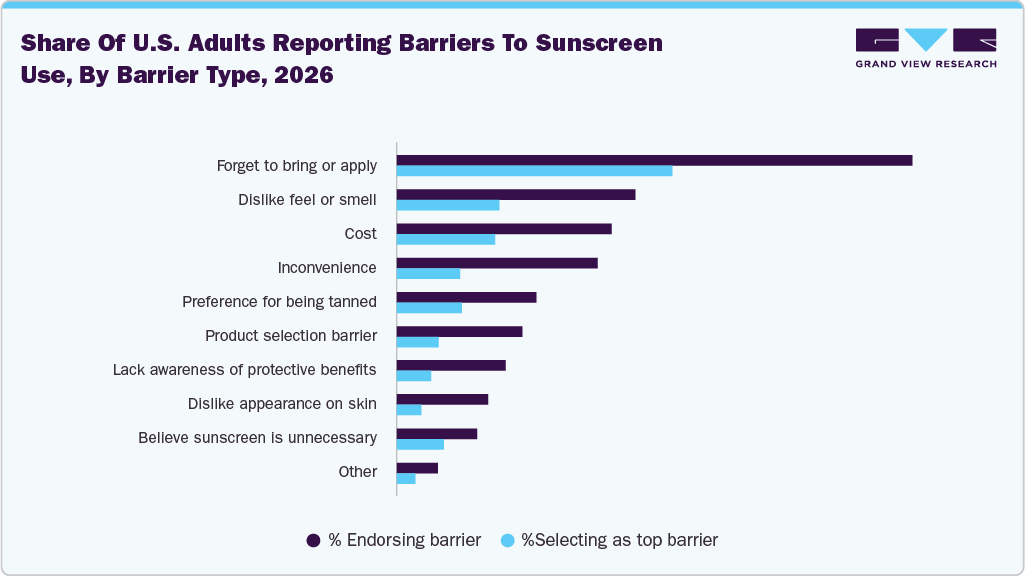
Consumer awareness is also translating into more frequent discussion of daily and year-round UV protection, expanding usage beyond summer vacations and outdoor recreation. The CDC reported that 88.1 million U.S. adults, or 35.1%, experienced at least one sunburn in 2024, while 18.8 million experienced four or more sunburns. Notably, 55.1% of adults who reported their most recent sunburn said it occurred despite using sunscreen, highlighting ongoing gaps in sunscreen application and reapplication. These gaps create opportunities for brands to compete through education, easier application formats, higher SPF, broad-spectrum protection, and products designed for daily facial use. Neutrogena, for example, has expanded its sun-safety positioning beyond product sales by training more than 7,000 pharmacists and 12,000 beauty consultants, partnering with the Melanoma Research Foundation and Walgreens, and supporting educational programming reaching 13.5 million teachers, students, and families. Such initiatives reinforce the shift toward routine UV protection and support sustained demand across facial, body, sport, and daily-use sunscreen categories.
Safety concerns surrounding chemical UV filters remain a restraint for the U.S. sun care market, particularly as consumers and regulators increasingly scrutinize ingredient exposure. FDA research has shown that several commonly used sunscreen actives can be absorbed through the skin. In a randomized clinical trial conducted under maximum-use conditions, four sunscreen ingredients produced systemic blood concentrations above the FDA’s 0.5 ng/mL threshold, although the clinical significance of these concentrations remains unknown, and the FDA has emphasized that absorption does not by itself establish harm. This evidence has contributed to continued regulatory scrutiny of ingredients such as oxybenzone, octinoxate, octocrylene, homosalate, octisalate, and avobenzone. As of 2026, the FDA states that additional data are still required to determine GRASE status for these ingredients, whereas zinc oxide and titanium dioxide have sufficient safety data to support GRASE status; the agency added bemotrizinol (BEMT) to the OTC sunscreen monograph in June 2026.
Product-safety incidents have reinforced consumer concerns. In July 2021, Johnson & Johnson recalled five Neutrogena and Aveeno aerosol sunscreen product lines after testing identified low levels of benzene, a carcinogenic contaminant, even though benzene was not an intentionally added ingredient. Edgewell Personal Care subsequently recalled three batches of Banana Boat Hair & Scalp Sunscreen Spray SPF 30 in 2022 after detecting trace levels of benzene. Environmental concerns add another layer of pressure: Hawaii prohibits the sale of sunscreens containing oxybenzone or octinoxate without a prescription, reflecting concerns over impacts on marine ecosystems and coral reefs. These developments can encourage consumers to shift toward mineral-based, fragrance-free, or “reef-conscious” formulations, while requiring manufacturers to invest in reformulation, ingredient testing, and clearer safety communication.
Multifunctional and cosmetic-hybrid sunscreens are creating an opportunity for U.S. sun-care brands to move the category beyond seasonal or beach-oriented protection toward daily skincare and beauty routines. This opportunity is supported by the high and persistent burden of UV-related skin conditions. In the U.S., the American Cancer Society estimates that approximately 5.4 million basal and squamous cell skin cancers are diagnosed among 3.3 million people annually, highlighting the importance of regular sun protection. At the same time, FDA guidance recognizes products combining makeup and sun protection as both cosmetic and drug products, creating a clear regulatory pathway for hybrid formats. This is encouraging brands to integrate SPF with tint, hydration, primers, anti-aging ingredients, oil control, and skin-tone correction, reducing the number of products consumers need in their routines. The opportunity is particularly relevant for facial sun care, where cosmetic finish and compatibility with makeup can influence everyday usage.
Company launches demonstrate how this positioning is already expanding. Supergoop! positions Unseen Sunscreen SPF 50 as an invisible primer, while its Mineral Mattescreen SPF 40 combines mineral SPF with tint, pore-blurring, mattifying, and makeup-prep benefits. Its sunscreen stick is also designed to glide over makeup, addressing a practical barrier associated with SPF reapplication. EltaMD UV Clear Tinted SPF 46 combines broad-spectrum protection with 5% niacinamide, light color coverage, and formulations targeted toward acne-prone and sensitive skin; its Deep Tinted version is specifically designed and tested for deeper skin tones. Furthermore, the FDA added bemotrizinol to the U.S. OTC sunscreen monograph in June 2026, the first new sunscreen active ingredient added in roughly two decades, potentially broadening formulation innovation. These developments create whitespace for brands to develop SPF foundations, skin tints, primers, moisturizers, treatment-SPFs, and reapplication formats that combine protection with visible skincare or cosmetic benefits.
Consumer Insights
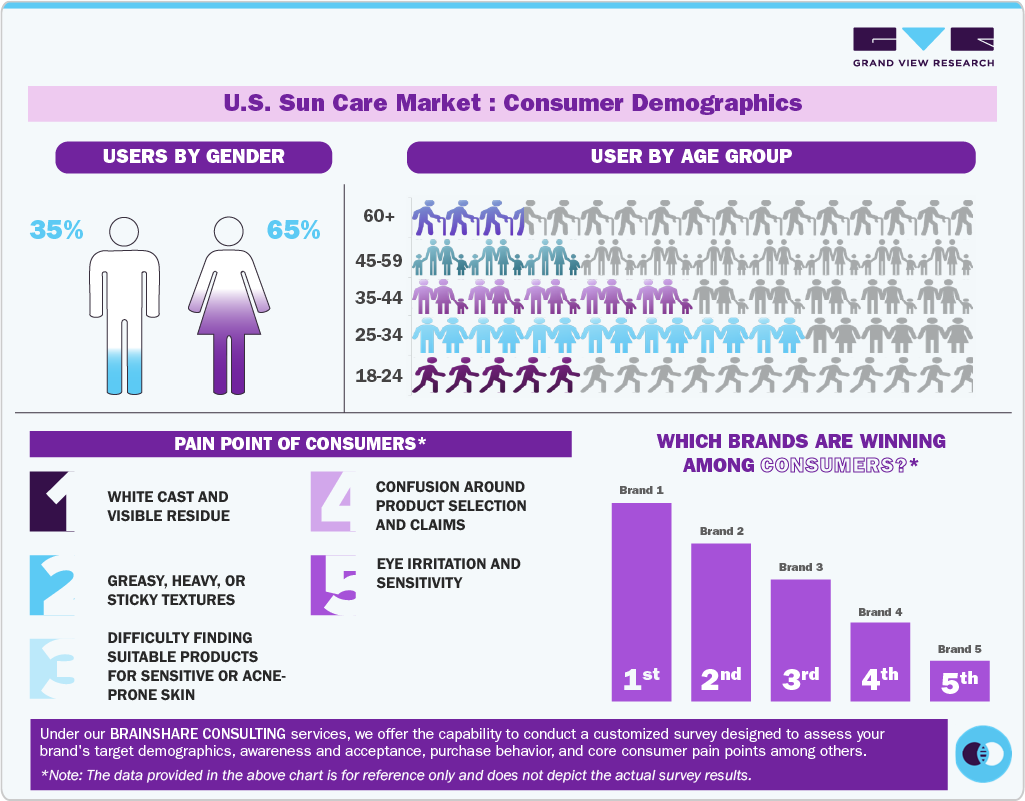
U.S. sun care consumption is evolving from a predominantly seasonal protection category toward a daily skincare and beauty-oriented routine. Consumers increasingly expect SPF products to provide more than UV protection, including hydration, skin-barrier support, invisible finishes, cosmetic compatibility, and convenient application. This shift is reflected in product innovation, with brands increasingly developing facial sunscreens in the form of serums, moisturizers, primers, tints, sticks, and sprays. Croda Beauty identifies this transition as a move toward products that combine “performance, pleasure and purpose,” with disruptive textures and multifunctional formats designed to encourage both application and reapplication.
 To learn more about this report, Download Free Sample Report
-
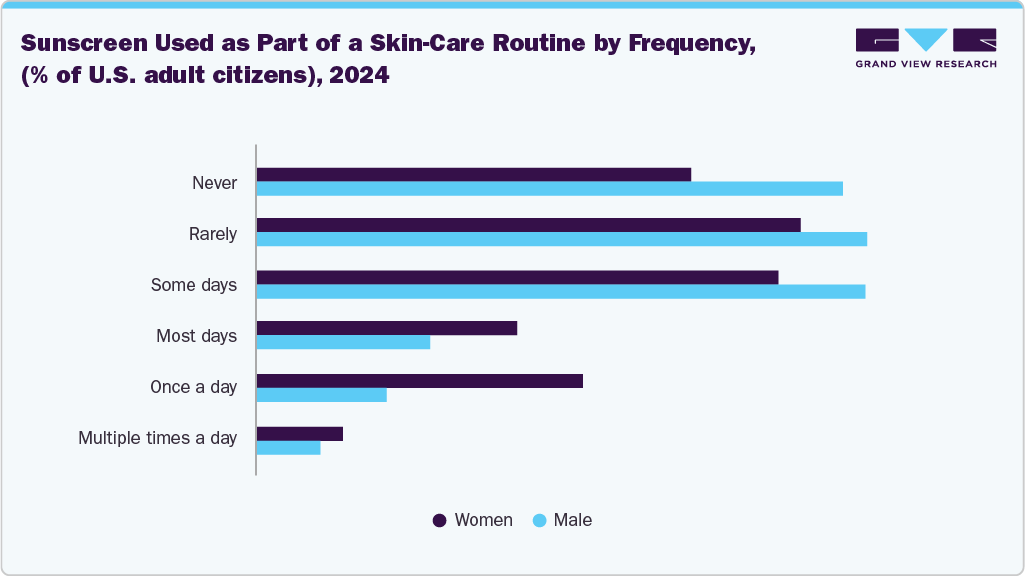
Sunscreen penetration is substantial but daily usage remains below broader skincare participation: The 56% regular-use rate reported by AAD indicates that sunscreen has become established among a significant share of U.S. adults, but usage is not yet universal. The gap with the 73% using anti-aging products or procedures suggests that consumers may recognize skincare benefits without consistently incorporating SPF into their routines. This creates whitespace for facial sunscreens positioned as an integral skincare step rather than an additional product.
 To learn more about this report, Download Free Sample Report
-
Usage frequency is influenced by routine integration and seasonality: Sunscreen consumption continues to exhibit seasonal characteristics, although purchasing behavior indicates year-round replenishment. A 2026 YouGov survey found that 46% of U.S. consumers purchase sunscreen when their existing supply runs out, while 30% purchase as summer begins, and 18% before a holiday. This indicates a combination of routine replenishment and occasion-driven consumption rather than purely summer-led purchasing.
-
Purchase frequency is increasingly supported by repeat replenishment: Circana's U.S. data for the 12 months ending March 2026 indicate that consumers purchased sun care products approximately three times per year, with average annual spending per buyer reaching USD 44.24. This suggests that sun care has moved beyond a single annual summer purchase for a meaningful portion of consumers, although purchase frequency remains relatively modest compared with daily-use skincare categories.
-
Protection performance remains the primary purchase driver, ahead of brand name: In YouGov's 2026 U.S. data, 55% of consumers cited UVA/UVB protection among the features they consider when choosing sunscreen, followed by water resistance at 44% and product format at 34%. By comparison, only 20% cited brand name, indicating that functional performance currently has greater stated importance than brand recognition alone.
 To learn more about this report, Download Free Sample Report
-
Facial SPF is increasingly being evaluated as a skincare product rather than only a protective product: Neutrogena's Invisible Daily Defense Face Serum SPF 60+ combines SPF with hydration, antioxidants, and skin-tone benefits, while EltaMD UV Clear Deep Tinted SPF 46 combines sun protection with niacinamide and positioning around sensitive, acne-prone, and deeper skin tones. Such formulations align SPF with established facial-skincare routines and expand the attributes consumers can evaluate beyond protection alone.
 To learn more about this report, Download Free Sample Report
-
Cosmetic compatibility is becoming a differentiating attribute of facial SPF: U.S. brands are increasingly designing sunscreen around the requirements of makeup and daily facial skincare. Supergoop!'s Unseen Sunscreen SPF 50 is positioned as an invisible, weightless formula that doubles as a makeup primer, while the brand's Glowscreen and Dewscreen products extend SPF into luminous and hydrating complexion-prep formats. CeraVe's Hydrating Sheer Sunscreen SPF 30 similarly combines mineral and chemical filters with hydration, a non-greasy finish, and makeup-priming functionality, demonstrating how cosmetic elegance is being incorporated directly into sun-care product design.
-
Brand consideration is increasingly reinforced through differentiated product ecosystems rather than sunscreen alone: Leading U.S. sun-care brands are expanding beyond conventional lotion formats into primers, tints, serums, sticks, sprays, and hybrid formulations. Supergoop!, for example, offers Unseen Sunscreen, Glowscreen, Protec(tint) Skin Tint, sunscreen sticks, and body formats, while CeraVe has extended its established skincare positioning into hybrid SPF. This portfolio approach allows brands to build consideration around specific routines and use occasions rather than relying solely on traditional sunscreen recognition.
-
Product innovation is increasingly focused on eliminating traditional sensory barriers: Newer U.S. SPF products emphasize invisible application, lightweight textures, non-greasy finishes, no white cast, and compatibility across skin tones. Supergoop! describes Unseen SPF 50 as a weightless, scentless formula with no white cast, while CeraVe positions its hybrid sunscreen around seamless blending, rapid absorption, and a velvety finish. These developments indicate that formulation aesthetics are becoming part of the product proposition alongside UV protection.
-
Multifunctionality is expanding the role of sunscreen within established beauty routines: U.S. product development increasingly combines SPF with hydration, makeup preparation, skin-smoothing, tint, and other skincare functions. Supergoop!'s Dewscreen Daily Hydrator + Primer SPF 50 combines SPF with hydration and makeup-priming claims, while CeraVe's Hydrating Sheer Sunscreen provides hydration and makeup-prep benefits in addition to sun protection. Such products blur the distinction among sun care, skincare, and complexion products, creating opportunities for SPF to occupy a more central position in morning routines.
U.S. sun care consumption is characterized by a gradual shift from seasonal protection toward daily skincare, while consumers continue to evaluate products primarily on protection performance, water resistance, format, skin compatibility, and perceived value. The growing overlap between SPF, facial skincare, and cosmetics is particularly significant, with serum sunscreens, tinted products, makeup primers, hydrating formulas, and skin-concern-specific products addressing different consumer needs. At the same time, premium sun care is gaining traction alongside mass products, suggesting that U.S. consumers are willing to spend more when SPF provides differentiated skincare, cosmetic, or sensory benefits.
Analyst Perspective
The U.S. sun care market is increasingly defined by daily, multifunctional protection rather than sunscreen use limited to outdoor or summer activities. Demand spans facial sunscreens, body lotions, sprays, sticks, after-sun products, SPF moisturizers, and lip balms, with consumers seeking formats that integrate easily into skincare routines. Product differentiation is increasingly centered on broad-spectrum protection, water resistance, lightweight textures, and cosmetic compatibility, particularly for facial applications. FDA regulatory developments are also influencing formulation innovation, including the 2026 addition of bemotrizinol as a permitted sunscreen active ingredient. Mineral formulations containing zinc oxide or titanium dioxide remain particularly relevant within the U.S. regulatory landscape.
Product Insights
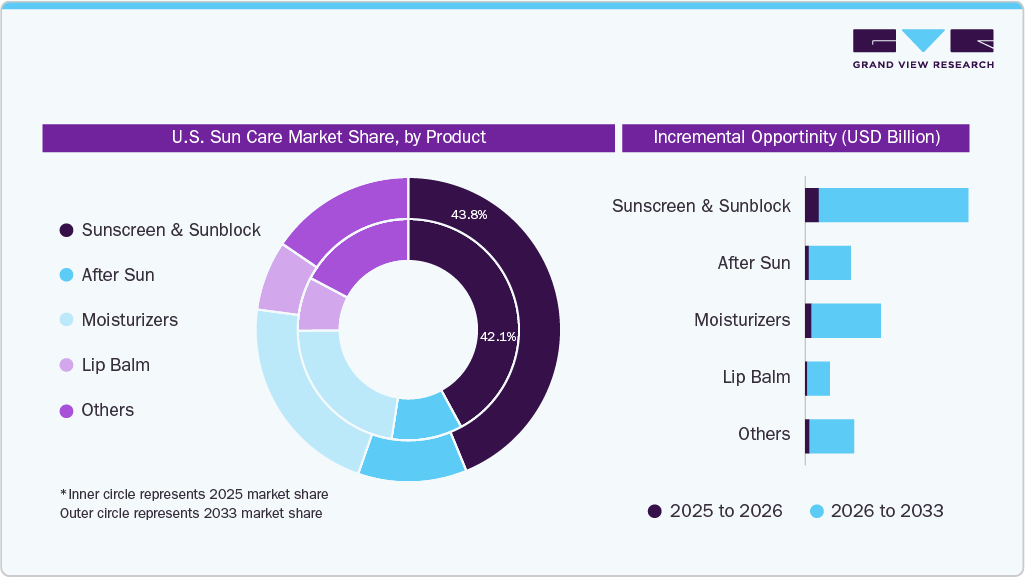
Sunscreen & sunblock dominated the U.S. sun care industry, accounting for a revenue share of 42.1% in 2025, reflecting the category's central role in preventing UV-related skin damage and supporting year-round sun-protection routines. The underlying demand is reinforced by U.S. public-health guidance; the CDC recommends sun protection throughout the year and advises consumers to use broad-spectrum sunscreen with an SPF of 15 or higher when the UV Index is 3 or above. The need for preventive protection is also evident in recent U.S. sunburn data: the CDC's 2024 National Health Interview Survey estimated that 88.1 million U.S. adults, or 35.1%, experienced at least one sunburn during the previous year, while 55.1% reported that their most recent sunburn occurred despite using sunscreen. In the commercial market, Circana recorded USD 2.7 billion in U.S. sun care sales in the 12 months ending March 2026, up 6% year over year, reinforcing the scale of demand for preventive sun-protection products.
 To learn more about this report, Download Free Sample Report
The after-sun products segment is projected to grow at the fastest CAGR of 10.4% from 2026 to 2033. Demand is supported by the sizeable incidence of sun exposure and sunburn in the U.S., creating opportunities for products positioned around cooling, soothing, and replenishing moisture following outdoor exposure. CDC data show that 60.6% of U.S. adults who experienced a sunburn in 2024 reported that their most recent sunburn occurred during water-related activities, while 24.7% cited exercising as the context. Brands are responding with differentiated post-exposure formats: Neutrogena's Sun Rescue range includes a replenishing lotion, rehydrating spray, and medicated relief gel, addressing moisturizing, cooling, and sunburn-relief needs, while Vaseline's Intensive Care Aloe Soothe Lotion targets hydration and soothing for sun-exposed skin.
Format Insights
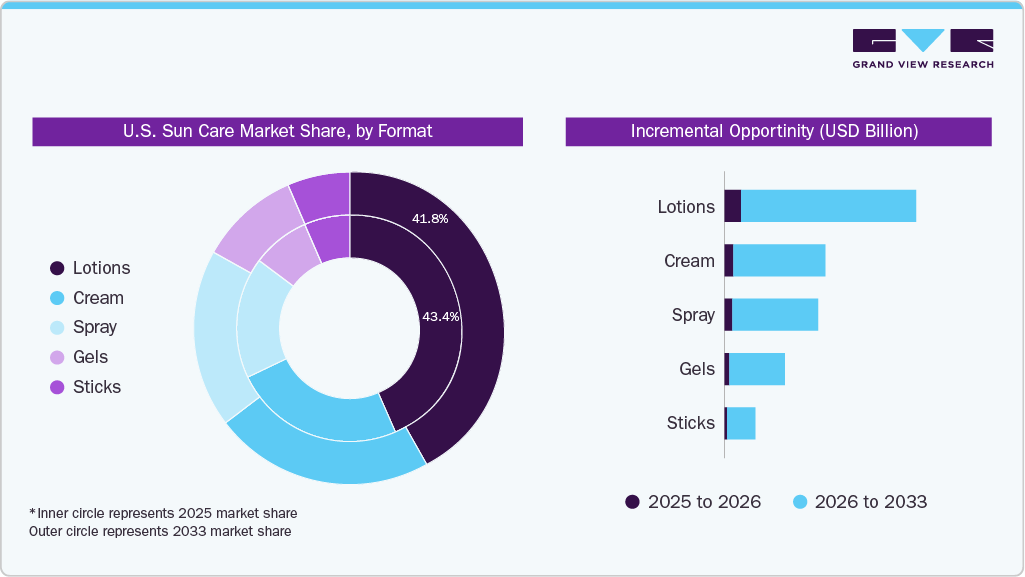
Lotions dominated the U.S. sun care market, accounting for a revenue share of 43.4% in 2025, reflecting their suitability for broad-area application and their established presence across mass-market and dermatological sunscreen portfolios. U.S. sunscreen guidance reinforces the relevance of formats that facilitate liberal application across exposed skin: the FDA recommends at least one ounce of sunscreen to cover the body of an average-size adult or child, while lotions remain among the dosage forms permitted for sunscreen products in the U.S. Leading brands continue to use the format across mainstream and specialized sun-care products, including body lotions and moisturizing sunscreen formulations, supporting its broad applicability across everyday, outdoor, and family-oriented use cases.
 To learn more about this report, Download Free Sample Report
The gels segment is projected to grow at the fastest CAGR of 12.1% from 2026 to 2033, as their lightweight texture and targeted application characteristics expand their relevance across facial, oily-skin, and hair-bearing use cases. The American Academy of Dermatology specifically identifies gels as suitable for hairy areas such as the scalp and the male chest, and notes their suitability for oily complexions. Products such as Neutrogena Hydro Boost Water Gel Lotion Sunscreen Broad Spectrum SPF 50 combine a water-light, non-greasy texture with broad-spectrum protection and are formulated for both face and body. Similarly, EltaMD UV Clear Broad-Spectrum SPF 46 is positioned as a lightweight, oil-free sunscreen for combination, oily, acne-prone, and sensitive skin, illustrating the role of lightweight gel-like textures in daily facial sun protection. These applications broaden the role of gel formats beyond conventional beach-oriented sunscreen toward daily facial, scalp, and targeted sun-protection routines.
End User Insights
Women accounted for 50.1% revenue share of the U.S. sun care industry in 2025, driven by the increasing integration of sun protection into daily skincare routines and concerns about visible sun-related skin damage. The American Academy of Dermatology recommends daily sunscreen use as part of skincare and notes that women may consider tinted sunscreens to avoid white cast, while sunscreen should also be applied before makeup as part of the morning routine. In addition, AAD guidance highlights sunscreen's role in addressing premature skin aging, including age spots, wrinkles, and other visible signs of cumulative UV exposure. This convergence of UV protection with skincare and appearance-related benefits supports continued demand for facial sunscreens, tinted SPF, moisturizing sunscreen, and other multifunctional products among women in the U.S.
 To learn more about this report, Download Free Sample Report
The kids segment is projected to grow at the fastest CAGR of 9.3% from 2026 to 2033, driven by age-specific sun-protection requirements and the increasing emphasis on protecting children from cumulative UV exposure. The American Academy of Dermatology recommends sunscreen for children 6 months and older with SPF 30 or higher, broad-spectrum, and water-resistant protection; it also notes that many children's products contain zinc oxide and titanium dioxide. This has encouraged the development of dedicated children's formulations that emphasize sensitivity-skin compatibility and simplified application. For example, pediatric-positioned sunscreens commonly use mineral filters and fragrance-free formulations, and spray formats are also recognized by the AAD as a preferred option for some parents because of ease of application. For infants younger than six months, the emphasis shifts toward shade and protective clothing rather than routine sunscreen use, creating a distinct age-specific positioning within the children's sun-care category.
Distribution Channel Insights
Hypermarkets & supermarkets accounted for 48.2% revenue share of the U.S. sun care market in 2025, reflecting the importance of mass retail as a primary purchase point for sunscreen and other sun-protection products. Circana confirms that mass retail was the leading channel for sun care sales in the U.S. during the 12 months ending March 2026, ahead of e-commerce, drug stores, beauty specialty retailers, and traditional grocery outlets. During the same period, the overall U.S. sun care category generated USD 2.7 billion in sales, up 6% year over year, while consumers spent an average of USD 44.24 per buyer annually on sun protection products. The combination of broad physical availability and recurring sunscreen purchases supports the continued importance of mass retail in the U.S. sun care distribution structure.
 To learn more about this report, Download Free Sample Report
The online segment is expected to grow at the fastest CAGR of 13.9% from 2026 to 2033. E-commerce already represents the second-largest U.S. sun care sales channel, according to Circana's data for the 12 months ending March 2026. Digital growth is being reinforced by the rapid expansion of higher-value SPF products: U.S. prestige sun care sales reached USD 774.9 million, up 11% year over year, while masstige SPF brands generated USD 323 million, up 23%. The stronger performance of premium and masstige sun care is particularly relevant to online retail, where consumers can access a wider assortment of facial sunscreens, mineral SPF, tinted products, and skincare-oriented formulations than is typically feasible within a single physical retail shelf.
Cross Segmentation Analysis
The study provides a detailed cross-segmentation analysis of the U.S. sun care market to assess how demand varies across product categories, formats, end users, and distribution channels. Beyond individual segment analysis, the report evaluates sunscreen & sunblock, after sun, moisturizers, lip balm, and other sun care products across lotions, creams, sprays, gels, and sticks, providing a granular view of format preferences within each product category. The analysis further cross-segments adult and kids’ sun care products by product type and format to identify differences in protection needs and purchasing patterns. In addition, product categories and formats are assessed across hypermarkets & supermarkets, specialty stores, pharmacies & drugstores, online, and other channels, enabling evaluation of channel-specific demand and digital adoption. Further cross-segmentation of men, women, and kids’ products across distribution channels provides insights into consumer purchasing behavior and channel preferences. These cross-segment insights help identify opportunities in format innovation, kids-focused protection, skincare-integrated sun care, online expansion, and targeted omnichannel portfolio strategies.
Key U.S. Sun Care Company Insights
 To learn more about this report, Download Free Sample Report
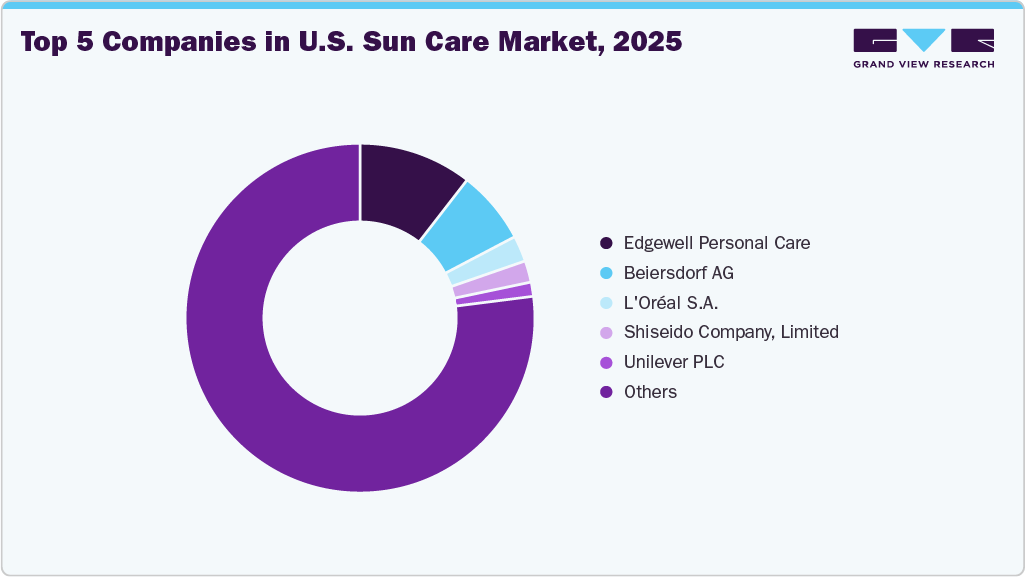
The U.S. sun care market is characterized by competition between mass-market sunscreen specialists, dermatological skincare brands, prestige sun protection portfolios, and lifestyle-oriented sun care companies. Competitive positions are shaped by brand recognition, SPF efficacy, water and sweat resistance, dermatological credibility, cosmetic sensorial properties, product formats, retail distribution, and the ability to address everyday facial SPF as well as outdoor, sport, family, and after-sun occasions. Edgewell's Banana Boat and Hawaiian Tropic provide substantial mass-market exposure, while Beiersdorf competes through Coppertone and its broader NIVEA and Eucerin skincare expertise. L'Oréal participates primarily through La Roche-Posay, CeraVe, and other dermatological skincare brands, whereas Shiseido brings premium sun protection through SHISEIDO and ANESSA. Unilever's exposure is comparatively smaller but includes SPF-oriented products within its Vaseline and skincare portfolio.
Company
Key Sun Care Brands / Portfolios
Competitive Positioning of Brands
Edgewell Personal Care
Banana Boat; Hawaiian Tropic; Sun Bum
Mass-market, sport, outdoor, family, and lifestyle-oriented sun care
Beiersdorf AG
Coppertone; Eucerin Sun; NIVEA Sun
Broad-market and dermatological sun protection across mass and premium-functional segments
L'Oréal S.A.
La Roche-Posay Anthelios; CeraVe; SkinCeuticals
Dermatological, facial, and skincare-integrated sun protection
Shiseido Company, Limited
SHISEIDO; ANESSA
Premium, technology-driven, and high-performance UV protection
Unilever PLC
Vaseline; SPF-enabled skincare portfolio
Skincare and body-care-led expansion into everyday SPF protection
-
Leading Sun Care Companies & Brand Portfolios: Edgewell has one of the most concentrated U.S. sun care portfolios among top companies, with Banana Boat and Hawaiian Tropic serving as its principal sun care brands. In its FY2025 10-K, Edgewell stated that these two brands held a leading combined market share position in the U.S. and competed across general protection, sport, kids, baby, tanning, and after-sun categories. Its Sun and Skin Care segment generated USD 743.1 million in net sales in FY2025, although Sun Care itself declined 4.1% during the year amid unfavorable U.S. weather and increased competition.
-
Mass-Market Reach & Outdoor Positioning: Mass and outdoor sun care remains important because sunscreen is widely purchased for vacations, beaches, sports, swimming, and family use. Edgewell's competitive strength is particularly relevant to the high-volume portion of U.S. sun care because Banana Boat and Hawaiian Tropic address multiple usage occasions rather than concentrating solely on facial or premium SPF. The company's portfolio includes lotions, sprays, and products positioned for sports, outdoor activities, family use, and tanning. Importantly, Edgewell reported that U.S. sun care category consumption increased approximately 17% in Q2 FY2026, while the company gained 180 basis points of U.S. value share, driven primarily by Hawaiian Tropic, despite a slight decline in Banana Boat. This indicates that its competitive position can move materially with seasonal demand and brand-specific innovation.
-
Beiersdorf - Dermatological Credibility & Mass-to-Premium Coverage: Beiersdorf competes through Coppertone, NIVEA, and Eucerin, giving the company exposure across traditional sunscreen, everyday skincare, and dermatological sun protection. Beiersdorf's Consumer business generated USD 9.24 billion in sales in 2025, with North America generating USD 1.13 billion and organic growth of 3.8%. The company specifically reported that Eucerin and Aquaphor were among the key North American growth drivers, while Coppertone sales remained significantly below the prior year. At the broader brand level, NIVEA generated USD 6.25 billion globally in 2025, with NIVEA Sun identified among the positive contributors to brand performance.
-
Dermatological Sun Care & Everyday SPF: L'Oréal's competitive position is increasingly linked to the convergence of sunscreen and skincare. Its La Roche-Posay, CeraVe, and SkinCeuticals brands provide access to consumers seeking dermatologist-oriented products and skincare benefits alongside UV protection. L'Oréal's Dermatological Beauty division generated €7.20 billion in 2025 sales, up 5.5% like-for-like, with La Roche-Posay remaining its largest growth contributor. The company also reported that only 18% of U.S. men and 42% of U.S. women use sunscreen every day, highlighting the sizeable opportunity for products designed to make daily SPF easier to incorporate into skincare routines.
-
Product Innovation & Cosmetic-Elegance: Companies are differentiating through lightweight textures, invisible finishes, water and sweat resistance, high UVA/UVB protection, and products compatible with makeup and daily skincare.L'Oréal has been using formulation and texture innovation to address one of the central barriers to regular sunscreen use, product feel. In 2025, La Roche-Posay introduced Anthelios UVAIR SPF 50+ and Anthelios UVMUNE 400 Anti-Dark Spot Fluid, with the latter combining ultra-long-UVA protection with an anti-pigmentation proposition. L'Oréal also highlighted its more than 85 years of sun-protection research and continued investment in formulations designed to improve daily SPF adoption. These developments illustrate the shift in U.S. sun care from basic UV protection to products that combine SPF with hydration, pigmentation management, anti-aging, and skincare benefits.
-
Premium Sun Care & Asian Technology: Premiumization is particularly visible in facial and specialty sun care, where consumers increasingly value advanced UV protection, lightweight textures, anti-aging benefits, pigmentation care, and makeup compatibility.Shiseido's competitive presence is more heavily concentrated in premium and prestige sun protection than in mass-market sunscreen. Its portfolio includes SHISEIDO and ANESSA, with technology platforms such as WetForce supporting water- and activity-oriented protection. Shiseido reports that its WetForce-enabled SHISEIDO sunscreen became No. 1 in the U.S., Italy, and China following its 2016 introduction, although this is a historical product-level claim rather than a current U.S. market share measure. More recently, the company introduced ANESSA Perfect UV Brush-on Powder, addressing reapplication over makeup and combining UV protection with a portable brush format.
-
Premiumization & Skincare-Sun Care Convergence: Competition is increasingly extending beyond conventional sunscreen into multi-benefit SPF products, particularly facial products combining UV protection with hydration, anti-aging, pigmentation control, barrier support, and cosmetic benefits. L'Oréal's Anthelios portfolio, Shiseido's premium UV products, Beiersdorf's Eucerin sun care, and Unilever's SPF-oriented Vaseline products illustrate different approaches to the same structural shift. This expands the addressable market from seasonal beach and outdoor sunscreen toward daily skincare routines, while also creating opportunities for premium pricing and differentiated formulations.
-
Distribution & Omnichannel Competition: Distribution remains a major differentiator because U.S. sun care spans mass merchants, drugstores, supermarkets, specialty beauty retailers, dermatology-oriented channels, and e-commerce. Mass brands such as Banana Boat, Hawaiian Tropic, and Coppertone benefit from broad retail availability, while La Roche-Posay, CeraVe, and Shiseido can leverage pharmacy, specialty beauty, and skincare-oriented channels. L'Oréal reported that e-commerce remained its primary growth engine across all four divisions in 2025, reinforcing the importance of digital discovery and online availability for premium and dermatological sun care.
The U.S. sun care industry is characterized by competition across mass-market sunscreen, outdoor and sport protection, dermatological SPF, premium facial sun care, and SPF-infused skincare. Edgewell maintains a strong specialist presence through Banana Boat and Hawaiian Tropic, supported by broad product coverage and extensive retail distribution, while Beiersdorf competes through Coppertone alongside the dermatological positioning of Eucerin. L'Oréal is strengthening its position through skincare-led sun protection under La Roche-Posay and CeraVe, whereas Shiseido targets premium consumers through SHISEIDO and ANESSA. Unilever participates through SPF extensions within its broader skincare portfolio. Competitive differentiation is increasingly influenced by formulation technology, sensory experience, dermatological credibility, brand equity, retail reach, and the integration of sun protection into everyday skincare routines.
 To learn more about this report, Download Free Sample Report
Key U.S. Sun Care Companies
The following key companies have been profiled for this study of the U.S. sun care market.
-
Beiersdorf AG
-
Shiseido Company, Limited
-
L'Oréal S.A.
-
Edgewell Personal Care
-
Unilever PLC
-
Johnson & Johnson Services, Inc.
-
W. S. Badger Company
-
Clarins Group
-
Coty Inc.
-
The Estee Lauder Companies Inc.
Competitive Benchmarking
Category
Operating Strategies
Competitive Edge
Weakness
Established Players (Beiersdorf AG; Shiseido Company, Limited; L'Oréal S.A.; Edgewell Personal Care; Unilever PLC; Johnson & Johnson Services, Inc.; Clarins Group; Coty Inc.; The Estée Lauder Companies Inc.)
- Expand sun care portfolios across sunscreen, sun protection, after-sun care, sun care moisturizers, lip protection, and specialized formulations while strengthening presence across mass, premium, pharmacy, specialty beauty, and e-commerce channels.
- Invest in advanced UV protection technologies, skincare-infused formulations, water- and sweat-resistant products, mineral and hybrid sunscreen technologies, and dermatologist-oriented positioning.
- Leverage established brand portfolios, marketing capabilities, retailer relationships, and omnichannel distribution to capture demand across everyday, sports, family, and premium sun protection applications.
- Strong brand recognition, broad product portfolios, extensive retail and distribution networks, and substantial marketing capabilities support high consumer visibility and market penetration. Established relationships with pharmacies, mass retailers, department stores, specialty beauty retailers, and online platforms enable broad accessibility.
- Significant R&D capabilities and skincare expertise also support innovation in high-SPF, broad-spectrum, sensitive-skin, anti-aging, and multifunctional sun care products.
- High exposure to regulatory requirements, ingredient restrictions, raw material costs, and intense competition across mass and premium price tiers.
- Large organizations can face longer product development and commercialization cycles, while maintaining extensive portfolios and retail networks can increase operational complexity.
- Strong competition from specialist sunscreen brands and digitally native players can also pressure market share in targeted consumer segments.
Specialty & Premium Sun Care Players (W. S. Badger Company)
- Focus on specialized, ingredient-conscious, and environmentally oriented sun care products, emphasizing mineral sunscreen formulations, natural or organic positioning, sensitive-skin applications, and transparent ingredient communication.
- Utilize specialty retailers, natural-product channels, direct-to-consumer platforms, and digital marketing to reach consumers seeking alternative formulations and sustainability-oriented products. Differentiate through focused product portfolios and brand positioning rather than broad category coverage.
- Strong specialization in natural and mineral-based sun protection, distinctive brand positioning, and appeal among consumers prioritizing ingredient transparency, organic formulations, and environmentally conscious purchasing.
- Greater portfolio flexibility enables faster adaptation to niche consumer preferences and specialized product requirements.
- Smaller scale, limited distribution reach, and lower marketing resources compared with multinational beauty and personal care companies.
- Greater dependence on niche consumer segments and specialty retail channels can limit mass-market penetration, while premium positioning may increase sensitivity to discretionary spending and competitive pricing.
Recently Closed Transactions
Trends
Description
RoundTable Healthcare Partners Acquires Colorescience
In February 2026, RoundTable Healthcare Partners acquired Colorescience from a shareholder group led by 1315 Capital, in a transaction with undisclosed financial terms. Headquartered in California, Colorescience specializes in mineral-based, clinically validated skincare and sun protection products and serves dermatologists, plastic surgeons, aestheticians, and medical spas. The acquisition strengthens RoundTable’s consumer healthcare portfolio while providing Colorescience with additional resources to expand brand awareness, deepen channel penetration, and broaden its product portfolio across professional, direct-to-consumer, and e-commerce channels.
VMG Partners Invests in Vacation
In March 2026, VMG Partners made a minority investment in Vacation, a U.S.-based sunscreen and body-care brand known for its nostalgia-led positioning and fragrance-oriented sun protection products. Industry sources reported that VMG invested approximately USD 70 million, primarily through secondary proceeds, at a valuation of approximately USD 210 million. The investment supports Vacation’s next phase of growth as it expands its retail presence and develops its portfolio across sun care, body care, and adjacent personal-care categories.
Crown Laboratories Acquires Revance Therapeutics
In April 2025, Crown Laboratories completed its acquisition of Revance Therapeutics, creating a broader U.S. dermatology and skincare platform. Revance’s portfolio includes Blue Lizard Australian Sunscreen, a U.S. mineral sun protection brand, alongside aesthetic and therapeutic dermatology products. The transaction enables Crown to combine its consumer skincare portfolio with Revance’s professional and specialty dermatology capabilities, while expanding its reach across physician-led, retail, and consumer channels. The deal is relevant to the U.S. sun care market because Blue Lizard adds an established mineral sunscreen franchise to Crown’s broader skincare platform.
Recent Developments
-
In September 2026, Neutrogena launched Ultra Sheer Daily Face Sunscreen SPF 70 and Clear Face Sunscreen SPF 60 in the U.S., becoming among the first products to incorporate newly permitted UV filter Bemotrizinol (BEMT). The formulations combine BEMT with Neutrogena’s Helioplex360 technology, targeting lightweight, broad-spectrum facial protection and acne-prone skin. Both products are priced at USD 16.99 and launched through Amazon.
-
In August 2026, Australian suncare brand Ultra Violette launched Unblock Screen SPF 50 in the U.S., becoming the first sunscreen to use Bemotrizinol (BEMT), following the FDA’s approval of the filter in June 2026. The launch introduces a broad-spectrum, photostable UV filter designed for lightweight, skincare-oriented formulations, initially available through Ultra Violette and Sephora.
-
In August 2026, BASF launched Tinosorb S (Bemotrizinol) in the U.S. following FDA approval of the UV filter in June. Under a license agreement with DSM Nutritional Products, BASF received co-exclusive rights to market and sell the ingredient during the FDA’s 18-month exclusivity period. Tinosorb S provides broad-spectrum UVA/UVB protection and high photostability, expanding formulation options for U.S. sunscreen manufacturers.
-
In August 2026, CeraVe launched Invisible Mineral Sunscreen SPF 50 in the U.S., supported by a Gen Z-focused campaign addressing tanning culture and barriers associated with mineral sunscreen use. The formulation is designed to minimize white cast while combining broad-spectrum protection with ceramides, niacinamide, and glycerin, highlighting the continued development of skincare-oriented mineral sunscreens.
-
In May 2026, Dr. Squatch entered the U.S. sun care market with its first SPF product, launching a mineral SPF 30 spray sunscreen targeted toward men. The zinc oxide-based formula emphasizes natural-origin ingredients, a lightweight application experience, and reduced greasiness, reflecting the expansion of sun protection into men’s personal care and lifestyle-oriented brands.
-
In April 2026, ILIA Beauty launched Sun Serum Mineral Sunscreen SPF 50 in the U.S., introducing its first standalone sunscreen. The product combines mineral UV protection with skincare positioning, including hyaluronic acid and Aquaxyl, and launched through Sephora and ILIA’s own online channel, illustrating the convergence of sun protection, skincare, and premium beauty.
-
In April 2026, SkinCeuticals introduced Future Mineral UV Defense SPF 50 in the U.S., combining zinc oxide and titanium dioxide with skincare actives and positioning the product around both daily UV protection and anti-aging benefits. The launch also targets post-procedure skincare, reflecting the increasing specialization of facial sunscreens around aesthetic treatments, skin health, and cosmetic benefits.
Sun Care Market Report Scope
Report Attribute
Details
Market size in 2025
USD 6.8 billion
Estimated market size in 2026
USD 7.4 billion
Projected market size by 2033
USD 13.4 billion
Growth rate
CAGR of 8.9% from 2026 to 2033
Base year
2025
Actuals
2021 - 2025
Forecast period
2026 - 2033
Quantitative units
Revenue in USD billion and CAGR from 2026 to 2033
Report coverage
Revenue forecast, company ranking, competitive landscape, growth factors, and trends
Segments covered
Product, format, end user, distribution channel
Country scope
U.S.
Key companies profiled
Beiersdorf AG; Shiseido Company, Limited; L'Oréal S.A.; Edgewell Personal Care; Unilever PLC; Johnson & Johnson Services, Inc.; W. S. Badger Company; Clarins Group; Coty Inc.; The Estee Lauder Companies Inc.
Customization scope
Free report customization (equivalent up to 8 analysts’ working days) with purchase. Addition or alteration to country, regional & segment scope.
Pricing and purchase options
Avail customized purchase options to meet your exact research needs. Explore purchase options
U.S. Sun Care Market Report Segmentation
This report forecasts revenue growth at the country level and provides an analysis of the latest trends and opportunities in each of the sub-segments from 2021 to 2033. For this study, Grand View Research has segmented the U.S. sun care market report based on product, format, end user, and distribution channel:
-
Product Outlook (Revenue, USD Billion, 2021 - 2033)
-
Sunscreen & Sunblock
-
After Sun
-
Moisturizers
-
Lip Balm
-
Others
-
-
Format Outlook (Revenue, USD Billion, 2021 - 2033)
-
Lotions
-
Cream
-
Spray
-
Gels
-
Sticks
-
-
End User Outlook (Revenue, USD Billion, 2021 - 2033)
-
Men
-
Women
-
Kids
-
-
Distribution Channel Outlook (Revenue, USD Billion, 2021 - 2033)
-
Hypermarkets & Supermarkets
-
Specialty Stores
-
Pharmacies & Drugstores
-
Online
-
Others
-
-
Product by End User Outlook (Revenue, USD Billion, 2021 - 2033)
-
Sunscreen & Sunblock
-
Men
-
Women
-
Kids
-
-
After Sun
-
Men
-
Women
-
Kids
-
-
Moisturizers
-
Men
-
Women
-
Kids
-
-
Lip Balm
-
Men
-
Women
-
Kids
-
-
Others
-
Men
-
Women
-
Kids
-
-
-
Product by Distribution Channel Outlook (Revenue, USD Billion, 2021 - 2033)
-
Sunscreen & Sunblock
-
Hypermarkets & Supermarkets
-
Specialty Stores
-
Pharmacies & Drugstores
-
Online
-
Others
-
-
After Sun
-
Hypermarkets & Supermarkets
-
Specialty Stores
-
Pharmacies & Drugstores
-
Online
-
Others
-
-
Moisturizers
-
Hypermarkets & Supermarkets
-
Specialty Stores
-
Pharmacies & Drugstores
-
Online
-
Others
-
-
Lip Balm
-
Hypermarkets & Supermarkets
-
Specialty Stores
-
Pharmacies & Drugstores
-
Online
-
Others
-
-
Others
-
Hypermarkets & Supermarkets
-
Specialty Stores
-
Pharmacies & Drugstores
-
Online
-
Others
-
-
Research Methodology
The U.S. sun care market figures in this report are based on a proven research process that combines executive interviews with secondary research from proprietary databases, company filings, and recognized regulatory and institutional sources. Market size is built through value-chain sizing-reconciling supply-side and demand-side estimates-and triangulated with bottom-up and top-down approaches. Every estimate passes multiple levels of expert validation before publication, with each U.S. sun care segment quantified using the revenue-capture definitions in the table below.
Segment Definition
Product
Revenue capture definition
Sunscreen & Sunblock
Includes topical products formulated primarily to protect against ultraviolet radiation, including broad-spectrum and SPF-rated sunscreen products for face and body. The scope includes mineral and chemical sunscreen formulations available as lotions, creams, sprays, gels, sticks, and other applicable topical formats, including water-resistant variants.
After Sun
Includes products applied after sun exposure to soothe, cool, hydrate, moisturize, or replenish skin affected by environmental and ultraviolet exposure. The scope encompasses after-sun lotions, gels, creams, sprays, balms, and related formulations containing ingredients such as aloe vera, glycerin, moisturizers, antioxidants, and skin-conditioning agents.
Moisturizers
Includes facial and body moisturizing products positioned with sun-protection or post-exposure benefits, including SPF-containing moisturizers and daily hydration products with UV protection. The scope encompasses creams, lotions, gels, emulsions, and similar formulations designed to moisturize skin while incorporating sun-protection functionality where applicable.
Lip Balm
Includes lip-care products formulated to moisturize, condition, protect, or soothe the lips in connection with sun exposure. The scope encompasses conventional lip balms, SPF lip balms, protective lip treatments, and similar stick or balm formulations containing sunscreen actives or other ingredients intended for lip protection.
Others
Includes sun-care products that do not fall within sunscreen and sunblock, after-sun products, moisturizers, or lip balms. The scope encompasses complementary products such as specialized sun-protection treatments, powders, oils, mousses, and other topical formulations marketed for UV protection or sun-exposure-related skin care.
Format
Revenue capture definition
Lotions
Includes fluid or semi-fluid sun-care formulations designed for topical application across the face or body. The scope encompasses sunscreen lotions, after-sun lotions, moisturizing lotions with sun-protection functionality, and related products distributed in pump, squeeze, tube, or other dispensing packaging. FDA recognizes lotion among permissible sunscreen dosage forms.
Cream
Includes thicker, emulsion-based sun-care formulations intended for topical application and providing protection, hydration, soothing, or post-exposure care. The scope encompasses sunscreen creams, SPF moisturizers, after-sun creams, and other cream-based products formulated for facial, body, or targeted skin application.
Spray
Includes aerosol, pump, mist, and continuous-spray sun-care products designed to distribute formulations across exposed skin. The scope encompasses sunscreen sprays, after-sun sprays, moisturizing sprays with sun-protection functionality, and comparable spray-based topical products intended for convenient application to facial or body areas.
Gels
Includes lightweight, gel-based sun-care formulations designed for rapid topical application and absorption. The scope encompasses sunscreen gels, cooling after-sun gels, hydrating sun-care gels, and other gel formulations used for UV protection, skin soothing, hydration, or post-exposure care across relevant facial and body applications.
Sticks
Includes solid or semi-solid stick formulations designed for direct application to skin or lips. The scope encompasses sunscreen sticks, facial sun-protection sticks, lip SPF products, targeted application sticks, and related sun-care formulations intended for convenient, portable, or precision application to exposed areas.
Estimation Model
Sun Exposure & Protection Need Layer
Sun Protection Need & Affordability Layer
Product Adoption & Consumption Layer
Monetisation Layer
Where does potential demand for sun care products exist?
Which consumers are realistically addressable for sun care purchases?
What sun care products are being purchased and used?
How much is spent on perfumes & fragrances products?
The U.S. population forms the primary consumer base, with demand shaped by age, gender, outdoor exposure, geographic location, climate, lifestyle, and sun-protection awareness. Relevant indicators include population size, outdoor recreation participation, and pool activity, sports participation, travel, UV exposure, and seasonal sun intensity. Demand is considered across facial and body sun care applications and relevant consumer use occasions.
Household income, discretionary spending, skin type, sun sensitivity, outdoor activity, geographic exposure, and consumer awareness establish the economically and practically addressable consumer base. Product suitability is further influenced by SPF requirements, water/sweat resistance, formulation preferences, skin concerns, and usage occasions. Premium and specialized products are assessed separately based on consumers' willingness and ability to pay.
Demand is differentiated across sunscreen & sunblock, after-sun care, sun care moisturizers, lip balms, and other sun care products. Usage frequency, reapplication behavior, seasonal outdoor activity, product format preferences, SPF requirements, and skincare integration provide observable indicators of category consumption. FDA guidance specifically recognizes multiple legally marketed sunscreen dosage forms, including lotions, creams, sticks, gels, oils, pastes, sprays, and powders.
Annual unit demand is valued using segment-specific ASPs across sunscreen lotions/creams, sprays, sticks, gels, and other relevant sun-care formats. Revenue reflects differences in SPF, formulation, ingredients, claims, packaging, product size, premium positioning, and brand equity. Facial sun care, specialized formulations, and premium/dermatological products can command higher ASPs than mass-market body sunscreen.
Delivered Customizations
This report has been delivered with the following In-depth customizations
Client Request
Customization Delivered
Value Adds
Cross-Segmentation Analysis of Sun Care Products Across Consumer Targets and Formats
Detailed cross-segmentation of the U.S. sun care market across Sunscreen & Sunblock, After Sun, Moisturizers, Lip Balm, and Others, mapped against Lotions, Creams, Sprays, Gels, and Sticks, with further differentiation between Adult and Kids applications. The analysis identifies which product-format combinations are most relevant across consumer groups and where format preferences vary by product category.
Identifies areas where specific formats are gaining relevance within major sun care categories, such as lightweight gels and sprays for active/outdoor use, sticks for portability and targeted application, and creams/lotions for everyday protection. It also highlights opportunities for brands to develop age-specific formats and extend successful formats across adjacent product categories.
SPF & Protection-Level Opportunity Mapping
Assessment of the market by SPF/protection positioning, including everyday protection, higher-SPF protection, and specialized protection claims, mapped across sunscreen, facial/body moisturizers, lip products, and other sun care formats. The analysis evaluates how protection positioning differs across adult and kids products and identifies areas of product-line concentration.
Helps identify where brands can differentiate through higher protection, daily-use positioning, broad-spectrum protection, and specialized applications rather than competing solely on product format. It also provides a framework for assessing whitespace between mass-market everyday products and more specialized protection offerings.
Sun Care Product Positioning & Ingredient/Claim Benchmarking
Comparative benchmarking of major U.S. sun care brands across mineral vs. chemical positioning, broad-spectrum claims, water/sweat resistance, sensitive-skin positioning, moisturizing benefits, anti-aging benefits, clean/natural claims, reef-conscious positioning, and dermatologist-oriented positioning.
Helps distinguish competitors based on functional and formulation positioning, rather than only revenue or product category. It also identifies areas of claim saturation and emerging positioning opportunities, particularly where sun protection is increasingly integrated with skincare benefits.
Frequently Asked Questions About This Report
The U.S. sun care market size was valued at USD 6.8 billion in 2025 and is estimated at USD 7.4 billion in 2026.
The U.S. sun care market is expected to grow at a CAGR of 8.9% from 2026 to 2033, reaching USD 13.4 billion by 2033.
Sunscreen & sunblock segment held the largest revenue share of 42.1% in 2025 while after-sun products segment is expected to be the fastest-growing market.
The Lotions segment held the largest revenue share of 43.4% in 2025, while gels are projected to be the fastest-growing format segment.
Women accounted for 50.1% revenue share of the U.S. sun care industry in 2025, driven by the increasing integration of sun protection into daily skincare routines and concerns about visible sun-related skin damage.
Hypermarkets & supermarkets held the largest revenue share of 48.2% in 2025, and online segment is second fastest growing market
Some key players include Beiersdorf AG; Shiseido Company, Limited; L'Oréal S.A.; Edgewell Personal Care; Unilever PLC; Johnson & Johnson Services, Inc.; W. S. Badger Company; Clarins Group; Coty Inc; The Estée Lauder Companies Inc.
Key factors include growing consumer awareness of UV protection, increasing demand for high-SPF and multifunctional sun care products, rising adoption of lightweight and cosmetically elegant formulations, expanding demand for specialized products for children and different skin needs, and increasing availability through online channels.
About the Author(s)
Beauty & Personal Care Research Team
Consumer Goods · Beauty & Personal CareThis report was authored by the beauty & personal care research team at Grand View Research - comprising two research analysts, one senior research analyst, and one industry expert - with specialized expertise in the beauty & personal care segment of the consumer goods industry. All findings are based on proprietary consumer goods databases, executive interviews, and regulatory analysis, subject to internal peer review prior to publication.
Last Updated:
Speak to Analyst

Customize this report to your needs - add regions, segments, or data points, with 20% free customization.
Or view our licence options:


ISO 9001:2015 & 27001:2022 Certified
We are GDPR and CCPA compliant! Your transaction & personal information is safe and secure. For more details, please read our privacy policy.


