
- Home
- »
- Healthcare IT
- »
-
U.S. Urgent Care Centers Market Size, Industry Report, 2033GVR Report cover

U.S. Urgent Care Centers Market (2026 - 2033) Size, Share & Trends Analysis Report By Application (Acute Respiratory Infection, Injuries, Joint/Soft Tissue Issues), By Ownership (Hospital, Corporation), By Region, And Segment Forecasts
U.S. Urgent Care Centers Market Summary
The U.S. urgent care centers market size was valued at USD 36.4 billion in 2025 and is expected to reach USD 75.0 billion by 2033, growing at a CAGR of 9.8% from 2026 to 2033. The growth is attributed to the delivery of rapid services and short wait times compared to primary care physicians (PCPs). In addition, the growing burden of chronic diseases and the geriatric population coupled with the rising number of urgent care centers are propelling market growth. According to Trilliant Health study published in May 2024, the number of urgent care centers in the U.S. experienced a nearly two‐fold increase between 2014 and 2023. Specifically, the count grew from 7,220 in 2014 to 14,382 in 2023, which represents a 99.2% increase.
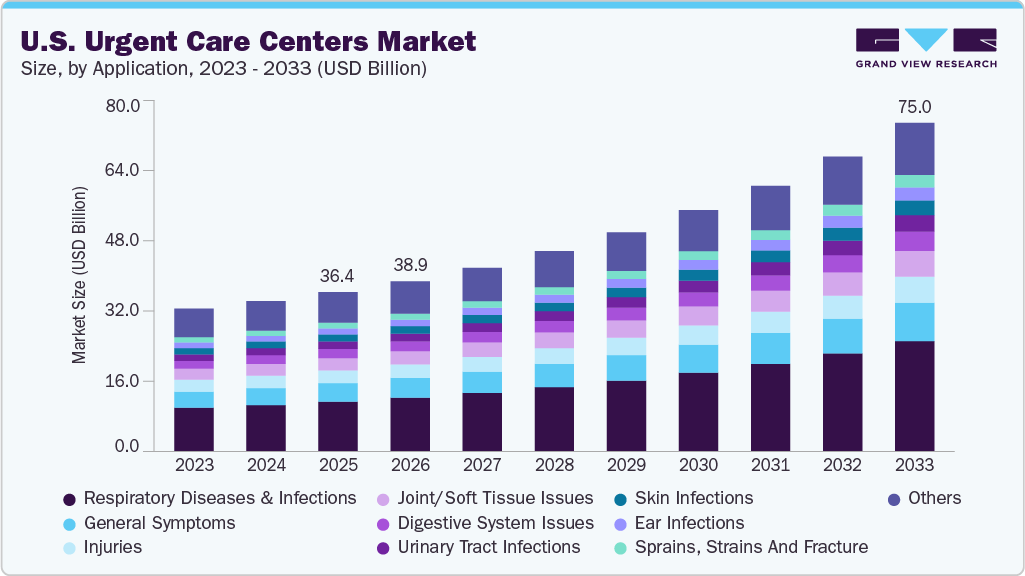 Source: Grand View Research, IR Documents, Primary Interviews, Paid DatabasesTo learn more about this report,
 Download Free Sample Report
 The section below outlines the key factors driving the growth of the U.S. urgent care centers industry, highlighting rising patient demand, cost advantages over emergency departments and primary care providers, and expanding service capabilities. It also examines the role of telehealth integration, technology adoption, and reduced wait times in strengthening urgent care as a preferred point of care.
Market Drivers
The demand for urgent care services has been increasing to help manage different types of emergencies such as heart attacks, stroke, electrical shock, and severe burns. Emergency rooms treat patients based on the severity of their condition, which requires an average treatment time of 2 hours and 15 minutes from the time patients arrive until they depart. Furthermore, an urgent care center is a link between emergency room services and primary care physicians. These centers provide immediate care to patients who need access to their primary care physicians. According to the Urgent Care Association (UCA), in 2023, there were more than 14,230 urgent care centers in the U.S. Moreover, according to UCA, more than 206 million people in the U.S. are treated in urgent care settings in the U.S. Urgent care centers can offer nearly all the services provided in an emergency room or a traditional doctor’s office.
Moreover, the average cost of treatment at UCCs is much lower compared to the PCPs, which is majorly contributing to the increase in the patient influx at these facilities. It treats similar conditions for which patients tend to visit PCPs. The average cost of treatment at these facilities without insurance ranges from USD 80 to USD 280 for acute treatment and around USD 140 to USD 440 for more advanced treatment. The average cost of PCPs without insurance ranges from USD 300 to USD 600, which is considerably higher compared to UCCs.
Telehealth adoption has developed a huge demand for these facilities in the U.S. As per the Harvard Business News published in January 2023, telehealth has emerged as a critical component of the U.S. healthcare system. Its integration into mainstream healthcare practices offers numerous benefits, including increased access to care, convenience for patients, and potential cost savings for both providers and patients.
In addition, urgent care centers in the U.S. are increasingly adopting new technologies to enhance patient care, improve operational efficiency, and expand service offerings. The integration of wearables and RPM technologies is gaining traction. These tools enable continuous monitoring of patients' health metrics, facilitating proactive management of chronic conditions and reducing hospital readmissions. For instance, in July 2024, UCHealth's Virtual Health Center uses remote video-capture technology to monitor patients at risk of falls, enhancing safety without requiring constant in-person supervision.
The waiting time in urgent care centers in the U.S. is less than that in physician clinics. Patients can always seek treatment at their local ED. According to the American College of Emergency Physicians, most EDs are "at or near capacity." According to a 3-year analysis of Blue Cross and Blue Shield (BCBS) of Texas, the average wait time in EDs remained over 4 hours, and the cost of average ED care is 10 times that of an urgent care visit for the same condition. The estimated reduction in yearly cost from using urgent care services instead of ED services for appropriate care is more than USD 4.4 billion.
Market Dynamics
The U.S. urgent care centers market is fragmented, with many small players entering the market and launching new innovative facilities & services. The degree of innovation is high, the level of mergers & acquisitions activities is medium, the impact of regulations on the market is high, and the service expansion of the market is high.
Innovations include integration of urgent care features into various platforms reflect a broader shift in healthcare consumer behavior towards seeking immediate and convenient care options. For instance, in In February 2025, Zocdoc announced the launch of an urgent care feature within its healthcare marketplace. The launch of an urgent care feature by Zocdoc is a strategic move aimed at improving patient access to immediate medical care for acute health issues. By integrating urgent care services into its existing platform, Zocdoc enables patients to easily find and book appointments with urgent care centers. This convenience is crucial, as many individuals face barriers when seeking timely medical attention, such as long waiting times or difficulty in locating nearby facilities.
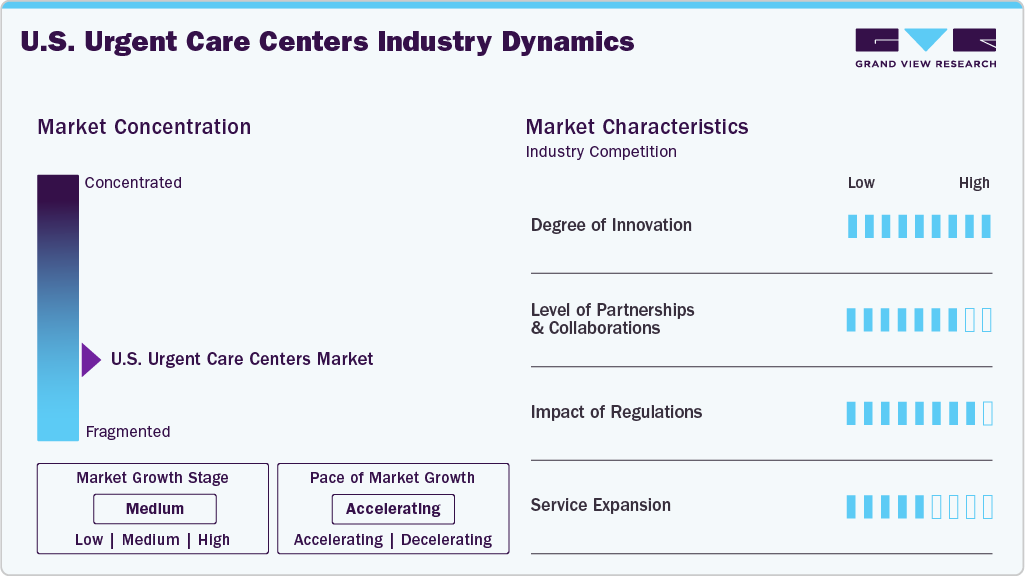 To learn more about this report, Download Free Sample Report
 The market saw notable consolidations as larger operators sought to expand their reach and capabilities. For instance, Ardent Health made significant strides in expanding its urgent care services through strategic acquisitions. In January 2025, the company announced the acquisition of 18 urgent care clinics from NextCare Urgent Care, located across New Mexico and Oklahoma. This move is part of Ardent Health’s broader strategy to enhance access to healthcare services in mid-sized urban communities.
The impact of regulations on the U.S. urgent care centres industry is high, with strict guidelines influencing device development and deployment. The reimbursement landscape for urgent care services is influenced by both federal programs such as Medicare and Medicaid as well as private insurers. Regulatory changes affecting reimbursement rates can directly impact the financial viability of urgent care centres. For instance, if reimbursement rates decrease or if certain services are excluded from coverage, UCCs may struggle to maintain profitability.
Service expansion efforts are evident as urgent care centres aim to penetrate underserved markets across the U.S. In December 2023, Northwest Urgent Care, has completed the acquisition of certain urgent care centres owned and operated by Carbon Health in Arizona. Northwest Healthcare now has over 80 care sites within its network. This expansion is significant as it enhances resource allocation, improves patient access to urgent care services, and ensures better continuity of care across various healthcare settings.
Application Insights
The respiratory diseases & infections segment led the U.S. urgent care centers market, accounting for the largest revenue share of 31.3% in 2025. Its dominance is attributed to the rising demand for these categories owing to the growing prevalence of respiratory conditions. In April 2023, the National Center for Biotechnology Information highlighted the U.S. National Health and Nutrition Examination Survey III (NHANES III), in which, approximately 19.2% of COPD cases are expected to be attributed to workplace exposures across the general population. This statistic highlights the significant impact that occupational environments can have on respiratory health. Among never-smokers, the fraction of COPD attributable to workplace exposures is even higher at 31.1%.
The urinary tract infections segment is expected to grow at the fastest CAGR over the forecast period. Its growth is attributed to the growing prevalence of antimicrobial resistance, which complicates outpatient treatment options and leads to more patients seeking care in urgent care facilities. As traditional first-line oral antimicrobials become less effective, patients who might have previously managed their UTIs at home are now presenting with more severe symptoms that necessitate urgent medical attention. The demographic shift also plays a role; women, particularly those aged 18-24 and older adults, are among the most affected groups, leading to higher visit rates to urgent care centers for UTI management.
Ownership Insights
The hospital segment led the U.S. urgent care centers industry, accounting for the largest share of 41.1% in 2025. Its dominance is attributed to the growing interest of healthcare systems such as HCA, Aurora Health, Community Health Systems (CHS), Carolinas Healthcare, Dignity Health, and others; to provide accessible care at an affordable price. For instance, in December 2024, Northwest Urgent Care, a subsidiary of Community Health Systems (CHS), successfully acquired urgent care centers previously owned and operated by Carbon Health in Arizona. This acquisition is part of Northwest Healthcare’s strategy to expand its integrated healthcare network that serves Tucson and the surrounding communities.
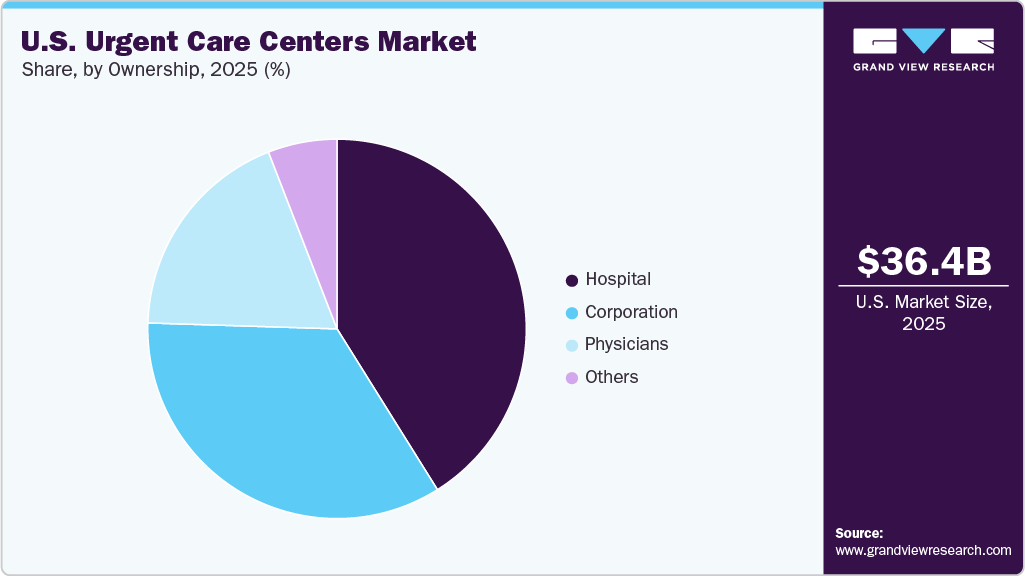 To learn more about this report, Download Free Sample Report
 The corporation segment is expected to grow at a lucrative CAGR over the forecast period. Its growth is attributed to the private equity firms which have become increasingly involved in the urgent care sector, acquiring smaller centers and forming partnerships with multi-site operators. Companies Such as FastMed and American Family Care exemplify this trend, actively pursuing acquisitions to expand their market presence. The financial backing from private equity provides growth resources and enhances operational efficiencies through shared best practices and technology integration.
Regional Insights
The Southeast U.S. urgent care centers market held the largest revenue share in 2025. Its dominance is driven by rapid population growth, an expanding elderly demographic, and rising prevalence of chronic diseases. The region has experienced strong in-migration, particularly among retirees, increasing demand for accessible, same-day care services. High rates of conditions such as diabetes, cardiovascular disease, and respiratory illnesses further support the need for convenient walk-in facilities.
The West U.S. urgent care centers industry segment is expected to grow at a lucrative CAGR over the forecast period. Its growth is driven by rapid population expansion, urban sprawl, and increasing demand for accessible, cost-effective healthcare services. The region has experienced strong demographic growth, including aging populations and migrant inflows, which has increased the burden on hospital emergency departments and primary care networks. Urgent care centers provide shorter wait times and significantly lower treatment costs compared to emergency rooms, making them an attractive alternative for non-life-threatening conditions.
Key U.S. Urgent Care Centers Company Insights
Some of the emerging companies in the market are NextCare (nextcare.com); Pediatric Urgent Care Piscataway; FastMed Urgent Care; Tiny Pediatrics; and RCE Technologies, Inc. The strategies of key players to strengthen their market presence include new product launches, partnership & collaborations, mergers & acquisitions, and geographical expansion. For instance, in May 2023, HCA Healthcare signed an agreement to purchase 41 urgent care centers from FastMed, to enhance its healthcare services in Texas. This acquisition includes 19 locations branded as FastMed and 22 under the MedPost branding. The urgent care centers are strategically located across major Texas cities, including Dallas, Austin, San Antonio, Houston, and El Paso.
Key U.S. Urgent Care Centers Companies:
- Concentra, Inc.,
- American Family Care
- CityMD Urgent Care
- MedExpress Urgent Care
- NextCare Urgent Care
- Tenet Health Urgent Care
- FastMed Urgent Care
- Ascension Health Urgent Care
- Aurora Urgent Care
- WellNow Urgent Care
- Sutter Health
- Intuitive Health
- HCA Healthcare
Three ways to get this report
Buy it, customize it, or ask a question.Ask an Analyst
Analyst response in 1 business day
- AccessReport author, directly
- Reply timeWithin 1 working day
- No sales callDirect answer only
- FormatEmail reply
- CostFree, no cost
Get the Full Report
What the study covers
- FormatsPDF · Excel · Dashboard
- Timeline2026–2033 annual, 2025 base
- Coverage20+ countries, 5 regions
- Companies10+ key players profiled
Customize the Report
20% free customization
- IncludeCountries, segments, points
- TailorTo your product definition
- ExtendDeeper competitor detail
- OrA fully bespoke study
- Turnaround5–10 working days
Recent Developments
-
In July 2025, the University of Maryland Urgent Care is expanding its services by opening two new locations in Anne Arundel County. This initiative aims to enhance access to urgent care services for residents in the area, providing them with timely medical attention for non-life-threatening conditions.
-
In September 2024, Yale New Haven Health (YNHH) officially rebranded its urgent care centers, marking a significant change in its healthcare service offerings. This rebranding was highlighted with the opening of a new facility located at 340 Grasmere Ave. in Fairfield, Connecticut. This location is notable as it is the first to operate under the newly adopted name of Yale New Haven Health Urgent Care.
-
In July 2024, Virginia Mason Franciscan Health (VMFH) entered a partnership with Intuitive Health, a company known for its innovative approach to healthcare delivery. This collaboration aims to enhance access to healthcare services for residents in the Puget Sound region. The partnership is designed to address the growing demand for accessible and efficient healthcare solutions, particularly considering the challenges posed by the COVID-19 pandemic and ongoing public health needs.
-
In July 2024, CentraCare partnered with KeyCare to provide patients with virtual urgent care services that are available anytime and anywhere. This partnership leverages KeyCare’s Epic-based telehealth platform, which is designed to enhance the delivery of healthcare services through digital means.
U.S. Urgent Care Centers Market Report Scope
Report Attribute
Details
Revenue forecast in 2033
USD 75.0 billion
Growth rate
CAGR of 9.8% from 2026 to 2033
Actual data
2021 - 2025
Forecast data
2026 - 2033
Quantitative units
Revenue in USD Million/Billion and CAGR from 2026 to 2033
Report coverage
Revenue forecast, company ranking, competitive landscape, growth factors, and trends
Segments covered
Application, ownership, region
Country scope
U.S.
Key companies profiled
Concentra, Inc.; American Family Care; CityMD Urgent Care; MedExpress Urgent Care; NextCare Urgent Care; Tenet Health Urgent Care; FastMed Urgent Care; Ascension Health Urgent Care; WellNow Urgent Care; Sutter Health; Aurora Urgent Care; Intuitive Health; HCA Healthcare
Customization scope
Free report customization (equivalent up to 8 analysts working days) with purchase. Addition or alteration to country, regional & segment scope.
Pricing and purchase options
Avail customized purchase options to meet your exact research needs. Explore purchase options
U.S. Urgent Care Centers Market Report Segmentation
This report forecasts revenue growth at the country level and provides an analysis of the latest industry trends in each of the sub-segments from 2021 to 2033. For this study, Grand View Research has segmented the U.S. urgent care centers market report based on application, ownership, and region:
-
Application Outlook (Revenue, USD Billion, 2021 - 2033)
-
Respiratory Diseases & Infections
-
General Symptoms
-
Injuries
-
Joint/Soft Tissue Issues
-
Digestive System Issues
-
Skin Infections
-
Urinary Tract Infections
-
Ear Infections
-
Sprains, Strains and Fracture
-
Influenza & Pneumonia
-
Others
-
-
Ownership Outlook (Revenue, USD Billion, 2021 - 2033)
-
Hospital
-
Corporation
-
Physicians
-
Others
-
-
Regional Outlook (Revenue, USD Billion, 2021 - 2033)
-
West
-
Southeast
-
Southwest
-
Midwest
-
Northeast
-
Frequently Asked Questions About This Report
The U.S. urgent care centers market size was valued at USD 36.4 billion in 2025.
The respiratory diseases & infections segment held the largest revenue share of 31.3% in 2025. Its dominance is attributed to the rising demand for these categories owing to the growing prevalence of respiratory conditions.
Some key players operating in the U.S. urgent care centers market include Concentra, Inc.; American Family Care; CityMD Urgent Care; MedExpress Urgent Care; NextCare Urgent Care; Tenet Health Urgent Care; FastMed Urgent Care; Ascension Health Urgent Care; WellNow Urgent Care; Sutter Health; Aurora Urgent Care; Intuitive Health; HCA Healthcare
Key factors that are driving the market growth include the delivery of rapid services and short wait times compared to primary care physicians (PCPs). In addition, the growing burden of chronic diseases and the geriatric population coupled with the rising number of urgent care centers are propelling market growth
The U.S. urgent care centers market is expected to grow at a compound annual growth rate (CAGR) of 9.8% from 2026 to 2033 to reach USD 75.0 billion by 2033.
About the Author(s)
Healthcare IT Research Team
Healthcare · Healthcare ITThis report was authored by the healthcare it research team at Grand View Research - comprising two research analysts, one senior research analyst, and one industry expert - with specialized expertise in the healthcare it segment of the healthcare industry. All findings are based on proprietary healthcare databases, executive interviews, and regulatory analysis, subject to internal peer review prior to publication.
Last Updated:
Speak to Analyst

Customize this report to your needs - add regions, segments, or data points, with 20% free customization.
Or view our licence options:


ISO 9001:2015 & 27001:2022 Certified
We are GDPR and CCPA compliant! Your transaction & personal information is safe and secure. For more details, please read our privacy policy.


