
- Home
- »
- Medical Devices
- »
-
U.S. Uterine Fibroids Treatment Devices Market Report, 2030GVR Report cover

U.S. Uterine Fibroids Treatment Devices Market (2025 - 2030) Size, Share & Trends Analysis Report By Technology (Surgical Techniques, Laparoscopic Techniques), By Mode of Treatment (Invasive Treatment, Minimally Invasive Treatment), And Segment Forecasts
Market Size & Trends
The U.S. uterine fibroids treatment devices market size was estimated at USD 2.77 billion in 2024 and is projected to grow at a CAGR of 9.3% from 2025 to 2030. This growth can be attributed to the growing number of women are being diagnosed with uterine fibroids, particularly in the age group of 30 to 50 years. For instance, according to an article published by Gynecology and Pelvic Medicine in September 2024, uterine fibroids (UFs) affect approximately 25-50% of women and contribute to an estimated $34 billion in direct and indirect annual costs in the U.S. This increase in cases drives the demand for effective treatment options, including medical devices to address fibroids effectively in the uterine fibroids treatment devices industry. Moreover, innovations in non-invasive and minimally invasive devices for treating uterine fibroids have increased the market potential. New technologies such as ultrasound and radiofrequency ablation have improved patient outcomes and recovery times.
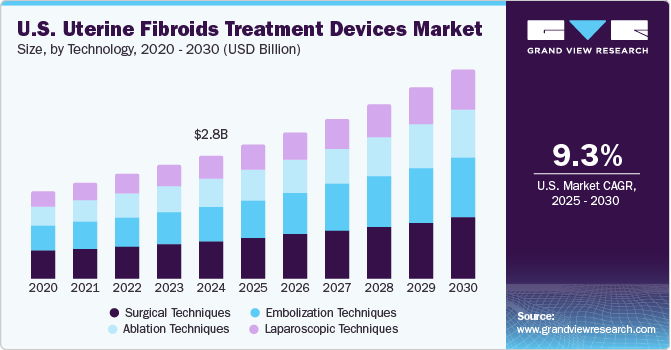 Source: Grand View Research, IR Documents, Primary Interviews, Paid DatabasesTo learn more about this report,
 Download Free Sample Report
The growing preference for minimally invasive procedures is expected to fuel market growth. Treatments like uterine artery embolization (UAE), laparoscopic myomectomy, and high-intensity focused ultrasound (HIFU) are becoming increasingly popular due to quicker recovery times, fewer complications, and better overall outcomes. Both patients and healthcare providers are favoring these options, which is driving the demand for advanced treatment devices. As the prevalence of uterine fibroids increases, the demand for minimally invasive procedures increases.
Prevalence of Uterine Fibroids in U.S. States (2019 - 2021)
States
2019
2020
2021
California
717720
718448
730140
Colorado
81427
82077
88202
Oregon
55364
55858
60072
Michigan
180774
180338
181982
Arizona
122499
123616
127037
Alaska
8611
8570
9342
Nevada
65893
67026
67748
Texas
521729
524912
544877
Wyoming
5733
5707
6489
Montana
12121
12256
13296
Incidence of Uterine Fibroids in U.S. States (2019 - 2021)
States
2019
2020
2021
Arizona
8625
8670
9026
California
51050
50845
52284
Alaska
661
656
720
Michigan
11676
11646
11925
Texas
37982
37947
39213
Wyoming
427
422
481
Colorado
5973
6017
6494
Montana
861
870
952
Nevada
4668
4754
4861
Oregon
4036
4059
4359
Advancements in medical technology and the launch of new products play a significant role in driving the growth of the U.S. uterine fibroids treatment devices industry. For instance, in September 2024, Gynesonics Inc., a medical device company specializing in minimally invasive solutions for symptomatic uterine fibroids, announced the release of its new SMART OS 2.4 software technology for the Sonata System. This innovative treatment combines the first and only intrauterine ultrasound system with a proprietary advanced radiofrequency ablation device, offering an incision-free, uterus-preserving, transcervical option for treating symptomatic uterine fibroids, which is expected to drive market growth over the forecast period.
The rising awareness programs and initiatives to raise awareness of uterine fibroids are propelling market growth. The U.S. has several programs and initiatives to raise awareness of uterine fibroids, including Fibroid Awareness Month, legislation, and research.
-
Fibroid Awareness Month: July is Fibroid Awareness Month, which aims to bring awareness to uterine fibroids. Program goals are listed below:
-
Address the effects of uterine fibroids on women's health throughout their lives, with a particular focus on the disparities in disease prevalence and the stigma faced by women living with fibroids.
-
Develop materials to expand education and raise awareness about uterine fibroids.
-
Advocate for evidence-based healthcare policies related to uterine fibroids to enhance patient outcomes.
-
Participate in outreach initiatives that involve women, healthcare providers, and policymakers in conversations aimed at improving care for women with fibroids.
-
The FDA Office of Women's Health is collaborating with the NIH Office of Research on Women's Health to increase awareness about the inclusion of women of various ages, races, ethnicities, and health conditions in clinical trials.
Market Concentration & Characteristics
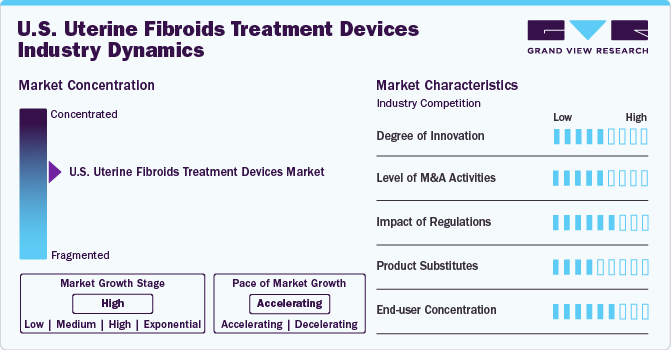
The degree of innovation in the U.S. uterine fibroids treatment devices industry is high, driven by the continuous development of advanced, minimally invasive technologies that improve both treatment outcomes and patient experiences. Innovations such as high-intensity focused ultrasound (HIFU), MRI-guided focused ultrasound, and radiofrequency ablation systems have revolutionized how uterine fibroids are treated, allowing for more targeted, precise, and less invasive procedures.
Regulations play a significant role in the market. Regulatory bodies like the U.S. Food and Drug Administration (FDA) play a critical role in approving new technologies and products, setting standards for clinical trials, and monitoring post-market safety. Stringent regulatory requirements can sometimes delay product launches but also help build trust among healthcare providers and patients, ensuring that only proven, safe devices are available for use. In addition, regulatory support for minimally invasive treatments, like the FDA's clearance of novel devices such as MRI-guided ultrasound and radiofrequency ablation systems, has accelerated their adoption.
 To learn more about this report, Download Free Sample Report
The level of mergers and acquisitions (M&A) activities in the market has steadily increased as companies look to strengthen their product portfolios, expand market share, and gain access to innovative technologies. Larger medical device companies are acquiring smaller, specialized firms with novel treatments or advanced technologies, such as minimally invasive devices for uterine fibroids. These M&As allow for accelerated growth, more excellent R&D capabilities, and a broader range of treatment options for healthcare providers and patients.
In the U.S. uterine fibroids treatment devices industry, several product substitutes offer alternative treatment options, which can impact the demand for medical devices. Traditional surgical procedures, such as hysterectomy and myomectomy, remain common substitutes, particularly for patients with severe symptoms or those who prefer a more permanent solution. In addition, non-invasive treatments like medications (e.g., GnRH agonists, progestins) and hormone therapy serve as alternatives for managing symptoms, though they do not eliminate fibroids. Uterine artery embolization (UAE) is another non-surgical substitute, offering a less invasive approach by blocking blood flow to fibroids.
The end-user concentration in the market primarily focuses on healthcare settings such as hospitals, outpatient surgical centers, and specialized clinics. Hospitals, particularly those with dedicated gynecology or women’s health departments, represent a significant portion of the market due to their ability to offer a wide range of treatment options, including advanced minimally invasive procedures. Outpatient surgical centers and specialized clinics are also growing end-users, as they provide less costly, non-hospital-based options for treatments like radiofrequency ablation and uterine artery embolization.
Technology Insights
The surgical techniques segment dominated the market in 2024. This dominance is attributed due to the growing prevalence of uterine fibroids among women has highlighted the need for effective surgical interventions. For instance, as per a report by Society for Women’s Health Research (SWHR) in July 2023, Uterine fibroids are among the most prevalent gynecologic conditions, impacting approximately 26 million women between the ages of 15 and 50 in the U.S. Advances in surgical technology have improved the precision and safety of procedures, making them more attractive to both healthcare providers and patients. Furthermore, increasing awareness of available treatment options has motivated more women to pursue surgical solutions, boosting the performance of this segment.
The ablation techniques segment is expected to witness the fastest growth in the U.S. uterine fibroids treatment devices industry. This can be attributed due to the growing demand for minimally invasive treatment options that provide substantial benefits, including less pain, shorter hospital stays, and faster recovery times compared to traditional surgical methods. The increasing prevalence of chronic conditions requiring ablation procedures further drives this trend.
Mode of Treatment Insights
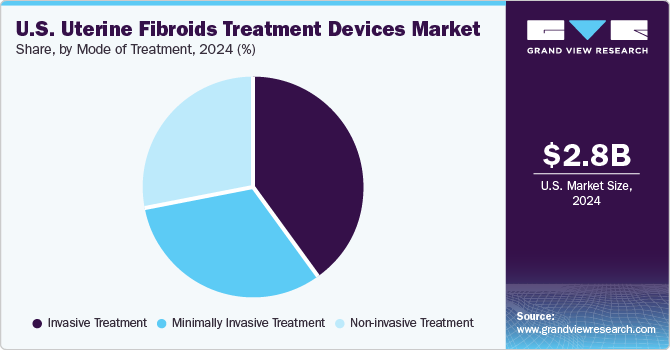
The invasive treatment segment dominated the market in 2024. This dominance is attributed due to the effectiveness and widespread use of surgical interventions in managing fibroids. As the prevalence of uterine fibroids continues to rise, many patients and healthcare providers prefer more definitive treatments, such as myomectomy and hysterectomy, which are often necessary for large or symptomatic fibroids. For instance, as per a report by NIH in October 2023, each year, approximately 600,000 hysterectomy procedures are carried out in the U.S., making it the most frequently performed non-obstetric surgery for women. These procedures, supported by advanced surgical devices, offer high success rates and significant symptom relief, making them the preferred choice for many women. In addition, as healthcare facilities continue to invest in advanced technologies, the quality and outcomes of invasive treatments are expected to improve further in the uterine fibroids treatment devices industry.
 To learn more about this report, Download Free Sample Report
The non-invasive treatment segment is expected to grow at the fastest CAGR over the forecast period. This can be attributed due to a rising patient preference for procedures that reduce recovery time and discomfort. Increasing awareness of non-invasive options has led to higher demand among women seeking alternatives to traditional surgery. Moreover, technological advancements have also made these treatments more effective and accessible, broadening their appeal to a broader patient population. As more healthcare providers incorporate these methods, the market share of non-invasive treatments in the uterine fibroids treatment devices market is anticipated to grow significantly.
Key U.S. Uterine Fibroids Treatment Devices Company Insights
Key market players are adopting various strategies such as product launches, approvals and others to increase their market presence and get competitive advantage over other market players. These advancements in market is anticipated to boost market growth over the forecast period.
Key U.S. Uterine Fibroids Treatment Devices Companies:
- Medtronic
- Stryker
- Boston Scientific Corporation
- Insightec.
- CooperSurgical Inc.
- Hologic, Inc.
- CONMED Corporation.
- Merit Medical Systems.
- Minerva Surgical, Inc.
Three ways to get this report
Buy it, customize it, or ask a question.Ask an Analyst
Analyst response in 1 business day
- AccessReport author, directly
- Reply timeWithin 1 working day
- No sales callDirect answer only
- FormatEmail reply
- CostFree, no cost
Get the Full Report
What the study covers
- FormatsPDF · Excel · Dashboard
- Timeline2025–2030 annual, 2024 base
- Coverage20+ countries, 5 regions
- Companies10+ key players profiled
Customize the Report
20% free customization
- IncludeCountries, segments, points
- TailorTo your product definition
- ExtendDeeper competitor detail
- OrA fully bespoke study
- Turnaround5–10 working days
Recent Developments
-
In January 2025, Hologic, Inc. acquired Gynesonics, Inc., a privately held company specializing in minimally invasive solutions for uterine fibroid treatment, for approximately USD 350 million. Gynesonics is renowned for its Sonata System, an innovative technology that combines real-time intrauterine ultrasound guidance with targeted radiofrequency ablation to treat symptomatic uterine fibroids without incisions.
-
In September 2024, Gynesonics Inc., a medical device company specializing in minimally invasive solutions for symptomatic uterine fibroids, announced the release of its new SMART OS 2.4 software technology for the Sonata System. This innovative treatment combines the first and only intrauterine ultrasound system with a proprietary advanced radiofrequency ablation device, offering an incision-free, uterus-preserving, transcervical option for treating symptomatic uterine fibroids.
U.S. Uterine Fibroids Treatment Devices Market Report Scope
Report Attribute
Details
Market size value in 2025
USD 3.02 billion
Revenue forecast in 2030
USD 4.71 billion
Growth Rate
CAGR of 9.3% from 2025 to 2030
Base year for estimation
2024
Historical data
2018 - 2023
Forecast period
2025 - 2030
Quantitative units
Revenue in USD Million and CAGR from 2025 to 2030
Report coverage
Revenue, competitive landscape, growth factors, and trends
Key companies profiled
Medtronic; Stryker; Boston Scientific Corporation; Insightec.; CooperSurgical Inc.; Hologic, Inc.; CONMED Corporation.; Merit Medical Systems.; Minerva Surgical, Inc.
Customization scope
Free report customization (equivalent up to 8 analysts working days) with purchase. Addition or alteration to country, regional & segment scope
Pricing and purchase options
Avail customized purchase options to meet your exact research needs. Explore purchase options
U.S. Uterine Fibroids Treatment Devices Market Segmentation
This report forecasts revenue growth and provides an analysis on the latest trends in each of the sub-segments from 2018 to 2030. For this study, Grand View Research has segmented the U.S. uterine fibroids treatment devices market report on the basis of technology, mode of treatment:
-
Technology Outlook (Revenue, USD Million; 2018 - 2030)
-
Surgical Techniques
-
Hysterectomy
-
Myomectomy
-
-
Laparoscopic Techniques
-
Laparoscopic Myomectomy
-
Myolysis
-
-
Ablation Techniques
-
Microwave Ablation
-
Hydrothermal Ablation
-
Cryoablation
-
Ultrasound Ablation
-
High Intensity Focused Ultrasound (HIFU)
-
MRI-guided Focused Ultrasound (MRgFUS)
-
-
-
Embolization Techniques
-
-
Mode of Treatment Outlook (Revenue, USD Million; 2018 - 2030)
-
Invasive Treatment
-
Minimally Invasive Treatment
-
Non-invasive Treatment
-
Frequently Asked Questions About This Report
The U.S. uterine fibroids treatment devices market size was estimated at USD 2.77 billion in 2024 and is expected to reach USD 3.02 billion in 2025
The U.S. uterine fibroids treatment devices market is expected to grow at a compound annual growth rate of 9.3% from 2025 to 2030 to reach USD 4.71 billion by 2030.
Surgical technologies dominated the U.S. uterine fibroids treatment devices market with a share of 30.67% in 2024. This is attributable to the increasing prevalence of uterine fibroids among women, necessitating effective surgical interventions.
Some of the key players operating in the U.S. uterine fibroids treatment devices market include Medtronic; Stryker; Boston Scientific Corporation; Insightec.; CooperSurgical Inc.; Hologic, Inc.; CONMED Corporation.; Merit Medical Systems.; Minerva Surgical, Inc.
Key factors that are driving the market growth include rising awareness of fibroid treatment options, advancements in minimally invasive procedures, and increasing demand for uterus-preserving alternatives to hysterectomy. In addition, the growing prevalence of uterine fibroids among women of reproductive age and the availability of innovative treatment devices are key factors driving market expansion.
About the Author(s)
Medical Devices Research Team
Healthcare · Medical DevicesThis report was authored by the medical devices research team at Grand View Research - comprising two research analysts, one senior research analyst, and one industry expert - with specialized expertise in the medical devices segment of the healthcare industry. All findings are based on proprietary healthcare databases, executive interviews, and regulatory analysis, subject to internal peer review prior to publication.
Last Updated:
Speak to Analyst -

Customize this report to your needs - add regions, segments, or data points, with 20% free customization.
Or view our licence options:


ISO 9001:2015 & 27001:2022 Certified
We are GDPR and CCPA compliant! Your transaction & personal information is safe and secure. For more details, please read our privacy policy.


