
- Home
- »
- Homecare & Decor
- »
-
U.S. Vertical Garden Construction Market Report, 2026-2033GVR Report cover

U.S. Vertical Garden Construction Market (2026 - 2033)
Size, Share & Trends Analysis Report By Garden Type (Green Facades, Living Walls, Hydroponic & Artificial Vertical Gardens), By Type (Indoor, Outdoor), By Application (Residential, Commercial), And Segment Forecasts
Market Size, 2025
$349.9MMarket Estimate, 2026
$372.1MMarket Forecast, 2033
$660.0MCAGR, 2026–2033
8.5%U.S. Vertical Garden Construction Market Summary
The U.S. vertical garden construction market size was valued at USD 349.9 million in 2025 and is projected to grow from 372.1 million in 2026 to USD 660.0 million by 2033, at a CAGR of 8.5% from 2026 to 2033. The market is driven by rising adoption of living walls and green façades across commercial and residential buildings, growing demand for biophilic design, increasing space constraints in urban areas, and investment in sustainable landscaping and building solutions.
Key Market Trends & Insights
- By garden type: Living walls accounted for the largest revenue share of 43.3% in 2025.
- By type: Outdoor segment accounted for the largest share of 62.5% in 2025.
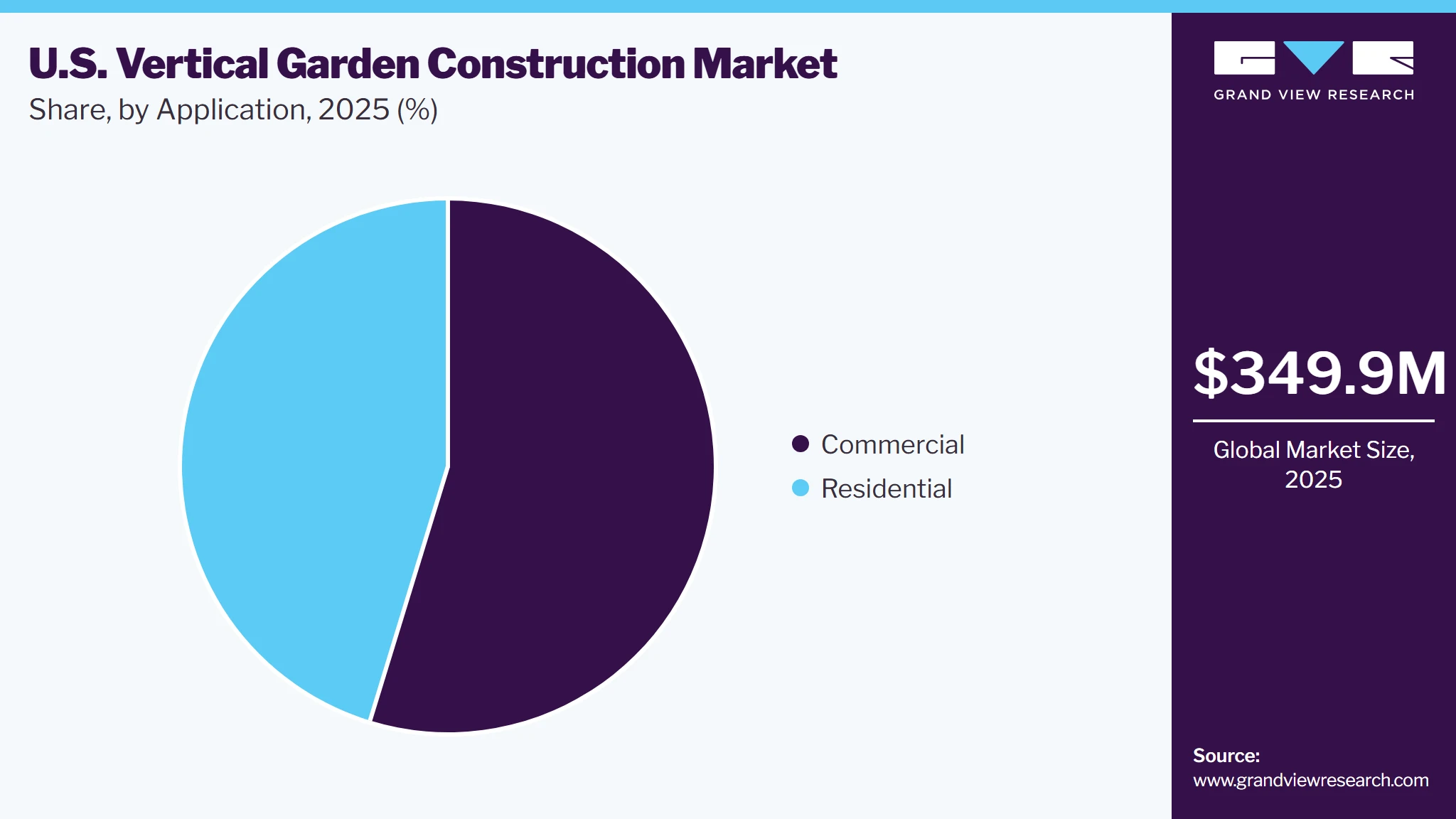
- By application: Residential accounted for the largest revenue share of 54.7% in 2025.
Market Size & Forecast
- Market size in 2025: USD 349.9 Million
- Estimated market size in 2026: USD 372.1 Million
- Projected market size by 2033: USD 660.0 Million
- CAGR (2026-2033): 8.5%
Prism AI by Grand View Research Free to tryAsk a question about the U.S. vertical garden construction market✓Every figure cited from GVR research Prefer the report? Download free sample →
The increasing integration of green infrastructure and nature-based solutions into U.S. development is supporting demand for vertical garden construction, as architects, developers, and property owners seek to incorporate vegetation into built environments. In September 2025, the U.S. Environmental Protection Agency (EPA) released its Green Infrastructure Strategic Agenda 2035, establishing a 10-year roadmap focused on scaling green infrastructure and nature-based solutions across the country. The agenda identifies four priority areas, including regulatory integration, demonstrating community and watershed benefits, and connecting communities with federal funding, technical assistance, and financing.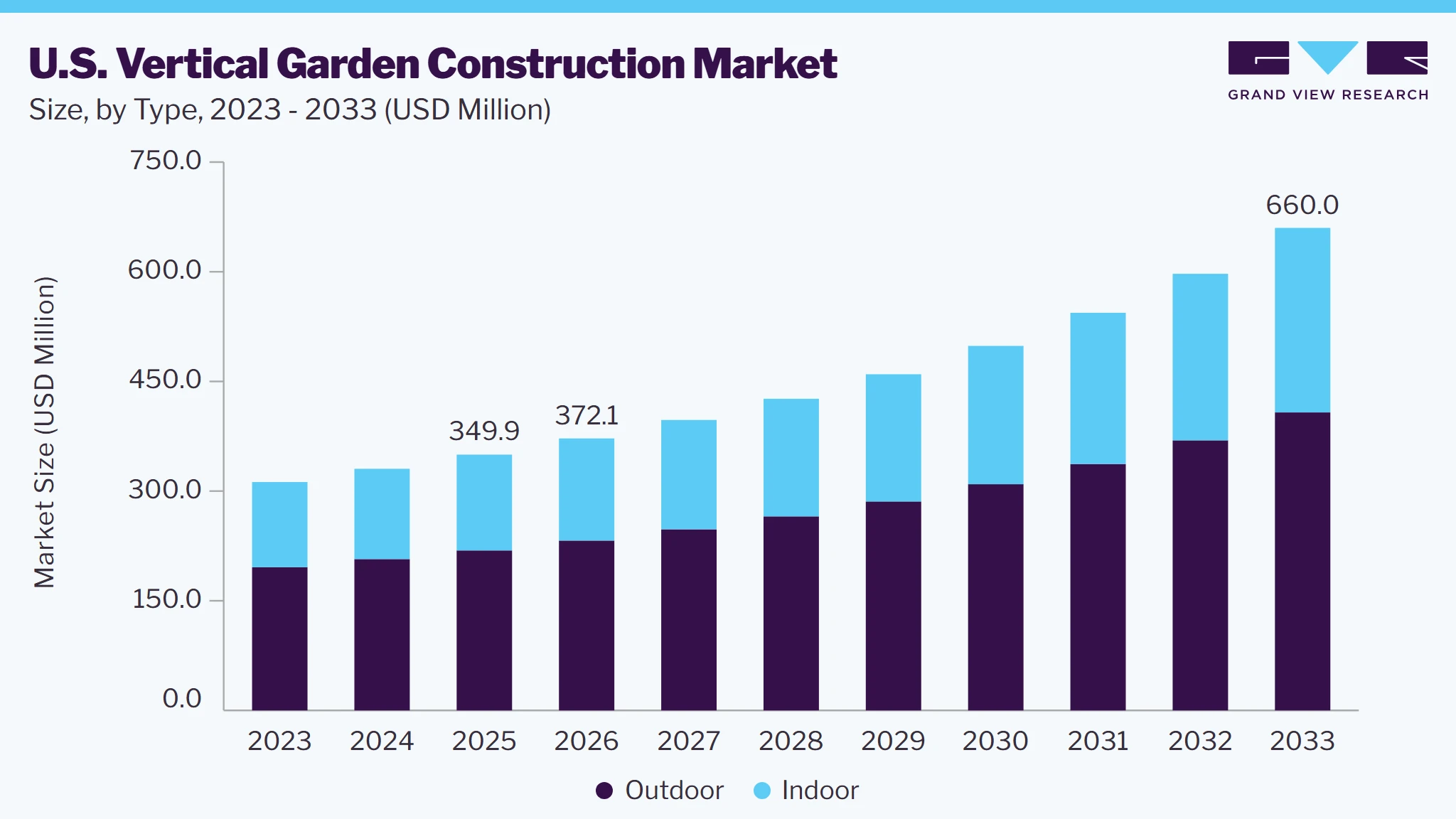 Source: Grand View Research, IR Documents, Primary Interviews, Paid DatabasesTo learn more about this report,
 Download Free Sample Report
Rising urban temperatures are encouraging U.S. cities to integrate vegetation into built infrastructure to reduce heat exposure and improve climate resilience. For instance, in September 2026, New York City launched a pilot featuring the city’s first green-roof bus shelter in Brownsville, with native plants, grasses, and wildflowers specifically intended to cool the bus stop and make the surrounding public space more comfortable during extreme heat. This investment in vegetation-based cooling infrastructure demonstrates growing demand for nature-based construction solutions to address urban heat, supporting opportunities for the U.S. vertical garden construction market.
Rising household spending on gardening and landscaping increases household investment in gardening and landscaping is creating a favorable environment for residential vertical garden installations. In 2025, U.S. gardening spending reached a record USD 79.0 billion, while average spending per gardening household increased 18.3% to USD 740, indicating higher spending among participating households and potential demand for space-efficient landscaping solutions such as vertical gardens.
Market Dynamics
The growing integration of biophilic design in commercial and institutional buildings is driving demand for vertical garden construction in the U.S., as developers and architects use living walls to enhance aesthetics while creating stronger connections between occupants and nature. In October 2025, LiveWall highlighted a living-wall installation at the Amway Grand Plaza Hotel in Grand Rapids, Michigan, where changing plant designs were used as a prominent architectural feature. In March 2026, LiveWall also featured a living wall at Hendricks Regional Health in Indiana, demonstrating the application of vertical greenery in healthcare environments. The increasing use of living walls across hotels, healthcare facilities, offices, and other commercial spaces is expanding opportunities for vertical garden construction as architects seek to integrate greenery into building interiors and façades without requiring additional floor space.
High installation and maintenance costs are restraining the adoption of vertical garden construction in the U.S. A February 2026 turnkey living-wall estimate prepared by Miami Vertical Garden Inc. for a Cooper City, Florida project illustrates the multiple cost components involved in a vertical garden installation. The estimate included USD 66 per sq. ft. for the living-wall system, along with USD 3,400 for the hydroponic system, USD 2,500 for a free-standing structure, USD 11,060 for decorative perimeter framing, USD 3,792 for planting labor, and USD 5,670 for installation labor. The estimate demonstrates that vertical garden projects can involve substantial expenditures across plant materials, structural components, irrigation/hydroponic systems, framing, and specialized labor, which can increase the upfront investment required compared with conventional landscaping.
Commercial Properties
Increasing investment in high-visibility biophilic features in commercial and hospitality properties is creating opportunities for the U.S. vertical garden construction market. In July 2025, Foliage Design Systems highlighted a 45-foot Green Wall at Hotel Signia in Atlanta, Georgia, featuring more than 3,500 plants. The project transformed a blank concrete wall into a prominent architectural feature and incorporated an automatic irrigation system to support the installation. The scale of the project demonstrates an opportunity for contractors in the vertical garden construction market to develop large-format green wall installations that combine architectural differentiation, guest experience, and nature-based design in commercial and hospitality properties.
Analyst Perspective
The U.S. vertical garden construction market is evolving toward integrated, design-focused green infrastructure, with commercial and institutional properties increasingly incorporating green façades and living walls into building interiors and exteriors. Demand is supported by growing interest in biophilic design, space-efficient greenery, and sustainable building environments. Vertical garden providers are expanding customized systems, modular solutions, irrigation technologies, and maintenance services while targeting offices, hotels, healthcare facilities, retail properties, and other commercial spaces.
Consumer Insights
 To learn more about this report, Download Free Sample Report
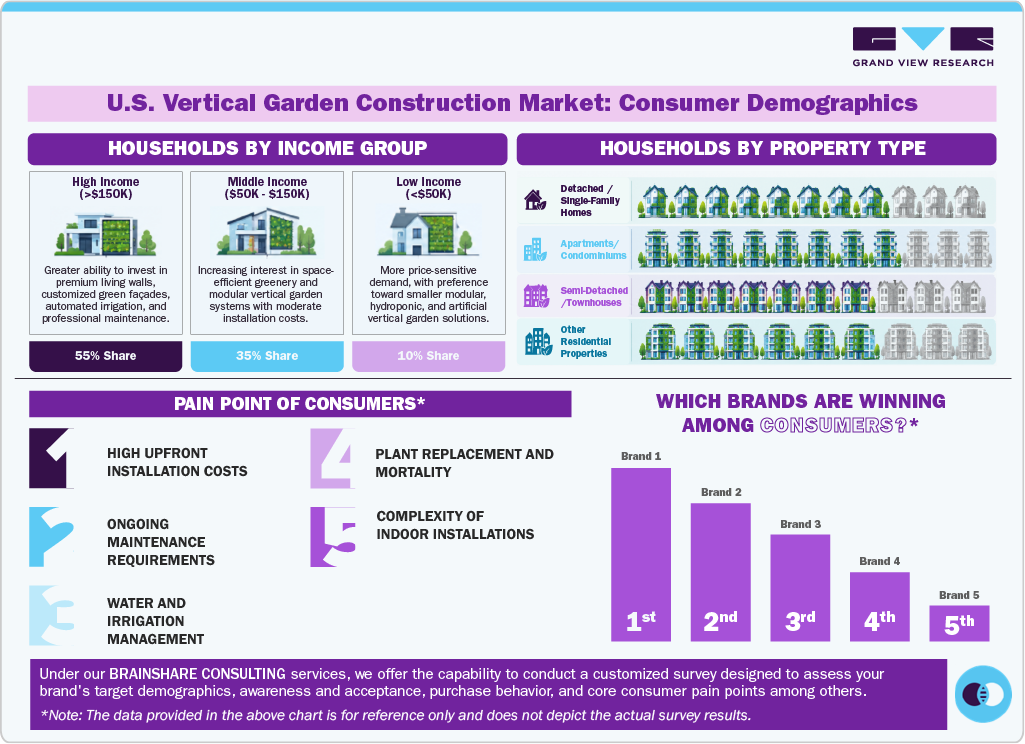
The consumer profile of the U.S. vertical garden construction market reflects demand across different household income groups and property types, with purchasing decisions influenced by disposable income, available landscaping space, desired aesthetics, maintenance requirements, and the ability to invest in customized or professionally installed vertical garden solutions.
-
High-income households account for approximately 55% of the market, supported by their greater capacity to invest in premium living walls, customized Green Wall installations, automated irrigation systems, high-quality plant selections, and professional maintenance services.
-
Middle-income households represent around 35% of the market, with demand primarily focused on space-efficient and modular vertical garden systems that offer a balance between aesthetics, functionality, installation costs, and maintenance requirements.
-
Low-income households account for approximately 10% of the market, with purchasing decisions largely centered on affordability and lower-maintenance solutions. Artificial greenery, modular planters, and smaller-scale vertical garden systems are particularly relevant to this consumer group.
By property type, detached and single-family homes represent a major consumer base for vertical garden construction, as homeowners generally have greater flexibility to install exterior living walls, vertical landscaping systems, and customized green walls. apartments and condominiums also present opportunities because limited outdoor space encourages the use of vertical greenery on balconies, terraces, façades, and shared areas. Semi-detached homes and townhouses provide additional opportunities for compact vertical garden systems, while other residential properties can adopt vertical greenery where conventional landscaping space is limited.
Consumers in the U.S. vertical garden construction market commonly encounter several challenges during product selection, installation, and ownership.
-
High initial installation costs can limit the adoption of professionally designed living walls, particularly where structural preparation, irrigation, drainage, and specialized installation are required.
-
Plant replacement and mortality remain concerns for consumers because unsuitable plant selection, irrigation problems, pests, and environmental conditions can increase replacement requirements.
-
Ongoing maintenance requirements can create additional ownership costs, particularly for living walls requiring regular pruning, fertilization, irrigation monitoring, pest control, and plant replacement.
-
The complexity of indoor installations can restrict adoption because indoor vertical gardens may require specialized lighting, drainage, irrigation, and electrical infrastructure.
-
Water and irrigation management remain important considerations, as uneven watering, clogged irrigation components, leaks, and excessive water requirements can affect plant health and system performance.
Garden Type Insights
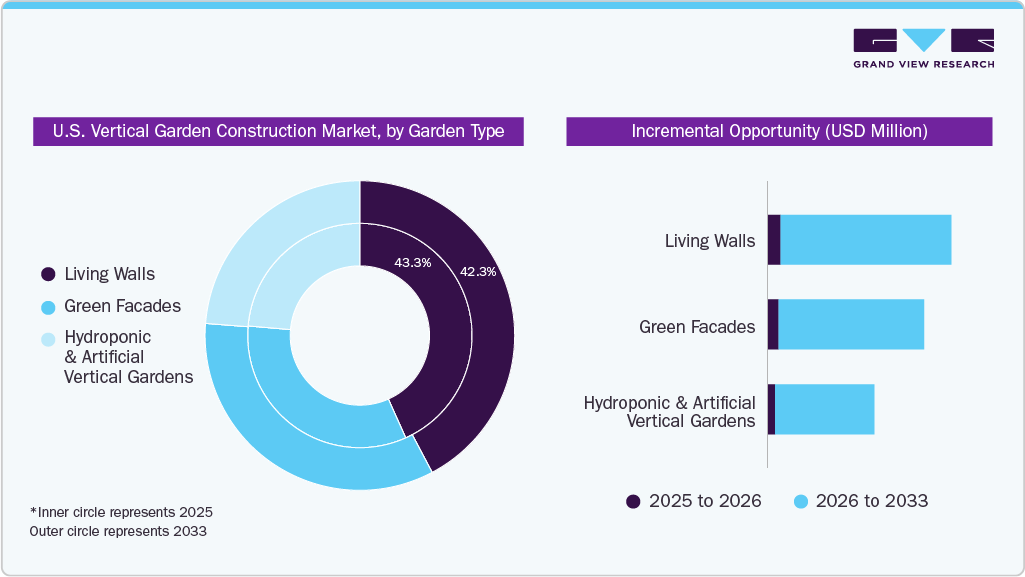
The living walls accounted for the largest revenue share of 43.3% in 2025. driven by their increasing integration into workplace interiors and multi-floor commercial spaces. In January 2026, Foliage Design Systems reported the installation of 12 living green walls across three floors at Novelis’ new headquarters in Atlanta, Georgia, using pothos plants selected for their durability and ability to thrive indoors. The installation also included approximately 150 additional plants, with weekly maintenance initiated after installation to support long-term plant health. This project illustrates the use of green wall systems as permanent interior design elements in corporate workplaces, supporting demand for the vertical garden construction market beyond hospitality applications.
 To learn more about this report, Download Free Sample Report
The green facades are expected to grow at a CAGR of 8.9% from 2026 to 2033, supported by their application as exterior building-envelope features that integrate vegetation with architectural design. In March 2025, WTOP reported that 17xM, a 334,000-square-foot office building in Washington, D.C., features a two-story, 1,500-square-foot self-watering green wall with eight flowering plant species. The installation was designed to attract pollinators and provide an exterior/interior-facing greenery feature while absorbing 50% of sunlight and reflecting 30%. This application demonstrates the potential for green facades and related vertical greenery systems to be incorporated into large commercial buildings as part of sustainable façade and biophilic design strategies.
Type Insights
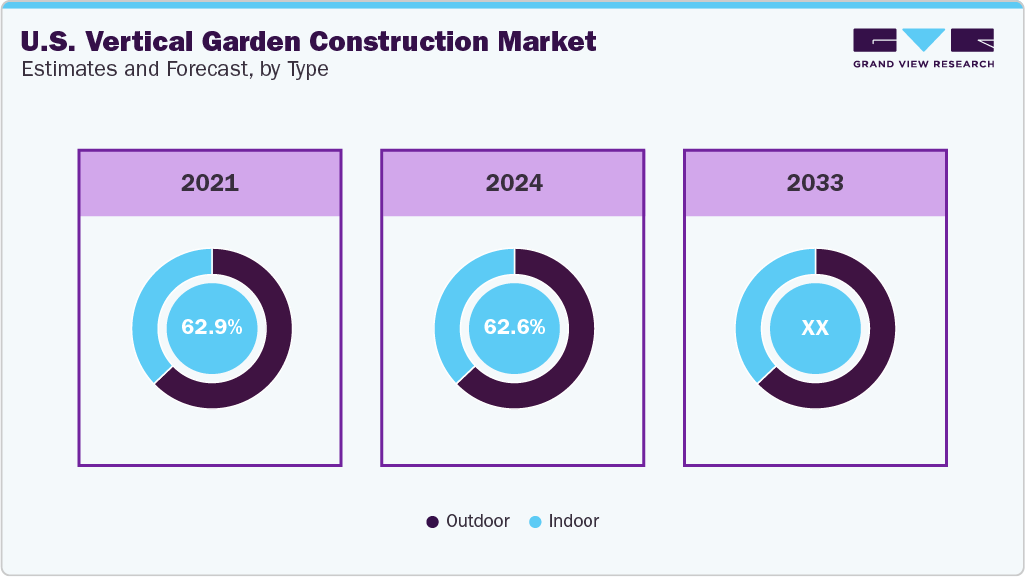
The outdoor vertical gardens accounted for the largest share of 62.5% in 2025, supported by their increasing integration into commercial and mixed-use developments to enhance outdoor aesthetics and create nature-oriented public spaces. In March 2026, B&D Contractors reported the installation of a 286-unit custom stainless-steel planter system at GreenStreet, a three-block mixed-use complex in downtown Houston. A bespoke cable system was installed between the second and third stories to create a green wall effect, with Star Jasmine climbing the cables and Asian Jasmine spilling over the planters. The installation highlights the potential for outdoor vertical greenery to be integrated into existing commercial developments to create landscaped pedestrian environments while addressing structural, irrigation, and space constraints. This growing use of outdoor greenery is creating opportunities for the vertical garden construction market across mixed-use, retail, hospitality, and other commercial properties.
 To learn more about this report, Download Free Sample Report
The indoor vertical gardens are expected to grow at a CAGR of 8.8% from 2026 to 2033, driven by increasing adoption of green wall systems in offices, retail spaces, hospitality properties, and other commercial interiors. In October 2025, New Jersey-based Shades of Green introduced self-contained living plant walls for corporate and commercial spaces, with the systems supplied with fully grown plants and designed to reduce maintenance requirements for clients. The launch reflects growing demand for indoor vertical greenery that can be incorporated into commercial interiors while minimizing operational requirements, creating opportunities for the U.S. vertical garden construction market.
Application Insights
The commercial vertical garden construction market accounted for the largest revenue share of 54.7% in 2025, driven by increasing adoption of vertical greenery in corporate offices and commercial interiors to enhance workplace aesthetics and biophilic design. In May 2025, Wildleaf highlighted a preserved moss Green Wall installation at Two Six Technologies’ office in Arlington, Virginia, providing a nature-inspired feature within the corporate workplace while reducing the maintenance requirements associated with traditional living walls. The installation highlights the growing use of green wall solutions in commercial office environments and creates opportunities for the vertical garden construction market across corporate workplaces and commercial interiors.
 To learn more about this report, Download Free Sample Report
The residential vertical garden construction market is expected to grow at a CAGR of 8.2% from 2026 to 2033, supported by the growing adoption of space-efficient and durable vertical greenery solutions in residential outdoor spaces. In April 2025, UpScapers replaced an existing residential exterior living-wall pocket system in Bowie, Maryland, with an all-weather vertical greenery system designed for year-round outdoor performance. The installation highlights the use of green wall solutions in residential properties to maintain year-round visual greenery while addressing the maintenance and durability requirements of exterior landscaping. This application supports the expansion of the vertical garden construction market across residential properties seeking space-efficient and low-maintenance greenery solutions.
Key U.S. Vertical Garden Construction Company Insights
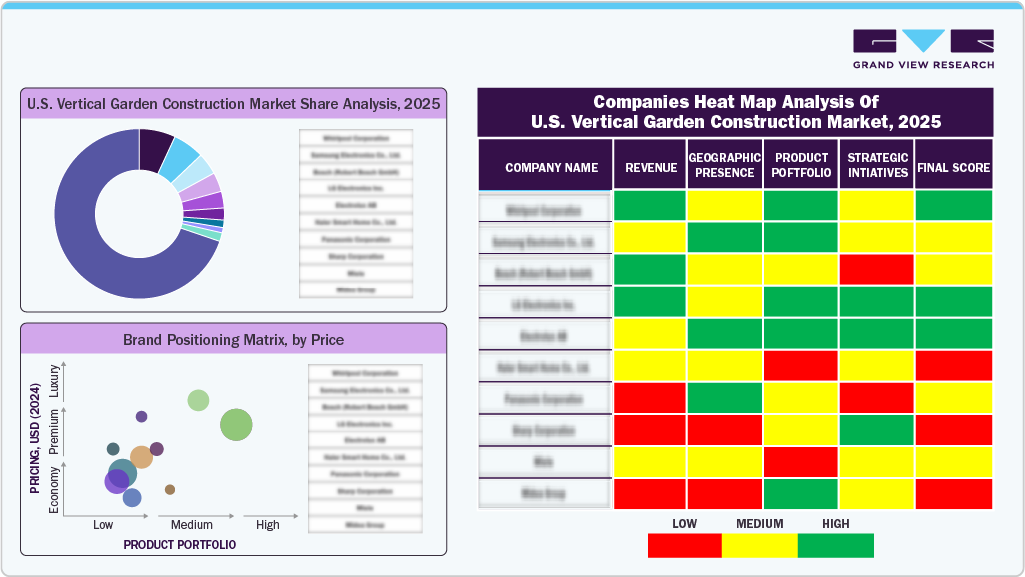
The U.S. vertical garden construction market is characterized by a competitive structure comprising specialized living-wall providers, green-wall system manufacturers, landscape service companies, and green-building solution providers. Competition is primarily shaped by system design capabilities, plant selection, irrigation technology, installation expertise, maintenance services, customization, project scale, and the ability to deliver integrated indoor and outdoor vertical greenery solutions.
-
Specialized Living Wall System Providers: Companies such as LiveWall, LLC, GSky Plant Systems, Inc., SageGreenLife, and SemperGreenwall compete through specialized living-wall technologies, modular systems, plant-based design solutions, and installation expertise. LiveWall provides engineered living-wall systems for indoor and outdoor applications, while GSky Plant Systems offers modular green-wall systems designed for commercial and institutional environments. SageGreenLife focuses on living green-wall systems and plant-based interior solutions, whereas SemperGreenwall provides modular living-wall systems supported by design, installation, and maintenance capabilities.
-
Commercial Green Wall & Landscape Solution Providers: GreenWalls, Ambius, Four Leaf Landscape, and The Greenwall Company strengthen competition through customized vertical greenery solutions for commercial, hospitality, corporate, and institutional properties. These companies combine green wall design, installation, plant selection, and ongoing maintenance services, enabling customers to incorporate vertical greenery into offices, hotels, healthcare facilities, and other high-traffic environments.
-
Green Building & Specialized Infrastructure Providers: American Hydrotech, Inc. and Green Roof Outfitters, Inc. participate in the market through expertise in green-building infrastructure, waterproofing, vegetated systems, and structural solutions. Their capabilities support the integration of vegetation into building envelopes and architectural spaces, particularly where structural, drainage, waterproofing, and long-term performance requirements influence vertical garden construction.
-
Integrated Design, Installation & Maintenance Providers: Several market participants differentiate by offering end-to-end services spanning site assessment, system design, plant installation, irrigation, maintenance, and plant replacement. This integrated approach is particularly relevant for commercial and institutional projects where vertical gardens require ongoing horticultural management and specialized maintenance to preserve plant health and visual appearance.
 To learn more about this report, Download Free Sample Report
Key U.S. Vertical Garden Construction Companies
-
LiveWall, LLC
-
GSky Plant Systems, Inc.
-
SageGreenLife
-
SemperGreenwall
-
GreenWalls
-
Ambius
-
American Hydrotech, Inc.
-
Green Roof Outfitters, Inc.
-
Four Leaf Landscape
-
The Greenwall Company
Competitive Benchmarking
Category
Operating Strategies
Competitive Edge
Key Challenges
Established Players:
LiveWall, LLC;
GSky Plant Systems, Inc.;
SemperGreenwall;
Ambius;
American Hydrotech, Inc.- Focus on expanding commercial vertical garden installations through customized living-wall systems, turnkey design and installation services, irrigation solutions, and recurring maintenance programs. These companies target offices, hotels, healthcare facilities, retail spaces, and institutional buildings, while strengthening relationships with architects, developers, contractors, and facility managers to secure large-scale projects.
- Strong brand recognition, established project portfolios, technical expertise, and comprehensive capabilities across design, installation, irrigation, plant selection, and maintenance provide an advantage in complex commercial projects. Established relationships with architects, contractors, and property owners further support project acquisition and repeat business.
- Higher project complexity and installation costs, dependence on specialized horticultural and irrigation expertise, and recurring maintenance requirements can increase the total cost of ownership. Established players may also face challenges in scaling highly customized projects while maintaining consistent plant health and visual quality.
Emerging Players: SageGreenLife; GreenWalls; Green Roof Outfitters, Inc.; Four Leaf Landscape; The Greenwall Company
- Focus on specialized and customized vertical greenery solutions, including modular living walls, green façades, landscape integration, lightweight systems, and technology-enabled plant installations. These companies emphasize project-specific designs, sustainability features, and flexible solutions to differentiate themselves in commercial and institutional applications while expanding their project portfolios.
- Greater specialization, customized system design, flexible project execution, and differentiated technologies enable these players to address specific architectural and landscaping requirements. Their focus on modular systems, lightweight structures, smart monitoring, and integrated landscaping can provide greater flexibility for projects with space or design constraints.
- Relatively smaller scale, narrower geographic presence, and lower brand visibility can limit access to large multi-location commercial projects. Dependence on specialized installation capabilities, project-specific customization, and maintenance expertise can also increase execution requirements and restrict rapid expansion across the U.S. market.
Recent Developments
-
In April 2025, Garden on the Wall announced the debut of “Slice of Nature” at NeoCon 2025 in Chicago. The new biophilic installation uses preserved moss species sculpted over a dimensional, Rhino-modeled base, creating a three-dimensional interpretation of natural landforms for commercial interiors. The development expands the use of maintenance-free preserved botanical systems as architectural vertical greenery solutions in the U.S. commercial design market.
-
In May 2026, Garden on the Wall and Myceen announced “The Architecture of Nature,” a new collaborative installation for NeoCon 2026 in Chicago. The concept combines preserved biophilic design with mycelium-based acoustic panels, introducing regenerative materials into commercial interior environments. The development broadens vertical greenery applications by combining botanical installations with functional acoustic and sustainable material solutions.
-
In January 2025, Plantaform launched its Smart Indoor Garden in the U.S. at CES 2025, introducing a fogponics-based automated indoor growing system. While the product is primarily designed for indoor food cultivation rather than architectural Green Walls, its launch reflects the broader development of automated, water-efficient indoor plant-growing technologies relevant to controlled-environment vertical gardening.
U.S. Vertical Garden Construction Market Report Scope
Report Attribute
Details
Market size in 2025
USD 349.9 million
Estimated market size in 2026
USD 372.1 million
Projected market size by 2033
USD 660.0 million
Growth rate
CAGR of 8.5% from 2026 to 2033
Base year
2025
Actual data
2021 - 2025
Forecast period
2026 - 2033
Quantitative units
Revenue in USD million and CAGR from 2026 to 2033
Report coverage
Revenue forecast, company ranking, competitive landscape, growth factors, and trends
Segments covered
Garden type, type, application
Key companies profiled
LiveWall, LLC; GSky Plant Systems, Inc.; SageGreenLife; SemperGreenwall; GreenWalls; Ambius; American Hydrotech, Inc.; Green Roof Outfitters, Inc.; Four Leaf Landscape; The Greenwall Company
Customization scope
Free report customization (equivalent up to 8 analysts’ working days) with purchase. Addition or alteration to country, regional & segment scope.
Pricing and purchase options
Avail customized purchase options to meet your exact research needs. Explore purchase options
U.S. Vertical Garden Construction Market Report Segmentation
This report forecasts revenue growth at country levels and provides an analysis of the latest trends and opportunities in each of the sub-segments from 2021 to 2033. For the purpose of this study, Grand View Research has segmented the U.S. vertical garden construction market on the basis of garden type, type, and application.
-
Garden Type Outlook (Revenue, USD Million, 2021 - 2033)
-
Green Facades
-
Living Walls
-
Hydroponic & Artificial Vertical Gardens
-
-
Type Outlook (Revenue, USD Million, 2021 - 2033)
-
Indoor
-
Outdoor
-
-
Application Outlook (Revenue, USD Million, 2021 - 2033)
-
Residential
-
Commercial
-
Research Methodology
The U.S. vertical garden construction market figures in this report are based on a proven research process that combines executive interviews with secondary research from proprietary databases, company filings, and recognized regulatory and institutional sources. Market size is built through value-chain sizing-reconciling supply-side and demand-side estimates-and triangulated with bottom-up and top-down approaches. Every estimate passes multiple levels of expert validation before publication, with each U.S. vertical garden construction segment quantified using the revenue-capture definitions in the table below.
Segment Definition
Garden Type
Revenue capture definition
Green Facades
This segment covers revenue generated from the sale, design, construction, installation, and maintenance of green façade systems, including climbing-plant structures, trellis systems, façade support systems, irrigation components, growing media, and associated landscaping services. Revenue includes projects for commercial buildings, hotels, healthcare facilities, offices, retail properties, institutional buildings, and other structures where vegetation is integrated with exterior building façades.
Living Walls
This segment covers revenue generated from the sale, design, construction, installation, and maintenance of living-wall systems, including modular planting panels, irrigation systems, growing media, plant materials, structural supports, lighting, monitoring systems, and associated maintenance services. Revenue includes customized indoor and outdoor living-wall projects for commercial, hospitality, healthcare, retail, corporate, and institutional properties. Living walls represent a major vertical-garden format in which plants are directly incorporated into engineered wall systems.
Hydroponic & Artificial Vertical Gardens
This segment covers revenue generated from hydroponic vertical-garden systems and artificial vertical-garden installations, including hydroponic growing structures, nutrient delivery and irrigation systems, pumps, sensors, planting modules, artificial plants, decorative panels, installation, and maintenance services. Revenue includes projects where space-efficient soilless cultivation systems or low-maintenance artificial greenery are installed in commercial and institutional environments. Hydroponic systems use growing media or nutrient-rich water to support vertical plant growth, while artificial systems provide decorative greenery without live-plant cultivation.
Estimation Model
Target Project Layer
Market Accessibility Layer
Purchase Behavior Layer
Monetization Layer
Which projects need vertical gardens?
Which projects can install them?
Which projects actively invest?
How much revenue is generated?
Identify offices, hotels, healthcare facilities, retail spaces, institutions, and residential projects suitable for vertical gardens.
Filter projects based on available space, building structure, irrigation, lighting, and access to specialized contractors.
Apply adoption rates based on sustainability goals, biophilic design, aesthetics, space constraints, and project budgets.
Estimate revenue based on the number of projects, average installation value, system components, and maintenance services.
Delivered Customizations
This report has been delivered with the following In-depth customizations
Client Request
Customization Delivered
Value Adds
U.S. Vertical Garden Construction Market Assessment
Conducted a detailed assessment of the U.S. Vertical Garden Construction Market, covering commercial and institutional applications, living green walls, modular vertical garden systems, design and installation services, irrigation requirements, maintenance solutions, and adoption across offices, hospitality, healthcare, retail, and other built environments.
Helps stakeholders understand market development, application areas, project requirements, and adoption drivers, supporting market-entry planning, investment evaluation, and business expansion strategies.
Vertical Garden Construction Technology & Design Analysis
Evaluated vertical garden construction approaches, including modular living-wall systems, indoor and outdoor installations, customized plant configurations, irrigation systems, structural requirements, and technology-enabled solutions. The assessment considered how providers such as LiveWall, GSky, and Ambius integrate design, engineering, installation, and maintenance into project delivery.
Provides insights into evolving construction and design requirements, helping stakeholders identify technology opportunities, differentiate service offerings, optimize project specifications, and develop solutions suited to commercial building requirements.
Commercial Application & Market Opportunity Assessment
Assessed growth opportunities across offices, hotels, healthcare facilities, retail properties, airports, educational institutions, and other commercial spaces, while analyzing demand for aesthetic enhancement, biophilic design, space optimization, and ongoing plant maintenance. Companies such as GSky and Ambius demonstrate applications across healthcare, hospitality, offices, retail, and transportation environments.
Supports investment decisions, customer targeting, channel expansion, and project development by identifying high-potential application areas and commercial opportunities for vertical garden construction across the U.S.
Frequently Asked Questions About This Report
Emerging trends in the U.S. vertical garden construction market include greater adoption of modular living wall systems, smart irrigation, and low-maintenance plant solutions in commercial and residential projects.
The U.S. vertical garden construction Market is driven by growing demand for space-efficient landscaping, urban greening, and biophilic design across residential and commercial properties. Increasing adoption of green walls in offices, hotels, and public spaces, along with rising interest in sustainable building solutions, is further supporting market growth.
Key players in the U.S. Vertical Garden Construction Market include LiveWall, GSky Plant Systems, SageGreenLife, Sempergreen, GreenWalls Bioengineering, Ambius, American Hydrotech, Green Roof Outfitters, Four Leaf Landscape, and The Greenwall Company.
The outdoor segment accounted for the largest share of 62.5% in 2025 while indoor vertical gardens segment is expected to be the fastest-growing market.
The U.S. vertical garden construction market is expected to grow at a CAGR of 8.5% from 2026 to 2033, reaching USD 660.0 million by 2033.
The U.S. vertical garden construction market size was valued at USD 349.9 million in 2025 and is estimated at USD 372.1 million in 2026.
By garden type, living walls accounted for the largest revenue share of 43.3% in 2025, driven by their increasing integration into workplace interiors and multi-floor commercial spaces.
The commercial vertical garden construction market accounted for the largest revenue share of 54.7% in 2025, driven by increasing adoption of vertical greenery in corporate offices and commercial interiors to enhance workplace aesthetics and biophilic design.
About the Author(s)
Homecare & Decor Research Team
Consumer Goods · Homecare & DecorThis report was authored by the homecare & decor research team at Grand View Research - comprising two research analysts, one senior research analyst, and one industry expert - with specialized expertise in the homecare & decor segment of the consumer goods industry. All findings are based on proprietary consumer goods databases, executive interviews, and regulatory analysis, subject to internal peer review prior to publication.
Last Updated:
Speak to Analyst

Customize this report to your needs - add regions, segments, or data points, with 20% free customization.
Or view our licence options:


ISO 9001:2015 & 27001:2022 Certified
We are GDPR and CCPA compliant! Your transaction & personal information is safe and secure. For more details, please read our privacy policy.


