
- Home
- »
- Advanced Interior Materials
- »
-
Vacuum Evaporators Market Size, Industry Report, 2033GVR Report cover
![Vacuum Evaporators Market Size, Share & Trends Report]()
Vacuum Evaporators Market (2026 - 2033) Size, Share & Trends Analysis Report By Product (Heat Pump Vacuum Evaporators, Thermal Vacuum Evaporators), By Application (Wastewater Treatment, Product Processing), By End Use, By Region, And Segment Forecasts
Market Size, 2025
$3.5BMarket Estimate, 2026
$3.7BMarket Forecast, 2033
$5.8BCAGR, 2026–2033
7.0%Vacuum Evaporators Market Summary
The global vacuum evaporators market size was valued at USD 3.5 billion in 2025 and is projected to grow from USD 3.7 billion in 2026 to USD 5.8 billion by 2033, at a CAGR of 7.0% from 2026 to 2033. The North America vacuum evaporators market held the largest share of 34.0% of the global market in 2025. The growing need for efficient industrial wastewater treatment is a major factor driving the adoption of vacuum evaporators across various industries.

Key Market Trends & Insights
- By product: Heat pump vacuum evaporators segment is expected to register a CAGR of 8.0% from 2026 to 2033.
- By application: Wastewater treatment segment dominated the market, accounting for a 53.4% share in 2025.
- By end use: Pharmaceutical segment is projected to grow at a CAGR of 8.1% from 2026 to 2033.
Regional Highlights
- Largest regional market: North America (34.0% revenue share, 2025)
- Fastest-growing regional market: Asia Pacific (highest CAGR, 2026-2033)
- By country: The vacuum evaporators industry in the U.S. is expected to grow at significant CAGR over the forecast period.
Market Size & Forecast
- Market size in 2025: USD 3.5 Billion
- Estimated market size in 2026: USD 3.7 Billion
- Projected market size by 2033: USD 5.8 Billion
- CAGR (2026-2033): 7.0%
Manufacturing sectors such as chemicals, pharmaceuticals, automotive, and electronics generate large volumes of wastewater containing dissolved solids, heavy metals, and hazardous contaminants.
Rising demand for energy-efficient and sustainable process technologies in industrial operations. Modern vacuum evaporators, particularly systems using heat pump and mechanical vapor recompression (MVR) technologies, offer lower energy consumption compared to conventional evaporation methods. These systems allow evaporation at lower temperatures under vacuum conditions, improving operational efficiency while protecting heat-sensitive materials. As industries focus more on resource recovery, operational cost reduction, and sustainable production practices, the adoption of vacuum evaporators is expected to continue expanding across multiple industrial sectors.
Market Concentration & Characteristics
The vacuum evaporators industry is fragmented, with the presence of several regional and international manufacturers offering specialized evaporation systems for industrial wastewater treatment and process applications. While a few established companies provide advanced and large-scale evaporation technologies, many small and mid-sized manufacturers focus on customized solutions for specific industries such as chemicals, pharmaceuticals, food processing, and metal finishing.
The market is witnessing steady technological innovation as manufacturers focus on improving energy efficiency, automation, and system performance. Advanced technologies such as mechanical vapor recompression (MVR) and heat pump-based evaporation systems are increasingly being adopted to reduce energy consumption and operating costs.
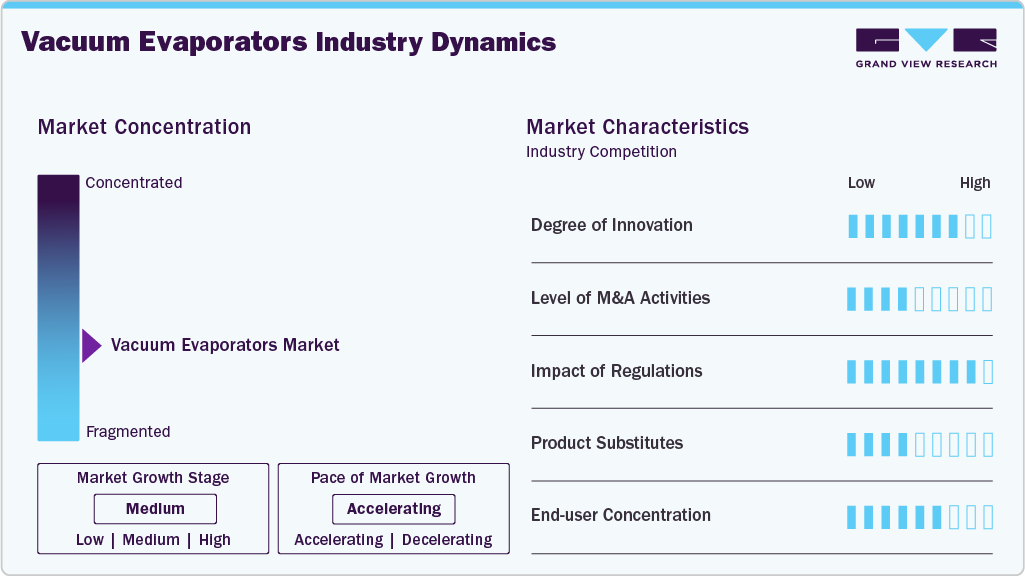
Environmental regulations related to industrial wastewater discharge are playing a significant role in driving the adoption of vacuum evaporators. Governments and regulatory bodies across many regions have introduced strict limits on wastewater discharge, hazardous waste disposal, and water pollution. As a result, industries are increasingly required to implement advanced treatment technologies that can minimize liquid waste and enable water reuse.
Demand for vacuum evaporators is largely concentrated in industries that generate large volumes of complex wastewater during production processes. Key end users include the chemical and petrochemical, pharmaceutical, electronics and semiconductor, food and beverage, and automotive industries. These sectors require reliable wastewater treatment solutions to manage contaminated process water and reduce environmental impact.
Drivers, Opportunities & Restraints
The increasing volume of industrial wastewater generated from sectors such as chemicals, pharmaceuticals, automotive, and electronics is a major driver for the vacuum evaporators industry. Industries are under growing pressure to treat and reduce wastewater before discharge due to stricter environmental standards and rising disposal costs. Vacuum evaporators help reduce wastewater volume by separating water from contaminants, enabling water reuse and lowering waste management expenses.
Growing focus on water conservation and resource recovery presents significant opportunities for the market. Many industries are increasingly investing in technologies that support water recycling and zero liquid discharge systems to reduce freshwater consumption. Rapid industrialization in emerging economies is also creating new demand for advanced wastewater treatment solutions.
High initial installation and capital costs remain a key restraint for the adoption of vacuum evaporators, particularly for small and medium-sized enterprises. The equipment requires specialized design, energy supply, and maintenance, which can increase operational expenses for some industrial facilities.
Product Insights
Mechanical vapor recompression (MVR) vacuum evaporators held the largest share with 48.3% in 2025, due to their high energy efficiency and ability to handle large volumes of industrial wastewater. These systems reuse the vapor generated during the evaporation process by compressing it and using it as a heat source, which significantly reduces energy consumption compared to conventional thermal evaporation systems. Their capability to lower operating costs while maintaining continuous and large-scale treatment capacity has made them widely adopted across industries such as chemicals, pharmaceuticals, and food processing.
Heat pump vacuum evaporators are expected to witness the fastest growth during the forecast period at a CAGR of 8.0%, due to their compact design, lower energy requirements, and suitability for small to medium-scale industrial wastewater treatment. These systems operate by transferring heat within a closed loop, allowing efficient evaporation at lower temperatures while minimizing energy use. Increasing demand from industries seeking cost-effective and environmentally sustainable wastewater treatment solutions is supporting the rapid adoption of heat pump-based vacuum evaporators.
Application Insights
The wastewater treatment segment held the largest share of the market in 2025 and accounted for 53.4% share, due to the increasing need for efficient management of industrial effluents. Industries such as chemicals, pharmaceuticals, automotive, and electronics generate large volumes of wastewater containing dissolved solids, oils, and hazardous contaminants. Vacuum evaporators are widely used to reduce wastewater volume and recover clean water, helping industries meet environmental regulations and reduce disposal costs.
The product processing segment is expected to witness notable growth during the forecast period as industries increasingly use vacuum evaporation for concentration and purification processes. In sectors such as food and beverage, chemicals, and pharmaceuticals, vacuum evaporators help concentrate liquids while maintaining product quality by operating at lower temperatures. The growing demand for efficient processing technologies and improved product recovery is supporting the expansion of this segment.
End Use Insights
The electronics and semiconductor segment held the largest share of the market and accounted for 25.9% share, due to the high volume of wastewater generated during semiconductor fabrication and electronic component manufacturing. These processes produce wastewater containing heavy metals, acids, and chemical residues that require advanced treatment before disposal. Vacuum evaporators are widely used in this industry to reduce wastewater volume, recover valuable materials, and support water recycling, helping manufacturers comply with strict environmental regulations.
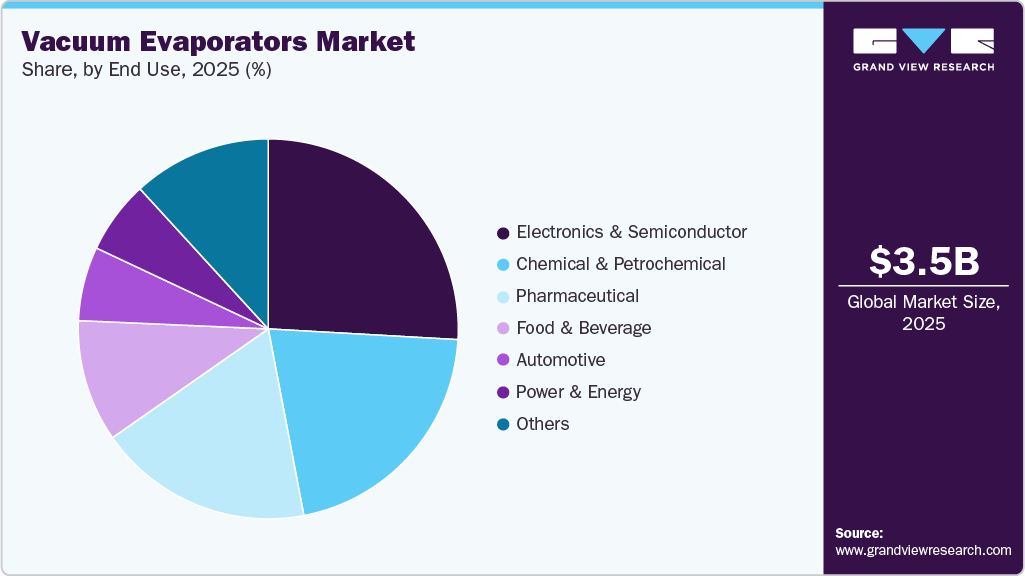
The pharmaceutical segment is expected to witness the fastest growth during the forecast period at a annual growth rate of 8.1%, driven by increasing drug manufacturing activities and stringent wastewater treatment requirements. Pharmaceutical production generates complex effluents containing active compounds, solvents, and chemical residues that require effective treatment. Vacuum evaporators are increasingly adopted in pharmaceutical facilities to concentrate waste streams, recover solvents, and reduce liquid waste, supporting regulatory compliance and sustainable production practices.
Regional Insights
North America Vacuum Evaporators Market Trends
North America held a 34.0% largest share of the vacuum evaporators industry. North America vacuum evaporators industry accounted for the largest share globally due to the strong presence of advanced manufacturing industries and well-established wastewater management infrastructure. Industries such as chemicals, pharmaceuticals, electronics, and automotive generate large volumes of complex industrial effluents that require efficient treatment solutions. The regional focus on sustainable water management, industrial automation, and the adoption of advanced wastewater treatment technologies has supported the widespread use of vacuum evaporators across multiple industrial sectors.

U.S. Vacuum Evaporators Market Trends
The U.S. vacuum evaporators industry represents a significant market for vacuum evaporators due to the large volume of industrial and municipal wastewater generated across multiple sectors. Industries such as chemicals, pharmaceuticals, electronics, and food processing require advanced treatment technologies to manage complex effluents and reduce liquid waste. According to the Environmental Protection Agency (EPA), there are approximately 14,800 wastewater treatment plants operating in the country, and these facilities process nearly 34 billion gallons of wastewater every day. This substantial wastewater treatment infrastructure highlights the growing need for efficient water management solutions, including advanced evaporation systems that support wastewater reduction and water reuse in industrial operations.
The vacuum evaporators industry in Canada is witnessing steady growth due to increasing focus on sustainable water management and industrial wastewater treatment. The country has a well-developed industrial base including sectors such as mining, chemicals, food processing, and energy, all of which generate wastewater requiring proper treatment. Industries are increasingly investing in advanced technologies to improve water recycling and reduce environmental impact.
Europe Vacuum Evaporators Market Trends
Europe vacuum evaporators industry represents a mature market for vacuum evaporators, supported by strong environmental policies and widespread adoption of sustainable industrial practices. Industrial facilities across the region are focusing on reducing liquid waste generation and improving water reuse within production processes. The demand for energy-efficient wastewater treatment technologies and advanced evaporation systems is steadily increasing as industries aim to optimize resource management and reduce environmental impact.
The vacuum evaporators industry in Germany represents a significant market for vacuum evaporators due to its well-developed wastewater treatment infrastructure that supports demand for advanced treatment technologies. According to available statistics, the country has more than 9,100 municipal wastewater treatment and disposal facilities, treating around 9.6 billion m³ of wastewater annually. In addition, about 2,600 industrial wastewater treatment plants handle nearly 1.5 billion m³ of commercial wastewater each year, which supports the adoption of technologies such as vacuum evaporators for efficient wastewater management.
The vacuum evaporators industry in the UK is witnessing steady adoption of advanced wastewater treatment technologies as industries focus on improving water reuse and reducing environmental impact. Industrial sectors including chemicals, pharmaceuticals, and food processing generate wastewater that requires efficient treatment solutions, which is supporting the use of technologies such as vacuum evaporators.
Asia Pacific Vacuum Evaporators Market Trends
Asia Pacific vacuum evaporators industry is expected to register the fastest growth in the market during the forecast period at CAGR of 7.9%, supported by rapid industrial expansion and increasing investments in manufacturing facilities. Growing production activities in sectors such as electronics, pharmaceuticals, and chemicals are generating higher volumes of industrial wastewater, creating demand for efficient treatment technologies.
The vacuum evaporators industry in China represents a significant market for vacuum evaporators due to its large manufacturing sector and rapid expansion in electronics and semiconductor production. According to the Semiconductor Industry Association (SIA), China is the world’s largest manufacturing hub, producing 36% of the world’s electronics. In addition, the country has invested over USD 150 billion in semiconductor development, which is accelerating the growth of chip fabrication and electronics manufacturing facilities. The expansion of these industries generates large volumes of industrial wastewater, increasing the demand for advanced treatment technologies such as vacuum evaporators.
India vacuum evaporators industry is emerging as an important market for vacuum evaporators due to growing industrialization and expanding manufacturing activities across sectors such as pharmaceuticals, chemicals, food processing, and electronics. Increasing production in these industries is leading to higher volumes of industrial wastewater that require efficient treatment solutions. In addition, government initiatives supporting manufacturing expansion and improved water management are encouraging industries to adopt advanced wastewater treatment technologies, including evaporation systems used for wastewater reduction and water reuse.
Latin America Vacuum Evaporators Market Trends
The vacuum evaporators industry in Latin America is gradually expanding as industries increasingly adopt modern wastewater treatment solutions to manage industrial effluents. Growth in manufacturing and processing industries is contributing to higher wastewater generation, which is encouraging the use of technologies that can reduce waste volume and improve water recovery.
Brazil vacuum evaporators industry represents a developing market for vacuum evaporators, supported by expanding industrial activities in sectors such as food processing, chemicals, mining, and pulp and paper. These industries generate wastewater streams that require efficient treatment and management before disposal or reuse. Increasing industrial production and growing attention toward environmental compliance are encouraging companies to invest in advanced wastewater treatment technologies.
Middle East & Africa Vacuum Evaporators Market Trends
The Middle East & Africa vacuum evaporators industry is witnessing steady growth, supported by rising industrial development and increasing focus on water conservation. Industries are investing in advanced wastewater treatment technologies to manage limited water resources more efficiently and reduce environmental impact. Vacuum evaporators are gaining attention as a solution for wastewater concentration and water reuse, particularly in industrial sectors that generate high-salinity or complex effluents.
Saudi Arabia vacuum evaporators industry is witnessing increasing demand for advanced wastewater treatment technologies due to the expansion of industrial sectors such as petrochemicals, oil refining, and manufacturing. These industries generate complex wastewater streams that require efficient treatment solutions before discharge or reuse. In addition, the country’s focus on water conservation and sustainable resource management is encouraging industries to adopt technologies that support wastewater reduction and recycling.
Key Vacuum Evaporators Company Insights
Some of the key players operating in the market include Veolia, ENCON Evaporator, and SANSHIN MFG.CO., LTD.
-
Veolia is a global provider of environmental solutions specializing in water, waste, and energy management services for industrial and municipal customers. The company develops technologies that support water treatment, wastewater recycling, waste recovery, and energy optimization to improve resource efficiency and reduce environmental impact. Within its water technologies portfolio, Veolia also offers evaporation systems such as vacuum evaporators, which are used to treat industrial wastewater by separating water from contaminants and reducing liquid waste volumes.
-
ENCON Evaporators develops systems that use vacuum evaporation technology to reduce the volume of industrial wastewater and recover usable water. Its Vacuum Heat Pump (VHP) evaporator operates under low-pressure conditions, allowing wastewater to evaporate at lower temperatures while separating clean water from dissolved contaminants. The condensed water can often be reused within industrial processes, while the remaining concentrate is minimized for disposal. These systems are designed to handle complex wastewater streams and help industries lower treatment costs while improving overall water management efficiency.
Key Vacuum Evaporators Companies:
The following key companies have been profiled for this study on the vacuum evaporators market.
- Veolia
- ENCON Evaporators
- SANSHIN MFG.CO., LTD.
- CG Evaporator
- Yasa ET (Shanghai) Co., Ltd.
- YATHERM SCIENTIFIC
- Phoenix Scientific Co., Ltd.
- Myande Group
- Schulz+Partner GmbH
- Thermo Fisher Scientific Inc.
- Condorchem Enviro Solutions
- C&G Iberica
- KOVOFINIS a.s.
- Martin Christ Gefriertrocknungsanlagen GmbH
- GEA Group
Recent Developments
-
In April 2025, ENCON Evaporators installed a Zero Liquid Discharge (ZLD) system to treat wastewater from a seawater aquarium at a theme park facility. The project uses a propane-fired thermal evaporator and drum dryer to remove water and concentrate the remaining waste. This system helps eliminate liquid discharge and reduces wastewater disposal requirements. It highlights the role of evaporation technology in efficient wastewater management.
-
In January 2025, GEA Group launched the eZero Dairy Evaporator, designed to improve energy efficiency in dairy processing. The system can significantly reduce energy use and lower carbon emissions compared with conventional evaporation technologies. It is used for applications such as milk powder and whey production. The technology can also be integrated with existing evaporation systems to improve overall efficiency.
Vacuum Evaporators Market Report Scope
Report Attribute
Details
Market size in 2025
USD 3.5 billion
Estimated market size in 2026
USD 3.7 billion
Projected market size by 2033
USD 5.8 billion
Growth rate
CAGR of 7.0% from 2026 to 2033
Historical data
2021 - 2024
Forecast period
2026 - 2033
Quantitative units
Revenue in USD million and CAGR from 2026 to 2033
Report coverage
Revenue forecast, company market position analysis, competitive landscape, growth factors, and trends
Segments covered
Product, application, end use, region
Regional scope
North America; Europe; Asia Pacific; Latin America; Middle East & Africa
Country Scope
U.S.; Canada; Mexico; Spain; France; Germany; Italy; UK; China; India; Japan; Australia; South Korea; Brazil; Argentina; Saudi Arabia; UAE; South Africa
Key companies profiled
Veolia; ENCON Evaporators; SANSHIN MFG. CO., LTD.; CG Evaporator; Yasa ET (Shanghai) Co., Ltd.; YATHERM Scientific; Phoenix Scientific Co., Ltd.; Myande Group; Schulz+Partner GmbH; Thermo Fisher Scientific Inc.; Condorchem Enviro Solutions; C&G Iberica; KOVOFINIS a.s.; Martin Christ Gefriertrocknungsanlagen GmbH; GEA Group.
Customization scope
Free report customization (equivalent up to 8 analysts working days) with purchase. Addition or alteration to country, regional & segment scope.
Pricing and purchase options
Avail customized purchase options to meet your exact research needs. Explore purchase options
Global Vacuum Evaporators Market Report Segmentation
This report forecasts revenue growth at global, regional & country levels and provides an analysis on the latest trends and opportunities in each of the sub-segments from 2021 to 2033. For this study, Grand View Research has segmented the vacuum evaporators market report based on product, application, end use, and region:

-
Product Outlook (Revenue, USD Million, 2021 - 2033)
-
Heat Pump Vacuum Evaporators
-
Mechanical Vapor Recompression (MVR) Vacuum Evaporators
-
Thermal Vacuum Evaporators
-
-
Application Outlook (Revenue, USD Million, 2021 - 2033)
-
Wastewater Treatment
-
Product Processing
-
Others
-
-
End Use Outlook (Revenue, USD Million, 2021 - 2033)
-
Chemical & Petrochemical
-
Electronics & Semiconductor
-
Food & Beverage
-
Pharmaceutical
-
Power & Energy
-
Automotive
-
Others
-
-
Regional Outlook (Revenue, USD Million, 2021 - 2033)
-
North America
-
U.S.
-
Canada
-
Mexico
-
-
Europe
-
Spain
-
Germany
-
Italy
-
France
-
UK
-
-
Asia Pacific
-
China
-
India
-
Japan
-
Australia
-
South Korea
-
-
Latin America
-
Brazil
-
Argentina
-
-
Middle East & Africa
-
Saudi Arabia
-
UAE
-
South Africa
-
-
Frequently Asked Questions About This Report
Asia Pacific is the fastest-growing region over the forecast period.
The mechanical vapor recompression (MVR) segment led with a 48.3% revenue share in 2025, while heat pump is the fastest-growing product.
The wastewater treatment segment led with a 53.4% revenue share in 2025.
The global vacuum evaporators market size was valued at USD 3.5 billion in 2025 and is estimated at USD 3.7 billion for 2026.
The global vacuum evaporators market is expected to grow at a CAGR of 7.0% from 2026 to 2033, reaching USD 5.8 billion by 2033.
North America dominated with a 34.0% revenue share in 2025, due to the strong presence of advanced manufacturing industries and well-established wastewater management infrastructure. Industries such as chemicals, pharmaceuticals, electronics, and automotive generate large volumes of complex industrial effluents that require efficient treatment solutions.
Key players include Veolia; ENCON Evaporators; SANSHIN MFG. CO., LTD.; CG Evaporator; Yasa ET (Shanghai) Co., Ltd.; YATHERM Scientific; Phoenix Scientific Co., Ltd.; Myande Group; Schulz+Partner GmbH; Thermo Fisher Scientific Inc.; Condorchem Enviro Solutions; C&G Iberica; KOVOFINIS a.s.; Martin Christ Gefriertrocknungsanlagen GmbH; GEA Group.
The vacuum evaporators market is driven by the increasing need for efficient industrial wastewater treatment and stricter environmental regulations on liquid waste discharge. Growing adoption of water reuse and zero-liquid-discharge systems across industries is also supporting market growth.
The electronics and semiconductor led with a 25.9% revenue share in 2025, while pharmaceutical is the fastest-growing segment.
About the Author(s)
Advanced Interior Materials Research Team
Advanced Materials · Advanced Interior MaterialsThis report was authored by the advanced interior materials research team at Grand View Research - comprising two research analysts, one senior research analyst, and one industry expert - with specialized expertise in the advanced interior materials segment of the advanced materials industry. All findings are based on proprietary advanced materials databases, executive interviews, and regulatory analysis, subject to internal peer review prior to publication.
Last Updated:
Speak to Analyst


Need a Tailored Report?
Customize this report to your needs — add regions, segments, or data points, with 20% free customization.
Or view our licence options:


ISO 9001:2015 & 27001:2022 Certified
We are GDPR and CCPA compliant! Your transaction & personal information is safe and secure. For more details, please read our privacy policy.












