
- Home
- »
- Medical Devices
- »
-
Vein Illuminator Market Size And Share Report, 2026-2033GVR Report cover

Vein Illuminator Market (2026 - 2033)
Size, Share & Trends Analysis Report By Technology (Infrared, Transillumination), By Application (Intravenous Access, Blood Draw, Sclerotherapy & Vein Treatment), By End Use, By Region, And Segment Forecasts
Market Size, 2025
$157.9MMarket Estimate, 2026
$166.8MMarket Forecast, 2033
$238.5MCAGR, 2026–2033
5.2%Vein Illuminator Market Summary
The global vein illuminator market size was valued at USD 157.9 million in 2025 and is projected to grow from USD 166.8 million in 2026 to USD 238.5 million by 2033, at a CAGR of 5.2% from 2026 to 2033. The market in North America dominated with a revenue share of 43.2% in 2025. The growth is attributed to the rising burden of chronic diseases and obesity, the rising prevalence of venous leg ulcers, and increasing aesthetic & vein treatment procedures.
 Source: Grand View Research, IR Documents, Primary Interviews, Paid DatabasesTo learn more about this report,
 Download Free Sample Report
 Key Market Trends & Insights
- By technology: Near-infrared (NIR)/infrared technology segment held the largest market share of 64.9% in 2025.
- By application: IV access & venipuncture segment held the largest market share in 2025.
- By end use: Hospitals segment held the largest market share of 54.5% in 2025.
Regional Highlights
- Largest regional market: North America (43.2% revenue share, 2025)
- Fastest-growing regional market: Asia Pacific (highest CAGR, 2026-2033)
- By country: The U.S. held the largest market share in 2025
Market Size & Forecast
- Market size in 2025: USD 157.9 Million
- Estimated market size in 2026: USD 166.8 Million
- Projected market size by 2033: USD 238.5 Million
- CAGR (2026-2033): 5.2%
Three ways to get this report
Buy it, customize it, or ask a question.Ask an Analyst
Analyst response in 1 business day
- AccessReport author, directly
- Reply timeWithin 1 working day
- No sales callDirect answer only
- FormatEmail reply
- CostFree, no cost
Get the Full Report
What the study covers
- FormatsPDF · Excel · Dashboard
- Timeline2026–2033 annual, 2025 base
- Coverage20+ countries, 5 regions
- Companies10+ key players profiled
Customize the Report
20% free customization
- IncludeCountries, segments, points
- TailorTo your product definition
- ExtendDeeper competitor detail
- OrA fully bespoke study
- Turnaround5–10 working days
Moreover, technological advancements in vein imaging are expected to drive the growth. The growing burden of chronic diseases such as diabetes, cancer, along with obesity, is a significant driver of the vein finder and illuminator industry growth, as these conditions directly affect venous access complexity. Patients with diabetes often experience vascular changes such as reduced vein elasticity, microvascular damage, and increased vein fragility. These changes complicate routine venipuncture and intravenous access. For instance, according to the International Diabetes Federation (IDF), approximately 589 million people are currently living with diabetes, with an estimated number to reach 853 million by 2050. To learn more about this report, Download Free Sample Report
 The rising volume of aesthetic and vein treatment procedures further drives the vein illuminator market. The growing demand for minimally invasive cosmetic treatments, such as sclerotherapy, laser vein ablation, and cosmetic injectable procedures, has heightened the need for precise vein visualization. For instance, in 2024, more than 38 million cosmetic surgery procedures were performed worldwide. Similarly, according to the 2024 Procedural Statistics report by the American Society of Plastic Surgeons, around 29% of patients in the U.S. aged 30-39 underwent minimally invasive skin treatments such as lasers, skin resurfacing, and sclerotherapy, which treats varicose and spider veins. In addition, the 2024 Global Survey on Aesthetic/Cosmetic Procedures showed a 42.5% increase in cosmetic procedures over the last four years, with 20.5 million non-surgical procedures and 17.4 million surgical procedures performed in 2024.
 To learn more about this report, Download Free Sample Report
 Technological advancements in imaging have substantially improved the clinical effectiveness and adoption of vein finder and illuminator devices. Modern systems increasingly rely on enhanced near-infrared (NIR) imaging technologies that offer higher sensitivity and improved vein-to-tissue contrast. Advances in optical sensors, illumination sources, and wavelength optimization enable clearer visualization of superficial and moderately deep veins across diverse patient profiles. These improvements address historical limitations in skin tone variability, edema, and body mass index, thereby expanding the clinical applicability of vein finders. As imaging performance becomes more reliable and consistent, healthcare providers gain greater confidence in using these devices in routine venous access workflows.
Emerging Technologies:
Emerging technologies such as integrating AI for vein analysis, hybrid NIR-ultrasound for obese patients, and AR overlays for hands-free guidance hold promise, thereby contributing to market growth. For instance, Fujifilm Sonosite's PIV Assist AI boosts pediatric success, while Veinlite EMS PRO advances transillumination. Modular architectures allow software upgrades without hardware replacement. Furthermore, AR projects vein maps directly on the skin, aligning with real-time anatomy for hands-free use. For example, Vivolight combines an NIR illuminator with AR, reducing alignment time.
Furthermore, cloud-based machine learning deployment enables vein finders to analyze real-time vein dynamics, delivering predictive insertion guidance with enhanced accuracy across skin tones and BMI ranges. Algorithms process large video feeds, overlaying optimal angles and catheter sizes onto AR projections, reducing DIVA complications in oncology and neonatology.
Market Concentration & Characteristics
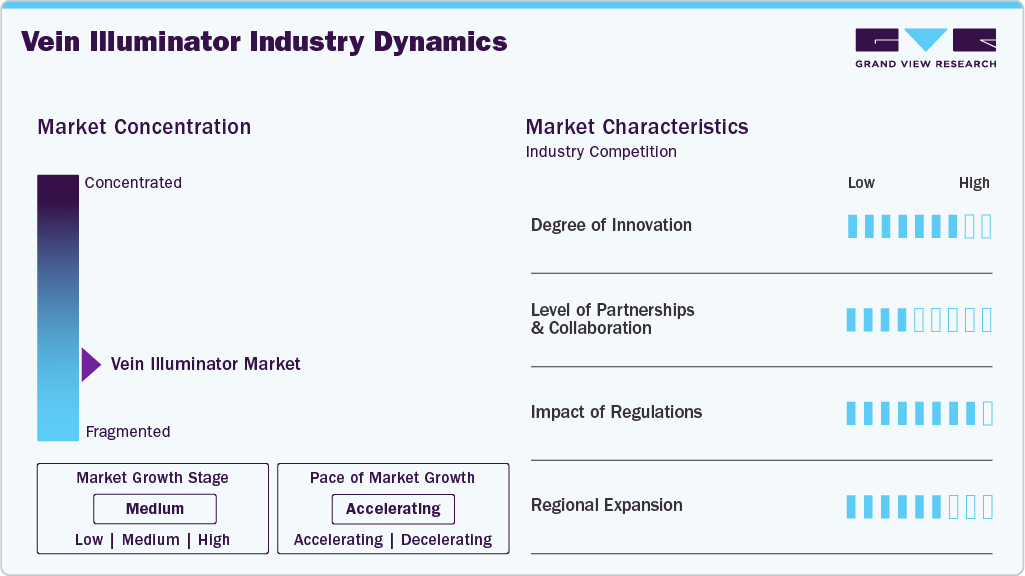
The chart below illustrates the relationship between market concentration, industry characteristics, and industry participants. The x-axis represents the level of industry concentration, ranging from low to high. The y-axis represents various industry characteristics, including industry competition, impact of regulations, level of partnerships & collaborations activities, degree of innovation, and regional expansion. For instance, the vein illuminator market is widely fragmented. The degree of innovation, the level of partnerships & collaboration, and the impact of regulations on the industry are high. However, the regional expansion observes moderate growth.
The vein illuminator industry is witnessing significant product innovation, with manufacturers increasingly integrating AI-driven imaging and visualization technologies to enhance vein detection accuracy, optimize real-time mapping, and improve clinical efficiency, while also focusing on portability, ease of use, and patient comfort for both healthcare professionals and patients. For instance, in April 2024, Vivolight Medical unveiled its VGLASSES AR-based vascular navigation glasses at Arab Health 2024 in Dubai, showcasing how the device combines infrared imaging with advanced AR to provide real-time vein and artery visualization.
 To learn more about this report, Download Free Sample Report
 The level of partnerships and collaborations in the market remains relatively limited, as companies primarily rely on direct sales channels and selective regional distributors rather than extensive strategic alliances. However, targeted collaborations with local distributors and service partners are gradually emerging to expand geographic reach and improve product accessibility in specific markets.
The impact of regulations is high on the vein illuminator market, as these devices must meet stringent medical device standards set by authorities such as the U.S. Food and Drug Administration and the European Medicines Agency. Compliance increases development time and costs but ensures safety, performance reliability, and stronger market acceptance. Stringent approval pathways also create moderate entry barriers, limiting new entrants and intensifying competition among established players.
The vein illuminator industry is witnessing moderate regional expansion, driven by increasing venipuncture procedures and improving healthcare infrastructure in emerging economies. Companies are expanding through product launches and selective distribution partnerships, supporting wider adoption across developed and developing markets.
Technology Insights
The near-infrared (NIR)/infrared technology segment led the vein illuminator industry, accounting for the largest share of 64.99% in 2025, driven by enhanced clinical validation and significant first-attempt venipuncture success across diverse patient populations, including neonates and obese individuals. Moreover, clinical adoption of infrared vein finders is driven by improved patient outcomes and procedural efficiency. Hospitals and specialty clinics utilize these devices to reduce multiple needle sticks, minimize patient discomfort, and lower complication rates.
The ultrasound-based vein visualization segment is expected to grow at the fastest CAGR of 5.84% over the forecast period, as this system is designed to address limitations of optical and near-infrared technologies. These systems use high-frequency sound waves to generate real-time images of veins deeper beneath the skin. Unlike projection-based devices, ultrasound allows clinicians to visualize vein depth, diameter, and surrounding anatomical structures. This capability supports accurate vessel selection in patients with difficult venous access. As a result, ultrasound-based systems are increasingly adopted in high-acuity care environments.
Application Insights
The IV access & venipuncture segment held the largest share of the vein illuminator market in 2025, owing to intravenous cannulation being the most frequently performed clinical procedure across all healthcare settings. High incidence of difficult venous access among pediatric, geriatric, obese, and chronically ill patients increases reliance on vein visualization devices. Vein illuminators improve first-attempt success rates, reduce procedure time, and enhance patient comfort, driving widespread and routine adoption for IV access applications.
The blood collection & donation segment is expected to grow at the fastest CAGR over the forecast period. The need for consistent, reliable venous access drives this growth. Blood donation procedures require identification of suitable veins to ensure safe, efficient collection and maintain donor comfort. Vein illuminating devices help phlebotomists rapidly visualize superficial veins, particularly in donors with low vein visibility. Their use supports smooth workflow during high-volume donation sessions. This enhances operational efficiency in collection centers.
End Use Insights
The hospitals segment held the largest market share of 54.51% in 2025, driven by high patient volumes and frequent venous access needs across multiple departments. Hospitals perform a wide range of procedures requiring intravenous access, including emergency care, surgery, oncology treatment, intensive care, and inpatient therapy. A higher concentration of complex and difficult venous access cases increases reliance on vein visualization technologies.
 To learn more about this report, Download Free Sample Report
 The ambulatory surgical centers (ASCs) segment is expected to grow at the fastest CAGR of 6.51% over the forecast period. These facilities perform a wide range of minimally invasive and elective surgeries that require reliable intravenous access for anesthesia and perioperative medication delivery. Vein finder devices assist clinicians in rapid vein identification during preoperative preparation. Their use reduces delays caused by difficult cannulation.
Regional Insights
North America Vein Illuminator Market Trends
North America region held the largest revenue share of over 43.24% in 2025. The North America vein illuminator industry is expanding rapidly, driven by high volumes of IV-dependent procedures, the increasing prevalence of chronic conditions such as cancer, diabetes, and renal disorders, and the growing demand for patient-centered, minimally invasive care. Rising rates of chronic disease and workforce shortages have amplified the need for technologies that improve first-stick success, reduce failed venous access attempts, and standardize procedures across hospitals, outpatient clinics, and mobile IV therapy services.
 To learn more about this report, Download Free Sample Report
 U.S. Vein Illuminator Market Trends
The U.S. Vein Illuminator market held the largest share in 2025.The U.S. vein illuminator industry is shaped by structural characteristics of the country’s healthcare delivery system, particularly the high volume of IV-dependent procedures performed across emergency departments, outpatient infusion centers, and hospital-based specialty clinics. U.S. hospitals manage large populations of patients with chronic conditions such as cancer, renal disease, and autoimmune disorders, all of which require repeated venous access for chemotherapy, dialysis, biologics, and supportive infusions. For instance, according to the American Cancer Society, excluding non-melanoma skin cancers, approximately 2.1 million new cancer cases are expected to be diagnosed in the U.S. in 2026, with more than 626,000 estimated deaths.
Europe Vein Illuminator Market Trends
In Europe, the vein illuminator industry’s growth is driven by high volumes of venous access procedures across hospitals, outpatient clinics, and ambulatory care settings, as well as an aging population and the rising prevalence of chronic diseases that require repeated IV access. Emphasis on patient safety, reduced failed cannulation attempts, and workflow standardization support the adoption of vein visualization technologies. Ongoing nursing shortages and the shift toward portable, point-of-care devices further reinforce demand.
The UK vein illuminator market growth is driven by the high volume of venous access procedures performed across NHS hospitals, community care settings, and outpatient clinics. Operational pressures within the NHS, including persistent nursing shortages and high patient throughput, have increased interest in technologies that improve efficiency and reduce procedural variability. For instance, according to the Commons Library Research Briefing February 2024, vacancy levels in NHS England reached 121,070 positions, including 42,300 nursing vacancies and 8,850 doctor vacancies.
The vein illuminator market in Germany is supported by the country’s well-established healthcare infrastructure and high procedural volumes across hospitals, outpatient clinics, and specialty care centers. Germany manages a large population of patients requiring repeated venous access due to chronic conditions such as cancer, renal disease, cardiovascular disorders, and diabetes, driving routine demand for IV therapy, blood sampling, and infusion treatments. According to the WHO, in 2022, 605,805 new cancer cases were registered in Germany.
Asia Pacific Vein Illuminator Market Trends
The Asia Pacific vein illuminator industry is expected to grow at the fastest CAGR from 2026 to 2033. Asia Pacific represents a structurally strong growth region for vein illuminators, driven by a combination of demographic pressure, high procedural volumes, and expanding healthcare access across both developed and emerging economies. Rapid population aging in countries such as Japan, South Korea, Taiwan, and parts of China has increased the prevalence of patients with fragile or difficult-to-access veins. At the same time, rising burdens of chronic diseases across the region continue to elevate demand for frequent venipuncture and intravenous therapies.
The vein illuminator market in China is influenced by the demands of a high-volume healthcare system where clinicians routinely manage large numbers of patients within limited procedural timeframes. In busy public hospitals, frequent intravenous access and blood collection require accurate vein localization, as unsuccessful attempts can disrupt workflow and increase patient discomfort. Vein visualization devices are therefore being used to assist healthcare staff in reliably identifying veins, particularly in patients where visual or tactile assessment is challenging.
India’s vein illuminator market is set to expand as hospitals place increasing emphasis on improving IV therapy safety and patient outcomes. Initiatives such as the BD and JCI PRIME programme, adopted by six leading Indian hospitals in 2025, aim to reduce IV-related complications and standardize clinical practices, highlighting the growing institutional focus on procedural accuracy. This rising demand for safer, more efficient venous access creates a favorable environment for vein illumination technologies, which can help clinicians achieve higher first-attempt success rates, reduce patient discomfort, and improve overall workflow efficiency across diverse clinical settings.
Latin America Vein Illuminator Market Trends
The vein illuminators industry in Latin America is driven by rising demand for safe, efficient venous access across healthcare systems under increasing clinical pressure. Hospitals and outpatient facilities in countries such as Brazil, Colombia, and Argentina manage high patient volumes with limited clinical resources. Emergency care, intensive care, and inpatient wards require rapid and reliable venipuncture to support intravenous therapy, diagnostics, and acute interventions. For instance, according to the Pan American Health Organization’s (PAHO) June 2025 data, 75% of total blood donations were recorded in major countries such as Brazil, Argentina, and Colombia.
Middle East & Africa Vein Illuminator Market Trends
The growth of the Middle East vein illuminator industry is driven by large-scale healthcare infrastructure development and system modernization across the Gulf Cooperation Council countries. Governments in Saudi Arabia, the UAE, Qatar, and Kuwait are investing heavily in new hospitals, medical cities, and specialty care centers as part of long-term national healthcare strategies. These initiatives prioritize patient safety, clinical efficiency, and the adoption of advanced medical technologies. As newly developed facilities integrate modern clinical workflows, vein illumination devices are increasingly incorporated to improve procedural accuracy and reduce treatment delays.
Key Vein Illuminator Company Insights
Key players in the vein illuminator market are adopting innovative strategies focused on advanced imaging technologies, improved illumination accuracy, and ergonomic, portable designs to enhance clinical efficiency and patient comfort. Companies are expanding through direct sales and distributor networks, while collaborating with hospitals and healthcare institutions to strengthen adoption and expand market presence across diverse clinical settings.
Key Vein Illuminator Companies:
The following key companies have been profiled for this study on the vein illuminator market.
- Christie Medical Holdings, Inc. (Acquired by CAREstream Group in June 2019)
- Hellovein
- Veinlite
- AccuVein, Inc.
- Venoscope
- ZD Medical Inc.
- Koninklijke Philips N.V.
- Infinium Medical, Inc.
- Vivolight
- VINO Optics
- GE Healthcare
Recent Developments
-
In January 2026, ZD Medical was awarded the title of Provincial Enterprise Research Institute by the Zhejiang Provincial Department of Economy and Information Technology, recognizing its commitment to technological innovation and R&D in ophthalmic medical devices and marking a new milestone in its innovation efforts.
-
In October 2023, AccuVein issued a U.S. service notice stating that the HF580 Powered Stand can now be serviced on-site in the U.S., eliminating the need to return the unit to AccuVein and helping reduce device downtime.
Vein Illuminator Market Report Scope
Report Attribute
Details
Market size in 2025
USD 157.9 million
Estimated Market size in 2026
USD 166.8 million
Projected Market size by 2033
USD 238.5 million
Growth rate
CAGR of 5.2% from 2026 to 2033
Actual data
2021 - 2025
Forecast period
2026 - 2033
Quantitative units
Market Value in USD million and CAGR from 2026 to 2033
Report coverage
Revenue forecast, company ranking, competitive landscape, growth factors, and trends
Segments covered
Technology, application, end use, region
Regional scope
North America; Europe; Asia Pacific; Latin America; MEA
Country scope
U.S.; Canada; Mexico; Germany; UK; France; Italy; Spain; Netherlands; Russia; Switzerland; Turkey; Denmark; Sweden; Norway; Poland; Japan; China; India; Australia; South Korea; Thailand; Indonesia; Taiwan; Hong Kong; Philippines; Malaysia; South Africa; Saudi Arabia; UAE; Kuwait; Qatar; Brazil; Argentina; Colombia; Chile
Key companies profiled
Christie Medical Holdings, Inc.; Hellovein; Veinlite; AccuVein, Inc.; Venoscope; ZD Medical Inc.; Koninklijke Philips N.V.; Infinium Medical, Inc.; Vivolight; VINO Optics; GE Healthcare
Customization scope
Free report customization (equivalent up to 8 analysts working days) with purchase. Addition or alteration to country, regional & segment scope.
Pricing and purchase options
Avail customized purchase options to meet your exact research needs. Explore purchase options
Global Vein Illuminator Market Report Segmentation
This report forecasts revenue growth at the global, regional, and country levels and provides an analysis of the latest industry trends in each of the sub-segments from 2021 to 2033. For this study, Grand View Research has segmented the global vein illuminator market report based on technology, application, end use, and region:
 To learn more about this report, Download Free Sample Report
 -
Technology Outlook (Revenue, USD Million, 2021 - 2033)
-
Near-Infrared (NIR)/Infrared Technology
-
Transillumination Technology
-
Ultrasound-Based Vein Visualization
-
-
Application Outlook (Revenue, USD Million, 2021 - 2033)
-
IV Access & Venipuncture
-
Blood Collection & Donation
-
Sclerotherapy & Vein Treatment
-
Surgical, Emergency & Critical Care
-
Pediatric, Geriatric & Difficult Access Cases
-
Other Application (Medical training & education, etc.)
-
-
End Use Outlook (Revenue, USD Million, 2021 - 2033)
-
Hospitals
-
Clinics & Diagnostic Centers
-
Ambulatory Surgical Centers (ASCs)
-
Blood Banks & Donation Centers
-
Other (Academic & Research Institutes, etc.)
-
-
Regional Outlook (Revenue, USD Million, 2021 - 2033)
-
North America
-
U.S.
-
Canada
-
Mexico
-
-
Europe
-
Germany
-
UK
-
France
-
Italy
-
Spain
-
Netherlands
-
Russia
-
Switzerland
-
Turkey
-
Denmark
-
Sweden
-
Norway
-
Poland
-
-
Asia Pacific
-
Japan
-
China
-
India
-
Australia
-
South Korea
-
Thailand
-
Indonesia
-
Taiwan
-
Hong Kong
-
Philippines
-
Malaysia
-
-
Latin America
-
Brazil
-
Argentina
-
Colombia
-
Chile
-
-
Middle East and Africa (MEA)
-
South Africa
-
Saudi Arabia
-
UAE
-
Kuwait
-
Qatar
-
-
Frequently Asked Questions About This Report
The global vein illuminator market size was valued at USD 157.9 million in 2025 and is estimated at USD 166.8 million for 2026.
The global vein illuminator market is expected to grow at a CAGR of 5.2% from 2026 to 2033, reaching USD 238.5 million by 2033.
North America dominated with a 43.2% revenue share in 2025.
Asia Pacific is the fastest-growing region over the forecast period.
Some key players operating in the vein illuminator market include Christie Medical Holdings, Inc., Hellovein, Veinlite, AccuVein, Inc., Venoscope, ZD Medical Inc., Koninklijke Philips N.V., Infinium Medical, Inc., Vivolight, VINO Optics, GE Healthcare
Key factors that are driving the market growth include the growing burden of chronic diseases and obesity, rising prevalence venous leg ulcers, and Increasing aesthetic & vein treatment procedures. Moreover, technological advancements in vein imaging drive market growth further.
The near-infrared (NIR)/infrared technology segment led with a 64.9% revenue share in 2025, while the ultrasound-based vein visualization segment is the fastest-growing.
The IV access & venipuncture segment held the largest revenue share in 2025, while the blood collection & donation segment is the fastest-growing.
The hospitals segment led with a 54.5% revenue share in 2025, while the ambulatory surgical centers (ASCs) segment is the fastest-growing.
About the Author(s)
Medical Devices Research Team
Healthcare · Medical DevicesThis report was authored by the medical devices research team at Grand View Research - comprising two research analysts, one senior research analyst, and one industry expert - with specialized expertise in the medical devices segment of the healthcare industry. All findings are based on proprietary healthcare databases, executive interviews, and regulatory analysis, subject to internal peer review prior to publication.
Last Updated:
Speak to Analyst

Customize this report to your needs - add regions, segments, or data points, with 20% free customization.
Or view our licence options:


ISO 9001:2015 & 27001:2022 Certified
We are GDPR and CCPA compliant! Your transaction & personal information is safe and secure. For more details, please read our privacy policy.


