
- Home
- »
- Homecare & Decor
- »
-
Vertical Garden Construction Market Size Report, 2026-2033GVR Report cover

Vertical Garden Construction Market (2026 - 2033)
Size, Share & Trends Analysis Report By Garden Type (Green Facades, Living Walls), By Type (Indoor, Outdoor), By Application (Residential, Commercial), By Region, And Segment Forecasts
Market Size, 2025
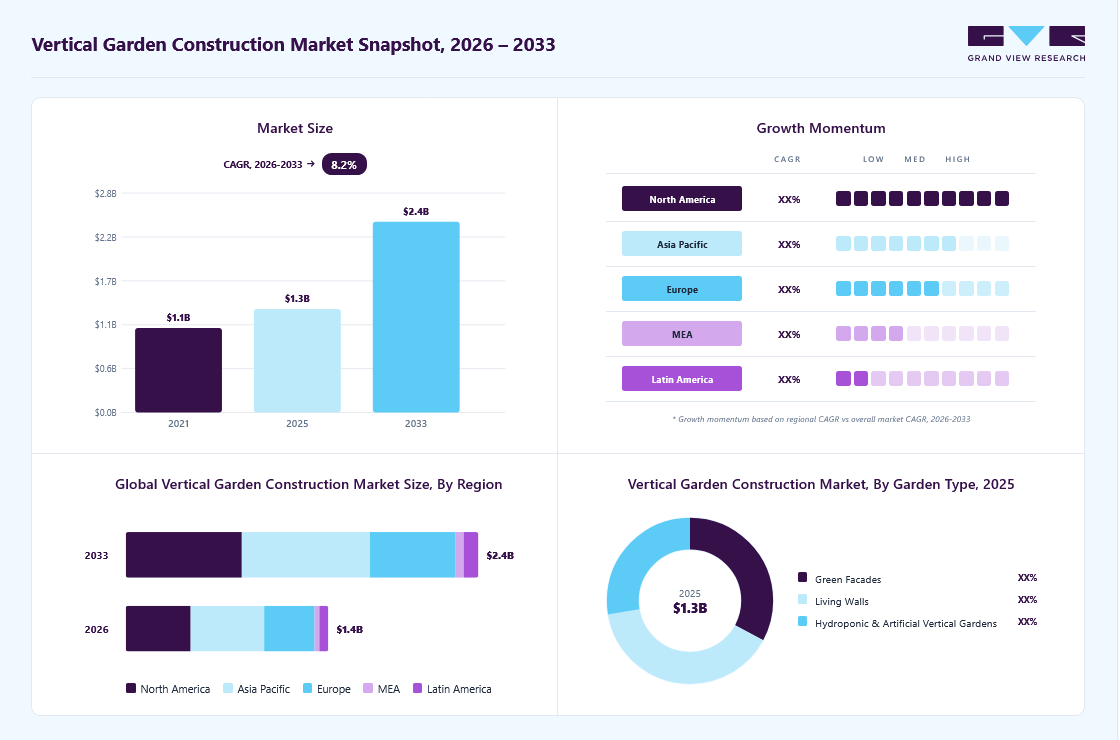
$1.3BMarket Estimate, 2026
$1.4BMarket Forecast, 2033
$2.4BCAGR, 2026–2033
8.2%Vertical Garden Construction Market Summary
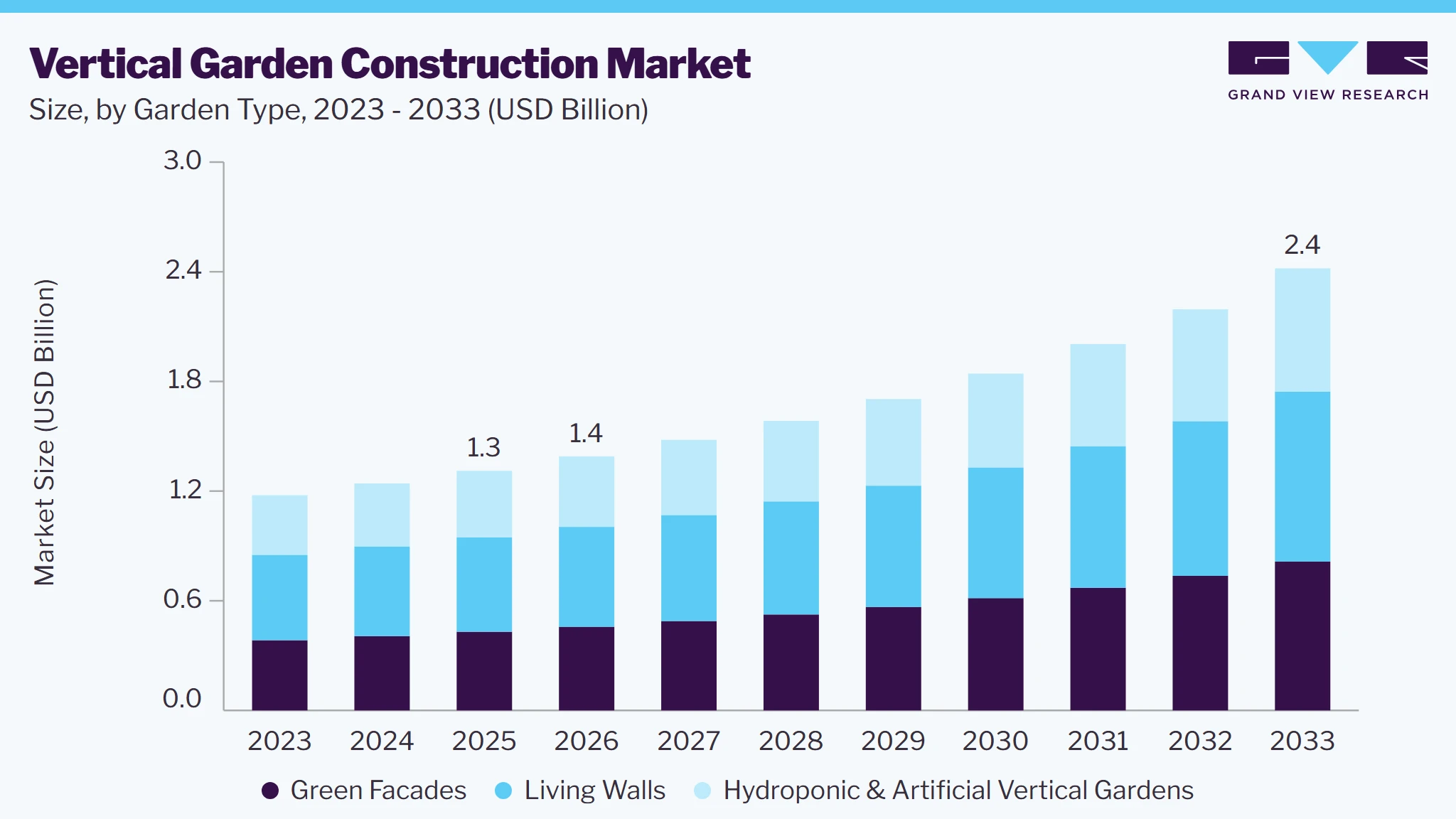
The global vertical garden construction market size was valued at USD 1.3 billion in 2025 and is projected to grow from USD 1.4 billion in 2026 to USD 2.4 billion by 2033, at a CAGR of 8.2% from 2026 to 2033. Asia Pacific dominated the market, accounting for a revenue share of 36.3% in 2025. The market is driven by urban heat mitigation, building-energy performance, and pressure to add greenery without requiring additional land. Vertical greenery allows vegetation to be integrated directly onto façades and walls in dense built environments.
 Source: Grand View Research, IR Documents, Primary Interviews, Paid DatabasesTo learn more about this report,
 Download Free Sample Report
Key Market Trends & Insights
- By garden type: Living walls segment led the industry with a share of 39.4% in 2025.
- By type: Outdoor segment led the industry with a share of 67.7% in 2025.
- By application: Commercial segment led the market with a share of 59.8% in 2025.
Regional Highlights
- Largest regional market: Asia Pacific (36.3% revenue share, 2025)
- By country: China held the largest market share in 2025
Market Size & Forecast
- Market Size in 2025: USD 1.3 billion
- Estimated market size in 2026: USD 1.4 billion
- Projected Market Size by 2033: USD 2.4 billion
- CAGR (2026-2033): 8.2%
Prism AI by Grand View Research Free to tryAsk a question about the vertical garden construction marketTry asking✓Every figure cited from GVR research Prefer the report? Download free sample →The growth is also supported by biophilic design, property differentiation, and rising buyer interest in sustainable buildings. Green walls are increasingly incorporated into residential, hospitality, office, and retail projects where visual appeal and perceived property value matter. A 2025 homebuyer study found 63% of respondents were interested in living in apartments incorporating exterior hydroponic green walls, despite 84% having previously been unfamiliar with them.
 To learn more about this report, Download Free Sample Report
Market penetration is occurring through architects, landscape designers, developers, and specialized green-wall contractors, rather than conventional retail-led purchasing. These intermediaries increasingly specify systems during building design, refurbishment, and landscape planning, allowing green façades and living walls to enter projects before construction is completed. A 2025 survey of 390 design professionals published by Springer Nature found 67.2% believed vertical greenery systems were becoming increasingly popular, indicating growing acceptance among the professionals who influence project specification.
However, adoption is expanding selectively toward projects where environmental performance, aesthetics, and available wall area justify installation and maintenance requirements. Developers and building owners are therefore moving beyond purely decorative installations toward systems positioned around cooling, energy performance, and property enhancement. A 2024 study published by Science Direct found vertical greenery could reduce building energy consumption by 5.9%, strengthening its case as a functional building-integrated solution rather than simply landscape decoration.
Major Trends in the Vertical Garden Construction Market
Trends Definition
Modular systems are simplifying vertical garden installation Vertical gardening is shifting toward modular systems that reduce on-site complexity and allow flexible configurations across different façades. Viritopia’s modular system was used across three differently designed data-center buildings, while Sempergreen’s Nuage targets compact residential and workspace applications. This supports faster installation, easier customization, and broader adoption across building types.
Biodiversity is becoming a core design objective Vertical gardens are increasingly designed to support pollinators, insects, and native plant species rather than aesthetics alone. Habitat Horticulture’s Meadowall uses pre-seeded panels with native wildflowers and grasses, while Bauer Media Outdoor’s Vertical Meadow uses 25 native plant varieties developed with The Wildlife Trusts and Buglife.
Green walls are moving into data centers Data centers are emerging as a new application for large-scale vertical greenery, particularly where developers need biodiversity measures alongside visually integrated infrastructure. Viritopia’s 2025 Union Park project installed 2,252 m² of modular living walls across three AI-ready data-center buildings, combining façade design with biodiversity and thermal-performance objectives.
Low-maintenance systems are gaining importance Product development is increasingly focused on reducing irrigation, plant replacement, and maintenance requirements. Bauer’s Vertical Meadow grows plants directly from seeded mats without a mains-water connection, while Habitat Horticulture positions Meadowall as a lower-cost, lower-maintenance alternative using seed-grown native plants.
Market Dynamics
The market is also being driven by biodiversity restoration within dense urban areas, where conventional ground-level landscaping is constrained by limited land availability. Green walls allow developers and property owners to convert otherwise unused façades into habitat for pollinators and other species, strengthening their role as urban ecological infrastructure. A 2025 Vienna study recorded 32 wild bee species and 8 butterfly species on vertical greenings, with significantly higher species richness where plant diversity was greater. This is encouraging adoption where biodiversity objectives increasingly influence landscape and building design.
High installation and maintenance costs remain a major restraint, particularly for living walls requiring irrigation, drainage, structural integration, plant replacement, and specialist servicing. These recurring requirements can make vertical systems less financially attractive than conventional landscaping, especially where owners cannot justify long-term operating costs. A 2025 survey of 390 architects, landscape architects, planners, and VGS vendors found installation and maintenance costs received the highest barrier score, with a mean rating of 4.4/5.
The market presents an opportunity for automated irrigation, remote monitoring, water recirculation, and low-maintenance plant systems that reduce watering requirements, plant replacement, maintenance labor, and lifecycle costs. Integration of sensors and automated controls can enable real-time monitoring of moisture levels, irrigation schedules, plant health, and system performance, making vertical gardens easier to operate across commercial and residential properties.
Analyst Perspective
The global vertical garden construction market is shifting toward engineered green-wall systems that integrate irrigation, structural support, planting media, and maintenance requirements rather than simple decorative greenery. Demand is supported by commercial projects requiring façade greening, indoor living walls, and space-efficient greenery in offices, hospitality, retail, residential developments, and public infrastructure. System selection increasingly depends on wall structure, climate, water availability, plant survival, maintenance access, and installation complexity, while hydroponic and artificial systems provide alternatives where conventional living-wall maintenance is difficult. Market differentiation is therefore increasingly tied to system engineering, project execution, plant suitability, irrigation performance, and lifecycle maintenance capabilities.
Consumer Insights
Consumer interest in vertical greenery is increasingly shaped by the functional value delivered alongside visual appeal, particularly air quality, stress reduction, thermal comfort, and aesthetic enhancement. A 2025 homebuyer study found that awareness of green-wall benefits, thermal performance, aesthetics, and property marketability positively influenced willingness to pay, indicating that consumers are placing greater emphasis on measurable benefits rather than decoration alone.
 To learn more about this report, Download Free Sample Report
-
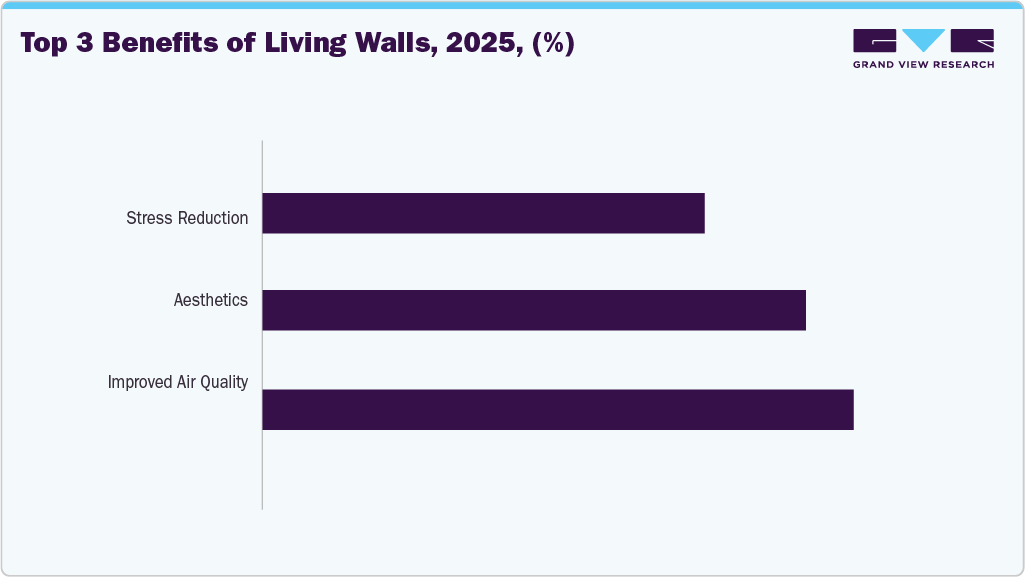
Air quality leads perceived living-wall benefits: SimpleSpring’s 2024 consumer survey identifies improved air quality (64%), aesthetic appeal (59%), and stress reduction (48%) as the top three perceived benefits of living walls. The results indicate that consumers primarily associate living walls with healthier indoor environments, visual enhancement, and well-being rather than purely decorative landscaping.
-
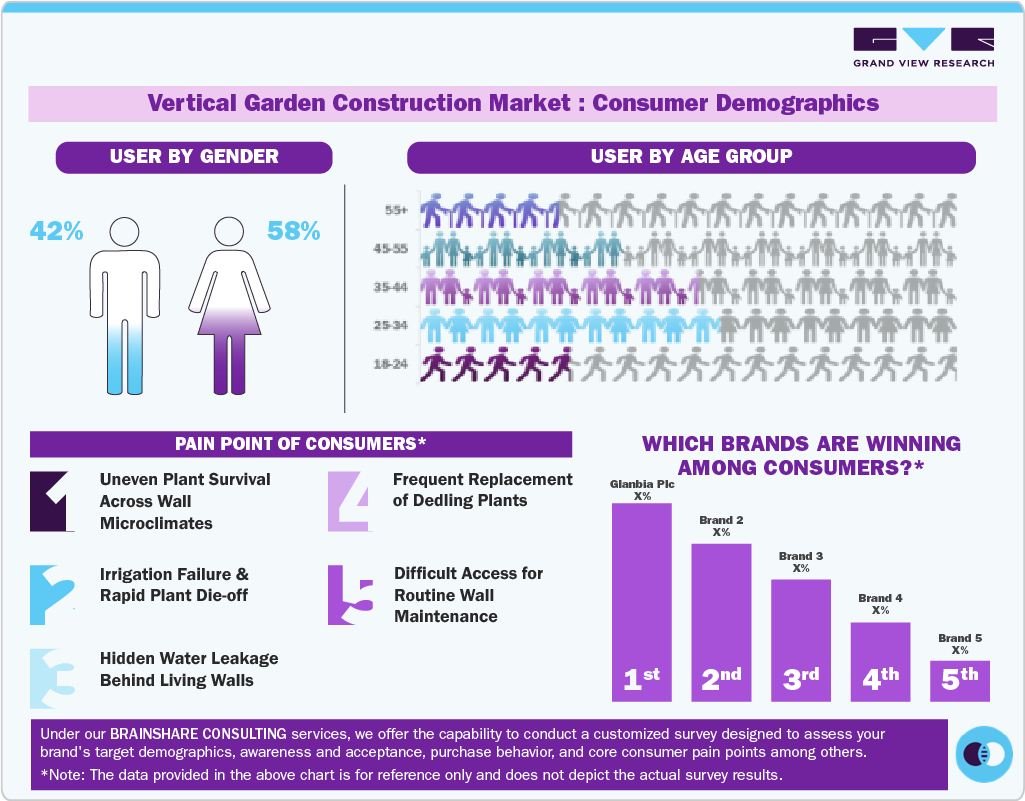
Low maintenance is becoming increasingly important: Consumers are also placing greater emphasis on maintenance requirements, plant survival, irrigation, and long-term appearance when considering vertical greenery. SimpleSpring found that 72% preferred moss walls for ease of upkeep, while 65% selected them for affordability. Separately, a 2025 Delhi study identified watering, irrigation, plant mortality, and additional manpower as important adoption concerns, highlighting demand for reliable, lower-maintenance systems.
 To learn more about this report, Download Free Sample Report
-
Consumers are placing greater emphasis on space-efficient greenery: Consumers increasingly value vertical greenery where it can add plants without requiring additional floor or garden space. A 2024 residential-greening study of 578 respondents found that 90% were interested in having a garden, while balconies represented the most available urban residential space in Chennai, highlighting the relevance of space-efficient greening solutions.
Garden Type Insights
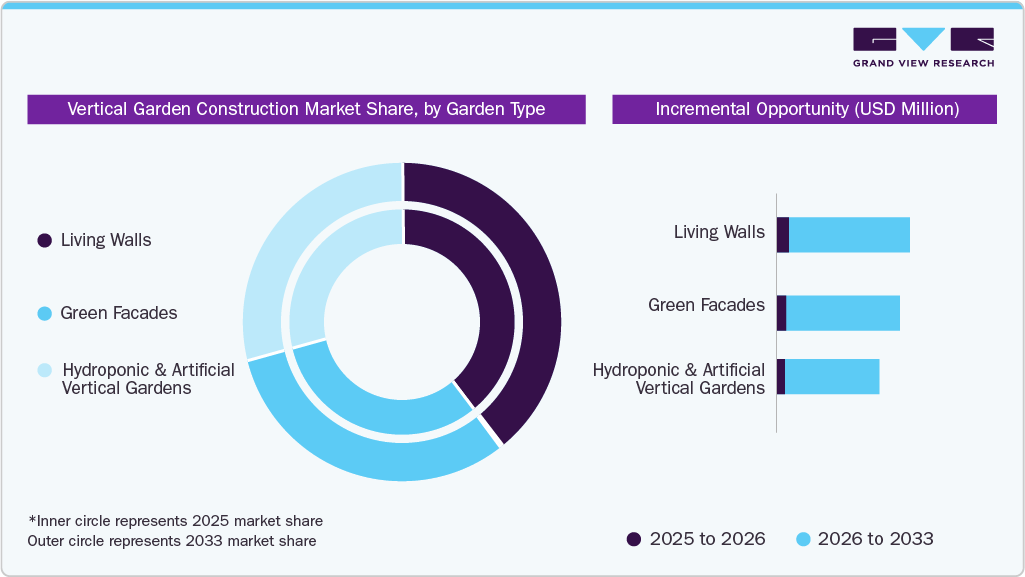
The living walls segment accounted for a share of 39.4% of the global revenue in 2025, driven by their ability to add dense vegetation where ground-level landscaping is constrained, while supporting biophilic design, biodiversity, and building-performance objectives. Their use is expanding across commercial buildings, hospitality, residential developments, and urban projects as architects seek to integrate greenery directly into building surfaces.
 To learn more about this report, Download Free Sample Report
The green facades segment is projected to grow at a CAGR of 8.6% from 2026 to 2033, driven by lower-cost retrofit potential, façade-level shading, and the ability to add vegetation without major structural changes. Demand is strengthening as building owners seek passive cooling and thermal-performance improvements, particularly across existing buildings where full living-wall systems can be more complex to install. A 2025 review found that direct green facades consistently generated positive net economic returns, supporting their use in renovation projects.
Type Insights
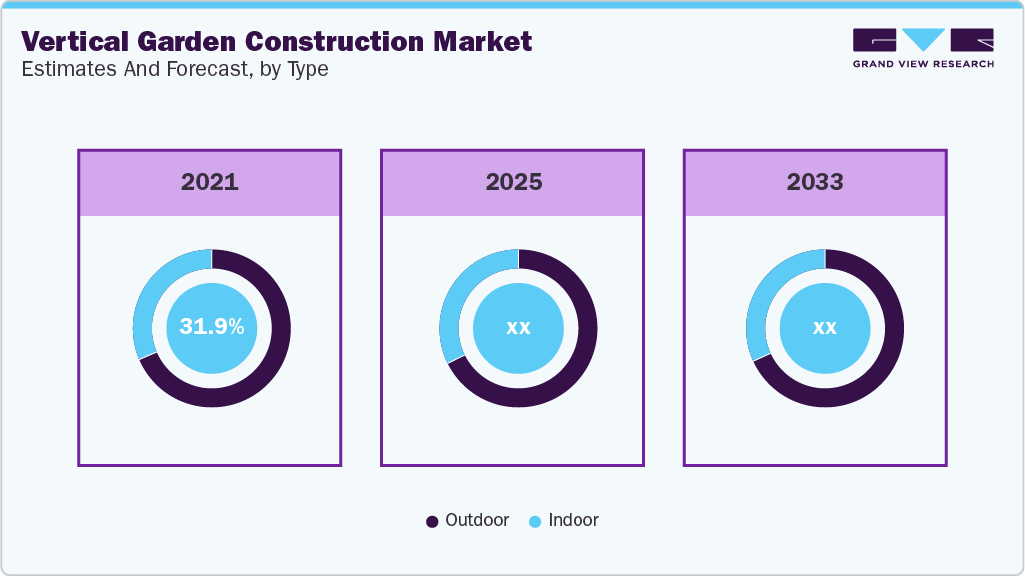
The outdoor segment in the vertical garden construction market accounted for a share of 67.7% in 2025, driven by façade-level cooling, urban heat mitigation, and the ability to add greenery across large exterior surfaces without requiring additional land. Adoption is strengthening as developers and architects integrate outdoor vertical greenery into building envelopes for thermal, environmental, and aesthetic benefits.
 To learn more about this report, Download Free Sample Report
The indoor segment is projected to grow at a CAGR of 8.6% from 2026 to 2033, valued for bringing biophilic design into space-constrained interiors while supporting visual quality, occupant well-being, and indoor environmental conditions. Its adoption is expanding across offices, hospitality, healthcare, education, and residential spaces as green walls integrate nature without requiring additional floor area.
Application Insights
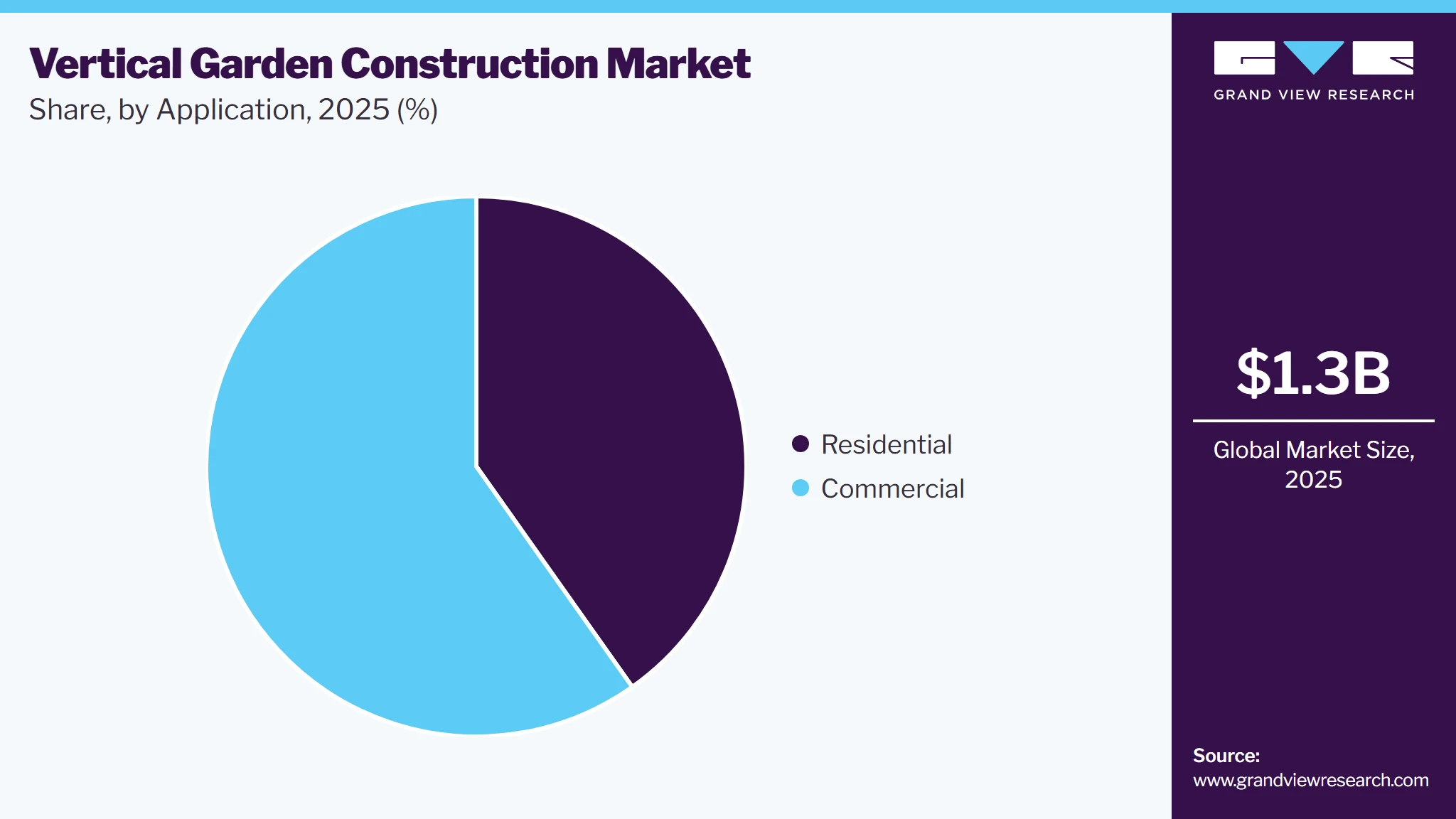
The commercial segment accounted for a share of 59.8% of the global revenue in 2025. This segment plays a huge role by enabling commercial buyers to compare modular living-wall systems, façade components, irrigation solutions, and installation packages before project procurement. Online specifications and project portfolios also support early-stage evaluation by architects, developers, and facility managers. The channel is particularly relevant for standardized systems that can be specified and shipped across multiple commercial projects.
 To learn more about this report, Download Free Sample Report
The residential segment is projected to grow at a CAGR of 8.5% from 2026 to 2033. This application plays a huge role by giving homeowners access to modular wall systems, balcony gardens, planters, and installation solutions suited to space-constrained properties. Online channels also simplify comparison of system types, plant configurations, irrigation requirements, and pricing before purchase.
Regional Insights
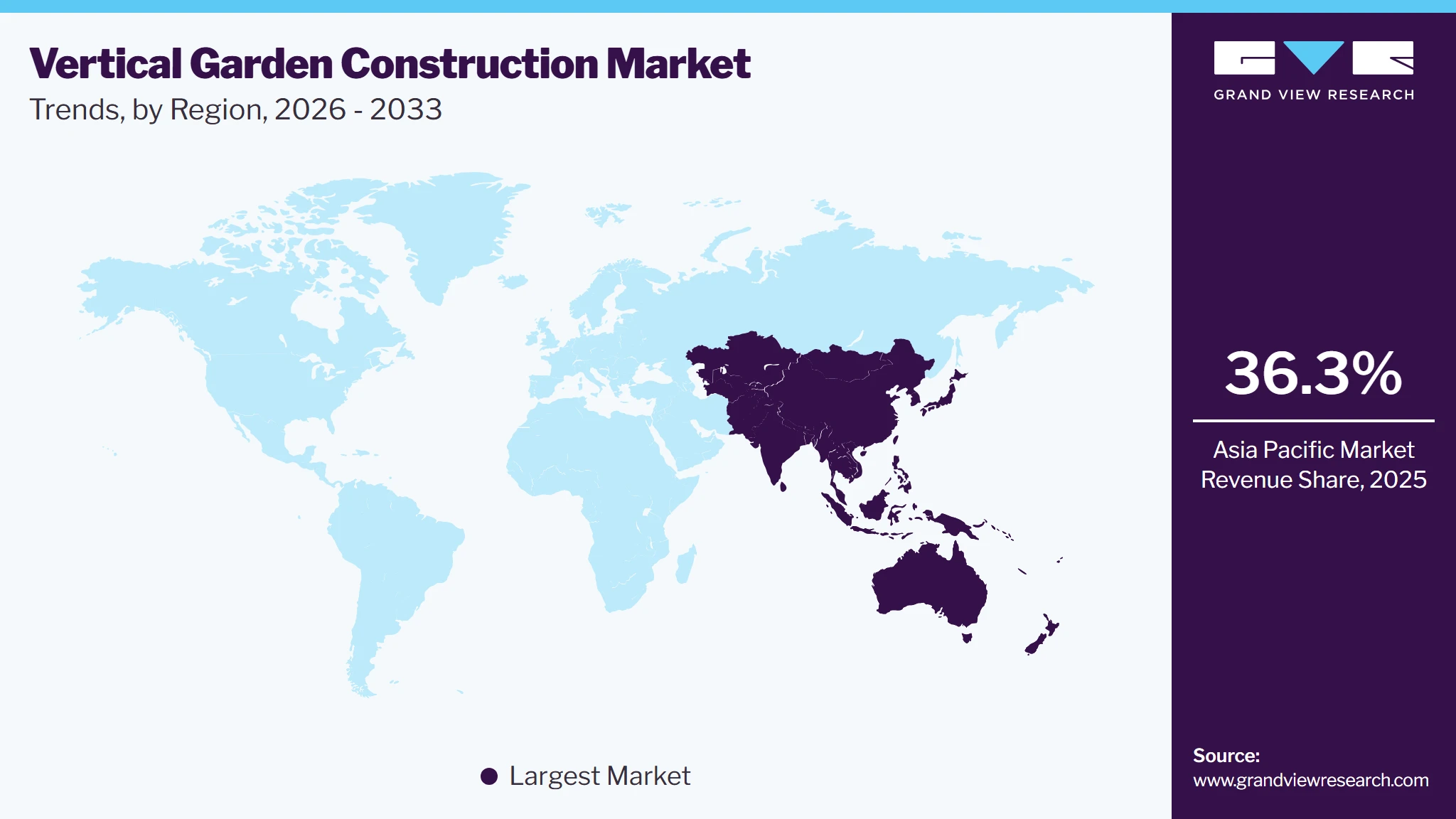
The Asia Pacific vertical garden construction market led the global market with the largest revenue share of 36.3% in 2025. Asia Pacific has strong adoption potential because dense cities combine limited ground-level space with high cooling requirements and extensive building development. Vertical greenery is increasingly being integrated into commercial complexes, residential developments, transport infrastructure, and public buildings. China, Singapore, Japan, South Korea, and India are among the markets where vertical greening is being incorporated into urban-design programs.
 To learn more about this report, Download Free Sample Report
China Vertical Garden Construction Market Trends
China led the vertical garden construction industry in the Asia Pacific and accounted for 33.6% of the global market in 2025. China is expanding vertical greening through city-level greening programs, urban regeneration, and large-scale public and commercial developments. Shanghai added 425,000 m² of three-dimensional greenery in 2025, including vertical green walls across commercial buildings, offices, communities, and public spaces. Beijing’s 2025 urban-greening program specifically includes pilot vertical-greening projects in public spaces. The industry is therefore increasingly connected with government-led urban greening rather than being limited to private architectural projects.
The vertical garden construction market in India is projected to grow at a CAGR of 8.4% from 2026 to 2033. The Indian market is developing around space-constrained cities such as Delhi, Mumbai, Bengaluru, Hyderabad, and Pune. Government programs are encouraging new greening techniques for urban and semi-urban areas where conventional planting space is limited. Commercial buildings, metro infrastructure, hospitality projects, and premium residential developments provide important installation opportunities. The demand is also linked to heat mitigation, façade aesthetics, and the integration of greenery into dense urban developments.
North America Vertical Garden Construction Market Trends
The vertical garden construction market in North America accounted for a revenue share of 31.9% of the global market in 2025. North America benefits from an established green-wall contractor and supplier network, particularly across commercial real estate and institutional buildings. The U.S. and Canada have developed demand for living walls in offices, healthcare, hospitality, and high-visibility public spaces. Green-wall installations are increasingly tied to biophilic interiors, façade greening, and building certification requirements.
The vertical garden construction market in the U.S. accounted for the largest revenue share of around 83.7% in 2025. The industry is supported by specialized living-wall contractors serving offices, healthcare facilities, hotels, retail, and institutional buildings. Vertical greenery is increasingly incorporated into commercial interiors and façades where developers want visible landscaping without additional ground-level land. Cities are also using vertical greening in public spaces and streetscape projects to expand greenery within built-up areas.
Europe Vertical Garden Construction Market Trends
The vertical garden construction market in Europe accounted for 24.9% share in 2025. Europe has a mature vertical-greening ecosystem supported by green-building standards, urban greening programs, and established façade-design practices. Demand is concentrated around building retrofits, dense urban districts, offices, hospitality, and public infrastructure, where horizontal landscaping is constrained. In addition, nature-based cooling is becoming an important application as European cities address urban overheating and climate adaptation.
The Germany vertical garden construction market in Europe accounted for the largest revenue share of around 30.4% in 2025. Germany has a long-established green-building and green-roof industry that also supports the adoption of façade greening and living-wall systems. Vertical greenery is increasingly considered in urban climate adaptation, façade renovation, and biodiversity-oriented building design. The industry is particularly relevant to dense cities where building façades provide additional space for vegetation without consuming land.
The vertical garden construction industry in France accounted for a revenue share of around 21.2% in 2025. France is developing vertical greenery within broader urban cooling and nature-based adaptation programs, particularly in dense metropolitan areas. Green façades and living walls provide opportunities to introduce vegetation into constrained streetscapes and existing building envelopes. Paris and other large cities are increasing the integration of vegetation into buildings, public spaces, and urban regeneration projects.
Central & South America Vertical Garden Construction Market Trends
The vertical garden construction industry in Central & South America is projected to grow at a CAGR of 7.2% from 2026 to 2033. The adoption is concentrated in tropical and subtropical cities, where vegetation can be integrated directly into building façades. Brazil, Colombia, and Chile provide opportunities across commercial buildings, hospitality, residential projects, and urban redevelopment. Living walls are particularly relevant where dense construction limits conventional landscaping, but year-round vegetation can be maintained. The market is also suited to façade systems that combine shading and vegetation with architectural design in warmer climates.
Middle East & Africa Vertical Garden Construction Market Trends
The vertical garden construction market in the Middle East & Africa is projected to grow at a CAGR of 7.6% from 2026 to 2033. The industry is driven by extreme heat, limited natural vegetation, and the need to introduce greenery without consuming scarce land. Vertical gardens are increasingly suited to hotels, luxury retail, commercial developments, and landmark architectural projects where visual impact is important. In Africa, adoption is more fragmented, with vertical gardening also being applied to urban food production and space-constrained communities. Across both regions, irrigation efficiency and plant survivability remain particularly important for system selection and long-term installation performance.
Key Vertical Garden Construction Company Insights
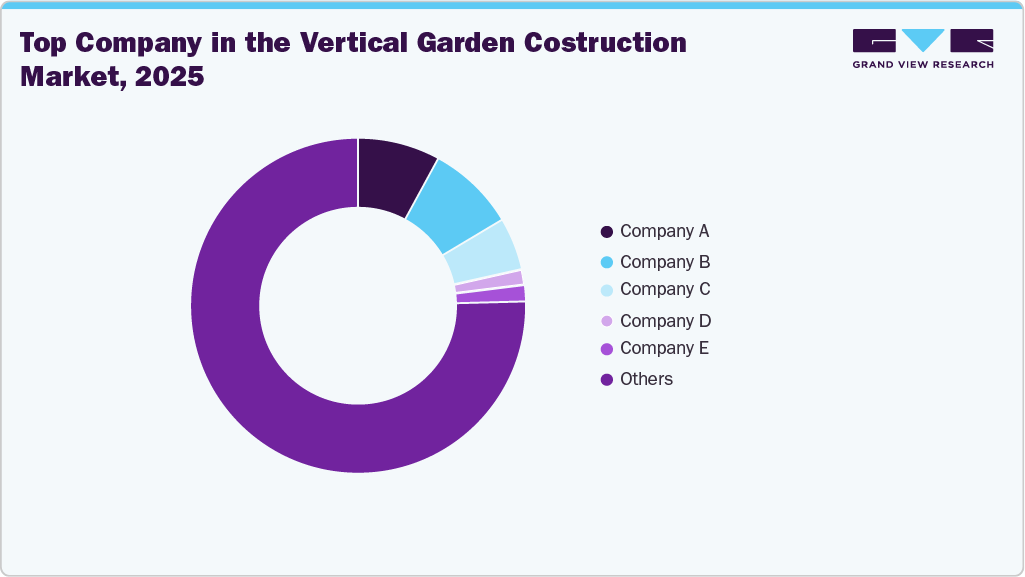
The vertical garden construction market is competitive, with companies differentiating through living-wall systems, green façades, modular technologies, irrigation solutions, plant selection, installation capabilities, maintenance services, and project-specific engineering. Leading players are expanding portfolios across commercial buildings, hospitality, offices, residential developments, infrastructure, and public spaces, while strengthening capabilities in modular construction, hydroponics, biodiversity-focused systems, and low-maintenance vertical greenery.
 To learn more about this report, Download Free Sample Report
Product differentiation increasingly centers on modular living-wall systems, hydroponic technology, green façades, automated irrigation, lightweight construction, biodiversity-focused planting, and lifecycle maintenance. Companies are also strengthening their presence through large commercial projects, architectural partnerships, international expansion, system certifications, and specialized solutions for data centers, hospitality, offices, and urban infrastructure. Recent product development is additionally focused on reducing installation complexity and improving long-term plant performance.
-
Viritopia is a major specialist in living-wall construction, offering modular living walls, green façades, and associated design, engineering, installation, and maintenance services. The company serves commercial buildings, offices, hospitality, infrastructure, data centers, and residential projects, with its portfolio emphasizing biodiversity, building performance, modular construction, and long-term maintenance.
-
Sempergreen is a major vertical-greening company offering living walls, green façades, and broader green-building solutions. The company competes through its combination of horticultural expertise, modular systems, international project execution, and maintenance services, serving commercial, residential, hospitality, infrastructure, and public-space applications.
-
Brand Positioning & Competitive Strength: Companies are differentiating through engineered living wall systems, modular green façades, hydroponic technologies, automated irrigation, plant selection, and integrated installation and maintenance services. Competitive strength increasingly depends on the ability to deliver customized systems for complex building envelopes while maintaining plant health, irrigation performance, and visual quality over the installation lifecycle.
-
Brand Growth & Portfolio Momentum: Market growth is being supported by large commercial and infrastructure projects, international expansion, new modular systems, biodiversity-focused solutions, and applications across data centers, offices, hospitality, retail, and residential buildings. Companies are also expanding beyond initial installation through maintenance, refurbishment, and lifecycle services, creating recurring opportunities alongside new construction activity.
 To learn more about this report, Download Free Sample Report
Key Vertical Garden Construction Companies
The following key companies have been profiled for this study on the vertical garden construction market.
-
Sempergreen Vertical Systems B.V.
-
GSky Plant Systems Inc.
-
ANS Global Ltd.
-
Biotecture Limited
-
LiveWall LLC
-
Fytogreen Australia Pty Ltd.
-
Elmich Pte. Ltd.
-
Sage Vertical Garden Systems, LLC.
-
Green Roof Outfitters, Inc.
-
The Greenwall Company
Competitive Benchmarking
Category
Operating Strategies
Competitive Edge
Weakness
Established Players (Sempergreen Vertical Systems B.V.; GSky Plant Systems Inc.; ANS Global Ltd.; Biotecture Limited; LiveWall LLC)
- Offer engineered green-wall systems spanning modular panels, living walls, green façades, irrigation, planting, installation, and maintenance, targeting commercial, institutional, hospitality, and large-scale projects.
- Extensive project portfolios, proprietary system designs, technical installation expertise, and established relationships with architects, landscape professionals, developers, and commercial property owners strengthen project specification opportunities.
- Project-led business models require specialized installation and maintenance capabilities, while living-wall systems involve higher upfront costs, site-specific engineering, and ongoing irrigation and plant-management requirements.
Emerging Players (Fytogreen Australia Pty Ltd.; Elmich Pte. Ltd.; Sage Vertical Garden Systems, LLC; Green Roof Outfitters, Inc.; The Greenwall Company)
- Target specialized vertical-greening applications through modular systems, façade solutions, living walls, irrigation technologies, and project-specific designs, supported by regional installation and landscaping partnerships.
- Regional expertise, specialized system configurations, localized project execution, and flexibility in adapting wall structures, planting systems, irrigation, and maintenance requirements to individual building conditions.
- Smaller geographic coverage and project pipelines can limit access to large international developments, while regional climate requirements, installation complexity, and maintenance resources can constrain expansion into unfamiliar markets.
Recent Developments
-
In August 2026, Viritopia’s Modular Living Wall System achieved a verified Environmental Product Declaration (EPD), providing independently verified lifecycle-impact data for the system, including raw materials, installation, maintenance, water use, and end-of-life stages. The certification supports environmental assessment of living-wall systems in building projects.
-
In October 2025, Sempergreen expanded into Turkey through a partnership with Armada Groupe, establishing Sempergreen Türkiye and introducing local production and supply of its green infrastructure solutions, including SemperGreenwalls for living-wall applications across major Turkish cities.
-
In July 2025, Bauer Media Outdoor launched Vertical Meadows, a scalable green-wall system developed with Vertical Meadow, using seeded mats containing 25 native wildflowers and grasses to integrate biodiversity into urban infrastructure. The system is designed for installation without a mains water connection and uses recycled and renewable materials.
-
In July 2024, Habitat Horticulture launched Meadowall, a seeded living-wall system using pre-seeded panels and its Growtex growing medium to transform fences and walls into biodiverse vertical gardens. The system integrates irrigation and is designed for lower-cost installation and maintenance than traditional living walls.
Vertical Garden Construction Market Report Scope
Report Attribute
Details
Market size in 2025
USD 1.3 billion
Estimated market size in 2026
USD 1.4 billion
Projected market size by 2033
USD 2.4 billion
Growth rate
CAGR of 8.2% from 2026 to 2033
Base Year
2025
Actuals
2021 - 2025
Forecast period
2026 - 2033
Quantitative units
Revenue in USD billion and CAGR from 2026 to 2033
Report coverage
Revenue forecast, company ranking, competitive landscape, growth factors, and trends
Segments covered
Garden type, type, application, region
Regional scope
North America; Europe; Asia Pacific; Central & South America; Middle East & Africa
Country scope
U.S.; Canada; Mexico; Germany; UK; France; Italy; Spain; China; Japan; India; South Korea; Australia & New Zealand; Brazil; South Africa
Key companies profiled
Sempergreen Vertical Systems B.V.; GSky Plant Systems Inc.; ANS Global Ltd.; Biotecture Limited; LiveWall LLC; Fytogreen Australia Pty Ltd.; Elmich Pte. Ltd.; Sage Vertical Garden Systems, LLC.; Green Roof Outfitters, Inc.; The Greenwall Company
Customization scope
Free report customization (equivalent up to 8 analysts’ working days) with purchase. Addition or alteration to country, regional & segment scope.
Pricing and purchase options
Avail customized purchase options to meet your exact research needs. Explore purchase options
Global Vertical Garden Construction Market Report Segmentation
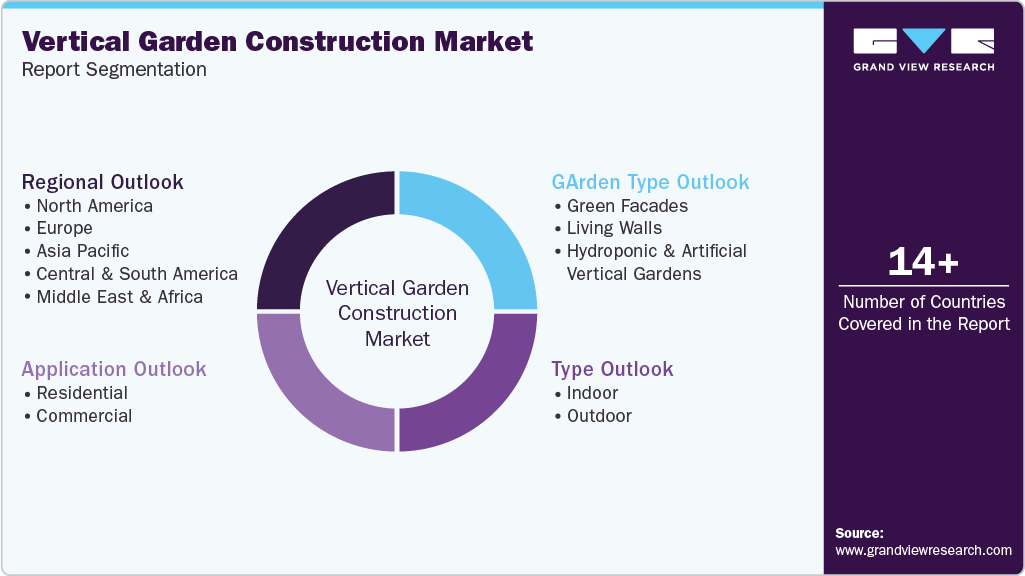
This report forecasts revenue growth at the global, regional & country levels and provides an analysis of the latest trends and opportunities in each sub-segment from 2021 to 2033. For this study, Grand View Research has segmented the global vertical garden construction market report by garden type, type, application, and region:
 To learn more about this report, Download Free Sample Report
-
Garden Type Outlook (Revenue, USD billion, 2021 - 2033)
-
Green Facades
-
Living Walls
-
Hydroponic & Artificial Vertical Gardens
-
-
Type Outlook (Revenue, USD billion, 2021 - 2033)
-
Indoor
-
Outdoor
-
-
Application Outlook (Revenue, USD billion, 2021 - 2033)
-
Residential
-
Commercial
-
-
Regional Outlook (Revenue, USD billion, 2021 - 2033)
-
North America
-
U.S.
-
Canada
-
Mexico
-
-
Europe
-
Germany
-
UK
-
France
-
Italy
-
Spain
-
-
Asia Pacific
-
China
-
Japan
-
India
-
South Korea
-
Australia & New Zealand
-
-
Central & South America
-
Brazil
-
-
Middle East & Africa
-
South Africa
-
-
Research Methodology
The vertical garden construction marketfigures in this report are based on a proven research process that combines executive interviews with secondary research from proprietary databases, company filings, and recognized regulatory and institutional sources. Market size is built through value-chain sizing-reconciling supply-side and demand-side estimates-and triangulated with bottom-up and top-down approaches. Every estimate passes multiple levels of expert validation before publication, with eachvertical garden construction segment quantified using the revenue-capture definitions in the table below.
Segment Definition
Segment - Type
Revenue capture definition
Indoor
Revenue is generated from the construction of vertical gardens installed inside buildings, including living walls, green façades, hydroponic systems, and artificial vertical gardens in residential and commercial spaces.
Outdoor
Revenue is generated from the construction of vertical gardens installed on exterior building surfaces and outdoor structures, including façades, balconies, terraces, courtyards, and boundary walls.
Estimation Model
Layer
Key Question
Description
Potential Installation Base Layer
Which buildings have potential for vertical gardens?
Identify residential and commercial buildings suitable for indoor and outdoor vertical gardens based on building type, available wall area, climate, and installation conditions.
Market Accessibility Layer
Which projects can be reached through construction channels?
Filter potential installations based on access through architects, developers, landscape contractors, specialist installers, distributors, and direct project procurement channels.
Installation & Adoption Layer
Which projects actively adopt vertical garden systems?
Apply vertical-garden adoption rates, project conversion rates, installation frequency, system preferences, and project-area assumptions across residential and commercial applications.
Construction Revenue Layer
How much construction revenue is generated?
Multiply addressable installations by average project area and construction value per square meter, incorporating system type, installation complexity, indoor/outdoor placement, and project scale.
Delivered Customizations
This report has been delivered with the following In-depth customizations
CLIENT REQUEST
CUSTOMIZATION DELIVERED
VALUE ADDS
Assessment Of Vertical Garden System and Technology Adoption
Evaluated the adoption of green façades, living walls, hydroponic systems, modular panels, vegetated mats, trellis systems, and artificial vertical gardens across global markets.
Identified technology-specific deployment patterns and system gaps, supporting technology selection, product development, and market-entry planning.
Benchmarking Vertical Garden Installation Costs Across Global Markets
Compared construction costs by system type, installation complexity, growing medium, irrigation requirements, structural support, and maintenance intensity across key countries.
Identified cost differentials and system-level cost drivers, supporting project budgeting, quotation development, and country-specific pricing decisions.
Mapping of Vertical Garden Projects by Size and Application
Assessed project sizes across residential buildings, offices, hotels, retail spaces, airports, restaurants, public infrastructure, and mixed-use developments.
Identified suitable plant categories by application and climate, supporting planting specifications, sourcing decisions, and system design.
Frequently Asked Questions About This Report
The global vertical garden construction market was valued at USD 1.3 billion in 2025 and is estimated at USD 1.4 billion in 2026.
The global vertical garden construction market is expected to grow at a CAGR of 8.2% from 2026 to 2033, reaching USD 2.4 billion by 2033.
North America is the fastest-growing region over the forecast period.
Asia Pacific dominated with a 36.3% revenue share in 2025.
Key factors include urban biodiversity requirements, green-building standards, façade heat mitigation, limited ground-level landscaping space, modular living-wall systems, water-efficient irrigation technologies, and rising demand for nature-integrated commercial and residential developments.
Some of the key players operating in the vertical garden construction market include Sempergreen Vertical Systems B.V.; GSky Plant Systems Inc.; ANS Global Ltd.; Biotecture Limited; LiveWall LLC; Fytogreen Australia Pty Ltd.; Elmich Pte. Ltd.; Sage Vertical Garden Systems, LLC.; Green Roof Outfitters, Inc.; and The Greenwall Company
The living walls segment accounted for the largest share, at 39.4%, in the vertical garden construction market, while the green facades segment is the fastest-growing.
The commercial segment led with a 59.8% revenue share in 2025, while the residential segment is the fastest-growing.
The outdoor segment accounted for the largest market share of 67.7% in 2025, while the indoor segment is the fastest-growing segment.
About the Author(s)
Homecare & Decor Research Team
Consumer Goods · Homecare & DecorThis report was authored by the homecare & decor research team at Grand View Research - comprising two research analysts, one senior research analyst, and one industry expert - with specialized expertise in the homecare & decor segment of the consumer goods industry. All findings are based on proprietary consumer goods databases, executive interviews, and regulatory analysis, subject to internal peer review prior to publication.
Last Updated:
Speak to Analyst

Customize this report to your needs - add regions, segments, or data points, with 20% free customization.
Or view our licence options:


ISO 9001:2015 & 27001:2022 Certified
We are GDPR and CCPA compliant! Your transaction & personal information is safe and secure. For more details, please read our privacy policy.


