
- Home
- »
- Animal Health
- »
-
Veterinary Testing, Inspection And Certification Market Report 2033GVR Report cover

Veterinary Testing, Inspection And Certification Market (2026 - 2033)
Size, Share & Trends Analysis Report By Service (Testing, Inspection, Certification), By Type (Pharmaceuticals, Medical Devices), By Customer, By Region, And Segment Forecasts
Market Size, 2025
$745.5MMarket Estimate, 2026
$790.7MMarket Forecast, 2033
$1,358.2MCAGR, 2026–2033
8.0%Veterinary Testing, Inspection And Certification Market Summary
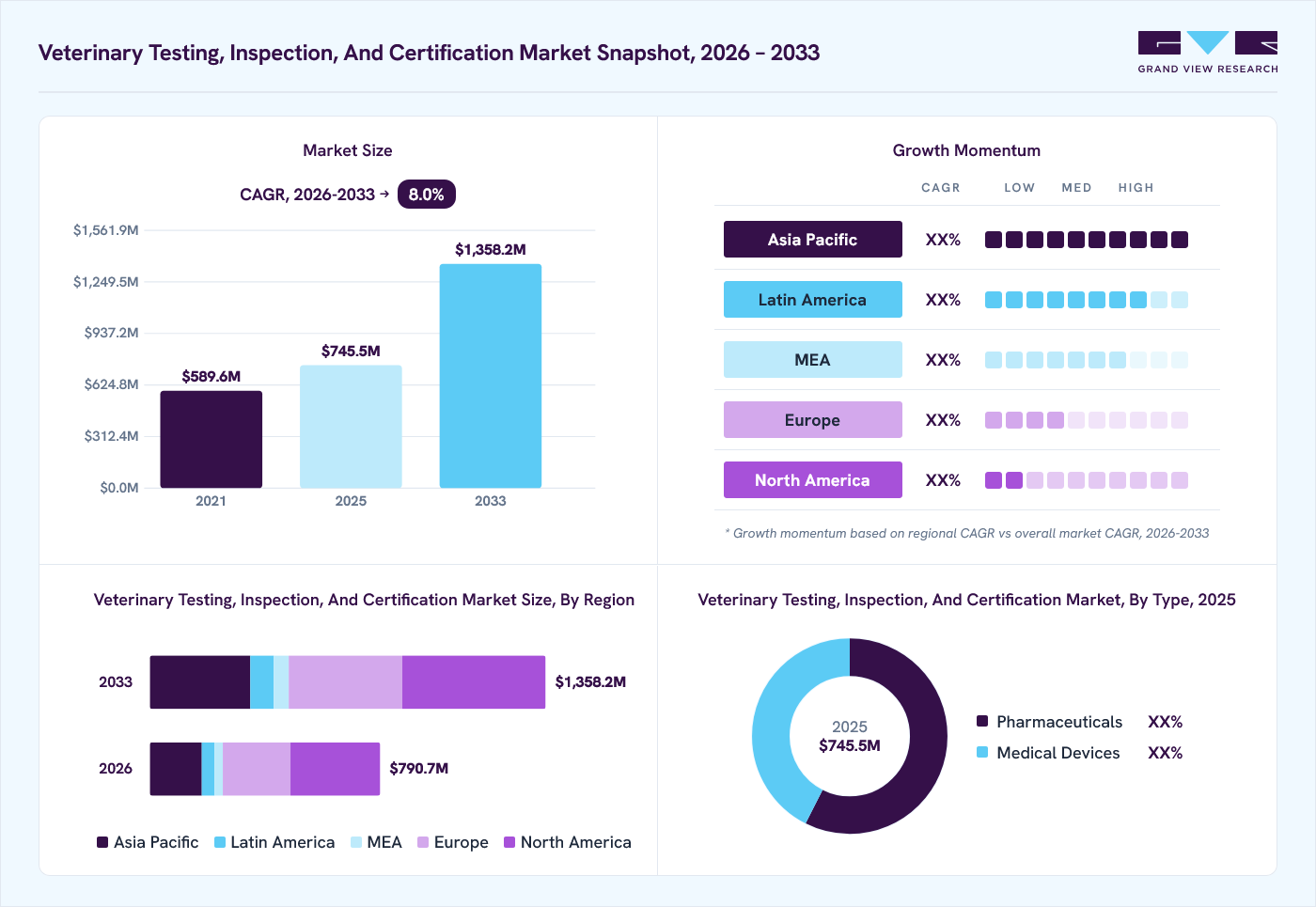
The global veterinary testing, inspection and certification market size was valued at USD 745.5 million in 2025 and is projected to grow from USD 790.7 million in 2026 to USD 1,358.2 million by 2033, at a CAGR of 8.0% from 2026 to 2033. North America dominated the market, accounting for a revenue share of 38.9% in 2025. The market is driven by factors such as strengthening veterinary pharmaceutical GMP and product quality requirements, expansion of veterinary pharmaceutical and biologics manufacturing, increasing technical complexity of veterinary diagnostic and imaging devices, expansion of veterinary healthcare infrastructure and installed equipment base.
 Source: Grand View Research, IR Documents, Primary Interviews, Paid DatabasesTo learn more about this report,
 Download Free Sample Report
Key Market Trends & Insights
- By service: Testing segment dominated the market, with a revenue share of 58.7% in 2025.
- By type: Pharmaceuticals segment held the largest market share of 55.4% in 2025.
- By customer: Veterinary pharmaceutical manufacturers segment held the largest revenue share of 38.0% in 2025.
Regional Highlights
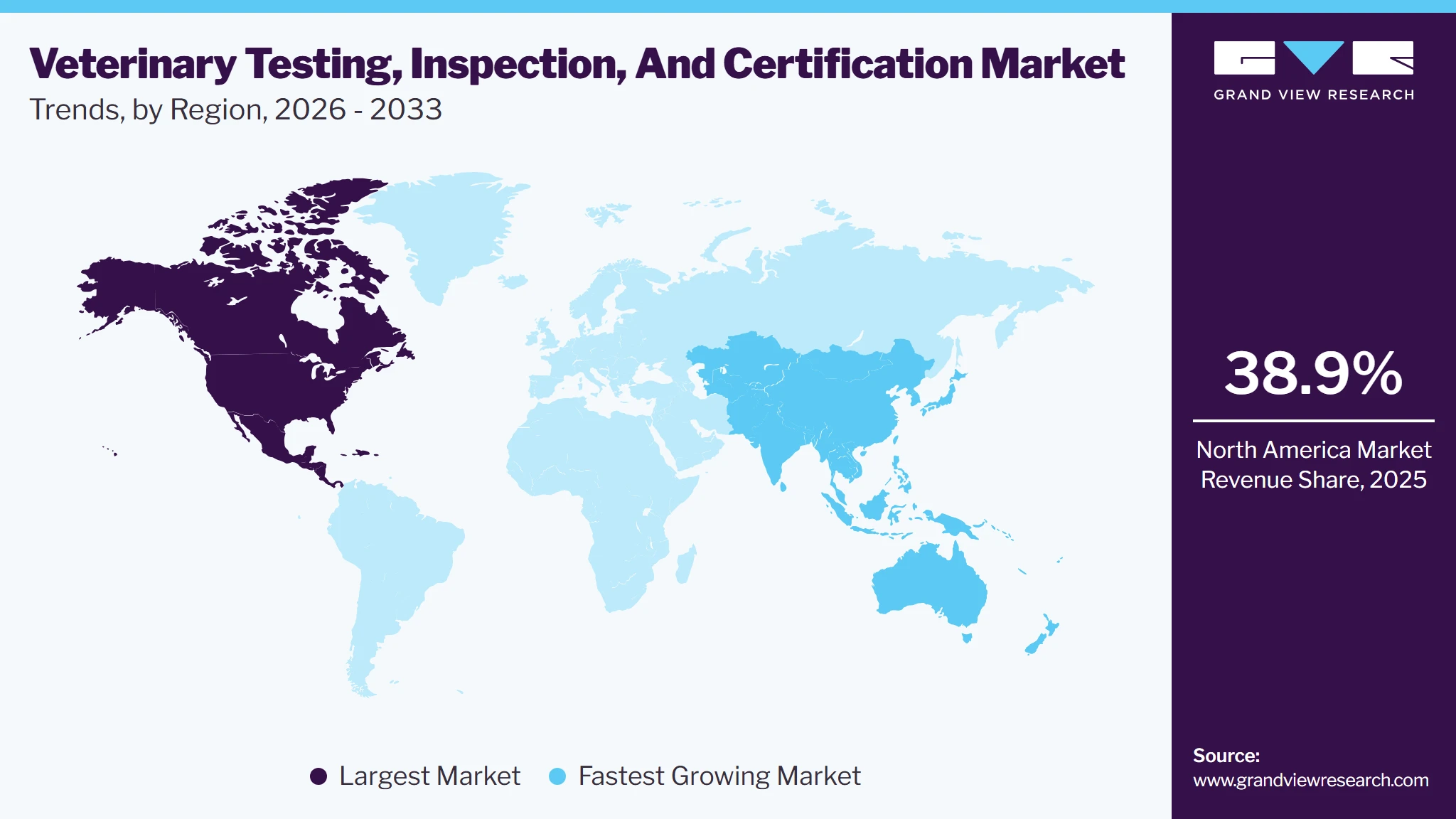
- Largest regional market: North America (38.9% revenue share, 2025)
- Fastest-growing regional market: Asia Pacific (highest CAGR, 2026-2033)
- By country: The U.S. held the largest market share in 2025.
Market Size & Forecast
- Market size in 2025: USD 745.5 Billion
- Estimated market size in 2026: USD 790.7 Million
- Projected market size by 2033: USD 1,358.2 Million
- CAGR (2026-2033): 8.0%
Prism AI by Grand View Research Free to tryAsk a question about the veterinary Testing, inspection and certification marketTry asking✓Every figure cited from GVR research Prefer the report? Download free sample →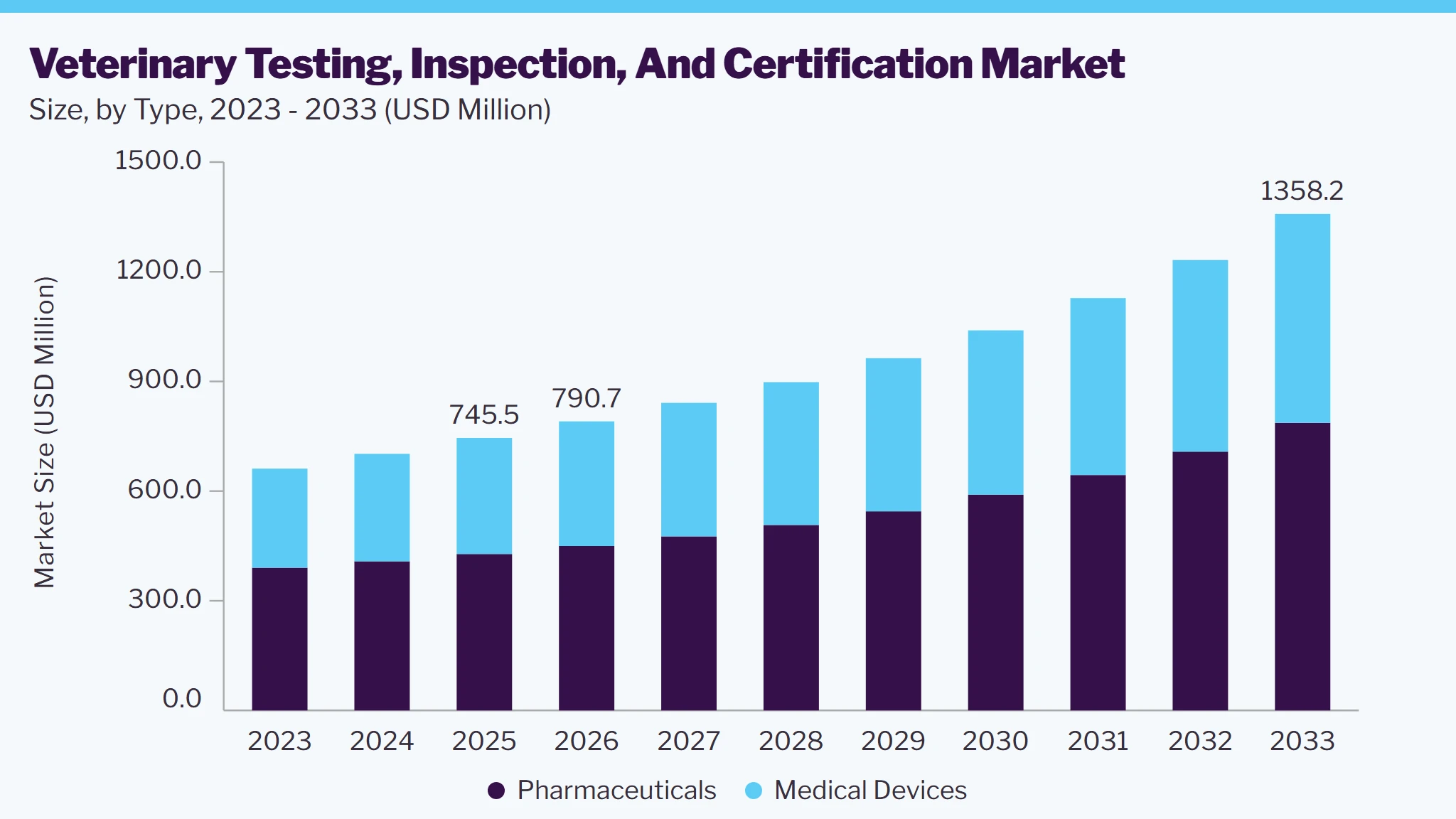 To learn more about this report, Download Free Sample Report
Market Dynamics
The veterinary testing, inspection, and certification (TIC) market is shaped by two distinct demand pools; product assurance commissioned by veterinary pharmaceutical and medical device manufacturers, and in-service equipment assessment commissioned by veterinary hospitals, clinics, and laboratories. Pharmaceutical demand is more directly linked to formal product-quality controls, including analytical, stability, potency, and microbiological testing, while device-related demand is distributed across electrical safety, electromagnetic compatibility, functional performance, and equipment verification. Regulatory requirements are also diverging by product and jurisdiction, making veterinary-specific technical expertise more valuable than general healthcare testing capacity alone. For instance, in July 2026, the European Union’s veterinary GMP regulations became applicable, raising the importance of quality-system and manufacturing compliance across veterinary medicines. Moreover, in May 2026, EU-U.S. mutual recognition for covered veterinary products reduced duplicate batch testing, showing that regulatory alignment can shift rather than uniformly increase TIC demand. The market therefore favors providers that combine specialist veterinary methods with regional regulatory knowledge and end-user service coverage.
Veterinary diagnostic and imaging equipment is incorporating more specialized analytical methods, multispecies measurement capabilities, digital image capture, and connectivity with laboratory or practice management systems. These features increase the range of technical attributes manufacturers must verify, including analytical performance, functional reliability, electrical safety, electromagnetic compatibility, and software-device interoperability. For instance, in May 2026, HORIBA launched its Yumivet VH2500 hematology analyzer with 57 parameters, multispecies profiles, and connectivity with laboratory and practice management systems. Moreover, in October 2026, Antech introduced the trūRapid Reader, which captures timed test images and supports result integration with practice information management systems. Such product complexity expands the potential scope of independent verification, although clinical use of the diagnostic device itself remains outside TIC market revenue.
Regulatory cooperation and risk-based validation initiatives can reduce duplicated testing activity and constrain revenue from repeat or stand-alone validation assignments. For instance, in May 2026, the EU-U.S. GMP mutual recognition framework became fully operational for covered veterinary medicines, allowing qualifying products to avoid repeat batch testing when the required controls have been completed by the recognised authority. Veterinary immunological products remain excluded. Moreover, in October 2026, the U.S. FDA introduced a risk-based residue-method pilot that permits a single validation study to support multiple regulatory purposes and can remove a separate animal study in applicable cases. These changes improve development efficiency for sponsors, while reducing the volume of duplicative external testing that some TIC providers may otherwise have performed.
Expansion of specialized testing for veterinary vaccines and biologics creates an opportunity for TIC providers to develop capabilities in potency, identity, purity, sterility, adventitious-agent, stability, and batch-release testing. These products require product-specific assays and biological expertise, making validated methods, reference materials, and controlled laboratory environments important differentiators. For instance, in February 2026, the European Medicines Agency released a draft guideline on quality aspects of mRNA vaccines for veterinary use, bringing active substances, starting materials, and finished-product quality into a more defined technical framework. Moreover, in June 2026, India expanded the notified testing scope of the Central Drugs Laboratory at CCS-NIAH from two to 42 veterinary vaccines, covering companion-animal and livestock diseases. These developments create opportunities for specialist laboratories to support vaccine developers with analytical method development, validation, and independent quality assessment. Providers with virology, immunology, molecular testing, and biologics capabilities are best positioned to capture this work, particularly as vaccine portfolios diversify across species and disease targets.
Dual-Lifecycle Veterinary TIC: Integrated Product Assurance and In-Service Equipment Assessment
Market Opportunity / Trend
Description
Opportunity
Dual-Lifecycle Demand Across Manufacturers and End Users
Veterinary TIC demand extends across product development and manufacturing, as well as the operational use of veterinary medical equipment. Manufacturers commission product testing and quality assessments, while veterinary hospitals, clinics, and diagnostic laboratories require periodic equipment testing and verification.
Address two distinct revenue pools through manufacturer-level product assurance and recurring end-user equipment assessment services.
Specialized Pharmaceutical and Medical Device Assurance
Veterinary pharmaceuticals require analytical, microbiological, potency, and stability testing, whereas medical devices require functional, electrical safety, EMC, and performance assessments. These distinct technical requirements create demand for specialized testing capabilities across both product categories.
Develop dedicated veterinary testing capabilities across pharmaceutical analytics, biological testing, diagnostic equipment performance, and technical safety assessments.
Recurring In-Service Equipment Assessment
Veterinary hospitals, clinics, and diagnostic laboratories operate imaging systems, anesthesia equipment, patient monitors, and sterilization devices that require periodic calibration, safety inspection, and performance verification. These requirements extend TIC demand beyond initial product development and manufacturing.
Establish recurring testing, calibration, and inspection contracts with veterinary facilities, creating repeat service revenue beyond manufacturer-commissioned engagements.
Integrated Veterinary Quality and Compliance Services
Differences in veterinary pharmaceutical regulations and animal-use medical device requirements across countries create demand for providers with specialized technical capabilities and jurisdiction-specific compliance knowledge. Manufacturers and end users require assessments aligned with product characteristics, operating conditions, and applicable standards.
Build integrated testing, inspection, and applicable certification portfolios that address veterinary product manufacturers and equipment users across multiple geographic markets.
Market Concentration & Characteristics
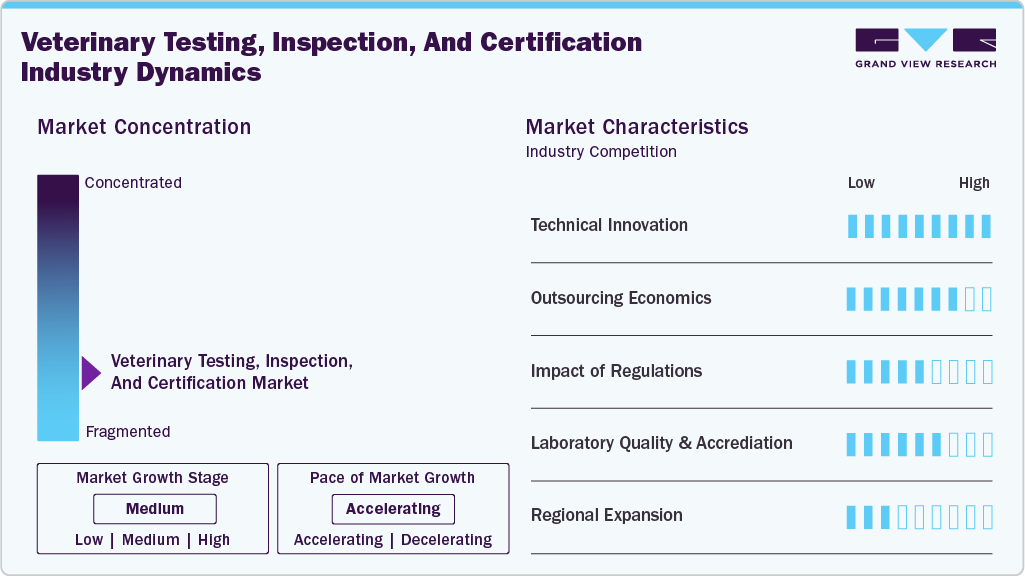
The market is fragmented, with specialist veterinary pharmaceutical laboratories, diversified life sciences testing groups, generalist TIC companies, and local biomedical equipment service firms serving different parts of the value chain. Not many single providers cover all product, regulatory, and in-service requirements, leaving buyers to source specialist capabilities across multiple suppliers.
Impact of technical innovation is expected to be high, as veterinary TIC providers must assess a widening range of product attributes as diagnostic analyzers, digital imaging systems, connected readers, and multispecies platforms become more technically complex. Testing spans analytical accuracy, reproducibility, electrical safety, electromagnetic compatibility, software functionality, and interoperability. This favors laboratories with specialized equipment, validated methods, and engineering expertise, while creating service-expansion opportunities for established healthcare TIC providers.
 To learn more about this report, Download Free Sample Report
Impact is expected to be high, as veterinary manufacturers retain routine quality-control functions internally but commission external laboratories for specialized potency, sterility, stability, and method-validation work requiring dedicated facilities or independent assessment. Veterinary hospitals and clinics similarly purchase periodic calibration and safety assessments when internal biomedical capabilities are limited. This division determines the addressable commercial market, as only externally commissioned testing, inspection, and certification generate third-party provider revenue.
Veterinary pharmaceutical GMP, product-quality, and biological testing requirements create formal demand for testing and manufacturing assessments, while animal-use medical device regulations vary across jurisdictions. The EU's veterinary GMP framework establishes defined quality obligations, whereas the U.S. excludes animal-only devices from certain premarket approval pathways. Providers with jurisdiction-specific regulatory expertise gain an advantage, although regulatory differences limit standardization across countries.
Veterinary product testing requires validated analytical procedures, traceable standards, controlled laboratory conditions, and documented technical competence, particularly for vaccine potency, sterility, microbiology, and residue analysis. Accreditation and proficiency testing help buyers assess laboratory capabilities and result reliability. This favors providers maintaining established quality systems and specialised veterinary testing methods, while smaller laboratories face investment requirements for equipment, validation, and qualified personnel.
Veterinary pharmaceutical testing capacity is concentrated in markets with established manufacturers, regulatory laboratories, and specialist providers, while in-service equipment assessments require technicians close to veterinary clinics and hospitals. Cross-border regulatory recognition can reduce duplicated testing for manufacturers, but local regulations and service logistics retain regional importance. Providers therefore require centralized specialist laboratories supported by local inspection, calibration, and customer-service networks.
Analyst Perspective
The veterinary TIC sector is moving toward more specialised, technically advanced, and compliance-driven service offerings as veterinary pharmaceutical pipelines expand and medical devices become increasingly sophisticated. Demand is expected to shift toward outsourced analytical, microbiological, stability, potency, and biologics testing, alongside functional safety and performance assessment of veterinary devices. Opportunities are emerging in vaccine and biologics testing, veterinary-specific method development, device conformity assessment, and recurring calibration and inspection of equipment across veterinary hospitals, clinics, and diagnostic laboratories. Providers that combine relevant accreditations, specialised testing capabilities, and geographic reach are positioned to capture a larger share of outsourced expenditure. Strategic expansion into high-growth markets, particularly Asia Pacific, offers further potential.
Service Insights
On the basis of service, testing segment dominated the market in 2025 with a share of 58.7%. The segment is driven by recurring quality-assessment requirements across veterinary pharmaceuticals and medical devices. Pharmaceutical manufacturers commission analytical, microbiological, stability, potency, and batch-release testing, while device manufacturers require functional, mechanical, electrical safety, and electromagnetic compatibility assessments. Additionally, veterinary hospitals and clinics commission equipment calibration and performance verification. The broad applicability of testing throughout product development, manufacturing, and equipment operation positions it as the largest revenue-generating service category.
Certification segment is anticipated to grow at the fastest CAGR over the forecast period. The growth is supported by supported by increasing demand for independent quality-system certification and applicable product conformity assessments across veterinary pharmaceuticals and medical devices. Veterinary pharmaceutical manufacturers require certification and compliance assessments associated with manufacturing quality systems, while medical device manufacturers seek applicable technical conformity assessments and quality management system certification. The implementation of dedicated veterinary GMP requirements in Europe and increasing attention to documented product quality create opportunities for accredited certification bodies with specialised veterinary industry expertise.
Type Insights
Pharmaceuticals segment accounted for the largest share of 57.4% in 2025 and is also expected showcase highest growth rate in the segment over the forecast period. Its revenue contribution is driven by the higher frequency and breadth of outsourced testing across veterinary drugs, vaccines, and biologics, covering analytical, microbiological, stability, potency, and batch-release assessments. Repeated testing across product development and commercial manufacturing generates recurring service fees, while expanding vaccine portfolios and stricter veterinary GMP requirements increase annual testing and quality-assessment expenditure.
The medical devices segment is anticipated to register the second-fastest CAGR during the forecast period, supported by increasing expenditure on product performance, electrical safety, electromagnetic compatibility, and functional testing of diagnostic analyzers, imaging systems, and monitoring equipment. Revenue generation extends beyond manufacturer-commissioned product assessments to include recurring calibration, safety inspection, and performance verification of equipment installed across veterinary hospitals, clinics, and laboratories. This broader customer base expands the number of potential paid service engagements, supporting incremental revenue growth across the segment.
Customer Insights
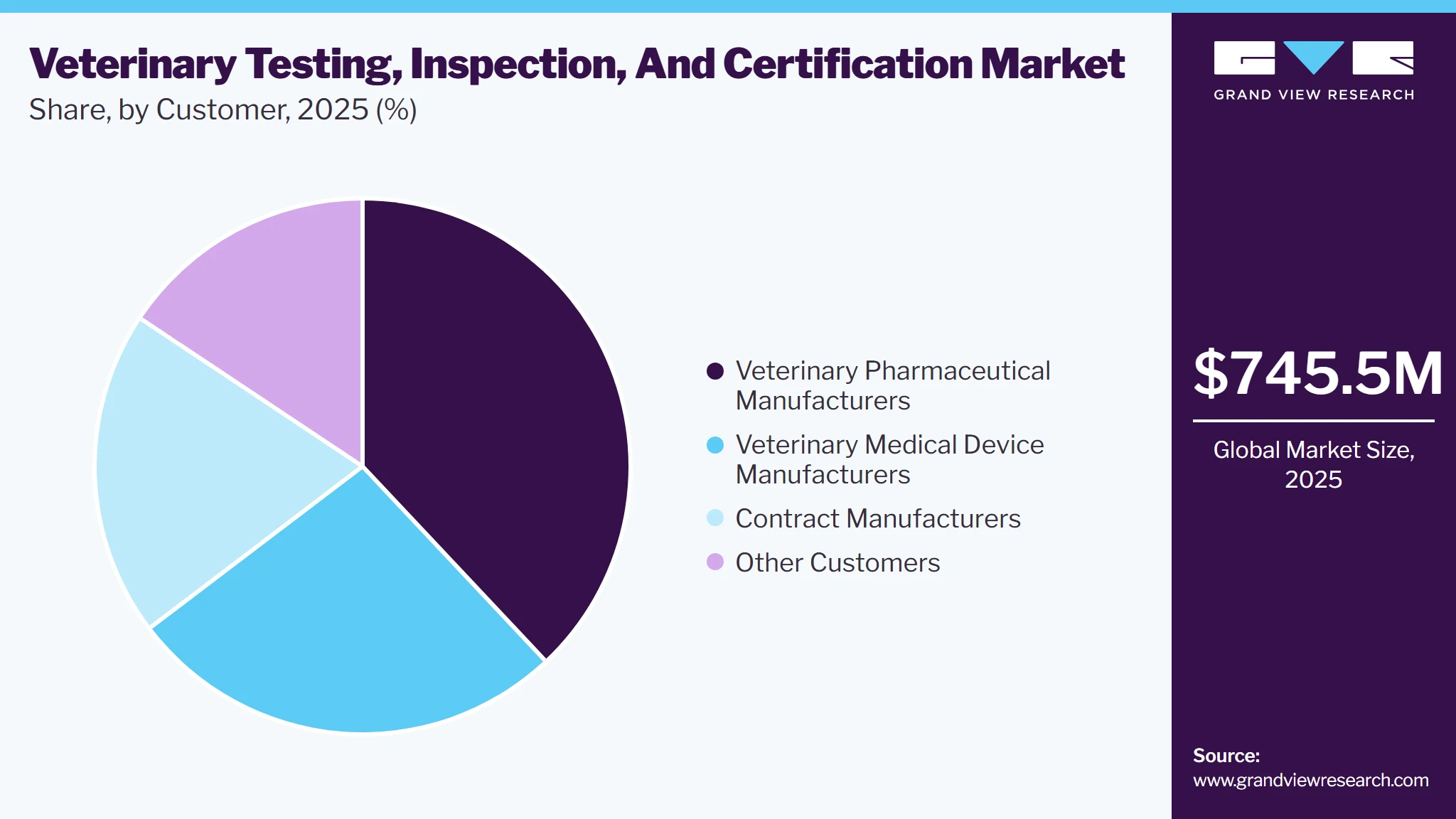
The veterinary pharmaceuticals manufacturers segment dominated the market with share of 38.0% in 2025. The segment is driven by higher recurring expenditure on outsourced product testing and manufacturing quality assessments. Manufacturers commission multiple testing services across veterinary drugs, vaccines, and biologics, including analytical, stability, potency, sterility, and batch-release assessments. The frequency of these engagements, combined with the technical requirements of pharmaceutical quality control and manufacturing compliance, generates comparatively higher annual TIC expenditure per customer than several other customer categories.
 To learn more about this report, Download Free Sample Report
The contract manufacturers segment is projected to register the highest CAGR over the forecast period, driven by increasing outsourcing of veterinary pharmaceutical and medical device production. As contract manufacturers undertake production and quality responsibilities for multiple veterinary product owners, their expenditure on external analytical testing, batch verification, process validation, facility inspections, and applicable certification increases. The ability to serve multiple clients and product portfolios generates repeat TIC engagements, increasing annual service expenditure and positioning contract manufacturers as the fastest-growing customer category in terms of revenue contribution.
Regional Insights
North America veterinary TIC industry held the largest revenue share of 38.9% in 2025.The region's leading position is supported by the concentration of veterinary pharmaceutical manufacturers, established testing laboratories, and a developed veterinary medical device industry, particularly in the U.S. Canada adds a sizeable and expanding veterinary practice network, while Mexico maintains regulated veterinary product manufacturing, importation, and distribution infrastructure through SENASICA. The presence of established analytical testing providers and specialised medical device testing facilities further supports commercial service availability. The region's higher service expenditure and established outsourcing practices support greater revenue generation per testing and assessment engagement.
 To learn more about this report, Download Free Sample Report
U.S. Veterinary Testing, Inspection, And Certification Market Trends
U.S. veterinary testing, inspection, and certification TIC industry held the largest share in North America in 2025.The country's position is supported by its extensive veterinary pharmaceutical development base, established biological product manufacturing ecosystem, and availability of specialised commercial testing laboratories. The FDA maintains a regularly updated database of approved animal drugs, while USDA APHIS maintains licensing records for veterinary biological manufacturers and their products. The presence of established analytical testing and medical device compliance providers further increases service availability, positioning the U.S. as the region's primary revenue-generating market across pharmaceutical product testing and veterinary equipment assessment.
Canada veterinary TIC industry is expected to grow at the fastest rate in the region over the forecast period. Growth is supported by an expanding veterinary workforce and increasing demand for services across veterinary hospitals, clinics, and diagnostic facilities. The Canadian Veterinary Medical Association reported approximately 16,359 veterinarians and 4,694 veterinary practices in 2025. Its 2024 economic assessment recorded 7.9% growth in actively practicing veterinarians compared with 2022-2023 and 7.4% growth in the sector's total economic output. The expanding facility base creates additional opportunities for equipment calibration, safety inspection, and performance verification, while established pharmaceutical and laboratory activities support manufacturer-side testing demand.
Europe Veterinary Testing, Inspection, And Certification Market Trends:
Europe veterinary testing, inspection, and certification market is witnessing significant growth.The applicability of Commission Implementing Regulations (EU) 2025/2091 and 2025/2154 from July 2026 establishes specific GMP requirements for veterinary medicinal products and their active substances, increasing the importance of manufacturing quality assessments and compliance testing. Germany, France, and the UK contribute established pharmaceutical manufacturing and laboratory capabilities, while Spain and Italy provide additional demand through expanding veterinary healthcare infrastructure. The region's harmonized regulatory framework supports cross-border commercial opportunities for TIC providers, particularly those offering pharmaceutical analytical testing, manufacturing inspections, and applicable certification services.
Germany’s dominates the region in terms of revenue share in 2025. Its position is supported by an established animal health manufacturing base, specialised pharmaceutical laboratories, and the presence of multinational veterinary pharmaceutical companies. The German animal health industry association represents 24 companies involved in manufacturing and distributing veterinary medicines and feed additives, including Boehringer Ingelheim Vetmedica, MSD Animal Health, Ceva, Elanco, HIPRA, and Zoetis. This concentration of manufacturers generates demand for analytical testing, stability assessment, biological testing, and manufacturing quality inspections. Germany's technical infrastructure and high-value pharmaceutical testing requirements support greater commercial revenue per engagement
Spain is expected to grow at the fastest rate in the region over the forecast period.Growth is supported by expanding veterinary healthcare activity, increasing veterinary pharmaceutical demand, and a broadening companion-animal healthcare network. According to the June 2026 publication presented by the Spanish Association of the History of Veterinary Medicine, Spain has more than 7,000 companion-animal veterinary clinics and over 15 million pets. The expanding customer base increases demand for testing of veterinary medicines and diagnostic equipment, while the growing installed equipment base creates additional opportunities for calibration, safety inspection, and performance verification.
Asia Pacific Veterinary Testing, Inspection, And Certification Market Trends
Asia Pacific is expected to grow at the fastest CAGR over the forecast period, supported by expanding veterinary pharmaceutical manufacturing, increasing livestock healthcare requirements, and investment in domestic biological testing infrastructure. China provides the region's largest pharmaceutical product base, while India is advancing veterinary vaccine testing capacity and domestic manufacturing infrastructure. South Korea also contributes through an established veterinary product manufacturing and importation ecosystem, with industry records identifying 77 veterinary medicine manufacturers and 470 veterinary medical device manufacturers as of December 2025 as per Korea Animal Pharmaceutical Association. These developments expand the addressable product base for analytical testing and technical assessments, while growing veterinary healthcare infrastructure creates additional end-user equipment testing demand.
China held the largest share in Asia Pacific in 2025. Its position is supported by a large veterinary pharmaceutical manufacturing ecosystem, extensive livestock production, and an established regulatory framework governing veterinary drug registrations and quality control. The Ministry of Agriculture and Rural Affairs reported that 229 new feed and veterinary drug products were approved for registration in 2025, twice the previous year's number, while the country's registered veterinary drug portfolio reached approximately 2,450 products. The expansion of registered products and ongoing regulatory sampling creates demand for analytical testing, product-quality assessments, and manufacturing compliance services, supporting China's leading regional revenue contribution
India is estimated to grow at the fastest growth rate globally over the forecast period. Growth is supported by government investment in veterinary vaccine manufacturing, expansion of biological testing infrastructure, and increasing formalisation of veterinary pharmaceutical quality requirements. For instance, as per June 2026 publication by {ress Information Bureau, in January 2026, the government notified an expansion of the Central Drugs Laboratory's veterinary vaccine testing mandate at CCS-NIAH from 2 to 42 vaccines, covering companion-animal and livestock applications. In addition, four veterinary vaccine and drug production projects had been approved under the Animal Husbandry Infrastructure Development Fund by December 2025, with one operationalized. These developments expand domestic testing capacity and the potential customer base for independent quality assessments, particularly across vaccines and veterinary biologics.
Latin America Veterinary Testing, Inspection, And Certification Market Trends
The Latin America is expected to grow lucratively during the forecast period, the region's livestock production base, domestic veterinary pharmaceutical manufacturing, and gradual expansion of companion-animal healthcare infrastructure. Brazil represents the primary revenue centre, while Argentina contributes through its established animal health pharmaceutical and biologics industry. Regulatory agencies across the region maintain product registration, manufacturing authorization, and quality-control requirements, creating demand for analytical testing and manufacturing assessments. However, specialist TIC infrastructure remains unevenly distributed, positioning established laboratories and international providers with regional service coverage to capture a larger share of outsourced veterinary product testing and inspection expenditure.
Brazil held the largest share in Latin America in 2025 and is also expected to grow at the fastest rate over the forecast period. Its position is supported by a sizeable domestic veterinary pharmaceutical manufacturing base and an expanding veterinary healthcare service network. SEBRAE's territorial observatory, drawing on Brazilian Federal Revenue records, reported 46,177 active veterinary service businesses and 39,360 employees in 2025, with veterinary employment increasing 6.53% year over year. The veterinary medicine manufacturing category comprised 312 active businesses and 11,609 employees, while new-business creation reached 33.3%. This combination expands demand across manufacturer-level analytical and quality testing as well as equipment assessment commissioned by veterinary facilities. The country's established agricultural and animal health regulatory framework further supports recurring product-registration and compliance-related testing requirements
Middle East & Africa Veterinary Testing, Inspection, And Certification Market Trends
The Middle East & Africa is witnessing steady growth. Growth supported by expanding veterinary healthcare infrastructure, livestock health programmes, and regulatory development across GCC countries and South Africa. Saudi Arabia and the UAE contribute through investments in veterinary clinics, laboratories, and animal health monitoring systems, while South Africa provides an established veterinary pharmaceutical and animal healthcare base. The region's growing institutional veterinary network creates opportunities for end-user equipment inspections, calibration, and performance verification, while pharmaceutical manufacturers and importers generate demand for product-quality testing and compliance assessments. However, differences in regulatory maturity, provider availability, and service expenditure across countries create an uneven revenue distribution.
Saudi Arabia veterinary TIC industry held the largest share in Middle East & Africa in 2025 and is also expected to grow at the fastest rate over the forecast period. The market is driven by an extensive veterinary healthcare network, government investment in animal health infrastructure, and growing institutional demand for quality-assurance services. According to Saudi Arabia's 2025 submission to the World Organisation for Animal Health, the country had 2,443 private veterinary facilities in 2024, comprising 694 clinics, 1,709 veterinary pharmacies, and six mobile clinics, alongside 181 government clinics and 121 mobile clinics. The national laboratory network also includes ISO/IEC 17025:2017-accredited central and regional facilities. This infrastructure expands the base of potential institutional customers and establishes local quality-assurance capabilities. As veterinary facilities expand their diagnostic and treatment equipment inventories, demand for eligible third-party calibration, safety inspection, and performance verification can increase. The country's veterinary pharmaceutical distribution and livestock health requirements further support product-testing and compliance expenditure.
Key Veterinary Testing, Inspection, And Certification Company Insights
The veterinary TIC market features competition among global TIC providers, specialist pharmaceutical testing laboratories, medical device testing companies, and biomedical equipment assessment providers. Market positioning is shaped by veterinary-specific analytical and biological testing capabilities, laboratory accreditations, technical expertise, geographic coverage, and relationships with pharmaceutical and medical device manufacturers. Competition is further intensified by specialised providers targeting vaccine potency testing, pharmaceutical quality assessment, electronic device compliance, and in-service equipment calibration. Market share remains fragmented across providers with different service portfolios, while competitive concentration is difficult to assess because several participants generate revenue from broader healthcare, industrial, or laboratory services rather than veterinary TIC alone. Some of the prominent players in the veterinary testing, inspection, and certification (TIC) include:
Key Veterinary Testing, Inspection And Certification Companies
The following key companies have been profiled for this study on the veterinary testing, inspection, and certification market.
-
Eurofins
-
ALS
-
Minerva Scientific (Tentamus)
-
SGS
-
Reading Scientific Services Ltd
-
Microbac Laboratories
-
Bioassay
-
EFRAC (Qima)
-
FILAB
-
Laboratorios Anderson
-
cetecom advanced
-
Waltek Services Co., Ltd.
-
TÜV SÜD
-
U-Tech Medical
-
Anderson's Biomedical
-
Aussin Intensive Care Pvt. Ltd.
-
Zoetek Medical Sales & Service, Inc
-
Ronco Biomedical
-
UL Solutions Inc. (UL Llc.)
-
Element Materials Technology
-
Intertek Group Plc.
-
DEKRA
Competitive Benchmarking
Category
Operating Strategies
Competitive Edge
Weakness
Established Global Leaders Eurofins, ALS, SGS, TÜV SÜD, UL Solutions, Element Materials Technology, Intertek, DEKRA QIMA (EFRA), and Tentamus (Minerva Scientific)
Operate through geographically diversified laboratory networks, offering integrated testing, inspection, and certification services across pharmaceuticals, biologics, and medical devices. Leverage established laboratory infrastructure, regulatory expertise, and multidisciplinary technical teams to serve veterinary product manufacturers and healthcare customers.
Benefit from international accreditations, established regulatory relationships, extensive analytical capabilities, and broad geographical coverage. Their ability to offer multiple testing and compliance services through established infrastructure supports multinational veterinary pharmaceutical manufacturers and medical device companies.
Veterinary-specific services represent a relatively specialized part of their broader healthcare and industrial portfolios. Limited dedicated veterinary service positioning and competition for laboratory resources across multiple industries can restrict specialized veterinary market focus.
Emerging / Specialized Players Reading Scientific Services Ltd, Microbac Laboratories, Biossays, FILAB Laboratories Services, Neogen and Reading Scientific Services Ltd, Aragen Life Sciences, and Envisia Scientific, AUSM Intensive Care, Zoetek Medical Sales & Service, and Ronco Biomedical.
Focus on specialized veterinary pharmaceutical testing, biological potency assessment, electronic device testing, and in-service veterinary equipment calibration and inspection. Develop targeted service portfolios around specific product categories, testing methodologies, and customer requirements rather than offering broad cross-industry TIC portfolios.
Benefit from specialized technical expertise, veterinary-specific testing capabilities, focused customer relationships, and flexibility in addressing niche requirements. Direct experience in pharmaceutical analysis, biological testing, electronic device verification, and veterinary equipment assessment enables targeted service delivery.
Operate with comparatively narrower geographical coverage and service portfolios than diversified global TIC groups. Limited laboratory networks, lower international brand recognition, and concentration in specific testing or equipment categories constrain their ability to serve multinational customers across the complete veterinary TIC value chain.
Recent Developments
-
In October 2026, ICAR-NIVEDI expanded its NABL accreditation under ISO/IEC 17025:2017 to 28 veterinary diagnostic tests, covering livestock diseases, zoonotic infections, and antimicrobial resistance. This strengthens accredited veterinary testing capabilities and laboratory quality assurance in India.
-
In October 2026, Cotecna acquired Hyderabad-based Energon Labs, expanding its accredited pharmaceutical testing capabilities across pharmaceuticals, biopharmaceuticals, and medical devices. The acquisition strengthens its laboratory infrastructure and capacity to serve regulated healthcare manufacturers across India and international markets.
Veterinary Testing, Inspection, And Certification Market Report Scope
Report Attribute
Details
Market size in 2025
USD 745.5 million
Estimated market size in 2026
USD 790.7 million
Projected market size by 2033
USD 1,358.2 million
Growth Rate
CAGR of 8.0% from 2026 to 2033
Actual Data
2021 - 2025
Forecast period
2026 - 2033
Quantitative units
Revenue in USD million and CAGR from 2026 to 2033
Report coverage
Revenue forecast, company ranking, competitive landscape, growth factors, and trends
Segments covered
Service, type, customer, Region
Regional scope
North America, Europe, Asia Pacific, Latin America, MEA
Country scope
U.S., Canada, Mexico, UK, Germany, France, Italy, Spain, Denmark, Sweden, Norway, Japan, China, India, Thailand, South Korea, Australia, Brazil, Argentina, South Africa, UAE, Saudi Arabia, Kuwait, Oman, Qatar
Key companies profiled
Eurofins; ALS; Minerva Scientific (Tentamus); SGS; Reading Scientific Services Ltd; Microbac Laboratories; Bioassay; EFRAC (QIMA); FILAB; Laboratorios Anderson; cetecom advanced; Waltek Services Co., Ltd.; TÜV SÜD; U-Tech Medical; Anderson's Biomedical; Aussin Intensive Care Pvt. Ltd.; Zoetek Medical Sales & Service, Inc.; Ronco Biomedical; UL Solutions Inc. (UL LLC); Element Materials Technology; Intertek Group Plc.; and DEKRA
Customization scope
Free report customization (equivalent up to 8 analysts working days) with purchase. Addition or alteration to country, regional & segment scope.
Pricing and purchase options
Avail customized purchase options to meet your exact research needs. Explore purchase options
Veterinary Testing, Inspection, And Certification Market Report Segmentation
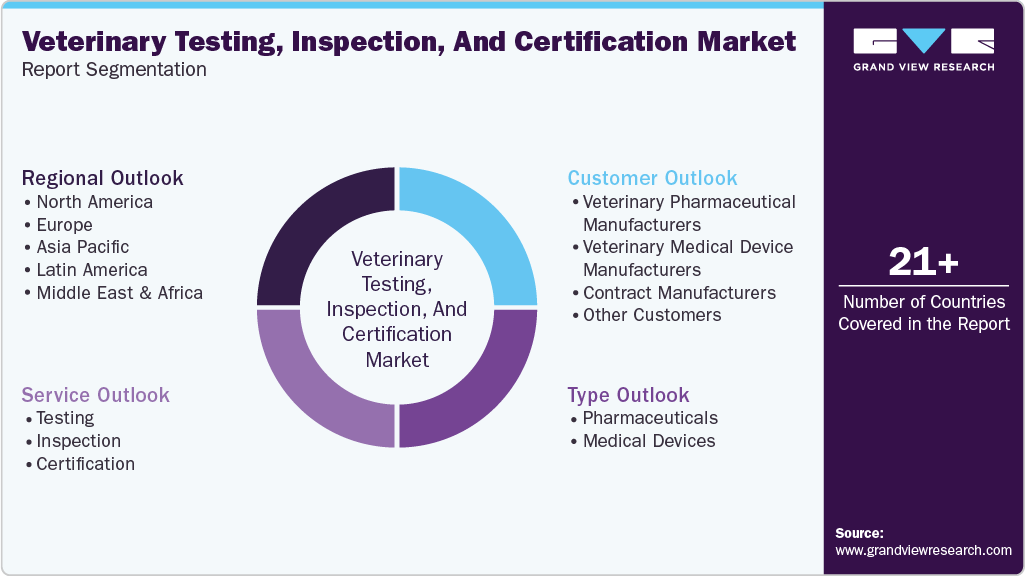
This report forecasts revenue growth at global, regional, and country levels and provides an analysis of the latest industry trends in each of the sub-segments from 2021 to 2033. For this study, Grand View Research has segmented the global veterinary testing, inspection, and certification (TIC) report based on service, type, customer, and region.
 To learn more about this report, Download Free Sample Report
-
Service Outlook (Revenue, USD Million, 2021 - 2033)
-
Testing
-
Inspection
-
Certification
-
-
Type Outlook (Revenue, USD Million, 2021 - 2033)
-
Pharmaceuticals
-
Medical Devices
-
-
Customer Outlook (Revenue, USD Million, 2021 - 2033)
-
Veterinary Pharmaceutical Manufacturers
-
Veterinary Medical Device Manufacturers
-
Contract Manufacturers
-
Other Customers
-
-
Regional Outlook (Revenue, USD Million, 2021 - 2033)
-
North America
-
U.S.
-
Canada
-
Mexico
-
-
Europe
-
UK
-
Germany
-
France
-
Italy
-
Spain
-
Denmark
-
Sweden
-
Norway
-
-
Asia Pacific
-
Japan
-
China
-
India
-
Australia
-
Thailand
-
South Korea
-
-
Latin America
-
Brazil
-
Argentina
-
-
Middle East & Africa
-
South Africa
-
UAE
-
Saudi Arabia
-
Kuwait
-
Qatar
-
Oman
-
-
Research Methodology
The veterinary testing, inspection, and certification market figures in this report are based on a proven research process that combines executive interviews with secondary research from proprietary databases, company filings, and recognized regulatory and institutional sources. Market size is built through value-chain sizing-reconciling supply-side and demand-side estimates-and triangulated with bottom-up and top-down approaches. Every estimate passes multiple levels of expert validation before publication, with each veterinary testing, inspection, and certification segment quantified using the revenue-capture definitions in the table below.
Segment Definition
Market
Definition
Veterinary Testing, Inspection and Certification (TIC) Market
This market covers revenue generated from third-party testing, inspection, and certification services for veterinary pharmaceuticals and veterinary medical devices. It includes services that assess product quality, safety, performance, manufacturing processes, and compliance with applicable regulatory requirements and technical standards. It also covers eligible testing, inspection, calibration, and performance verification of veterinary medical equipment during use.
Service
Definition
Testing
This segment covers revenue generated from testing veterinary pharmaceuticals and medical devices to assess their quality, safety, composition, functionality, and performance. It includes laboratory-based analyses and technical evaluations conducted during product development, manufacturing, quality control, and equipment use.
Inspection
This segment covers revenue generated from independent inspections and assessments of veterinary pharmaceutical and medical device manufacturing facilities, production processes, equipment, and quality systems. It also includes eligible inspections of veterinary medical equipment in hospitals, clinics, laboratories, and other operating environments.
Certification
This segment covers revenue generated from independent certification and applicable conformity assessment services for veterinary pharmaceutical and medical device manufacturers, products, and quality management systems. It includes assessments against relevant standards and the issuance, maintenance, or renewal of certificates by appropriately authorized certification bodies.
Type
Definition
Pharmaceuticals
This segment covers revenue generated from third-party TIC services for pharmaceutical and medicinal products specifically intended for use in animals. It includes assessments of product quality, composition, safety, potency, stability, and manufacturing compliance during product development and commercial production.
Medical Devices
This segment covers revenue generated from third-party TIC services for medical devices specifically designed or intended for veterinary use. It includes assessments of device quality, safety, functionality, performance, and applicable technical compliance during development, manufacturing, and operational use.
Customers
Definition
Veterinary Pharmaceutical Manufacturers
This segment covers revenue generated from TIC services commissioned by manufacturers and product owners involved in the development and production of veterinary pharmaceuticals. These organizations purchase independent testing, inspection, and applicable certification services to establish product quality and support manufacturing compliance.
Veterinary Medical Device Manufacturers
This segment covers revenue generated from TIC services commissioned by companies manufacturing or developing medical devices specifically intended for veterinary use. It includes independent assessments of device quality, safety, functionality, performance, and compliance with applicable technical standards.
Contract Manufacturers
This segment covers revenue generated from TIC services commissioned by third-party manufacturers producing veterinary pharmaceuticals or medical devices on behalf of other companies. It includes independent assessments undertaken to verify the quality, safety, and compliance of manufactured products and associated production processes.
Other Customers
This segment covers revenue generated from TIC services commissioned by organizations other than veterinary pharmaceutical manufacturers, veterinary medical device manufacturers, and contract manufacturers. It includes organizations requiring independent assessment of veterinary medical equipment during operation or commissioning other eligible veterinary product-related TIC services.
Estimation Model
Bottom-Up Market Estimation
Top-Down Market Estimation Model
Demand-Side Market Estimation Model
Supply-Side Estimation Model
• The bottom-up approach estimates the Veterinary TIC Market by aggregating revenue potential across veterinary pharmaceutical manufacturers, veterinary medical device manufacturers, contract manufacturers, and veterinary customers, including veterinary hospitals, clinics, and diagnostic laboratories.
• Customer-level estimates incorporate the number of eligible organizations, outsourced TIC requirements, service utilization frequency, average testing and inspection fees, and annual expenditure on qualifying services.
• Revenue estimates are consolidated across testing, inspection, and certification services and expanded geographically to account for regional differences in manufacturing activity, veterinary healthcare infrastructure, regulatory requirements, and service pricing.• The top-down approach begins with the broader Healthcare TIC Market and applies an estimated veterinary-specific share to determine addressable Veterinary TIC opportunity.
• The share assessment considers veterinary pharmaceutical and medical device markets, healthcare product-testing ecosystem, alongside eligible in-service equipment testing, inspection, and calibration activities.
• The model accounts for veterinary pharmaceutical manufacturing, animal-health product registrations, veterinary device development, regulatory requirements, and the expansion of veterinary healthcare infrastructure.
• Regional variations in veterinary product manufacturing, TIC provider presence, regulatory maturity, and end-user service expenditure inform the assessment of market development trajectories.• The demand-side model evaluates purchasing potential across four customer groups: veterinary pharmaceutical manufacturers, veterinary medical device manufacturers, contract manufacturers, and other customers, including veterinary hospitals, clinics, diagnostic laboratories, research institutions, and government veterinary facilities.
• Demand is assessed using customer eligibility, outsourcing penetration, testing and inspection frequency, average service pricing, and annual TIC expenditure, with assumptions adjusted to the operational requirements of each customer category.
• The assessment considers pharmaceutical analytical and microbiological testing, vaccine potency and stability testing, medical device performance and safety assessments, equipment calibration, and applicable certification requirements.
• Differences in manufacturing scale, product portfolios, regulatory obligations, installed equipment base, and service procurement patterns determine relative expenditure across customer groups and regions.• The supply-side model evaluates revenue-generating capabilities across global TIC companies, specialist veterinary testing laboratories, medical device testing providers, and biomedical equipment assessment companies.
• Provider assessments incorporate veterinary-specific service portfolios, laboratory infrastructure, technical capabilities, accreditation, geographic presence, customer coverage, and estimated utilization-related revenue contributions.
• Revenue potential is assessed through service pricing, testing volumes, inspection frequency, laboratory capacity, equipment utilization, and the proportion of business attributable to veterinary pharmaceuticals and medical devices.
• Competitive positioning, service expansion, laboratory investments, acquisitions, partnerships, and regional presence are considered to estimate supplier-side revenue and market-share distribution.Key Takeaway / Summary
Summary Statement
The Veterinary TIC Market is assessed through four complementary analytical approaches covering customer-level expenditure, broader healthcare market allocation, purchasing potential, and supplier-side commercialization. The combined framework validates market estimates using both expenditure and revenue perspectives while accounting for differences in veterinary pharmaceutical and medical device testing requirements, customer adoption, service frequency, provider capabilities, and regulatory maturity across regions. These approaches support cross-validation of market estimates and help identify assumptions influencing the addressable opportunity.
Delivered Customizations
This report has been delivered with the following In-depth customizations
Client Request
Customization Delivered
Value Adds
Global Market Intelligence & Commercialization Strategy: Veterinary Testing, Inspection, and Certification (TIC)
• Comprehensive assessment of global and regional market opportunities across veterinary pharmaceutical testing, veterinary medical device testing, inspection, and certification services.
• Evaluates revenue opportunities across analytical testing, microbiological testing, potency assessment, product performance testing, equipment calibration, safety inspections, and applicable certification services.
• Maps TIC providers, veterinary product manufacturers, contract manufacturers, and institutional customers, including veterinary hospitals, clinics, diagnostic laboratories, and research institutions.
• Includes regional opportunity assessment, demand-side customer profiling, supply presence, regulatory maturity, outsourcing patterns, and prioritization of commercially attractive countries.
• Detailed assessment of regulatory frameworks governing veterinary pharmaceutical quality, manufactured veterinary biological products, and veterinary medical device testing across priority countries.
• Evaluates applicable GMP requirements, analytical testing standards, laboratory accreditation, product conformity assessment, electronic safety, electromagnetic compatibility, and equipment performance verification requirements.
• Examines differences between veterinary pharmaceuticals and medical devices, including product-specific testing requirements, inspection protocols, and certification pathways.
• Assesses outsourcing requirements, laboratory infrastructure, technical capabilities, and accreditation coverage and service availability across manufacturer and end-user customer categories.
• Identifies regulatory and operational barriers affecting independent TIC service procurement and geographic expansion.• Supports market-entry planning by identifying commercially attractive service categories, product types, customer groups, and geographic markets.
• Helps prioritize opportunities based on veterinary product manufacturers, academic, institutional medical equipment base, manufacturing density, and regulatory requirements.
• Enables companies to distinguish manufacturer-level product testing opportunities from end-user equipment testing, inspection, and calibration demand.
• Provides a structured basis for regional expansion, service portfolio development, laboratory investments, and strategic partnerships with veterinary manufacturers and institutional customers.
• Helps organizations evaluate regulatory requirements and technical capabilities necessary to provide veterinary-specific TIC services across target markets.
• Supports identification of service gaps in veterinary pharmaceutical testing, biological testing, medical device assessment, and in-service equipment verification.
• Enables early identification of accreditation, infrastructure, technical personnel, and regulatory barriers that could restrict service expansion.
• Provides a framework for assessing laboratory investment requirements, service differentiation, and opportunities to expand existing healthcare TIC capabilities into veterinary applications.Competitive Intelligence & Strategic Benchmarking: Veterinary TIC Providers
• Comparative assessment of established global TIC companies, specialist veterinary pharmaceutical testing laboratories, veterinary medical device testing providers, and commercial equipment inspection and calibration companies.
• Covers Eurofins, ALS, SGS, Minerva Scientific (Tentamus), Reading Scientific Services Ltd, Microbac Laboratories, Biossays, EFRAC (QIMA), FILAB, Laboratories Anderson, VAWTEK, TÜV SÜD, U-Tech Medical, Anderson's Biomedical, Ausm Intensive Care, Zoetek Medical, Ronco Biomedical, UL Solutions, Element Materials Technology, Intertek, and DEKRA.
• Benchmarks service portfolios, veterinary-specific capabilities, laboratory infrastructure, accreditations, geographic presence, customer focus, and commercial positioning.
• Distinguishes direct veterinary TIC providers from diversified healthcare TIC companies with transferable technical capabilities and specialist end-user equipment assessment providers.
• Evaluates strategic initiatives, laboratory expansions, acquisitions, partnerships, service diversification, and regional market expansion strategies.• Enables clients to identify competitive gaps across veterinary pharmaceutical testing, biological testing, medical device assessment, and end-user equipment verification.
• Supports the evaluation of potential acquisition targets, laboratory partnerships, technical collaborations, and regional service-provider relationships.
• Helps distinguish established veterinary revenue-generating laboratories from general healthcare TIC providers with potential veterinary market exposure.
• Identifies opportunities in underserved testing categories, specialized veterinary product assessments, and fragmented regional markets.
• Provides a practical foundation for differentiating through specialized testing capabilities, expanded accreditation coverage, integrated service delivery, and targeted geographic expansion.About the Author(s)
Animal Health Research Team
Healthcare · Animal HealthThis report was authored by the animal health research team at Grand View Research - comprising two research analysts, one senior research analyst, and one industry expert - with specialized expertise in the animal health segment of the healthcare industry. All findings are based on proprietary healthcare databases, executive interviews, and regulatory analysis, subject to internal peer review prior to publication.
Last Updated:
Speak to Analyst

Customize this report to your needs - add regions, segments, or data points, with 20% free customization.
Or view our licence options:


ISO 9001:2015 & 27001:2022 Certified
We are GDPR and CCPA compliant! Your transaction & personal information is safe and secure. For more details, please read our privacy policy.


