
- Home
- »
- Next Generation Technologies
- »
-
Virtual Influencer Market Size And Share Report, 2026-2033GVR Report cover

Virtual Influencer Market (2026 - 2033)
Size, Share & Trends Analysis Report By Type (Non-human, Human Avatar), By Offering (Solution, Services), By End-use (Food & Entertainment, Sports & Fitness, Banking & Finance), By Region, And Segment Forecasts
Market Size, 2025
$11.2BMarket Estimate, 2026
$14.5BMarket Forecast, 2033
$110.4BCAGR, 2026–2033
33.6%Virtual Influencer Market Summary
The global virtual influencer market size was valued at USD 11.2 billion in 2025 and is projected to grow from USD 14.5 billion in 2026 to USD 110.4 billion by 2033, at a CAGR of 33.6% from 2026 to 2033. The market in North America dominated with a revenue share of 44.6% in 2025. The virtual influencer market is driven by increasing social media engagement, the rapid advancement of artificial intelligence and computer-generated imagery (CGI) technologies, and growing brand investments in influencer marketing.
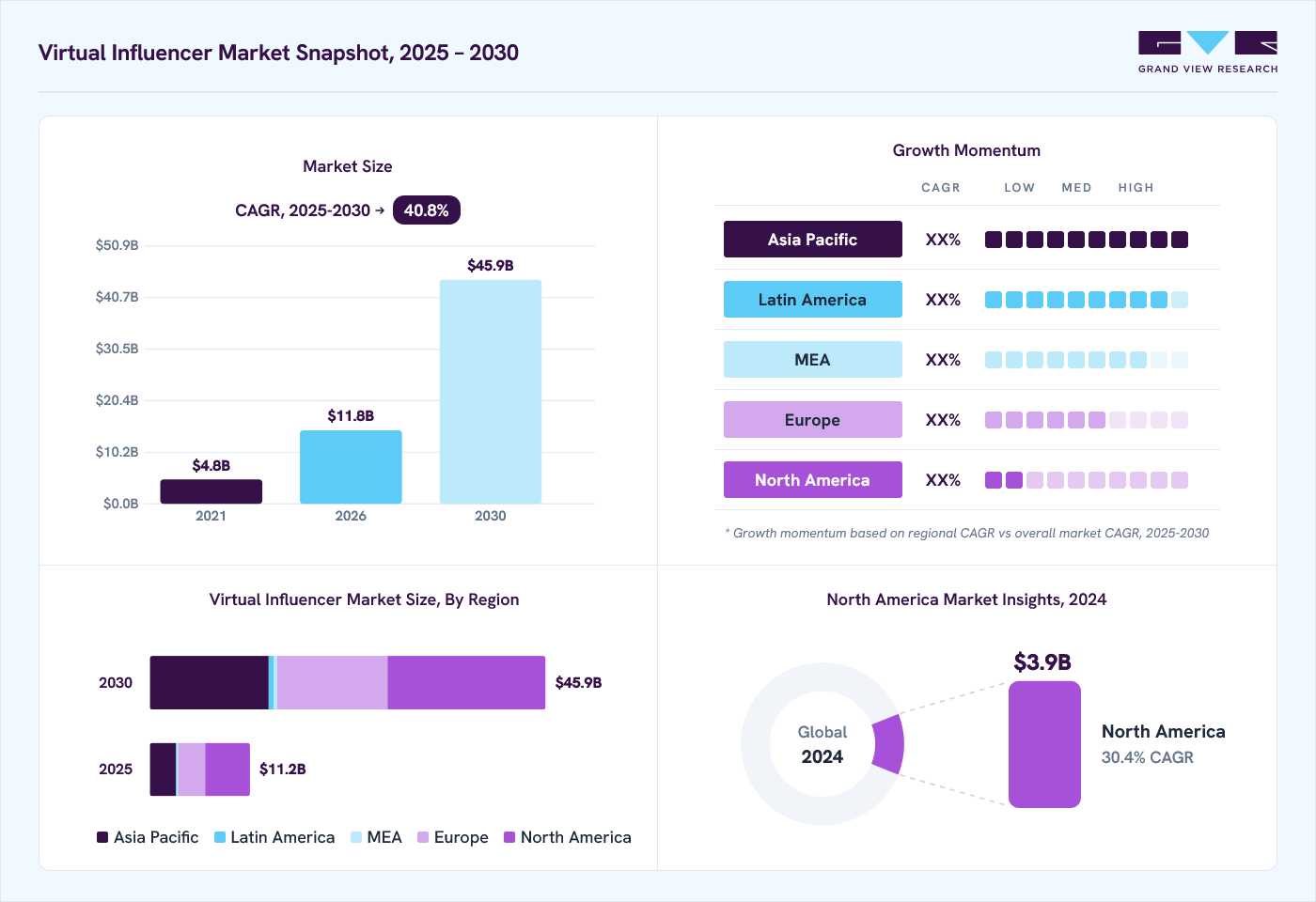 Source: Grand View Research, IR Documents, Primary Interviews, Paid DatabasesTo learn more about this report,
 Download Free Sample Report
 Key Market Trends & Insights
- By offering: Solution segment held the largest market share of 69.9% in 2025.
- By type: Human avatar segment held the largest market share of 69.0% in 2025.
- By end use: Fashion & lifestyle segment held the largest market share of 34.3% in 2025.
Regional Highlights
- Largest regional market: North America (44.6% revenue share, 2025)
- Fastest-growing regional market: Asia Pacific (highest CAGR, 2026-2033)
- By country: The U.S. held the largest market share in 2025
Market Size & Forecast
- Market size in 2025: USD 11.2 Billion
- Estimated market size in 2026: USD 14.5 Billion
- Projected market size by 2033: USD 110.4 Billion
- CAGR (2026-2033): 33.6%
Three ways to get this report
Buy it, customize it, or ask a question.Ask an Analyst
Analyst response in 1 business day
- AccessReport author, directly
- Reply timeWithin 1 working day
- No sales callDirect answer only
- FormatEmail reply
- CostFree, no cost
Get the Full Report
What the study covers
- FormatsPDF · Excel · Dashboard
- Timeline2026–2033 annual, 2025 base
- Coverage20+ countries, 5 regions
- Companies10+ key players profiled
Customize the Report
20% free customization
- IncludeCountries, segments, points
- TailorTo your product definition
- ExtendDeeper competitor detail
- OrA fully bespoke study
- Turnaround5–10 working days
Additionally, the rising popularity of digital content consumption, metaverse experiences, and personalized customer engagement strategies is further accelerating the adoption of virtual influencers across industries.The market growth is largely driven by the increasing preference among brands for unique marketing strategies that leverage digital personas to reach expansive audiences. Additionally, technological advancements in artificial intelligence and 3D modeling is further enhancing the realism and functionality of virtual influencer industry, making them more appealing to consumers, which is expected to significantly boost market expansion. To learn more about this report, Download Free Sample Report
 The cost-effectiveness of virtual influencers compared to their human counterparts is another significant driver of the market. Brands can save on expenses related to accommodation, travel, and other logistical costs associated with real-life influencers while still achieving impactful marketing outcomes. The interactive and immersive experiences offered by virtual influencers help brands build stronger connections with their target audiences, which is essential in today’s competitive landscape. This shift towards digital personas not only allows for greater creative freedom but also enables brands to tailor their messaging to specific demographics effectively.
In addition, the rising demand for realistic and relatable virtual influencers that can connect emotionally with consumers is fueling the market growth. Brands across various sectors, particularly in fashion and lifestyle, have successfully utilized human avatars to promote their products on social media platforms, leading to increased engagement and brand loyalty. As technology continues to advance, the capabilities of human avatars are expected to improve further, solidifying their position as a preferred choice for many brands.
The emergence of unique and imaginative non-human avatars allows brands to differentiate themselves in a crowded marketplace. These digital personas can be designed without the limitations of physical reality, enabling limitless creativity and adaptability in marketing campaigns. As consumer preferences evolve towards more engaging and visually striking content, brands are likely to invest more in non-human influencers that capture attention and foster brand recognition, thereby driving virtual influencer industry’s expansion.
Moreover, services such as consultancy, analytics, content strategy development, and social media management are becoming essential for brands looking to optimize their use of virtual influencers. This trend highlights a shift towards a more comprehensive approach in leveraging digital characters as part of broader marketing strategies, ensuring that brands can effectively engage with their audiences while maximizing their return on investment, which is further propelling the virtual influencer industry growth.
Market Dynamics
The virtual influencer industry is highly innovative, reshaping how brands approach digital marketing through AI-generated personalities, data-led content strategies, and immersive storytelling formats. The growing collaboration among technology developers, creative agencies, and social media platforms enables brands to engage audiences in more controlled, scalable, and interactive ways presents significant opportunity for market expansion. This shift is also redefining traditional notions of authenticity and influence, as virtual personas increasingly blend entertainment, branding, and technology into a unified digital experience.
Brands are increasingly incorporating virtual influencers into their marketing strategies to enhance audience engagement and differentiate themselves in highly competitive digital environments. Virtual influencers offer complete control over messaging, appearance, content schedules, and brand alignment, reducing many of the uncertainties associated with human influencer partnerships. This capability makes them attractive to organizations seeking consistent, scalable marketing assets.
Furthermore, the growing consumption of social media across platforms such as Instagram, TikTok, YouTube, and emerging virtual environments is creating favorable conditions for the adoption of virtual influencers. Digital audiences, particularly younger demographics, are increasingly accepting computer-generated personalities, prompting brands to experiment with innovative forms of engagement. Strong visual appeal and unique storytelling capabilities further support their popularity.
Moreover, advances in artificial intelligence, computer-generated imagery, and real-time content-generation technologies are enabling the creation of increasingly realistic and interactive virtual influencers. These technological improvements are enhancing audience engagement while reducing constraints on content production, contributing significantly to market growth.
Consumer trust remains a significant challenge for the virtual influencer market. Many audiences continue to value genuine human experiences, personal stories, and real-world credibility when engaging with influencers. Virtual influencers often face skepticism regarding the authenticity of their opinions, recommendations, and interactions.
Brand campaigns that rely heavily on virtual personalities may encounter lower emotional connection among certain consumer groups. Perceptions of artificiality can reduce engagement effectiveness, particularly in sectors where trust and credibility strongly influence purchasing decisions. Industries such as healthcare, financial services, and personal wellness may face greater limitations in adopting virtual influencers compared to lifestyle or entertainment sectors.
Concerns about transparency and disclosure further constrain the market. Regulatory bodies and consumers increasingly expect clear communication regarding AI-generated content and synthetic personalities. Compliance requirements and public scrutiny may create operational challenges for brands utilizing virtual influencers in promotional activities.
The emergence of virtual worlds, augmented reality experiences, gaming environments, and interactive digital platforms presents substantial growth opportunities for virtual influencers. Organizations are increasingly exploring immersive engagement strategies that extend beyond traditional social media content. Virtual influencers are well-positioned to serve as persistent digital representatives across multiple interconnected platforms.
Additionally, the integration with conversational AI and personalized engagement technologies can transform virtual influencers from passive content creators into interactive digital companions. Real-time communication capabilities enable deeper audience relationships, increased user engagement, and enhanced brand interaction. These developments create opportunities for new service offerings and revenue generation models.
Furthermore, growing investments in digital commerce, virtual events, branded virtual experiences, and digital asset ecosystems are expected to expand the commercial value of virtual influencers. Companies can leverage these digital personalities to support product launches, customer engagement initiatives, and virtual shopping experiences, creating long-term opportunities for market expansion.
Market Concentration & Characteristics
The virtual influencer market is moderately fragmented, with a mix of AI technology providers, digital human developers, creative agencies, animation studios, social media marketing firms, and virtual character specialists competing across diverse application areas and audience segments. The market is characterized by a high degree of innovation, driven by advancements in generative AI, computer-generated imagery (CGI), real-time rendering, conversational AI, and immersive digital content creation technologies. Additionally, the level of M&A activities is medium, as technology companies, marketing agencies, and digital content platforms increasingly acquire specialized virtual human and AI avatar developers to strengthen their digital engagement capabilities, while numerous independent innovators continue to enter the market.
 To learn more about this report, Download Free Sample Report
 Furthermore, the impact of regulations is medium, primarily related to data privacy, AI transparency, intellectual property rights, digital content disclosure, and the ethical use of synthetic media, with regulatory requirements varying across regions. Product substitutes are medium, since human influencers, celebrity endorsements, brand ambassadors, and traditional digital advertising channels can serve similar marketing and audience engagement functions depending on campaign objectives. Moreover, end-user concentration is low, as demand is distributed across fashion & lifestyle, entertainment, gaming, retail, travel, financial services, consumer brands, and other industries rather than being concentrated among a limited number of organizations.
Analyst Perspective
The virtual influencer market is experiencing strong expansion driven by the increasing adoption of AI-generated digital personalities for brand marketing and audience engagement, growing investments in social media monetization strategies, and rising demand for scalable, controllable, and data-driven influencer campaigns.
Type Insights
Based on type, the human avatar segment led the market with the largest revenue share of 69.0% in 2025 and is expected to grow at a considerable CAGR over the forecast period. This growth can be attributed to the increasing demand for realistic and relatable virtual influencers that can connect with consumers on an emotional level. Human avatars are often designed to embody traits and aesthetics that resonate with target audiences, making them effective in brand storytelling and engagement. Furthermore, advancements in artificial intelligence (AI) and computer-generated imagery (CGI) have enhanced the realism of these avatars, allowing brands to create more authentic interactions that foster consumer trust and loyalty, thereby driving segmental growth.
The non-human segment is projected to register the fastest CAGR of over 35.0% from 2026 to 2033. This rapid growth is driven by the emergence and popularity of unique non-human avatars, which offer limitless design possibilities that capture consumer attention in a crowded digital landscape. Brands are increasingly leveraging these imaginative personas to differentiate themselves and create distinctive identities that stand out. The flexibility of non-human avatars also allows them to be utilized across various marketing campaigns, from entertainment to educational content, catering to diverse audience preferences.
Offering Insights
Based on the offering, the solution segment dominated the market with the largest revenue share of 69.9% in 2025, owing to the increasing demand for comprehensive and innovative marketing solutions that integrate virtual influencers into brand strategies. As businesses recognize the effectiveness of virtual influencers in enhancing consumer engagement and brand visibility, they are turning to solution providers that offer tailored services to streamline the implementation process. These solutions not only simplify the integration of virtual influencers into various marketing campaigns but also provide brands with creative freedom, allowing them to leverage unique digital personas that resonate with their target audiences. This growing reliance on specialized solutions has solidified the segment's dominance in the market.
 To learn more about this report, Download Free Sample Report
 The services segment is expected to register a considerable CAGR from 2026 to 2033, driven by the increasing complexity of managing virtual influencer campaigns. As brands seek to maximize their return on investment, they are increasingly relying on specialized services such as consultancy, analytics, and reporting. These services help brands effectively create and manage virtual influencers while leveraging advanced technologies to engage audiences across multiple platforms. The rising demand for data-driven insights and performance metrics is further propelling growth in this segment, as brands aim to optimize their marketing strategies through expert guidance and innovative service offerings.
End-use Insights
Based on end use, the fashion lifestyle segment led the market with the largest revenue share of 34.3% in 2025 and is expected to grow at a considerable CAGR over the forecast period. Virtual influencers are particularly effective in promoting a wide range of products, such as clothing, accessories, and beauty items, as they embody the aesthetics and values that resonate with target audiences. Their ability to create immersive narratives and engage consumers through storytelling enhances brand recall and fosters a deeper connection with the audience, thereby fueling market growth.
The food & entertainment segment is anticipated to record a significant CAGR from 2026 to 2033, driven by the growing demand for engaging content that resonates with younger audiences. Virtual influencers are being utilized to host interactive cooking shows, promote food products, and create buzz around entertainment events, effectively bridging the gap between brands and consumers. This segment's appeal lies in its ability to create memorable experiences through storytelling and immersive content that captures the interest of digital-savvy consumers. As brands increasingly recognize the potential of virtual influencers to enhance their marketing strategies in the food and entertainment sectors, this segment is expected to experience substantial growth.
Regional Insights
North America dominated the virtual influencer market with the largest revenue share of 44.6% in 2025. This growth is driven by rapid advancements in artificial intelligence (AI) and computer-generated imagery (CGI), which enable the creation of highly realistic and engaging digital personas. As brands increasingly seek innovative marketing strategies to connect with tech-savvy audiences, virtual influencers have emerged as cost-effective alternatives to traditional influencers, allowing for tailored content that aligns with brand values.
 To learn more about this report, Download Free Sample Report
 U.S. Virtual Influencer Market Trends
The virtual influencer market in the U.S. held the largest share in the North America region in 2025. Brands are increasingly focusing on authenticity and sustainability in their marketing efforts, leading to the development of virtual influencers that resonate with socially conscious consumers is propelling market growth in the U.S
Europe Virtual Influencer Market Trends
The Europe industry for virtual influencer is expected to grow at a considerable CAGR of over 34.3% from 2026 to 2033, driven by the increasing demand for innovative marketing strategies and the rapid evolution of digital technologies. Brands are leveraging virtual influencers to create hyper-personalized content that resonates with diverse consumer preferences, enhancing engagement and brand loyalty. The integration of AI and deep learning technologies allows for real-time interactions and adaptive behaviors, making virtual influencers more dynamic and relatable.
The UK virtual influencer market is expected to grow rapidly in the coming years. The trend towards using AI in influencer marketing is also gaining momentum, as brands explore the potential of virtual reality influencers created through advanced 3D modeling. This shift reflects a broader acceptance of virtual personas among consumers, particularly Gen Z and Millennials, who are increasingly drawn to authentic and creative digital content.
The virtual influencer market in Germany held a substantial market share in 2025, driven by an increasing recognition of mental well-being within fitness programs. Virtual influencers are being integrated into fitness apps to provide personalized workout content and wellness guidance, enhancing user experiences and attracting broader audiences. Additionally, the fashion sector in Germany is leveraging virtual influencers for targeted marketing campaigns, allowing brands to tailor their messaging while maintaining creative flexibility.
Asia-Pacific Virtual Influencer Market Trends
The Asia Pacific virtual influencer market is expected to grow at the fastest CAGR of 37.3% from 2026 to 2033, primarily driven by the increasing demand for innovative marketing strategies and the rapid adoption of social media platforms. As brands seek to engage digital-savvy consumers, virtual influencers have emerged as effective tools for brand endorsements and storytelling. The fashion and beauty industries, in particular, have embraced virtual influencers as trendsetters, leveraging their ability to showcase products and create immersive narratives that resonate with audiences.
The Japan virtual influencer market is expected to grow rapidly in the coming years. The market is driven by a cultural affinity for digital characters and storytelling. Virtual influencers in Japan are not only used for marketing but also play significant roles in entertainment, often participating in virtual events and collaborations with real-world brands.
The virtual influencer market in China held a substantial revenue share in 2025. The rise of hyper-realistic virtual influencers, such as Ayayi, reflects a trend towards blending physical and digital experiences through innovative brand concepts. Brands are increasingly utilizing these digital personas to promote products across various sectors, including fashion and entertainment. Furthermore, the Chinese government's support for the food and entertainment industry is fostering an environment conducive to the expansion of virtual influencers, allowing them to cater to evolving consumer preferences in urban areas.
Key Virtual Influencer Company Insights
Some of the key players operating in the market include Superplastic and Dapper Labs.
-
Superplastic is an entertainment brand that specializes in creating and managing a diverse roster of animated synthetic celebrities and virtual influencers. Superplastic combines the worlds of designer toys, digital collectibles, and animated content, aiming to build a Disney-like metaverse for the NFT age. The company is at the forefront of the virtual influencer market, engaging audiences through innovative storytelling and character-driven experiences.
-
Dapper Labs, Inc. is a pioneering technology company focused on creating engaging digital experiences through blockchain technology and NFTs (non-fungible tokens). Known for its innovative products like NBA Top Shot and CryptoKitties, Dapper Labs aims to connect people by enabling them to collect, trade, and own unique digital assets. The company emphasizes the importance of decentralization, allowing creators and brands to build meaningful interactions within the digital landscape.
Some of the emerging market players in the virtual influencer market include UneeQ Limited and Soul Machines.
-
UneeQ Limited specializes in creating digital humans for customer engagement across various industries. Their technology allows brands to deploy virtual influencers that can interact with customers, enhancing user experience and brand connection.
-
Soul Machines is a pioneering company in the field of digital humans, utilizing advanced artificial intelligence to create lifelike avatars that can interact with users in real-time. The company focuses on developing emotionally responsive digital characters that can be used across various industries, including entertainment, customer service, and education. By combining neuroscience with cutting-edge graphics and AI, Soul Machines aims to revolutionize human-computer interaction and enhance the way brands connect with consumers through virtual influencers.
Key Virtual Influencer Companies
The following key companies have been profiled for this study on the virtual influencer market.
-
Epic Games, Inc.
-
Pinscreen Inc.
-
Soul Machines
-
NEON
-
Superplastic
-
Dapper Labs, Inc.
-
UneeQ Limited
-
Didimo Inc.
-
Spatial Systems, Inc.
-
DeepBrain AI Inc.
-
REBLIKA
-
Ogilvy
-
Cafegroup
Competitive Benchmarking
Operating Strategies
Competitive Edge
Weaknesses
Established Players (Epic Games, Inc., Soul Machines, NEON, Ogilvy, Dapper Labs, Inc.)
- Develop advanced virtual human ecosystems through investments in AI, real-time rendering, digital content creation, and immersive engagement platforms.
- Expand brand partnerships, advertising campaigns, gaming integrations, and digital commerce initiatives to strengthen market presence.
- Strong technological capabilities, established global client networks, and significant financial resources for innovation and expansion.
- Ability to integrate virtual influencers across gaming, advertising, entertainment, and digital commerce ecosystems while supporting large-scale brand campaigns and global audience engagement.
- High development and operational costs associated with creating realistic digital humans and maintaining content ecosystems.
- Complex organizational structures may slow adaptation to rapidly changing social media trends and emerging creator-economy dynamics.
Emerging Players (Pinscreen Inc., Superplastic, UneeQ Limited, Didimo Inc.)
- Focus on AI-generated avatars, virtual influencer creation platforms, personalized digital humans, and social media engagement solutions.
- Emphasize rapid deployment, customizable virtual personalities, conversational AI, and creator-focused business models to address evolving brand and consumer requirements.
- High innovation agility, faster product iteration cycles, and strong specialization in AI-driven avatar generation and virtual influencer technologies.
- Ability to deliver highly customized, scalable, and interactive digital personalities tailored to specific brand campaigns, demographics, and regional markets.
- Limited global brand recognition and smaller customer bases compared with established industry participants. Resource constraints.
- Dependence on social media platform algorithms and evolving regulatory frameworks can also create growth challenges.
Recent Developments
-
In July 2024, UneeQ Limited announced its participation in SIGGRAPH 2024, where it held the first-ever speaking session co-presented by an AI-powered digital human named Sophie. This interactive avatar, one of the first digital humans in the world, shared the stage with Marco Chavira, VP Sales USA at UneeQ, responding to questions in real time.
-
In June 2024, UneeQ Limited announced a significant collaboration with NVIDIA at COMPUTEX 2024, integrating its advanced digital human solutions with NVIDIA ACE technology. This partnership aims to enhance the lifelike capabilities of digital humans, enabling more accurate information delivery and improved user interactions.
-
In May 2024, Superplastic announced a strategic partnership with AREA15, which aimed to introduce its animated characters into the real world for the first time. This collaboration involved the opening of an experiential space within AREA15.
Virtual Influencer Market Report Scope
Report Attribute
Details
Market size in 2025
USD 11.2 billion
Estimated market size in 2026
USD 14.5 billion
Projected market size by 2033
USD 110.4 billion
Growth rate
CAGR of 33.6% from 2026 to 2033
Base year for estimation
2025
Historical data
2021 - 2024
Forecast period
2026 - 2033
Quantitative units
Revenue in USD million and CAGR from 2026 to 2033
Report coverage
Revenue forecast, company ranking, competitive landscape, growth factors, and trends
Segments covered
Type, offering, end use, and region
Regional scope
North America; Europe; Asia Pacific; Latin America; MEA
Country scope
U.S.; Canada; U.K.; Germany; France; Italy; China; Australia; Japan; India; South Korea; Brazil; Mexico; South Africa; Saudi Arabia
Key companies profiled
Epic Games, Inc.; Pinscreen Inc.; Soul Machines; NEON; Superplastic; Dapper Labs, Inc.; UneeQ Limited; Didimo Inc.; Spatial Systems, Inc.; DeepBrain AI Inc.; REBLIKA; Ogilvy; Cafegroup
Customization scope
Free report customization (equivalent up to 8 analysts' working days) with purchase. Addition or alteration to country, regional & segment scope.
Pricing and purchase options
Avail customized purchase options to meet your exact research needs. Explore purchase options
Global Virtual Influence Market Report Segmentation
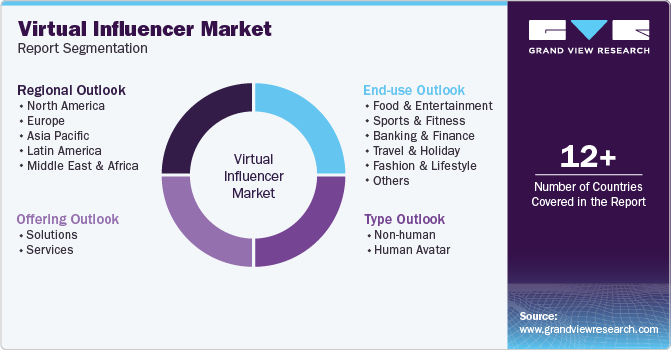
This report forecasts revenue growth at global, regional, and country levels and provides an analysis of the latest technology trends in each of the sub-segments from 2021 to 2033. For this study, Grand View Research has segmented the global virtual influencer market report based on type, offering, end-use, and region:
 To learn more about this report, Download Free Sample Report
 -
Type Outlook (Revenue, USD Million, 2021 - 2033)
-
Non-human
-
Human Avatar
-
-
Offering Outlook (Revenue, USD Million, 2021 - 2033)
-
Solutions
-
Services
-
-
End-use Outlook (Revenue, USD Million, 2021 - 2033)
-
Food & Entertainment
-
Sports & Fitness
-
Banking & Finance
-
Travel & Holiday
-
Fashion & Lifestyle
-
Others
-
-
Regional Outlook (Revenue, USD Million, 2021 - 2033)
-
North America
-
U.S.
-
Canada
-
-
Europe
-
UK
-
Germany
-
France
-
Italy
-
Spain
-
-
Asia Pacific
-
China
-
India
-
Japan
-
South Korea
-
-
Latin America
-
Brazil
-
Mexico
-
Middle East & Africa
-
South Africa
-
Saudi Arabia
-
UAE
-
-
Research Methodology
The virtual influencer market figures in this report are based on a proven research process that combines executive interviews with secondary research from proprietary databases, company filings, and recognized regulatory and institutional sources. Market size is built through value-chain sizing-reconciling supply-side and demand-side estimates-and triangulated with bottom-up and top-down approaches. Every estimate passes multiple levels of expert validation before publication, with each cryptocurrency payment apps segment quantified using the revenue-capture definitions in the table below.
Segment Definition
Segment - Device
Revenue capture definition
Non-human
Revenue is generated through AI-generated or fully computer-created virtual influencers used by brands for marketing campaigns, social media promotions, and digital engagement, often monetized through endorsements, collaborations, and branded content partnerships.
Human Avatar
Revenue is generated through digitally enhanced or motion-captured representations of real humans used as influencers, enabling monetization through brand endorsements, sponsorships, content creation, and social media collaborations.
Segment - Application
Revenue capture definition
Solutions
Revenue is generated through the development and deployment of virtual influencer platforms, AI tools, content creation systems, and avatar generation technologies used by brands and creators for digital marketing and engagement.
Services
Revenue is generated through managed services such as content creation, influencer campaign management, avatar customization, strategy consulting, and ongoing support for virtual influencer marketing activities.
Segment – End Use
Revenue capture definition
Food & Entertainment
Revenue is generated through brand promotions, product endorsements, and digital campaigns by food, restaurant, and entertainment companies using virtual influencers to engage target audiences.
Sports & Fitness
Revenue is generated through fitness promotions, sports brand endorsements, training content, and sponsorship campaigns delivered via virtual influencers in health and athletic segments.
Banking & Finance
Revenue is generated through digital marketing, customer engagement campaigns, and financial product promotions conducted by banks and financial institutions using virtual influencers.
Travel & Holiday
Revenue is generated through destination marketing, travel promotions, hotel advertising, and tourism campaigns featuring virtual influencers to attract travelers.
Fashion & Lifestyle
Revenue is generated through fashion brand endorsements, lifestyle product promotions, influencer collaborations, and digital runway or campaign marketing using virtual influencers.
Others
Revenue is generated through applications across education, healthcare, technology, automotive, consumer electronics, retail, and corporate communications, among others.
Estimation Model
Layer Name
Key Questions
Description
Social Media Audience Layer
Who can potentially engage with virtual influencers?
Identify the global social media user base across major platforms such as Instagram, TikTok, and YouTube. Filter users based on demographics and categories where virtual influencers are most active to define the potential audience pool.
End-user Adoption Base
Who are the primary paying customers?
Includes brands, marketing agencies, entertainment companies, e-commerce platforms, and financial institutions using virtual influencers for customer engagement and advertising.
Engagement & Adoption Layer
Who actively follows and interacts with virtual influencers?
Apply virtual influencer followership, engagement rates, content interaction metrics, and brand collaboration exposure rates to estimate the active audience that regularly consumes virtual influencer content and engages with sponsored campaigns.
Revenue Generation Layer
How is revenue generated?
Revenue is generated through brand collaborations, sponsored content, influencer marketing campaigns, licensing of virtual avatars, subscription-based platforms, and content creation or management services offered by agencies and AI-driven virtual influencer platforms.
Delivered Customizations
This report has been delivered with the following In-depth customizations
Client Request
Customization Delivered
Value Adds
Virtual Influencer Market Strategy, Audience Positioning & Commercial Feasibility Analysis
Conducted detailed assessment of virtual influencer categories (human-like avatars, anime-inspired characters, CGI personalities, AI-generated influencers), deployment channels (Instagram, TikTok, YouTube, gaming platforms), target audience demographics, engagement models, brand collaboration frameworks, and monetization strategies including sponsorships, merchandise, subscriptions, and digital asset sales.
Enables optimal audience targeting, improves influencer-brand alignment, enhances monetization opportunities across digital channels, and reduces market entry risks through data-driven positioning strategies.
Digital Content Ecosystem, Brand Partnerships & Engagement Optimization
Evaluated content creation workflows, social media platform integration, audience engagement mechanisms, community-building strategies, campaign performance measurement, multilingual content deployment, and collaboration models between brands, agencies, and virtual influencer developers.
Strengthens audience engagement, improves campaign effectiveness, increases brand partnership opportunities, enhances cross-platform reach, and supports scalable digital marketing operations with consistent brand messaging.
AI-Driven Personalization, Generative Technologies & Next-Generation Virtual Influencer Innovation
Assessed adoption of generative AI, conversational AI, real-time rendering technologies, digital human platforms, personalized audience interactions, AI-powered content generation, immersive experiences in AR/VR environments, and integration with metaverse and virtual commerce ecosystems.
Enables highly interactive and scalable influencer experiences, enhances audience personalization, supports continuous content production, expands revenue opportunities through immersive digital environments, and strengthens competitive differentiation in the evolving creator economy.
Frequently Asked Questions About This Report
The key players in this industry are Epic Games, Inc.; Pinscreen Inc.; Soul Machines; NEON; Superplastic; Dapper Labs, Inc.; UneeQ Limited; Didimo Inc.; Spatial Systems, Inc.; DeepBrain AI Inc.; REBLIKA; Ogilvy; Cafegroup.
Key factors that are driving the virtual influencer market growth include the continuously evolving digital landscape and rising usage of social media around the globe are fueling the market’s growth.
The global virtual influencer market size was valued at USD 11.2 billion in 2025 and is estimated at USD 14.5 billion for 2026.
Asia-Pacific is expected to register the fastest growth of over 37.0% from 2026 to 2033.
Non-human is expected to register the fastest growth of over 35.0% from 2026 to 2033.
The solution segment led with a 69.9% revenue share in 2025.
The global virtual influencer market is expected to grow at a CAGR of 33.6% from 2026 to 2033, reaching USD 110.4 billion by 2033.
Based on type, the human avatar segment dominated the market in 2025 with a share of 69.0% due to the increasing demand for more realistic and relatable virtual influencers, as human avatars can connect with consumers on an emotional level.
Fashion & Lifestyle segment held the largest revenue share of 34.3% in 2025.
About the Author(s)
Next Generation Technologies Research Team
Technology · Next Generation TechnologiesThis report was authored by the next generation technologies research team at Grand View Research - comprising two research analysts, one senior research analyst, and one industry expert - with specialized expertise in the next generation technologies segment of the technology industry. All findings are based on proprietary technology databases, executive interviews, and regulatory analysis, subject to internal peer review prior to publication.
Last Updated:
Speak to Analyst

Customize this report to your needs - add regions, segments, or data points, with 20% free customization.
Or view our licence options:


ISO 9001:2015 & 27001:2022 Certified
We are GDPR and CCPA compliant! Your transaction & personal information is safe and secure. For more details, please read our privacy policy.


