
- Home
- »
- Next Generation Technologies
- »
-
Voice Communication Control System Market Report 2026-2033GVR Report cover
![Voice Communication Control System Market Size, Share & Trends Report]()
Voice Communication Control System Market (2026 - 2033) Size, Share & Trends Analysis Report By Component (Hardware, Software, Services), By Application (Air Traffic Control, Vessel Traffic Control), By End Use, By Region, And Segment Forecasts
Market Size, 2025
$4.5BMarket Estimate, 2026
$4.8BMarket Forecast, 2033
$7.9BCAGR, 2026–2033
7.3%Voice Communication Control System Market Summary
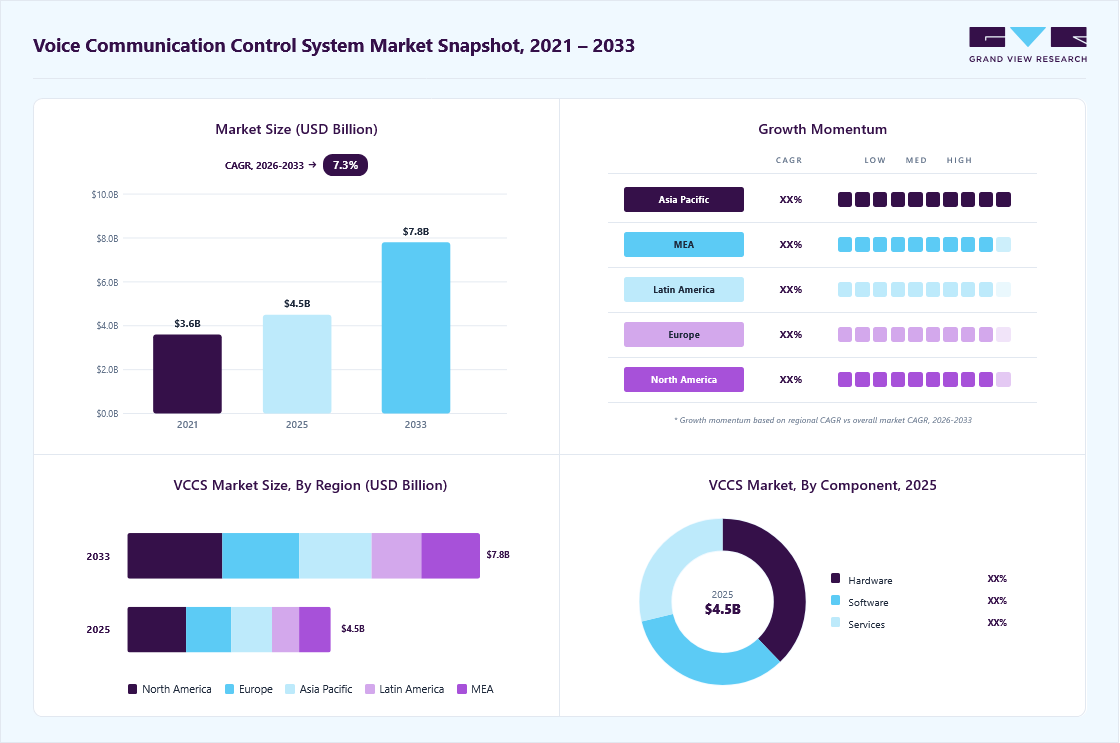
The global voice communication control system market size was valued at USD 4.5 billion in 2025 and is projected to grow from USD 4.8 billion in 2026 to USD 7.9 billion by 2033, at a CAGR of 7.3% from 2026 to 2033. The North America voice communication control system market held the largest share of 28.1% of the global market in 2025. The voice communication control system industry is being driven by rising demand for real-time, secure communication in mission-critical sectors such as aviation, defense, and emergency services.
Key Market Trends & Insights
- By component: Hardware led the global voice communication control system industry and accounted for a share of 38.1% in 2025.
- By application: Air traffic control segment led the market and accounted for a share of 38.8% in 2025.
- By end use: Commercial segment led the market in 2025.
Regional Highlights
- Largest regional market: North America (28.1% revenue share, 2025)
- Fastest-growing regional market: Asia Pacific (highest CAGR, 2026-2033)
- By country: The U.S. held the largest revenue share in 2025.
Market Size & Forecast
- Market size in 2025: USD 4.5 Billion
- Estimated market size in 2026: USD 4.8 Billion
- Projected market size by 2033: USD 7.9 Billion
- CAGR (2026-2033): 7.3%
The VCCS is majorly used in air traffic control to enable communication between air traffic controllers and pilots. The growing demand for air travel is expected to increase the number of flights, which in turn boosts market growth. The adoption of next-generation voice communication systems has increased due to technological innovation. Standard certifications such as ED-136, ED-138, and ED-137B are required to integrate voice over internet protocol (VoIP) into air traffic management (ATM) operation. These standards are followed for designing VoIP-based ATM communication components. Continuous voice communication is critical in military and commercial air traffic control, thereby increasing the adoption of the voice communication system.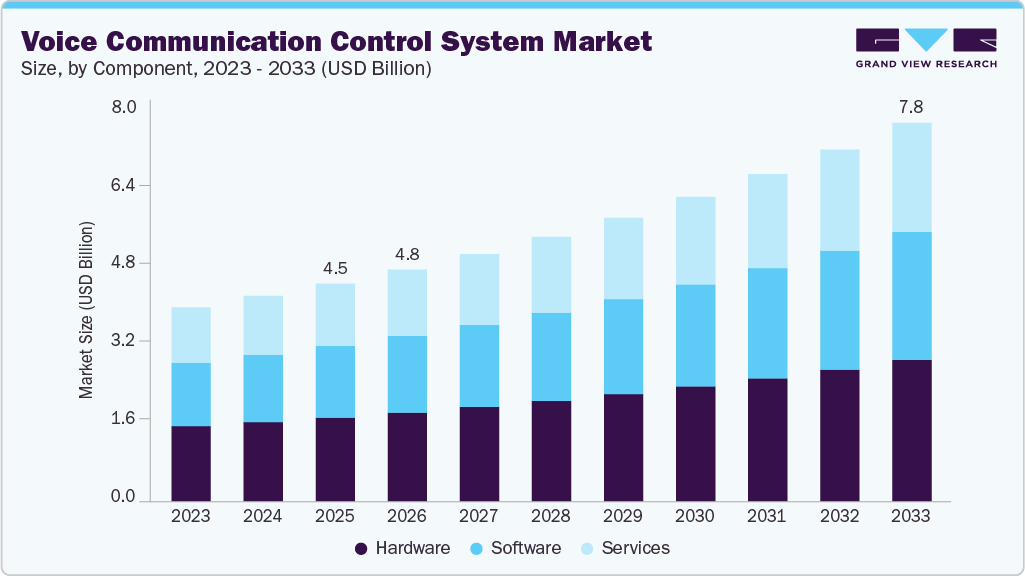
Demand for advanced voice communication control systems continues to be strongly driven by the growth in global air traffic and airport infrastructure expansion. As passenger volumes rise and airspace becomes increasingly congested, aviation authorities are investing in sophisticated VCCS platforms to support safe and efficient coordination between pilots and controllers. Modernization of air traffic control (ATC) centers, implementation of digital towers, and compliance with evolving international aviation communication standards are compelling organizations to adopt robust VCCS solutions that handle higher traffic volumes with greater reliability. This sustained investment in aviation communication systems underpins long-term market growth.
Voice communication control systems are used in several defense applications, including military communications and air traffic control for military aircraft. VCCS is used to enable communication between military personnel involved in operations, as well as to control the movement of military aircraft. The demand for VCCS in the military is anticipated to grow as military organizations worldwide are investing in VCS to ensure the safety and effectiveness of their operations. In addition, the development of new technologies, such as drones and other unmanned systems is anticipated to increase the demand for VCCS. However, the voice communication system designed for airports, aircraft, or defense applications has to be developed with strict design standards.
The complexity of regulatory frameworks restrains the growth of the voice communication control systems industry. Several government regulations mandate VCCS providers to ensure high levels of reliability, fail-safety, and interoperability with other ATC systems. In addition to regulatory requirements, aviation system design standards dictate more stringent measures for companies developing VCCS solutions. These systems must meet rigorous design specifications to ensure they can operate seamlessly in mission-critical environments. Thus, the stringent airport & aircraft safety regulations, along with strict design standards of the voice communication control equipment for aviation and defense applications, are the factors expected to restrain market growth.
Component Insights
The hardware segment dominated the market in 2025 and accounted for the largest share of 38.1%. A rise in demand for technologically advanced VCCS components such as consoles, digital switches, connectors, and antennas is anticipated to fuel the growth of the segment. Moreover, a growing development of air traffic control towers is anticipated to boost the growth of the segment as new ATC towers require advanced VCCS equipment. In addition, increasing emphasis on system resilience, fault tolerance, and compliance with stringent safety standards has reinforced the requirement for high-performance, certified hardware platforms.
The software segment is expected to register a notable CAGR over the forecast period. The growth can be attributed to the rising development of voice communication system software to enable seamless communication between the air traffic controller and the pilot. In addition, an increase in demand for VCCS in disaster & emergency management is anticipated to further propel the growth of the segment. Furthermore, the shift toward cloud-based and virtualized deployments has increased reliance on software solutions, positioning this segment as a key contributor to long-term market growth.
Application Insights
The air traffic control segment dominated the market in 2025. Voice communication control system is majorly used in the aviation sector for air traffic control operations. In air traffic control, VCCS enables ground-to-ground communication and ground-to-air communication. A recent development in VCCS technology such as digital voice communication system that transmits real-time aircraft data to the pilots and ground crew is anticipated to support the market growth. In addition, the growing demand for new technologies such as unmanned aerial vehicles (UAVs) for commercial purposes is expected to fuel the growth in segment.
The vessel traffic control segment is expected to grow at a notable CAGR over the forecast period. Growing congestion at the marine ports owing to the increasing sea trade activities is anticipated to fuel the segment’s growth. VCCS in vessel traffic control helps controllers monitor the movement of the vessels and to track their positions in real-time communication between the ship crew and port crew. The demand for VCCS in vessel traffic management is likely to continue to be strong, as the need for effective communication and coordination in busy waterways is critical for the safety and efficiency of vessel traffic.
End Use Insights
The commercial segment dominated the market in 2025. The segment growth can be attributed to the growing commercial aviation sector. A rise in demand for air travel has increased the number of flights per day, which has increased need for air traffic management fueling the segment growth. Moreover, growing international seaborne trade has also increased the demand for vessel traffic control, supporting market growth.
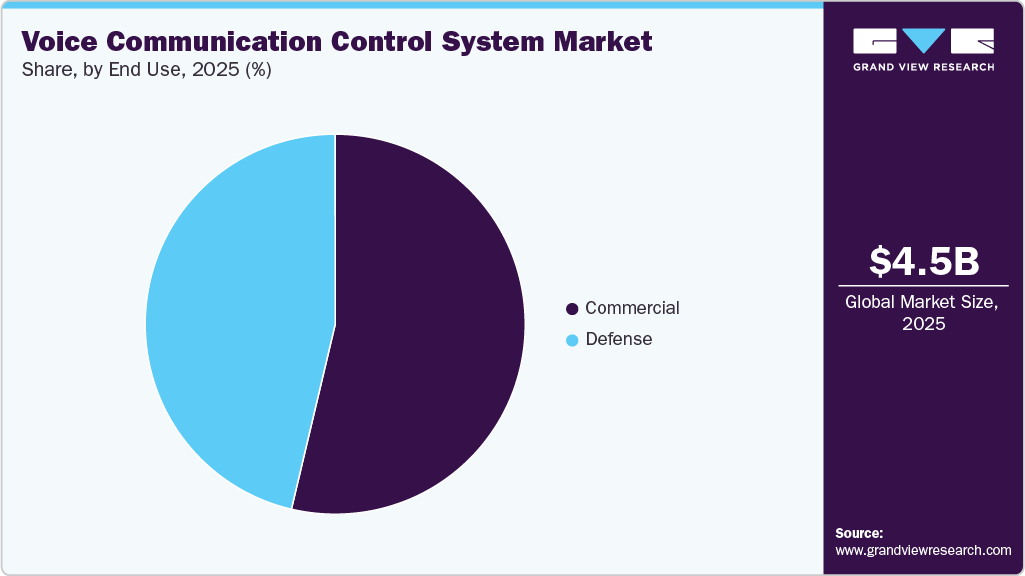
The defense segment is expected to grow at a notable CAGR over the forecast period. Growth of this segment is being driven by large-scale modernization programs aimed at replacing legacy communication systems with secure, digital voice communication control platforms. Defense agencies are prioritizing advanced VCCS solutions to support real-time command and control operations across air, land, and naval forces. The need for reliable, low-latency voice communication in mission-critical environments has reinforced adoption of systems with high availability, redundancy, and fail-safe architectures. As multi-domain operations become more complex, demand for centralized and interoperable communication control systems has continued to increase.
Regional Insights
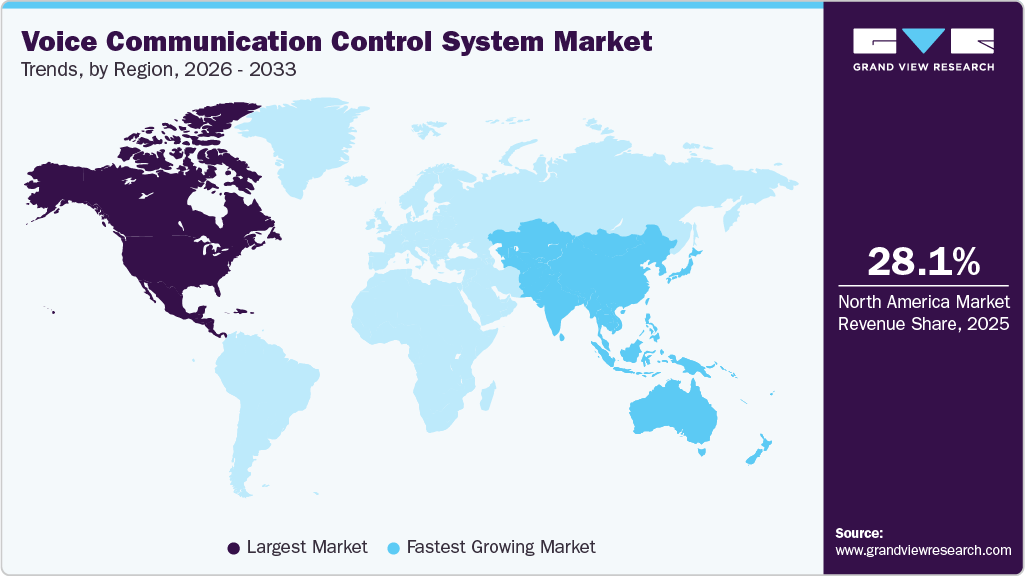
North America voice communication control system industry dominated the global market and accounted for a share of 28.1% in 2025. The dominance can be attributed to the presence of many airports in the U.S. and Canada, increasing the demand for VCCS used for air traffic control. Moreover, North America has the presence of some of the major players in the market, such as L3Harris Technologies, Inc. and Morocom International, Inc., which is anticipated to boost the market’s growth. Furthermore, rising investment by the Department of Defense (DoD) for modernization programs is expected to support market growth.
U.S. Voice Communication Control System Market Trends
The U.S. voice communication control system industry held a dominant position in the region in 2025. Increasing government investments from the U.S. Department of Transportation in airport infrastructure modernization programs drive the demand for voice communication control systems in the country. For instance, in July 2024, The U.S. Department of Transportation’s Federal Aviation Administration (FAA) announced the seventh round of Airport Infrastructure Grants (AIG), allocating a total of USD 289 million to 129 airports across 40 states to enhance the efficiency and safety of air travel. Such initiatives are expected to contribute to the country’s market growth.
Europe Voice Communication Control System Market Trends
Europe voice communication control system industry is expected to register a notable CAGR from 2026 to 2033. Key factors contributing to this growth include the rising number of air passengers, stringent safety regulations in aviation, and the integration of next-generation technologies such as VoIP and cloud-based solutions. Furthermore, investments in the modernization of air traffic control systems and increased military requirements for secure communication drive market growth.
The UK voice communication control system industry is expected to grow at the fastest CAGR from 2026 to 2033 among the European nations. The market’s growth is driven by ongoing investments to enhance air traffic management capabilities and digital communications infrastructure within both commercial aviation and military applications.
The Germany voice communication control system industry held a substantial market share in 2025. The market’s growth is driven by the country’s strong aerospace sector and increasing demand for advanced communication technologies. The rising number of air traffic operations and the need for enhanced safety measures in aviation also contribute to the growth of the market.
Asia Pacific Voice Communication Control System Market Trends
The Asia Pacific voice communication control system industry is expected to grow at the fastest CAGR during the forecast period. The growth of the region is attributed to the rising development of new airports in emerging countries such as India and China as a result of increasing air passenger traffic. The new airport development will lead to the construction of air traffic management centers, which is expected to generate demand for voice communication systems.
The China voice communication control system industry held a substantial market share in 2025. The growing adoption of virtual control centers is significantly enhancing the efficiency and flexibility of air traffic management, driving market growth. The country’s aggressive rollout of new airports and upgrades to existing facilities is fueling demand for scalable voice communication control systems capable of handling complex, high-density operations.
The India voice communication control system industry is expected to grow at the fastest CAGR from 2026 to 2033 in the Asia Pacific region. In India, the VCCS market is gaining significant momentum as part of broader air traffic management (ATM) and airport modernization programs. Investments in greenfield airports, regional connectivity schemes, and the adoption of next-generation digital communication platforms are creating demand for advanced voice communication control systems across civil and defense applications.
Key Voice Communication Control System Company Insights
Some of the key companies in the voice communication control system industry include L3Harris Technologies, Inc.; Frequentis AG; and Indra Sistemas, S.A., among others. Organizations are focusing on integrating advanced technologies into their offerings to maintain competitive advantages. Therefore, key players are taking several strategic initiatives, such as new product launches, mergers and acquisitions, and partnerships, among others.
-
L3Harris Technologies, Inc. leverages its extensive expertise in communication technologies to deliver robust VCCS solutions tailored for both commercial and defense applications. The company focuses on building strong partnerships with government agencies and commercial airlines by offering regulatory-compliant solutions as part of the efforts to strengthen its market presence.
-
Frequentis AG provides VCCS solutions for air traffic control operations. The company offers flexible and adaptable products that provide seamless, unified communication experience for controllers and pilots.
Key Voice Communication Control System Companies:
The following are the leading companies in the voice communication control system market. These companies collectively hold the largest market share and dictate industry trends.
- S.I.T.T.I. S.p.A.
- Rohde & Schwarz
- Copperchase Ltd.
- Thales S.A.
- Indra Sistemas, S.A.
- Saab AB
- Morcom International Inc.
- Frequentis AG
- L3Harris Technologies, Inc.
- Applied Electro Magnetics
Recent Developments
-
In March 2025, Leonardo DRS, Inc. delivered its first next-generation integrated voice communication systems for the U.S. Navy’s Arleigh Burke-class (DDG 51) destroyers. These advanced systems enable mission-critical, secure, ship-wide communications, supporting effective operations across the full range of surface navy missions.
Voice Communication Control System Market Report Scope
Report Attribute
Details
Market size in 2025
USD 4.5 billion
Estimated Market size in 2026
USD 4.8 billion
Projected Market size by 2033
USD 7.9 billion
Growth rate
CAGR of 7.3% from 2026 to 2033
Base year for estimation
2025
Historical data
2021 - 2024
Forecast period
2026 - 2033
Quantitative Applications
Revenue in USD million/billion and CAGR from 2026 to 2033
Report coverage
Revenue forecast, company ranking, competitive landscape, growth factors, and trends
Segments covered
Component, application, end use, region
Regional scope
North America; Europe; Asia Pacific; Latin America; MEA
Country scope
U.S.; Canada; Mexico; Germany; UK; France; Italy; China; India; Japan; South Korea; Australia; Brazil; KSA; UAE; South Africa
Key companies profiled
S.I.T.T.I. S.p.A.; Rohde & Schwarz; Copperchase Ltd.; Thales S.A.; Indra Sistemas, S.A.; Saab AB; Morcom International Inc.; Frequentis AG; L3Harris Technologies, Inc.; Applied Electro Magnetics
Customization scope
Free report customization (equivalent up to 8 analysts working days) with purchase. Addition or alteration to country, regional & segment scope.
Pricing and purchase options
Avail customized purchase options to meet your exact research needs. Explore purchase options
Global Voice Communication Control System Market Report Segmentation
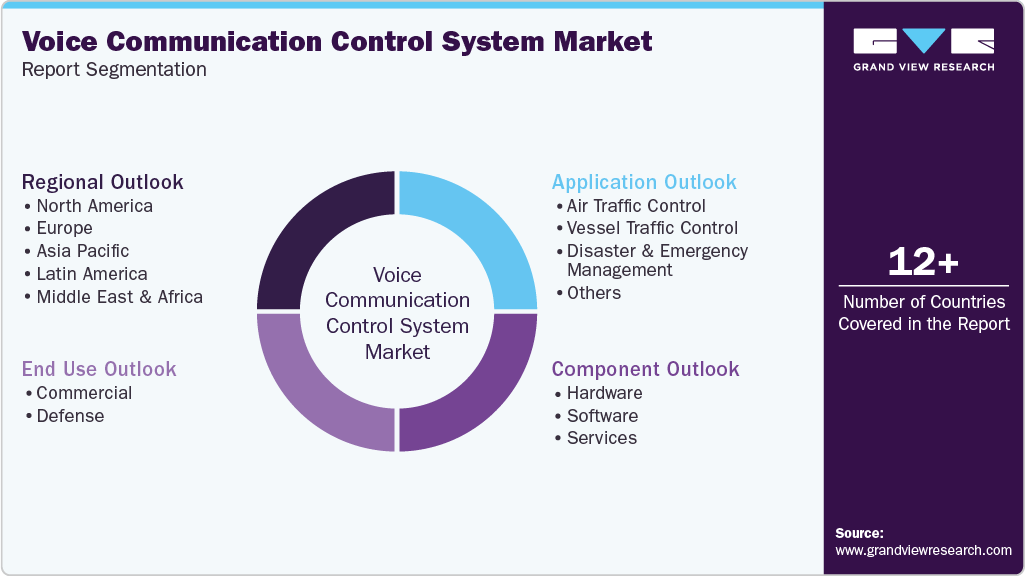
This report forecasts revenue growth at global, regional, and country levels and provides an analysis of the latest industry trends in each of the sub-segments from 2021 to 2033. For this study, Grand View Research has segmented the global voice communication control system market report based on component, application, end use, and region:
-
Component Outlook (Revenue, USD Million, 2021 - 2033)
-
Hardware
-
Software
-
Services
-
-
Application Outlook (Revenue, USD Million, 2021 - 2033)
-
Air Traffic Control
-
Vessel Traffic Control
-
Disaster & Emergency Management
-
Others
-
-
End Use Outlook (Revenue, USD Million, 2021 - 2033)
-
Commercial
-
Defense
-
-
Regional Outlook (Revenue, USD Million, 2021 - 2033)
-
North America
-
U.S.
-
Canada
-
Mexico
-
-
Europe
-
UK
-
Germany
-
France
-
Italy
-
-
Asia Pacific
-
India
-
Japan
-
Australia
-
South Korea
-
-
Latin America
-
Brazil
-
-
Middle East & Africa
-
Kingdom of Saudi Arabia (KSA)
-
UAE
-
South Africa
-
-
Frequently Asked Questions About This Report
Asia Pacific is the fastest-growing region over the forecast period.
The hardware segment led with a 38.1% revenue share in 2025, while software is the fastest-growing segment.
The air traffic control segment held the highest market share in 2025, while vessel traffic control is the fastest-growing segment.
The global voice communication control system market size was estimated at USD 4.5 billion in 2025 and is expected to reach USD 4.8 billion in 2026.
The global voice communication control system market is expected to grow at a compound annual growth rate of 7.3% from 2026 to 2033 to reach USD 7.9 billion by 2033.
North America dominated the voice communication control system industry and accounted for a share of 28.1% in 2025. The dominance can be attributed to the presence of numerous airports in the U.S. and Canada, which increases the demand for VCCS in air traffic control.
Some key players operating in the voice communication control system market include S.I.T.T.I. S.p.A., Rohde & Schwarz, Copperchase Ltd., Thales S.A., Indra Sistemas, S.A., Saab AB, Morcom International Inc., Frequentis AG, L3Harris Technologies, Inc., and Applied Electro Magnetics.
Key factors that are driving the market growth include growing number of greenfield airport projects in emerging countries and increasing demand for interoperable voice communication
The commercial segment held the highest market share in 2025, while defense is the fastest-growing segment.
About the Author(s)
Next Generation Technologies Research Team
Technology · Next Generation TechnologiesThis report was authored by the next generation technologies research team at Grand View Research - comprising two research analysts, one senior research analyst, and one industry expert - with specialized expertise in the next generation technologies segment of the technology industry. All findings are based on proprietary technology databases, executive interviews, and regulatory analysis, subject to internal peer review prior to publication.
Last Updated:
Speak to Analyst

Need a Tailored Report?
Customize this report to your needs — add regions, segments, or data points, with 20% free customization.
Or view our licence options:


ISO 9001:2015 & 27001:2022 Certified
We are GDPR and CCPA compliant! Your transaction & personal information is safe and secure. For more details, please read our privacy policy.












