
- Home
- »
- Advanced Interior Materials
- »
-
Wear Plates Market Size & Share Report, 2026-2033GVR Report cover

Wear Plates Market (2026 - 2033)
Size, Share & Trends Analysis Report By Material (Steel, Ceramics), By End Use (Mining & Quarrying, Steel & Cement, Construction & Earthmoving Equipment, Oil & Gas), By Region, And Segment Forecasts
Market Size, 2025
$3.9BMarket Estimate, 2026
$4.2BMarket Forecast, 2033
$7.0BCAGR, 2026–2033
7.6%Wear Plates Market Size & Trends
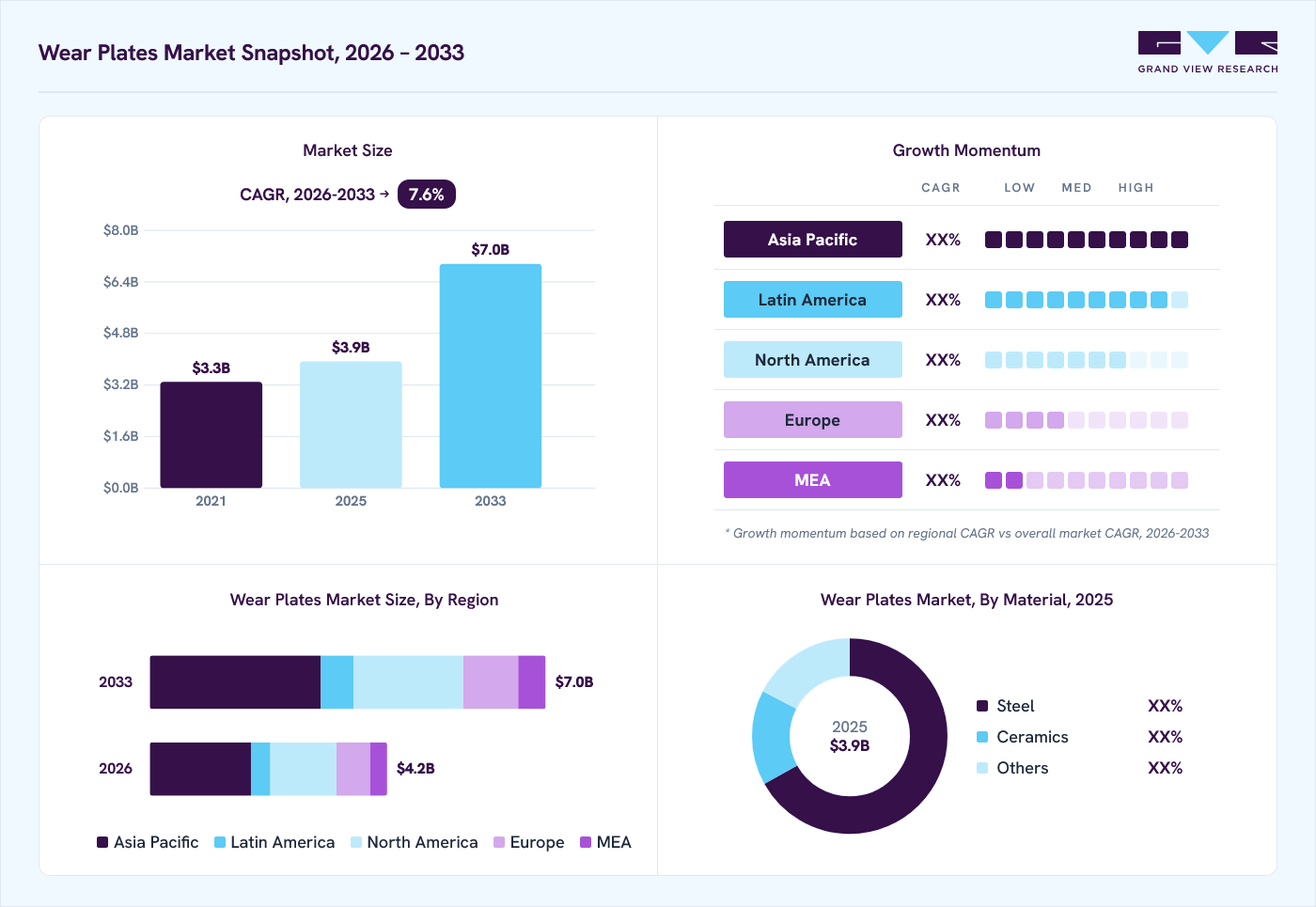
The global wear plates market size was valued at USD 3.9 billion in 2025 and is projected to grow from USD 4.2 billion in 2026 to USD 7.0 billion by 2033, at a CAGR of 7.6% from 2026 to 2033. Asia Pacific dominated the market, accounting for a revenue share of 42.6% in 2025. The increasing demand for wear-resistant materials, critical in industries like mining, construction, and manufacturing, proliferates the market.
 Source: Grand View Research, IR Documents, Primary Interviews, Paid DatabasesTo learn more about this report,
 Download Free Sample Report
Key Market Trends & Insights
- By material: Steel segment led the market with the largest revenue share of 66.8% in 2025.
- By end use: Mining & quarrying segment led the market with the largest revenue share of 40.0% in 2025.
Regional Highlights
- Largest regional market: Asia Pacific (42.6% revenue share, 2025)
- By country: China held the largest market share in 2025.
Market Size & Forecast
- Market size in 2025: USD 3.9 Billion
- Estimated market size in 2026: USD 4.2 Billion
- Projected market size by 2033: USD 7.0 Billion
- CAGR (2026-2033): 7.6%
Prism AI by Grand View Research Free to tryAsk a question about the wear plates marketTry asking✓Every figure cited from GVR research Prefer the report? Download free sample →
These industries rely heavily on machinery and equipment exposed to extreme conditions, such as abrasion, corrosion, and impact. Wear plates, often made from high-strength alloys or composite materials, help extend the lifespan of critical components by reducing wear and tear. As these industries grow, so does the demand for wear plates to maintain operational efficiency and reduce downtime caused by equipment failure. Manufacturers are developing high-performance wear plates that offer enhanced durability and resistance to a wider range of harsh environments. Innovations such as the introduction of carbide-based wear plates or ceramics are becoming popular due to their ability to withstand extreme conditions like high temperatures, heavy impact, and corrosive environments. These advancements allow industries to optimize their operations and reduce maintenance costs, which, in turn, drives demand for these high-performance solutions.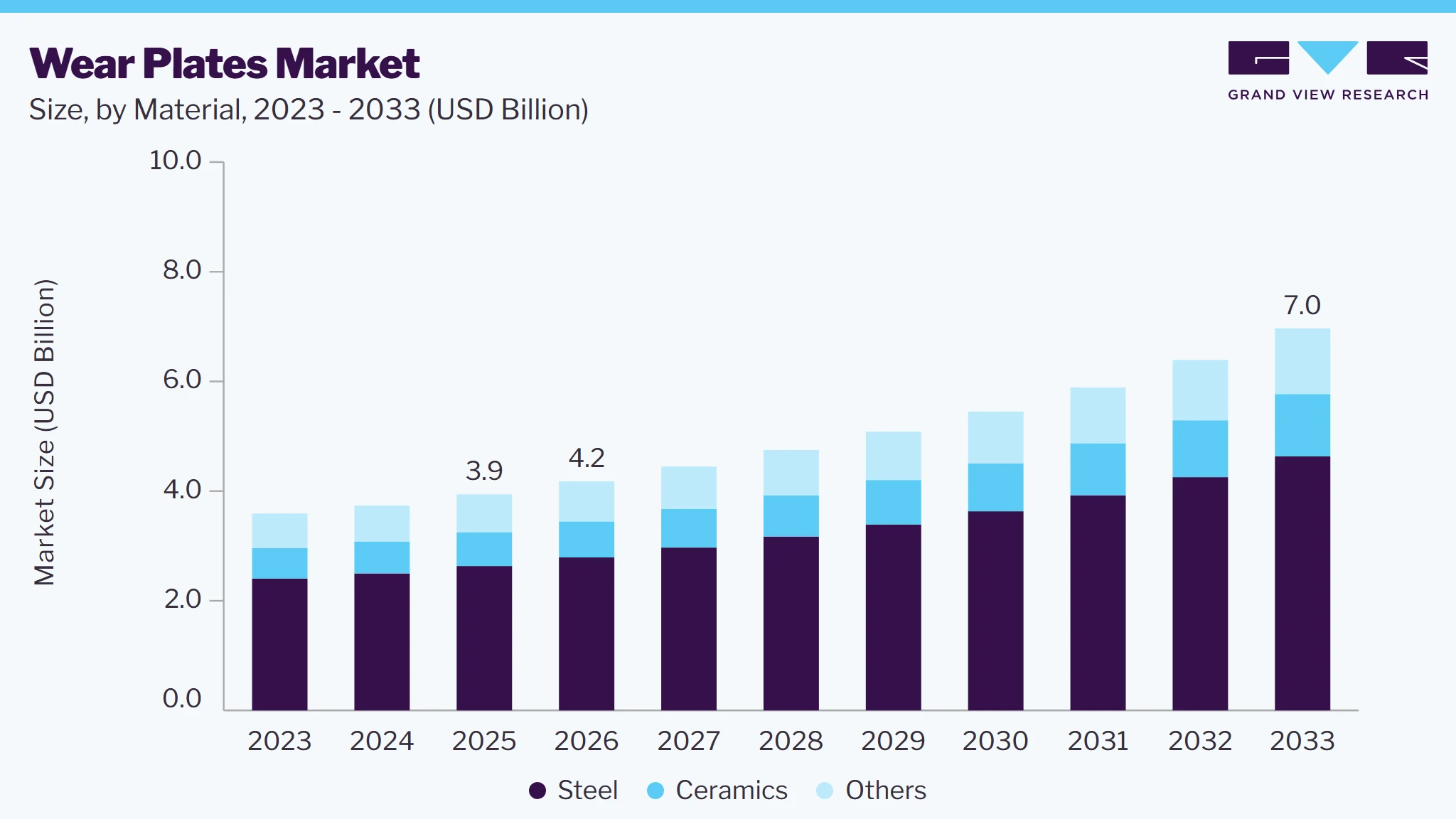 To learn more about this report, Download Free Sample Report
Expanding industrial infrastructure in emerging economies also significantly affects the wear plates market's growth. As countries in Asia-Pacific, Latin America, and Africa continue to industrialize, the demand for machinery and equipment in construction, mining, and other heavy industries has surged. The need to protect expensive machinery from wear and tear, combined with the increasing adoption of automated processes in these sectors, has raised the importance of wear-resistant materials. This trend is expected to continue, fostering higher demand for wear plates in emerging markets.
Additionally, the growing sustainability and energy efficiency trend is driving the wear plates market. Companies across various industries increasingly focus on reducing waste, improving energy efficiency, and minimizing downtime. Wear plates contribute to these objectives by extending the service life of the equipment and reducing the need for frequent replacements or repairs, which leads to fewer resources being consumed over time. The role of wear plates in promoting sustainability aligns with global efforts to reduce carbon footprints, making them an attractive option for industries aiming to improve both productivity and environmental impact.
Market Dynamics
The growth of the wear plates market is primarily driven by the increasing demand from mining, construction, and material handling industries, where equipment is continuously exposed to abrasion, impact, and erosion. Wear plates significantly enhance the operational life of heavy machinery such as excavator buckets, crushers, hoppers, dump trucks, conveyors, and chutes by minimizing maintenance requirements and reducing equipment downtime. As mining companies expand production to meet rising demand for critical minerals, metals, and aggregates, investments in durable, wear-resistant components have increased considerably. Similarly, infrastructure development and large-scale construction projects across emerging economies are boosting the utilization of heavy equipment, creating sustained demand for high-performance wear plates that improve productivity and lower lifecycle costs.
The growing demand for wear resistant equipment across mining, construction, cement, and material handling industries is a major driver for the wear plates market. Wear plates help extend the service life of machinery exposed to severe abrasion, impact, and erosion, reducing equipment downtime and maintenance costs. As industrial operations expand globally, the need for durable wear protection solutions continues to increase.
Infrastructure development and increased mining activities are further supporting the adoption of wear plates in crushers, chutes, excavators, loaders, dump trucks, and conveyor systems. High performance wear plates improve operational efficiency by minimizing component replacement frequency and enhancing equipment reliability, making them a preferred solution for heavy duty industrial applications.
The wear plates market faces challenges due to the relatively high cost of advanced wear resistant steels and alloy based plates. Manufacturing, machining, and installation of premium wear plates require specialized processes and skilled labor, increasing overall ownership costs. These factors can limit adoption among cost sensitive industries and smaller end users.
Opportunity - Increasing adoption of advanced high hardness wear plates for equipment life extension
The growing emphasis on improving equipment durability and reducing lifecycle costs is creating significant opportunities for advanced wear plate manufacturers. Continuous innovations in high hardness steel grades, chromium carbide overlay plates, and ceramic composite wear solutions are enabling superior abrasion resistance across demanding industries. Rising investments in automation and productivity improvement are expected to further accelerate demand for high performance wear protection products.
Analyst Perspective
The wear plates market is poised for robust growth, driven by rising demand for durable and abrasion resistant materials across mining, construction, quarrying, steel, cement, and other heavy industrial sectors. As operators increasingly prioritize equipment reliability, lower maintenance costs, and higher operational efficiency, the adoption of advanced wear plates is expanding in crushers, conveyors, excavator buckets, dump trucks, and material handling systems exposed to harsh operating conditions.
Material Insights
Based on material, steel segment led the market with the largest revenue share of 66.8% in 2025. Steel wear plates, particularly those made from high-strength and abrasion-resistant steel alloys, offer superior protection against impact, friction, and corrosion. This durability enhances the lifespan of machinery and reduces operational downtime, contributing to cost savings and improving overall efficiency. The rapid industrialization in emerging economies and expanding infrastructure projects worldwide further drive the demand for the market, particularly in sectors such as mining and construction, where equipment is subjected to harsh environments.
Ceramics is anticipated to register the fastest CAGR over the forecast period. Ceramics are highly valued for their exceptional hardness, wear resistance, and ability to withstand extreme temperatures and corrosive environments. These properties make them ideal for applications where traditional materials like metals fail to deliver long-lasting performance. As industries prioritize efficiency and durability, the adoption of ceramic wear plates is rising, particularly in heavy machinery and equipment subjected to abrasive and erosive conditions.
End Use Insights
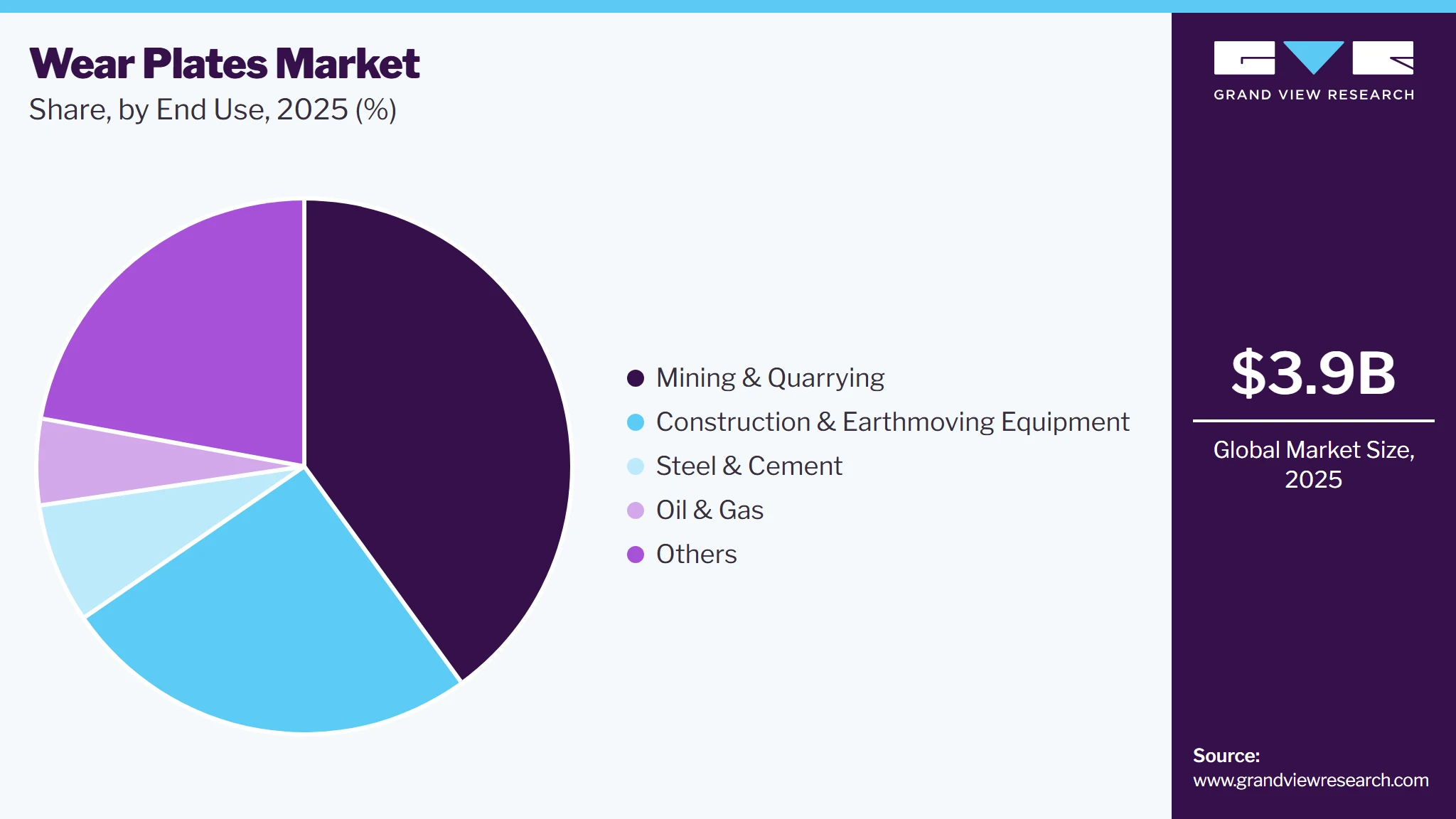
Based on end use, mining & quarrying segment led the market with the largest revenue share of 40.0% in 2025. As mining activities intensify to meet the rising needs of industries such as construction, automotive, and electronics, the wear and tear on equipment has escalated. Wear plates, essential for protecting heavy machinery from abrasion, impact, and corrosion, have seen heightened demand. For instance, in 2023, the surge in lithium mining for electric vehicle batteries and the expansion of copper mining for renewable energy infrastructure has driven the need for durable wear plates.
 To learn more about this report, Download Free Sample Report
Construction & earthmoving equipment is anticipated to register the fastest CAGR over the forecast period. With rapid urbanization and the need for improved transportation networks, including roads, bridges, and airports, the construction sector has been expanding significantly. As a result, there is a growing demand for heavy machinery such as excavators, loaders, and bulldozers, all of which require wear plates to enhance durability and extend operational life. Improving efficiency and minimizing machine failure in these sectors pushes the demand for high-quality, wear-resistant materials in the machinery's construction and repair processes.
Regional Insights
North America wear plates market has experienced significant growth, driven primarily by expanding industries such as mining, construction, and manufacturing. For instance, the U.S. Geological Survey 2023 reported a 12% year-on-year increase in mining activities, particularly in regions rich in critical minerals like lithium and cobalt, essential for the growing EV industry. This surge in mining operations has directly fueled the need for durable wear plates to enhance the longevity and efficiency of heavy machinery.
U.S. Wear Plates Market Trends
The wear plates market in the U.S. is growing. As industries in the U.S. continue to expand, especially in sectors like mining and construction, the need for durable and high-performance materials to withstand harsh working conditions rises. Additionally, with technological advancements, wear plates are being designed with enhanced materials such as high-strength steel and alloys, improving their efficiency and resistance to wear, thus fueling market growth.
Asia Pacific Wear Plates Market Trends
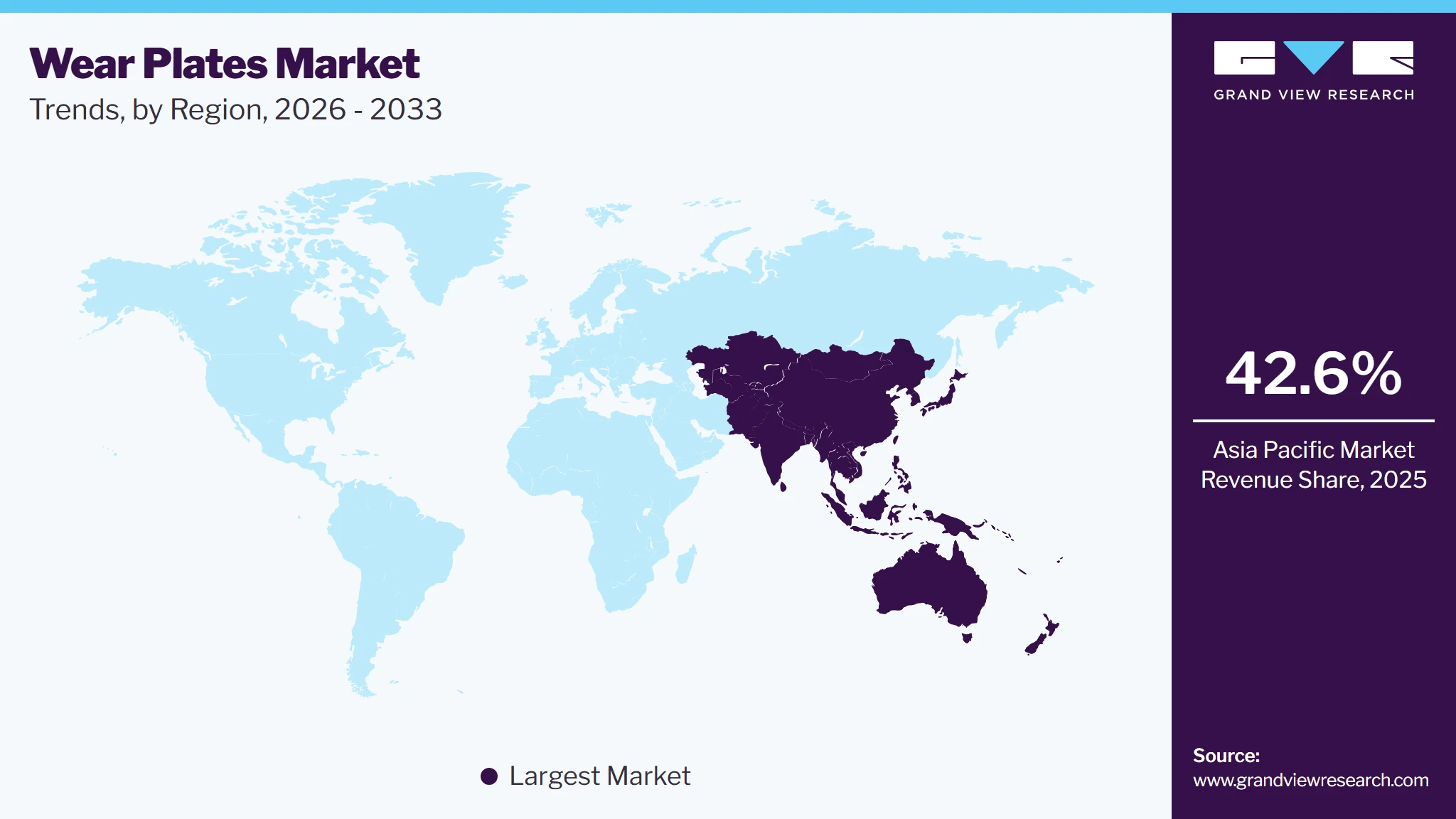
Asia Pacific dominated the wear plates market with the largest revenue share of 42.6% in 2025. The wear plates market in the China held the largest share in the Asia Pacific region in 2025. The wear plates market in Asia Pacific is growing as countries such as China, India, and Southeast Asian nations are investing heavily in the construction, mining, and manufacturing sectors, which are key end-users of wear plates. The increasing demand for durable and high-performance materials to withstand harsh operating conditions in these industries has fueled the adoption of wear plates. Additionally, the expansion of the automotive and aerospace industries in the region has further boosted the market, as wear plates are essential for machinery and equipment that require resistance to abrasion, impact, and corrosion.
 To learn more about this report, Download Free Sample Report
Europe Wear Plates Market Trends
The wear plates market in Europe held a significant market share in 2025. Europe's manufacturing sector is characterized by high-quality production standards, which demand materials capable of withstanding wear and tear in harsh operating conditions. The European Union's regulations promoting environmental sustainability and energy efficiency encourage industries to opt for solutions that minimize waste and lower operational costs. As European industries strive to modernize their machinery and optimize production processes, the demand for wear plates that offer durability, reliability, and cost-effectiveness is expected to continue growing, further bolstering the market.
Central & South America Wear Plates Market Trends
The wear plates market in Central & South America is anticipated to grow significantly over the forecast period. Countries such as Chile, Peru, and Brazil have seen increased mining activities, particularly in copper, lithium, and iron ore extraction. For instance, Chile, the world’s largest copper producer, reported a 5% year-on-year increase in copper production in 2023, reaching approximately 5.6 million metric tons. This surge in mining output has directly fueled the demand for wear plates, essential for protecting equipment from abrasion and corrosion in harsh mining environments.
Middle East & Africa Wear Plates Market Trends
The wear plates market in the Middle East & Africa is driven by rapid urbanization and infrastructure development in countries such as the UAE, Saudi Arabia, and South Africa that have increased demand for wear-resistant materials for construction equipment, mining machinery, and heavy industrial applications. Additionally, the region's focus on diversifying economies away from oil dependency has spurred investments in manufacturing, mining, and energy sectors, further boosting the need for durable wear plates.
Key Wear Plates Company Insights
Some of the key players operating in the market include SSAB, ThyssenKrupp, and others.
-
SSAB is a specialized steel manufacturer recognized for its innovative approach to producing high-quality steel grades tailored for various applications. SSAB’s flagship product line includes Hardox wear plates, renowned for their exceptional abrasion resistance and durability. These wear plates are designed to withstand extreme wear conditions while maintaining structural integrity, making them ideal for heavy-duty applications in mining, construction, and recycling sectors.
-
ThyssenKrupp is a global industrial group based in Germany. It is known for its diversified operations in various sectors, including steel production, automotive technology, and engineering services. ThyssenKrupp offers premium wear plates under the brand name perdur, which are designed to provide high wear resistance while maintaining excellent forming properties.
Key Wear Plates Companies:
The following key companies have been profiled for this study on the wear plates market.
-
ANSTEEL
-
ArcelorMittal
-
Baohua Resistant Steel
-
Baosteel Group
-
Bisalloy
-
Dillinger
-
Essar Steel Algoma
-
JFE
-
NLMK Clabecq
-
NSSMC
-
SSAB
-
ThyssenKrupp
-
TISCO
-
Wuyang Steel
-
Xinyu Iron & Steel
Competitive Benchmarking
Category
Operating Strategies
Competitive Edge
Weakness
Established Players (e.g. SSAB, JFE Steel Corporation)
- Mature participants in the wear plates market primarily focus on manufacturing high performance abrasion-resistant steel plates through advanced alloy design, controlled rolling, and heat treatment processes.
- Their strategies emphasize continuous product innovation to deliver wear plates with superior hardness, toughness, weldability, and service life.
- Established players possess significant competitive advantages through their advanced metallurgical expertise, proprietary steelmaking technologies, and large scale integrated production facilities.
- Their ability to manufacture wear plates with consistent hardness, impact resistance, and dimensional accuracy enables them to meet stringent requirements across heavy industrial applications.
- Despite their strong market positions, mature players face challenges related to fluctuations in steel and alloy raw material prices, increasing energy costs, and stringent environmental regulations affecting steel production.
- Manufacturing premium wear plates requires sophisticated rolling mills, heat treatment facilities, and quality control systems, resulting in high capital investment and operating expenses.
Emerging & Regional Players (e.g., Baohua Resistant Steel, Bisalloy)
- Emerging participants in the wear plates market generally focus on specialized abrasion-resistant steel products, regional manufacturing expansion, and customized wear solutions for specific industrial applications.
- Rather than competing directly with established producers on production volume, these companies emphasize operational flexibility, shorter lead times, and customer specific engineering support.
- Emerging companies benefit from operational agility and the ability to adopt modern steel processing technologies without extensive legacy manufacturing infrastructure.
- Their facilities often incorporate advanced automation, precision heat treatment systems, and digital quality control platforms that improve production efficiency and product consistency.
- Emerging participants face significant challenges related to limited production capacity, lower economies of scale, and restricted financial resources.
- Competing against established steel producers with integrated manufacturing operations, proprietary metallurgy, and global distribution networks can be difficult, particularly in large infrastructure and mining projects.
Recent Developments
-
In December 2024, SSAB expanded its Hardox wear plate portfolio by adding Hardox HiAce. This new wear steel is designed to withstand wear in acidic and corrosive environments, complementing the existing Hardox product range. Hardox HiAce is engineered to offer enhanced resistance when materials are exposed to corrosive substances, extending the lifespan of equipment and components in such harsh environments.
Wear Plates Market Report Scope
Report Attribute
Details
Market definition
The market size represents the apparent consumption of wear plates-in various applications.
Market size in 2025
USD 3.9 billion
Estimated market size in 2026
USD 4.2 billion
Projected market size by 2033
USD 7.0 billion
Growth rate
CAGR of 7.6% from 2026 to 2033
Base year for estimation
2025
Historical data
2021 - 2024
Forecast period
2026 - 2033
Quantitative units
Revenue in USD million and CAGR from 2026 to 2033
Report coverage
Revenue forecast, company ranking, competitive landscape, growth factors, and trends
Segments covered
Material, end use, and region
Regional scope
North America; Europe; Asia Pacific; Latin America; Middle East & Africa
Country scope
U.S., Canada, Mexico, Germany, France, UK, Italy, Spain, China, India, Japan, South Korea, Brazil, Saudi Arabia, UAE
Key companies profiled
SSAB; JFE; ThyssenKrupp; Dillinger; ArcelorMittal; Essar Steel Algoma; NSSMC; Wuyang Steel; Xinyu Iron & Steel; NLMK Clabecq; Baosteel Group; Baohua Resistant Steel; Bisalloy; ANSTEEL; TISCO; among others
Customization scope
Free report customization (equivalent up to 8 analysts' working days) with purchase. Addition or alteration to country, regional & segment scope.
Pricing and purchase options
Avail customized purchase options to meet your exact research needs. Explore purchase options
Global Wear Plates Market Report Segmentation
This report forecasts revenue growth at global, regional, and country levels and provides an analysis of the latest industry trends in each of the sub-segments from 2021 to 2033. For this study, Grand View Research has segmented the global wear plates market report on the basis of material, end use, and region.
 To learn more about this report, Download Free Sample Report
-
Material Outlook (Revenue, USD Million, 2021 - 2033)
-
Steel
-
Ceramics
-
Others
-
-
End Use Outlook (Revenue, USD Million, 2021 - 2033)
-
Mining & Quarrying
-
Steel & Cement
-
Construction & Earthmoving Equipment
-
Oil & Gas
-
Others
-
-
Regional Outlook (Revenue, USD Million, 2021 - 2033)
-
North America
-
U.S.
-
Canada
-
Mexico
-
-
Europe
-
Germany
-
UK
-
Spain
-
France
-
Italy
-
-
Asia Pacific
-
China
-
India
-
Japan
-
South Korea
-
-
Central & South America
-
Brazil
-
-
Middle East & Africa
-
Saudi Arabia
-
UAE
-
-
Research Methodology
The wear plates market figures in this report are based on a proven research process that combines executive interviews with secondary research from proprietary databases, company filings, and recognized regulatory and institutional sources. Market size is built through value-chain sizing - reconciling supply-side and demand-side estimates - and triangulated with bottom-up and top-down approaches. Every estimate passes multiple levels of expert validation before publication, with each wear plates segment quantified using the revenue-capture definitions in the table below.
Segment Definition
Material
Revenue Capture Definition
Steel
The steel segment captures revenue generated from wear plates manufactured using abrasion resistant, quenched and tempered, alloy, and hardened steel grades.
Ceramics
The ceramics segment represents revenue generated from wear plates manufactured using advanced ceramic materials such as alumina, silicon carbide, and zirconia.
Others
The others segment includes revenue generated from wear plates manufactured using composite materials, rubber, polyurethane, chromium carbide overlays, and other specialty materials designed for specific operating conditions.
End Use
Revenue Capture Definition
Mining & Quarrying
The mining and quarrying segment captures revenue generated from wear plates used in crushers, chutes, hoppers, excavators, loaders, conveyors, and other equipment exposed to severe abrasion and impact.
Steel & Cement
The steel and cement segment represents revenue generated from wear plates used in mills, kilns, crushers, conveyors, clinker handling systems, and material processing equipment.
Construction & Earthmoving Equipment
The construction and earthmoving equipment segment includes revenue generated from wear plates used in excavators, bulldozers, loaders, dump trucks, graders, buckets, and other heavy machinery.
Oil & Gas
The oil and gas segment captures revenue generated from wear plates used in drilling equipment, pipelines, processing facilities, slurry handling systems, and offshore infrastructure.
Others
The others segment represents revenue generated from wear plates used in industries such as power generation, agriculture, recycling, marine, pulp and paper, and industrial manufacturing.
Estimation Model
Layer Name
Key Question
Description
Heavy Equipment & Industrial Demand Base Layer
What forms the demand base?
Identify global demand from major wear plate consuming industries including mining, quarrying, construction, cement, steel, power generation, oil & gas, and material handling. Assess production volumes of heavy equipment and industrial machinery operating under high abrasion and impact conditions to establish the total addressable demand for wear plates.
Wear Plate Application Penetration Layer
Where are wear plates utilized?
Estimate the penetration of wear plates across key applications including excavator buckets, dump truck bodies, crushers, chutes, hoppers, conveyors, loaders, mixers, cement plants, steel processing equipment, and material handling systems. Analyze the adoption of abrasion resistant, chromium carbide overlay, quenched & tempered, and other wear resistant plate products across end use industries and regions.
Wear Plate Consumption Intensity Layer
How much wear plate is consumed?
Analyze wear plate consumption intensity based on equipment fleet size, operating hours, abrasion severity, replacement frequency, and maintenance cycles. Evaluate wear plate usage across mining, construction, steel, cement, and industrial operations according to equipment specifications and operating environments. Consumption intensity varies according to material hardness, production throughput, maintenance practices, and equipment utilization rates.
Revenue Layer
How is market revenue generated?
Market revenue is quantified through the sale of abrasion resistant steel plates, chromium carbide overlay plates, and other specialty wear resistant plate products. Revenue generation is driven by demand from mining, quarrying, construction, steel, cement, oil & gas, and industrial manufacturing sectors for both OEM installations and replacement applications. Market value is influenced by steel prices, alloy composition, wear resistance performance, replacement demand, production volumes, and regional industrial activity.
Delivered Customizations
This report has been delivered with the following In-depth customizations
Client Request
Customization Delivered
Value Adds
Regional Segmentation
Detailed regional analysis of the wear plates market across North America, Europe, Asia Pacific, Latin America, and Middle East & Africa. Included evaluation of steel production, mining activities, construction equipment manufacturing, cement production, oil and gas operations, heavy industrial investments, and infrastructure development driving demand for wear resistant steel plates.
Identified key manufacturing hubs, high growth consumption markets, and emerging industrial regions. Enabled strategic expansion planning based on mining, construction, and heavy equipment demand. Supported regional demand forecasting and supply chain optimization.
Cross Segmentation
Comprehensive cross segmentation analysis by material, end use industry, and region, including steel, ceramics, and other wear resistant materials across mining and quarrying, steel and cement, construction and earthmoving equipment, oil and gas, and other industrial applications. Evaluated regional consumption trends, material performance requirements, replacement cycles, and end use demand dynamics.
Enabled identification of the most attractive material application combinations and high growth market segments. Supported product portfolio optimization, customer targeting, and investment prioritization strategies.
Opportunity Assessment
Identification of high growth opportunities across mining equipment, quarry machinery, bulk material handling systems, cement plants, steel mills, construction machinery, recycling equipment, and energy infrastructure.
Enabled prioritization of high return growth segments and emerging regional opportunities. Supported long term investment planning, manufacturing capacity expansion, product innovation, and strategic business development initiatives aligned with industrial modernization and infrastructure development.
Frequently Asked Questions About This Report
The global wear plates market is expected to grow at a compound annual growth rate of 7.6% from 2026 to 2033 to reach USD 7.0 billion by 2033.
Asia Pacific dominated the market with revenue share of 42.6% in 2025.
China dominated the Asia Pacific market with revenue share of 64.7% in 2025.
Mining & quarrying accounted for largest revenue share of 40.0% in 2025.
Construction & earthmoving equipment is anticipated to register the fastest CAGR over the forecast period.
The key players operating in the wear plates market are SSAB; JFE; ThyssenKrupp; Dillinger; ArcelorMittal; Essar Steel Algoma; NSSMC; Wuyang Steel; Xinyu Iron & Steel; NLMK Clabecq; Baosteel Group; Baohua Resistant Steel; Bisalloy; ANSTEEL; TISCO; among others
The global wear plates market size was estimated at USD 3.9 billion in 2025 and is expected to reach USD 4.2 billion in 2026.
Based on material, steel accounted for largest revenue share of 66.8% in 2025.
The key factor that is driving the growth of the global wear plates market is the growing demand for durable materials in industries such as mining, construction, and manufacturing. This is fueled by the need to reduce maintenance costs and improve the longevity of equipment.
About the Author(s)
Advanced Interior Materials Research Team
Advanced Materials · Advanced Interior MaterialsThis report was authored by the advanced interior materials research team at Grand View Research - comprising two research analysts, one senior research analyst, and one industry expert - with specialized expertise in the advanced interior materials segment of the advanced materials industry. All findings are based on proprietary advanced materials databases, executive interviews, and regulatory analysis, subject to internal peer review prior to publication.
Last Updated:
Speak to Analyst

Customize this report to your needs - add regions, segments, or data points, with 20% free customization.
Or view our licence options:


ISO 9001:2015 & 27001:2022 Certified
We are GDPR and CCPA compliant! Your transaction & personal information is safe and secure. For more details, please read our privacy policy.


