
- Home
- »
- Beauty & Personal Care
- »
-
Wearable LED Light Therapy Devices Market Report, 2033GVR Report cover

Wearable LED Light Therapy Devices Market (2026 - 2033)
Size, Share & Trends Analysis Report By Type (LED Face Masks, LED Neck & Chest Masks), By Light Technology (Blue Light, Amber/Yellow Light), By Price Tier, By End User, By Distribution Channel, By Region, and Segment Forecasts
Market Size, 2025
$2.1BMarket Estimate, 2026
$2.6BMarket Forecast, 2033
$5.9BCAGR, 2026–2033
12.3%Wearable LED Light Therapy Devices Market Summary
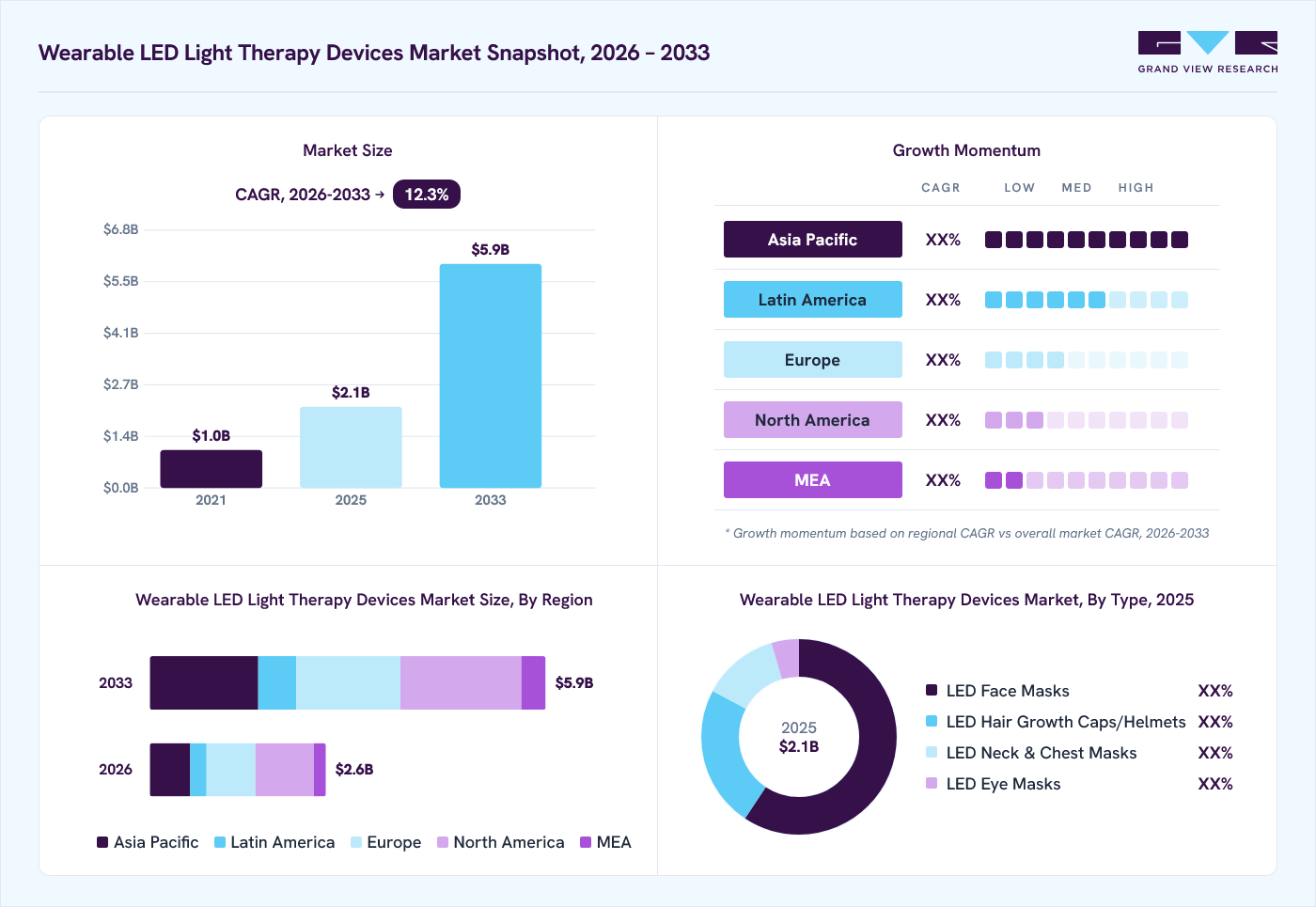
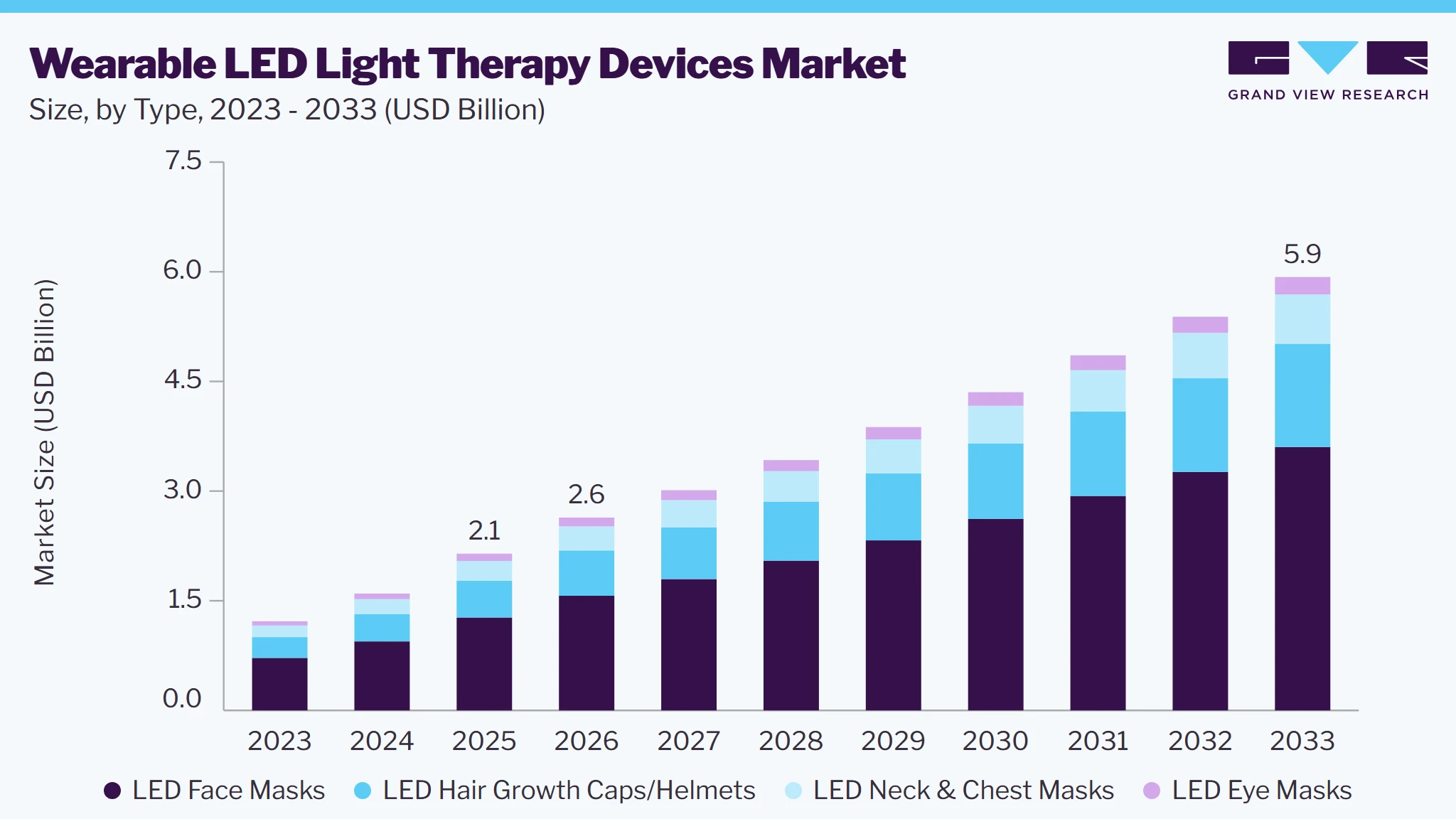
The global wearable LED light therapy devices market size was valued at USD 2.1 billion in 2025 and is expected to grow from USD 2.6 billion in 2026 to USD 5.9 billion in 2033, at a CAGR of 12.3% from 2026 to 2033. North America dominated the global market, accounting for a revenue share of 33.5% in 2025. The global market growth is driven by increasing consumer adoption of at-home skincare solutions, rising demand for non-invasive light-based treatments, growing awareness of LED light therapy for skin rejuvenation and acne management, and continued product innovation in wearable, cordless, and multifunctional LED devices.
 Source: Grand View Research, IR Documents, Primary Interviews, Paid DatabasesTo learn more about this report,
 Download Free Sample Report
 Key Market Trends & Insights
- By type: LED face masks held the largest revenue share of 59.3% in 2025.
- By light technology: Red light held the largest revenue share of 58.0% in 2025.
- By price tier: Premium (USD 301 to USD 600) held the largest revenue share of 34.4% in 2025.
- By end user: Women held the largest revenue share of 71.6% in 2025.
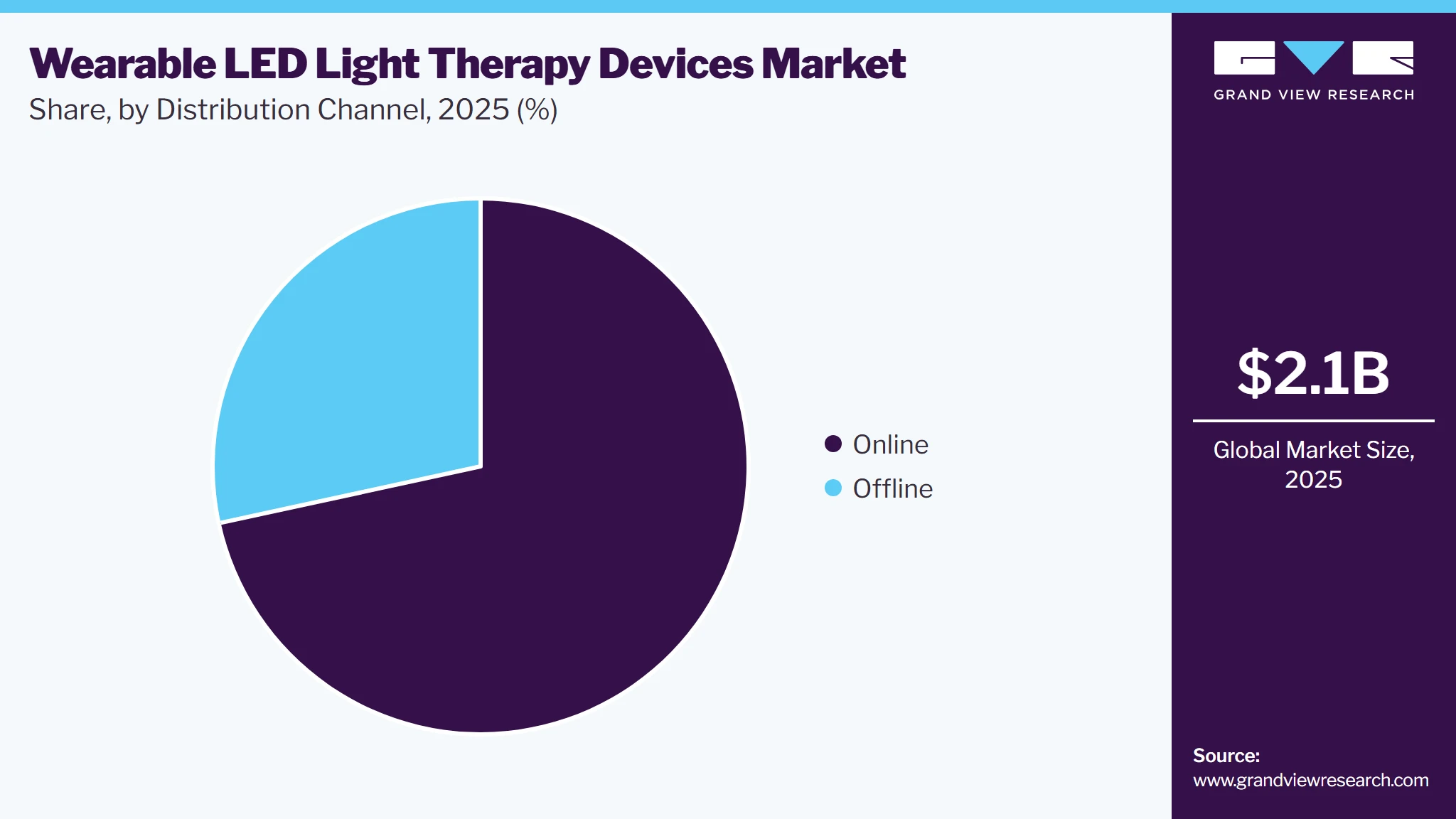
- By distribution channel: Online channels held the largest revenue share of 71.6% in 2025.
Regional Highlights
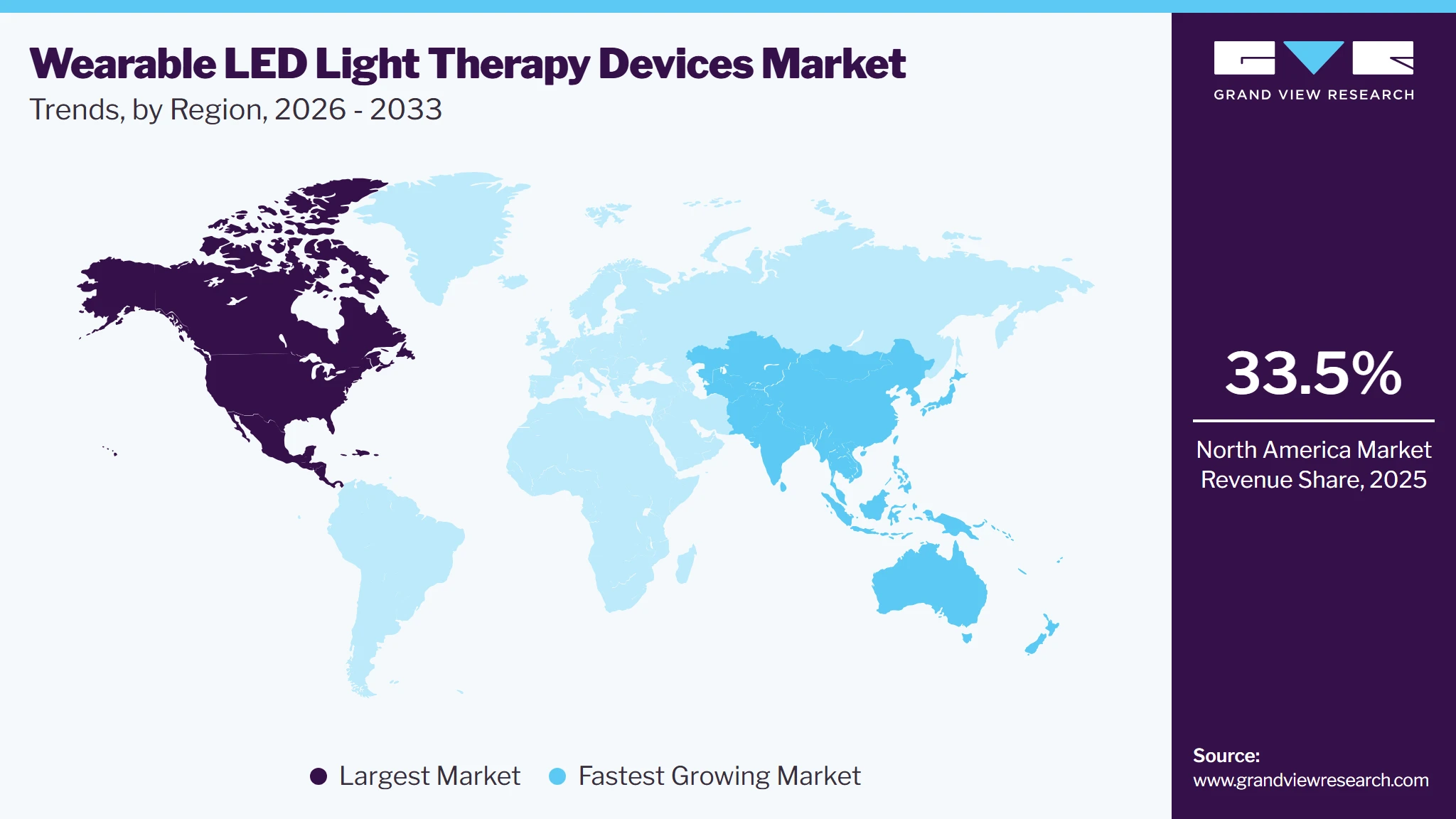
- Largest regional market: North America (33.5% revenue share, 2025)
- Fastest-growing regional market: Asia Pacific (fastest CAGR, 2026-2033)
Market Size & Forecast
- Market Size in 2025: USD 2.1 Million
- Estimated Market Size in 2026: USD 2.6 Million
- Projected Market Size by 2033: USD 5.9 Million
- CAGR (2026-2033): 12.3%
Three ways to get this report
Buy it, customize it, or ask a question.Ask an Analyst
Analyst response in 1 business day
- AccessReport author, directly
- Reply timeWithin 1 working day
- No sales callDirect answer only
- FormatEmail reply
- CostFree, no cost
Get the Full Report
What the study covers
- FormatsPDF · Excel · Dashboard
- Timeline2026–2033 annual, 2025 base
- Coverage20+ countries, 5 regions
- Companies10+ key players profiled
Customize the Report
20% free customization
- IncludeCountries, segments, points
- TailorTo your product definition
- ExtendDeeper competitor detail
- OrA fully bespoke study
- Turnaround5–10 working days
At-home skincare is strengthening demand for convenient, non-invasive treatment formats, positioning wearable LED light therapy devices as an increasingly visible component of personal beauty routines. Consumers are using LED light therapy devices as an alternative or complement to salon and clinic-based treatments, particularly for routines focused on wrinkles, skin texture, acne, and overall skin appearance. Recent beauty coverage also indicates that LED masks have moved from niche professional treatments into mainstream home beauty routines.
 To learn more about this report, Download Free Sample Report
 Clinical research is strengthening the role of LED therapy as an at-home acne-management approach in the U.S. A 2024 systematic review published in PubMed Central found that 92% of acne patients achieved partial remission with visible-light therapy; among blue-light users, 95% experienced partial clearance. Blue light was used in approximately 64% of cases, reinforcing blue LED as a key modality for acne-focused devices. Omnilux’s 2025 study also reported that individual participants recorded reductions of 86% in inflammatory acne lesions, 72% in pore bacteria, and 28% in redness severity, indicating measurable effects beyond general skincare claims.
Evidence is also becoming more specific to wearable home masks. A 2025 clinical study of a 415-nm blue/633-nm red LED facial mask enrolled 30 participants aged 14-45 and reported significant reductions in both inflammatory and non-inflammatory lesions after seven weeks, with 86% achieving at least a one-grade improvement in acne severity. A separate 2026 randomized trial of an at-home red/blue LED device found significant reductions in total lesions at both four and eight weeks, while inflammatory lesions declined significantly in both treatment groups.
Adoption is further supported by treatment adherence and consumer-reported outcomes from commercially available wearable masks. Omnilux's 2025 clinical study reported that 93% of users saw a decrease in inflammatory acne, 83% said they would likely recommend the device, and 79% said they would likely choose it over a topical acne treatment. The recommended regimen is four 10-minute sessions per week for six weeks, creating a recurring treatment pattern rather than a one-time purchase. This combination of measurable outcomes, short sessions, and repeated use at home is driving the adoption of acne-focused LED masks in U.S. skincare routines.
Market Dynamics
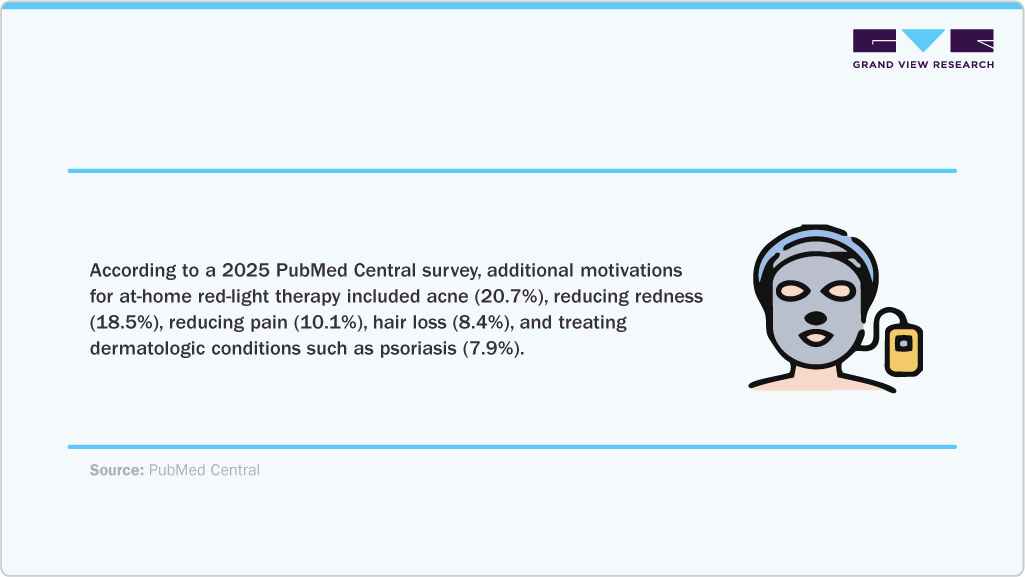
At-home skin rejuvenation is expanding demand for wearable LED devices as consumers seek non-invasive treatments that fit their routine skincare. A 2025 PubMed Central survey of 226 social media users found that 50.2% cited anti-aging as a motivation for red light therapy, while 37.9% sought improved skin texture, and 30.8% wanted to reduce dark spots. Face masks were the most considered device format at 34.4%, while 90.0% said they would consider purchasing an at-home red-light device. This indicates strong consumer interest in wearable formats for visible signs of skin aging.
 To learn more about this report, Download Free Sample Report
 This broader application base helps LED therapy move into adjacent wearable formats, including hair-growth caps and helmets, neck and chest devices, and full- and partial-face masks.
High upfront pricing remains a barrier to the adoption of wearable LED light therapy devices in the U.S., particularly since the category is positioned as a premium beauty-tech purchase rather than a routine skincare consumable. In 2025, Forbes Vetted reported that LED face-mask prices ranged from approximately USD 100 to more than USD 1,500, while the leading clinically positioned devices typically sit around USD 400. Omnilux Contour is priced at USD 395, while CurrentBody Series 2 is approximately USD 470.
This premium pricing is evident across multiple leading products. Shark CryoGlow is priced at USD 349.99, Dr. Dennis Gross' SpectraLite FaceWare Pro at around USD 455, and Therabody's TheraFace Mask at USD 649.99. Allure's 2025 assessment similarly placed leading masks at USD 349-650, demonstrating that clinically positioned wearable LED products generally require several hundred dollars in upfront expenditure. This creates a higher entry threshold compared with conventional topical acne and anti-aging products.
• Wearable LED devices can be positioned as post-treatment and maintenance products alongside dermatology, aesthetic, and skincare services rather than being sold only as standalone beauty devices.
• The American Academy of Dermatology notes that dermatologists may recommend at-home red-light devices to help maintain results after in-office treatments.
• This creates an opportunity for brands to build dermatologist, med-spa, aesthetic clinics, and skincare-retailer distribution partnerships, giving consumers a treatment-to-home-care pathway.
Consumer Insights
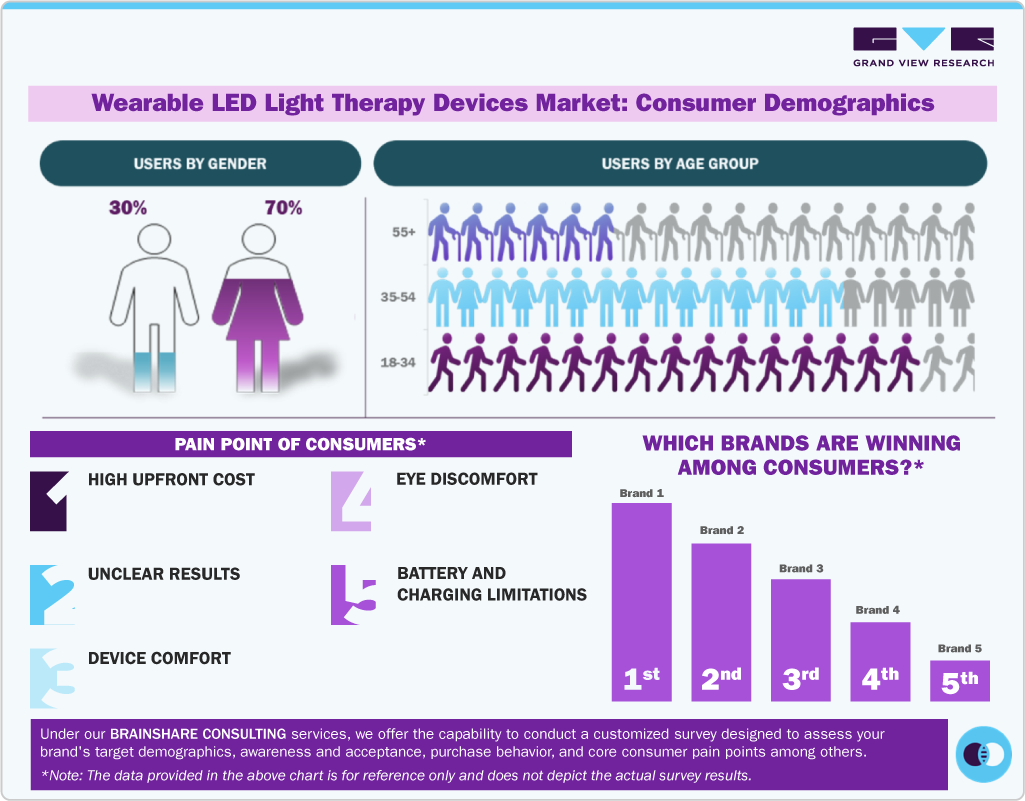
The wearable LED light therapy devices market serves consumers seeking convenient, non-invasive, and at-home skincare solutions across diverse age groups and genders, with demand influenced by skincare concerns, interest in beauty technology, treatment convenience, and willingness to invest in personal beauty devices. The market includes LED light therapy devices designed to deliver targeted wavelengths for skincare applications, while wearable devices offer hands-free, convenient treatment options that can be incorporated into regular beauty routines.
 To learn more about this report, Download Free Sample Report
 Users by Gender:
-
Female consumers account for the largest share of around 70%, reflecting their stronger participation in skincare and personal beauty routines. Women are also major users of LED light therapy devices designed for skin rejuvenation, anti-aging, acne management, and overall skin appearance.
-
Male consumers account for an estimated 30%, supported by growing interest in at-home skincare, appearance management, acne treatment, and technology-enabled personal care solutions. Increasing availability of gender-neutral wearable light therapy devices and multifunctional products is also expanding adoption among male consumers.
Users by Age Group:
Consumers aged 18-34 years form the largest user group, comprising younger consumers, beauty enthusiasts, professionals, and digitally engaged users who are increasingly interested in convenient at-home skincare technologies. This group is increasingly exposed to LED Light Therapy Devices through digital beauty content and product demonstrations. Consumers aged 35-54 years consist of working professionals and middle-aged consumers seeking solutions for visible signs of aging, skin rejuvenation, and consistent skincare routines. Consumers aged 55 years and above primarily seek anti-aging, skin-firming, and skin-rejuvenation applications, with greater emphasis on device comfort, ease of operation, and perceived treatment effectiveness.
Consumers in the wearable LED light therapy devices market commonly face several challenges when evaluating and using these devices.
-
High upfront costs remain a major concern, particularly for premium LED light therapy devices that incorporate multiple wavelengths, advanced controls, rechargeable batteries, and ergonomic designs.
-
Unclear or slow-to-observe results can make consumers hesitant to purchase wearable light therapy devices, as users may expect visible improvements within a short period, while regular and repeated use may be required.
-
Device comfort and fit represent another challenge because the weight, rigidity, straps, facial pressure, and overall design of wearable masks can affect user comfort during treatment sessions.
-
Eye discomfort can influence the user experience, particularly with LED light therapy devices that produce bright visible light, increasing the importance of appropriate eye-protection features and comfortable device design.
-
Battery and charging limitations can reduce the convenience of cordless wearable light therapy devices, as consumers need to recharge products regularly and may experience interruptions when the battery is depleted.
Analyst Perspective
The wearable LED light therapy devices market is evolving from niche light-based skincare technology toward a more mainstream at-home beauty and wellness category, with LED face masks remaining a widely adopted format while hair-growth caps, helmets, and multi-wavelength devices expand the application base. Growing consumer interest in non-invasive skincare, the convenience of home-based treatments, and beauty technology are supporting the adoption of LED light therapy devices. Manufacturers are increasingly focusing on flexible, lightweight designs, multiple-wavelength options, shorter treatment times, cordless operation, and multifunctional capabilities to improve user convenience and treatment versatility. The increasing integration of wearable light therapy devices into daily skincare and hair-care routines is also strengthening their position as convenient alternatives to in-clinic light-based treatments.
Type Insights
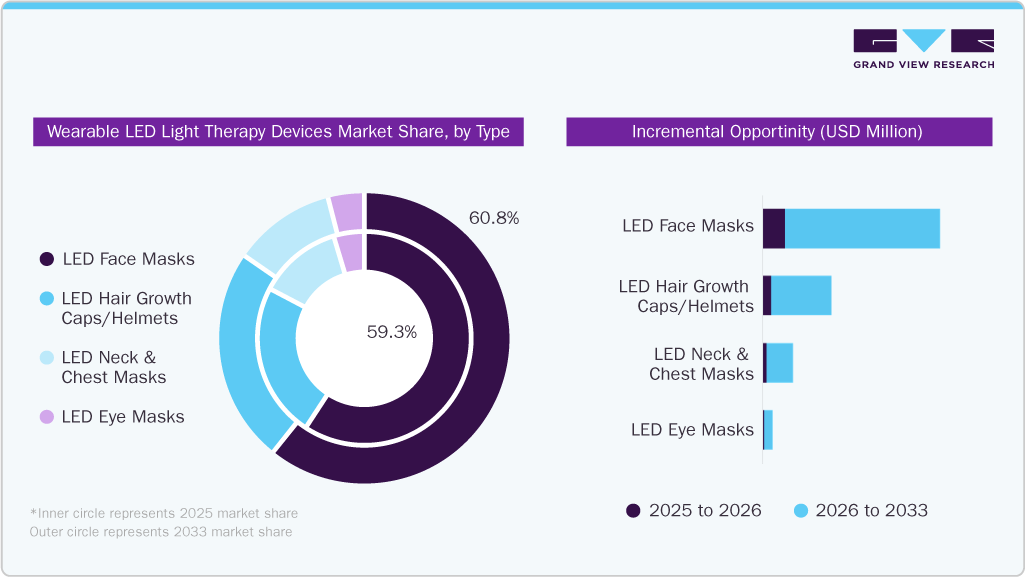
LED face masks dominated the wearable LED light therapy devices market, accounting for a revenue share of 59.3% in 2025, reflecting their established position as a consumer-facing format for at-home light-based skincare. These LED light therapy devices provide hands-free treatment and are increasingly designed around convenience, portability, and integration into daily skincare routines. For instance, Philips ReAura, launched in August 2026, features a flexible 3-in-1 design for the face, eye area, and neck, with red, blue, and near-infrared LED wavelengths, as well as short treatment sessions. The launch demonstrates how manufacturers are enhancing wearable light therapy devices with flexible designs and multifunctional treatment options to support convenient at-home use.
 To learn more about this report, Download Free Sample Report
 LED hair growth caps/helmets are projected to grow at a CAGR of 12.5% from 2026 to 2033. The demand is supported by growing consumer interest in non-invasive, at-home approaches to hair thinning and scalp care. These LED light therapy devices provide hands-free treatment across the scalp, while newer cap and helmet designs emphasize cordless operation, shorter sessions, lightweight construction, and broader scalp coverage. For instance, CurrentBody’s LED Hair Growth Helmet, which uses red-light wavelengths of 620-660 nm and provides a hands-free 10-minute daily treatment. The device is also Bluetooth-enabled and designed to deliver full scalp coverage, illustrating the shift toward more convenient wearable light therapy devices for hair-growth applications.
Light Technology Insights
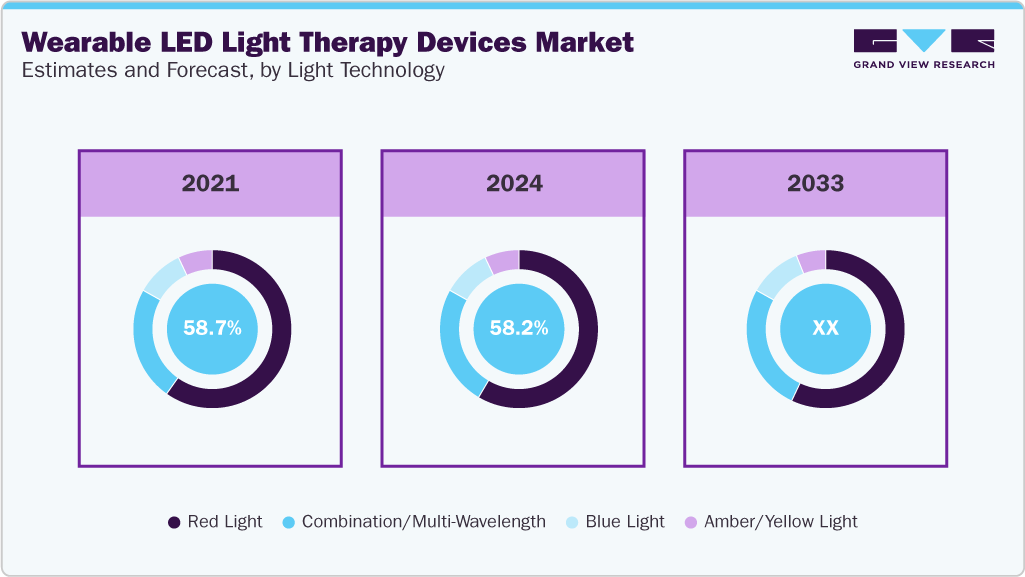
The red light segment dominated the wearable LED light therapy devices industry, accounting for 58.0% revenue share in 2025, supported by its expanding use across both facial skincare and hair-growth applications. For instance, HigherDOSE’s Red Light Therapy Hat was highlighted by Vogue in September 2026. The wearable uses 120 medical-grade LEDs operating at a 650 nm red-light wavelength and is designed in a cordless baseball-cap format for scalp and hair-growth applications. The product demonstrates how red-light technology is extending beyond facial LED light therapy devices into discreet, hands-free wearable light therapy devices that can be incorporated into daily hair-care routines.
 To learn more about this report, Download Free Sample Report
 The combination/multi-wavelength devices segment is projected to grow at a CAGR of 4.9% from 2026 to 2033. The segment is gaining traction as manufacturers integrate multiple wavelengths into a single wearable LED light therapy device, enabling consumers to select targeted treatment modes for different skincare concerns. In January 2026, Wavytalk launched its Glow Time LED Mask, a 3-in-1 LED Light Therapy Device featuring 114 LED beads and three treatment modes: 415 nm blue + 630 nm red light for acne-prone skin, 630 nm red + 850 nm near-infrared light for fine lines and skin rejuvenation, and 590 nm amber light for dullness and uneven skin tone. Wavytalk reported results from an Intertek-conducted 28-day clinical study, including up to an 81.5% reduction in acne breakouts, a 10.5% decrease in fine lines, and a 70.4% improvement in overall skin radiance. The launch demonstrates how manufacturers are combining multiple wavelengths and treatment settings in wearable light therapy devices to address multiple skincare concerns with a single at-home device.
Price Tier Insights
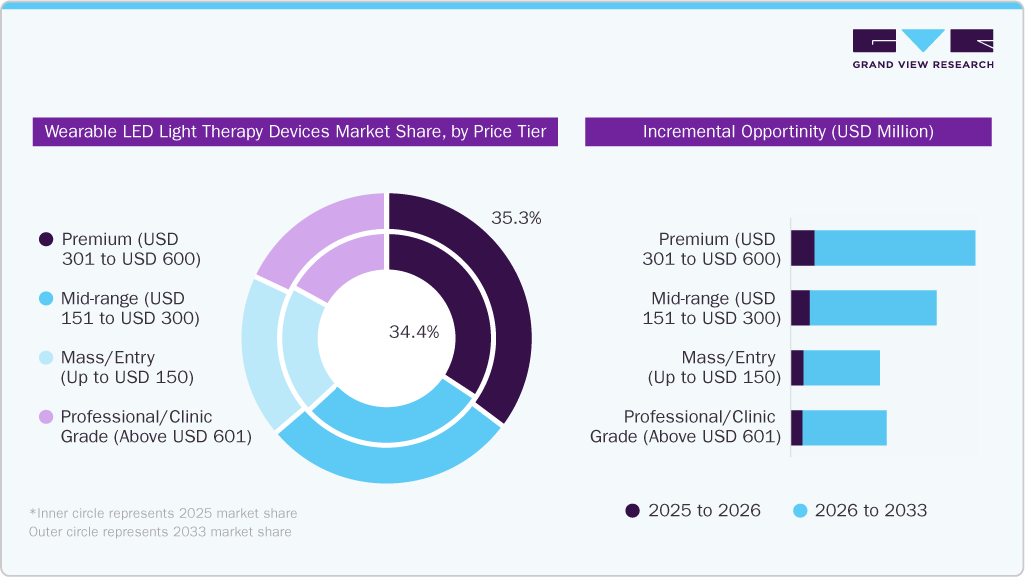
The premium (USD 301 to USD 600) segment dominated the wearable LED light therapy devices market, accounting for a revenue share of 34.4% in 2025, reflecting strong consumer acceptance of higher-priced wearable LED light therapy devices that offer greater LED density, multiple wavelengths, targeted treatment modes, and clinically positioned skincare benefits. Recent product activity indicates that brands are using technical specifications and treatment customization to justify premium pricing rather than relying solely on brand positioning. Ulike launched the ReGlow LED Light Therapy Mask in the U.S. in May 2025 at USD 429, featuring 272 LEDs and FDA clearance, with the device positioned around acne, redness, uneven skin tone, and anti-aging applications.
 To learn more about this report, Download Free Sample Report
 The professional/clinic grade (above USD 601) segment is projected to grow at a CAGR of 13.1% from 2026 to 2033. The pricing is increasingly linked to medical-grade construction, broader treatment coverage, multiple energy modalities, and physician-led product development. Recent launches indicate that manufacturers are extending wearable treatment beyond facial skincare to address the face, neck, scalp, and hairline within a single device. In November 2025, Rajani MD launched the PlasmaGLO HALO LED Face, Neck, & Hair Mask at an MSRP of USD 750. The device combines red and near-infrared LED therapy with blue light and pulsed electromagnetic field (PEMF) energy, while its medical-grade silicone construction provides coverage across the face, neck, scalp, and hairline. The four-mode configuration and 10-minute treatment routine position the product closer to a physician-developed treatment platform than a conventional consumer LED mask.
End User Insights
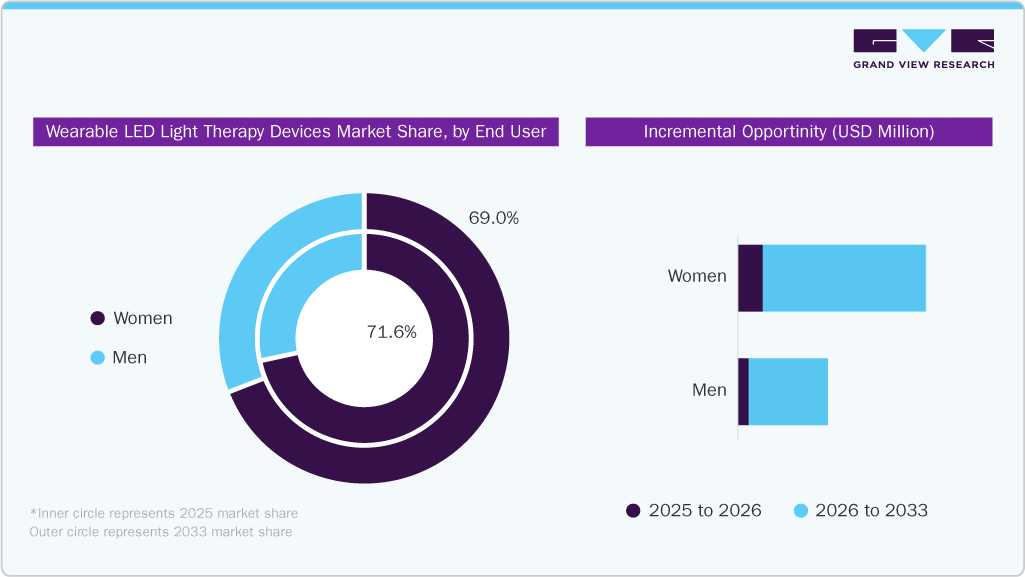
The women segment dominated the wearable LED light therapy devices industry, accounting for a revenue share of 71.6% in 2025, supported by continued demand for at-home solutions targeting acne, wrinkles, pigmentation, and other appearance-related skin concerns. Product development is increasingly broadening the use cases of wearable LED light therapy devices, with manufacturers combining skin and hair treatments within a single device. For instance, Celluma launched the MYSTIQUE LED mask in April 2026, an FDA-cleared wearable designed to simultaneously address facial acne, facial wrinkles, and scalp hair loss. This multifunctional positioning expands the role of wearable light therapy devices beyond facial skincare, offering female consumers a broader range of applications from a single at-home treatment device.
 To learn more about this report, Download Free Sample Report
 The men segment for wearable LED light therapy devices is projected to grow at a CAGR of 13.1% from 2026 to 2033, driven by increasing male interest in convenient, at-home solutions for acne, skin aging, uneven skin tone, and hair- and scalp-related concerns. Product development is increasingly addressing these requirements through male-specific designs and multifunctional treatment capabilities. For instance, Buff’s LED Light Therapy Face Mask is marketed specifically toward men and combines red, near-infrared, blue, and yellow light to target acne, redness, inflammation, fine lines, and visible signs of skin aging.
Distribution Channel Insights
The sale of wearable LED light therapy devices through online channels accounted for 71.6% of global revenue in 2025, driven by consumers' preference to research technical specifications, treatment capabilities, and product reviews before purchasing higher-priced light therapy devices. Online platforms allow brands to communicate detailed product attributes, including wavelength combinations, LED configurations, treatment durations, irradiance levels, intended applications, and regulatory clearances, thereby facilitating comparisons across competing devices. In 2026, Maysama introduced its AURA LED light therapy mask through its digital platform, emphasizing its science-led development, LED distribution, and biological approach to light therapy. The launch illustrates how specialist brands can use direct online channels to communicate technical product differentiation and treatment benefits directly to consumers.
 To learn more about this report, Download Free Sample Report
 The sale of wearable LED light therapy devices through offline channels is projected to grow at a CAGR of 10.5% from 2026 to 2033, driven by increasing availability of light therapy products across beauty retailers, wellness stores, and specialty outlets. Physical retail allows consumers to assess device design, fit, comfort, and treatment features before purchase, which is particularly relevant for premium-priced LED light therapy devices. For instance, in March 2026, Therabody expanded its partnership with Ulta Beauty by adding more than 650 stores, bringing its total presence to over 1,000 Ulta Beauty locations nationwide, up from more than 300 stores when the partnership began in the fall of 2025. The expanded rollout includes the TheraFace Mask Glo, an FDA-cleared LED mask featuring red, red plus infrared, and blue light therapies. The expansion demonstrates how established beauty retailers are increasing physical access to wearable light therapy devices, allowing consumers to discover and evaluate products within dedicated beauty and wellness environments.
Regional Insights
North America Wearable LED Light Therapy Devices Market Trends
The wearable LED light therapy devices market in North America led the global market, accounting for the largest revenue share of 33.5% in 2025, driven by established consumer awareness of at-home skincare technologies and the availability of advanced LED light therapy devices. The U.S. and Canada have developed demand for LED face masks, wearable hair-growth devices, and multi-wavelength wearable light therapy devices targeting skin rejuvenation, anti-aging, acne management, and hair-growth applications. Growing consumer preference for convenient, non-invasive treatments is encouraging the integration of wearable LED devices into regular at-home beauty routines, while manufacturers are introducing flexible designs, shorter treatment sessions, and multifunctional wavelength configurations to expand adoption.
 To learn more about this report, Download Free Sample Report
 U.S. Wearable LED Light Therapy Devices Market Trends
The U.S. wearable LED light therapy devices industry is projected to grow at a CAGR of 8.6% from 2026 to 2033, driven by growing consumer preference for convenient, non-invasive skincare solutions that can be incorporated into existing home routines. Wearable LED masks are particularly suited to this behavior as they provide hands-free treatment without requiring consumers to visit a clinic. Social media is also accelerating consumer awareness; a 2025 U.S.-linked survey found that 60.4% of respondents first learned about red-light therapy through social media, while 90% were willing or potentially willing to purchase an at-home device. The appeal of LED light therapy devices is therefore centered on convenience, routine use, targeted skincare applications, and accessible home-based treatment.
Europe Wearable LED Light Therapy Devices Market Trends
The Europe wearable LED light therapy devices industry accounted for 27.9% of revenue share in 2025, reflecting the region's established beauty and personal-care industry and the increasing penetration of technology-enabled skincare products. The UK is an important market in the region, with a 2025 survey reporting that 73% of users had adopted red-light therapy in the previous two years, while 36% identified red-light face masks as their preferred device format. The presence of established European and international brands offering LED light therapy devices is further expanding access to wearable masks and other wearable light therapy devices across skincare and hair-care applications.
The wearable LED light therapy devices market in Germany is projected to grow at a CAGR of 9.5% from 2026 to 2033. The German beauty media has identified LED masks as a major at-home beauty trend, with consumers increasingly incorporating light therapy into their regular skincare routines for concerns such as wrinkles, redness, and blemishes. ELLE Germany reported in February 2025 that LED masks were among the most popular at-home beauty treatments.
The France wearable LED light therapy devices market is projected to grow at a CAGR of 10.4% from 2026 to 2033. The market is experiencing growing consumer interest in at-home LED skincare, especially among those focused on preventing visible signs of aging. According to YouGov’s 2026 France Anti-aging Report, LED light therapy masks show higher future purchase intent than other advanced at-home or in-office treatments, though adoption is mainly among prevention-oriented consumers. The survey found that 49% of French consumers are classified as “preventers,” who prioritize aging prevention, spend the most, and are more open to new formats and therapies. YouGov also identified LED masks as a selective addition to traditional skincare routines, highlighting opportunities for LED and wearable light therapy devices as consumers increasingly seek technology-enabled, at-home skin rejuvenation solutions.
The wearable LED light therapy devices market in Spain is projected to grow at a CAGR of 9.3% from 2026 to 2033. Growing consumer awareness of the cosmetic and wellness applications of LED technology is supporting device adoption in Spain. According to the II Observatorio SKINVITY, 88% of women surveyed were aware of LED therapy's association with collagen stimulation and wrinkle reduction, while 64% associated LED technology with both beauty and overall health and wellness. In addition, 35% of respondents fully trusted cosmetic technology because it is non-invasive and tested. The high level of awareness and acceptance of LED-based technology is supporting consumer interest in wearable devices for at-home skincare and wellness applications.
Asia Pacific Wearable LED Light Therapy Devices Market Trends
The Asia Pacific wearable LED light therapy devices industry is projected to grow at the fastest CAGR of 15.1% from 2026 to 2033, and is expanding alongside the region’s rapid adoption of beauty technology and digitally influenced skincare practices. The integration of LED-based treatments with emerging beauty-device formats is broadening the use of LED light therapy devices beyond conventional facial skincare, including applications targeting hair growth, pigmentation, and skin tone. Product innovation is also shifting toward multifunctional wavelength configurations and compact, wearable designs, creating greater variety within wearable light therapy devices and strengthening their presence in the region’s technology-oriented beauty market.
The India wearable LED light therapy devices market is projected to grow at a CAGR of 10.7% from 2026 to 2033. Increasing product launches by international beauty-technology brands are expanding consumer access to wearable LED treatments in India. In June 2026, Therabody launched the TheraFace Mask Glo in India, a hands-free wearable device combining red, blue, and near-infrared light therapy to target concerns such as signs of aging, acne, inflammation, and uneven skin tone. The introduction of an advanced LED device through the Indian market is strengthening product availability and increasing consumer exposure to at-home light-based skincare treatments, supporting the adoption of wearable LED light therapy devices.
The wearable LED light therapy devices market in Japan is projected to grow at a CAGR of 11.1% from 2026 to 2033, driven by the increasing use of LED beauty devices in home-based beauty routines. A June 2026 survey by the Japanese beauty media platform Mimi Beauty found that 41.5% of respondents who currently owned facial beauty devices owned an LED device. In addition, 82.1% reported experiencing an effect from their beauty devices, while more than 60% used them at least twice a week. The high ownership and recurring usage indicate growing acceptance of LED-based devices as part of routine home beauty care in Japan.
Central & South America Wearable LED Light Therapy Devices Market Trends
The Central & South America wearable LED light therapy devices industry is projected to grow at a CAGR of 12.9% from 2026 to 2033, driven by the expansion of wearable LED skincare products through regional launches. In September 2025, SharkNinja launched the Shark CryoGlow LED mask in Colombia, combining red, blue, and infrared LED light with cooling technology for at-home facial treatments. The launch expanded access to wearable LED skincare technology in the Colombian market and strengthened the availability of professional-inspired light therapy devices for home use.
Middle East & Africa Wearable LED Light Therapy Devices Market Trends
The Middle East & Africa wearable LED light therapy devices industry is projected to grow at a CAGR of 10.6% from 2026 to 2033, driven by the expansion of locally available LED skincare devices and specialized beauty-technology offerings. In 2025, Dubai-based SkinMirae launched its Advanced LED light therapy face mask, developed specifically for the UAE market and tailored to local climate conditions, including high humidity, dust, and prolonged exposure to air conditioning. The locally developed wearable device strengthens product availability in the region and reflects the emergence of LED-focused beauty technology tailored to Middle Eastern consumers.
Key Wearable LED Light Therapy Devices Company Insights
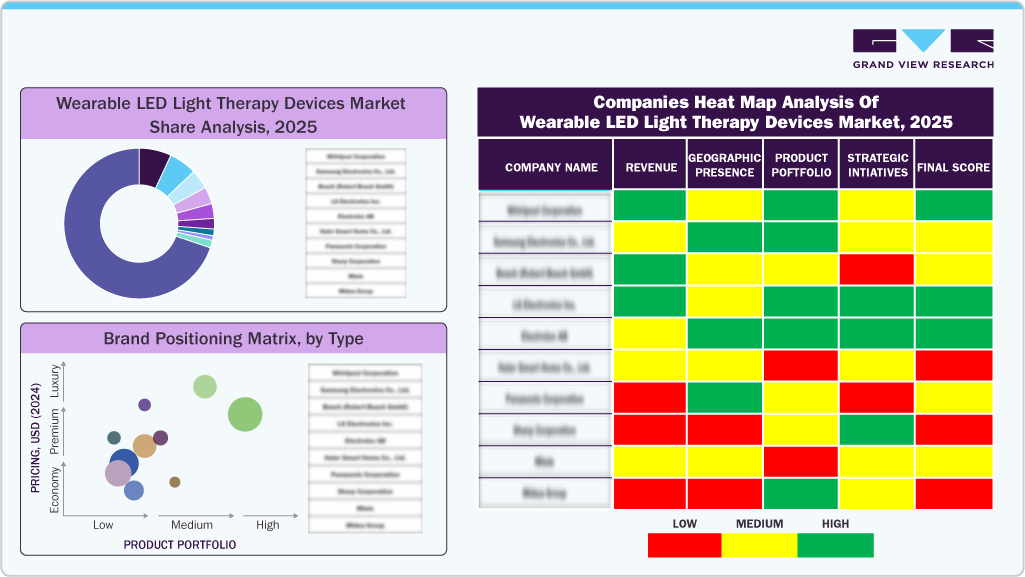
The wearable LED light therapy devices market is moderately fragmented, with competition distributed across established beauty-technology brands, specialized LED therapy manufacturers, diversified personal-care technology companies, and emerging consumer-focused players. The market includes manufacturers offering LED light therapy devices for facial skincare, hair growth, and other at-home light-based applications. Competition is shaped by brand recognition, product innovation, wavelength configurations, device design, treatment convenience, pricing, clinical validation, and retail and online distribution reach.
-
Established LED Therapy & Beauty-Technology Brands: CurrentBody, Omnilux, Therabody, FOREO, and Dr. Dennis Gross Skincare compete through established brand recognition, dedicated LED product portfolios, product innovation, and broad direct-to-consumer and retail distribution. Their portfolios include wearable light therapy devices such as LED face masks and other hands-free treatment formats targeting skincare concerns, including acne, wrinkles, skin rejuvenation, and firmness.
-
Specialized Light Therapy & Hair-Growth Manufacturers: HigherDOSE, LightStim, and iRESTORE focus on targeted light-therapy applications, including facial skincare and hair-growth treatments. These companies differentiate through specialized device formats, wavelength configurations, treatment protocols, and application-specific designs, including wearable caps and helmets for scalp treatment.
-
Consumer-Focused & Emerging Players: Solawave and Shark Beauty compete through consumer-oriented product designs, multifunctional features, and strong online and retail visibility. Their LED light therapy devices emphasize ease of use, portability, and integration into regular at-home skincare routines, while newer product launches increasingly combine multiple wavelengths and treatment modes within a single wearable LED light therapy device.
 To learn more about this report, Download Free Sample Report
Key Wearable LED Light Therapy Devices Companies
The following key companies have been profiled for this study on the wearable LED light therapy devices market.
-
CurrentBody
-
Omnilux
-
Therabody
-
SharkNinja
-
Dr. Dennis Gross Skincare
-
Solawave
-
HigherDOSE
-
FOREO
-
LightStim
-
iRESTORE
Competitive Benchmarking
Category
Operating Strategies
Competitive Edge
Key Challenges
Established Players (CurrentBody; Omnilux; Therabody; SharkNinja; Dr. Dennis Gross Skincare)
- Focus on clinically positioned wearable LED devices, with emphasis on facial skincare, anti-aging, acne management, and multi-wavelength light therapy. These companies leverage established brand recognition, product portfolios, direct-to-consumer channels, retail partnerships, and clinical or regulatory validation to strengthen consumer adoption. CurrentBody, for example, has expanded its portfolio across facial and neck/decolletage LED devices, while Therabody combines LED therapy with vibration-based treatment in its TheraFace range.
- Strong brand recognition established distribution networks, product differentiation through multi-wavelength configurations, hands-free designs, treatment coverage, clinical positioning, and complementary skincare or wellness technologies. Therabody differentiates its wearable devices by integrating red, infrared, and blue LED therapy with vibration, while Dr. Dennis Gross offers selectable anti-aging and anti-blemish modes.
- Intense competition across premium LED masks; pressure to continuously improve wavelength combinations, treatment speed, comfort, fit, battery performance, and safety features; high expectations for clinical evidence and regulatory clearance; and increasing competition from specialized beauty-tech brands and lower-priced alternatives.
Emerging / Niche Players (Solawave; HigherDOSE; FOREO; LightStim; iRESTORE)
- Focus on differentiated wearable and portable light-therapy formats, targeted consumer applications, and technology-led positioning. Strategies include cordless and flexible designs, multi-wavelength treatment, shorter treatment routines, hair-growth applications, and integration of LED technology into broader wellness and beauty portfolios. Solawave's Wrinkle Retreat Pro uses four wavelengths and a three-minute treatment, while HigherDOSE combines red and near-infrared light in a flexible, cordless face mask.
- Agile product development, specialized technology positioning, portability, hands-free usability, and differentiated treatment formats. FOREO's FAQ 202 emphasizes wireless flexible-silicone construction and multiple wavelengths, LightStim uses its MultiWave technology with four wavelength ranges, and HigherDOSE extends its red-light portfolio across skin, hair, and wellness applications.
- Lower brand visibility within the broader wearable LED category for some specialized players; need to build consumer trust around efficacy and safety; pressure to substantiate technology claims through clinical testing and regulatory clearances; customer acquisition costs; and competition from larger beauty-tech and consumer-device brands. Product differentiation can also become difficult as multi-wavelength, cordless, and flexible-mask features become more common across the category.
Recent Developments
-
In January 2026, Mito Red Light launched MitoGLOW, a wearable facial and neck light therapy mask designed with 1,064 light chips across 266 four-chip LED packages. The device combines red, blue, amber, and near-infrared wavelengths across five treatment modes and features a rotatable chin and neck attachment to extend coverage beyond the face. The launch expands Mito Red Light's portfolio from professional-grade light therapy panels into wearable skincare devices, supporting its strategy of applying its light-therapy engineering expertise to at-home facial and neck treatments.
-
In January 2026, L’Oréal Groupe announced the development of a flexible LED Face Mask in collaboration with I-Smart Developments, an LED device technology company. The prototype features an ultra-thin silicone design with red light at 630 nm and near-infrared light at 830 nm, with 10-minute automatically timed sessions. The collaboration combines L’Oréal’s skincare expertise with I-Smart Developments’ LED technology capabilities, supporting the development of next-generation wearable LED devices and expanding L’Oréal’s presence in beauty-tech solutions.
-
In October 2025, FOREO’s sister brand, FAQ Swiss, introduced the FAQ 202 plus, an upgraded version of its FAQ202 anti-aging LED face mask. The wearable device features 634 LED light points, compared with 600 in the previous model, and delivers 50% stronger light. The upgraded mask also adds nine LEDs to the forehead area, addressing an illumination gap in the previous design. The device retains the flexible silicone construction, eye protection, wireless operation, and app-connected treatment controls of the FAQ 202. The company reports that the upgraded technology reduced wrinkles by 32% and acne by 48% after two weeks in clinical testing.
Wearable LED Light Therapy Devices Market Report Scope
Report Attribute
Details
Market size in 2025
USD 2.1 billion
Estimated market size in 2026
USD 2.6 billion
Projected market size by 2033
USD 5.9 billion
Growth rate
CAGR of 12.3% from 2026 to 2033
Base year
2025
Actuals
2021 - 2025
Forecast period
2026 - 2033
Quantitative units
Revenue in USD million/billion and CAGR from 2026 to 2033
Report coverage
Revenue forecast, company ranking, competitive landscape, growth factors, and trends
Segments covered
Type, light technology, price tier, end user, distribution channel, region
Regional scope
North America; Europe; Asia Pacific; Central & South America; Middle East & Africa
Country scope
U.S.; Mexico; Germany; France; Italy; Spain; Japan; India; South Korea; Australia & New Zealand; Brazil; South Africa
Key companies profiled
CurrentBody; Omnilux; Therabody; SharkNinja; Dr. Dennis Gross Skincare; Solawave; HigherDOSE; FOREO; LightStim; iRESTORE
Customization scope
Free report customization (equivalent up to 8 analysts’ working days) with purchase. Addition or alteration to country, regional & segment scope.
Pricing and purchase options
Avail customized purchase options to meet your exact research needs. Explore purchase options
Global Wearable LED Light Therapy Devices Market Report Segmentation
This report forecasts revenue growth at the global, regional & country levels and provides an analysis of the latest trends and opportunities in each sub-segment from 2026 to 2033. For this study, Grand View Research has segmented the wearable LED light therapy devices market report based on type, light technology, price tier, end use, distribution channel, and region:
-
Type Outlook (Revenue, USD Million/Billion, 2021 - 2033)
-
LED Face Masks
-
Full Face LED Masks
-
Partial/Half Face LED Masks
-
-
LED Neck & Chest Masks
-
LED Hair Growth Caps/Helmets
-
LED Eye Masks
-
-
Light Technology Outlook (Revenue, USD Million/Billion, 2021 - 2033)
-
Blue Light
-
Amber/Yellow Light
-
Red Light
-
Combination/Multi-Wavelength
-
-
Price Tier Outlook (Revenue, USD Million/Billion, 2021 - 2033)
-
Mass/Entry (Up to USD 150)
-
Mid-range (USD 151 to USD 300)
-
Premium (USD 301 to USD 600)
-
Professional/Clinic Grade (Above USD 601)
-
-
End User Outlook (Revenue, USD Million/Billion, 2021 - 2033)
-
Men
-
Women
-
-
Distribution Channel Outlook (Revenue, USD Million/Billion, 2021 - 2033)
-
Offline
-
Supermarkets & Hypermarkets
-
Pharmacies & Drugstores
-
Specialty Retailers
-
Others
-
-
Online
-
Brand-Owned Websites (DTC)
-
Online Marketplaces & Retailers
-
-
-
Regional Outlook (Revenue, USD Million/Billion; 2021 - 2033)
-
North America
-
U.S.
-
Mexico
-
-
Europe
-
Germany
-
France
-
Italy
-
Spain
-
-
Asia Pacific
-
Japan
-
India
-
South Korea
-
Australia & New Zealand
-
-
Central & South America
-
Brazil
-
-
Middle East & Africa
-
South Africa
-
-
Research Methodology
The wearable LED light therapy devices market figures in this report are based on a proven research process that combines executive interviews with secondary research from proprietary databases, company filings, and recognized regulatory and institutional sources. Market size is built through value-chain sizing-reconciling supply-side and demand-side estimates-and triangulated with bottom-up and top-down approaches. Every estimate passes multiple levels of expert validation before publication, with each wearable LED light therapy devices segment quantified using the revenue-capture definitions in the table below.
Segment Definition
Segment - End User
Revenue capture definition
Men
Revenue from sales of wearable LED light therapy devices purchased by individual consumers for personal, at-home use. Includes devices used for facial skincare, acne management, anti-aging, skin rejuvenation, and other personal beauty or wellness applications, sold through brand-owned websites, online marketplaces, specialty retailers, beauty retailers, and other consumer-facing channels. Includes consumer purchases of LED face masks, wearable facial devices, and other personal LED light therapy formats.
Women
Revenue from wearable LED light therapy devices purchased or used by dermatology clinics, aesthetic clinics, medical spas, beauty salons, wellness centers, and other professional service providers for use in client or patient treatments. Includes devices intended for repeated professional treatments, aesthetic procedures, skincare services, and practitioner-led light therapy applications
Estimation Model
Layer
Guiding Question
Description
Beauty & Wellness Addressable Base Layer
Who forms the addressable consumer base?
Identifies consumers seeking at-home solutions for skincare, beauty, wellness, acne, anti-aging, skin rejuvenation, and hair-care needs.
LED Light Therapy Demand Layer
Which consumers are likely to require or purchase wearable LED light therapy devices?
Narrows the base to consumers with relevant skincare or hair-care needs. LED therapy awareness, and willingness to adopt convenient, portable, hands-free treatments.
Purchase Profile Layer
What device is purchased, by whom, and through which channel?
Segments purchases by type, light technology, wavelength, end user, price tier, and distribution channel, including individual and professional users.
Monetization Layer
How much revenue is generated?
Converts estimated device sales into revenue using average selling price, product mix, end-user mix, channel pricing, and replacement frequency.
Delivered Customizations
This report has been delivered with the following In-depth customizations
CLIENT REQUEST
CUSTOMIZATION DELIVERED
VALUE ADDS
Assessment of Wearable LED Light Therapy Device Technology Adoption
Evaluated the adoption of different LED light therapy devices by technology configuration, including red, near infrared, and blue light wavelengths, treatment modes, wearable formats, and application areas such as facial skincare and hair growth across key markets.
Identified technology-specific adoption patterns and emerging device configurations, supporting technology selection, product development, and market-entry planning.
Benchmarking Wearable LED Light Therapy Device Costs Across Key Markets
Compared device pricing across different product formats and technology configurations, considering LED wavelength combinations, treatment coverage, battery operation, portability, smart features, treatment duration, and premium versus mass-market positioning across key countries.
Identified price differentials and product-level cost drivers, supporting pricing strategy, product development, competitive benchmarking, and country-specific commercialization decisions.
Mapping Wearable LED Light Therapy Devices by Product Format and Application
Assessed wearable light therapy devices across product formats such as LED face masks, flexible LED panels, helmets/caps, and other wearable configurations, segmented by applications including skincare, acne management, anti-aging, and hair growth.
Identified suitable device formats by application and consumer need, supporting product portfolio planning, feature prioritization, and targeted market positioning.
Frequently Asked Questions About This Report
The wearable LED light therapy devices market size was estimated at USD 2.1 billion in 2025 and is expected to reach USD 2.6 billion in 2026.
The wearable LED light therapy devices market is expected to grow at a compound annual growth rate of 12.3% from 2026 to 2033 to reach USD 5.9 billion by 2033.
In the type segment, LED face masks accounted for the largest share of 59.3% of the global revenue in 2025.
North America dominated the global wearable LED light therapy devices market with the largest revenue share of 33.5% in 2025.
The wearable LED light therapy devices market is driven by rising consumer demand for convenient at-home skincare and non-invasive treatments for acne, pigmentation, fine lines, and other skin concerns. Increasing FDA clearances, technological advancements in multi-wavelength LED devices, and growing adoption of personalized skincare routines are further supporting market growth.
Key players in the Wearable LED Light Therapy Devices Market include CurrentBody, Omnilux, Therabody, HigherDOSE, and SharkNinja.
In the light technology segment, red light accounted for the largest share of 58.0% of the global revenue in 2025.
In the price tier segment, premium (USD 301 to USD 600) accounted for the largest share of 34.4% of the global revenue in 2025.
The sales of wearable LED light therapy devices through online channels accounted for a revenue share of 71.6% in 2025.
About the Author(s)
Beauty & Personal Care Research Team
Consumer Goods · Beauty & Personal CareThis report was authored by the beauty & personal care research team at Grand View Research - comprising two research analysts, one senior research analyst, and one industry expert - with specialized expertise in the beauty & personal care segment of the consumer goods industry. All findings are based on proprietary consumer goods databases, executive interviews, and regulatory analysis, subject to internal peer review prior to publication.
Last Updated:
Speak to Analyst

Customize this report to your needs - add regions, segments, or data points, with 20% free customization.
Or view our licence options:


ISO 9001:2015 & 27001:2022 Certified
We are GDPR and CCPA compliant! Your transaction & personal information is safe and secure. For more details, please read our privacy policy.


