
- Home
- »
- Alcohol & Tobacco
- »
-
White Spirits Market Size & Share Report, 2026-2033GVR Report cover

White Spirits Market (2026 - 2033)
Size, Share & Trends Analysis Report By Type (Vodka, Rum, Gin), By Distribution Channel (On-trade, Off-trade), By Region (North America, Europe, APAC, Central & South America, Middle East & Africa), And Segment Forecasts
Market Size, 2025
$67.6BMarket Estimate, 2026
$71.2BMarket Forecast, 2033
$111.5BCAGR, 2026–2033
6.6%White Spirits Market Summary
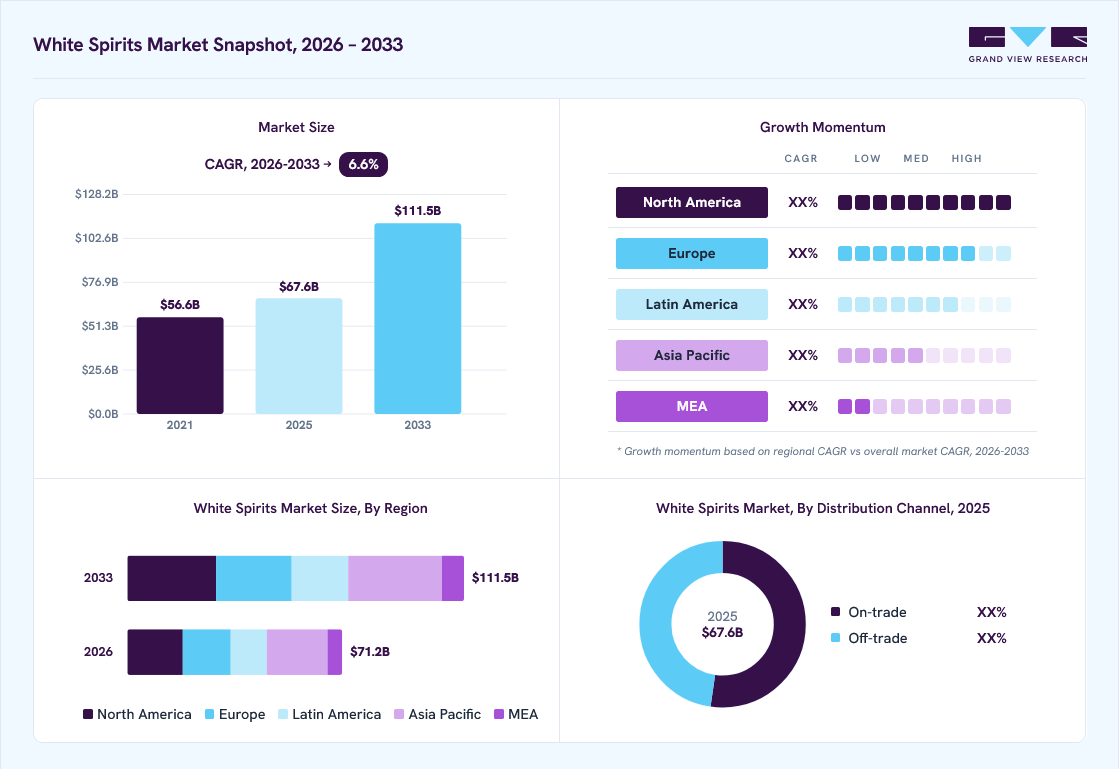
The global white spirits market size was valued at USD 67.6 billion in 2025 and is projected to grow from USD 71.2 billion in 2026 to USD 111.5 billion by 2033, at a CAGR of 6.6% from 2026 to 2033. Asia Pacific dominated the market, accounting for a revenue share of 38.0% in 2025. The global trend towards premium products and the growing popularity of cocktail culture have led to a surge in demand for high-quality white spirits.
 Source: Grand View Research, IR Documents, Primary Interviews, Paid DatabasesTo learn more about this report,
 Download Free Sample Report
Key Market Trends & Insights
- By product: Vodka segment led the market with the largest revenue share of 61.0% in 2025 and is expected to grow at the fastest CAGR over the forecast period.
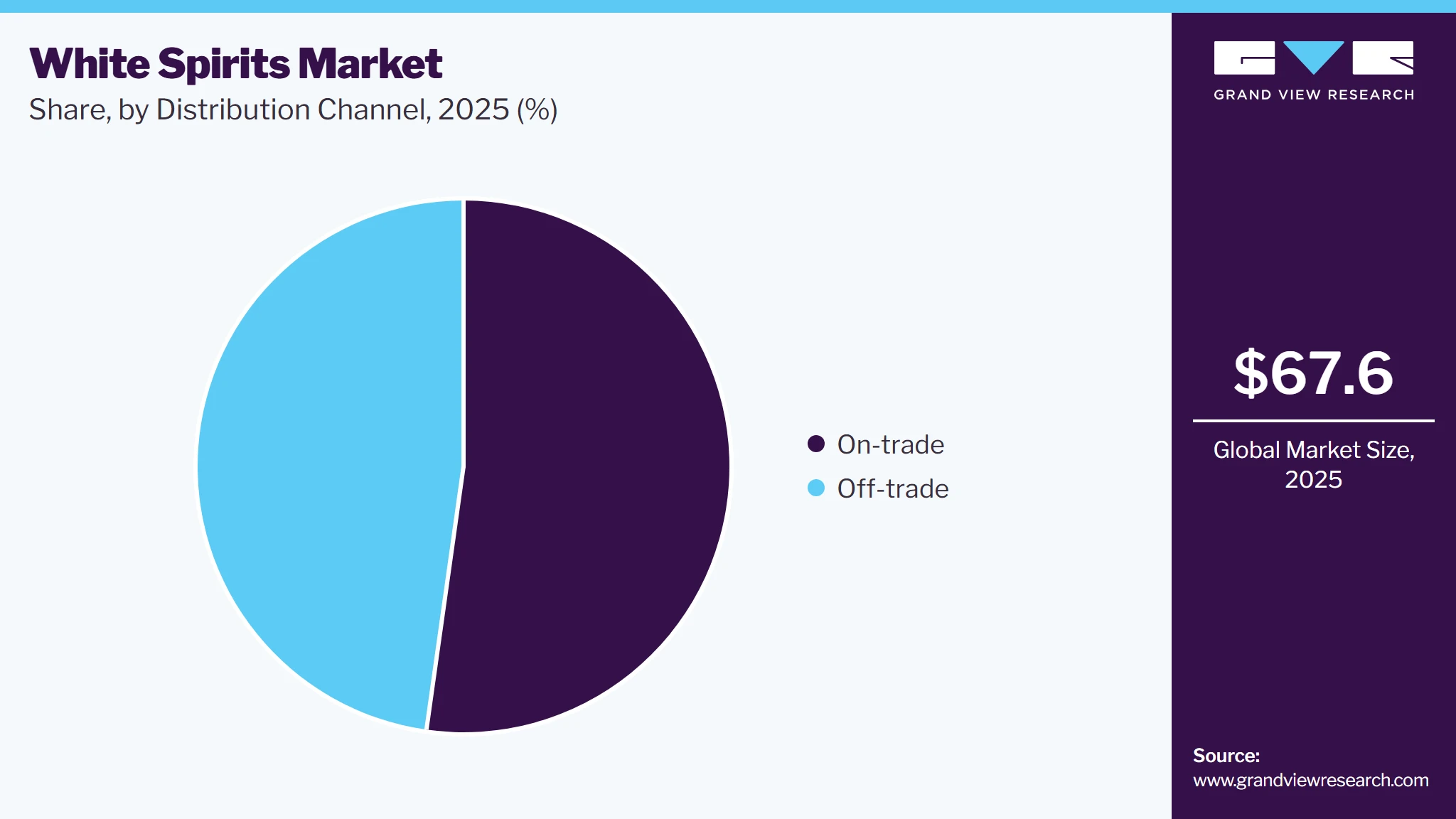
- By distribution channel: On-trade segment led the market with the largest revenue share of 52.2% in 2025.
Regional Highlights
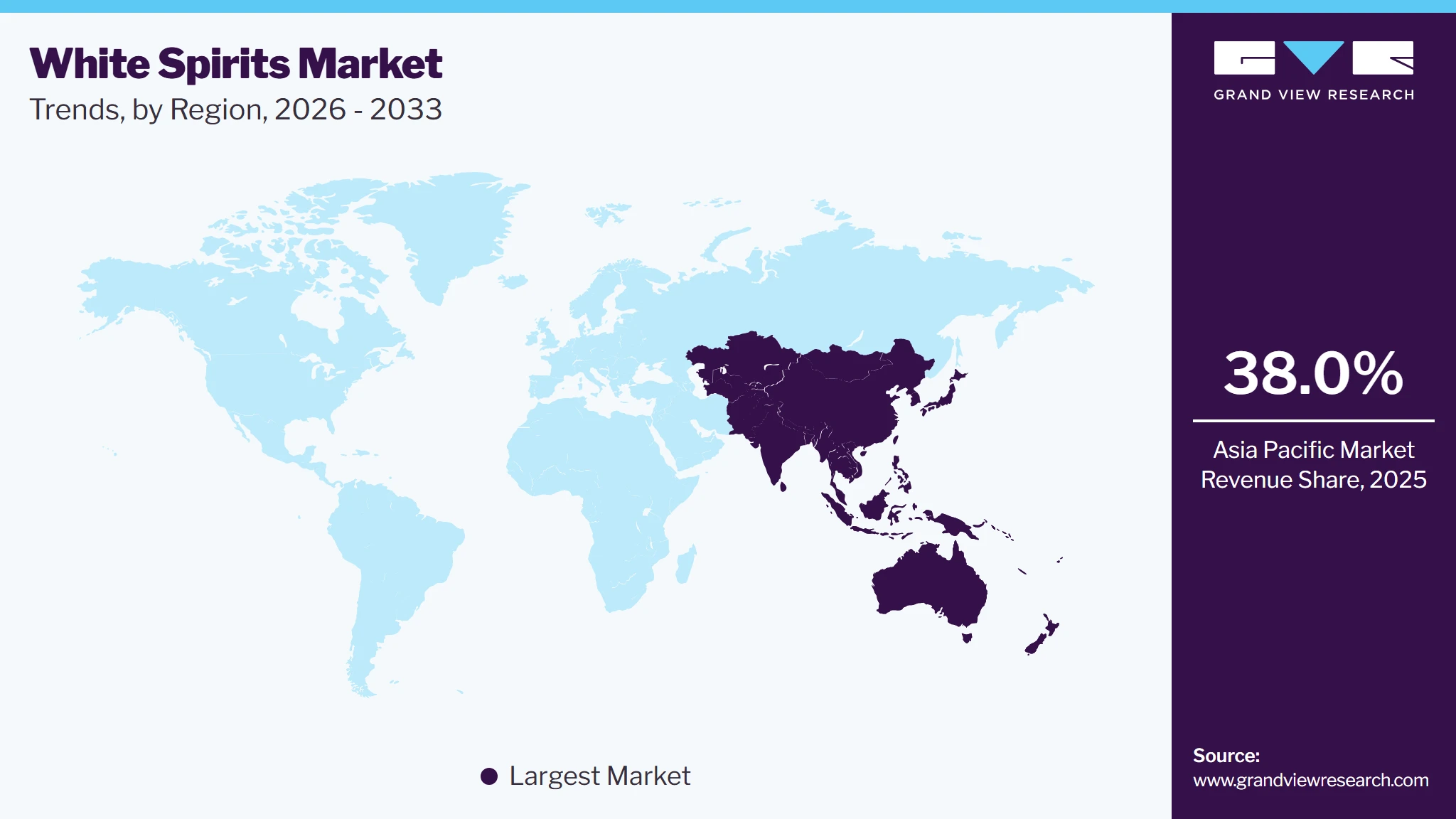
- Largest regional market: Asia Pacific (38.0% revenue share, 2025)
- By country: The China held the largest market share in 2025.
Market Size & Forecast
- Market size in 2025: USD 67.6 Billion
- Estimated market size in 2026: USD 71.2 Billion
- Projected market size by 2033: USD 111.5 Billion
- CAGR (2026-2033): 6.6%
Prism AI by Grand View Research Free to tryAsk a question about the white spirits marketTry asking✓Every figure cited from GVR research Prefer the report? Download free sample →
Consumers increasingly seek unique and sophisticated spirits to enhance their drinking experiences. This shift has encouraged producers to invest in innovative product development and marketing strategies to cater to the changing preferences of consumers. The market is fueled by economic growth and increasing disposable incomes. As economies grow and disposable incomes continuously improve, people are more inclined to treat themselves to high-end products such as premium spirits. The growing purchasing power drives the demand for white spirits, especially in developing economies. Moreover, the increasing global inclination towards casual drinking and the success of cocktail establishments and eateries are playing a part in the market's expansion.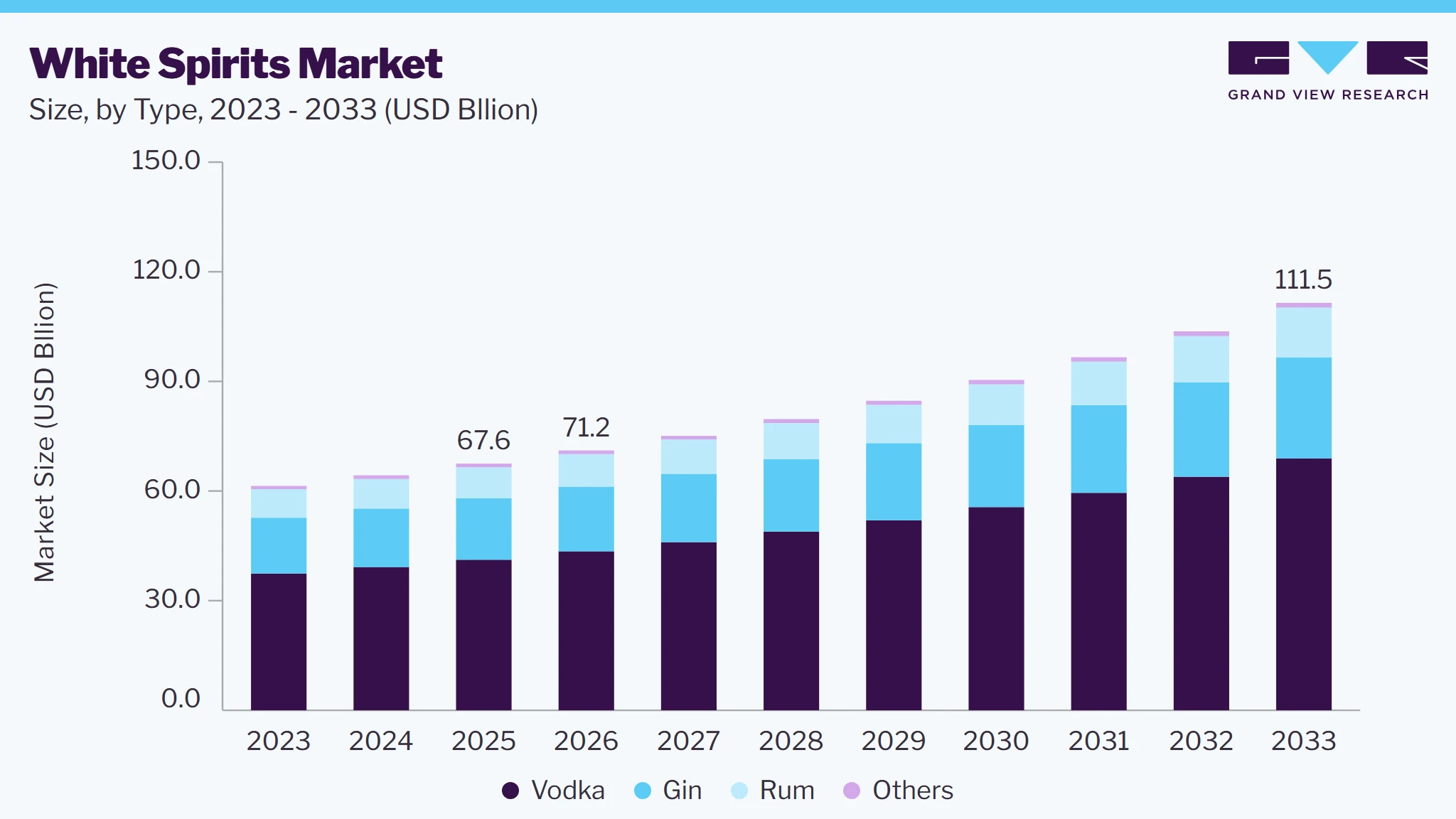 To learn more about this report, Download Free Sample Report
Various factors, such as industrial use, consumer tastes, and economic expansion, influence the white spirits alcohol market worldwide. The growing need for white spirits in different industrial fields drives this market. White spirits are commonly used as solvents in manufacturing paints, coatings, adhesives, and printing inks. Expanding the construction, automotive, and manufacturing sectors, especially in developing areas, is closely linked to the need for white spirits. The growing urbanization and efforts to improve infrastructure in various regions also lead to higher levels of white spirits consumption.
Market Dynamics
The white spirits alcoholic beverages market is being shaped by premium product adoption, expanding cocktail consumption, and growing consumer interest in authentic spirit categories. Demand remains strong across vodka, gin, rum, tequila, and other white spirits as consumers increasingly seek diverse drinking experiences. Growth in hospitality establishments, nightlife venues, and modern retail formats is supporting category expansion. In addition, product innovation through flavored variants, small-batch production, and premium packaging is helping brands attract new consumers and strengthen market positioning across mature and emerging markets.
Consumer preferences are shifting toward higher-value alcoholic beverages, resulting in increased demand for premium vodka, gin, tequila, and rum. Rather than focusing solely on volume consumption, consumers are increasingly evaluating product quality, ingredient provenance, distillation methods, and brand heritage. This shift is encouraging manufacturers to introduce premium portfolios that command higher average selling prices and improve profitability.
The growing popularity of cocktails is further supporting market growth. White spirits serve as the primary base for numerous cocktails consumed across bars, restaurants, hotels, and entertainment venues. Rising interest in mixology, social drinking occasions, and premium beverage experiences continues to increase consumption of white spirits across both on-trade and off-trade channels.
Market expansion is constrained by increasingly stringent alcohol regulations imposed across several countries. Governments continue to implement higher excise duties, stricter advertising standards, health-warning requirements, and limitations on alcohol availability. These measures can increase product costs, reduce promotional flexibility, and affect consumption growth. Simultaneously, changing consumer attitudes toward health and wellness are encouraging moderation, particularly among younger legal-age consumers. The increasing acceptance of low-alcohol and alcohol-free beverages is gradually redirecting a portion of consumer spending away from traditional white spirits, creating additional competitive pressure for market participants.
The expansion of bars, pubs, restaurants, hotels, and entertainment venues is creating significant opportunities for the white spirits market. On-trade establishments play a critical role in driving consumption of vodka, gin, rum, tequila, and other white spirits through cocktails, mixed drinks, and premium beverage offerings. Rising urbanization, increasing tourism activity, and higher spending on dining and nightlife experiences are supporting growth across these channels. Furthermore, improving alcohol distribution networks and a growing legal-age consumer population in emerging economies are increasing market penetration. These factors are expected to strengthen white spirits sales and create new growth avenues for manufacturers over the forecast period.
Analyst Perspective
The white spirits market is witnessing value growth driven by increasing demand for tequila, premium vodka, flavored spirits, and cocktail-based consumption. Competitive positioning is increasingly determined by brand strength, distribution reach, premium portfolio depth, and access to key raw materials such as agave and grain. Companies with strong presence in high-growth categories and emerging markets are expected to gain share as consumers increasingly prioritize quality, authenticity, and premium drinking experiences.
Product Insights
Based on product, the vodka segment led the market with the largest revenue share of 61.0% in 2025 and is expected to grow at the fastest CAGR over the forecast period .The versatility and neutral flavor of vodka make it a popular choice for a wide range of cocktails and mixed drinks. Furthermore, compared to other white spirits, such as whiskey and gin, vodka's cost-effective production makes it more affordable and readily accessible. The growing demand for vodka-based cocktails, especially in developing countries, has continued to expand its market. In addition, the increasing focus on health and wellness has shifted towards beverages with lower alcohol levels. Moreover, vodka's dominance in the white spirits market has been reinforced by the worldwide growth of vodka brands and their effective marketing strategies.
The gin segment is expected to register a significant CAGR of 6.4% during the forecast period. The growing popularity of craft gin, due to its unique flavors and high-quality ingredients, has attracted a large consumer base. This trend has led to a surge in demand for premium gin brands, driving market growth. Moreover, the increasing popularity of gin-based drinks, especially traditional drinks such as the Negroni and Martini, has helped drive the segment's growth. Additionally, the growing interest in craft spirits and the demand for distinctive and flavorful experiences have contributed to the popularity of gin. Additionally, the effective marketing strategies and branding initiatives implemented by gin manufacturers have boosted recognition and enhanced consumer favorability towards gin alcohol.
Distribution Channel Insights
Based on distribution channel, the on-trade segment led the market with the largest revenue share of 52.2% in 2025. The convenience and accessibility of off-trade channels, such as supermarkets, hypermarkets, and liquor stores, make them a preferred choice for consumers. The wide range of products available in off-trade channels allows consumers to compare prices and select their favorite brands easily. Additionally, the growing trend of home consumption, fueled by factors such as changing lifestyles and economic conditions, has increased the demand for white spirits purchased through off-trade channels. Furthermore, the ability of off-trade channels to offer bulk discounts and promotional activities attracts consumers and contributes to the segment's market expansion.
 To learn more about this report, Download Free Sample Report
The on-trade distribution channel is expected to register the fastest CAGR during the forecast period. The on-trade channel is growing due to the rise in cocktail culture, the increasing number of bars, restaurants, and nightclubs, and an upward trend towards social drinking. Furthermore, the increasing demand for high-quality and handcrafted alcoholic beverages frequently highlighted and supported in establishments that sell alcohol for consumption on-site, is also contributing to the expansion of this market.
Regional Insights
The North American white spirits market is growing at the fastest CAGR during the forecast period. The demand for white spirits in North America has increased due to the rising popularity of cocktails and mixed drinks and the trend of hosting events at home. The region's thriving tourism industry and frequent international events and festivals have also increased the market's growth.
U.S. White Spirits Market Trends
The white spirits market in the U.S. held the largest share in the North America region in 2025. The U.S. is at the forefront due to a flourishing cocktail culture and a desire for premium-quality spirits. Major players prioritize developing new products and marketing strategies to meet the demands of a wide range of consumer tastes and preferences.
Asia Pacific White Spirits Market Trends
Asia Pacific dominated the white spirits market with the largest revenue share of 38.0% in 2025 owing to the region's burgeoning population, rising disposable incomes, and swift urbanization, there has been a marked increase in the demand for alcoholic beverages. This demand is further fueled by the cultural significance of social gatherings and celebrations prevalent in many Asian countries, which often include the consumption of white spirits. Additionally, the growing popularity of Western-style bars and restaurants, coupled with the rising trend of at-home cocktail cultures, is pushing the demand for premium white spirits even higher in the area.
 To learn more about this report, Download Free Sample Report
The India dominated the Asia Pacific white spirits market in 2023 pertaining to the alcoholic beverage market is due to several factors. One of these is the growing young population in the country, which has significant purchasing power. This younger demographic is more willing to explore and try different types of alcoholic drinks, including craft beers and high-quality spirits. Their preference for unique and diverse experiences has created a demand for creative and high-quality alcoholic beverages. As a result, producers and manufacturers are introducing a wider variety of products to meet this demand and expand the market for alcoholic beverages.
Europe White Spirits Market Trends
The white spirits market in Germany held the largest share in the North America region in 2025. The region's long-standing tradition of alcohol consumption and a well-established culture of drinking, with a growing interest in premium and artisanal spirits, have contributed to its attractiveness. Additionally, cocktails and mixed drinks' increasing popularity have fueled the demand for white spirits in Europe. Furthermore, the region's strong tourism industry and the presence of numerous international events and festivals have also played a role in driving the market's growth.
The UK white spirits market is expected to grow rapidly in the coming years. This dynamic market is thriving due to innovations by manufacturers in the spirits industry. The resurgence in consumer preferences and a variety of creative choices have created demand for spirits in the country.
Key White Spirits Market Company Insights
Some of the key companies in the white spirits market include Diageo, BACARDI, Pernod Ricard, Suntory Global Spirits, Inc., Stock Spirits Group., Proximo Spirits, and others. Organizations focus on increasing customer base to gain a competitive edge in the industry. Therefore, key players are taking several strategic initiatives.
-
BACARDI has played a significant role in shaping the white spirits market. The company offers various products, such as rum, vodka, gin, tequila, whiskey, and other spirits. The company has been at the forefront of innovation by offering new products and flavors to cater to evolving consumer preferences. Bacardi's marketing strategies and collaborations with celebrities and events have also contributed to its success.
-
Diageo's portfolio features well-known white spirits brands worldwide. The company has a solid presence in global markets, and its products are readily accessible to consumers everywhere. Diageo makes significant investments in marketing and innovation to boost sales and launch new products. The company is dedicated to sustainability and has implemented several programs to minimize its environmental footprint.
Key White Spirits Companies:
The following key companies have been profiled for this study on the white spirits market.
-
Diageo
-
BACARDI
-
Pernod Ricard
-
Suntory Global Spirits, Inc.
-
Stock Spirits Group.
-
Proximo Spirits,
-
Alberta Distillers, LTD
-
William Grant & Sons
-
JACOB RIEGER & CO.
-
Rémy Cointreau
Competitive Benchmarking
Category
Operating Strategies
Competitive Edge
Weakness
Established Players (Diageo, BACARDI, Pernod Ricard, Suntory Global Spirits, Rémy Cointreau)
- Expand global distribution networks through retail, duty-free, and on-trade partnerships.
- Invest in portfolio diversification, premium product development, and strategic acquisitions.
- Strong brand equity, extensive distribution reach, and diversified product portfolios. Significant marketing budgets and long-standing relationships with distributors and retailers.
- High dependence on mature markets and complex regulatory compliance requirements. Slower response to emerging consumer trends and craft spirit innovations.
Emerging Players (Proximo Spirits, Stock Spirits Group, Alberta Distillers Ltd., William Grant & Sons, J. Rieger & Co.)
- Focus on craft, flavored, and category-specific white spirits. Leverage digital marketing, local sourcing, and targeted geographic expansion strategies.
- Greater flexibility in product innovation and faster adaptation to changing consumer preferences.
- Strong differentiation through heritage, authenticity, and niche offerings.
- Limited global distribution capabilities and lower marketing budgets. Challenges in achieving scale and competing with multinational spirits companies.
Recent Developments
-
In November 2022, Bacardi introduced its first Indian whisky by launching a new blend known as Legacy. This new blend is Bacardi's first 'made-in-India whisky innovation' and the sole premium Indian whisky in their lineup. Legacy, representing India's 'culture and passion,' has been crafted using handpicked Indian grains and a blend of Indian and Scottish malt whiskies.
White Spirits Market Report Scope
Report Attribute
Details
Market size in 2025
USD 67.6 billion
Estimated market size in 2026
USD 71.2 billion
Projected market size by 2033
USD 111.5 billion
Growth rate
CAGR of 6.6% from 2026 to 2033
Base year for estimation
2025
Historical data
2021 - 2024
Forecast period
2026 - 2033
Quantitative units
Revenue in USD million/billion and CAGR from 2026 to 2033
Report coverage
Revenue forecast, company ranking, competitive landscape, growth factors, and trends
Segments covered
Product, distribution channel, region
Regional scope
North America; Europe; Asia Pacific; Central &South America; MEA
Country scope
U.S.; Canada; Mexico; Germany; UK; France; Italy; Spain; Norway; Denmark; Sweden; Russia; Iceland; Finland; China; Japan; India; South Korea; Australia; Thailand; Singapore; Brazil; Argentina; Saudi Arabia; South Africa; UAE; Kuwait; Israel
Key companies profiled
Diageo; BACARDI; Pernod Ricard; Suntory Global spirits, Inc.; Stock Spirits Group.; Proximo Spirits,; Alberta Distillers, LTD; William Grant & Sons; JACOB RIEGER & CO.; Rémy Cointreau
Customization scope
Free report customization (equivalent up to 8 analysts' working days) with purchase. Addition or alteration to country, regional & segment scope.
Pricing and purchase options
Avail customized purchase options to meet your exact research needs. Explore purchase options
Global White Spirits Market Report Segmentation
This report forecasts revenue growth at global, regional, and country levels and provides an analysis of the latest industry trends in each of the sub-segments from 2021 to 2033. For this study, Grand View Research has segmented the global white spirits market report based on type, distribution channel, and region.
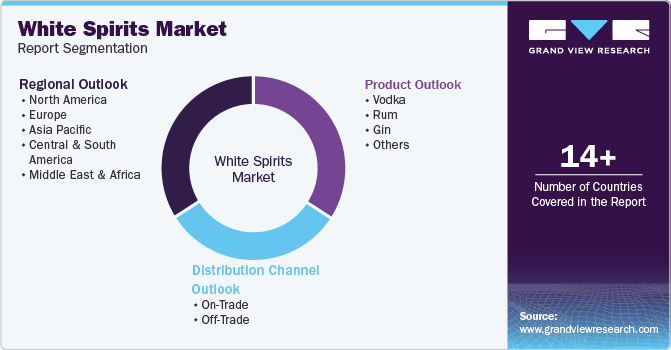 To learn more about this report, Download Free Sample Report
-
Type Outlook (Revenue, USD Million, 2021 - 2033)
-
Vodka
-
Rum
-
Gin
-
Others
-
-
Distribution Channel Outlook (Revenue, USD Million, 2021 - 2033)
-
On-Trade
-
Off-Trade
-
-
Regional Outlook (Revenue, USD Million, 2021 - 2033)
-
North America
-
U.S.
-
Canada
-
Mexico
-
-
Europe
-
Germany
-
UK
-
France
-
Italy
-
Spain
-
-
Asia Pacific
-
China
-
Japan
-
India
-
South Korea
-
Australia & New Zealand
-
-
Central & South America
-
Brazil
-
-
Middle East and Africa (MEA)
-
South Africa
-
-
Research Methodology
The white spirits market figures in this report are based on a proven research process that combines executive interviews with secondary research from proprietary databases, company filings, and recognized regulatory and institutional sources. Market size is built through value-chain sizing - reconciling supply-side and demand-side estimates - and triangulated with bottom-up and top-down approaches. Every estimate passes multiple levels of expert validation before publication, with each white spirits segment quantified using the revenue-capture definitions in the table below.
Segment Definition
Segment - Product
Revenue capture definition
Vodka
This segment includes the sales of grain-, potato-, and fruit-based vodka products through premium, flavored, craft, and standard variants across retail stores, supermarkets, liquor outlets, bars, restaurants, and e-commerce channels.
Rum
This segment includes the sales of white rum products used for direct consumption and cocktail preparation, supported by demand from hospitality venues, retail distribution networks, and duty-free outlets.
Gin
This segment includes the sales of traditional and botanical gin varieties across premium and mass-market categories, driven by cocktail culture, craft spirit offerings, and expanding retail availability.
Others
This segment includes the sales of tequila, white whiskey, white wine, and other clear spirit products through on-premise consumption, specialty liquor stores, supermarkets, and online alcohol retail platforms.
Segment - Distribution Channel
Revenue capture definition
On-Trade
This segment includes the sales of alcoholic beverages through bars, pubs, clubs, hotels, restaurants, lounges, and entertainment venues where products are purchased and consumed on-site.
Off-Trade
This segment includes the sales of alcoholic beverages through supermarkets, hypermarkets, convenience stores, liquor stores, duty-free shops, and online retail channels for off-premise consumption.
Estimation Model
Consumption Layer
Distribution Access Layer
Purchase Behavior Layer
Monetisation Layer
Who consumes white spirits?
Who can purchase white spirits?
Who purchases regularly?
How much revenue is generated?
Identify the legal drinking-age population and white spirits consumption incidence across key regions to determine the addressable consumer base.
Apply retail availability, on-trade penetration, e-commerce accessibility, and regulatory distribution coverage to derive the reachable consumer pool.
Apply purchase frequency, brand adoption rates, and per-capita consumption benchmarks to estimate active white spirits consumers.
Multiply active consumers by average annual spending on white spirits across retail and on-trade channels, including premium product sales and new launches.
Delivered Customizations
This report has been delivered with the following In-depth customizations
CLIENT REQUEST
CUSTOMIZATION DELIVERED
VALUE ADDS
White Spirits Consumption & Market Trends
Conducted a structured review of white spirits consumption patterns across vodka, gin, white rum, and tequila, focusing on shift toward higher-value products, flavor innovation, and changing urban drinking preferences among younger consumers.
Helps stakeholders identify high-growth segments, evolving taste profiles, and category shifts within the global white spirits landscape.
Ready-to-Drink (RTD) & Flavored White Spirits Adoption
Analyzed the rising adoption of ready-to-drink cocktails and flavored variants in white spirits, including product innovation cycles, convenience-led consumption, and increasing preference for low-effort alcoholic beverage formats.
Enables identification of innovation-led growth pockets and supports product development strategies in convenience-driven beverage consumption.
Distribution Expansion & Channel Dynamics in White Spirits
Assessed distribution shifts across on-trade recovery, off-trade retail expansion, and rapid growth of e-commerce and direct-to-consumer platforms, alongside emerging market penetration trends.
Supports understanding of changing consumption patterns across vodka, gin, white rum, and tequila, driven by evolving consumer preferences, wider product availability, and increased experimentation with new flavors and drinking formats across urban markets.
Frequently Asked Questions About This Report
The global white spirits market size was valued at USD 67.6 billion in 2025 and is estimated to reach USD 71.2 billion in 2026.
The global white spirits market is expected to grow at a CAGR of 6.6% from 2026 to 2033, reaching USD 111.5 billion by 2033.
The vodka segment led with a 61.0% revenue share in 2025 and is the fastest-growing segment.
Asia Pacific dominated with a 28.3% revenue share in 2025.
North America is the fastest-growing region over the forecast period.
The on-trade channel held the largest share in 2025 and was the fastest-growing channel.
Key players include Diageo; BACARDI; Pernod Ricard; Suntory Global spirits, Inc.; Stock Spirits Group.; Proximo Spirits,; Alberta Distillers, LTD; William Grant & Sons; JACOB RIEGER & CO.; Rémy Cointreau
Key factors include rising demand for premium alcoholic beverages, continuous introduction of innovative spirit variants, and the growing popularity of cocktail culture among consumers. These trends are encouraging consumers to explore diverse flavor profiles and premium offerings, supporting the expansion of the spirits market.
About the Author(s)
Alcohol & Tobacco Research Team
Consumer Goods · Alcohol & TobaccoThis report was authored by the alcohol & tobacco research team at Grand View Research - comprising two research analysts, one senior research analyst, and one industry expert - with specialized expertise in the alcohol & tobacco segment of the consumer goods industry. All findings are based on proprietary consumer goods databases, executive interviews, and regulatory analysis, subject to internal peer review prior to publication.
Last Updated:
Speak to Analyst

Customize this report to your needs - add regions, segments, or data points, with 20% free customization.
Or view our licence options:


ISO 9001:2015 & 27001:2022 Certified
We are GDPR and CCPA compliant! Your transaction & personal information is safe and secure. For more details, please read our privacy policy.


