
- Home
- »
- Plastics, Polymers & Resins
- »
-
Wine Packaging Market Size & Share Report, 2026-2033GVR Report cover

Wine Packaging Market (2026 - 2033)
Size, Share & Trends Analysis Report By Material (Glass, Plastic, Metal, Paper & Paperboard, Other Materials), By Closure Type, By Capacity, By Packaging Format, By Region, And Segment Forecasts
Market Size, 2025
$6.8BMarket Estimate, 2026
$7.2BMarket Forecast, 2033
$12.2BCAGR, 2026–2033
7.8%Wine Packaging Market Summary
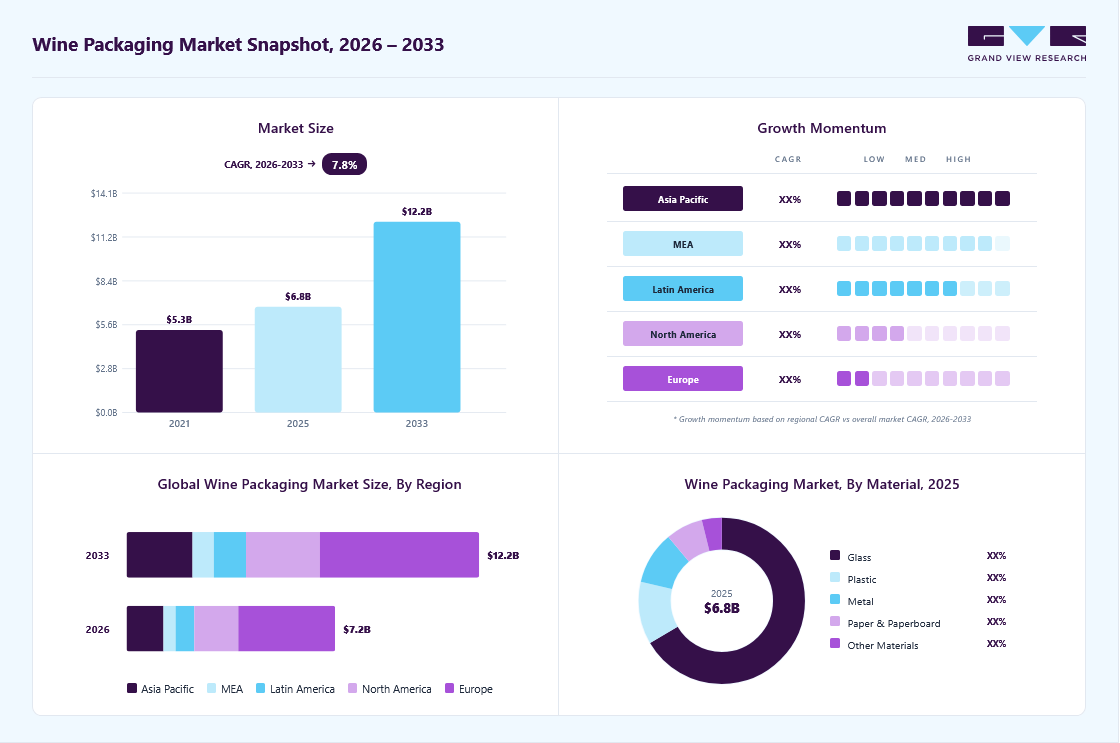
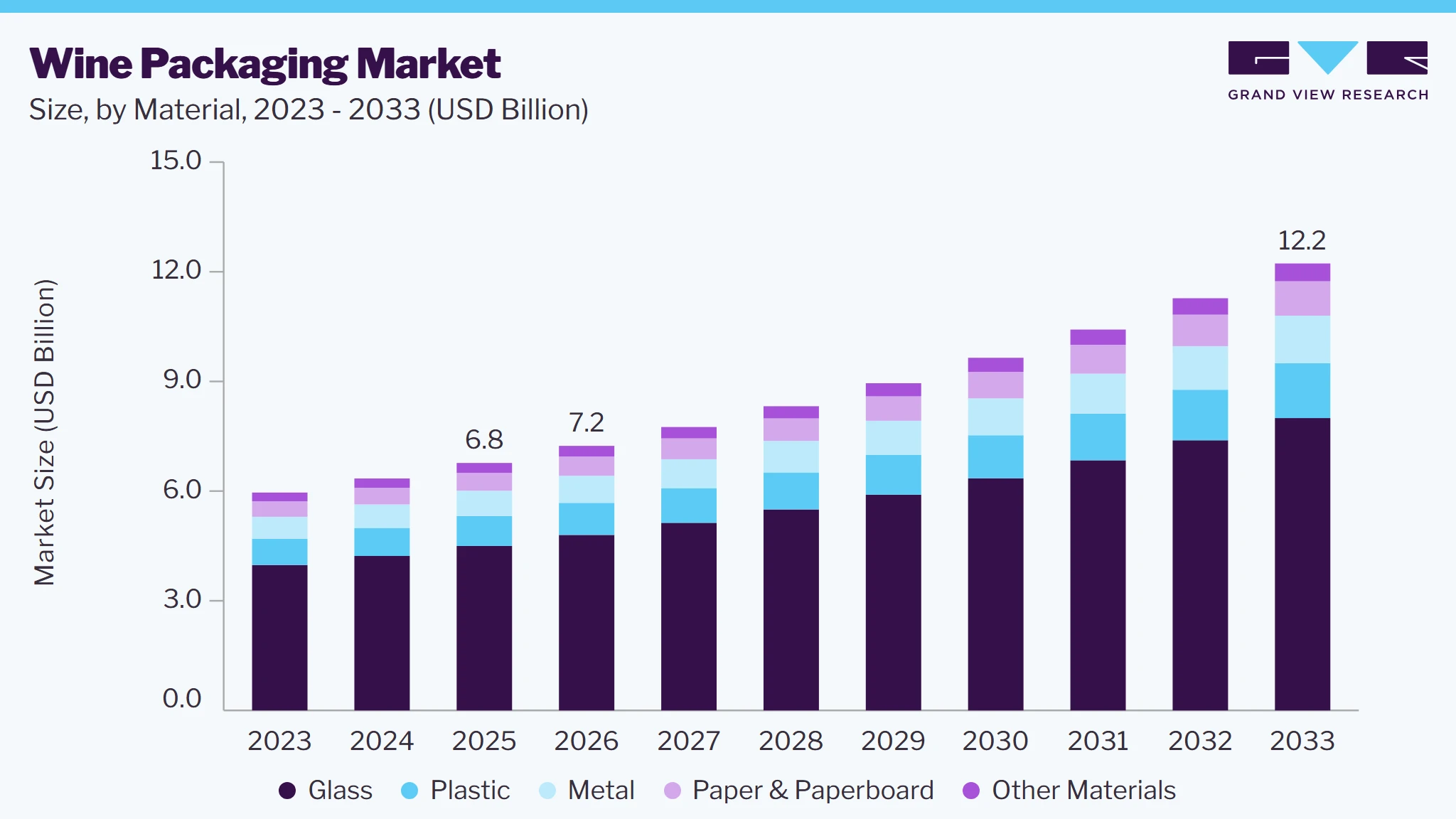
The global wine packaging market size was valued at USD 6.8 billion in 2025 and is expected to grow from USD 7.2 billion in 2026 to USD 12.2 billion in 2033, at a CAGR of 7.8% from 2026 to 2033. Europe dominated the market, accounting for a revenue share of 46.6% in 2025. The market growth is primarily driven by the expanding wine industry, increasing demand for premium and convenient packaging formats, and the growing adoption of sustainable packaging materials.
 Source: Grand View Research, IR Documents, Primary Interviews, Paid DatabasesTo learn more about this report,
 Download Free Sample Report
 Key Market Trends & Insights
- By material: Glass segment held the largest revenue share of 66.5% in 2025.
- By closure type: Natural cork segment held the largest revenue share of 41.5% in 2025.
- By capacity: 375-750 mL segment held the largest revenue share of 71.4% in 2025.
- By packaging format: Glass bottles segment held the largest revenue share of 60.5% in 2025.
Regional Highlights
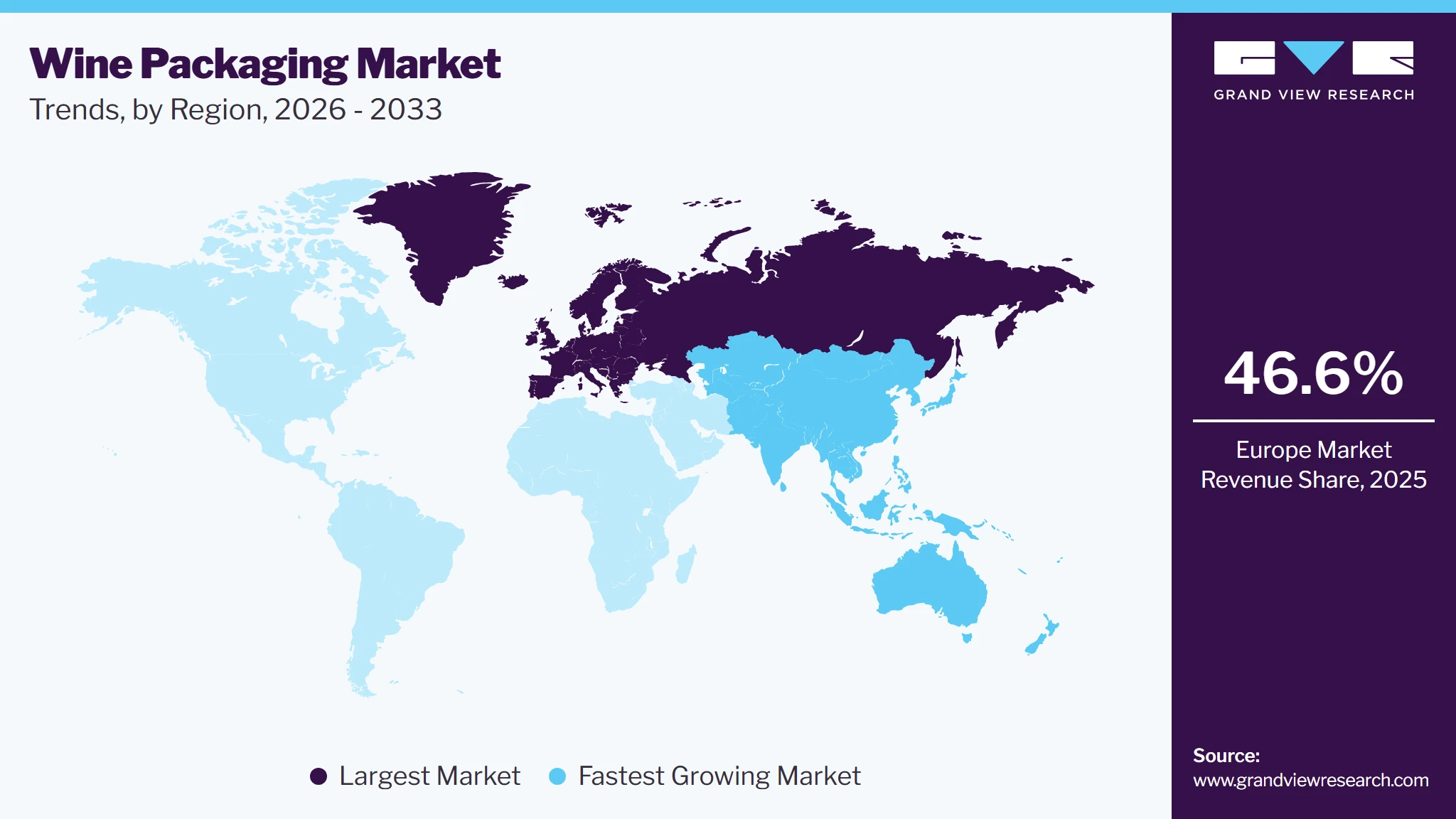
- Largest regional market: Europe (46.6% revenue share, 2025)
- Fastest-growing regional market: Asia Pacific (fastest CAGR, 2026-2033)
Market Size & Forecast
- Market Size in 2025: USD 6.8 Billion
- Estimated Market Size in 2026: USD 7.2 Billion
- Projected Market Size by 2033: USD 12.2 Billion
- CAGR (2026-2033): 7.8%
Three ways to get this report
Buy it, customize it, or ask a question.Ask an Analyst
A direct answer, usually in 1 working day
- AccessReport author, directly
- Reply timeWithin 1 working day
- No sales callDirect answer only
- FormatEmail reply
- CostFree, no cost
Get the Full Report
What the study covers
- FormatsPDF · Excel · Dashboard
- Timeline2026–2033 annual, 2025 base
- Coverage20+ countries, 5 regions
- Companies10+ key players profiled
Customize the Report
20% free customization
- IncludeCountries, segments, points
- TailorTo your product definition
- ExtendDeeper competitor detail
- OrA fully bespoke study
- Turnaround5–10 working days
Europe accounted for the largest market share of 46.6% in 2025, while Asia Pacific is expected to grow at the fastest CAGR of 8.6% over the forecast period, supported by rising wine consumption, expanding retail channels, and increasing adoption of modern packaging solutions.The wine packaging industry is driven by the growing demand for effective, attractive, and convenient packaging solutions for wine products. Glass bottles remain the preferred packaging format, supported by their established use in wine packaging and suitability for premium product presentation. However, alternative formats such as cans, bag-in-box, pouches, and plastic bottles are gaining traction, providing manufacturers with greater flexibility in packaging design and product positioning.
 To learn more about this report, Download Free Sample Report
 Convenience and portability are increasingly influencing wine packaging choices, particularly with the rising adoption of smaller pack sizes and alternative formats. Packaging capacities below 375 mL are gaining attention, while metal cans and bag-in-box formats are expanding as practical solutions for single-serve, lightweight, and easy-to-handle wine products. These formats are also supporting broader product diversification across the market.
Sustainability is becoming an important consideration in wine packaging, encouraging the use of recyclable, lightweight, and material-efficient solutions. Paper and paperboard, metal, and flexible packaging formats are gaining interest as alternatives to conventional glass packaging. The shift toward diversified materials and packaging formats is expected to support innovation and expand sustainable packaging options across the wine industry.
Market Dynamics
The wine packaging market is experiencing steady growth, driven by rising wine consumption, premiumization, and growing demand for convenient, differentiated packaging formats. Wine producers are focusing on packaging solutions that provide product protection, enhance shelf appeal, improve portability, and support sustainability objectives. While glass bottles remain the traditional packaging choice, increasing adoption of cans, bag-in-box, pouches, and lightweight packaging is contributing to greater diversification across retail, hospitality, and on-the-go consumption channels.
The increasing consumption of wine and the growing preference for premium and differentiated wine products are key drivers of the Wine Packaging market. Wine producers are investing in packaging that enhances product presentation, protects wine quality, and strengthens brand differentiation on retail shelves. Premium wines continue to rely heavily on glass bottles and high-quality closures, while changing consumption patterns are creating demand for smaller and more convenient packaging formats.
The expansion of wine distribution through supermarkets, specialty stores, restaurants, hotels, and e-commerce channels is further increasing the need for packaging that can withstand transportation and storage requirements. Manufacturers are also developing lightweight bottles, improved closures, and alternative formats to address changing consumer preferences. The growing availability of wine across diverse consumption occasions is therefore supporting demand for packaging solutions with different capacities, materials, and designs.
A key restraint for the wine packaging market is the high weight, material consumption, and transportation requirements associated with conventional glass bottles. Glass remains widely preferred for its durability, barrier properties, recyclability, and premium appearance; however, its heavier weight can increase shipping costs, handling requirements, and transportation-related emissions. Growing environmental concerns are encouraging wine producers to reduce packaging weight and improve material efficiency, while differences in recycling infrastructure and collection systems across countries can limit the recovery of used packaging. These factors are increasing the need for packaging optimization and may raise development and conversion costs for manufacturers.
A significant opportunity for the wine packaging market lies in the growing adoption of lightweight, recyclable, and alternative packaging formats. Bag-in-box, metal cans, pouches, paper-based formats, and lightweight glass bottles are gaining attention as wine producers seek to reduce packaging weight, improve transportation efficiency, and meet changing consumer preferences. Alternative formats also support single-serve, outdoor, and on-the-go consumption, allowing brands to address a broader range of consumption occasions. In addition, advancements in recyclable materials, lightweight bottle designs, and sustainable closures are creating opportunities for packaging manufacturers to develop differentiated solutions while supporting the wine industry's sustainability objectives.
Market Concentration & Characteristics
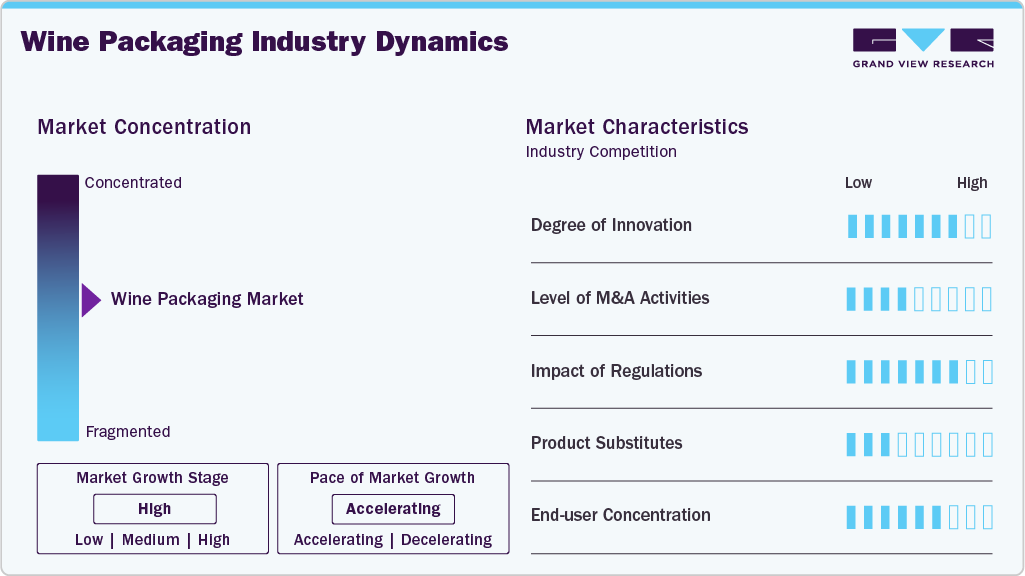
The wine packaging market is characterized by a strong dependence on traditional glass bottles, premium presentation, and established packaging formats, with manufacturers balancing product protection, brand differentiation, and cost efficiency. Glass remains the primary material for wine packaging due to its barrier properties, durability, recyclability, and suitability for premium wine products. The industry also relies on corks, screw caps, capsules, labels, and secondary packaging to protect wine during storage and transportation and to support product positioning on retail shelves. Manufacturers are increasingly focusing on lightweight bottle designs, efficient filling and sealing processes, and automated packaging operations to reduce material use and improve production efficiency. Leading packaging companies and wine producers are also expanding their use of alternative formats such as bag-in-box, cans, and pouches to address changing consumption patterns and distribution requirements.
 To learn more about this report, Download Free Sample Report
 A defining feature of the industry is the coexistence of premium traditional packaging with emerging lightweight and alternative formats. Glass bottles continue to be strongly associated with wine quality and premium positioning, while cans, bag-in-box, pouches, and paper-based formats are gaining attention for their portability, convenience, and lower packaging weight. Sustainability considerations are increasingly influencing material selection, encouraging the use of lightweight glass, recyclable materials, recycled content, and material-efficient designs. Regulatory requirements related to packaging waste, recycling, and extended producer responsibility are also influencing packaging development across major wine-producing and consuming markets. These trends are encouraging manufacturers to balance the visual and functional requirements of wine packaging with transportation efficiency, recyclability, and evolving consumer expectations.
Analyst Perspective
The global wine packaging market has evolved from a traditional glass bottle-focused sector toward a more diversified industry incorporating lightweight, sustainable, and convenient packaging formats. Glass remains central to wine packaging, particularly for premium and established products, while cans, bag-in-box, pouches, and paper-based formats are gaining adoption across convenience-oriented and alternative consumption occasions. In the future, the market is expected to maintain steady growth as wineries focus on packaging lightweighting, recyclability, transportation efficiency, premium presentation, and changing consumer preferences. Overall, the industry is moving toward a balance between traditional wine packaging and innovative formats that offer greater convenience and sustainability.
Material Insights
The glass segment led the wine packaging industry, accounting for a revenue share of 66.5% in 2025. Glass is the predominant material used for wine packaging, particularly for bottles, due to its strong barrier properties, durability, chemical stability, and premium appearance. Glass packaging helps preserve wine quality by providing an effective barrier against oxygen and external contaminants and is widely associated with premium and traditional wine presentation. Its established recycling infrastructure and compatibility with different bottle shapes and closure systems further support its widespread use across wine producers and distribution channels.
The paper & paperboard segment is expected to grow at the fastest CAGR of 8.6% during the forecast period. Paper and paperboard are gaining traction in wine packaging as producers explore lightweight, material-efficient alternatives to conventional formats. These materials can be used in paper-based cartons, secondary packaging, labels, and emerging bottle concepts, offering opportunities to reduce packaging weight and support recyclable packaging designs. Growing sustainability initiatives and consumer interest in lower-impact packaging are expected to encourage further development and adoption of paper-based solutions in the market.
Closure Type Insights
The natural cork segment led the wine packaging market with a revenue share of 41.5% in 2025. Natural cork remains a widely preferred closure for wine bottles, particularly in traditional and premium wine applications, owing to its heritage, sealing performance, and compatibility with long-term storage. Its natural appearance and association with premium wine presentation also make it an important element of brand positioning. The extensive use of natural cork across established wine-producing regions and its compatibility with glass bottle formats further support its leading market position.
The glass stopper segment is expected to grow at the fastest CAGR of 8.9% during the forecast period. Glass stoppers are gaining traction in premium and specialty wine packaging as producers seek distinctive closure solutions that enhance bottle aesthetics and product presentation. Their inert material properties, reusability, and suitability for repeated opening and closing make them attractive for selected wine applications. Increasing interest in visually differentiated packaging and alternative closure technologies is expected to support the expansion of glass stoppers, particularly among premium wine brands and specialty producers.
Capacity Insights
The 375-750 mL segment dominated the wine packaging industry, accounting for a revenue share of 71.4% in 2025. The segment benefits from its position as the standard serving and retail size for a broad range of still and sparkling wines. Its established role in household consumption, restaurants, bars, and retail sales has created a well-developed ecosystem of compatible bottles, closures, labels, and secondary packaging. The familiarity of this capacity among consumers and its suitability for both premium and mainstream wine products continue to reinforce its leading position.
The below 375 mL segment is anticipated to grow at the fastest CAGR of 8.6% during the forecast period. Demand for compact wine packs is being shaped by changing consumption occasions, including individual servings, social events, travel, and outdoor use. Smaller formats allow producers to offer wines in more accessible quantities and can reduce the commitment associated with purchasing a full-sized bottle. The segment also provides opportunities for brands to experiment with cans, mini bottles, and other compact formats, contributing to its comparatively rapid expansion within the market.
Packaging Format Insights
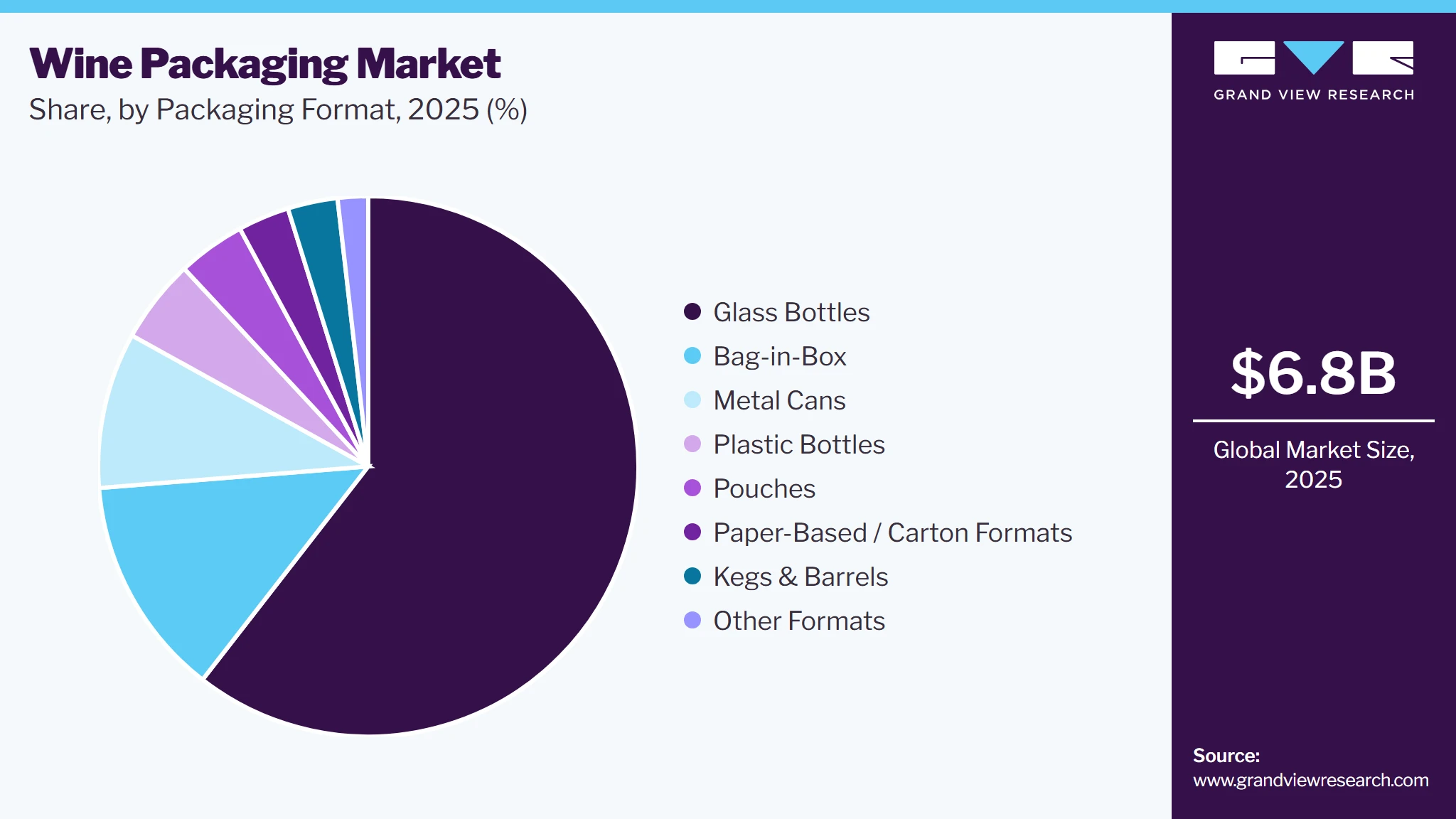
The glass bottles segment dominated the wine packaging market with a revenue share of 60.5% in 2025. Glass bottles remain the conventional choice for wine producers, particularly across premium, table, and sparkling wine categories, where bottle appearance contributes to product presentation and brand identity. Their compatibility with natural cork, technical cork, screw caps, and other closure systems also supports their extensive use. The established filling, labeling, storage, and distribution infrastructure for glass bottles further reinforces their position across the wine supply chain.
 To learn more about this report, Download Free Sample Report
 The metal cans segment is projected to register the fastest CAGR of 8.7% during the forecast period. Canned wine is gaining relevance as producers respond to demand for portable, easy-to-consume formats suited to outdoor occasions, events, travel, and single-serve consumption. Metal cans also provide advantages in handling, storage, and transportation compared with conventional bottles. Their expanding role in alternative wine formats, combined with growing interest in convenient packaging, is expected to contribute to the segment's comparatively rapid growth.
Regional Insights
The Europe wine packaging market held the largest global revenue share of 46.6% in 2025. The region's leading position is associated with its long-established wine production and consumption base, extensive presence of wineries, and strong reliance on glass bottles and traditional closures. Premium wine presentation, established packaging supply chains, and growing attention to recyclable, lightweight solutions continue to shape regional demand.
 To learn more about this report, Download Free Sample Report
 The wine packaging market in Germany accounts for a significant share of Europe in 2025, supported by established wine production, developed retail channels, and demand for both traditional and modern packaging solutions. Glass bottles remain an important format, while sustainability initiatives are encouraging greater consideration of lightweight materials and recyclable packaging.
The UK wine packaging market is expected to grow steadily during the forecast period, supported by well-developed retail, hospitality, and wine distribution channels. Demand for convenient formats such as cans and bag-in-box is increasing alongside conventional bottles, particularly for products aimed at casual and flexible consumption occasions.
Asia Pacific Wine Packaging Market Trends
The Asia Pacific wine packaging industry is expected to grow at the fastest CAGR of 8.6% during the forecast period (2026-2033). Expansion is being supported by rising wine consumption, urbanization, improving retail infrastructure, and increasing availability of domestic and imported wines. The growing acceptance of alternative formats and smaller packs is also widening packaging opportunities across emerging wine markets.
The China wine packaging market is significant in Asia Pacific, owing to its large consumer base, domestic wine production, and expanding wine distribution network. Conventional glass bottles remain prominent across premium and mainstream products, while evolving retail channels are creating scope for convenient and differentiated packaging formats.
The wine packaging market in India is expected to grow during the forecast period, supported by increasing wine consumption, urban market development, and the gradual expansion of organized retail and hospitality channels. Growth in domestic wine production and wider consumer exposure to different wine categories are generating demand for bottles, closures, and smaller packaging formats.
North America Wine Packaging Market Trends
The North America wine packaging industry is expected to witness steady growth during the forecast period, driven by established wine consumption, strong retail and hospitality networks, and demand for premium and convenient packaging formats. The region's mature wine market is also supporting continued use of glass bottles while creating opportunities for cans, bag-in-box, and smaller-format packaging.
U.S. Wine Packaging Market Trends
The U.S. wine packaging industry is expected to grow steadily throughout the forecast period. Demand is supported by a broad domestic wine industry, extensive supermarket and specialty retail distribution, and increasing interest in packaging suited to single-serve and outdoor consumption. Producers are also exploring lightweight and alternative formats to complement conventional bottles.
Latin America Wine Packaging Market Trends
The Latin America wine packaging industry is projected to grow steadily during the forecast period, supported by the region's established wine-producing countries and expanding distribution through retail and hospitality outlets. Increasing demand for practical and cost-efficient packaging is creating opportunities across glass bottles and newer alternative formats.
The Brazil wine packaging market represents a significant share of Latin America in 2025, due to its sizable consumer base and developing wine distribution infrastructure. Glass packaging continues to serve a broad range of wine products, while alternative formats are gaining relevance as producers seek to address different price points and consumption occasions.
The wine packaging market in Argentina is closely linked to the country's established wine production and export activities. Glass bottles and conventional closures remain central to wine packaging, particularly for established brands and export-oriented products. Growing attention to transportation efficiency and packaging differentiation is encouraging consideration of additional formats.
Middle East & Africa Wine Packaging Market Trends
The Middle East & Africa wine packaging industry is expected to experience strong growth during the forecast period, supported by expanding tourism and hospitality activities, modern retail development, and increasing availability of wine products in applicable markets. Demand for convenient and durable packaging formats is creating additional opportunities for suppliers across the region.
Key Wine Packaging Company Insights
Some key companies in the wine packaging market include Verallia; Ardagh Group S.A.; Vetropack Holding Ltd; Saverglass; Vidrala; Amcor plc; Diam; Smurfit Westrock; Sealed Air; Aran Group; Pact Group; and Vinolok. The market is characterized by strong demand for glass bottles and closures, premium packaging design, lightweighting, recyclable materials, and the gradual adoption of alternative formats such as bag-in-box, cans, and flexible packaging. Key participants are focusing on expanding sustainable packaging solutions, improving bottle weight and material efficiency, developing differentiated designs, and strengthening packaging solutions for premium, mainstream, and convenience-oriented wine products.
-
Verallia is a major glass packaging manufacturer with a strong presence in wine bottle production. The company provides glass containers in a wide range of shapes, capacities, colors, and designs for wine producers. Its focus on lightweighting, recycled glass utilization, and sustainable container development supports wineries seeking to reduce packaging impacts while maintaining the appearance and protection associated with glass bottles.
-
Ardagh Group S.A. is a global packaging manufacturer supplying glass and metal containers for beverage applications, including wine. Its packaging portfolio supports various wine categories and consumption occasions, while its emphasis on lightweighting, recycled content, and production efficiency enables wine brands to address material use and sustainability considerations.
Key Wine Packaging Companies
The following key companies have been profiled for this study of the wine packaging market.
-
Verallia
-
Ardagh Group S.A.
-
Vetropack Holding Ltd
-
Saverglass
-
Vidrala
-
Amcor plc
-
Diam
-
Smurfit Westrock
-
Sealed Air
-
Aran Group
-
Pact Group
-
Vinolok
Competitive Benchmarking
Category
Operating Strategies
Competitive Edge
Weakness
Established Players (Verallia; Ardagh Group S.A.; Vetropack Holding Ltd; Saverglass; Vidrala; Amcor plc; Diam; Smurfit Westrock; Sealed Air)
- Focus on broadening wine packaging portfolios across glass bottles, closures, flexible packaging, paper-based solutions, and protective packaging. Companies invest in lightweighting, recyclable materials, sustainable production, premium bottle designs, and packaging efficiency to serve diverse winery requirements.
- Strong manufacturing scale, established winery relationships, extensive distribution networks, specialized packaging technologies, and broad material capabilities provide a strong position across wine bottles, closures, and alternative packaging formats.
- High production and energy costs, exposure to glass and raw material price fluctuations, and substantial investment requirements for lightweighting, recycling, and sustainable packaging technologies can affect operating margins.
Emerging Players (Aran Group; Pact Group; Vinolok)
- Focus on specialized and alternative wine packaging solutions, including flexible packaging, recyclable materials, rigid containers, and premium glass closures. Emphasize customization, material efficiency, regional expansion, and solutions aligned with changing wine packaging requirements.
- Greater flexibility in customized packaging, specialized product expertise, regional customer relationships, and ability to address niche requirements support differentiation in selected wine packaging applications.
- Smaller manufacturing scale, narrower global distribution, and lower resources for large-scale R&D and capacity expansion compared with multinational packaging manufacturers may limit broader market penetration.
Recent Developments
-
In September 2026, Verallia announced a strategic R&D partnership with Moët Hennessy to develop a new generation of glass packaging for wine and spirits. The initiative focuses on resource efficiency, circularity, and bottle lightweighting, with the partners targeting a 30%-50% reduction in bottle weight while maintaining mechanical performance.
-
In July 2026, Vidrala’s 260G wine bottle received two Red Dot distinctions for Packaging Design and Sustainable Design. The 75 cl bottle weighs 260 grams and incorporates up to 80% recycled glass, highlighting the company's focus on lightweight wine bottles, recycled content, and sustainable packaging design.
-
In June 2026, Vetropack introduced a 350-gram Rhinewine bottle, described by the company as Europe's lightest Rhinewine bottle. The new bottle maintains the conventional 0.75-liter dimensions while reducing material use and supply-chain weight; Vetropack also introduced a reusable Rhinewine bottle for Austria's new reusable wine-bottle pooling system.
Wine Packaging Market Report Scope
Report Attribute
Details
Market size in 2025
USD 6.8 billion
Estimated market size in 2026
USD 7.2 billion
Projected market size by 2033
USD 12.2 billion
Growth rate
CAGR of 7.8% from 2026 to 2033
Base year for estimation
2025
Historical data
2021 - 2024
Forecast period
2026 - 2033
Quantitative units
Revenue in USD million/billion and CAGR from 2026 to 2033
Report coverage
Revenue forecast, company ranking, competitive landscape, growth factors, and trends
Segments covered
Material, closure type, capacity, packaging format, and region
Regional scope
North America; Europe; Asia Pacific; Latin America; Middle East & Africa
Country scope
U.S.; Canada; Mexico; Germany; France; UK; Italy; Spain; China; India; Japan; South Korea; Australia; Brazil; Argentina; Saudi Arabia; UAE; South Africa
Key companies profiled
Verallia; Ardagh Group S.A.; Vetropack Holding Ltd; Saverglass; Vidrala; Amcor plc; Diam; Smurfit Westrock; Sealed Air; Aran Group; Pact Group; Vinolok
Customization scope
Free report customization (equivalent up to 8 analysts working days) with purchase. Addition or alteration to country, regional & segment scope.
Pricing and purchase options
Avail of customized purchase options to meet your exact research needs. Explore purchase options
Global Wine Packaging Market Report Segmentation
This report forecasts revenue growth at the global, regional & country levels and provides an analysis of the latest industry trends and opportunities in each of the sub-segments from 2021 to 2033. For this study, Grand View Research has segmented the wine packaging market report based on material, closure type, capacity, packaging format, and region:
-
Material Outlook (Revenue, USD Million/Billion, 2021 - 2033)
-
Glass
-
Plastic
-
Metal
-
Paper & Paperboard
-
Other Materials
-
-
Closure Type Outlook (Revenue, USD Million/Billion, 2021 - 2033)
-
Natural Cork
-
Technical Cork
-
Synthetic Cork
-
Screw Cap
-
Glass Stopper
-
Crown Cap
-
Other Closures
-
-
Capacity Outlook (Revenue, USD Million/Billion, 2021 - 2033)
-
Below 375 mL
-
375-750 mL
-
751-1,500 mL
-
Above 1,500 mL
-
-
Packaging Format Outlook (Revenue, USD Million/Billion, 2021 - 2033)
-
Glass Bottles
-
Bag-in-Box
-
Metal Cans
-
Plastic Bottles
-
Pouches
-
Paper-Based / Carton Formats
-
Kegs & Barrels
-
Other Formats
-
-
Regional Outlook (Revenue, USD Million/Billion, 2021 - 2033)
-
North America
-
U.S.
-
Canada
-
Mexico
-
-
Europe
-
Germany
-
France
-
UK
-
Italy
-
Spain
-
-
Asia Pacific
-
China
-
India
-
Japan
-
South Korea
-
Australia
-
-
Latin America
-
Brazil
-
Argentina
-
-
Middle East & Africa
-
Saudi Arabia
-
UAE
-
South Africa
-
-
Research Methodology
The wine packaging market figures in this report are based on a proven research process that combines executive interviews with secondary research from proprietary databases, company filings, and recognized regulatory and institutional sources. Market size is built through value-chain sizing-reconciling supply-side and demand-side estimates-and triangulated with bottom-up and top-down approaches. Every estimate passes multiple levels of expert validation before publication, with each wine packaging segment quantified using the revenue-capture definitions in the table below.
Segment Definition
Segment - Material Type
Revenue capture definition
Glass
Revenue generated from the sale of glass packaging used for wine products, including standard and premium wine bottles manufactured in different sizes, shapes, colors, and designs. Includes glass containers supplied for still wine, sparkling wine, premium wine, and other wine categories.
Plastic
Revenue generated from the sale of plastic packaging used for wine products, including plastic bottles and containers designed for lightweight, durable, and convenient wine packaging. Includes packaging supplied for single-serve, travel, outdoor, and other convenience-oriented wine applications.
Metal
Revenue generated from the sale of metal packaging used for wine products, primarily aluminum and other metal cans designed for single-serve and portable wine consumption. Includes metal containers supplied for still and sparkling wines and other wine products requiring lightweight and convenient packaging.
Paper & Paperboard
Revenue generated from the sale of paper and paperboard packaging used for wine products, including paper-based bottles, cartons, boxes, sleeves, and other fiber-based packaging formats. Includes packaging designed for product presentation, secondary packaging, transportation, and applications emphasizing lightweight and recyclable materials.
Other Materials
Revenue generated from the sale of wine packaging manufactured using materials other than glass, plastic, metal, and paper & paperboard, including composite and other specialized materials. Includes packaging solutions developed for specific wine applications requiring alternative material properties, distinctive presentation, or specialized functional performance.
Segment - Closure Type
Revenue capture definition
Natural Cork
Revenue generated from the sale of natural cork closures used to seal wine bottles. Includes traditional cork stoppers supplied for still, sparkling, premium, and aged wines, where natural cork is selected for its sealing properties, heritage, and suitability for wine maturation.
Technical Cork
Revenue generated from the sale of technical cork closures manufactured using processed cork materials and specialized production technologies. Includes closures designed to provide consistent sealing performance, controlled oxygen transfer, and uniformity across wine bottling applications.
Synthetic Cork
Revenue generated from the sale of synthetic cork closures made from polymeric or other synthetic materials for wine bottles. Includes closures designed to provide consistent dimensions, reliable sealing, ease of insertion and removal, and suitability for wines intended for shorter or medium-term storage.
Screw Cap
Revenue generated from the sale of screw-cap closures used for wine bottles, including aluminum and other threaded closure systems. Includes closures supplied for still and sparkling wines where convenience, resealability, consistent sealing, and efficient bottling are required.
Glass Stopper
Revenue generated from the sale of glass stopper closures designed for wine bottles. Includes premium and specialty glass closures offering resealability, distinctive appearance, and compatibility with wine packaging requiring differentiated presentation.
Crown Cap
Revenue generated from the sale of crown cap closures used for wine and wine-based beverages, particularly products packaged in suitable glass bottles and specialty formats. Includes metal crown closures supplied for applications requiring secure sealing and efficient high-speed bottling.
Other Closures
Revenue generated from the sale of other wine closure systems not classified as natural cork, technical cork, synthetic cork, screw cap, glass stopper, or crown cap. Includes specialty and customized closure solutions developed for specific wine packaging requirements.
Segment - Capacity
Revenue capture definition
Below 375 mL
Revenue generated from the sale of wine packaging with a capacity below 375 mL, including mini bottles, single-serve containers, and other compact formats. Includes packaging designed for individual consumption, sampling, travel, events, and convenience-oriented wine applications.
375-750 mL
Revenue generated from the sale of wine packaging with a capacity ranging from 375 mL to 750 mL, including standard wine bottles and comparable containers. Includes packaging used for mainstream, premium, still, and sparkling wines across retail, hospitality, and household consumption.
751-1,500 mL
Revenue generated from the sale of wine packaging with a capacity ranging from 751 mL to 1,500 mL, including large-format bottles and containers. Includes packaging used for premium, celebratory, food-service, and specialty wine applications requiring larger serving volumes.
Above 1,500 mL
Revenue generated from the sale of wine packaging with a capacity exceeding 1,500 mL, including magnum and other large-format wine containers. Includes packaging supplied for events, hospitality, premium wine collections, and specialty or bulk-serving applications.
Segment - Packaging Format
Revenue capture definition
Glass Bottles
Revenue generated from the sale of glass bottles used for wine packaging, including different bottle shapes, sizes, colors, and designs for still, sparkling, premium, and mainstream wines.
Bag-in-Box
Revenue generated from the sale of bag-in-box packaging for wine, comprising a flexible inner bag and protective outer box. Includes formats designed for larger-volume storage, transportation, dispensing, and extended usability after opening.
Metal Cans
Revenue generated from the sale of metal cans used for wine packaging, primarily aluminum cans designed for single-serve, portable, and convenience-oriented wine products.
Plastic Bottles
Revenue generated from the sale of plastic bottles used for wine packaging. Includes lightweight and durable containers designed for convenient handling, transportation, and selected retail and outdoor consumption applications.
Pouches
Revenue generated from the sale of flexible pouches used for wine packaging, including stand-up and other pouch formats. Includes lightweight, portable, and space-efficient solutions for convenient wine consumption and distribution.
Paper-Based / Carton Formats
Revenue generated from the sale of paper-based and carton packaging used for wine products, including cartons, paper-based containers, boxes, and related formats. Includes solutions emphasizing material efficiency, recyclability, and product presentation.
Kegs & Barrels
Revenue generated from the sale of kegs and barrels used for wine storage, transportation, dispensing, and serving. Includes formats supplied for restaurants, bars, hospitality, events, and other foodservice applications.
Other Formats
Revenue generated from the sale of wine packaging formats not classified under glass bottles, bag-in-box, metal cans, plastic bottles, pouches, paper-based/carton formats, or kegs & barrels. Includes specialty, composite, and customized packaging solutions.
Estimation Model
Layer Name
Key Question
Description
Wine Industry Layer
What drives packaging demand?
Estimate wine packaging demand based on wine production, consumption, bottling volumes, export activity, and the development of retail, hospitality, and foodservice channels.
Packaging Format Adoption Layer
Which formats are being adopted?
Assess the use of glass bottles, bag-in-box, metal cans, plastic bottles, pouches, paper-based/carton formats, and kegs & barrels according to capacity, distribution requirements, consumption occasions, and product positioning.
Material & Closure Consumption Layer
Which packaging components generate demand?
Evaluate consumption of glass, plastic, metal, paper & paperboard, and other materials together with natural cork, technical cork, synthetic cork, screw caps, glass stoppers, crown caps, and other closures across wine packaging applications.
Revenue Layer
How is market revenue generated?
Revenue is generated through the sale of primary and secondary wine packaging, including bottles, alternative containers, closures, and related packaging formats supplied to wineries, wine brands, distributors, retailers, hospitality operators, and foodservice businesses.
Delivered Customizations
We have successfully delivered the following deep-dive customizations:
Client Request
Customization Delivered
Value Adds
Regional Segmentation
Detailed assessment of the Wine Packaging market across North America, Europe, Asia Pacific, Latin America, and Middle East & Africa, covering regional packaging preferences, wine consumption patterns, material and format adoption, sustainability requirements, and market growth outlook.
Enables identification of regional demand variations, high-growth markets, and geographic expansion opportunities for wine packaging manufacturers and suppliers.
Opportunity Assessment
Assessment of emerging opportunities across capacity, material, closure type, packaging format, and regional markets, with emphasis on lightweight packaging, sustainable materials, alternative formats, premium packaging, and convenience-oriented wine consumption.
Helps identify attractive demand pockets, emerging packaging trends, and areas for product development and market expansion.
Competitive Benchmarking
Comparative assessment of key Wine Packaging companies based on packaging portfolio, material and format capabilities, innovation, lightweighting initiatives, sustainability efforts, manufacturing footprint, regional presence, and strategic developments.
Provides insights into competitor capabilities, areas of differentiation, and strategic positioning across major Wine Packaging segments.
Frequently Asked Questions About This Report
The global Wine Packaging market size was valued at USD 6.8 billion in 2025 and is estimated to reach USD 7.2 billion in 2026.
The Wine Packaging market is primarily driven by increasing wine consumption, premiumization, demand for convenient packaging formats, expansion of retail and hospitality channels, adoption of sustainable materials, and growing interest in lightweight and alternative packaging solutions.
Europe dominated the Wine Packaging market with a 46.6% revenue share in 2025.
Asia Pacific is the fastest-growing region in the Wine Packaging market, with a CAGR of 8.6% over the forecast period.
The Below 375 mL segment is the fastest-growing capacity segment in the Wine Packaging market, with a CAGR of 8.6% over the forecast period.
The Glass segment led the Wine Packaging market with a 66.5% revenue share in 2025.
The Glass Bottles segment led the Wine Packaging market with a 60.5% revenue share in 2025.
Key players in the Wine Packaging market include Verallia, Ardagh Group S.A., Vetropack Holding Ltd, Saverglass, Vidrala, Amcor plc, Diam, Smurfit Westrock, Sealed Air, Aran Group, Pact Group, and Vinolok.
The global Wine Packaging market is expected to grow at a CAGR of 7.8% from 2026 to 2033, reaching USD 12.2 billion by 2033
About the Author(s)
Plastics, Polymers & Resins Research Team
Bulk Chemicals · Plastics, Polymers & ResinsThis report was authored by the plastics, polymers & resins research team at Grand View Research - comprising two research analysts, one senior research analyst, and one industry expert - with specialized expertise in the plastics, polymers & resins segment of the bulk chemicals industry. All findings are based on proprietary bulk chemicals databases, executive interviews, and regulatory analysis, subject to internal peer review prior to publication.
Last Updated:
Speak to Analyst

Customize this report to your needs - add regions, segments, or data points, with 20% free customization.
Or view our licence options:


ISO 9001:2015 & 27001:2022 Certified
We are GDPR and CCPA compliant! Your transaction & personal information is safe and secure. For more details, please read our privacy policy.


