
- Home
- »
- Medical Devices
- »
-
Wound Retractor Market Size Report, 2026-2033GVR Report cover

Wound Retractor Market (2026 - 2033)
Size, Share & Trends Analysis Report By Product (Disposable Wound Retractors, Reusable Wound Retractors), By Application, By Material (Plastic, Silicone/Polymer), By End-use, By Distribution Channel, By Region, And Segment Forecasts
Market Size, 2025
$650.0MMarket Estimate, 2026
$696.5MMarket Forecast, 2033
$1,143.3MCAGR, 2026–2033
7.3%Wound Retractor Market Summary
The global wound retractor market size was valued at USD 650.0 million in 2025 and is projected to grow from USD 696.5 million in 2026 to USD 1,143.3 million by 2033, at a CAGR of 7.3% from 2026 to 2033. The market in North America dominated with a revenue share of 36.7% in 2025. The market for wound retractors is driven by the increasing number of surgical procedures and the growing adoption of minimally invasive surgeries worldwide.
 Source: Grand View Research, IR Documents, Primary Interviews, Paid DatabasesTo learn more about this report,
 Download Free Sample Report
 Key Market Trends & Insights
- By product: Disposable wound retractors segment held the largest market share in 2025.
- By material: Plastic wound retractors segment held the largest market share in 2025.
- By application: Abdominal surgeries segment held the largest market share in 2025.
- By end-use: Hospitals segment held the largest market share in 2025.
Regional Highlights
- Largest regional market: North America (36.7% revenue share, 2025)
- Fastest-growing regional market: Asia Pacific (highest CAGR, 2026-2033)
- By country: U.S. held the largest market share in 2025
Market Size & Forecast
- Market size in 2025: USD 650.0 Million
- Estimated market size in 2026: USD 696.5 Million
- Projected market size by 2033: USD 1,143.3 Million
- CAGR (2026-2033): 7.3%
Three ways to get this report
Buy it, customize it, or ask a question.Ask an Analyst
Analyst response in 1 business day
- AccessReport author, directly
- Reply timeWithin 1 working day
- No sales callDirect answer only
- FormatEmail reply
- CostFree, no cost
Get the Full Report
What the study covers
- FormatsPDF · Excel · Dashboard
- Timeline2026–2033 annual, 2025 base
- Coverage20+ countries, 5 regions
- Companies10+ key players profiled
Customize the Report
20% free customization
- IncludeCountries, segments, points
- TailorTo your product definition
- ExtendDeeper competitor detail
- OrA fully bespoke study
- Turnaround5–10 working days
Rising demand for infection prevention and improved surgical visibility is accelerating the use of disposable wound protector/retractor systems across hospitals and ambulatory surgical centers. In addition, advancements in self-retaining and polymer-based retractors, along with expanding healthcare infrastructure in emerging economies, are supporting market growth.
 To learn more about this report, Download Free Sample Report
 The wound retractor industry is primarily driven by the increasing number of surgical procedures performed globally, particularly abdominal, orthopedic, gynecological, cardiovascular, and bariatric surgeries. The growing prevalence of chronic diseases, obesity, gastrointestinal disorders, and trauma cases has significantly increased the demand for advanced surgical instruments that improve surgical access and procedural efficiency. In addition, the rising aging population worldwide is contributing to higher surgical volumes, thereby supporting the adoption of wound retractors across hospitals and ambulatory surgical centers.
The growing number of gynecological procedures, including fallopian tube and ovary removal surgeries, is supporting demand for wound retractors in gynecological and abdominal procedures. Advanced wound protector/retractor systems are used to improve surgical visibility and reduce infection risk during these procedures.
The table below shows the percentage of women aged 50 and older who underwent gynecological procedures in the U.S. in 2023.
Percentage of women ages 50 and older who had their ovaries removed or their fallopian tubes cut, tied, or removed, by select demographics: U.S., August 2023
Demographic Category
Fallopian Tubes Cut
Fallopian Tubes Tied
Fallopian Tubes Removed
Ovaries Removed
% (95% CI)
Total
13.3 (11.7-15.2)
25.3 (23.1-27.6)
14.9 (13.0-16.9)
18.7 (16.7-20.9)
Age Group
50-64 years
14.7 (12.2-17.5)
24.7 (21.6-27.9)
12.6 (10.0-15.6)
12.0 (9.4-15.1)
65 years and older
11.9 (9.8-14.3)
25.9 (22.8-29.2)
17.3 (14.7-20.2)
25.7 (22.7-28.8)
Race and Hispanic Origin
Hispanic
19.6 (14.0-26.2)
29.2 (22.9-36.2)
10.1 (6.4-15.0)
12.0 (7.8-17.5)
Black or African American only, non-Hispanic
17.4 (11.7-24.5)
32.5 (25.3-40.3)
16.3 (10.7-23.5)
18.7 (12.8-25.8)
White only, non-Hispanic
12.0 (10.2-14.0)
24.0 (21.5-26.7)
16.1 (13.8-18.7)
20.8 (18.2-23.5)
Other single or multiple races, non-Hispanic
*
17.3 (10.0-27.1)
10.8 (5.9-17.8)
12.7 (6.7-21.2)
Education
High school degree or GED or less
17.7 (14.5-21.2)
33.3 (29.2-37.6)
13.7 (11.1-16.7)
19.5 (16.4-23.0)
Some college
14.5 (11.7-17.8)
24.5 (21.0-28.4)
17.0 (13.8-20.6)
19.4 (16.0-23.2)
Bachelor degree or higher
6.6 (4.6-9.2)
15.2 (12.2-18.5)
14.5 (10.8-18.9)
17.1 (13.1-21.7)
Household Income as a Percentage of Federal Poverty Level (FPL)
Less than 100% FPL
25.9 (19.1-33.8)
34.2 (26.6-42.5)
12.2 (7.3-18.7)
14.2 (8.9-20.9)
100% to less than 200% FPL
15.5 (11.4-20.4)
24.9 (19.7-30.8)
18.0 (13.8-22.8)
18.3 (14.2-23.0)
200% and greater FPL
10.7 (9.0-12.6)
24.0 (21.4-26.7)
14.5 (12.2-16.9)
19.6 (17.1-22.3)
Region
Northeast
12.7 (9.1-17.1)
20.1 (15.2-25.9)
10.6 (6.8-15.4)
13.6 (9.8-18.1)
Midwest
11.3 (8.3-14.8)
26.7 (22.3-31.4)
15.5 (12.2-19.3)
20.2 (16.2-24.7)
South
16.8 (13.7-20.2)
30.0 (26.2-33.9)
15.9 (12.9-19.2)
20.1 (17.0-23.5)
West
10.1 (7.0-13.9)
20.6 (16.4-25.4)
16.2 (11.7-21.6)
19.4 (14.6-25.0)
Urbanicity
Large central metro
11.9 (9.0-15.4)
22.2 (18.1-26.7)
12.1 (9.5-15.1)
14.1 (11.3-17.3)
Large fringe metro
15.3 (11.8-19.4)
24.3 (20.0-29.0)
16.6 (11.9-22.2)
20.3 (15.4-26.0)
Medium and small metro
12.3 (9.6-15.4)
26.4 (22.5-30.7)
16.0 (13.1-19.2)
18.4 (15.3-21.8)
Nonmetropolitan
14.4 (10.2-19.6)
30.1 (24.4-36.3)
15.4 (11.1-20.7)
26.4 (20.5-33.0)
Source: CDC
Another major factor driving market growth is the increasing adoption of minimally invasive and laparoscopic surgical procedures. Surgeons are using wound protectors/retractors to enhance visibility, reduce tissue trauma, and minimize the risk of surgical site infections (SSIs). The growing preference for disposable wound retractors, particularly soft-tissue and polymer-based retractors, is further accelerating market expansion by supporting infection control protocols and eliminating cross-contamination risks in operating rooms. For instance, In January 2026, the Annals of Laparoscopic and Endoscopic Surgery published a cross-sectional study based on prospective interventional clinical trials registered on ClinicalTrials.gov, a public database maintained by the U.S. National Library of Medicine. U.S.-based interventional studies are legally required to be registered, while global studies can also be voluntarily included. A total of 153 clinical trials were identified through the registry search strategy, of which 28 non-minimally invasive surgery (MIS) studies were excluded. The remaining 125 MIS-related trials were analyzed, with laparoscopic surgery accounting for a significantly larger share of the 2025 clinical trial pipeline than robotic surgery, with 89 trials versus 36, respectively.
 To learn more about this report, Download Free Sample Report
 Technological advancements in wound retraction devices are also contributing significantly to market growth. Manufacturers are developing ergonomic self-retaining retractors, silicone/polymer wound protectors, and procedure-specific retraction systems that improve surgical outcomes and patient recovery. Furthermore, the rapid expansion of healthcare infrastructure, increasing healthcare expenditure, and rising penetration of outpatient surgical centers in emerging economies such as China, India, and Brazil are creating favorable growth opportunities for the wound retractor industry.
Market Dynamics
The increasing emphasis on reducing surgical site infections (SSIs) and improving patient outcomes is significantly driving the growth of the wound retractor industry, particularly for disposable wound protector/retractor systems used in abdominal and gastrointestinal procedures. For instance, in April 2024, a randomized clinical trial published in JAMA Surgery reported that plastic wound protectors reduced the risk of SSI by 46.8% in bowel surgeries compared with conventional surgical gauze.
In addition, in September 2024, a meta-analysis published on ScienceDirect involving 25 randomized clinical trials and more than 5,000 patients demonstrated that wound edge protectors were highly effective in reducing superficial SSIs in gastrointestinal surgeries, especially double-ring protectors. Furthermore, the American Society of Colon and Rectal Surgeons recommends the use of wound protectors following colorectal surgery to help reduce infection risk and improve postoperative outcomes.
The availability of alternative surgical exposure techniques and conventional retractors acts as a restraint in the market, as many healthcare facilities continue to rely on traditional stainless-steel retractors due to their lower cost and long-term usability. In addition, surgeons in certain procedures prefer manual or self-retaining conventional retractors that are already well-established in clinical practice, limiting the adoption of advanced disposable wound protector/retractor systems. Budget constraints in developing healthcare markets further support the continued reliance on reusable conventional surgical retractors.
Market Concentration & Characteristics
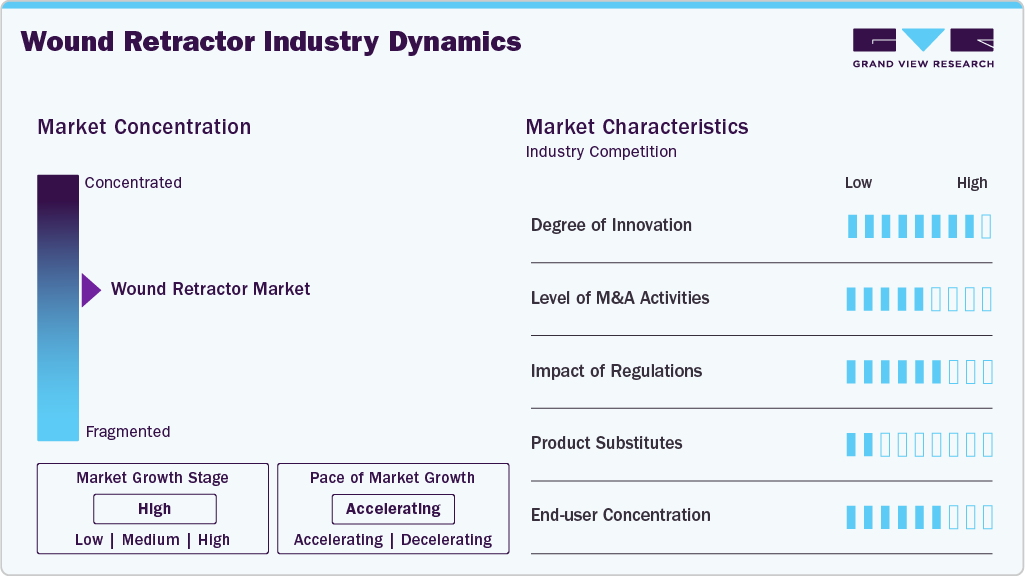
The wound retractor industry is witnessing a moderate to high degree of innovation, driven by the increasing adoption of minimally invasive and infection-prevention surgical techniques. Manufacturers are focusing on advanced soft tissue retractors and wound protector/retractor systems that enhance surgical visibility, reduce tissue trauma, and minimize surgical site infections. In addition, innovations such as disposable devices, ergonomic self-retaining retractors, and polymer-based flexible designs are improving procedural efficiency and supporting wider adoption across general, orthopedic, and gynecological surgeries. For instance, Applied Medical developed the Alexis Wound Protector/Retractor, which features 360-degree atraumatic retraction and wound protection for abdominal and laparoscopic surgeries.
 To learn more about this report, Download Free Sample Report
 The level of mergers and acquisitions in the market is moderate and increasing, as leading medical device companies aim to strengthen their surgical portfolios, expand technological capabilities, and enhance market presence. Companies are actively pursuing acquisitions of innovative retractor and surgical access device manufacturers to broaden their product offerings and support minimally invasive surgical procedures. For instance, in August 2024, CooperCompanies acquired Obp Surgical to expand CooperSurgical’s portfolio of single-use surgical retractors and illuminated surgical devices.
“This acquisition is a great strategic fit that builds upon CooperSurgical’s strong portfolio of leading medical devices,” said Al White, President and Chief Executive Officer of CooperCompanies. “obp Surgical’s differentiated products will integrate seamlessly into our business and allow us to provide clinicians with a broader range of innovative surgical technologies.”
“Our acquisition of obp Surgical demonstrates our commitment to our customers, rooted in a dedication to upholding the highest standards,” said Holly Sheffield, CooperSurgical President. “We are excited for our growing surgical portfolio to reach new heights with the addition of ONETRAC™ to the CooperSurgical product family, all to help ensure that healthcare providers are well-equipped with differentiated medical devices.”
Regulatory frameworks have a significant impact on the market, as manufacturers must comply with stringent quality, sterilization, and biocompatibility standards set by agencies such as the U.S. Food and Drug Administration and the European Commission under MDR regulations. These requirements increase product development and approval timelines but also encourage companies to focus on safer, infection-resistant, and clinically validated wound retractor technologies. In addition, strict regulatory oversight for single-use and sterile surgical devices is driving innovation in disposable wound protector/retractor systems and advanced material designs.
The wound retractor industry demonstrates a high level of end use concentration in hospitals and large surgical centers, as these facilities perform a substantial volume of general, orthopedic, gynecological, and abdominal surgeries requiring advanced surgical access devices. Hospitals remain the dominant end users due to their higher surgical procedure volumes, availability of specialized operating rooms, and increasing adoption of minimally invasive surgical techniques. In addition, ambulatory surgical centers are emerging as a growing end use segment, driven by rising preference for outpatient procedures and cost-effective surgical care.
Product Insights
Disposable wound retractors dominated the market in 2025 and is also expected to be the fastest growing during the forecast period. Due to the increasing emphasis on infection prevention, reduced cross-contamination risks, and improved operating room efficiency. Hospitals and ambulatory surgical centers prefer single-use wound protector/retractor systems because they eliminate reprocessing requirements and support compliance with stringent sterilization protocols. In addition, the growing adoption of minimally invasive and outpatient surgical procedures further accelerated demand for disposable wound retractors across general, gynecological, and abdominal surgeries.
Reusable wound retractors are witnessing significant growth in the market due to their cost-effectiveness, durability, and widespread use in high-volume surgical settings. Hospitals and large healthcare facilities prefer reusable self-retaining retractors for complex orthopedic, abdominal, and cardiovascular procedures where long-term instrument utilization is economically beneficial. In addition, advancements in stainless-steel designs and sterilization technologies are supporting the continued adoption of reusable wound retractors across developed and emerging healthcare markets.
Material Insights
Plastic wound retractors dominated the market in 2025 owing to their lightweight structure, flexibility, cost-effectiveness, and widespread use in disposable wound protector/retractor systems. These retractors are preferred in minimally invasive and abdominal surgeries due to their ability to provide atraumatic tissue retraction while reducing the risk of surgical site contamination. In addition, the growing demand for single-use surgical devices and advancements in medical-grade polymers further strengthened the dominance of plastic wound retractors across hospitals and ambulatory surgical centers.
Silicone/polymer wound retractors are expected to grow the fastest during the forecast period due to their superior flexibility, atraumatic tissue handling, and enhanced wound protection. These retractors are preferred in minimally invasive and laparoscopic procedures because they provide 360-degree circumferential retraction while minimizing tissue damage and contamination risks. In addition, advancements in biocompatible polymer materials and the growing demand for disposable surgical devices are accelerating the adoption of silicone/polymer wound retractors across hospitals and ambulatory surgical centers.
Application Insights
Abdominal surgeries dominated the market in 2025, driven by the high global volume of gastrointestinal, colorectal, bariatric, and hernia repair procedures that require effective surgical exposure and wound protection. Surgeons use wound protectors/retractors during abdominal operations to improve visibility, minimize tissue trauma, and reduce the risk of surgical site infections. In addition, the growing adoption of minimally invasive and laparoscopic-assisted abdominal surgeries has further strengthened the segment's dominance.
Bariatric surgeries are expected to witness the fastest growth during the forecast period, driven by the rising global prevalence of obesity and the increasing demand for weight-loss surgical procedures. Wound protector/retractor systems are utilized in bariatric surgeries to improve surgical access, reduce tissue trauma, and minimize the risk of surgical site infections in obese patients. In addition, the growing adoption of laparoscopic bariatric procedures is driving demand for flexible, minimally invasive wound retractors.
End-use Insights
Hospitals dominated the market in 2025 due to the high volume of surgical procedures performed across general, orthopedic, cardiovascular, and gynecological specialties. Large hospitals increasingly adopted advanced wound-protector/retractor systems to improve surgical visibility, reduce infection risk, and enhance procedural efficiency in operating rooms. In addition, the availability of advanced surgical infrastructure and skilled healthcare professionals further supported the dominance of the hospital segment.
Ambulatory Surgical Centers (ASCs) are expected to experience the fastest growth during the forecast period, driven by the increasing shift toward outpatient and minimally invasive surgical procedures. ASCs are adopting disposable wound protector/retractor systems to improve procedural efficiency, reduce infection risks, and support faster patient recovery with shorter hospital stays. In addition, the cost-effectiveness and operational efficiency of ASCs are driving greater utilization of advanced wound retractors across day-care surgical settings.
Distribution Channel Insights
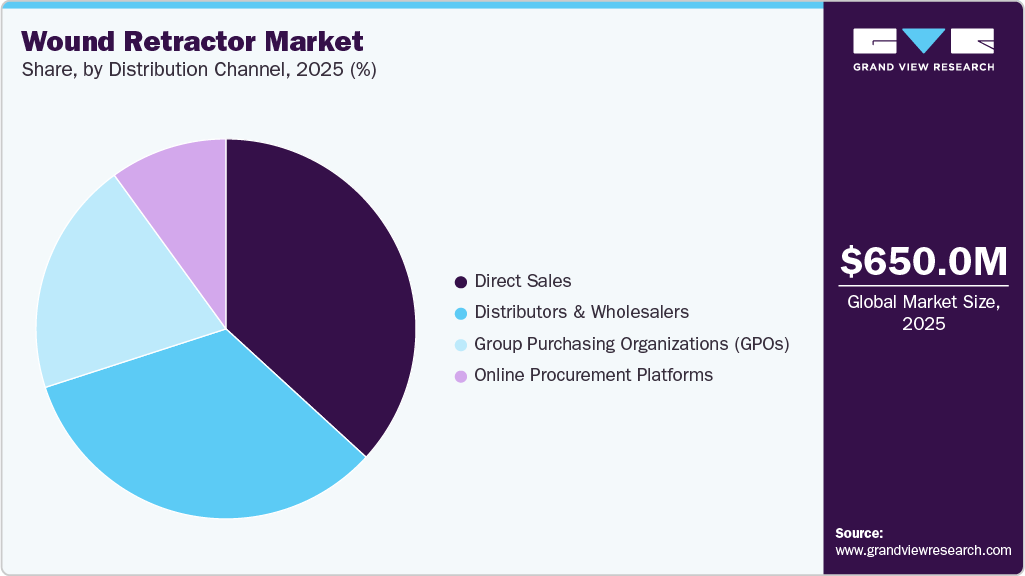
Direct sales dominated the market in 2025 as major medical device manufacturers relied on dedicated sales teams and long-term hospital partnerships to strengthen product adoption and customer relationships. Hospitals and large surgical centers preferred direct procurement channels for advanced wound-protector/retractor systems due to better pricing, product training, and after-sales support. In addition, direct sales channels enabled companies to efficiently promote technologically advanced and customized surgical retraction solutions to healthcare providers.
 To learn more about this report, Download Free Sample Report
 Online procurement platforms are expected to experience the fastest growth during the forecast period, driven by the increasing digitalization of healthcare supply chains and hospital purchasing systems. Healthcare providers and ambulatory surgical centers are utilizing online platforms for convenient product comparison, bulk purchasing, and faster procurement of surgical devices, including wound retractors. In addition, the expansion of e-commerce channels and improved access to global medical device suppliers are supporting the rapid growth of online procurement platforms in the market.
Regional Insights
The North America wound retractor market held the largest share and accounted for 36.70% of global revenue in 2025, driven by the rising number of surgical procedures and the increasing preference for minimally invasive operations across hospitals and ambulatory surgical centers. Healthcare providers in the region are adopting disposable wound protector/retractor systems to reduce the risk of surgical site infections and improve procedural efficiency. Furthermore, ongoing advancements in self-retaining and soft tissue retractors are supporting wider adoption in abdominal, orthopedic, and gynecological surgeries.
 To learn more about this report, Download Free Sample Report
 U.S. Wound Retractor Market Trends
The U.S. wound retractor industry is experiencing significant growth driven by the rising number of surgical procedures and the growing preference for minimally invasive and outpatient procedures. Healthcare facilities are adopting disposable wound protector/retractor systems to improve surgical visibility, reduce contamination risks, and enhance patient recovery outcomes. In addition, technological advancements in self-retaining and soft tissue retractors are supporting their broader use across general, bariatric, orthopedic, and gynecological surgeries.
Europe Wound Retractor Market Trends
The Europe wound retractor industry is witnessing growing adoption of advanced wound protection and self-retaining retractor systems, driven by the increasing volume of minimally invasive and colorectal surgeries across the region. Healthcare providers are focusing on reducing surgical site infections and improving postoperative outcomes, which is driving demand for disposable wound protectors/retractors in hospitals and specialty surgical centers. In addition, the presence of well-established healthcare systems and rising investments in surgical infrastructure are supporting market expansion across countries such as Germany, France, and the UK.
The UK wound retractor industry is witnessing increasing demand for disposable, minimally invasive surgical retractors, driven by a focus on reducing hospital-acquired infections and improving surgical efficiency. Hospitals across the country are adopting wound protector/retractor systems for colorectal, gynecological, and abdominal surgeries to improve postoperative outcomes. In addition, the growing number of day-care and outpatient surgical procedures is driving the adoption of compact, self-retaining wound retractors across healthcare facilities.
The France wound retractor industry is experiencing significant growth due to the increasing number of minimally invasive and gastrointestinal surgical procedures performed across hospitals and specialty surgical centers. Healthcare providers in the country are adopting disposable wound protector/retractor systems to improve infection control, enhance surgical access, and support faster patient recovery. Furthermore, growing investments in advanced surgical technologies and the modernization of hospital infrastructure are contributing to the adoption of ergonomic, self-retaining wound retractors in France.
Asia Pacific Wound Retractor Market Trends
The Asia Pacific wound retractor industry is expected to witness rapid growth driven by the increasing number of surgical procedures, expanding healthcare infrastructure, and the rising adoption of minimally invasive surgeries across countries such as China, India, and Japan. Hospitals and specialty surgical centers in the region are utilizing disposable wound protector/retractor systems to improve infection control and surgical efficiency. In addition, growing healthcare investments, medical tourism, and increasing awareness regarding advanced surgical instruments are supporting market expansion across the region.
The China wound retractor industry is anticipated to witness significant growth driven by the increasing number of surgical procedures, the rapid expansion of hospital infrastructure, and the rising adoption of minimally invasive surgeries across urban healthcare facilities. Demand for disposable wound protector/retractor systems is increasing as hospitals focus on improving infection control and surgical efficiency. In addition, growing domestic medical device manufacturing capabilities and rising healthcare expenditure are supporting the adoption of advanced self-retaining and soft-tissue wound retractors in China.
Latin America Wound Retractor Market Trends
The Latin America wound retractor industry is anticipated to experience gradual growth driven by the increasing number of surgical procedures and improved access to healthcare services across countries such as Brazil and Mexico. Hospitals are adopting disposable wound protector/retractor systems to enhance infection prevention and surgical efficiency, particularly in general and gynecological surgeries. In addition, the ongoing development of healthcare infrastructure and the rising awareness of advanced surgical instruments are supporting market expansion in the region.
Middle East & Africa Wound Retractor Market Trends
The MEA wound retractor industry is anticipated to witness significant growth due to improving healthcare infrastructure, rising surgical procedure volumes, and increasing investments in advanced surgical technologies across countries such as Saudi Arabia, the UAE, and South Africa. Hospitals in the region are gradually adopting disposable wound protector/retractor systems to enhance infection control and surgical outcomes. In addition, the expansion of private healthcare facilities and the growth of medical tourism are driving demand for advanced wound retraction devices across the MEA region.
Key Wound Retractor Company Insights
Key companies operating in the market for wound retractor include Applied Medical, Medtronic, CooperSurgical, and Stryker, which compete based on product innovation, infection prevention capabilities, and surgical efficiency. The market is moderately consolidated, with leading players holding significant market shares through strong global distribution networks, extensive surgical portfolios, and continuous advancements in wound protector/retractor technologies.
Key Wound Retractor Companies:
The following key companies have been profiled for this study on the wound retractor market.
- Stryker
- Medtronic
- Solventum
- Invotecmedical
- Victor Medical Instruments Co., Ltd.
- Yeso-Med
- Applied Medical Resources Corporation
- Tonglu Kanger Medical Instrument Co.,Ltd
- SHANGHAI TEAMSTAND CORPORATION
- Surgitools Medical Instruments Co., Ltd.
- Surtex Instruments Limited
- PAUL MEDICAL SYSTEMS
- TATA SURGICAL
- IndoSurgicals Private Limited
- Aspen Surgical Products
- CooperSurgical, Inc.
Competitive Benchmarking
Operating Strategies
Competitive Edge
Weaknesses
Mature Players: Stryker
- Focus on continuous product innovation, including advanced disposable wound protector/retractor systems, ergonomic self-retaining retractors, and infection-control technologies to strengthen market leadership.
- Expand global presence through direct sales networks, strategic acquisitions, long-term hospital partnerships, and strong regulatory compliance capabilities.
- Strong global brand recognition, extensive distribution networks, and established relationships with hospitals and surgical centers provide high market penetration and customer loyalty.
- Advanced R&D capabilities and broad surgical product portfolios enable continuous innovation in disposable, self-retaining, and minimally invasive wound retractor systems.
- High operational and R&D costs can increase product pricing, limiting adoption in price-sensitive and developing healthcare markets.
- Large organizational structures may slow product customization and responsiveness to rapidly changing regional market demands.
Emerging Players: Victor Medical Instruments Co., Ltd.
- Compete through cost-effective manufacturing and affordable reusable and disposable wound retractors targeted toward price-sensitive healthcare markets.
- Strengthen regional market presence through distributor partnerships, export expansion, and customized surgical instrument offerings for local hospitals and surgical centers.
- Competitive pricing and flexible manufacturing capabilities help emerging players cater to cost-sensitive healthcare facilities and developing markets.
- The ability to offer customized surgical instruments and rapidly adapt to regional market requirements supports faster expansion in local and niche segments.
- Limited global distribution networks and lower brand recognition can restrict market penetration in developed healthcare markets.
- Lower investment capacity in advanced R&D and regulatory compliance may limit technological innovation and international expansion opportunities.
Recent Developments
-
In August 2024, CooperCompanies announced that its subsidiary, CooperSurgical, Inc., acquired obp Surgical for approximately USD 100 million. The acquisition expanded CooperSurgical’s portfolio of single-use cordless surgical retractors featuring integrated multi-LED lighting and smoke evacuation technologies, along with illuminated surgical suction devices. The acquired product portfolio generated approximately USD 14.5 million in trailing twelve-month revenue and was expected to be neutral to CooperCompanies’ non-GAAP earnings per share in fiscal 2024 while becoming accretive in subsequent years.
-
In November 2022, Applied Medical celebrated 20 years since the launch of its Alexis[ Wound Protector/Retractor. The Alexis brand gained global recognition for enhancing patient outcomes and reducing superficial surgical site infections, protecting more than 17 million wounds across 75+ countries. Over the years, the company expanded the Alexis portfolio into a comprehensive range of wound protector-retractors designed to address diverse surgical and patient requirements.
Wound Retractor Market Report Scope
Report Attribute
Details
Market size in 2025
USD 650.0 million
Estimated market size in 2026
USD 696.5 million
Projected market size by 2033
USD 1,143.3 million
Growth rate
CAGR of 7.3% from 2026 to 2033
Base year for estimation
2025
Historical data
2021 - 2024
Forecast period
2026 - 2033
Quantitative units
Revenue in USD million/billion, and CAGR from 2026 to 2033
Report coverage
Revenue forecast, company ranking, competitive landscape, growth factors, and trends
Segments covered
Product, material, application, end-use, distribution channel and region
Regional scope
North America; Europe; Asia Pacific; Latin America; MEA
Country scope
U.S.; Canada; Mexico; Germany; UK; France; Norway; Italy; Denmark; Sweden; Spain; China; Japan; India; South Korea; Australia; Brazil; KSA; UAE; South Africa
Key companies profiled
Stryker; Medtronic; Solventum Invotecmedical; Victor Medical Instruments Co., Ltd.; Yeso-Med; Applied Medical Resources Corporation; Tonglu Kanger Medical Instrument Co., Ltd; SHANGHAI TEAMSTAND CORPORATION; Surgitools Medical Instruments Co., Ltd.; Surtex Instruments Limited; PAUL MEDICAL SYSTEMS; TATA SURGICAL; IndoSurgicals Private Limited; Aspen Surgical Products; CooperSurgical, Inc.
Customization scope
Free report customization (equivalent up to 8 analysts working days) with purchase. Addition or alteration to country, regional & segment scope.
Pricing and purchase options
Avail customized purchase options to meet your exact research needs. Explore purchase options
Global Wound Retractor Market Report Segmentation
This report forecasts revenue growth at global, regional, and country levels and provides an analysis on the latest industry trends in each of the sub-segments from 2021 to 2033. For this study, Grand View Research has segmented the global wound retractor market report based on product, material, application, end-use, distribution channel, and region:
-
Product Outlook (Revenue, USD Million, 2021 - 2033)
-
Disposable Wound Retractors
-
Reusable Wound Retractors
-
-
Material Outlook (Revenue, USD Million, 2021 - 2033)
-
Plastic Wound Retractors
-
Metal Wound Retractors
-
Silicone/Polymer Wound Retractors
-
Stainless Steel Wound Retractors
-
-
Application Outlook (Revenue, USD Million, 2021 - 2033)
-
Abdominal Surgeries
-
Gynecological Surgeries
-
Colorectal Surgeries
-
General Surgeries
-
Bariatric Surgeries
-
Other Surgical Procedures
-
-
End-use Outlook (Revenue, USD Million, 2021 - 2033)
-
Hospitals
-
Ambulatory Surgical Centers (ASCs)
-
Specialty Clinics
-
Others
-
-
Distribution Channel Outlook (Revenue, USD Million; 2021 - 2033)
-
Direct Sales
-
Distributors & Wholesalers
-
Online Procurement Platforms
-
Group Purchasing Organizations (GPOs)
-
-
Regional Outlook (Revenue, USD Million, 2021 - 2033)
-
North America
-
U.S.
-
Canada
-
Mexico
-
-
Europe
-
Germany
-
UK
-
France
-
Italy
-
Spain
-
Sweden
-
Denmark
-
Norway
-
-
Asia Pacific
-
Japan
-
China
-
India
-
Australia
-
South Korea
-
Thailand
-
-
Latin America
-
Brazil
-
Argentina
-
-
Middle East & Africa
-
South Africa
-
Saudi Arabia
-
UAE
-
Kuwait
-
-
Delivered Customizations
This report has been delivered with the following In-depth customizations
Client Request
Customization Delivered
Value Adds
Global & Regional Wound Retractor Market Analysis
Developed a comprehensive assessment of the global and regional wound retractor market, including market size analysis (USD Million), volume analysis (Units), ASP benchmarking, and segment-wise forecasts across product type, material, application, end use, and distribution channel. The study included detailed evaluation of surgical procedure volumes, minimally invasive surgery adoption trends, hospital infrastructure, infection-control practices, and country-level demand dynamics influencing wound retractor utilization across developed and emerging markets.
Enables stakeholders to compare regional growth opportunities, evaluate procedure-driven demand trends, benchmark pricing structures, and identify high-potential markets for expansion, localization, and commercialization strategies. The analysis also supports investment planning by providing insights into surgical infrastructure development and adoption trends for disposable and reusable wound retractors.
Country-Level Pricing, Regulatory & Procurement Analysis
Delivered a country-specific analysis of wound retractor pricing dynamics, procurement frameworks, regulatory pathways, reimbursement environments, and hospital purchasing behaviors across major healthcare markets. The assessment evaluated ASP variations between disposable and reusable retractors, procurement models in public and private hospitals, local versus multinational manufacturer presence, sterilization compliance standards, and import-export trade dynamics influencing market accessibility.
Helps stakeholders understand pricing sensitivities, procurement barriers, and regulatory challenges impacting product adoption and commercialization. The study supports optimized pricing strategies, distributor selection, reimbursement planning, and region-specific market entry approaches for both premium and cost-effective wound retractor portfolios.
Competitive Landscape & Surgical Technology Benchmarking
Conducted an in-depth competitive benchmarking analysis of global and regional wound retractor manufacturers, including company profiling, market positioning, product portfolio evaluation, innovation analysis, and strategic initiatives assessment. The study benchmarked leading companies such as Applied Medical Resources Corporation, Medtronic, Stryker, and CooperSurgical, Inc. based on their commercialization of disposable wound protector/retractor systems, self-retaining retractors, and minimally invasive surgical access technologies.
Supports strategic decision-making by identifying key market leaders, emerging regional manufacturers, acquisition opportunities, and product differentiation strategies across wound retractor technologies. The analysis also enables stakeholders to evaluate competitive intensity, innovation trends, market concentration, and long-term growth opportunities within the global surgical retraction devices industry.
Frequently Asked Questions About This Report
Asia Pacific is the fastest-growing region over the forecast period.
North America dominated the wound retractor market with a share of 36.7% in 2025. This is attributable to the rising number of surgical procedures and the increasing preference for minimally invasive operations across hospitals and ambulatory surgical centers.
Some key players operating in the wound retractor market include Stryker, Medtronic, Solventum Invotecmedical, Victor Medical Instruments Co., Ltd., Yeso-Med, Applied Medical Resources Corporation, Tonglu Kanger Medical Instrument Co.,Ltd, SHANGHAI TEAMSTAND CORPORATION, Surgitools Medical Instruments Co., Ltd., Surtex Instruments Limited, PAUL MEDICAL SYSTEMS, TATA SURGICAL, IndoSurgicals Private Limited, Aspen Surgical Products, CooperSurgical, Inc.
Key factors that are driving the market growth include the increasing number of surgical procedures and the growing adoption of minimally invasive surgeries worldwide. Rising demand for infection prevention and improved surgical visibility is accelerating the use of disposable wound protector/retractor systems across hospitals and ambulatory surgical centers.
The global wound retractor market size was estimated at USD 650.0 million in 2025 and is expected to reach USD 696.5 million in 2026.
The global wound retractor market is expected to grow at a compound annual growth rate of 7.3% from 2026 to 2033 to reach USD 1,143.3 million by 2033.
The disposable wound retractors segment held the largest revenue share in 2025, while the reusable wound retractors segment is the fastest-growing.
The plastic wound retractors segment held the largest revenue share in 2025, while the silicone/polymer wound retractors segment is the fastest-growing.
The abdominal surgeries segment held the largest revenue share in 2025, while the bariatric surgeries segment is the fastest-growing.
About the Author(s)
Medical Devices Research Team
Healthcare · Medical DevicesThis report was authored by the medical devices research team at Grand View Research - comprising two research analysts, one senior research analyst, and one industry expert - with specialized expertise in the medical devices segment of the healthcare industry. All findings are based on proprietary healthcare databases, executive interviews, and regulatory analysis, subject to internal peer review prior to publication.
Last Updated:
Speak to Analyst

Customize this report to your needs - add regions, segments, or data points, with 20% free customization.
Or view our licence options:


ISO 9001:2015 & 27001:2022 Certified
We are GDPR and CCPA compliant! Your transaction & personal information is safe and secure. For more details, please read our privacy policy.


