
- Home
- »
- Clothing, Footwear & Accessories
- »
-
Yoga Clothing Market Size, Share, Growth Report 2026-2033GVR Report cover

Yoga Clothing Market (2026 - 2033)
Size, Share & Trends Analysis Report By Product (Top Wear, Bottom Wear, Outerwear), By Price Tier (Mass, Mid-range,Premium & Luxury), By Material, By End-user, By Distribution Channel, By Region, And Segment Forecasts
Market Size, 2025
$52.8BMarket Estimate, 2026
$56.6BMarket Forecast, 2033
$92.8BCAGR, 2026–2033
7.3%yoga clothing Market Summary
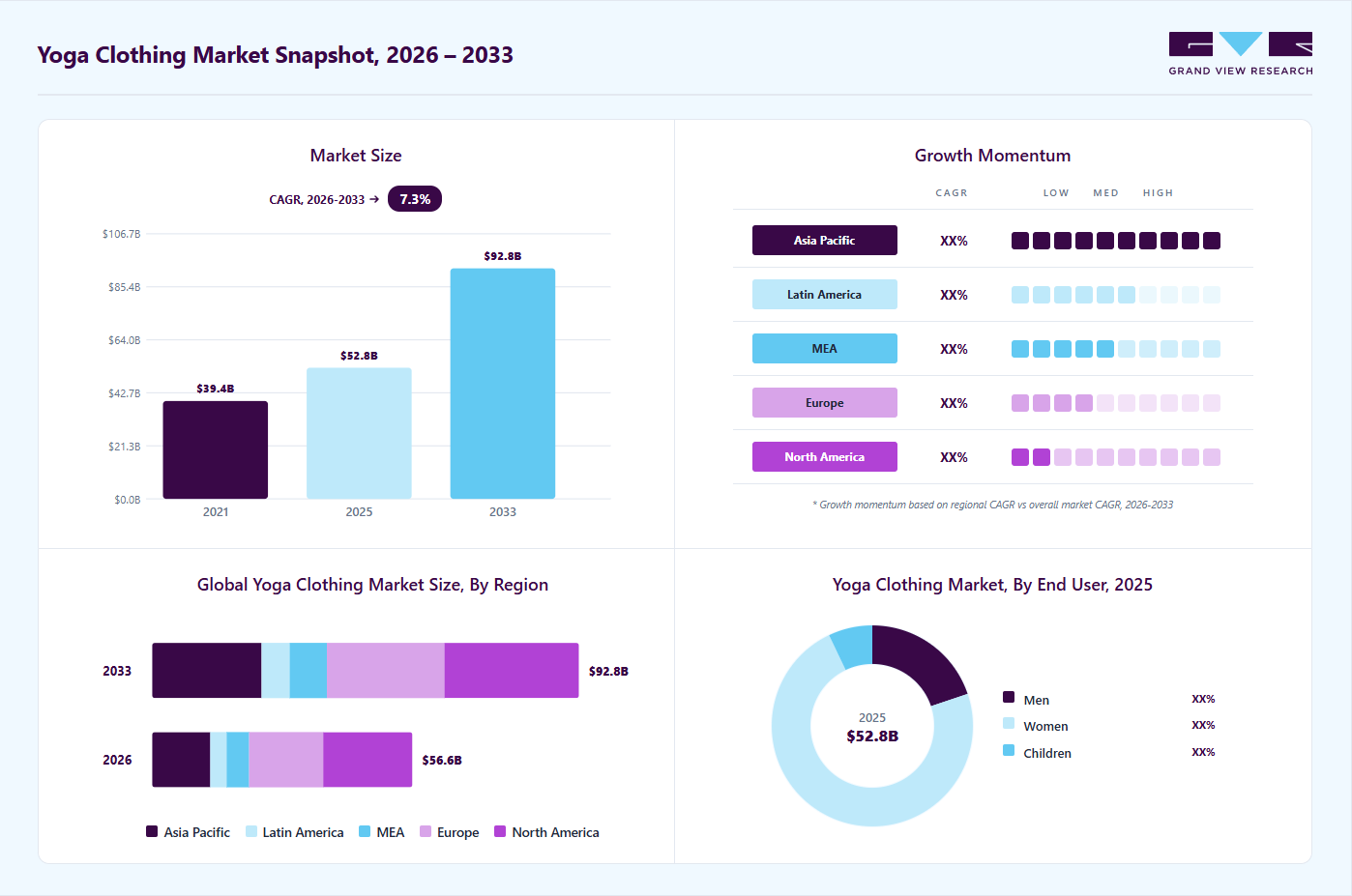
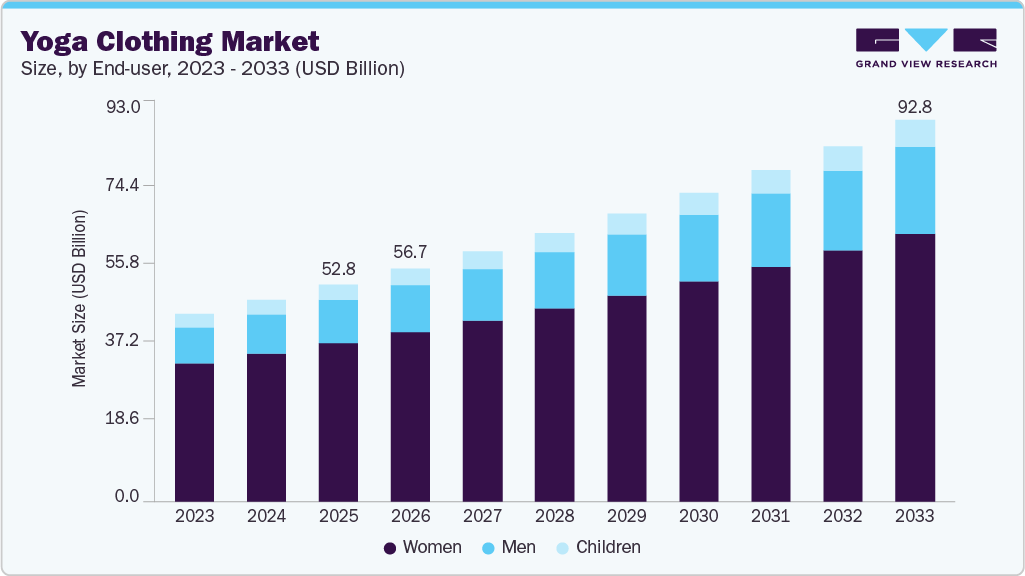
The yoga clothing market size was valued at USD 52.8 billion in 2025 and is projected to grow from USD 56.6 billion in 2026 to USD 92.8 billion by 2033, growing at a CAGR of 7.3% from 2026 to 2033. North America dominated the yoga clothing market with the largest revenue share of 34.6% in 2025. A sharp increase in the health-conscious population globally and rising incidences of lifestyle disorders such as diabetes and heart disease have driven the popularity of yoga exercises.
 Source: Grand View Research, IR Documents, Primary Interviews, Paid DatabasesTo learn more about this report,
 Download Free Sample Report
 Key Market Trends & Insights
- By product: Bottom wear segment led the market with the largest revenue share of 54.1% in 2025
- By price tier: Mass price segment led the market with the largest revenue share of 50.4% in 2025.
- By material: Polyester segment led the market with the largest revenue share of 29.5% in 2025.
- By distribution channel: Online/e-commerce segment led the market with the largest revenue share of 39.4% in 2025
Regional Highlights
- Largest regional market: North America (34.6% revenue share, 2025)
- Fastest-growing regional market: Asia Pacific (highest CAGR, 2026-2033)
- By country: The U.S. held the largest market share in 2025
Market Size & Forecast
- Market size in 2025: USD 52.8 Billion
- Estimated market size in 2026: USD 56.6 Billion
- Projected market size by 2033: USD 92.8 Billion
- CAGR (2026-2033): 7.3%
Three ways to get this report
Buy it, customize it, or ask a question.Ask an Analyst
Analyst response in 1 business day
- AccessReport author, directly
- Reply timeWithin 1 working day
- No sales callDirect answer only
- FormatEmail reply
- CostFree, no cost
Get the Full Report
What the study covers
- FormatsPDF · Excel · Dashboard
- Timeline2026–2033 annual, 2025 base
- Coverage20+ countries, 5 regions
- Companies10+ key players profiled
Customize the Report
20% free customization
- IncludeCountries, segments, points
- TailorTo your product definition
- ExtendDeeper competitor detail
- OrA fully bespoke study
- Turnaround5–10 working days
As a result, consumers are compelled to purchase appropriate clothing items and accessories that can enable them to practice different postures while also maintaining their comfort levels, directly supporting growth in the yoga pants market.Furthermore, the steadily growing presence of major clothing and lifestyle brands in this segment has boosted competition in the yoga clothing industry, driving the launch of products that offer unique features or use advanced materials. Yoga has become a mainstream fitness activity that people of all ages and backgrounds are practicing. As per a report by Yoga Vidya School, as of 2023, over 300 million people practiced Yoga globally, highlighting its popularity and awareness regarding its health benefits. This growing participation has created a strong activewear market that accommodates Yoga and other fitness routines such as Pilates, running, or cycling.
Social media platforms, including Instagram, TikTok, and YouTube, have played a major role in popularizing Yoga and fitness culture. Influencers and fitness trainers frequently showcase yoga clothing, creating a strong link between activewear and wellness lifestyle, thus driving consumer interest and purchases. In addition, yoga retreats, workshops, and the expansion of yoga studios worldwide have increased the demand for high-quality, stylish, and comfortable yoga clothing, further supporting the expansion of the yoga pants market.
 To learn more about this report, Download Free Sample Report
 The popular fashion trend of ‘athleisure’ has compelled manufacturers to design yoga clothing that can also function as everyday apparel due to its comfort, style, and versatility. Many celebrities, influencers, and high-profile athletes promote such products through collaborations with major brands, which engages customers and boosts product sales. Moreover, innovations in fabric technology, such as moisture-wicking, anti-odor, and flexible materials, have made yoga clothing more comfortable and functional. These fabrics help regulate body temperature, enhance movement, and improve durability, which increases their appeal to consumers. Tech-integrated clothing is also expected to become a major market trend in the coming years as companies seek to leverage smart fabrics that can monitor the wearer’s vitals while they perform their routines. Brands that offer inclusive sizing have also witnessed a surge in demand, as they enable plus-sized people to practice Yoga while also optimizing their comfort.
Growth in premium and luxury activewear positioning is reshaping the market by shifting consumer focus from basic functionality to brand-driven value, design aesthetics, and an elevated product experience, significantly influencing the high-end market. Consumers are increasingly willing to pay higher prices for apparel that delivers superior fit, durability, and a distinct lifestyle identity rather than just performance benefits. Brands such as Lululemon Athletica and Alo Yoga have built strong demand by combining technical fabrics with minimalist design, community-driven branding, and aspirational retail environments, turning yoga wear into a status-oriented purchase and accelerating the development of the high-end market.
This premiumization trend is further reinforced by emerging brands that position activewear within a broader wellness narrative rather than standalone apparel. For instance, in November 2025, entrepreneur Isha Jain launched A29 Wellbeing in Mumbai, presenting it as a premium activewear label integrated with a holistic wellness movement. The brand introduced performance-focused apparel such as leggings, sports bras, t-shirts, and joggers, along with accessories including yoga mats and bags, all designed for comfort and functionality. Its positioning extends beyond products to include future plans for wellness centers, recovery spaces, and expert-led health programs, reinforcing the shift toward experience-led, lifestyle-driven consumption and further strengthening the market.
Furthermore, rising penetration of organized retail and brand-owned stores is strengthening the market, including the U.S. market, by improving product accessibility, fit confidence, and brand engagement. Physical retail formats allow consumers to experience fabric quality, stretch, and comfort firsthand, critical factors in yoga apparel purchasing, reducing hesitation compared to online-only buying. Brands such as Lululemon Athletica and Nike are expanding exclusive stores and experiential outlets where trained staff guide consumers on product selection based on activity type and body fit. These developments are particularly visible in the market, where experiential retail plays a key role in influencing purchasing decisions and building brand loyalty.
In October 2025, Alo Yoga announced the expansion of its European retail footprint through multiple new store openings in the United Kingdom, including Manchester, Leeds, and London. This marked the company’s first expansion beyond the capital, with locations positioned in high-footfall, culturally significant retail destinations. The stores are designed as “wellness sanctuaries” that integrate retail with community and mindfulness experiences, reinforcing the brand’s positioning at the intersection of fashion, wellness, and lifestyle while supporting its broader international growth strategy, a model that is also influencing strategies adopted in the U.S. market.
Brand Market Share Insights
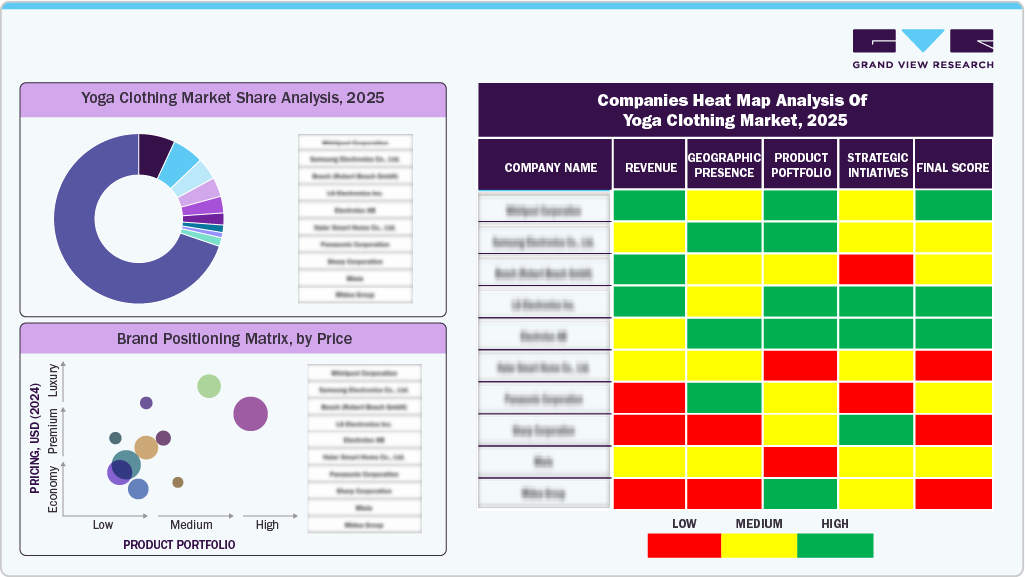
The global market is highly competitive, driven by established sportswear leaders and emerging lifestyle-focused brands competing on performance, design, and brand identity. Major players such as Nike, Adidas AG, Lululemon Athletica, Puma SE, and Under Armour maintain strong positions through broad product portfolios, global distribution, and continuous innovation in fabric technology and fit. At the same time, premium brands such as Alo Yoga and Vuori are expanding by blending wellness, fashion, and community-driven branding. The rapid growth of e-commerce and direct-to-consumer channels is further intensifying competition, enabling both global and niche brands to scale quickly and differentiate through design, sustainability, and lifestyle positioning.
 To learn more about this report, Download Free Sample Report
 Consumer Insights
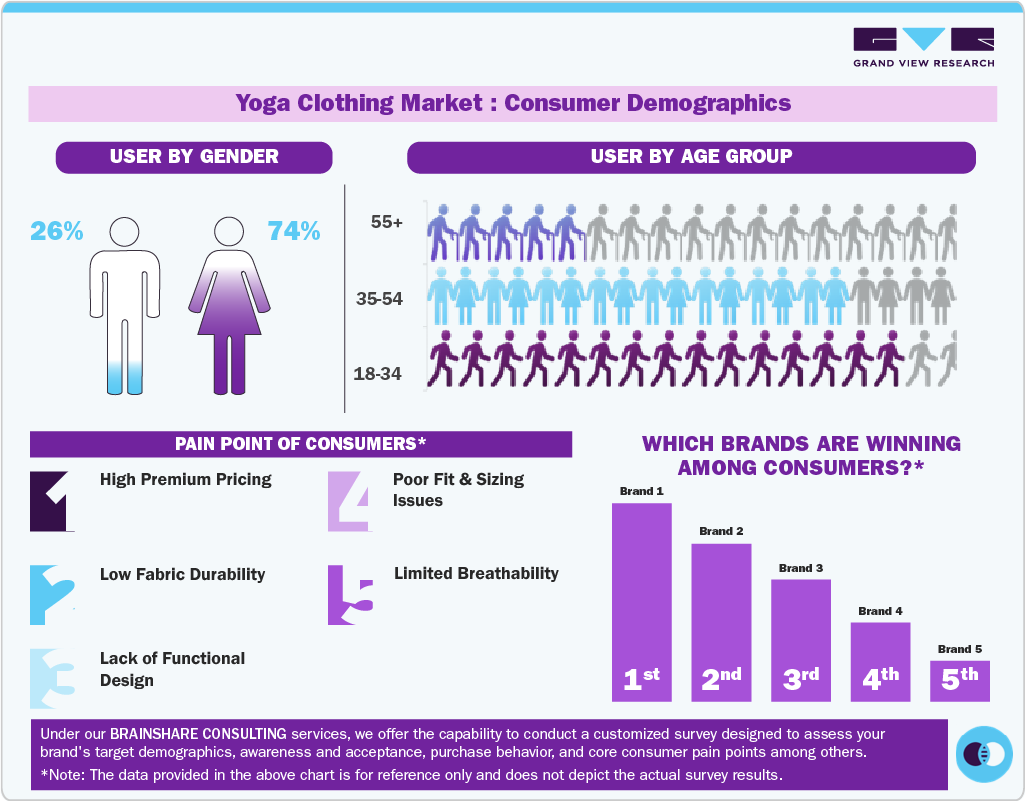
Consumers increasingly evaluate yoga clothing based on fabric composition, performance attributes, and brand transparency before making purchasing decisions. Technical features such as moisture-wicking capability, four-way stretch, breathability, and durability have become essential, particularly among regular yoga practitioners who prioritize comfort during extended sessions. Materials such as recycled polyester, organic cotton, and nylon blends are gaining traction as consumers look for apparel that balances performance with sustainability. As a result, product labels, fabric innovation claims, and functional benefits are playing a more decisive role in influencing purchase behavior across both entry-level and premium price tiers.
 To learn more about this report, Download Free Sample Report
 Rising preference for sustainability and ethical production is also shaping consumer choices in the market. A growing share of consumers actively seeks apparel made using eco-friendly materials and responsible manufacturing practices, reflecting broader awareness around environmental impact. Digital platforms such as Instagram and YouTube are significantly influencing these preferences, as fitness influencers and wellness creators showcase sustainable activewear brands and educate audiences on fabric quality and sourcing. This has accelerated demand for brands that combine performance with transparency, particularly among younger, urban consumers who align their purchasing decisions with personal values around sustainability and mindful consumption.
Market Dynamics
Yoga clothing is witnessing strong demand as consumers increasingly integrate fitness, wellness, and active lifestyles into their daily routines. Modern yoga apparel is designed with features such as moisture-wicking fabrics, four-way stretch materials, breathability, compression support, and seamless construction that enhance comfort and performance during yoga, fitness training, and other physical activities. Beyond functionality, yoga clothing has become a key component of the growing athleisure trend, with consumers seeking versatile apparel that can be worn for both exercise and everyday activities. The rising participation in yoga, and wellness-focused fitness programs, coupled with increasing health consciousness and disposable incomes, is driving market expansion. Furthermore, growing demand for sustainable and eco-friendly activewear made from recycled and organic materials, along with continuous product innovation by leading brands, is expected to support the long-term growth of the yoga clothing market.
The increasing popularity of celebrity-endorsed and celebrity-founded activewear brands is emerging as a key driver for the yoga clothing market. Celebrities, fitness influencers, and professional athletes are leveraging their large social media followings to promote yoga apparel as both a performance and lifestyle product, significantly influencing consumer purchasing decisions. Collaborations between apparel brands and high-profile personalities help create aspirational value, strengthen brand recognition, and attract younger consumers seeking fashionable and premium activewear. Furthermore, limited-edition collections and celebrity-backed product launches generate strong consumer engagement and drive repeat purchases. As social media continues to shape fashion and fitness trends, the influence of celebrity-endorsed activewear brands is expected to support sustained growth in the yoga clothing market.
The yoga clothing market faces significant challenges due to the increasing presence of global brands, private-label retailers, and low-cost manufacturers offering similar products at competitive prices. The availability of a wide range of yoga apparel with comparable designs, materials, and functionalities has intensified price competition and reduced product differentiation. As a result, manufacturers often face pressure on profit margins while struggling to maintain brand loyalty. Additionally, the proliferation of counterfeit products and inexpensive alternatives, particularly through online sales channels, further limits the growth potential of premium brands. This highly fragmented and competitive market environment is expected to restrain revenue growth for market participants over the forecast period.
The increasing consumer preference for sustainable and environmentally responsible products is creating significant growth opportunities in the yoga clothing market. Modern consumers, particularly millennials and Gen Z, are becoming more conscious of the environmental impact of their purchasing decisions and are actively seeking apparel made from recycled polyester, organic cotton, bamboo fibers, and other sustainable materials. This shift in consumer behavior is encouraging manufacturers to invest in eco-friendly fabric technologies, ethical sourcing practices, and transparent supply chains.
Furthermore, the growing emphasis on sustainability within the fashion and activewear industries is driving innovation in biodegradable materials, low-impact dyeing processes, and circular fashion initiatives. Brands that successfully combine performance, comfort, and sustainability are gaining a competitive advantage and attracting environmentally conscious consumers. As sustainability becomes a key purchasing criterion among fitness and wellness enthusiasts, demand for eco-friendly yoga clothing is expected to create substantial growth opportunities for market participants over the forecast period.
Analyst Perspective
The yoga clothing market benefits from the convergence of wellness adoption, athleisure expansion, and premium activewear demand. While performance features have become increasingly standardized across brands, the strongest competitive advantage will belong to companies that combine technical innovation, sustainability, and strong lifestyle branding. Brands that successfully build loyal consumer communities and position yoga apparel as an everyday lifestyle essential rather than solely fitness wear will be best positioned to sustain premium pricing and long-term growth.
Product Insights
Based on product, the bottom wear segment led the market with the largest revenue share of 54.1% in 2025 and is expected to grow at the fastest CAGR over the forecast period, driven by strong consumer demand for versatile, performance-oriented apparel such as t-shirts, tank tops, sports bras, and long-sleeve tops. These products play a central role in yoga practice by offering breathability, flexibility, and effective moisture management, ensuring comfort across different movements and session intensities. Continuous fabric innovation, including sweat-wicking materials, seamless designs, and stretchable blends, further enhances product appeal, while layering flexibility allows easy pairing with leggings, joggers, or shorts.
Outerwear is anticipated to grow at a CAGR of 8.9% from 2026 to 2033, driven by increasing demand for functional and versatile apparel that supports outdoor workouts and changing weather conditions. Products such as jackets, hoodies, and sweatshirts are gaining popularity as consumers expand yoga and fitness activities beyond indoor studios to parks, travel, and hybrid routines, requiring layering solutions that provide warmth and flexibility. Advancements in fabric technology, including lightweight insulation, breathability, and weather-resistant materials, are enhancing product appeal by offering comfort without restricting movement. At the same time, the rising influence of athleisure is positioning outerwear as both performance wear and casual fashion, with minimalist designs and relaxed fits attracting urban consumers.
Material Insights
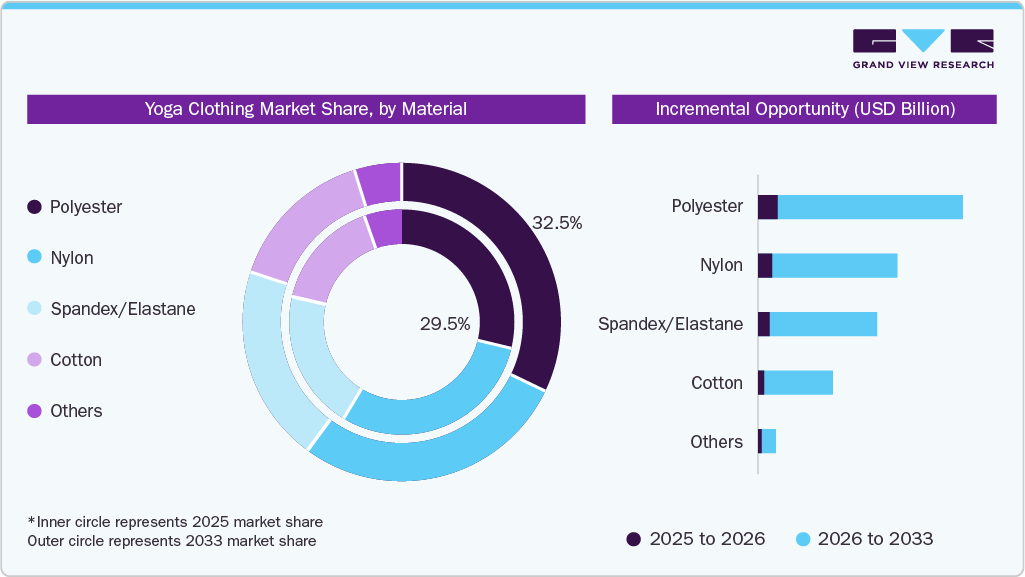
Based on material, the polyester segment led the market with the largest revenue share of 29.5% in 2025, supported by its balanced combination of performance, durability, and affordability, making it suitable for regular use across various yoga and fitness routines. The material is widely preferred for its moisture-wicking and quick-drying properties, which help maintain comfort during both low- and high-intensity sessions, while also offering resistance to wear, stretching, and shrinkage over time. Polyester-based apparel effectively manages sweat and supports ease of movement, making it a practical choice for daily workouts.
 To learn more about this report, Download Free Sample Report
 Spandex/elastane yoga clothing is expected to grow at a CAGR of 7.5% from 2026 to 2033, supported by increasing consumer preference for form-fitting apparel that enhances body confidence and provides a sculpted appearance during workouts. The rising influence of body-conscious fitness trends and social media-driven aesthetics is encouraging consumers to choose garments that offer compression, contouring, and a second-skin feel. In addition, the growing popularity of hybrid fitness formats such as Pilates, barre, and functional training is driving demand for apparel that can accommodate varied movement patterns without losing shape.
End User Insights
Based on end user, the women segment led the market with the largest revenue share of 73.1% in 2025, driven by higher participation of women in yoga, fitness, and wellness-oriented activities, along with strong adoption of athleisure as part of daily wear. Women consumers actively seek apparel that combines comfort, flexibility, and style, leading to increased demand for products such as leggings, sports bras, tank tops, and coordinated sets. These garments are designed to support a wide range of movements while offering body-contouring fits and aesthetic appeal, making them suitable for both workouts and casual settings. In addition, growing interest in wellness lifestyles, home workouts, and studio-based fitness programs is encouraging repeat purchases and wardrobe expansion.
The demand for yoga clothing among men is expected to grow at a CAGR of 9.1% from 2026 to 2033, driven by increasing participation in yoga, fitness training, and wellness-focused routines. Male consumers are progressively seeking performance-oriented apparel such as compression t-shirts, breathable tanks, and flexible shorts that support mobility, sweat management, and all-day comfort. Growing awareness around physical fitness and mental well-being is encouraging more consistent engagement in yoga, while the expansion of men’s activewear lines is improving product availability and choice.
Price Tier Insights
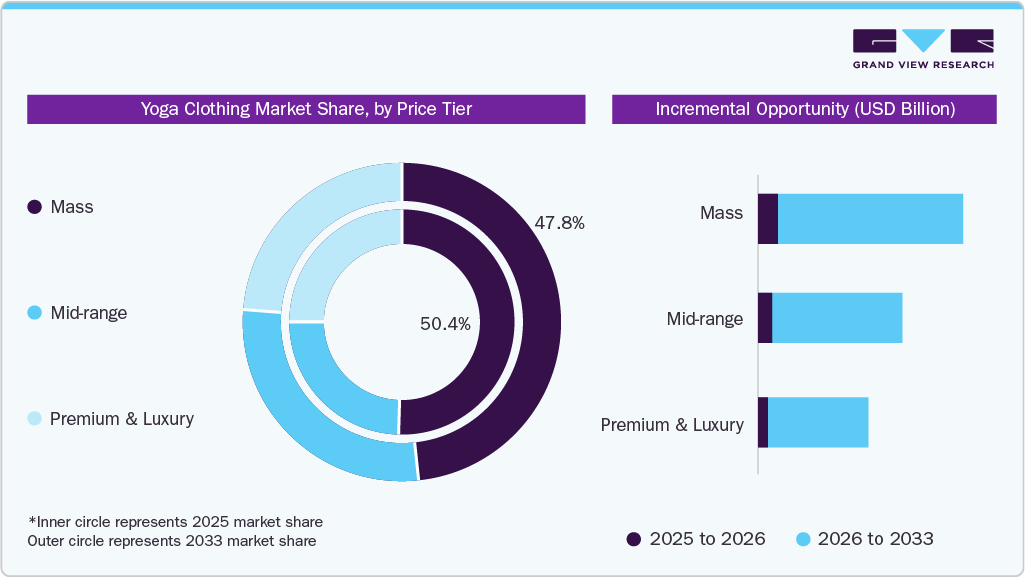
Based on price tier, the mass price segment led the market with the largest revenue share of 50.4% in 2025, driven by strong demand for affordable and functional apparel that caters to a wide consumer base engaged in regular yoga and fitness activities. Consumers in this segment prioritize value for money, opting for products that deliver essential features such as comfort, breathability, and durability at accessible price points. Basic categories, including t-shirts, leggings, tank tops, and shorts, are widely adopted for everyday use, particularly among beginners and price-sensitive buyers who focus on practicality over brand positioning.
 To learn more about this report, Download Free Sample Report
 Mid-range yoga clothing is expected to grow at a CAGR of 8.8% from 2026 to 2033, driven by the increasing demand for work-to-workout versatility among urban consumers who require apparel that can transition seamlessly between professional, casual, and fitness settings. This segment is also benefiting from the rapid expansion of private labels and in-house brands by large retailers, which offer improved design and quality at competitive price points. In addition, growing participation in group fitness formats such as yoga studios, community classes, and wellness retreats is encouraging consumers to invest in coordinated and presentable activewear without entering premium price tiers.
Distribution Channel Insights
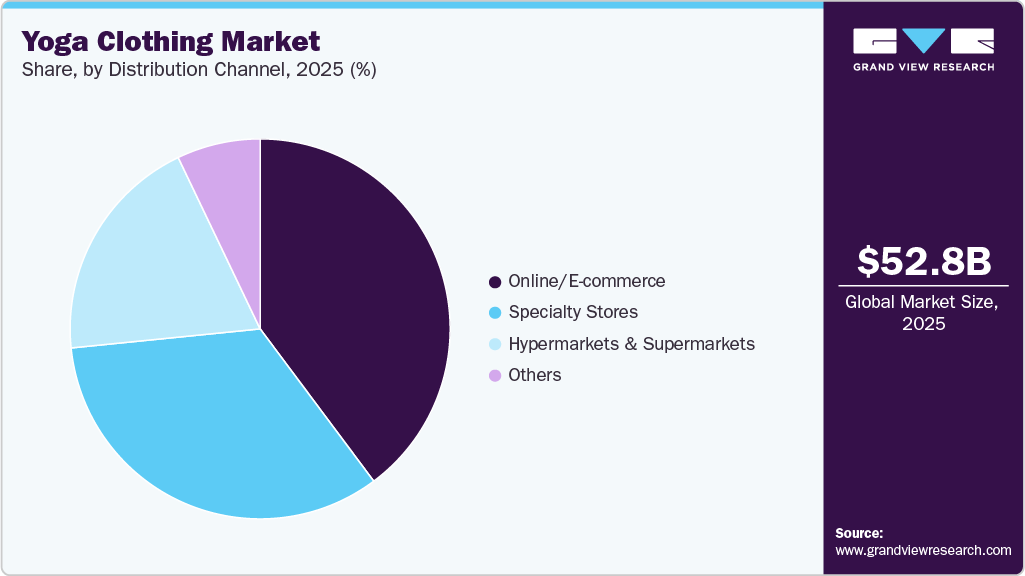
Based on distribution channels, the online/e-commerce segment led the market with the largest revenue share of 39.4% in 2025, driven by strong consumer preference for personalized shopping experiences and expert guidance when selecting performance-oriented apparel. These stores offer curated product assortments where consumers can directly assess fabric quality, fit, stretch, and overall comfort, which is particularly important for items such as leggings and sports bras. In-store assistance from trained staff further supports informed purchasing decisions based on activity type and individual preferences. In addition, specialty stores often carry premium and niche brands, exclusive collections, and new product launches, attracting consumers seeking differentiated offerings.
 To learn more about this report, Download Free Sample Report
 The sale of yoga clothing through online/e-commerce channels is expected to grow at a CAGR of 8.3% from 2026 to 2033, driven by increasing consumer preference for convenience, wider product accessibility, and seamless digital shopping experiences. Online platforms enable consumers to browse a diverse range of brands, styles, and price segments while easily comparing features such as fabric quality, fit, and performance. Detailed product descriptions, size guides, and customer reviews support informed purchasing decisions, particularly among new buyers. In addition, the strong influence of social media, fitness influencers, and targeted digital marketing is accelerating product discovery and engagement.
Regional Insights
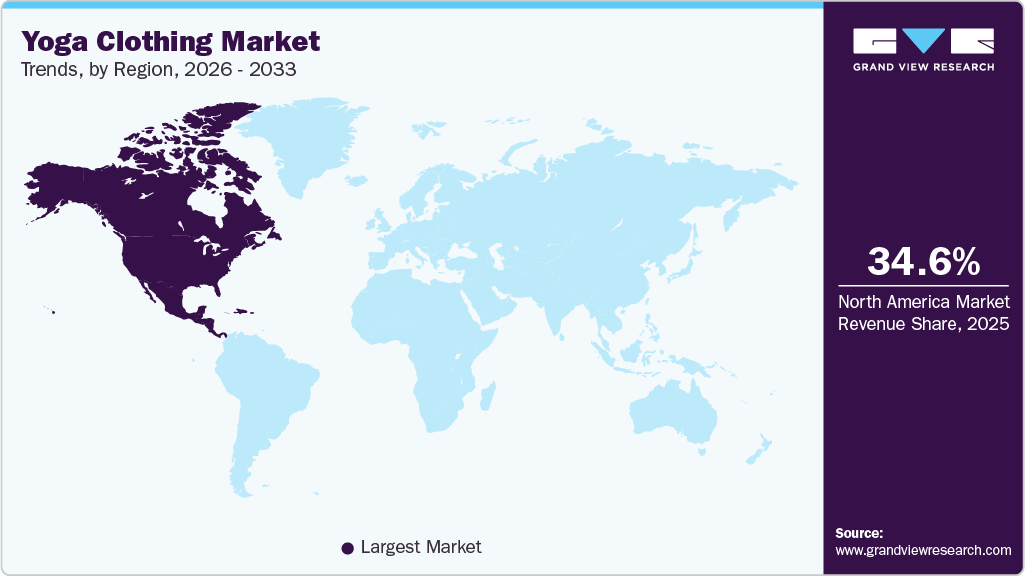
North America dominated the yoga clothing market with the largest revenue share of 34.6% in 2025. The industry is driven by high participation in fitness and wellness activities and strong adoption of athleisure as part of everyday wear. Consumers across the U.S. and Canada invest in performance-oriented apparel that combines comfort, functionality, and style, supporting consistent demand across product categories. The region benefits from the presence of established activewear brands, continuous product innovation, and a well-developed retail ecosystem spanning specialty stores and e-commerce platforms. In addition, rising awareness of physical health and mental well-being is encouraging regular engagement in yoga and structured fitness routines.
 To learn more about this report, Download Free Sample Report
 U.S. Yoga Clothing Market Trends
The yoga clothing market in the U.S. held the largest share in the North America region in 2025. The market is driven by strong consumer engagement in fitness, wellness, and athleisure lifestyles. Consumers actively invest in performance-oriented apparel that combines comfort, functionality, and style, supporting consistent demand across key categories such as leggings, sports bras, and tops. The market benefits from the presence of leading activewear brands, continuous product innovation, and a well-established retail ecosystem spanning specialty stores and e-commerce platforms. In addition, the growing popularity of home workouts, studio-based fitness, and hybrid exercise routines is encouraging repeat purchases and wardrobe expansion.
Canada yoga clothing marketis expected to grow at a CAGR of 9.1% from 2026 to 2033. The market is driven by increasing participation in yoga, fitness, and outdoor wellness activities. Consumers are actively adopting apparel that offers both performance and comfort, particularly for routines that extend beyond indoor settings to include outdoor and seasonal workouts. This is driving demand for versatile products such as layered tops, leggings, and weather-adaptive outerwear suited to varying climatic conditions. In addition, rising awareness of sustainability and mindful consumption is encouraging preference for eco-friendly materials and ethically produced garments.
Europe Yoga Clothing Market Trends
The yoga clothing industry in Europe is accounted for the revenue share of 28.5% in 2025. The European market is driven by strong adoption of fitness and wellness lifestyles alongside the growing integration of athleisure into everyday fashion. Consumers across France, Germany, Italy, Spain, and the UK prefer yoga clothing that combines performance functionality with modern design, supporting consistent demand across categories such as leggings, tops, and outerwear. The market is further supported by a well-developed retail ecosystem and the presence of both global and regional brands focusing on fabric innovation, product quality, and sustainability.
Germany yoga clothing market accounted for a revenue share of around 21.0% in 2025. The market is driven by strong participation in fitness, wellness, and outdoor activities. Consumers actively prefer high-quality, performance-oriented apparel that delivers durability, comfort, and functional design, supporting consistent demand across categories such as leggings, tops, and outerwear. The market reflects a clear preference for precise fit and advanced fabric performance, including moisture-wicking, stretchability, and long-lasting materials suited for regular use. In addition, growing emphasis on sustainability is influencing purchasing decisions, with increasing demand for eco-friendly fabrics and ethically produced garments.
The yoga clothing market in the UK is expected to grow at a CAGR of 8.7% from 2026 to 2033. The market is supported by the increasing demand for seasonally adaptable activewear suited to the region’s variable climate. Consumers are prioritizing layering-friendly apparel such as lightweight jackets, long-sleeve tops, and thermal leggings that can be used across changing weather conditions. In addition, the growing popularity of wellness tourism, yoga retreats, and weekend fitness experiences is encouraging consumers to invest in coordinated and travel-friendly activewear collections. The expansion of private-label offerings by major retailers is also making stylish and performance-oriented yoga clothing more accessible at competitive price points.
Asia Pacific Yoga Clothing Market Trends
The yoga clothing industry in the Asia Pacific is expected to grow at a CAGR of 9.4% from 2026 to 2033. The market is supported by the rapid expansion of organized fitness infrastructure, including yoga studios, wellness centers, and corporate fitness programs across urban areas. Increasing work-related stress and sedentary lifestyles are encouraging consumers to adopt yoga as part of their daily routines, driving consistent demand for dedicated apparel. In addition, the strong presence of cost-competitive manufacturing hubs in countries such as China and Vietnam enables brands to offer a wide range of products at varied price points, improving market penetration.
China yoga clothing market accounted for a revenue share of around 36.8% on the Asia Pacific market in 2025. The market is driven by strong participation in fitness, yoga, and wellness activities among urban consumers. Rapid urbanization and increasingly busy lifestyles are encouraging the adoption of flexible fitness routines such as home workouts and studio-based sessions, supporting steady demand for comfortable and performance-oriented apparel. Consumers prefer products that combine functionality with modern design, driving sales of leggings, tops, and coordinated sets. The market is further supported by the expansion of domestic activewear brands and the strong growth of e-commerce platforms, which enhance product accessibility across cities.
The yoga clothing market in India is expected to grow at a CAGR of 11.6% from 2026 to 2033. The market is driven by the increasing adoption of yoga and fitness as part of everyday lifestyles, supported by strong cultural relevance and rising health awareness. Urban consumers are actively engaging in yoga, gym workouts, and home-based fitness routines, creating consistent demand for comfortable and functional apparel such as leggings, t-shirts, and coordinated activewear sets. The market is further supported by government-led wellness initiatives and large-scale yoga participation, which are expanding the consumer base across different age groups. In addition, the rapid growth of e-commerce platforms and the presence of affordable domestic brands are improving accessibility across metropolitan and tier-2 cities.
Central & South America Yoga Clothing Market Trends
The yoga clothing industry in CSA is expected to grow at a CAGR of 7.7% from 2026 to 2033. The market is driven by increasing participation in fitness, dance-based workouts, and wellness activities across urban populations. Consumers in Brazil, Mexico, and Chile are actively adopting active lifestyles, supporting demand for comfortable and flexible apparel suited for yoga, gym training, and outdoor activities. The region’s strong fitness culture and rising health awareness are encouraging consistent engagement and repeat purchases of activewear. In addition, the growing influence of body-positive fashion trends is driving demand for form-fitting and visually appealing yoga clothing, particularly among younger consumers.
Middle East & Africa Yoga Clothing Market Trends
The yoga clothing industry in the MEA is expected to grow at a CAGR of 7.5% from 2026 to 2033. The market is driven by increasing adoption of fitness and wellness lifestyles and a rising number of women participating in yoga and studio-based activities. Consumers in the UAE, Saudi Arabia, and South Africa are actively seeking modest yet functional activewear that aligns with cultural preferences while offering comfort and performance, supporting demand for full-length leggings, long-sleeve tops, and layered apparel. The market is further supported by the expansion of premium retail infrastructure, international brand presence, and growing e-commerce penetration across urban centers.
Key Yoga Clothing Companies:
The following key companies have been profiled for this study on the yoga clothing market.
- lululemon athletica
- Green Apple Active
- Alo, LLC
- Be present
- Beyond Yoga
- Athleta LLC
- CRZ YOGA
- Mukha Yoga
- Mika Body Wear
- Jala
Competitive Benchmarking
Category
Operating Strategies
Competitive Edge
Weakness
Established Players (Lululemon Athletica Inc., Nike, Inc., Adidas AG, Puma SE, Athleta LLC, Under Armour, Inc.)
- Expand product portfolios through performance fabrics, sustainable collections, omnichannel retail networks, celebrity collaborations, and direct-to-consumer (DTC) platforms. Invest in brand communities, yoga events, and digital engagement to strengthen customer loyalty.
- Strong brand recognition, extensive distribution networks, premium product positioning, significant marketing budgets, and advanced fabric innovation capabilities. Large customer base enables economies of scale and high customer retention.
- High operational and manufacturing costs, dependence on consumer discretionary spending, slower response to niche fashion trends, and exposure to inventory management challenges in rapidly changing apparel markets.
Emerging Players (Alo Yoga, Beyond Yoga, Girlfriend Collective, CRZ YOGA, Vuori, Manduka Apparel)
- Focus on niche consumer segments such as sustainable activewear, premium athleisure, yoga-specific apparel, and digital-first sales strategies. Leverage influencer partnerships, social media marketing, and community-driven brand building to increase visibility.
- Greater agility in responding to emerging fashion trends, stronger appeal among younger consumers, innovative sustainability initiatives, and ability to create highly targeted product offerings.
- Limited financial resources compared to global brands, lower brand awareness in international markets, dependence on digital customer acquisition, and challenges in scaling operations while maintaining profitability.
Recent Developments
-
In February 2026, Lululemon Athletica announced the opening of its 100th store in the Europe, Middle East, and Africa (EMEA) region, marking a key milestone in its international expansion strategy. The expansion reflects the brand’s continued focus on growing its presence outside North America through a mix of company-operated and franchise stores, supported by partnerships such as its collaboration with Arion Retail Group. This milestone highlights Lululemon’s efforts to strengthen global market reach while building localized retail and community engagement across international markets.
-
In July 2025,H&M Move launched the SoftMove Pilates collection, featuring lightweight and breathable activewear designed for low-intensity workouts. The range includes bras, shorts, and flared leggings in soft fabrics and neutral tones, along with accessories such as yoga mats and ankle weights, positioning the collection for both studio use and everyday wear.
Yoga Clothing Market Report Scope
Report Attribute
Details
Market size in 2025
USD 52.8 billion
Estimated market size in 2026
USD 56.6 billion
Projected market size by 2033
USD 92.8 billion
Growth rate
CAGR of 7.3% from 2026 to 2033
Base year for estimation
2025
Historical data
2021 - 2024
Forecast period
2026 - 2033
Quantitative units
Revenue in USD million/billion and CAGR from 2026 to 2033
Report coverage
Revenue forecast, company ranking, competitive landscape, growth factors, and trends
Segments covered
Product, End user, material, distribution channel, region
Regional scope
North America; Europe; Asia Pacific; Latin America; MEA
Country scope
U.S.; Canada; Mexico; Germany; UK; France; Italy; Spain; China; Japan; India; South Korea; Australia & New Zealand; Thailand; Malaysia; Singapore; Brazil; Argentina; Colombia; Saudi Arabia; South Africa; UAE
Key companies profiled
lululemon athletica; Green Apple Active; Alo, LLC; Be present; Beyond Yoga; Athleta LLC; CRZ YOGA; Mukha Yoga; Mika Body Wear; Jala
Customization scope
Free report customization (equivalent up to 8 analysts' working days) with purchase. Addition or alteration to country, regional & segment scope.
Pricing and purchase options
Avail customized purchase options to meet your exact research needs. Explore purchase options
Global Yoga Clothing Market Report Segmentation
This report forecasts revenue growth at global, regional & country levels and provides an analysis of the latest trends and opportunities in each of the sub-segments from 2021 to 2033. For this study, Grand View Research has segmented the yoga clothing market based on product, material, end user, price tier, distribution channel, and region:
-
Product Outlook (Revenue, USD Million, 2021 - 2033)
-
Top Wear
-
Tank Tops & Vests
-
T-shirts
-
Sports Bras
-
-
Bottom Wear
-
Leggings and Pants
-
Shorts and Capris
-
-
Outerwear
-
Jackets
-
Hoodies
-
Sweatshirts
-
-
Accessories
-
-
Material Outlook (Revenue, USD Million, 2021 - 2033)
-
Polyester
-
Nylon
-
Spandex/Elastane
-
Cotton
-
Others
-
-
End User Outlook (Revenue, USD Million, 2021 - 2033)
-
Men
-
Women
-
Children
-
-
Price Tier Outlook (Revenue, USD Million, 2021 - 2033)
-
Mass
-
Mid-range
-
Premium & Luxury
-
-
Distribution Channel Outlook (Revenue, USD Million, 2021 - 2033)
-
Hypermarkets & Supermarkets
-
Specialty Stores
-
Online/E-commerce
-
Others
-
-
Regional Outlook (Revenue, USD Million, 2021 - 2033)
-
North America
-
U.S.
-
Canada
-
Mexico
-
-
Europe
-
Germany
-
UK
-
France
-
Italy
-
Spain
-
-
Asia Pacific
-
China
-
India
-
Japan
-
Australia & New Zealand
-
South Korea
-
Malaysia
-
Singapore
-
Thailand
-
-
Central & South America
-
Brazil
-
Argentina
-
Colombia
-
-
Middle East & Africa
-
South Africa
-
Saudi Arabia
-
UAE
-
-
Research Methodology
Segment Definition
Segment - Type
Revenue capture definition
Polyester
This segment covers the revenues generated through the sales of yoga clothing manufactured using polyester fabrics. Polyester is widely used in yoga apparel due to its durability, moisture-wicking properties, wrinkle resistance, and ability to retain shape after repeated use. It is particularly suitable for high-intensity yoga sessions and active lifestyles where sweat management and quick drying are important.
Nylon
This segment covers the revenues generated through the sales of yoga clothing made from nylon-based fabrics. Nylon is valued for its lightweight feel, softness, high elasticity, and abrasion resistance, providing enhanced comfort and flexibility during yoga practice. The material also offers a smooth texture and excellent stretch recovery, making it a preferred choice for premium yoga apparel.
Spandex/Elastane
This segment covers the revenues generated through the sales of yoga clothing manufactured using spandex or elastane fibers, either as a standalone material or blended with other fabrics. Spandex/elastane provides exceptional stretchability, flexibility, and shape retention, enabling unrestricted movement during yoga poses and fitness activities. It is commonly incorporated into yoga apparel to improve fit and comfort.
Cotton
This segment covers the revenues generated through the sales of yoga clothing produced using cotton fabrics. Cotton is a natural fiber known for its softness, breathability, skin-friendliness, and comfort. It is commonly preferred for low-intensity yoga practices, meditation sessions, and casual athleisure wear. Organic cotton variants are also gaining popularity among environmentally conscious consumers.
Others (Material)
This segment covers the revenues generated through the sales of yoga clothing manufactured using alternative materials, including bamboo fibers, rayon, hemp, recycled fabrics, and fabric blends. These materials are increasingly used to enhance sustainability, moisture management, softness, temperature regulation, and overall garment performance.
Estimation Model
Name
Focus Question
Description
Fitness & Wellness Participation Layer
Who is likely to purchase yoga clothing?
Identifies the global population actively participating in yoga, fitness training, wellness programs, and athleisure-focused lifestyles. Includes practitioners, gym members, enthusiasts, and those adopting wellness-oriented routines to define the potential consumer base.
Spending & Accessibility Layer
Who can access and afford yoga clothing?
Applies region-specific disposable income levels, urbanization rates, fitness infrastructure penetration, and retail accessibility (offline and online) to the eligible consumer population to estimate the addressable market with purchasing power.
Consumer Adoption Layer
Who actively purchases yoga clothing?
Applies activewear adoption rates, athleisure penetration, brand preference trends, and purchase frequency benchmarks to convert the addressable population into active yoga clothing buyers. Considers factors like health consciousness, fashion trends, social media influence, and fitness activity participation.
Revenue Generation Layer
How much revenue is generated?
Estimates market revenue by multiplying active consumers by average annual spending on yoga clothing (leggings, tops, sports bras, outerwear, accessories). Incorporates revenue from premium products, sustainable apparel, direct-to-consumer channels, and repeat purchases to derive total market value.
Delivered Customizations
This report has been delivered with the following In-depth customizations
CLIENT REQUEST
CUSTOMIZATION DELIVERED
VALUE ADDS
Growth Potential of E-commerce, Direct-to-Consumer, and Alcohol Delivery Channels
Assessed the adoption of online alcohol retail, direct-to-consumer sales models, quick-commerce platforms, and alcohol delivery services, including their impact on rum accessibility, premium product discovery, and consumer purchasing behavior.
Enables stakeholders to identify high-growth distribution channels, optimize route-to-market strategies, and evaluate opportunities for expanding premium rum sales through digital commerce ecosystems.
Market Share Assessment of Established and Emerging Industry Participants
Evaluated the competitive positioning, brand portfolios, and geographic presence, distribution capabilities, and market influence of leading multinational producers and emerging craft rum companies.
Provides strategic insights into competitive intensity, market concentration, partnership opportunities, and areas for differentiation to support investment and expansion decisions.
Product Innovation Trends Across Aged, Craft, Flavored, and Limited-Edition Rum Categories
Analyzed innovation activity across premium aged rum, craft offerings, flavored variants, cask-finished expressions, and limited-edition launches, including evolving consumer preferences and premiumization strategies.
Analyzed innovation activity across premium aged rum, craft offerings, flavored variants, cask-finished expressions, and limited-edition launches, including evolving consumer preferences and premiumization strategies.
Frequently Asked Questions About This Report
The global yoga clothing market size was estimated at USD 52.8 billion in 2025 and is expected to reach USD 56.6 billion in 2026.
The global yoga clothing market is expected to grow at a compound annual growth rate of 7.3% from 2026 to 2033 to reach USD 92.8 billion by 2033.
North America dominated the yoga clothing market with a share of 34.6% in 2025.
Some key players operating in the yoga clothing market include Lululemon athletica, Green Apple Active, Alo Yoga, Be present, Hosa Yoga, Athleta, Inner Waves, Lily Lotus, Mika Yoga Wear, and Shining Shatki.
Key factors that are driving the market growth include rising consumer awareness regarding the maintenance of balanced body fitness and the increasing availability of a wide variety of yoga clothing across all distribution channels worldwide.
Asia Pacific is the fastest-growing region over the forecast period.
The bottom wear segment led with a 54.1% revenue share in 2025, while outerwear is the fastest-growing segment.
The polyester segment led with a 29.5% revenue share in 2025, while spandex/elastane is the fastest-growing segment.
The online/e-commerce segment led with a 39.4% revenue share in 2025, while specialty stores are the fastest-growing segment.
About the Author(s)
Clothing, Footwear & Accessories Research Team
Consumer Goods · Clothing, Footwear & AccessoriesThis report was authored by the clothing, footwear & accessories research team at Grand View Research - comprising two research analysts, one senior research analyst, and one industry expert - with specialized expertise in the clothing, footwear & accessories segment of the consumer goods industry. All findings are based on proprietary consumer goods databases, executive interviews, and regulatory analysis, subject to internal peer review prior to publication.
Last Updated:
Speak to Analyst

Customize this report to your needs - add regions, segments, or data points, with 20% free customization.
Or view our licence options:


ISO 9001:2015 & 27001:2022 Certified
We are GDPR and CCPA compliant! Your transaction & personal information is safe and secure. For more details, please read our privacy policy.


