
- Home
- »
- Organic Chemicals
- »
-
Zinc Sulfate Market Size, Share & Trends Report, 2026-2035GVR Report cover

Zinc Sulfate Market (2026 - 2035)
Size, Share & Trends Analysis Report By Product (Zinc Sulfate Monohydrate, Zinc Sulfate Heptahydrate, Zinc Sulfate Hexahydrate, Zinc Sulfate Anhydrous), By Application (Agriculture, Others), By Region, And Segment Forecasts
Market Size, 2025
$2.1BMarket Estimate, 2026
$2.2BMarket Forecast, 2035
$3.9BCAGR, 2026–2035
6.5%Zinc Sulfate Market Summary
The global zinc sulfate market size was valued at USD 2.1 billion in 2025 and is projected to grow from USD 2.2 billion in 2026 to USD 3.9 billion in 2035, at a CAGR of 6.5% from 2026 to 2035. Asia Pacific dominated the global market, accounting for the largest revenue share in 2025. Increasing adoption of micronutrient fertilizers, rising awareness of zinc deficiency, and expanding applications across specialty chemicals are expected to further support market growth over the forecast period.
Key Market Trends & Insights
- By product: The zinc sulfate monohydrate segment held the largest market share in 2025.
- By application: The agriculture segment held the largest market share in 2025.
Regional Highlights
- Largest regional market: Asia Pacific
- Fastest-growing regional market: Latin America (highest CAGR, 2026-2035)
Market Size & Forecast
- Market size in 2025: USD 2.1 Billion
- Estimated market size in 2026: USD 2.2 Billion
- Projected market size by 2035: USD 3.9 Billion
- CAGR (2026-2035): 6.5%
Prism AI by Grand View Research Free to tryAsk a question about the zinc sulfate marketTry asking✓Every figure cited from GVR research Prefer the report? Download free sample →The growing prevalence of zinc-deficient soils and increasing awareness of balanced crop nutrition are key market drivers. Zinc sulfate is widely used as a micronutrient fertilizer to improve crop productivity, enhance nutrient uptake, and address zinc deficiencies in cereals, fruits, vegetables, and oilseed crops. Rising demand from the pharmaceutical industry for zinc-based nutritional supplements and therapeutic products, coupled with expanding applications in animal feed, is further supporting market growth. Government initiatives promoting micronutrient fertilization and sustainable agricultural practices are also contributing to increased consumption of zinc sulfate.
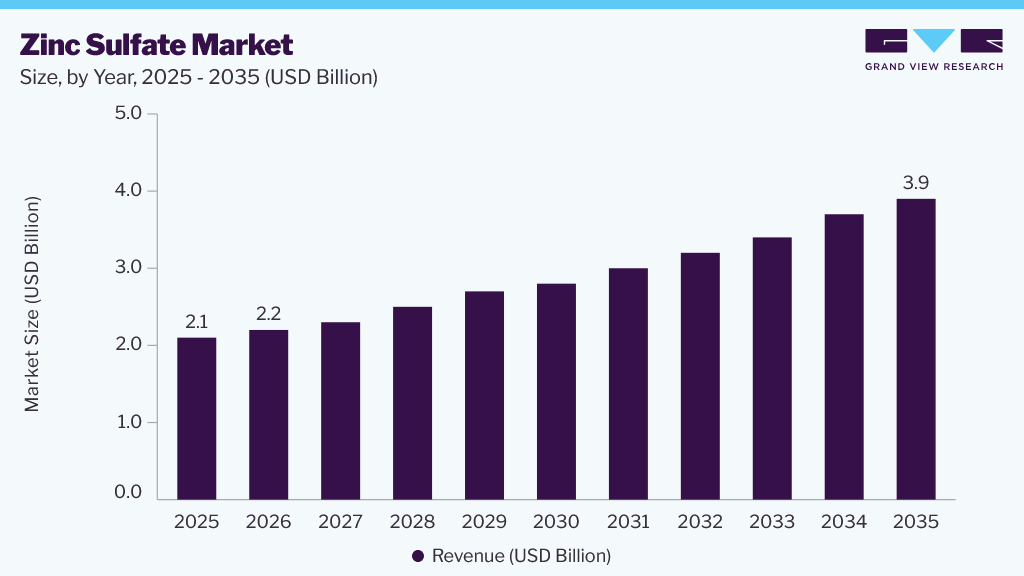 Source: Grand View Research, IR Documents, Primary Interviews, Paid DatabasesTo learn more about this report,
 Download Free Sample Report
Despite favorable demand conditions, the market faces challenges related to fluctuations in zinc metal prices, raw material availability, and stringent environmental regulations governing chemical manufacturing. Producers must also maintain high purity standards for pharmaceutical- and food-grade zinc sulfate, which can increase production and quality assurance costs. Competition from alternative zinc micronutrient formulations, including chelated zinc fertilizers, may also affect market growth in certain regions.
The market presents significant opportunities through increased investment in agricultural micronutrients and the development of integrated zinc value chains. In addition, growing investments by fertilizer manufacturers in zinc-enriched crop nutrition products, along with rising demand for specialty micronutrients, are expected to create new growth opportunities for zinc sulfate producers over the forecast period.
Analyst Perspective
The market is experiencing steady growth, primarily driven by rising demand for micronutrient fertilizers, animal nutrition products, and pharmaceutical formulations. Increasing awareness of zinc deficiency in agricultural soils, particularly across the Asia Pacific and Latin America, is accelerating the adoption of zinc sulfate to improve crop yields and quality. The pharmaceutical and nutraceutical industries are also contributing to market expansion, as zinc sulfate is increasingly used in dietary supplements and therapeutic formulations. Furthermore, the growing emphasis on balanced crop nutrition and sustainable farming practices is encouraging governments to promote the use of zinc-enriched fertilizers.
Product Insights
The zinc sulfate monohydrate segment accounted for the largest share of the global market in 2025 and is expected to maintain its dominant position throughout the forecast period. Zinc sulfate monohydrate is widely used for its high zinc content, excellent solubility, and suitability in agricultural fertilizers, animal nutrition, pharmaceutical formulations, and industrial applications. It is among the most widely used micronutrient fertilizers for correcting zinc deficiencies in crops such as rice, wheat, corn, sugarcane, and fruits, thereby improving crop yield and quality. Livestock producers use zinc sulfate monohydrate as a feed additive to support animal growth, immune function, and reproductive performance.
Growing concerns over soil micronutrient deficiencies, coupled with rising demand for high-quality agricultural output, are supporting increased consumption of zinc sulfate monohydrate. Government initiatives in several countries promoting balanced fertilizer application and micronutrient management to enhance agricultural productivity are further supporting segment growth. Manufacturers are also investing in higher-purity zinc sulfate grades to address growing demand from pharmaceutical and dietary supplement applications.
The zinc sulfate heptahydrate segment is expected to register the fastest CAGR during the forecast period. Owing to its high water solubility and ease of application, zinc sulfate heptahydrate is increasingly used in foliar fertilizers, water-soluble fertilizers, water treatment chemicals, and various industrial applications. The growing adoption of precision agriculture, fertigation systems, and specialty crop nutrition solutions is expected to further accelerate demand for zinc sulfate heptahydrate over the coming year.
Application Insights
The agricultural segment accounted for the largest share in 2025. Agriculture remains the largest consumer of zinc sulfate, as zinc is an essential micronutrient required for healthy plant growth, enzyme activity, chlorophyll formation, and overall crop development. Zinc sulfate fertilizers are widely used to correct zinc deficiencies in soils, improve crop productivity and grain quality, and enhance crop tolerance to environmental stress. Countries with intensive agricultural production increasingly rely on zinc fertilization to maintain soil fertility, improve crop productivity, and support food security.
Growing awareness of micronutrient deficiencies in agricultural soils, coupled with rising global food demand, is encouraging farmers to adopt balanced fertilization programs that incorporate zinc sulfate. Governments and agricultural organizations are also promoting the application of micronutrient fertilizers to improve crop yields and support sustainable agricultural practices.
The food and nutritional supplements segment is expected to register the fastest growth during the forecast period. Rising consumer awareness of zinc deficiency, increasing demand for immunity-supporting supplements, and growing adoption of preventive healthcare are driving demand for high-purity zinc sulfate in nutritional applications. Zinc plays an important role in immune function, wound healing, and normal metabolic processes, supporting its use in dietary supplements, fortified foods, and other nutritional products.
Regional Insights
Asia Pacific accounted for the largest share in 2025 and is expected to maintain its leadership throughout the forecast period. The region benefits from extensive agricultural activity, large livestock populations, expanding fertilizer consumption, and rising demand for animal nutrition products. Countries including China, India, Indonesia, Vietnam, and Thailand continue to invest in improving agricultural productivity through balanced fertilization programs that incorporate zinc-based micronutrients.
Rapid population growth, rising food demand, and the prevalence of zinc-deficient soils are encouraging governments to promote the use of micronutrient fertilizers across major agricultural regions. In addition, expanding pharmaceutical manufacturing and increasing production of animal feed supplements are supporting demand for zinc sulfate throughout the region. The presence of major fertilizer manufacturers and well-established agricultural supply chains further reinforces Asia Pacific’s leadership in the global market. Increasing adoption of precision farming technologies, fertigation systems, and water-soluble fertilizers is expected to further strengthen regional demand for zinc sulfate.
Latin America Zinc Sulfate Market Trends
The zinc sulfate market in Latin America is projected to register the fastest CAGR during the forecast period. Countries such as Brazil, Argentina, and Mexico continue to expand commercial agricultural production to meet growing domestic and global demand for soybeans, corn, sugarcane, coffee, and horticultural crops. Efforts to improve soil fertility, increasing application of micronutrient fertilizers, and growing awareness of zinc deficiencies are encouraging greater adoption of zinc sulfate across the region. The region is also witnessing growth in livestock production, increasing demand for zinc sulfate as a feed additive to support animal health, growth, and productivity. Continued investments in modern farming practices, precision agriculture, fertigation, and specialty crop nutrition are expected to support strong long-term market growth across Latin America.
Key Zinc Sulfate Company Insights
The market is moderately consolidated, with leading manufacturers competing on production capacity, product purity, cost efficiency, and extensive distribution networks. Market participants are increasingly focused on expanding manufacturing capacity, improving sustainable production practices, and developing high-purity zinc sulfate products for applications across agriculture, pharmaceuticals, chemicals, animal nutrition, and water treatment. Strategic initiatives, including capacity expansions, acquisitions, partnerships, and collaborations, are enabling manufacturers to strengthen their market positions, expand their geographic reach, and capitalize on growing global demand for micronutrient fertilizers and industrial-grade zinc sulfate.
Key Zinc Sulfate Companies
The following key companies have been profiled for this study on the zinc sulfate market:
-
Old Bridge Chemicals, Inc.
-
Rech Chemical Co., Ltd.
-
Zinc Nacional
-
Balaji Industries
-
Sulfozyme Agro India Pvt. Ltd.
-
Ravi Chem Industries
-
Tianjin Topfert Agrochemical Co., Ltd.
-
Changsha Latian Chemicals Co., Ltd.
-
JG Chemicals Limited
-
Gujarat Polysol Chemicals Ltd.
Recent Developments
-
In October 2025, the Government of India approved the Nutrient-Based Subsidy (NBS) rates for Rabi 2025–26, including an additional subsidy of approximately USD 5.50 per metric tonne for P&K fertilizers fortified or coated with zinc. The measure, effective from October 1, 2025, through March 31, 2026, is intended to promote the use of zinc-fortified fertilizers as part of the government’s broader focus on balanced nutrient application, soil health, and agricultural productivity.
-
In May 2024, J.G. Chemicals Limited announced the expansion of its zinc sulfate business as part of its strategy to diversify its product portfolio. The company reported a manufacturing capacity of 10,080 MTPA for zinc sulfate and allied chemicals and identified zinc ash, sourced through its existing galvanizer network and generated in-house as a by-product of zinc oxide production, as a key raw material. The company also indicated plans to ramp up utilization, develop its zinc sulfate business, and explore export opportunities, supported by demand from agricultural and pharmaceutical applications.
Zinc Sulfate Market Report Scope
Report Attribute
Details
Market size in 2025
USD 2.1 billion
Estimated market size in 2026
USD 2.2 billion
Projected market size by 2035
USD 3.9 billion
Growth rate
CAGR of 6.5% from 2026 to 2035
Historical data
2021 – 2024
Forecast period
2026 – 2035
Quantitative units
Revenue in USD billion, and CAGR from 2026 to 2035
Report coverage
Revenue forecast, company ranking, competitive landscape, growth factors, and trends
Segments covered
Product, application, region
Regional scope
North America; Europe; Asia Pacific; CSA; MEA
Country scope
U.S.; Canada; Mexico; UK; Germany; France; China; Japan; India; Australia; South Korea; Brazil; Argentina; South Africa; Saudi Arabia; UAE
Key companies profiled
Old Bridge Chemicals, Inc.; Rech Chemical Co., Ltd.; Zinc Nacional; Balaji Industries; Sulfozyme Agro India Pvt. Ltd.; Ravi Chem Industries; Tianjin Topfert Agrochemical Co., Ltd.; Changsha Latian Chemicals Co., Ltd.; JG Chemicals Limited; Gujarat Polysol Chemicals Ltd.
Customization scope
Free report customization (equivalent to 8 analyst working days) with purchase. Addition or alteration to country, regional & segment scope.
Pricing and purchase options
Avail of customized purchase options to meet your exact research needs. Explore purchase options
Global Zinc Sulfate Market Report Segmentation
This report forecasts revenue growth at the global, regional, and country levels and provides an analysis of the latest industry trends and opportunities across each sub-segment from 2021 to 2035. For this study, Grand View Research has segmented the global zinc sulfate market report based on product, application, and region:
-
Product Outlook (Revenue, USD Million, 2021–2035)
-
Zinc Sulfate Monohydrate
-
Zinc Sulfate Heptahydrate
-
Zinc Sulfate Hexahydrate
-
Zinc Sulfate Anhydrous
-
-
Application Outlook (Revenue, USD Million, 2021–2035)
-
Agriculture
-
Animal Feed
-
Pharmaceuticals
-
Food & Nutritional Supplements
-
Chemicals
-
Water Treatment
-
Others
-
-
Regional Outlook (Revenue, USD Billion, 2021 - 2035)
-
North America
-
U.S.
-
Canada
-
Mexico
-
-
Europe
-
UK
-
Germany
-
France
-
-
Asia Pacific
-
China
-
Japan
-
India
-
Australia
-
South Korea
-
-
Central & South America
-
Brazil
-
Argentina
-
-
Middle East and Africa (MEA)
-
South Africa
-
Saudi Arabia
-
UAE
-
-
Frequently Asked Questions About This Report
The global zinc sulfate market size was valued at USD 2.1 billion in 2025 and is estimated at USD 2.2 billion for 2026.
The global zinc sulfate market is expected to grow at a CAGR of 6.5% from 2026 to 2035, reaching USD 3.9 billion.
The zinc sulfate monohydrate segment accounted for the largest revenue share in 2025.
Asia Pacific dominated with the largest revenue share in 2025.
Key players in the market include Old Bridge Chemicals, Inc., Rech Chemical Co., Ltd., Zinc Nacional, Balaji Industries, Sulfozyme Agro India Pvt. Ltd., Ravi Chem Industries, Tianjin Topfert Agrochemical Co., Ltd., Changsha Latian Chemicals Co., Ltd., JG Chemicals Limited, and Gujarat Polysol Chemicals Ltd.
About the Author(s)
Organic Chemicals Research Team
Bulk Chemicals · Organic ChemicalsThis report was authored by the organic chemicals research team at Grand View Research - comprising two research analysts, one senior research analyst, and one industry expert - with specialized expertise in the organic chemicals segment of the bulk chemicals industry. All findings are based on proprietary bulk chemicals databases, executive interviews, and regulatory analysis, subject to internal peer review prior to publication.
Last Updated:
Speak to Analyst

Customize this report to your needs - add regions, segments, or data points, with 20% free customization.
Or view our licence options:


ISO 9001:2015 & 27001:2022 Certified
We are GDPR and CCPA compliant! Your transaction & personal information is safe and secure. For more details, please read our privacy policy.


