- Home
- »
- Market Trend Reports
- »
-
Anti-acne Cosmetics Market: Brand And Product Pipeline Analysis
![Anti-acne Cosmetics Market: Brand And Product Pipeline Report]()
Anti-acne Cosmetics Market: Brand And Product Pipeline Analysis
- Published: May, 2025
- Report ID: GVR-MT-100344
- Format: PDF/Excel databook
- No. of Pages/Datapoints: 50
- Report Coverage: 2024 - 2030
Report Overview
Anti-acne cosmetics are skincare products formulated to prevent, reduce, or treat acne by targeting excess oil, clogged pores, bacteria, and inflammation while improving overall skin health. The rising consumption of cosmetics by both men & women and the negative social stigma associated with acne, especially in emerging economies, are estimated to drive market growth. Acne affects individuals of all age groups, particularly teenagers and young adults, increasing the demand for effective skincare solutions.
The brand and competitive analysis report, compiled by Grand View Research, is a collection of the trends and competitive scenario in more than 20 countries. Qualitative information regarding the trends, competitive strategies, existing competition, and pipeline analysis will be provided in the report. Within the purview of the database, such information is systematically analyzed and provided in the form of outlook reports and summary presentations on individual areas of research.
Anti-acne Cosmetics Market: Brand And Product Pipeline Analysis Report Scope
Report Attributes
Details
Areas of Research
Industry trends, market opportunity, aesthetic penetration across countries, competitive and product revenue analysis
Report Representation
Consolidated report in PDF format
Country Coverage
20+ Countries
Product Coverage
- Creams and Lotions
- Cleanser & Toners
- Mask
- Laser and Light Therapies
- Chemical Peel
- Others
Highlights of Report (Competitive & Revenue Landscape, by Product)
- Acne Incidence & Prevalence
- Product Analysis
- Pipeline Analysis
- Brand Specific Insights
- Key Developments Recorded in the Anti-Acne Cosmetics Industry
Anti-acne Cosmetics Market: Acne Incidence & Prevalence
Acne continues to be one of the most widespread dermatological conditions, significantly impacting individuals across various age groups. This condition affects both adolescents and adults, with multiple forms ranging from mild to severe cases. Understanding the incidence and prevalence of acne is crucial for tailoring effective treatment and prevention strategies. In February 2025, the American Academy of Dermatology Association highlighted that acne remains the most prevalent skin condition in the U.S., impacting up to 50 million individuals annually. Given the diverse forms of acne, from blackheads to cysts, personalized treatment guided by a board-certified dermatologist is essential. While acne typically begins in adolescence, it can persist well into adulthood, with around 15% of women experiencing adult acne and approximately 85% of those aged 12 to 24 facing at least mild forms.
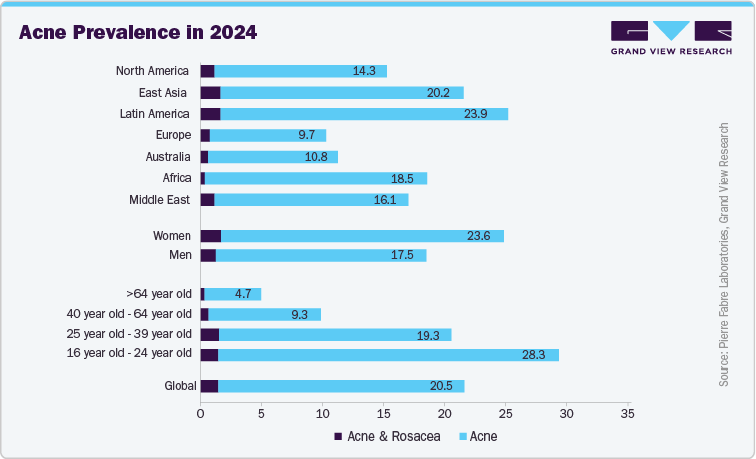
Acne remains one of the most widespread dermatological conditions globally, with its incidence notably shaped by age, region, and ethnicity. Large-scale studies continue to reinforce its persistence well beyond adolescence, highlighting its growing footprint in adult populations. In May 2024, a global population study published in the Journal of the American Academy of Dermatology reported an overall acne prevalence of 20.5%, peaking at 28.3% in individuals aged 16–24. The condition affected nearly 1 in 5 people aged 25–39, reaffirming the trend of rising adult acne. Geographically, acne prevalence was highest in Latin America and Africa, while Europe and Australia showed significantly lower rates. Ethnic disparities were also evident, with individuals of mixed ethnicity reporting the highest prevalence, followed by Asian populations.
Regional variation in acne prevalence can be attributed to environmental, lifestyle, and healthcare access factors. In Latin America and Africa, limited dermatological infrastructure, higher humidity levels, and increased exposure to environmental pollutants may contribute to elevated acne rates. Conversely, lower prevalence in Europe and Australia may reflect greater access to early dermatological intervention, widespread use of preventive skincare, and stronger public awareness campaigns. Dietary differences, particularly high glycemic load diets and dairy consumption, have also been cited as potential aggravators in higher-incidence regions.
Gender trends showed a slightly higher prevalence among females in early adulthood. Compared to previous studies relying on clinical assessments, the self-reported nature of this research may partly explain the elevated figures. Nonetheless, the data underscores the global burden of acne and reinforces the need for continued surveillance across emerging adult demographics and underrepresented regions. These findings emphasize that acne is no longer confined to adolescence or a specific geography or demographic. With its persistent presence across diverse age groups and areas, the dermatological community faces an ongoing challenge to refine diagnostic, preventive, and therapeutic strategies with evolving epidemiological insights.
Product Analysis
The anti-acne cosmetics segment has evolved rapidly with a growing consumer preference for scientifically backed, multi-functional skincare solutions. Modern formulations increasingly combine acne-fighting properties with ingredients that support skin hydration, tone correction, and barrier repair. Dermatologist-recommended products are leading the market, often addressing not only active breakouts but also concerns like hyperpigmentation, oiliness, and sensitivity. Serums enriched with niacinamide and hyaluronic acid, oil-control cleansers, and innovative moisturizers that deliver hydration and anti-acne benefits are becoming the norm. Moreover, hybrid formulations that blend therapeutic and cosmetic benefits, such as brightening, UV protection, and anti-aging, are redefining the boundaries of acne care. As transparency and clinical validation become essential purchasing factors, the market leans heavily on dermatologist-approved, ingredient-forward solutions that address immediate acne concerns and long-term skin health.
Key Anti-Acne Cosmetic Products
Product Name
Key Ingredients
Primary Functions
Target Users
Endorsement/Notes
Accutane Anti-Acne Oil Control Face Wash
Glycolic acid, Salicylic acid, Niacinamide
Oil control, exfoliation, and skin barrier support
Oily/acne-prone skin
Endorsed for being free from SLS/parabens; suitable for therapeutic and preventive use
PELLUCID-N5 & N10 Niacinamide Serums
Niacinamide (5%/10%), Hyaluronic acid
Sebum regulation, hydration, and pore minimization
Adult acne, dehydrated, or barrier-compromised skin
Dermatologist-recommended for hyperpigmentation and enlarged pores
AMVEL Skin Brightening Complex Cream
Lecithin, Bicowhite, Lysolecithin
Treats pigmentation and post-inflammatory dark spots
Post-acne discoloration
Offers UV protection and melanin regulation
Accutane-SR Anti-Acne Serum C Sebum Regulator
AHAs, BHAs, Zinc PCA, Sarcosine
Sebum control, inflammation reduction, and acne treatment
Severe acne, oily skin
Suitable for use with retinoids; recommended in combination therapy
Mario Badescu Drying Cream
Sulfur, Zinc oxide
Spot treatment reduces pustules and whiteheads
Teen acne, minimal routine users
Simple and fast-acting; backed by dermatologists
Pipeline Analysis
In recent years, innovation in acne treatment has moved beyond traditional formulations to include new delivery systems, natural ingredients, and combination therapies. Companies in the dermatological pipeline are increasingly focusing on multi-functional products and alternative approaches that improve efficacy while minimizing side effects. This shift is especially evident in developing plant-based actives, sponge-derived exfoliants, and triple-combination gels that offer both inflammatory and non-inflammatory acne relief. Below is a summary of key players' recent and ongoing pipeline activities, highlighting advancements in formulation, trial structure, and therapeutic outcomes.
Pipeline Insights
Company
Product
Phase / Status
Key Ingredients / Technology
Trial Highlights
Lindus Health (in collaboration with Acinonyx Bio)
ACX
Ongoing Clinical Trial (2024)
Plant-based ingredients targeting P. acnes
A decentralized 6-week trial, with remote participation, aims to match the efficacy of benzoyl peroxide without associated risks.
Dermata Therapeutics
DMT310
Phase 3 (STAR-1 Trial, 50% enrolled as of July 2024)
Silica spicules from Spongilla lacustris (freshwater sponge)
Weekly application over 12 weeks; randomized, double-masked; primary endpoints: lesion count, IGA score.
Bausch Health
Cabtreo (IDP-126)
FDA Approved (October 2023)
Clindamycin phosphate 1.2%, Adapalene 0.15%, Benzoyl Peroxide 3.1%
Based on two Phase 3 trials, 50% achieved treatment success, 75% reduction in lesion count, and mild skin reactions.
Brand Specific Insights
Healthcare professionals (HCPs) significantly influence consumer decisions in the anti-acne cosmetics by recommending evidence-based products. Brands owned by PCA Skin, Obagi Cosmeceuticals, PHYTOMER Group, AbbVie, and others maintain strong traction among dermatologists and aesthetic practitioners due to their clinically validated formulations. These brands offer targeted solutions often incorporated into professional treatment plans and home skincare routines.
HCPs direct patients toward suitable acne treatments and provide critical guidance on ingredient selection, treatment layering, and side-effect management. Many skincare companies collaborate with professionals by offering clinical data, hands-on training, and continued education. This strategic alliance enhances the credibility and trustworthiness of these brands within clinical settings, promoting long-term consumer loyalty in both pre- and post-procedure acne care.
Brand Performance and HCP Endorsement in Anti-Acne Skincare
Brand
Parent Company
Key Acne-Focused Products
HCP Engagement Strategy
PCA SKIN
Colgate-Palmolive
Acne Gel (salicylic acid), BPO 5% Cleanser
Offers certification programs for dermatologists and aestheticians
Obagi
Obagi Cosmeceuticals
CLENZIderm M.D. Acne System (benzoyl peroxide, salicylic acid)
Provides prescription-strength and OTC products with clinical validation
PHYTOMER
PHYTOMER Group
Marine-based detox cleansers and purifying masks
Focuses on marine biotech and holistic skincare, supported by aesthetic professionals
SkinMedica
AbbVie
Purifying Foaming Wash, Acne Treatment Lotion (salicylic acid, niacinamide)
Supplies clinical data and supports usage in conjunction with in-office procedures
Brand
Parent Company
Key Acne-Focused Products
HCP Engagement Strategy
Some of the key developments recorded in the anti-acne cosmetics industry-
Companies
Year
Month
Details
PCA
2024
September
PCA launched Acne Peel and Acne Peel Plus to address mild to severe acne with advanced AHA/BHA and third-generation retinoid blends. The peels are clinically proven to reduce whiteheads, pustules, and papules in a single treatment cycle.
SkinMedica
2024
April
SkinMedica has launched two innovative products, the Acne Clarifying Treatment and Pore Purifying Gel Cleanser, specifically formulated to address acne while preserving the skin's barrier. Combined with the Pore Purifying Pro-Infusion Serum used with DiamondGlow, these products create a holistic solution for acne-prone skin.
Jan Marini Skin Research (JMSR)
2025
January
Jan Marini Skin Research partnered with Restore Hyper Wellness to expand skin health services with facials, chemical peels, and homecare solutions targeting acne, wrinkles, and hyperpigmentation. The collaboration emphasizes personalized, science-backed skincare therapies.
PCA
2024
December
PCA partnered with Sterling Social to host an immersive, hydration-themed brand activation at 57 Windward in Venice Beach, California. The event featured illuminated tunnels, blue lighting, and curated product displays highlighting PCA’s science-backed hydration range. Touchpoints included mini peel treatments, interactive video booths, custom water bottles, and ingredient-themed cocktails, positioning hydration as experiential and essential.
Skinbetter Science,
2022
August
L’Oréal, a global leader in beauty and cosmetics, acquired Skinbetter Science, a Phoenix-based skincare brand specializing in physician-dispensed products rooted in advanced dermatological science.
![gvr icn]()
GET A FREE SAMPLE
![gvr icn]()
This FREE sample includes market data points, ranging from trend analyses to market estimates & forecasts. See for yourself.
![gvr icn]()
NEED A CUSTOM REPORT?
We can customize every report - free of charge - including purchasing stand-alone sections or country-level reports, as well as offer affordable discounts for start-ups & universities.
Contact us now to get our best pricing.
![esomar icon]()
ESOMAR certified & member
![ISO]()
ISO Certified
We are GDPR and CCPA compliant! Your transaction & personal information is safe and secure. For more details, please read our privacy policy.





We are committed towards customer satisfaction, and quality service.
Client Testimonials

"The quality of research they have done for us has been excellent..."
ISO Certified