
- Home
- »
- Medical Devices
- »
-
The Dialysis Shift: From Hospital-Based Care To Home-Centric Treatment: Analysis & Market Value InsightsGVR Report cover
![The Dialysis Shift: From Hospital-Based Care To Home-Centric Treatment: Report]()
The Dialysis Shift: From Hospital-Based Care To Home-Centric Treatment: Analysis & Market Value Insights (2021-2025 & 2033)
Market Drivers
The rising prevalence of chronic kidney disease (CKD) is a major factor in the shift toward home-centric dialysis treatment. As the number of patients requiring long-term renal replacement therapy continues to grow, healthcare systems are facing increasing pressure to provide cost-effective and accessible care. Home-based dialysis options, including peritoneal dialysis and home hemodialysis, offer a practical solution by reducing dependence on hospital-based facilities and enabling patients to receive treatment in the comfort of their homes. These therapies offer greater scheduling flexibility, improve patient convenience, and support better adherence to treatment regimens. Furthermore, home dialysis can help reduce healthcare expenditures, alleviate capacity constraints at dialysis centers, and enhance patients’ quality of life by allowing them to maintain their daily routines and employment. As CKD cases continue to rise globally, the adoption of home-centric dialysis models is expected to accelerate as healthcare providers seek more sustainable and patient-focused treatment approaches.
According to CDC data published in 2026, the following graph shows the percentage of people with CKD in the U.S.
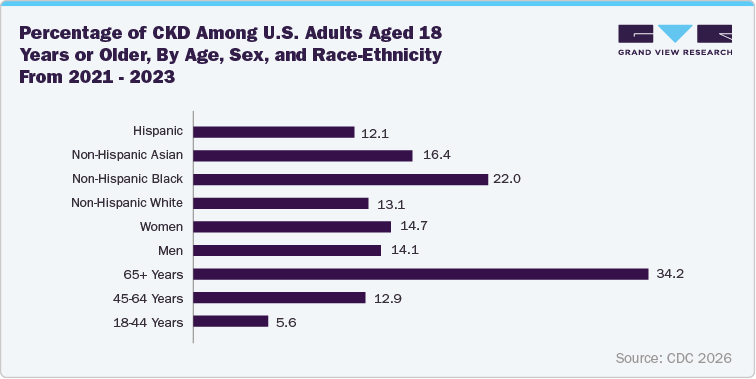
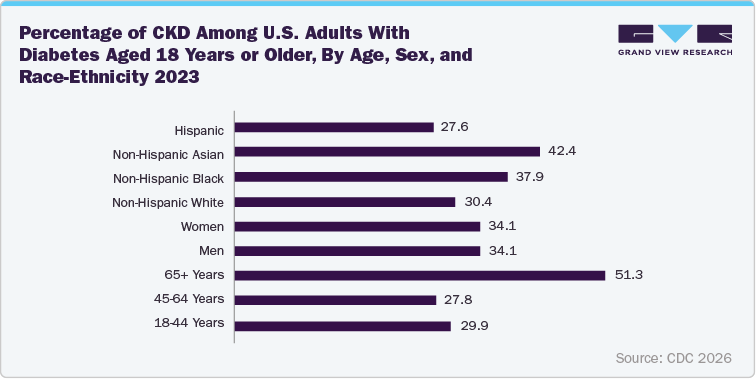
The rising prevalence of chronic diseases is a major contributor to the increasing burden of Chronic Kidney Disease (CKD). Conditions such as diabetes, hypertension, cardiovascular disease, and obesity are among the leading risk factors for kidney damage. Diabetes can damage the blood vessels in the kidneys, reducing their ability to filter waste effectively. Uncontrolled hypertension places excessive pressure on kidney tissues, leading to a gradual loss of function. Similarly, obesity and cardiovascular disorders increase the risk of metabolic and vascular complications that accelerate kidney deterioration. As the global incidence of these chronic conditions continues to grow due to aging populations, sedentary lifestyles, and unhealthy dietary habits, the number of individuals developing CKD is also rising. This expanding CKD patient population is increasing the demand for long-term renal care, including dialysis and kidney replacement therapies, thereby placing greater pressure on healthcare systems worldwide.
“Diabetes is the number one cause of kidney disease; so, because more patients have diabetes, we’re seeing more kidney disease,” - Randy Luciano, MD, a Yale Medicine nephrologist
-
According to the International Diabetes Federation in 2024, the global burden of Diabetes Mellitus is rapidly increasing, with approximately 589 million adults currently affected, a figure projected to reach 853 million by 2050, and notably, over 4 in 5 (81%) of these individuals residing in low- and middle-income countries.
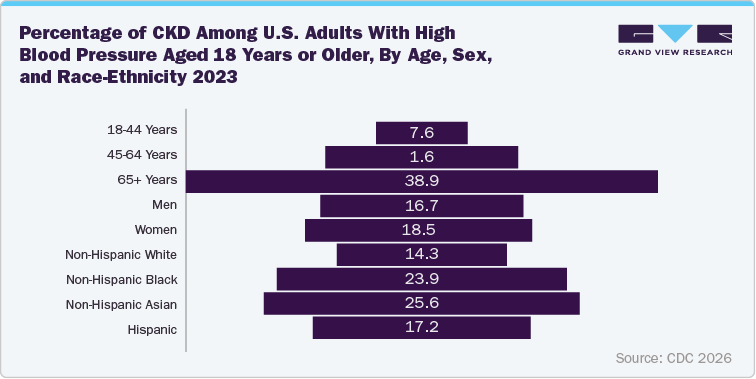
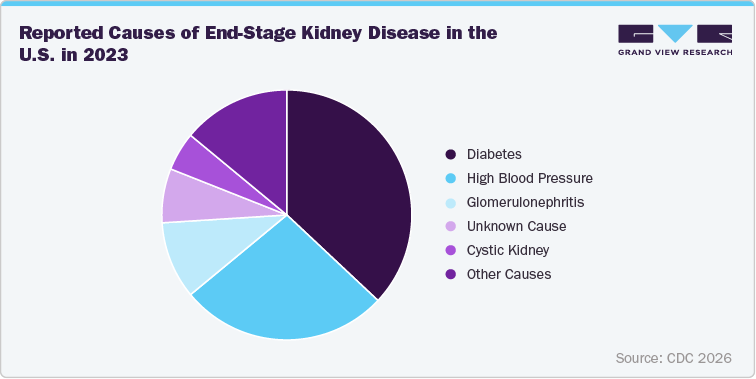
The growing incidence of End-stage Kidney Disease (ESKD) is a key factor accelerating the shift from hospital-based dialysis to home-centric treatment models. As more patients progress to kidney failure and require lifelong dialysis, healthcare systems are facing increasing challenges related to dialysis center capacity, treatment costs, and resource availability. Home-based dialysis modalities, such as peritoneal dialysis and home hemodialysis, offer an effective solution by enabling patients to receive treatment at home while reducing dependence on in-center facilities. These therapies provide greater flexibility, improve patient comfort, and support more personalized treatment schedules, which can lead to better clinical outcomes and quality of life. In addition, the rising ESKD population is prompting healthcare providers and policymakers to promote home dialysis as a cost-efficient and scalable approach to managing the growing demand for renal replacement therapy. Thus, the increasing burden of ESKD is playing a significant role in driving the transition toward home-centric dialysis care.
-
According to the CDC, in 2026, approximately 131,564 people in the U.S. started treatment for End-Stage Kidney Disease (ESKD) in 2023. About 831,000 people, or 2 in every 1,000 individuals, were living with ESKD, with 67% receiving dialysis and 33% living with a kidney transplant. Non-Hispanic Black individuals have an ESKD incidence rate four times higher than that of non-Hispanic White individuals, while Hispanic individuals have twice the incidence rate. Among adults aged 18 years and older, diabetes and high blood pressure remain the leading causes of ESKD. Among children and adolescents younger than 18 years, cystic kidney disease and glomerulonephritis are the primary causes of ESKD.
Rising awareness of home dialysis and its benefits is driving a shift from hospital-based care to home-centric treatment. Increasing patient education initiatives, support programs, and healthcare provider recommendations have improved understanding of home dialysis modalities such as peritoneal dialysis and home hemodialysis. Patients are becoming more aware of the advantages these therapies offer, including greater treatment flexibility, reduced travel to dialysis centers, improved convenience, and the ability to maintain work and daily activities. Home dialysis also promotes greater patient independence and can enhance quality of life by allowing treatment in a familiar environment. As awareness of these clinical, lifestyle, and economic benefits continues to grow, more patients and healthcare providers are choosing home-based dialysis options, accelerating the transition toward home-centric renal care models.
Category
Subcategory
Peritoneal Dialysis (Receiving) in 2023
(N=67,155)
Home Hemodialysis (Receiving) in 2023
(N=13,670)
Peritoneal Dialysis (Initiating) in 2024
(N=27,659)
Home Hemodialysis (Initiating) in 2024
(N=8,238)
Age
Median Age (Years)
62.4
56.9
62.4
55.3
18–44 Years (%)
16.5
21.1
18.6
28
45–64 Years (%)
40.1
48.1
37.7
42.6
65–74 Years (%)
24.4
19.4
24.1
18.5
≥75 Years (%)
19.1
11.4
19.6
11
Sex
Female (%)
43
37.5
41.4
37.4
Male (%)
57
62.5
58.6
62.6
Race/Ethnicity
White (%)
46.1
51
49.5
50.2
Black (%)
23.5
30
23.2
28.1
Hispanic (%)
19.1
12.9
17.3
15.6
Asian (%)
8.2
3.6
6.2
3.4
Other (%)
3.1
2.6
3.8
2.7
Primary Cause of ESRD
Diabetes (%)
40
37.1
41.4
42.1
Hypertension (%)
30.4
27
30.4
29.3
Glomerulonephritis (%)
12.3
15.1
9.4
10.3
Cystic Kidney Disease (%)
4.4
5.1
3.8
4.4
Other/Unknown (%)
13
15.7
15.1
14
Rural/Urban Status
Urban (%)
83.8
82.3
82.5
83.6
Large Rural City/Town (%)
8.7
9.2
9.5
9.1
Small Rural Town (%)
4.5
5
4.9
4.4
Isolated Small Rural Town (%)
2.9
3.4
3.1
2.8
Source: U.S. Department of Health and Human Services 2025
Percentage of adults using home hemodialysis by state in the U.S., 2024
State
Percentage
New Jersey
1.29
California
1.30
District of Columbia
1.63
New York
1.66
Connecticut
1.76
South Dakota
1.98
Rhode Island
2.04
Montana
2.05
Arizona
2.23
Texas
2.24
Maryland
2.27
Pennsylvania
2.29
Arkansas
2.30
Georgia
2.43
Alabama
2.50
Colorado
2.54
New Mexico
2.59
Alaska
2.60
Nevada
2.61
Minnesota
2.70
North Dakota
2.75
Wisconsin
2.80
Washington
2.82
Illinois
2.95
Delaware
2.98
Florida
3.00
Indiana
3.04
Louisiana
3.06
Kansas
3.06
Oregon
3.09
Missouri
3.17
Hawaii
3.19
Michigan
3.19
Massachusetts
3.30
Virginia
3.45
Kentucky
3.55
Ohio
3.59
South Carolina
3.60
Wyoming
3.64
North Carolina
3.74
Tennessee
3.75
Oklahoma
4.25
Iowa
4.31
Mississippi
4.40
Idaho
4.73
Utah
5.07
Vermont
5.32
Nebraska
5.40
West Virginia
5.53
Maine
5.63
New Hampshire
6.21
Source: U.S. Department of Health and Human Services 2025
The rapid advancement of home dialysis technologies is significantly contributing to the shift from hospital-based dialysis to home-centric treatment models. Modern home dialysis devices are becoming more compact, user-friendly, automated, and digitally connected, making it easier for patients to manage treatment safely outside traditional healthcare settings. Innovations such as remote patient monitoring, telehealth integration, cloud-based data transmission, AI-enabled systems, and connected dialysis platforms allow healthcare providers to track treatment performance, monitor patient health metrics, and make real-time adjustments without requiring frequent hospital visits. These technologies improve treatment adherence, enhance patient confidence, support early detection of complications, and reduce the burden on dialysis centers. In addition, portable dialysis systems and simplified training interfaces have increased accessibility for a broader patient population, including those living in rural or underserved areas. As technology continues to improve the safety, convenience, and effectiveness of home dialysis, more patients and healthcare providers are adopting home-based renal care.
-
In November 2024, Quanta Dialysis Technologies announced that the U.S. Food and Drug Administration (FDA) granted 510(k) clearance for the Quanta Dialysis System for use in the home setting. The clearance enables the company to offer a high-dialysate-flow (500 mL/min) hemodialysis system across the full continuum of care, including home treatment for patients with end-stage renal disease (ESRD). The approval was supported by results from a multicenter clinical trial demonstrating the system’s safety, effectiveness, dialysis adequacy, and high patient satisfaction. The compact device is designed to simplify home hemodialysis through an intuitive interface, minimal maintenance requirements, and the ability to deliver high-flow therapy comparable to conventional in-center dialysis systems.
Key Recent Developments
-
In February 2026, Byonyks announced that its X1 Automated Peritoneal Dialysis (APD) Cycler received U.S. FDA 510(k) clearance, marking a major milestone in the company's expansion into the U.S. home dialysis market. Designed for home-based automated peritoneal dialysis, the X1 system enables patients requiring long-term renal replacement therapy to receive treatment at home, reducing reliance on in-center dialysis facilities. The company highlighted that the device supports safe, reliable, and affordable home dialysis while improving patient flexibility and quality of life.
-
In October 2025, Simergent announced that its Archimedes Automated Peritoneal Dialysis (APD) Cycler received 510(k) clearance from the FDA. The clearance covers both the Archimedes Standard and Archimedes Pro devices, along with their disposable tubing sets, for use in both home and clinical settings. The approval followed a successful human factors study involving 15 peritoneal dialysis patients and 15 nurses conducted in collaboration with Indiana University and Northwestern University. The Archimedes system was developed to expand treatment options for patients with end-stage kidney disease by enabling bloodless dialysis therapy in the home environment while enhancing mobility and convenience.
-
In June 2025, Renalyx Health Systems launched RENALYX–RxT 21, India's first fully indigenous AI- and cloud-enabled smart hemodialysis machine. The system features real-time remote monitoring, clinical connectivity, cloud-based telenephrology platforms, AI-powered algorithms, Electronic Medical Records (EMR) integration, remote diagnostics, Internet of Medical Things (IoMT) capabilities, and advanced telemetry functions. Designed and manufactured in India, the machine aims to improve the affordability and accessibility of dialysis treatment, particularly in semi-urban and rural regions.
-


Customize this report to your needs - add regions, segments, or data points, with 20% free customization.
Or view our licence options:


ISO 9001:2015 & 27001:2022 Certified
We are GDPR and CCPA compliant! Your transaction & personal information is safe and secure. For more details, please read our privacy policy.


