
- Home
- »
- Pharmaceuticals
- »
-
Duchenne Muscular Dystrophy Drug Market Intelligence & Forecast Analysis, 2033GVR Report cover
![Duchenne Muscular Dystrophy Drug-Level Market Intelligence, Commercial Forecasting, Estimations & Portfolio Report]()
Duchenne Muscular Dystrophy Drug-Level Market Intelligence, Commercial Forecasting, Estimations & Portfolio Analysis, 2021 - 2033
Overview
The global duchenne muscular dystrophy (DMD) drugs market was valued at USD 1.4B in 2025 and is projected to grow at a CAGR of 5.0% from 2026 to 2033. The market is shifting from corticosteroid-based symptomatic treatment to disease-modifying therapies (DMTs), including exon-skipping drugs and gene therapy. Elevidys (delandistrogene moxeparvovec), Sarepta's gene therapy, is driving this shift in the U.S., supported by orphan drug incentives, specialized treatment centers, and early adoption by neuromuscular specialists. Exon-skipping therapies like Exondys 51 (eteplirsen), Vyondys 53 (golodirsen), Amondys 45 (casimersen), and Viltepso (viltolarsen) serve specific patient subgroups based on exon 51, 53, and 45 skippable mutations. Europe and parts of Asia Pacific are growing markets, supported by new approvals and expanding genetic testing and newborn screening. Corticosteroids such as Emflaza (deflazacort) and generic prednisone still account for most of the treatment volume, especially in cost-sensitive markets. Agamree (vamorolone), a newer steroid alternative, is gaining share due to a better side-effect profile.
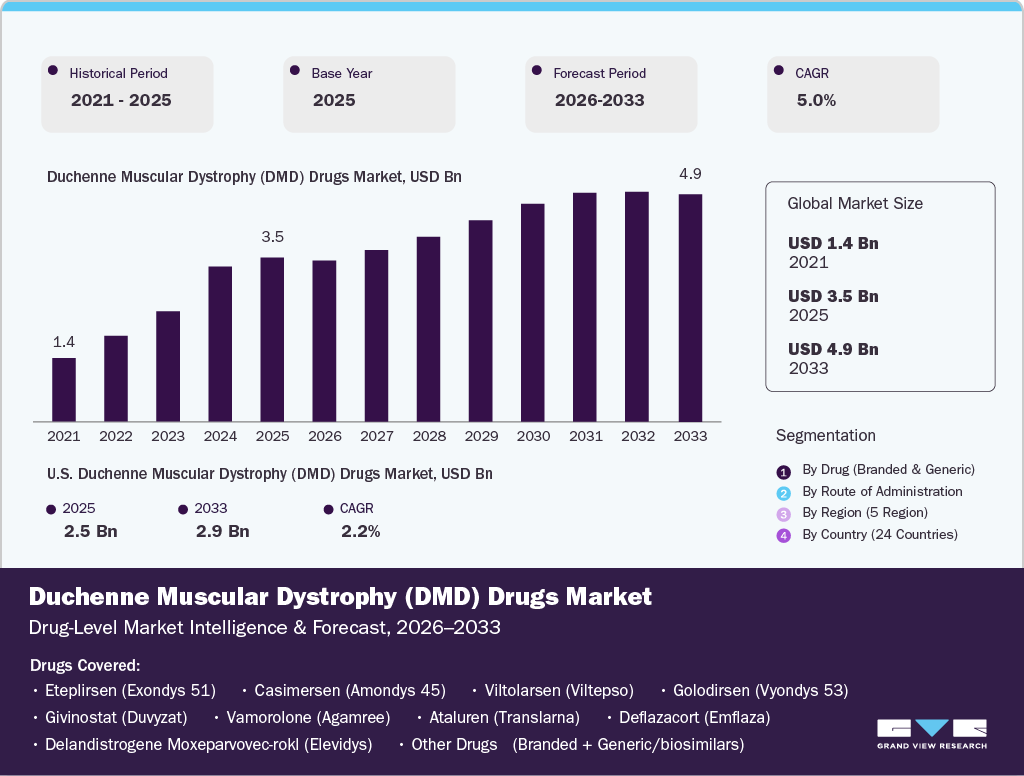
GVR's DMD drug intelligence database tracks branded and generic formulations across key molecule classes, from corticosteroids (Deflazacort/Emflaza, Prednisone) and exon-skipping agents (Eteplirsen/Exondys 51, Golodirsen/Vyondys 53, Casimersen/Amondys 45, Viltolarsen/Viltepso) to gene therapy (Delandistrogene moxeparvovec/Elevidys). DMD affects an estimated 1 in 3,500 to 5,000 male live births worldwide, making it the most common childhood muscular dystrophy. Corticosteroids still anchor treatment volume across most markets due to low cost and broad eligibility, while exon-skipping drugs and gene therapy capture value-based growth in the U.S., gated by mutation-specific eligibility, reimbursement approval, and access to genetic testing.
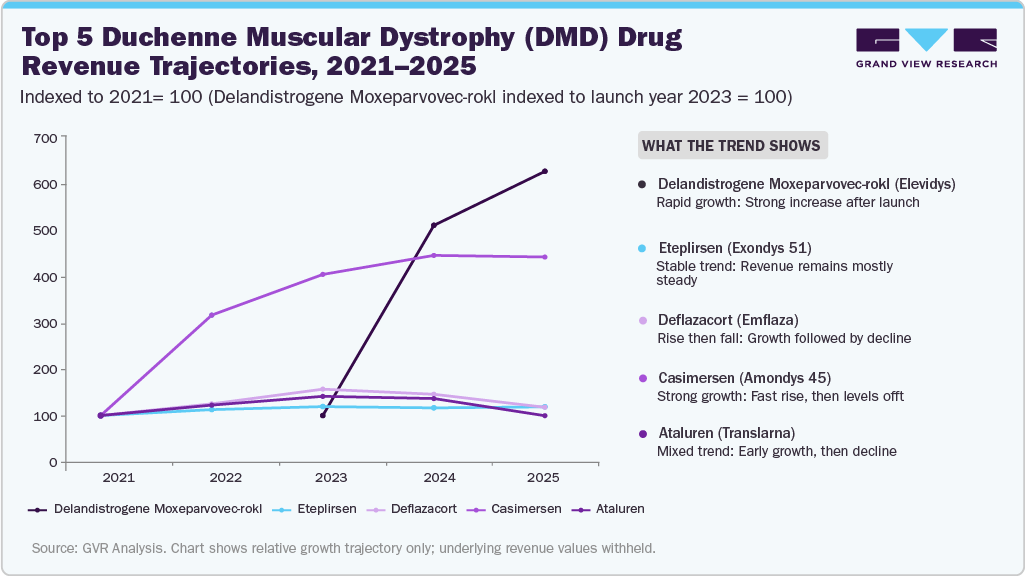
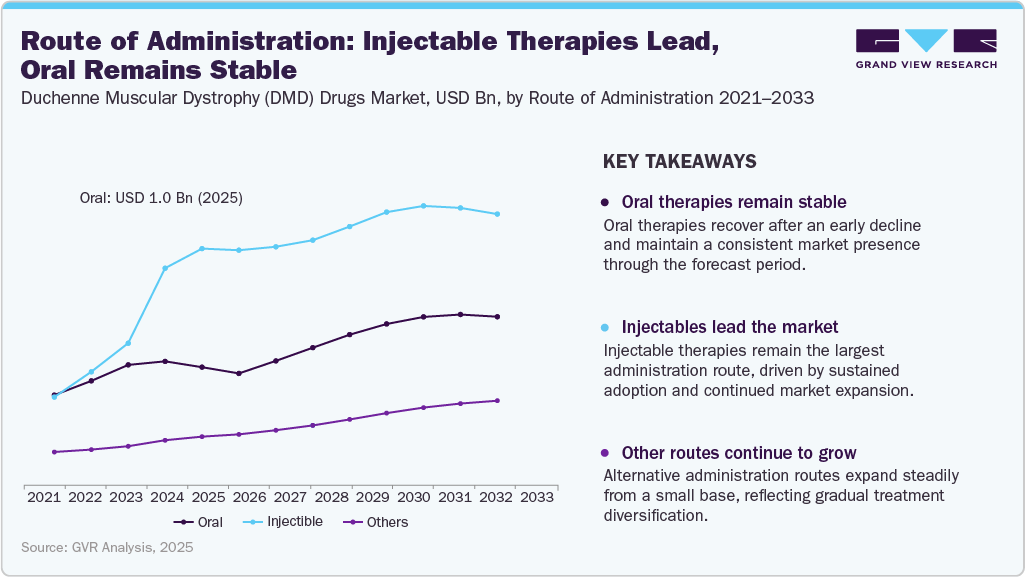
The market is witnessing two distinct growth trajectories. Gene therapy and exon-skipping drugs are driving revenue growth, while mature oral corticosteroids continue to face pricing pressure from generic competition. Elevidys demonstrates strong early commercial adoption as the first widely adopted gene therapy for DMD. Agamree (vamorolone) has emerged as one of the fastest-growing products, approved for DMD patients regardless of mutation type and offering a better side-effect profile than traditional steroids. In contrast, deflazacort and prednisone have entered mature lifecycle stages, with generic availability limiting revenue growth despite high prescription volumes.
Looking ahead, market expansion will depend not only on new product launches but also on improvements in access to genetic testing and treatment infrastructure. Wider availability of mutation testing, newborn screening, reimbursement coverage, and specialized treatment centers will determine the pace of DMT adoption across regions. Companies are also focusing on lifecycle management to improve patient convenience. For example, Elevidys is administered as a one-time infusion, reducing the treatment burden compared to chronic exon-skipping therapies that require weekly infusions. Future development in oral or less frequent dosing formats for exon-skipping drugs is expected to support broader adoption. As a result, the revenue mix is expected to shift steadily from generic corticosteroids toward gene therapy and mutation-specific biologics over the forecast period.
Net effect: revenue mix in this market is shifting away from volume-driven generic steroids and toward mechanism-differentiated, higher-value gene and exon-skipping therapies.
Current Market Scenario
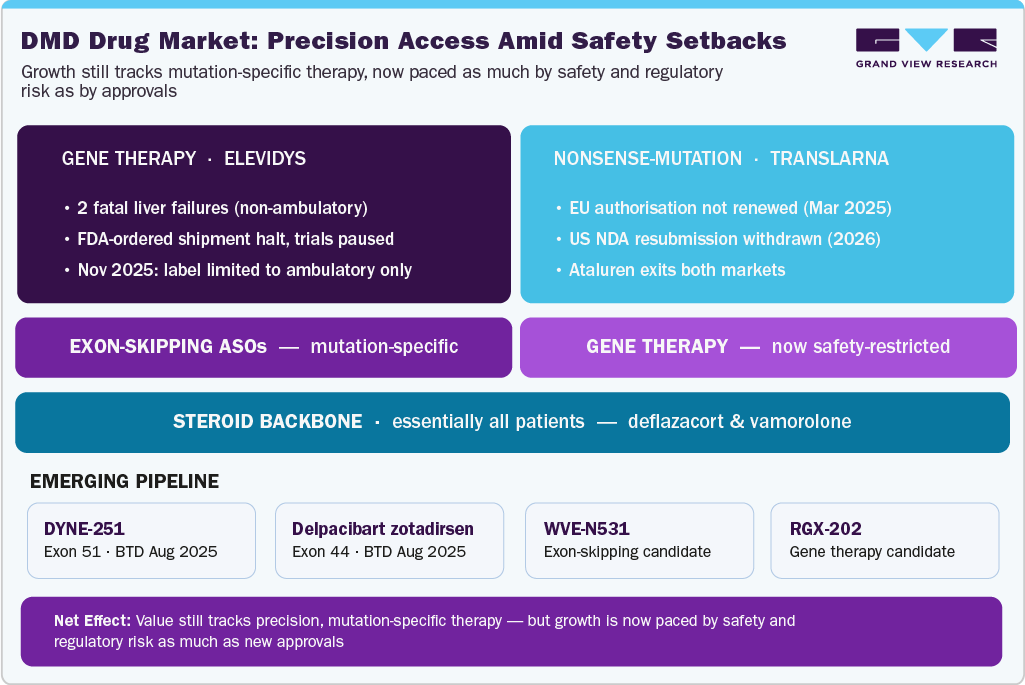
The DMD drugs market continues to track mutation-specific therapy, but growth is now paced as much by safety and regulatory risk as by new approvals. Elevidys, Sarepta's gene therapy, faced two reports of fatal acute liver failure in non-ambulatory patients, leading Sarepta to suspend shipments to this group in June 2025 and the FDA to request a broader shipment halt in July 2025. In November 2025, the FDA approved a revised label limiting Elevidys to ambulatory patients aged 4 and older, with a boxed warning for liver injury and removal of the non-ambulatory indication. Translarna (ataluren), the nonsense-mutation therapy from PTC Therapeutics, has exited both major markets: the European Commission declined to renew its conditional marketing authorization in March 2025, and PTC withdrew its resubmitted U.S. NDA in 2026 after the FDA raised efficacy concerns.
Corticosteroids (deflazacort and vamorolone) remain the backbone of treatment for essentially all patients, unaffected by these setbacks, as they carry no mutation-specific restriction. Exon-skipping ASOs continue to serve defined mutation subgroups and remain the more stable segment of the DMT class. The emerging pipeline reflects continued industry investment in precision approaches: DYNE-251 (exon 51) and delpacibart zotadirsen (exon 44) both received Breakthrough Therapy Designation in August 2025, alongside WVE-N531 (exon-skipping) and RGX-202 (gene therapy) in earlier-stage development. Net effect: the market's underlying value driver mutation-specific precision therapy hasn't changed, but the pace of adoption now depends on safety data and regulatory confidence as much as on new drug approvals.
Competitive Landscape
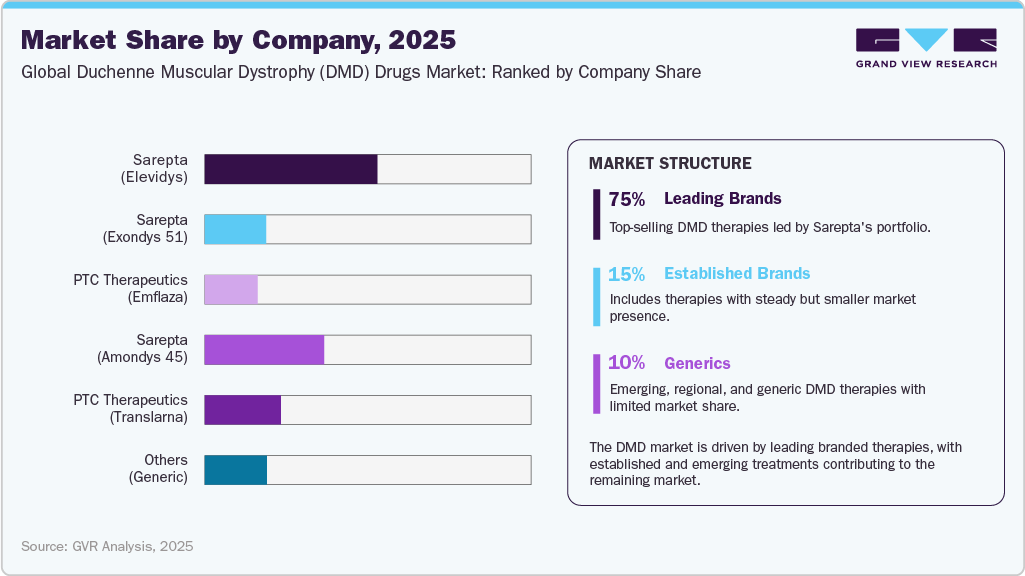
The DMD drugs market is moderately fragmented, with competition divided across gene therapy, exon-skipping, and steroid segments. In gene therapy, Sarepta holds a concentrated lead with Elevidys, though its position has narrowed following the 2025 safety restriction to ambulatory patients only. No other gene therapy is approved at a comparable commercial stage; RGX-202 (Regenxbio) and other candidates remain in earlier stages of development.
The exon-skipping segment is more fragmented, split by mutation eligibility rather than price. Sarepta holds Exondys 51 (exon 51), Vyondys 53 (exon 53), and Amondys 45 (exon 45), while NS Pharma competes with Viltepso for the exon 51 population. Since each drug serves a distinct, patent-protected mutation subgroup, competition centers on which patients qualify for treatment rather than direct price competition.
The steroid segment is the most fragmented, comprising generic deflazacort and prednisone, as well as the branded vamorolone (Agamree). Competition here is driven by price and broad generic availability, with vamorolone competing on an improved side-effect profile rather than cost.
With few approved options in the gene therapy and exon-skipping segments, competition is shaped more by mutation eligibility, safety monitoring requirements, and dosing burden than by pricing. As pipeline candidates such as DYNE-251 and delpacibart zotadirsen advance, dosing frequency, route of administration, and safety data are expected to play a larger role in shaping future market share.
Market Dynamics
In December 2025, the U.S. Department of Health and Human Services added DMD to the Recommended Uniform Screening Panel (RUSP), following scientific review. DMD affects about 2 per 10,000 male newborns, and the average U.S. diagnosis age has historically been 4.5 to 5 years due to delayed symptom recognition. Screening relies on measuring creatine kinase (CK-MM), an established, low-cost muscle-damage marker. Ohio and Minnesota already screen for this condition, and New York, Massachusetts, and Arizona have passed laws requiring implementation. Nationwide adoption of RUSP-recommended conditions typically takes 5 to 10 years, but the decision is expected to shorten diagnostic delays and expand the pool of infants identified early enough to start treatment before major muscle loss occurs.
Elevidys (delandistrogene moxeparvovec), Sarepta's AAV-based gene therapy, received accelerated approval in 2023, marking the first gene therapy for DMD and a shift beyond the steroid-based standard of care. Adoption grew quickly at first, but slowed in 2025 after reports of fatal liver failure in non-ambulatory patients led to a shipment pause and an FDA-mandated label restriction to ambulatory patients. Even so, Elevidys generated USD 898.7 million in net revenue for full-year 2025, and Sarepta has set a USD 500 million annual sales floor for the product in the future. This milestone approval is expected to continue shaping treatment eligibility criteria and influence how future gene therapies are developed and reviewed.
Key Market Trends
"Gene Therapy and Exon-Skipping Drugs Are Shifting DMD Care From Symptom Management to Disease Modification, But Safety Data Now Shapes the Pace"
Elevidys and the exon-skipping ASOs (Exondys 51, Vyondys 53, Amondys 45, Viltepso) are the first therapies to address the underlying genetic cause of DMD, rather than only managing symptoms with steroids. Commercially, Sarepta's PMO (exon-skipping) franchise generated USD 965.6 million in full-year 2025 revenue, with Exondys 51 contributing USD 148 million and Vyondys 53 USD 134 million in Q4 2025 alone. But unlike the steady climb seen with earlier DMTs, Elevidys revenue growth reversed course in 2025: quarterly sales fell after the FDA-mandated shipment pause, and management has cited lingering physician and patient hesitancy following the safety events. This is redirecting some investment focus toward next-generation candidates such as DYNE-251 and delpacibart zotadirsen, which carry Breakthrough Therapy Designation and no reported safety flags to date.
"Newborn Screening Is Expanding the Diagnosed and Treatable Patient Pool"
Diagnostic delay has long limited early treatment in DMD, since symptoms often don't appear until age 2–3, and formal diagnosis has historically taken years longer. This is changing with the December 2025 RUSP addition, which recommends universal newborn screening using a low-cost CK-MM blood test. As states adopt RUSP-recommended conditions into their own newborn screening panels over the coming years, more infants are expected to be identified before symptom onset, expanding the pool of patients eligible for early intervention with steroids, exon-skipping therapy, or gene therapy.
ROA Analysis
Regional Analysis
U.S. Duchenne Muscular Dystrophy (DMD) Drugs Market
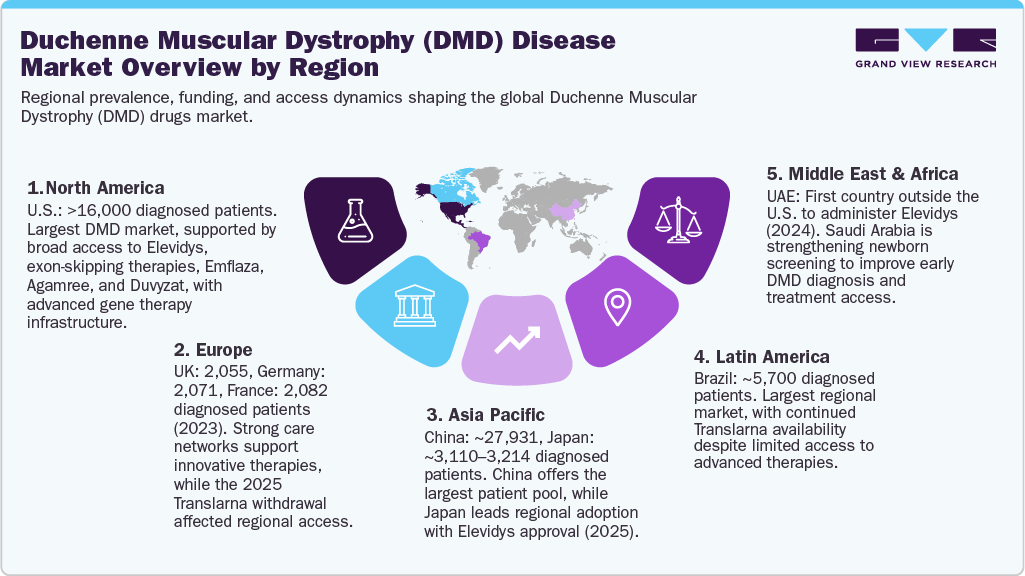
The U.S. is the largest and most developed DMD drugs market, supported by an established rare-disease infrastructure and orphan drug incentives. Epidemiology studies estimate roughly 10,000 to 15,000 people living with DMD in the U.S., with about two-thirds under age 20. In December 2025, HHS added DMD to the Recommended Uniform Screening Panel, a step expected to shorten the historical 4.5 to 5-year average diagnosis delay. The market includes all major treatment classes: corticosteroids (deflazacort, prednisone, vamorolone), exon-skipping ASOs (Exondys 51, Vyondys 53, Amondys 45, Viltepso), and gene therapy (Elevidys). Elevidys adoption slowed in 2025 following its restriction to ambulatory patients, though Sarepta's combined exon-skipping and gene therapy revenue still reached USD 1.86 billion for the full year.
UK DMD Drugs Market
The UK is one of the more established DMD markets in Europe, with about 100 boys born with DMD each year and roughly 2,500 people living with the condition at any time. Unlike the EU, the UK regulates medicines separately through the MHRA post-Brexit. NICE recommended Translarna (ataluren) for routine NHS funding in 2023 for ambulatory nonsense-mutation patients aged 5 and older, and this access has continued even after the drug's conditional EU marketing authorization was not renewed in March 2025. Agamree (vamorolone) is also approved and reimbursed. NHS access to newer gene and exon-skipping therapies remains limited, with managed access agreements the likely path for future approvals, given the high cost of these treatments.
Germany DMD Drugs Market
Germany is one of the larger EU5 markets for DMD, with diagnosed prevalence in Europe estimated at around 6.5 per 100,000 males. The German market remains centered on corticosteroids, since two of the newer DMT classes have faced EU-wide regulatory setbacks: Translarna lost its EU marketing authorization in March 2025, and the EMA's CHMP issued a negative opinion on Elevidys for ambulatory patients in July 2025. Agamree remains available following its EU approval in late 2023/early 2024. Germany continues to support DMD care through specialized neuromuscular centers, though access to gene therapy remains constrained pending further EMA review.
France DMD Drugs Market
France operates under the same EU regulatory environment as Germany, with an estimated 2,000+ people living with DMD, based on EU5 prevalence data. Translarna's non-renewal took direct effect in France in June 2025, when the ANSM ended its derogatory reimbursement following the EU decision, and the drug is no longer available to new patients in the country. As in the rest of the EU, Elevidys remains unapproved following the CHMP's negative opinion, leaving Agamree and generic corticosteroids as the primary treatment options. France continues to support DMD research through institutions such as the Institut de Myologie.
Japan DMD Drugs Market
Japan holds a distinct position in the DMD market as the home market for Viltepso (viltolarsen), developed jointly by Nippon Shinyaku and Japan's National Center of Neurology and Psychiatry. Viltepso received its first global marketing approval in Japan in March 2020, ahead of its U.S. approval later that year. Elevidys is also approved in Japan. Japan's universal healthcare system and established neuromuscular specialist network support relatively strong access to exon-skipping therapy and steroids, and the country continues to invest in domestic DMD research through NCNP.
China DMD Drugs Market
China is an emerging DMD market, with an estimated 70,000 people living with the condition. Until recently, there was no approved DMD-specific drug in the country, leaving patients dependent on off-label steroid use. This changed in December 2024, when China's NMPA approved Agamree (vamorolone) as the first and only approved DMD therapy in China. The approval followed Priority Review and Breakthrough Therapy designation, and commercialization is being carried out through Santhera's partner Sperogenix Therapeutics. Continued expansion of diagnostic infrastructure is expected to support further treatment uptake.
Brazil DMD Drugs Market
Brazil is one of the more advanced DMD markets in Latin America in terms of treatment access. Elevidys is approved in Brazil for ambulatory patients aged 4 through 7, a narrower age range than the U.S. approval, through Roche's regional commercialization agreement with Sarepta. Corticosteroids remain the backbone of treatment across the broader patient population. Brazil's growing network of neuromuscular referral centers is expected to support earlier diagnosis and expand the pool of patients eligible for advanced therapies over time.
Saudi Arabia DMD Drugs Market
Saudi Arabia is an emerging DMD market in the Middle East. An observational cohort study of DMD patients in the Kingdom found a mean age at diagnosis of 7 years, indicating continued diagnostic delay compared with Western markets. As of late 2025, Elevidys was still under regulatory review in Saudi Arabia, unlike several neighboring Gulf countries, where it has already been approved. Corticosteroids remain the standard of care, and the country continues to build out specialized pediatric neurology services to support earlier diagnosis and treatment planning.
UAE DMD Drugs Market
The UAE has emerged as one of the more accessible markets globally for advanced DMD therapy. Elevidys is approved in the UAE for patients aged 4 and older, regardless of ambulatory status, a broader approval than in the U.S., where use is now restricted to ambulatory patients only. This positions the UAE, along with Qatar, Kuwait, Bahrain, and Oman, among the earliest adopters of unrestricted access to gene therapy. The UAE's growing investment in specialized rare-disease care and its role as a regional referral hub are expected to continue to support the adoption of newer therapies.
Analyst Perspective
Value is shifting toward disease modification, but safety data is slowing the pace
Corticosteroids still dominate volume due to generic availability. Gene and exon-skipping therapies drive value despite serving a smaller, mutation-defined population. Elevidys' revenue declined in 2025 following safety-related label restrictions, highlighting that future growth depends on restoring physician and patient confidence as much as on demonstrating efficacy.
Diagnostic timing is becoming a stronger growth driver than prevalence
Adoption depends on newborn screening, mutation testing, reimbursement, and physician confidence in managing gene therapy risk. Adding DMD to the U.S. RUSP in 2025 directly targets diagnostic delay. The U.S., Japan, and Gulf markets, such as the UAE, lead in the adoption of advanced therapies, while Europe, Latin America, and other emerging markets remain reliant on corticosteroids due to regulatory or reimbursement constraints.
Mutation eligibility and monitoring burden are key competitive factors
Exon-skipping and gene therapies serve defined mutation subgroups, so competition centers on eligibility and monitoring rather than price. Elevidys's boxed warning raises its adoption burden versus steroids or oral vamorolone. Pipeline candidates like DYNE-251 and delpacibart zotadirsen are expected to compete on lower monitoring burden and easier dosing.
Lifecycle management is expanding revenue through broader access, not new indications
DMD's narrower symptom profile limits indication expansion. Agamree's approval across the U.S., EU, UK, and China, regardless of mutation, shows steroid alternatives capturing share across the full patient population. Continued international rollout, plus exon-skipping expansion into new mutation subtypes, is the more realistic near-term revenue lever.


Customize this report to your needs - add regions, segments, or data points, with 20% free customization.
Or view our licence options:


ISO 9001:2015 & 27001:2022 Certified
We are GDPR and CCPA compliant! Your transaction & personal information is safe and secure. For more details, please read our privacy policy.


