- Home
- »
- Market Trend Reports
- »
-
Exosomes Diagnostics And Therapeutics Market: Emerging Trends And Market Driver Analysis
![Exosomes Diagnostics And Therapeutics Market: Emerging Trends And Market Driver Report]()
Exosomes Diagnostics And Therapeutics Market: Emerging Trends And Market Driver Analysis
- Published: Oct, 2025
- Report ID: GVR-MT-100456
- Format: PDF/Excel databook
- No. of Pages/Datapoints: 50
- Report Coverage: 2024 - 2030
Report Overview
The exosome diagnostics and therapeutics industry is transforming as scientific understanding of extracellular vesicles deepens and their clinical potential becomes increasingly evident. Exosomes, which were formerly thought of as cellular waste, are now understood to be potent biological messengers with important implications for disease detection, prognosis, and targeted therapy. This paradigm shift is also fueling innovation in oncology, neurology, cardiovascular, and infectious disease research and changing the landscape of diagnostics and treatments.
Exosome-based drug delivery systems are becoming increasingly popular in the therapeutic field because of their inherent stability, biocompatibility, and capacity to pass through biological barriers like the blood–brain barrier. RNA, proteins, and other small molecules can be delivered directly to target cells by biopharmaceutical companies and research institutions using engineered exosomes, which provide a safer and more effective option than conventional delivery methods. These developments open the door to new developments in immune modulation, oncology treatments, and regenerative medicine.
The exosome diagnostics and therapeutics market is expected to grow into a key component of next-generation precision healthcare as the need for early detection and focused treatment increases. Translating this exciting science into broad clinical and commercial success will require striking a balance between scientific rigor, scalability, and accessibility.
Growth Drivers & Technological Advancements
Advancements in Clinical Research for Exosome-based Therapeutics
Developments significantly influence the market for exosome diagnostics and treatments in clinical research for exosome-based treatments. Clinical studies on exosome safety, effectiveness, and therapeutic potential have recently increased in several disease areas, such as cancer, neurodegenerative diseases, cardiovascular diseases, and autoimmune conditions. These advancements offer solid scientific proof highlighting exosomes' potential as precise drug delivery systems and agents in regenerative medicine. Exosome-based treatments are becoming more widely used in medicine as clinical trial data increases confidence among investors, researchers, and healthcare professionals.
Various therapeutic applications of exosomes.
Type of Exosome
Therapeutic Application
Mode of Action
Exosome-loaded drugs
Anxiety disorders and refractory depression
Loaded with anti-inflammatory and growth substances
Stem-cell derived exosomes
Cerebrovascular diseases
Stimulate innate neuronal precursors
Exosomes derived from neurons
Synaptic transmission regulation
Control astrocytic glutamate
Exosomes derived from cerebral cells
Tissue regeneration
Transport regulatory components to the brain's damaged locations
Macrophage-derived exosomes
Parkinson's disease (PD)
Neuroprotection
SCAMP 5
Huntington's disease
Eliminates alpha-synuclein aggregation and mediates its clearance
Natural killer (NK)-cell-derived exosomes
Glioma
Immunotherapy
Exosomes derived from multipotent mesenchymal stromal cells
Stroke
Facilitate angiogenesis, remodeling, and neurogenesis
Exosomes of human umbilical cord-derived mesenchymal stem cells
Early glioma stage
Regulate miR-10a-5p/PTEN signaling pathway
Exosomal miR-193b
Alzheimer's disease
Reduces neuronal amyloid precursor protein expression
Exosome-based stem cell therapy
Multiple sclerosis (MS)
Improves motor and neural function, decreases myelin breakdown and neuroinflammation
Antisense molecule with exosomes
Brain glioma
Stimulate the adaptive immune system
Exosomes derived from stem cells
Traumatic brain injury (TBI)
Post-transcriptional gene regulation in recipient cells
Source: Extracellular Vesicle, Secondary Research, Grandview Research, inc.
More precise and efficient exosome treatments are made possible by advancements in trial design and bioengineering methods. Methods that enhance therapeutic results while reducing side effects, like surface modification, engineered exosome payloads, and scalable manufacturing processes, are being tested in clinical settings. Translational research is further improved by the expanding cooperation among academic institutions, biotech start-ups, and pharmaceutical companies, which helps to close the gap between laboratory discoveries and practical clinical applications. These developments are propelling market expansion and the pipeline of exosome-based treatments by boosting product viability, commercial potential, and investor confidence in this nascent industry.
Increasing Adoption of Non-invasive Diagnostic Tools
One of the main factors propelling the exosome diagnostics and therapeutics market is the growing use of non-invasive diagnostic tools. Naturally occurring in various biofluids, including blood, urine, saliva, and cerebrospinal fluid, exosomes provide a minimally invasive way to identify and track diseases at the molecular level. In contrast to conventional tissue biopsies, which are frequently invasive, dangerous, and time-consuming, exosome-based liquid biopsies give medical professionals real-time information about how a disease is progressing, how well a treatment works, and how early disorders like cancer, neurological disorders, and cardiovascular diseases can be detected. The demand for exosome-based diagnostic solutions is rising globally due to the increased clinical practice adoption of non-invasive diagnostic techniques due to their accuracy, safety, and convenience.
Developments in bioinformatics and high-sensitivity detection technologies are improving the accuracy and clinical utility of exosome diagnostics. Over the forecasted period, the market for exosome diagnostics and treatments is anticipated to grow substantially due to their increasing acceptance and incorporation into standard clinical workflows.
Growing Biopharma & Government R&D Investments
Growing Biopharma and government R&D Investments are emerging as a major driver for the exosome diagnostics and therapeutics market. Biopharmaceutical companies are increasingly allocating significant resources to research and development to explore the diagnostic and therapeutic potential of exosomes.
At the same time, public-private partnerships and government funding are essential for advancing exosome research. Academic institutions and biotech companies can pursue high-impact projects because of initiatives from organizations like the European Commission, the National Institutes of Health (NIH), and other regional research bodies that offer grants, subsidies, and collaborative frameworks. Such assistance promotes the conversion of lab findings into clinical applications and helps reduce the financial risks connected with innovative treatments. Government-sponsored research projects and private sector investment are working to build a strong innovation ecosystem that propels expansion and influences the future market for exosome diagnostics and treatments.
Technological Innovations
Progress in Exosome Isolation, Purification, and Characterization
Innovations in exosome isolation and purification are changing the clinical possibilities of exosomes. More modern methods, such as microfluidics-based isolation, immunoaffinity capture, and size-exclusion chromatography, provide higher purity, scalability, and reproducibility compared to historically used ultracentrifugation methods.
Advancements in characterization platforms such as nanoparticle tracking analysis (NTA), cryo-electron microscopy (cryo-EM), and high-resolution flow cytometry offer the opportunity for comprehensive characterization of exosome size, shape, and biomolecular contents. Collectively, these advances in characterization and diagnostic techniques are improving precision, reliability, and adoption in the market for exosome diagnostics and therapeutics.
Development of Analytical & High-throughput Platforms
Improvements in analytical and high-throughput technologies are transforming exosome research by increasing precision, scalability, and data reproducibility.
This infographic depicts how exosome research has evolved from low-throughput analytical and high-throughput platforms with low throughput, utilizing mostly manual methods, to advanced automated and AI-driven systems. The field is now moving from traditional means of characterization, early automated techniques, such as NTA and TRPS, to high-resolution multi-omics integration, and now, large-scale high-throughput platforms utilizing AI and machine learning. Each shift reflects compound technological advances in precision, scalability, and clinical utility, rapidly advancing the search for biomarkers and treatment developments.
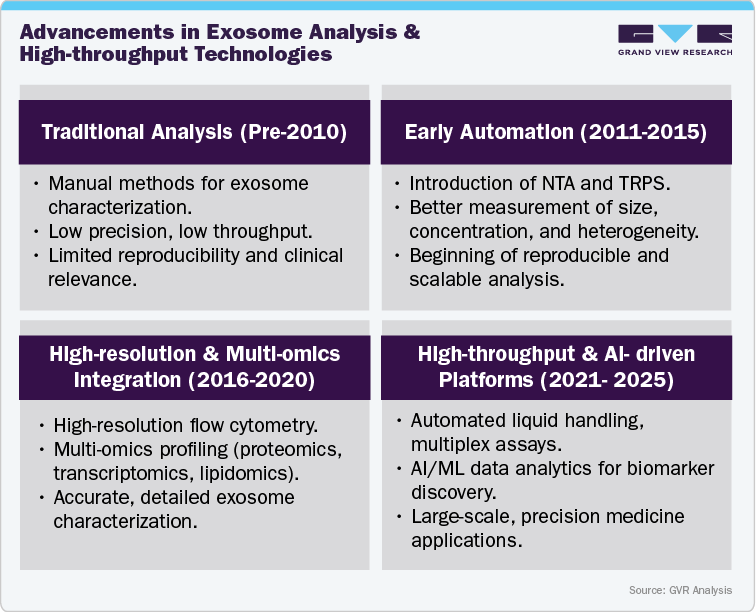
High-throughput and multi-omics approaches, combined with AI-enabled data analytics, enable the simultaneous profiling of thousands of samples for biomarker discovery and therapeutic evaluation. These advances will allow timely large-scale investigations, speed up diagnostic commercialization, and promote exosome-based approaches to precision medicine.
Emergence of Exosome-based Drug Delivery Systems
Drug delivery systems based on exosomes are distinguished by their natural biocompatibility, low immunogenicity, and ability to cross biological barriers, including the blood-brain barrier. Unlike synthetic nanoparticles, exosomes can effectively deliver proteins, nucleic acids, and small molecules to target cells while enhancing drug stability, bioavailability, and therapeutic efficacy.
New engineering innovations and loading methods, such as surface modification, cargo encapsulation, and ligand attachment strategy, have improved the specificity and control over the release of exosome-based therapies. These developments continue to bolster the position of exosomes as multi-functional nanocarriers for cancer treatment, neurological disorders, and regenerative medicine, and as an appealing platform for next-generation drug delivery.
Emerging Trends
The exosome diagnostics and therapeutics market is changing rapidly due to technological advancements and collaborative efforts. The incorporation of AI and machine learning will improve exosome biomarker discovery by enhancing the analysis of complex datasets, identifying disease signals with increased precision, and accelerating therapeutic target discovery and development.
The field's development is also being driven by a surge of collaborations between academic and industry partners, focusing on translating research, production, and clinical availability of exosome-based diagnostic kits and therapeutics. At the same time, regulatory processes are emerging to address clinical verification, standardization, and safety, thus fostering clinical adoption and commercialization. Together, these forces consolidate the foundation for exosome-based innovations, moving from the research space into the clinic and the marketplace.
Competitive Landscape: Exosomes Diagnostics & Therapeutics Report Coverage
The Exosomes Diagnostics & Therapeutics market is characterized by robust competition, driven by leading innovators including Thermo Fisher Scientific, Bio-Techne Corporation, Qiagen N.V., Lonza Group AG, Exosome Diagnostics, NanoSomix, Danaher Corporation, System Biosciences, Miltenyi Biotec, Aethlon Medical, Norgen Biotek, Creative Biolabs, Evox Therapeutics, Codiak BioSciences, and Capricor Therapeutics. These companies are advancing diverse platforms for exosome isolation, characterization, and therapeutic applications, leveraging proprietary technologies, scalable manufacturing processes, and novel delivery systems. The competitive landscape in this sector is analyzed based on technological differentiation, product pipeline, strategic partnerships, and global market presence. The report analyses the competitive landscape in this industry based on the parameters mentioned below:
Top 10 Exosomes Diagnostics & Therapeutics Market
Competitive Landscape: Top 10 Exosomes Diagnostics & Therapeutics Market Analysis Overview
Market Outlook
Company Categorization
Company Share Analysis (10 companies)
Company Position Analysis
List of Key Companies by Region
Company Overview
Product Benchmarking
Financial Performance
Recent Strategic Initiatives
SWOT Analysis
Thermo Fisher Scientific, Inc.
Company Overview
-
Headquarter: U.S.
-
Establishment Year: 1956
-
Employee Strength (2024): 122,000
-
Business Overview: Thermo Fisher Scientific, Inc., is a global leader in life sciences, providing advanced instruments, reagents, and platforms essential for exosome research and clinical applications. In the Exosome Diagnostics and therapeutics market, technologies such as nanoparticle tracking analysis, flow cytometry, and molecular biology tools facilitate efficient exosome isolation, characterization, and biomarker discovery. With strong R&D investments, strategic collaborations, and a broad global presence, Thermo Fisher drives innovation and supports the translation of exosome-based diagnostics and therapeutics from research to clinical and commercial applications.
Financial Performance
Key Financials (Thermo Fisher Scientific Inc.)
2024 (USD million)
2023 (USD million)
2022 (USD million)
Revenue
42,879
42,857
44,915
Net Income/(Loss)
6,338
5,955
6,960
Note: Similar analysis will be provided for all the companies in the final deliverable.
Strategic Initiatives
Thermo Fisher Scientific Inc. is strengthening its position in the. exosomes diagnostics & therapeutics industry through several key initiatives. The company is expanding its manufacturing facilities and upgrading its research and development capabilities.
-
In May 2025, in the U.S., RoosterBio collaborated with Thermo Fisher Scientific to accelerate development and GMP manufacturing of hMSC- and exosome-based therapies for degenerative disease treatments.
SWOT Analysis
SWOT Analysis – Thermo Fisher Scientific Inc.
Strengths
Weaknesses
- Global leadership in life sciences and biotechnology solutions with a diversified product portfolio.
- Strong R&D capabilities driving innovation in exosome diagnostics, analytical tools, and advanced therapy manufacturing.
- Extensive global distribution and supply chain network ensuring broad market reach.
- Strong brand reputation and strategic partnerships enhancing credibility in clinical and research markets.
- High dependence on life sciences research and diagnostic markets, making revenue sensitive to funding fluctuations.
- Complex operations across multiple segments can increase management and operational challenges.
- Premium pricing of advanced instruments may limit adoption in smaller labs or emerging markets.
Opportunities
Threats
- Growing demand for exosome-based diagnostics and therapeutics, including personalized medicine applications.
- Expansion of contract development and manufacturing services (CDMO) for cell and gene therapies.
- Integration of AI and high-throughput platforms for biomarker discovery and drug development.
- Strategic acquisitions and collaborations to strengthen technological capabilities and market presence.
- Intense competition from other biotechnology and life sciences companies offering alternative platforms.
- Regulatory uncertainties in advanced therapeutics and exosome-based products.
- Economic fluctuations affecting research funding, healthcare spending, and capital equipment investments.
- Rapid technological changes may require continuous investment to stay competitive.
![gvr icn]()
GET A FREE SAMPLE
![gvr icn]()
This FREE sample includes market data points, ranging from trend analyses to market estimates & forecasts. See for yourself.
![gvr icn]()
NEED A CUSTOM REPORT?
We can customize every report - free of charge - including purchasing stand-alone sections or country-level reports, as well as offer affordable discounts for start-ups & universities.
Contact us now to get our best pricing.
![esomar icon]()
ESOMAR certified & member
![ISO]()
ISO Certified
We are GDPR and CCPA compliant! Your transaction & personal information is safe and secure. For more details, please read our privacy policy.






We are committed towards customer satisfaction, and quality service.
Client Testimonials

"The quality of research they have done for us has been excellent..."
ISO Certified