
- Home
- »
- Medical Devices
- »
-
Gen Z Aesthetic Injectables: The Rise Of Prejuvenation And Preventative AestheticsGVR Report cover
![Gen Z Aesthetic Injectables: The Rise Of Prejuvenation And Preventative AestheticsReport]()
Gen Z Aesthetic Injectables: The Rise Of Prejuvenation And Preventative Aesthetics
Executive Summary
The global GenZ aesthetic injectable market size was valued at USD 1.0 billion in 2025 and is projected to grow from USD 1.1 billion in 2026 to USD 1.8 billion by 2033, at a CAGR of 7.2% from 2026 to 2033. The market is witnessing strong growth due to the rising demand for preventive aesthetic treatments among adults aged 18-34 years, increasing social media influence, and growing acceptance of minimally invasive cosmetic procedures. Gen Z, particularly consumers entering their 20s, is becoming an increasingly visible participant in the aesthetics ecosystem. Rather than waiting for pronounced signs of aging, younger consumers are increasingly interested in maintaining facial harmony, preventing the development of dynamic lines, improving skin quality, and making small changes that preserve their natural appearance.
TRADITIONAL
Correct visible aging
Wrinkles • Volume loss
TransformationEMERGING
Prevent early change
Skin quality • Balance
Subtle optimizationFUTURE
Personalized longevity
Maintenance • Regeneration
Natural-looking resultsThe Gen Z Injectable Aesthetics Shift
Core shift:
“Fix aging” → “Manage aging before it becomes visible”
The trend is not limited to Botox-style wrinkle prevention. The emerging Gen Z aesthetic basket increasingly encompasses neuromodulators, lip enhancement, facial balancing, skin boosters, biostimulatory injectables, regenerative-oriented treatments, and combination treatment plans. At the same time, the aesthetic ideal itself is changing. Instead of the highly volumized or visibly treated appearance associated with earlier aesthetic cycles, younger consumers are increasingly attracted to results that appear undetectable, balanced, personalized, and compatible with their existing facial identity.
This is creating an important commercial opportunity for aesthetic clinics, injectable manufacturers, dermatologists, plastic surgeons, medspas, and digital-first beauty brands. However, the opportunity is accompanied by significant challenges involving patient education, social-media-driven expectations, counterfeit products, inappropriate treatment, provider qualifications, and the medicalization of appearance among younger consumers.
What Is Gen Z Prejuvenation?
Prejuvenation refers broadly to aesthetic strategies intended to maintain youthful appearance or delay visible signs of aging rather than treating established aging. Within injectable aesthetics, it can include conservative use of neuromodulators, facial balancing, skin-quality treatments and other minimally invasive approaches.
The distinction between anti-aging and prejuvenation is important.
Traditional Anti-Aging
Gen Z Prejuvenation
Primarily correction-oriented
Prevention and maintenance-oriented
Addresses visible aging
Addresses early or potential changes
Often focused on wrinkles and volume loss
Focuses on skin quality, facial harmony and prevention
Treatment begins later
Treatment consideration begins earlier
Stronger correction may be acceptable
Subtlety is generally prioritized
“Look younger”
“Look like myself, but refreshed”
Periodic treatment
Maintenance-oriented approach
Prejuvenation should not automatically be interpreted as a medical recommendation for young people to receive injectables. Instead, it describes a consumer and aesthetic philosophy that has become increasingly visible among younger adults.
ASPS data provides an important indicator of this transition. In 2024, neuromodulator injections were the most popular minimally invasive cosmetic treatment among individuals aged 20-29.
Social Media Is Reshaping Gen Z Aesthetic Injectable Discovery
Social media is increasingly functioning as a beauty-search environment for Gen Z. SociallyIn's 2026 analysis reports that 41% of Gen Z turn to social media first for information, compared with 32% who default to traditional search engines. It also cites a separate finding that 46% of Gen Z prefer social platforms over Google when seeking information. For aesthetic medicine, this is important because the consumer journey often starts with visual discovery rather than a direct purchase decision.
SociallyIn reports that Gen Z spends approximately three hours per day on TikTok and 2 hours 18 minutes on Instagram. It also indicates that TikTok and YouTube together account for about 68% of Gen Z social-media time. These patterns make video a core channel for explaining treatments, showing realistic results, discussing recovery and introducing terminology such as prejuvenation, skin boosters and facial balancing.
Gen Z Digital
Gen Z Digital Behavior
Data Points
Relevance to Aesthetic Injectables
Social media first for information
41%
Treatment discovery can start on social platforms
Prefer social platforms to Google
46%
Social search visibility becomes strategically important
Spend 4+ hours/day on social media
50-54%
Large exposure window for aesthetic content
TikTok use
~3 hours/day
Major trend-discovery channel
Instagram use
~2h 18m/day
Visual provider and result discovery
TikTok + YouTube share of time
~68%
Video should be central to communication
Comments/ratings important
69%
Peer validation strongly influences decisions
Follow relatable micro-influencers
74%
Creator-led education can build trust
Use AR filters
28%
Digital beauty tools can shape facial expectations
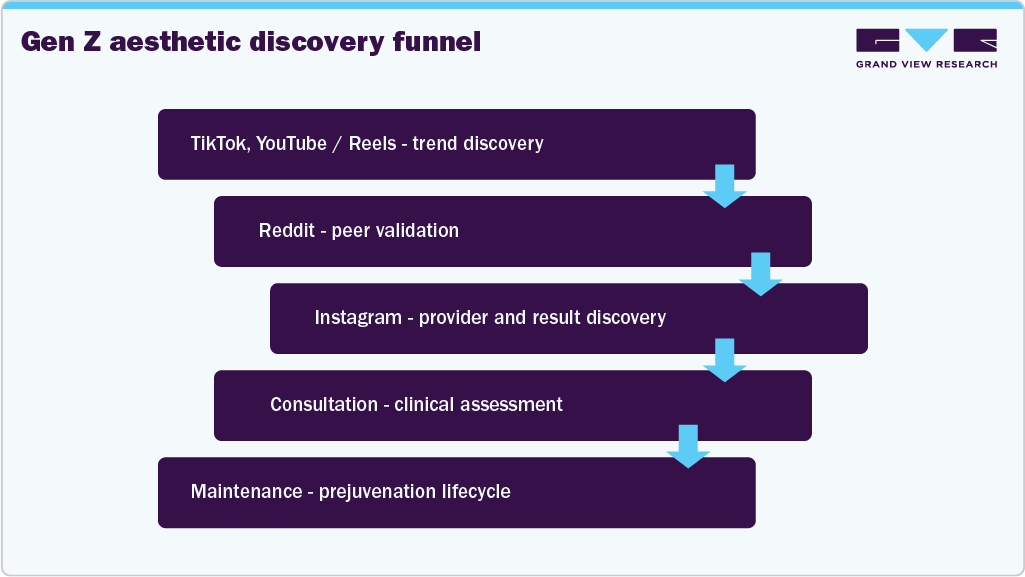
Gen Z aesthetic discovery funnel
Gen Z as a Value-Conscious Aesthetic Consumer
The estimates monthly aesthetic spending at approximately USD 95 for Gen Z and around USD 115 for Millennials. It characterizes Gen Z as more responsive to single-session, cost-effective treatments and transparent pricing. For providers, this supports modular entry points, clear pricing and upfront communication about expected results and maintenance. Perceived value is increasingly connected to natural outcomes, trust and personalization rather than treatment volume alone.
A Credit Karma survey in which 55% of Gen Z and 45% of Millennials reportedly felt compelled to pursue cosmetic procedures after seeing influencer posts. It also cites research linking social-media imagery with body dissatisfaction among young people. For injectable aesthetics, social media has a dual effect. It can accelerate awareness, education and demand, but idealized or filtered imagery can also create unrealistic expectations. Education-first content, real results, transparent limitations and clinically appropriate guidance are therefore increasingly important.
Trend Matrix and Five-Year Outlook
Trend
2026 Momentum
2027-2028 Direction
2029-2030 Outlook
Commercial Impact
Preventative neuromodulators
High
↑↑
Mainstream
Very High
Natural-looking results
Very High
↑↑
Dominant philosophy
Very High
Facial balancing / micro-tweaks
High
↑↑
Core model
High
Skin-quality injectables
Emerging
↑↑
Established category
High
Biostimulatory injectables
Growing
↑↑
Mainstream
Very High
Regenerative-oriented aesthetics
Early
↑↑↑
Potential major category
Very High
AI consultation
Emerging
↑↑
Routine support tool
High
Social search
Very High
↑
Core discovery channel
Very High
Personalized protocols
High
↑↑
Expected standard
Very High
Dramatic filler aesthetic
Relative decline
↓
Niche / selective
Moderate
Market Participant Categorization
Category
Operating Strategies
Competitive Edge
Weakness
Established Players (AbbVie Inc., Galderma, Merz GmbH and Co. KGaA, Sinclair, Medytox)
- Focus on expanding minimally invasive aesthetic portfolios including hyaluronic acid fillers, botulinum toxin products, skin boosters, and regenerative injectables tailored to younger consumers.
- Invest in clinical studies, physician education, digital marketing campaigns, and strategic partnerships with aesthetic clinics and medspas to strengthen market presence.
- Strong global brand recognition, extensive product portfolios, and well-established distribution networks.
- Significant investment in R&D, long-term safety data, and regulatory expertise increases physician confidence.
- High product pricing compared to emerging brands may limit adoption among younger price-sensitive consumers.
- Large organizations often have longer product development and regulatory approval timelines.
Emerging Players (HUGEL, Inc., Ipsen Pharma, Teoxane)
- Focus on innovative injectable technologies such as biostimulatory fillers, polynucleotide (PN/PDRN) injectables, exosome-based aesthetics, and personalized skin rejuvenation solutions.
- Emphasize affordable premium products, rapid product innovation, and partnerships with independent aesthetic clinics and medical spas.
- Faster innovation cycles enable rapid introduction of new injectable formulations and regenerative aesthetic products.
- Competitive pricing strategies improve accessibility among younger consumers seeking preventive aesthetic treatments.
- Limited financial resources and smaller commercial infrastructure compared to multinational companies.
- Lower physician awareness and fewer long-term clinical studies may affect adoption.
Global Injectable Momentum
The growth of injectables provides a large platform on which younger-consumer trends can develop. However, Gen Z should be viewed as one emerging consumer segment within the wider injectable market rather than as the sole source of growth.
Younger-Consumer Trends
Region
Share (2025)
Gen Z / Younger-Consumer Characteristics
North America
33.3%
Preventative Botox, natural results, facial balancing and medspa culture
Europe
22.6%
Natural aesthetics, skin quality, conservative treatment and medical-provider emphasis
Asia Pacific
29.5%
Skin quality, facial harmony, technology-driven beauty and innovation, growing social-media influence, lip/facial tweaks and normalization
Middle East & Africa
7.0%
High aesthetic awareness, contouring and premium clinic experiences
Latin America
7.6%
Strong aesthetic culture and growing minimally invasive adoption


Customize this report to your needs - add regions, segments, or data points, with 20% free customization.
Or view our licence options:


ISO 9001:2015 & 27001:2022 Certified
We are GDPR and CCPA compliant! Your transaction & personal information is safe and secure. For more details, please read our privacy policy.


