- Home
- »
- Market Trend Reports
- »
-
Top M&A Deals And Strategic Buyers In The General Surgery Devices Market
![Top M&A Deals And Strategic Buyers In The General Surgery Devices MarketReport]()
Top M&A Deals And Strategic Buyers In The General Surgery Devices Market
- Published: Oct, 2025
- Report ID: GVR-MT-100453
- Format: PDF/Excel databook
- No. of Pages/Datapoints: 50
- Report Coverage: 2024 - 2030
Overview of M&A Activity in General Surgery Devices
The general surgery devices market is undergoing a period of rapid consolidation. Leading medical device companies have strategically acquired innovative companies in order to enhance their product offerings and competitive advantage in the post-pandemic healthcare environment. Deal activity has surged in the past 18 months, largely fueled by the rapid advances in robotic surgery, minimally invasive surgical work, and AI-assisted technology.
Prominent companies, including Johnson & Johnson, Boston Scientific, Zimmer Biomet, and Medtronic, have actively sought mergers and/or acquisitions in order to broaden their product portfolios and improve their procedural ecosystems. These activities underscore an even greater shift toward creating digitally integrated, robotic, and imaging platforms on a clinical and operational basis in surgical care, to drive improved outcomes.
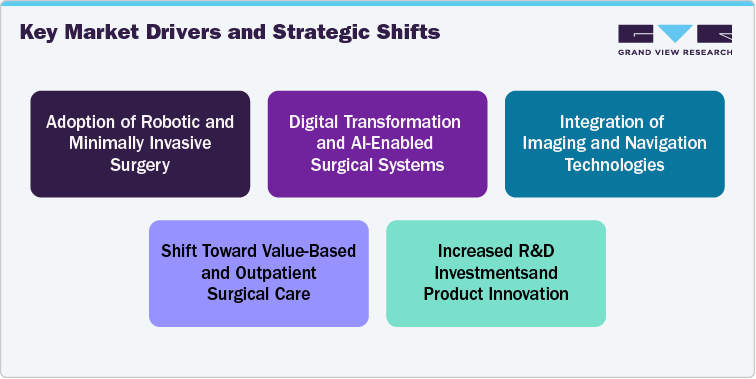
Adoption of Robotic And Minimally Invasive Surgery
There has been an increased spread of robotic and minimally invasive surgery as hospitals and health systems pursue improved clinical outcomes, shorter lengths of stay, and faster recovery and the underlying technology strategy is quickly evolving. Major platform launches and regulatory approvals in 2024-2025 have lessened barriers for more extensive clinical uptake: Intuitive’s more recently-released fifth-generation da Vinci 5., transitioned from limited rollout to broader placements (362 systems and ~32,000 procedures reported in the initial launch), which Intuitive’s CEO compared to bringing “first-of-their-kind technologies” that can “invite more surgeons in and ease their journey”. In addition, evidence from studies that compare an institution’s prior capabilities with robotic approaches for several procedures (e.g., colectomies) cite clinical benefits, specifically improvements in conversion rates and postoperative outcomes, establishing a clinical argument for justification for capital and training costs.
Regulatory and competitive activity has developed the market, beyond the former notion of a single incumbent, to create even more attractive options for hospitals and ambulatory surgical centers. CMR Surgical's Versius has achieved FDA De Novo clearance (opening up cholecystectomy indications) and is marketed as a modular and lower-footprint option to legacy systems, which many commentators believe will create broader access and pricing change dynamics in the OR. Medtronic has continued to advance its Hugo system through CE marks and one U.S. IDE study to include gynecologic indications, as well as considerations from smaller companies like Asensus robotics and miniaturized-robot vendors with expanded FDA indications. All of these are indicating that platform diversity, and purpose-built robots (from multiport systems to miniaturized and single-site devices) is becoming commercially viable, supporting different adoption rates across general surgery subsegments.
Key Developments Driving Adoption of Robotic and Minimally Invasive Surgery (2023-2025)
Company Name
Product/Platform
Recent Milestone
Intuitive Surgical
da Vinci 5
FDA Clearance (2024); Global rollout began mid-2024
CMR Surgical
Versius Surgical System
FDA De Novo Clearance (Dec 2023) for laparoscopic cholecystectomy and other soft-tissue procedures
Medtronic plc
Hugo RAS System
CE Mark expansion (2024); ongoing U.S. IDE study for gynecologic surgery
Asensus Surgical
Senhance Surgical System / ISU (Intelligent Surgical Unit)
Expanded FDA 510(k) clearance (2024) for general surgery; AI-driven digital laparoscopy
Johnson & Johnson (Ethicon + Ottava Project)
Ottava Robotic Platform
Pre-clinical testing phase (2024); anticipated commercial launch by 2026
Zimmer Biomet
Rosa One & Rosa Knee Platform Enhancements
Software upgrades (2023-2024) with AI-based alignment and analytics
Stryker
Mako SmartRobotics
Integration of new analytics module (2024)
Source: Company Websites
Digital Transformation and AI-Enabled Surgical Systems
The surgical systems are becoming digitally transformed and changing how surgical planning, execution, and assessment will be delivered, focusing on AI and data-driven capabilities. Surgical devices are being connected with real-time imaging capabilities, analytics, and robotic automation, creating precision, consistency, and faster decision making in the operating room (OR). Leading manufacturers are embedding devices with AI to facilitate preoperative planning, intraoperative guidance, and postoperative assessments of the procedures. For example, Asensus Surgical has developed the Intelligent Surgical Unit (ISU), which provides real-time analytics and augmented reality overlays to improve visualization for and control of the surgeon. Patently, Medtronic has developed Touch Surgery Enterprise ecosystem that allows hospitals to securely record, analyze, and benchmark surgical videos with AI, enabling clinical staff and surgeons to improve their surgical performance with standardized best practices within and across departments.
Additionally, the emergence of connected OR ecosystems is fostering interoperability among imaging, robotics, and navigation systems. Companies such as Stryker with Mako SmartRobotics and digital planning software and Zimmer Biomet with the Rosa digital ecosystem are using data integration to achieve improved accuracy in joint and spine surgeries. AI is being used for predictive maintenance and optimization of workflows to decrease downtime and improve OR throughput. Partners such as GE HealthCare’s acquisition of IMACTIS to leverage an AI-based interventional guidance and Johnson & Johnson working with NVIDIA to develop real-time simulation systems for surgical procedures reflect a broader industry shift toward intelligent, learning-based surgical environments. As the surgical ecosystem increases in digitization, this type of innovation will reduce variability, promote better clinical outcomes, and likely stimulate the next wave of M&A activity in smart, AI-enabled surgical solutions.
Top M&A Deals in General Surgery Devices
Johnson & Johnson’s Acquisition of Shockwave Medical
In March 2024, Johnson & Johnson MedTech revealed that it has purchased Shockwave Medical for around USD 13.1 billion, one of the largest medical device M&A transactions in a number of years. Shockwave Medical develops intravascular lithotripsy (IVL) technology to treat calcified cardiovascular lesions, augmenting Johnson & Johnson's cardiovascular business lines: Biosense Webster and Abiomed. The deal fits with J&J’s strategy of focusing on high-growth, high-margin areas in medtech, especially interventional cardiology and peripheral vascular care.
Joaquin Duato, CEO of Johnson & Johnson, stated that this acquisition “positions the company to lead in the transformation of cardiovascular intervention through innovative and differentiated technologies.” Shockwave’s IVL platform has been rapidly adopted by interventional cardiologists due to its safety, simplicity, and ability to improve placement outcomes in heavily calcified arteries , a growing patient population worldwide. The deal not only enhances J&J’s product diversification but also reflects a broader trend of large medtech firms investing in next-generation, minimally invasive solutions that merge device innovation with precision therapy delivery.
Boston Scientific’s Acquisition of Silk Road Medical
In June 2024, Boston Scientific publicly announced plans to buy Silk Road Medical, Inc. for USD 27.50 per share in cash, representing a total enterprise value of approximately USD 1.16 billion. The acquisition was intended to diversify Boston Scientific’s vascular portfolio with Silk Road’s clinically differentiated platform for stroke prevention; specifically, TransCarotid Artery Revascularization (TCAR), a method that combines surgical principles and endovascular modalities to treat carotid artery disease while significantly reducing the risk of stroke.
Silk Road’s TCAR system, which received FDA clearance in 2015, has been demonstrated through a number of clinical and real-world evidence studies that it has reduced the risk of perioperative complications relative to open carotid endarterectomy, primarily in high-risk patients. When the deal was initially struck, Silk Road had estimated 2024 net revenues to be in the range of USD 194 - 198 million, with gross year-over-year growth of roughly 10 - 12%. Boston Scientific had estimated that the acquisition will have an "immaterial" effect on adjusted EPS in 2024 and 2025, but will be accretive thereafter, odds favoring growth, though accounting under GAAP (includes amortization and acquisition-related costs), will likely result in dilution initially.
Private Equity and Venture Capital Investment Activity in the General Surgery Devices Market
Overview of Private Equity and VC Participation
Private equity (PE) and venture capital (VC) activity has grown to become one of the most important drivers of growth and innovation in the surgical devices space overall. Financial sponsors generally are interested in companies that facilitate robotic-assisted surgery platforms, minimally invasive instruments, AI-enabled surgical systems, and sophisticated imaging technology, given the high growth and recurring revenue these companies generate. PE and VC firms will often look to scale up mid-size players, consolidate fragmented sub-categories, and prepare companies for eventual exits in the form of IPOs or strategic sales, as opposed to strategic acquirers.
In recent years, there has been a clear increase in growth equity investments, leveraged buyouts, and minority investment stakes, which seems to be a function of the broader trend of financial investors beginning to view medtech as an asset class with steady growth and high margins. Leading private equity firms including Blackstone, TPG Capital, Bain Capital, and Warburg Pincus have all been active in developing portfolios in this sector, as have late-stage VC investors who are increasingly funding start-ups focused on medical robotics and AI, as add-on services for surgical devices. Observers have noted that this financial activity not only investors additional equity that can be used to fund R&D and commercialization, it also serves to increase M&A activity, as PE- or VC backing would lead to increased likelihood of medtech-focused start-ups becoming acquisition targets for larger more established strategic acquirers looking to expand into (technology) or expand their market share.
Regional M&A Insights
North America
Key Deals and Market Leaders
North America continues to be, by far, the most active region for M&A and private equity investment in the general surgery devices market, supported by a large patient population, high healthcare spending, and rapid adoption of advanced surgical technologies. For example, notable recent transactions include Johnson & Johnson’s purchase of Shockwave Medical, Boston Scientific’s acquisition of Silk Road Medical, and Medtronic’s acquisition of robotic and minimally invasive surgery platforms through several bolt-on acquisitions. These acquisitions illustrate a clear trend toward consolidation among market leaders, with strategic and financial buyers pursuing companies with differentiated technology, recurring consumables, and exposure to high growth procedure segments.
Regulatory and Economic Influences
For North America’s M&A and investing environment for general surgery devices, regulatory and economic factors have been instrumental in shaping the marketplace. The U.S. FDA’s 510(k) clearance and De Novo routes continue to allow new innovations and breakthroughs in surgical device technology, including robotic surgical systems, AI-enabled navigation, and next-generation imaging technology, that are reframing, streamlining, and enriching the surgical experience for patients and professionals, all while maintaining a focus on safety and efficacy. Reimbursement policies and practices from Medicare and private payers impact the specific devices that will be quickly onboarded, particularly where devices support cost savings, decreased lengths of stay, and/or improved procedural outcomes.
By design, economics, including ever-increasing healthcare spend, hospital consolidation, and excessive capital availability, drive strategic and financial buyers to pursue surgical device companies with high-growth and high-margin capabilities, while private equity backed firms continue to benefit from favorable capital markets and exit opportunities. The continued optimizing of supply chains, manufacturing on-shoring incentives, and growing interest in important medtech operational sites all have contributed to decision-making in the marketplace making North America a vibrant, opportunistic, and strategically positioned marketplace for device companies and financial buyers in the general surgery devices universe.
Company Profiles
Johnson & Johnson (Ethicon / J&J MedTech)
Company Overview:
Headquarters: New Brunswick, New Jersey, U.S.
Founded: 1886
Overview: Johnson & Johnson’s MedTech sector is a global frontrunner for surgical solutions, medical devices, and interventional technologies, with Ethicon acting as its principal surgical franchise. The company obtains great recognition for its innovative surgical devices and instruments involving a diverse range of surgical procedures, and in important categories; general surgery, minimally invasive surgery, wound closure, and hemostasis. J&J MedTech creates an emphasis on the technology integration, digital solutions, and procedure driven innovation to better clinical outcomes, patient safety, and operational efficiency. In addition, partnerships established with hospitals, research institutions or technology companies, have allowed J&J to expedite product development timeframes, broaden their scope for internationalization and training programs for healthcare providers.
Product Benchmarking:
Surgical Device Solutions:
Description: Ethicon provides a comprehensive suite of surgical tools and technologies designed to enhance procedural precision, reduce complications, and improve patient recovery times.
Key Offerings:
-
Minimally Invasive & Laparoscopic Devices: Advanced stapling, energy devices, and instrumentation for laparoscopic, robotic-assisted, and open procedures.
-
Robotic Surgery Platforms: Integration of the Ottava robotic surgery system (in development) and collaboration with AI-enabled surgical navigation.
-
Wound Closure & Hemostasis Solutions: Sutures, staplers, sealants, and hemostatic agents for general, orthopedic, and cardiovascular procedures.
-
Training & Simulation: Digital platforms and in-person training programs to ensure effective adoption of complex surgical technologies.
Pricing & Purchase Options
Service Guarantee
-
Insured Buying
This report has a service guarantee. We stand by our report quality.
-
Confidentiality
We are in compliance with GDPR & CCPA norms. All interactions are confidential.
-
Custom research service
Design an exclusive study to serve your research needs.
-
24/5 Research support
Get your queries resolved from an industry expert.


We are committed towards customer satisfaction, and quality service.
Client Testimonials

"The quality of research they have done for us has been excellent..."
ISO Certified