
- Home
- »
- Pharmaceuticals
- »
-
Myasthenia Gravis Drug Market Intelligence & Forecast Analysis, 2033GVR Report cover
![Myasthenia Gravis Drug-Level Market Intelligence, Commercial Forecasting, Estimations & Portfolio Report]()
Myasthenia Gravis Drug-Level Market Intelligence, Commercial Forecasting, Estimations & Portfolio Analysis, 2021 - 2033
Overview
The global myasthenia gravis drugs market was valued at USD 7.1B in 2025 and is projected to reach USD 10.9B by 2033, expanding at a CAGR of 4.6%. For years, treatment relied mainly on pyridostigmine and corticosteroids, drugs that ease symptoms but don't address the root cause of the disease. That is now changing with the rise of newer, targeted biologics. The commercialization of Vyvgart (efgartigimod), Ultomiris (ravulizumab), Rystiggo (rozanolixizumab), and Zilbrysq (zilucoplan) has expanded treatment options for generalized myasthenia gravis, particularly in anti-AChR antibody-positive and refractory patients. Continued label expansions, growing physician confidence in targeted therapies, and increasing diagnosis of rare autoimmune disorders are expected to support long-term market growth, although conventional therapies will continue to represent a substantial share of global prescription volume.
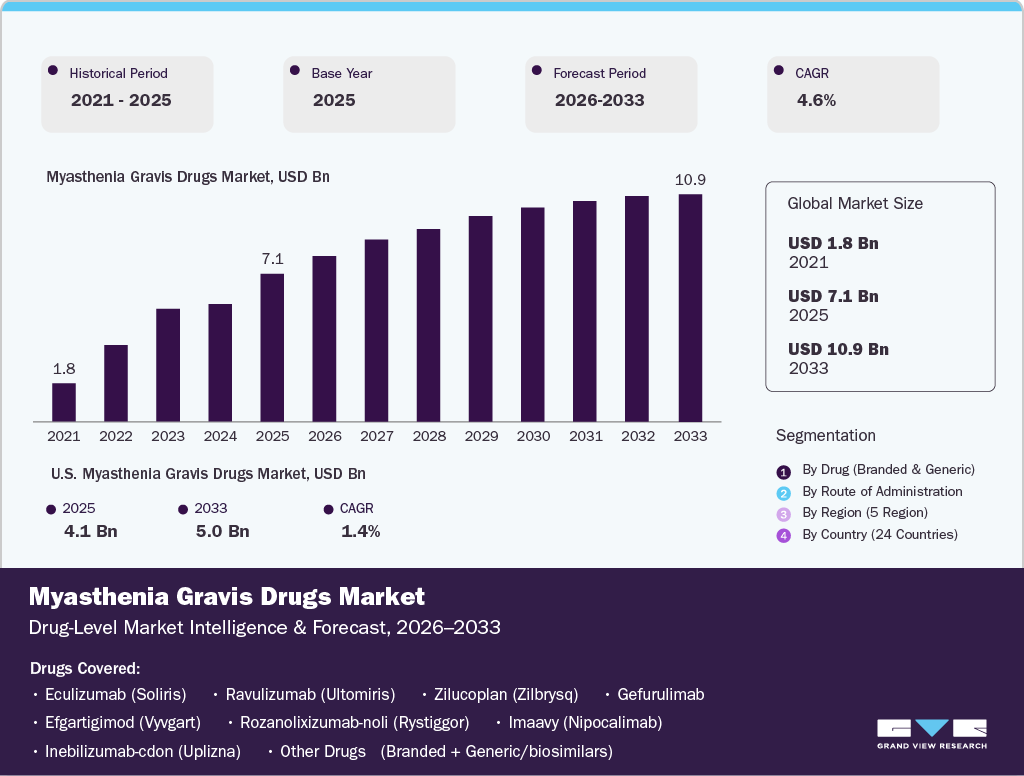
GVR's Myasthenia Gravis drugs intelligence database tracks 8+ branded and generic therapies across 12+ molecules, covering acetylcholinesterase inhibitors, corticosteroids, immunosuppressants, intravenous immunoglobulins (IVIg), plasma exchange-associated therapies, complement inhibitors, FcRn antagonists, and emerging targeted biologics. Myasthenia Gravis affects an estimated 700,000 people globally, with diagnosis rates increasing due to improved disease awareness, expanded antibody testing, and advances in neuromuscular care. While conventional therapies, including pyridostigmine, corticosteroids, and immunosuppressants, continue to account for a substantial share of treatment volumes, targeted biologics are driving market value growth across the U.S., Europe, and Japan. Recent approvals of complement inhibitors and FcRn-targeted therapies, supported by favorable reimbursement, increasing specialist adoption, and expanding access to rare disease treatment centers, are reshaping the commercial landscape and creating additional revenue opportunities for pharmaceutical manufacturers.
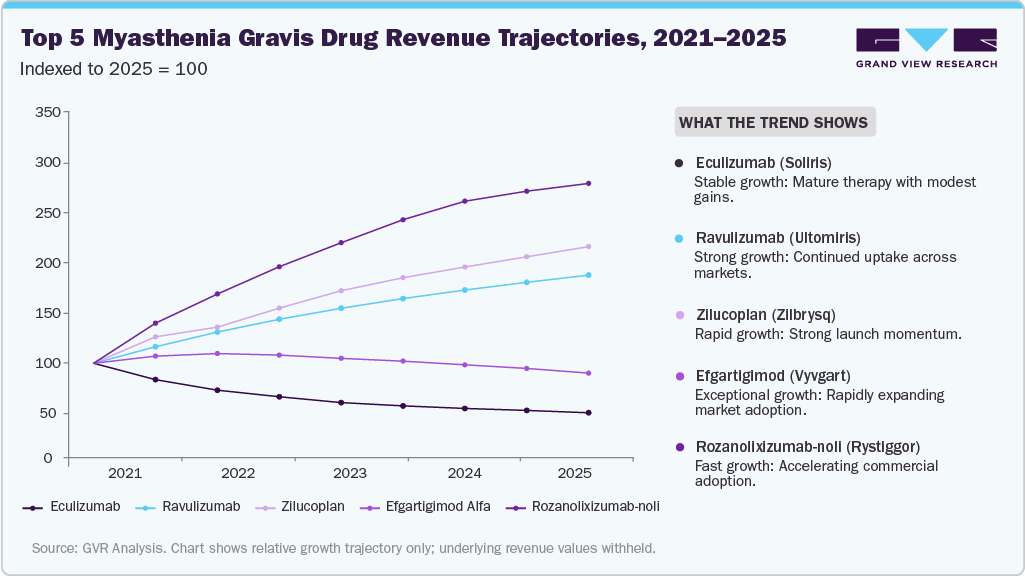
The myasthenia gravis drugs market is witnessing two distinct commercial trajectories. Targeted biologics, including Vyvgart (efgartigimod), Ultomiris (ravulizumab), Rystiggo (rozanolixizumab), and Zilbrysq (zilucoplan), are driving revenue growth, while conventional therapies continue to face pricing pressure from generic competition. A key market development occurred in May 2026, when the U.S. FDA expanded Vyvgart's label to include all adult patients with generalized myasthenia gravis, including those with triple-seronegative disease, significantly expanding the addressable patient population. Meanwhile, pyridostigmine, corticosteroids, and generic immunosuppressants continue to account for high treatment volumes despite ongoing pricing pressure from widespread genericization.
Net effect: Revenue growth is shifting toward targeted biologics and FcRn-directed therapies, while conventional therapies continue to dominate global treatment volumes.
Current Market Scenario
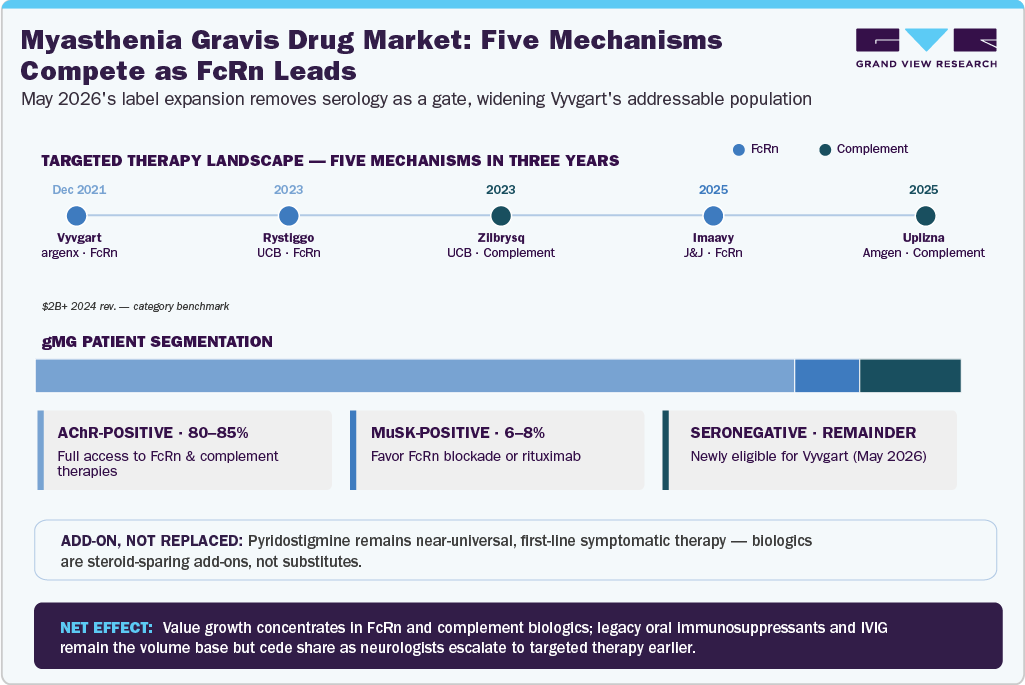
Generalized myasthenia gravis (gMG) represents the largest patient segment and remains the primary focus of the targeted therapy market. Around 80–85% of patients with gMG are anti-AChR antibody-positive, making them eligible for both FcRn inhibitors and complement inhibitors. Another 5–8% of patients are anti-MuSK antibody-positive and are generally treated with FcRn-targeted therapies or rituximab. Until May 2026, patients with triple-seronegative gMG did not have an approved targeted therapy and mainly relied on corticosteroids, immunosuppressants, IVIG, or plasma exchange. Pyridostigmine continues to be the standard first-line symptomatic treatment and is commonly used alongside biologic therapies. As the market evolves, competition is increasingly focused on FcRn inhibitors and complement inhibitors, with recent label expansions broadening access to targeted treatment for a larger patient population.
The myasthenia gravis drugs market is evolving with the increasing adoption of targeted biologics and precision immunotherapies. FcRn inhibitors and complement inhibitors are becoming key treatment options for patients with generalized myasthenia gravis. Companies are also expanding their pipelines through CAR-T cell therapies, IL-6 inhibitors, and other novel immune-modulating approaches. In addition, advances in biomarker research and updated treatment guidelines are improving patient selection and supporting earlier use of targeted therapies. These developments are strengthening the commercial outlook for specialty biologics and increasing competition across the market as pharmaceutical companies continue to invest in next-generation treatment options.
Table: Drug Estimations & Forecast 2025 & 2033 by Country (USD Mn)
Drug
Country
2025
2033
Analyst Perspective
Eculizumab
U.S.
138.4
29.3
Revenue is expected to decline due to biosimilar competition and increasing use of longer-acting complement inhibitors.
Germany
10.4
1.83
Biosimilar uptake and switching to newer therapies are expected to reduce sales.
UK
17.8
2.8
Market share is expected to decline as clinicians adopt newer complement inhibitors.
France
8.7
1.5
Revenue is expected to decrease due to biosimilar competition and treatment switching.
Ravulizumab
U.S.
349.6
539.7
Revenue is expected to grow due to strong adoption, longer dosing intervals, and continued patient conversion from eculizumab.
Germany
23.3
10.6
Increasing physician adoption and switching from eculizumab are expected to support growth.
UK
39.1
85.5
Expanded use and longer dosing intervals are expected to drive market growth.
France
19.3
45.1
Growing adoption as a preferred long-acting complement inhibitor is expected to support revenue growth.
Source: GVR Analysis
Competitive Landscape
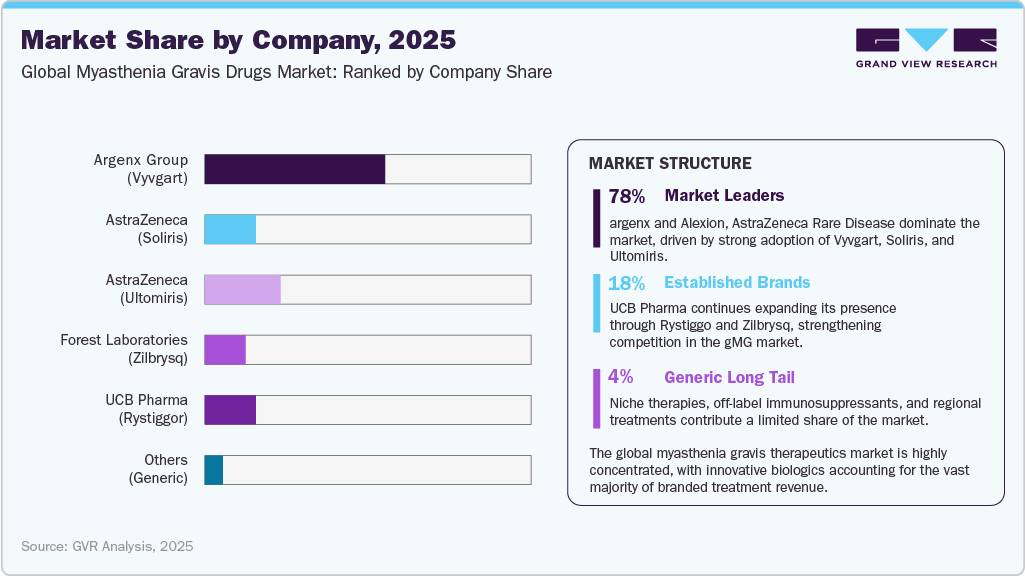
Argenx expanded its yasthenia gravis portfolio with Vyvgart and Vyvgart Hytrulo after the U.S. FDA broadened their indication in May 2026. UCB continues to strengthen its presence with Rystiggo and Zilbrysq. It also received a positive CHMP opinion for a pre-filled Zilbrysq pen in Europe. AstraZeneca (Alexion) continues to market Soliris and Ultomiris, although Soliris now faces biosimilar competition. Johnson & Johnson and Amgen have also entered the market with Imaavy (nipocalimab) and Uplizna (inebilizumab). These developments are increasing competition and expanding targeted treatment options for patients with generalized myasthenia gravis.
The myasthenia gravis pipeline is focused on several targeted approaches. FcRn inhibitors, such as IMVT-1402, continue to advance in late-stage clinical development. New complement inhibitors, including gefurulimab and cemdisiran, are also progressing through Phase III studies. Companies are further exploring CAR-T cell therapies, such as Descartes-08, and BTK inhibitors, including remibrutinib. As more therapies enter development, companies are focusing on convenient dosing, easier administration, and broader treatment indications to differentiate their products.
Market Dynamics
Recent regulatory approvals are expanding the use of targeted therapies in generalized myasthenia gravis. In May 2026, the U.S. FDA expanded the approval of Vyvgart (efgartigimod) to all adult patients with generalized myasthenia gravis, including those who are seronegative. This approval broadened patient access to FcRn-targeted therapy and may support future label expansion strategies for other biologic drugs.
Pharmaceutical companies are increasingly focusing on more convenient treatment options for generalized myasthenia gravis. Vyvgart Hytrulo provides subcutaneous administration, while Ultomiris requires less frequent dosing than Soliris. Companies are also developing therapies with improved dosing schedules and delivery methods to reduce treatment burden and support the broader adoption of targeted biologic therapies.
Key Market Trends
“Increasing Adoption of FcRn-Targeted Therapies”
FcRn-targeted therapies are gaining wider use in the Myasthenia Gravis market. Recent label expansions and new formulations have increased patient access to these therapies. At the same time, complement inhibitors remain an important treatment option for eligible patients. As more targeted therapies become available, competition is increasing between different treatment mechanisms, giving physicians more options for managing generalized myasthenia gravis.
“Biosimilar Competition Is Reshaping the Complement Inhibitor Therapies”
Soliris is facing increasing competition from biosimilars, including Bkemv and Epysqli. At the same time, Ultomiris continues to expand as a long-acting complement inhibitor with less frequent dosing. These developments are increasing competition within complement-targeted therapies and providing healthcare providers with additional treatment options for generalized myasthenia gravis.
Regional Analysis
U.S. Myasthenia Gravis Drugs Market
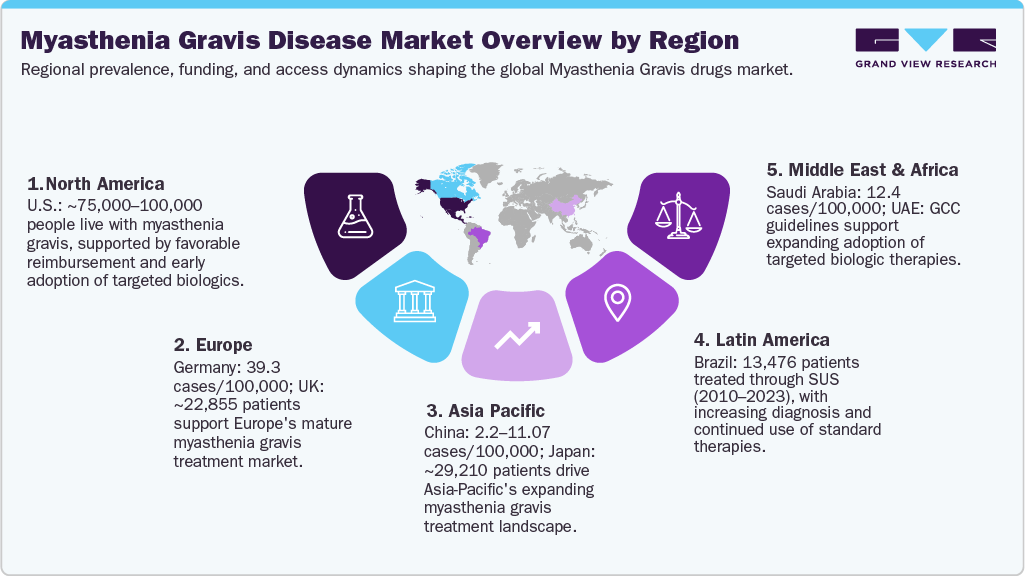
The U.S. is the largest Myasthenia Gravis drugs market, supported by favorable reimbursement and early adoption of targeted biologics. An estimated 75,000–100,000 people are living with myasthenia gravis in the country. In May 2026, the U.S. FDA expanded Vyvgart approval to all adults with generalized myasthenia gravis, including triple-seronegative patients.
UK Myasthenia Gravis Drugs Market
The myasthenia gravis drugs market in the UK is supported by a well-established specialist neurology network, National Health Service (NHS) care, and ongoing evaluation of innovative therapies through the National Institute for Health and Care Excellence (NICE). Approximately 22,855 people are estimated to be living with myasthenia gravis in the UK, corresponding to a prevalence of 33.7 cases per 100,000 population. Conventional therapies remain widely used, while targeted biologics continue to expand treatment options for eligible patients.
Germany Myasthenia Gravis Drugs Market
The myasthenia gravis drugs market in Germany is supported by increasing disease awareness, improved diagnosis, and access to specialized neurology care. According to a German claims-based study, the prevalence of myasthenia gravis reached 39.3 cases per 100,000 population at the end of 2019, while the annual incidence was 4.6 cases per 100,000 population. The study also reported that nearly one-third of newly diagnosed patients did not receive MG-specific treatment during their first year after diagnosis, indicating an opportunity to improve early treatment initiation and optimize disease management across the country.
France Myasthenia Gravis Drugs Market
The myasthenia gravis drugs market in France is supported by universal healthcare coverage and a network of specialized neuromuscular reference centers (FILNEMUS), which facilitate diagnosis and disease management. A nationwide study using the French National Health Data System (SNDS) reported a myasthenia gravis prevalence of 34.2 cases per 100,000 population and an incidence of 2.5 cases per 100,000 population in 2019. Conventional therapies remain widely used, while access to targeted biologics continues to expand through specialized care pathways.
Japan Myasthenia Gravis Drugs Market
Japan is a well-established market for Myasthenia Gravis drugs, supported by a relatively high disease prevalence and the availability of targeted biologic therapies. A nationwide two-step epidemiological survey estimated the prevalence of myasthenia gravis at 23.1 cases per 100,000 population in 2017, corresponding to approximately 29,210 patients. Recent approvals of FcRn-targeted and complement-targeted therapies have expanded treatment options for patients with generalized myasthenia gravis.
China Myasthenia Gravis Drugs Market
China’s population-based studies have reported a myasthenia gravis prevalence of approximately 2.2–11.07 cases per 100,000 population, which is lower than that reported in many Western countries. As awareness of the disease grows and access to diagnostic testing and specialized neurology care continues to improve, more patients are likely to be diagnosed and receive appropriate treatment, supporting the gradual expansion of the market.
Brazil Myasthenia Gravis Drugs Market
The myasthenia gravis drugs market in Brazil is supported by increasing diagnoses and expanding use of the public healthcare system (SUS). A nationwide real-world study identified 13,476 patients with myasthenia gravis treated through SUS between 2010 and 2023. Azathioprine and pyridostigmine were the most commonly used therapies. Frequent treatment changes and continued use of intravenous immunoglobulin (IVIg) highlight ongoing disease management challenges.
Saudi Arabia Myasthenia Gravis Drugs Market
Saudi Arabia follows the 2025 GCC regional consensus guideline, which reported a myasthenia gravis prevalence of 12.4 cases per 100,000 population. The guideline was developed by the Saudi Arabia Neuromuscular and Electrodiagnostic Medicine chapter with specialists from across the Gulf Cooperation Council. Hospital-based studies from Saudi Arabia show that pyridostigmine is the main first-line treatment and was used in more than 94% of patients in one tertiary-care cohort. Access to targeted biologics is still expanding across the region.
UAE Myasthenia Gravis Drugs Market
The UAE participated in the 2025 GCC consensus guideline on the diagnosis and management of myasthenia gravis. The guideline was developed by experts from across the Gulf Cooperation Council to standardize patient care. It includes recommendations for targeted biologic therapies, such as FcRn- and complement-targeted therapies, for eligible patients. These recommendations are expected to support the broader adoption of advanced treatments across the GCC region.
Analyst Perspective
- Increasing Adoption of FcRn-Targeted Therapies
FcRn-targeted therapies are being used more widely in the treatment of generalized myasthenia gravis. Recent label expansions, including broader eligibility for Vyvgart and the availability of subcutaneous formulations, have increased patient access. Pharmaceutical companies are also developing new therapies with different dosing schedules and treatment approaches to strengthen their market position.
- Growing Competition Among Complement Inhibitor Therapies
The complement inhibitor segment is becoming more competitive with the launch of Soliris biosimilars and the continued use of Ultomiris. Biosimilar competition and the availability of longer-acting therapies are influencing treatment choices and increasing competition within this class of targeted therapies.
- Broader Label Expansions Are Increasing the Eligible Patient Population
The May 2026 U.S. FDA approval expanded Vyvgart to all adults with generalized myasthenia gravis, including patients with triple-seronegative disease. This approval increased the number of patients eligible for FcRn-targeted therapy and may support future label expansion efforts for other targeted biologics.
- Emerging Markets Offer Long-Term Growth Opportunities
Emerging countries, including China, Brazil, and countries in the Gulf region, offer long-term growth opportunities for the myasthenia gravis drugs market. Improving disease awareness, expanding diagnostic capabilities, and increasing access to specialist care and reimbursement are expected to support the gradual adoption of targeted therapies in these regions.


Customize this report to your needs - add regions, segments, or data points, with 20% free customization.
Or view our licence options:


ISO 9001:2015 & 27001:2022 Certified
We are GDPR and CCPA compliant! Your transaction & personal information is safe and secure. For more details, please read our privacy policy.


